Suddenly, what happens online matters

Yesterday, the Globe and Mail had a very good editorial about online death threats. In short, the piece argues that death threats made online matter and shouldn’t be treated as somehow “inferior” to those that happen in “real life.”

Death threats made on the Internet can be as serious as death threats made in person or by other forms of communication; some other threats less so. Police, prosecutors and judges need to assess the gravity of the threats and apply their common sense, from the decision to prosecute through to sentencing. There is no need to amend the Criminal Code in order to treat Internet threats as if they were less serious, as some lawyers have suggested.

Of course, my hope is that this treatment of online behaviour isn’t selective. I mean, if online threats should be considered seriously, shouldn’t other forms of online behaviour – like political behaviour – also be treated seriously?

I remember just two years ago, during the initially online prorogation protests many journalists and pundits deemed them as silly and unimportant. Back then the online editor of the Globe was kind enough to publish two pieces of mine (here and here) that attempted to counter this narrative. But this ran against the grain. Even at the Globe there were pundits who thought that treating online protests and petitions seriously was, well, silly. It was fascinating to see how stories about a 200,000+ plus facebook group focused less on how disgruntled many Canadians were than on how online politics didn’t matter.

Of course that was before the Arab spring when all of a sudden it became vogue to write about how online politicsdidmatter. It would be fascinating to see how the prorogation protests might have played out in the media if they’d occurred after Egypt.

For many of us, we’ve known for a long time that what happens online matters. Its why we care so much about the virtual space and demand it be taken seriously.

It is great to see the Globe’s editorial board feel the same way. Frankly we’d love to see more of it since the online world is very much part of our world, and the threats to it as a space where citizens and consumers can be in free are very real as well.

Threats online matter, and so does commerce, politics, free speech, and the infinite other activities that humans engage in, and will engage in online. Let’s treat it that way.

China, Twitter and the 0.1%

Earlier this month I had the good fortune of visiting China – a place I’m deeply curious about and – aside from some second year university courses, the reporting from the Economist, and the occasional trip over to Tea Leaf Nation – remains too foreign to me for comfort given its enormous importance.

As always China – or to be specific – Beijing is overwhelming. The pollution, the people, the energy, the scale. It can be hard to grasp or describe. But I want to talk about my conversations which were overwhelming in other, equally fantastic ways.

As an indirect result of the trip I just posted a piece up on the WeGov section of TechPresident asking “Is Sina Weibo a Means of Free Speech or a Means of Social Control.” The post comes out of a dinner conversation I had in Beijing with Michael Anti, an exceedingly smart and engaging Chinese journalist, political blogger and former Nieman Journalism Fellow at Harvard who has a very interesting analysis about Weibo (Chinese twitter) as a means to enhance the power of the central government. The piece is worth reading largely because of the thoughts he has that are embedded in it.

There was another interesting thread that came out of our dinner conversation – one that was equally sobering. Michael described himself as part of the “Generation 70,” those who, if it isn’t obvious, were born in the 70s. For him, the defining trait or esprit, of that generation was a sense of possibility. As he noted “I’m from a humble family and fairly unimportant city in China, and I got to end up at Harvard.” For him and his peers as China grew, so did many of their opportunities. He argues that they were able to dream big in ways the almost no previous generation of Chinese could.

He contrasts that with the “Generation 90,” those now in mid teens to mid twenties and he sees a generation with small dreams and growing frustration. Forget about access to the top international universities in the world. Indeed, forget about access to top Chinese universities. Such opportunities are now reserved for the super rich and the super connected. What many have felt was a system that was relatively meritocratic is now flagrantly not. According to Anti, the result is that Generation 90 does not have big dreams. Forget about become a world class scientist, founding a leading company, leading an interesting organization. Many do not even dream of owning an apartment. This evolution (devolution?) in moods was summed up succinctly in a poster Anti saw at a demonstration a few months earlier which nihilistic read “We are Generation 90: Sacrifice Us.”

A few days later I had the good fortune of being in Soho (a very upscale neighborhood in Beijing) with a group of Generation 90ers. Eating at a very nice Chinese restaurant above a Nike and Apple store I discretely asked a few them if they agreed with Anti’s assessment about Generation 90.

Were they optimistic about their future? What were their dreams? Did they feel like opportunities for them were shrinking?

I was stunned.

They agreed with Anti. Here I was, in the nation’s capital, sitting in an upper middle class restaurant, with a vibrant, intelligent, bilingual group of young Chinese. This is a group that would easily fit in the top 5% in terms of education, opportunity and income, and most probably in the 1%. And they felt that opportunity for their generation were limited. Their dreams, were more limited than the generation before them.

Maybe this is a sort of Gen X syndrome Chinese style, but if I were the Chinese government, such sentiment would have me worried. There is an acceptance – from what I observed – in China that the system is rigged – but there was clearly a sense that before the benefits were more widely distributed, or at least available on a limited meritocratic basis.

I’ve never been as bullish on China as some of my peers. Between the demographic time bomb that is about to explode, the fact the state spends more on internal security than the military and the weak sense of the rule of law (essential for any effective market) I’ve felt that China’s problems are deeper and ultimately harder to address than say those in India or Brazil. But this conversation has given me new pause. If the 5% or worse, the 1% don’t feel like China can make room for them, where does that leave everyone else not in the .1%? These are, of course, problems many societies must face. But public discourse in China on a subject like this is almost certainly much harder to engage in than in say, Brazil, India or America.

China is a wonderfully complex and nuanced place. So maybe this all means nothing. Maybe it is a sort of Gen X funk. But it has given me a whole lot more to think about.

Lying with Maps: How Enbridge is Misleading the Public in its Ads

The Ottawa Citizen has a great story today about an advert by Enbridge (the company proposing to build a oil pipeline across British Columbia) that includes a “broadly representational” map that shows prospective supertankers steaming up an unobstructed Douglas Channel channel on their way to and from Kitimat – the proposed terminus of the pipeline.

Of course there is a small problem with this map. The route to Kitimat by sea looks nothing like this.

Take a look at the Google Map view of the same area (I’ve pasted a screen shot below – and rotated the map so you are looking at it from the same “standing” location). Notice something missing from Enbridge’s maps?

Kitimate-Google2

According to the Ottawa Citizens story an Enbridge spokesperson said their illustration was only meant to be “broadly representational.” Of course, all maps are “representational,” that is what a map is, a representation of reality that purposefully simplifies that reality so as to aid the reader draw conclusions (like how to get from A to B). Of course such a representation can also be used to mislead the reader into drawing the wrong conclusion. In this case, removing 1000 square kilometers that create a complicated body of water to instead show that oil tankers can steam relatively unimpeded up Douglas Channel from the ocean.

The folks over at Leadnow.ca have remade the Enbridge map as it should be:

EnbridgeV2

Rubbing out some – quite large – islands that make this passage much more complicated of course fits Enbridge’s narrative. The problem is, at this point, given how much the company is suffering from the perception that it is not being fully upfront about its past record and the level of risk to the public, presenting a rosy eyed view of the world is likely to diminish the public’s confidence in Enbridge, not increase their confidence in the project.

There is another lesson. This is great example of how facts, data and visualization matter. They do. A lot. And we are, almost every day, being lied to through visual representations from sources we are told to trust. While I know that no one thinks of maps as open or public data in many ways they are. And this is a powerful example of how, when data is open and available, it can enable people to challenge the narratives being presented to them, even when those offering them up are powerful companies backed by a national government.

If you are going to create a representation of something you’d better think through what you are trying to present, and how others are going to see it. In Enbridge’s case this was either an effort at guile gone horribly wrong or a communications strategy hopelessly unaware of the context in which it is operating. Whoever you are, and whatever you are visualization – don’t be like Enbridge – think through your data visualization before you unleash it into the wild.

How Government should interact with Developers, Data Geeks and Analysts

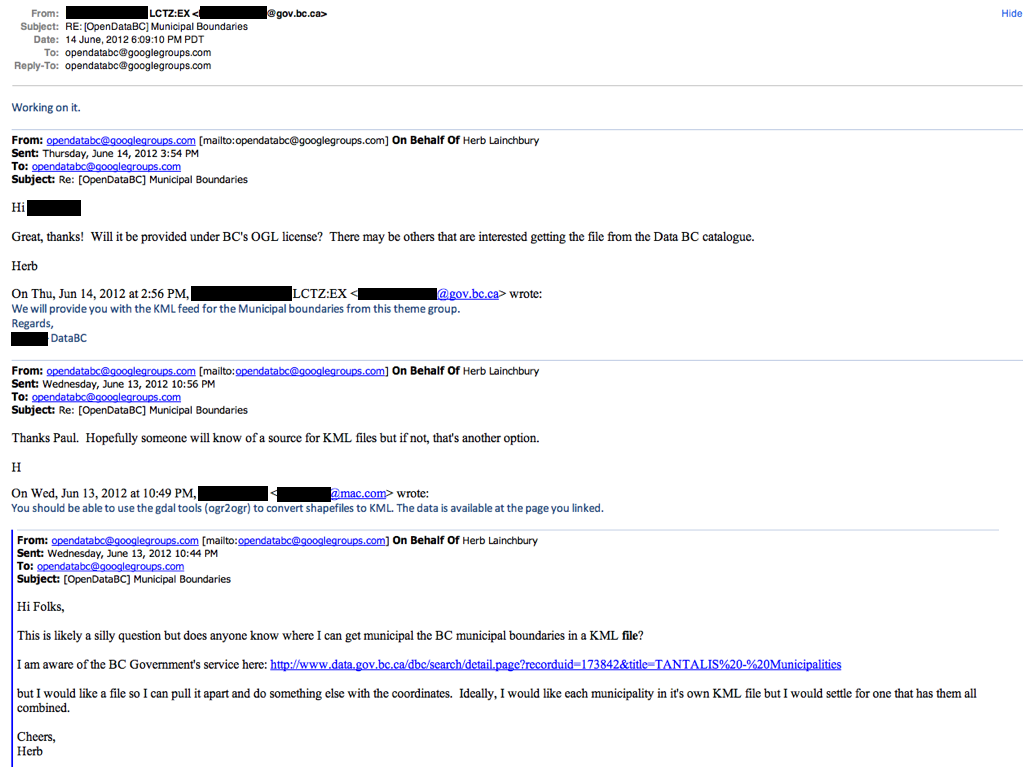
Below is a screen shot from the Opendatabc google group from about two months ago. I meant to blog about this earlier but life has been in the way. For me, this is a prefect example of how many people in the data/developer/policy world probably would like to interact with their local, regional or national government.

A few notes on this interaction:

  • I occasionally hear people try to claim the governments are not responsive to requests for data sets. Some aren’t. Some are. To be fair, this was not a request for the most controversial data set in the province. But it is was a request. And it was responded to. So clearly there are some governments that are responsive. The questions is figuring out which one’s are, why they are, and see if we can export that capacity to other jurisdictions.
  • This interaction took place in a google group – so the whole context is social and norm driven. I love that public officials in British Columbia as well as with the City of Vancouver are checking in every once in a while on google groups about open data, contributing to conversations and answering questions that citizens have about government, policies and open data. It’s a pretty responsive approach. Moreover, when people are not constructive it is the group that tends to moderate the behaviour, rather than some leviathan.
  • Yes, I’ve blacked out the email/name of the public servant. This is not because I think they’d mind being known or because they shouldn’t be know, but because I just didn’t have a chance to ask for permission. What’s interesting is that this whole interaction is public and the official was both doing what that government wanted and compliant with all social media rules. And yet, I’m blacking it out, which is a sign of how messed up current rules and norms make citizens relationships with public officials they interact with online -I’m worried of doing something wrong by telling others about a completely public action. (And to be clear, the province of BC has really good and progressive rules around these types of things)
  • Yes, this is not the be all end all of the world. But it’s a great example of a small thing being doing right. It’s nice to be able to show that to other government officials.


Using Metrics to Measure Interest in an Open Source Project

David Boswell has a couple of interesting posts (here and here) about how he is using metrics to measure how effective Mozilla is at attracting and engaging people express an interest in helping contribute to the Mozilla mission.

Some of the metrics being used can be seen at Mozilla’s Are We Growing Yet website. What I think is important is how the team is trying to look at metrics from the site to see if tweaks have an impact on attracting more people. Obviously, this is something commercial websites have been doing for a long time and it is about time these lessons were being applied in open source community management.

What I’m particularly excited about (and have helped with) is the creation of contribution paths for different parts of Mozilla. This way we can begin to try to measure how many people that express an interest in contributing to Mozilla start to contribute code (or engage in another activity, like marketing) and how far along the code contribution path they travel. Obviously we’d love for contributors to travel as far along that path as possible and so, with these metrics, we can ideally begin to see how changes in policy, tools or websites might encourage or discourage people’s decision to contribute.

Interesting stuff.

What do I think of the Canadian Senate?

Read Jennifer Ditchburn in the Globe and Mail – Senate stubborn on making information about chamber more accessible.

It is laughable about how hard the Canadian Senate makes it to access information about it. The lower house – which has made good progress in the last few years on this front – shares tons of information online. But the Senate? Attendance records, voting records and well, pretty much any record, is nigh high impossible to get online. Indeed, as Jennifer points out, for many requests you have to make an appointment and go in, in person, in Ottawa(!!!) to get them.

What year is it? 1823? It’s not like we haven’t had the mail, the telephone, the fax machine, and of course, the internet come along to make accessing all this information a little easier. I love that if you want to get certain documents about the operation of the senate you have to go to Ottawa.

Given the Senate is not even elected in Canada and has, shall we say, a poor reputation for accountability and accessibility, you’d think this would be a priority. Sadly, it is not. Having spoken with some of the relevant parties I can say, Senators are not interested in letting you see or know anything.

I understand the desire of the senate to be above the political fray, to not be bent by the fickle swings in electoral politics, to be a true house of “second sober thought.” And yet I see no reason why it can’t still be all that, while still making all the information that it must make public about itself, available online in a machine readable format. It is hard to see how voting records or attendance records will sway how the Senate operates, other than maybe prompt some Senators to show up for work more often.

But let’s not hold our breath for change. Consider my favourite part of the article:

“A spokeswoman for government Senate leader Marjory LeBreton said she was unavailable and her office had no comment. Ms. LeBreton has asked a Senate committee to review the rules around Senate attendance, but it’s unclear if the review includes the accessibility of the register.”

No comment? For a story on the Senate’s lack of accessibility? Oh vey! File it under: #youredoingitwrong


Is Civic Hacking Becoming 'Our Pieces, Loosely Joined?'

I’ve got a piece up over on the WeGov blog at TechPresident – Is Civic Hacking Becoming ‘Our Pieces, Loosely Joined?

Juicy bit:

There is however, a larger issue that this press release raises. So far, it appears that the spirit of re-use among the big players, like MySociety and the Sunlight Foundation*, only goes so deep. Indeed often it seems they are limited to believing others should re-use their code. There are few examples where the bigger players dedicate resources to support other people’s components. Again, it is fine if this is all about creating competing platforms and competing to get players in smaller jurisdictions who cannot finance creating whole websites on their own to adopt it. But if this is about reducing duplication then I’ll expect to see some of the big players throw resources behind components they see built elsewhere. So far it isn’t clear to me that we are truly moving to a world of “small pieces loosely joined” instead of a world of “our pieces, loosely joined.”

You can read the rest over there.

Living in the Future: My Car isn’t Flying, but it is Cheap and Gamified

I remember in the early 80’s when I was about 8 years old I walked up to my dad and said “you know the year 2000 really isn’t that far away, and unless something changes we aren’t going to get jetpacks and flying cars.” Even then I could see the innovation curve wasn’t going to meet the expectations movies and books had set for me.

Mostly I’m glad I reset my expectations at such an early age – since it is fairly rare that something comes along that makes me feel like I live in the future: things like the iPad and smartphones. Interestingly however, what feels most like magic to me these days – the thing I do regularly but that feels like it is the future – isn’t something I own, but a service that is all about whatI don’t have to own. A car.

A Car So Cheap, I don’t Own It

I actually belong to two car sharing entities: Modo (like Zipcar) and Car2Go. While I love both it is that latter that really has me feeling like I live in the future.

What makes Car2Go so amazing is that unlike ZipCar and Modo, which have fixed parking spots to which cars must be picked up and returned, Car2Go essentially scattered 600 cars around Vancouver. There are no dedicated parking spots to which you must return the car. You can leave it anywhere in the city that isn’t private parking or metered.

So, to lay it out. Here’s the process of using one of these cars:

  1. Fire up your smart phone and locate the nearest car – generally within 10-400 meters.
  2. Walk to said car
  3. Once you arrive, hold your Car2Go card against the windshield to “sign in” to the car
  4. Get in and start driving to your destination.
  5. Upon arrival, “sign out” by holding your card against the windshield

I then automatically get billed at $0.35 a minute for use, so basically a 10 minute car ride (about the average length of a trip when in Vancouver) comes to $3.50, about $1 more than bus fare. I can’t even begin to describe the convenience of this service. What it saves me over having to own a car… mind boggling. Between walking, transit, car2go, modo, taxis and uber…. living without owning a car has never been easier, even with a 7 month old.

But again, the magic is that, where ever I am in the city, I can pull up my phone, generally find a car within 2-3 minutes walk and drive anywhere I want without having to plan it all beforehand. There are, quite literally, cars scattered around Vancouver, at my disposal. Brilliant.

Gamifying my Car to help the environment

Once you get into a Car2Go (they are all two seater Smart cars built by Mercedes-Benz) there is a little screen that allows you to control a map and the radio. The other day however, I noticed a little green leaf icon with a number in it, so pushed that “button” to see what would happen.

Turns out Car2Go has a gamified driving. The onboard computer measures your performance around acceleration, cruising and deceleration and provides you with a score that reflects your performance. I took the photo below at the end of a ride the other day.

green-dashboard

What determines your score – from what I can tell-  is your efficiency around accelerating, cruising and decelerating. So the more smoothly you brake the gentler your acceleration (not an easy feat in a Smart Car) the better your score. Cruising appears to be about smoothness as well.

Once you are aware of these scoreboard – even if you are not looking at it and it is only in the back of your mind – I find myself trying to drive more smoothly.

In the subtitle, I point out that all this probably helps the environment by reducing the amount of gas consumed by Car2Go drivers. But I bet it also helps reduce maintenance costs on Car2Go’s cars. I’m sure many people are rougher on shared cars than they are on their own and that this gamification helps dampen that effect.

Either way, if you’d asked my six year old self if I’d not own a car when I’m 35, and that I’d actually be sharing a car with hundreds of other residents that I could swipe into using a simple card and that had a game inside it that urged me to drive more sustainable.. I suspect I’d just looked confused. But using Car2Go is probably the closest I get, on a regular basis, to doing something I really couldn’t have imagined when I was 6. And that’s kind of fun.

OSCON Community Management Keynote Video, Slides and some Bonus Material

Want to thank everyone who came to my session and who sent me wonderful feedback from both the keynote and the session. I was thrilled to see ZDnet wrote a piece about the keynote as well as have practioners, such as Sonya Barry, the Community Manager for Java write things like this about the longer session:

Wednesday at OSCON we kicked off the morning with the opening plenaries. David Eaves’ talk inspired me to attend his longer session later in the day – Open Source 2.0 – The Science of Community Management. It was packed – in fact the most crowded session I’ve ever seen here. People sharing chairs, sitting on every available spot on the floor, leaning up against the back wall and the doors. Tori did a great writeup of the session, so I won’t rehash, but if you haven’t, you should read it – What does this have to do with the Java Community? Everything. Java’s strength is the community just as much as the technology, and individual project communities are so important to making a project successful and robust.

That post pretty much made my day. It’s why we come to OSCON, to hopefully pass on something helpful, so this conference really felt meaningful to me.

So, to be helpful I wanted to lay out a bunch of the content for those who were and were not there in a single place, plus a fun photo of my little guy – Alec – hanging out at #OSCON.

A Youtube video of the keynote is now up – and I’ve posted my slides here.

In addition, I did an interview in the O’Reilly boothif it goes up on YouTube, I’ll post it.

There is no video of my longer session, formally titled Open Source 2.0 – The Science of Community Management, but informally titled Three Myths of Open Source Communities, but Jeff Longland helpfully took these notes and I’ll try to rewrite it as a series of blog posts in the near future.

Finally, I earlier linked to some blog posts I’ve written about open source communities, and on open source community management as these are a deeper dive on some of the ideas I shared.

Some other notes about OSCON…

If you didn’t catch Robert “r0ml” Lefkowitz’s talk: How The App Store Killed Free Software, And Why We’re OK With That which, contrary to some predictions was neither trolling nor link bait but a very thoughtful talk which I did not entirely agree with but has left me with many, many things to think about (a sign of a great talk) do try to see if an audio copy can be tracked down.

Jono Bacon, Brian Fitzpatrick and Ben Collins-Sussman are all menches of the finest type – I’m grateful for their engagement and support given I’m late arriving at a party they all started. While you are reading this, check out buying Brian and Ben’s new book – Team Geek: A Software Developer’s Guide to Working Well with Others.

Also, if you haven’t watched Tim O’Reilly’s opening keynote, The Clothesline Paradox and the Sharing Economy, take a look. My favourite part is him discussing how we break down the energy sector and claim “solar” only provides us with a tiny fraction of our energy mix (around the 9 minutes mark). Of course, pretty much all energy is solar, from the stuff we count (oil, hydroelectic, etc.. – its all made possible by solar) or the stuff we don’t count like growing our food, etc.. Loved that.

Oh, and this ignite talk on Cryptic Crosswords by Dan Bentley from OSCON last year, remains one of my favourite. I didn’t get to catch is talk this year on why the metric system sucks – but am looking forward seeing it once it is up on YouTube.

Finally, cause I’m a sucker dad, here’s early attempts to teach my 7 month old hitting the OSCON booth hall. As his tweet says “Today I may be a mere pawn, but tomorrow I will be the grandmaster.”

Alec-Chess

Posts on Open Source Community Management

For those stopping by my page because of my OSCON keynote here are some links on community management that might be of interest:

Structurelessness, feminism and open: what open advocates can learn from second wave feminists (this is in part about why open source communities are not pure meritocracies).

Developing Community Management Metrics and Tools for Mozilla (using data to better understand participation)

Community Management as Open Source’s Core Competency (an oldie, but still some good stuff in here)

Wiki’s and Open Source: Collaborative or Cooperative? (on why open source works, in part because we are anti-collaborative)

Remixing Angie Byron to create the next Million Mozillians

How GitHub saved Open Source (okay, maybe not saved – but I do think it turbo charged innovation and breathed new life in OS by teaching us the fork is not a four letter word)

Design Matters: Looking at a Re-themed Bugzilla

Okay, I’ll stop there. I tried to include a little something for everyone – hopefully some stuff here will at times challenge readers, at times confirm their thinking and always be helpful.