The Web and the End of Forgetting: the upside of down

A reader recently pointed me to a fantastic article in the New York Times entitled The Web and the End of Forgetting which talks about the downside of a world where one’s history is permanently recorded on the web. It paints of the dangers of a world where one can never escape one’s past – where mistakes from college rear their head in interviews and where bad choices constrain the ability to start anew.

It is, frankly, a terrifying view of the world.

I also think it is both overblown and, imagines a world where the technology changes, but our social condition does not. Indeed, the reader sent me the piece because it reminded him of a talk and subsequent blog post I wrote exactly a year ago on the same topic.

But let’s take the worse case scenario at face value. While the ability to start anew is important, at times I look forward to a world where there is a little more history. A world where choices and arguments can be traced. A world of personal accountability.

Broadcast media fostered a world where one could argue one position and then, a few months later, take the exact opposite stand. Without easily accessible indexes and archives discerning these patterns was difficult, if not impossible. With digitization, that has all changed.

The Daily Show remains the archetype example of this. The entire show is predicated on having a rich archival history of all the major network and cable news broadcasts and having the capacity, on a nightly basis, to put the raw hypocrisy of pundits and politicians on display.

The danger of course, is if this is brought to the personal level. The NYT article identifies and focuses on them. But what of the upsides? In a world where reputation matters, people may become more thoughtful. It will be interesting to witness a world where grandparents have to explain to their grandchildren why they were climate change deniers on their Facebook page. Or why you did, or didn’t join a given political campaign, or protest against a certain cause.

Ultimately, I think all this remembering leads to a more forgiving society, at least in personal and familial relationships, but the world of pundits and bloggers and politicans may become tougher. Those who found themselves very much on the wrong side of history, may have a hard time living it down. The next version of the daily show may await us all. But not saying anything may not be a safe strategy either. Those who have no history, who never said anything at anytime, may not be seen relevant, or worse, could be seen as having no convictions or beliefs.

I loved the New York Times article, but it looked at society as a place where social values will remain unchanged, where we won’t adapt to our technology and place greater emphasis on new values. I can imagine a world where our children may say – how did you have friends with so little personal history? It may not be our ideal world, but then, our grandparents world wasn’t one I would have wanted to live in either.

And now, the international laughing stock phase of our debate…

And now it has just become depressing.

The international media has picked up on the census debate and they’re just mocking it.

There is this priceless quote in a New York Times article:

“I wouldn’t call this political interference,” Professor Prewitt said. “I would call this government stupidity.”

Yes, the beauty for all of America to read from Kenneth Prewitt the former director of the United States Census Bureau and now Columbia University professor.

So, in the space of 1 short year our government has gone from model regulator of the banking industry to world laughing stock on policy. If only it ended there.

The Wall Street Journal – that left wing rag owned by that hippy Rupert Murdoch – has a piece as well. It opens up its article on the subject with a sly:

The government of Canadian Prime Minister Stephen Harper is under fire from a range of opponents for an unusual privacy initiative—making participation in his country’s census largely voluntary.

Even the Christian Science Monitor pokes fun at the decision.

Interestingly, even as people outside the country are starting to take notice, apparently the rank and file Conservative MPs continue to believe this story will blow over:

“It’s just another dead news-cycle story,” said one Conservative MP. “Most people will look at it, and say, what’s the difference?”

Ah, there is nothing like relying on the ignorance of Canadians to inspire confidence in leadership. This from a party who roots are allegedly in believing that the Canadian public has a way of learning about things and then forming judgments that are none too pleasant. Especially, when they think politicians are trying to pull a fast one.

Given that a diverse coalition of forces never before seen in this country has assembled in opposition to this idea, such a view smacks of arrogance. Possibly even hubris. Indeed, it is the same time of arrogance that the Conservatives have, for so long, claimed distinguished them from the Liberals. The kind of hubris that leads to decisions that wind up putting plans for a fall election on hold…

And yes! I do look forward to a day when I won’t write about this. Sorry about this folks… just sad to see billions upon billions of dollars of Canadian of taxpayers money spent over the last 100 years, and a multibillion dollar asset, destroyed by a government that doesn’t want reality to interfere with the decision making process. I promise this will be the only post on the census this week (barring some dramatic news).

David Akin: Live by the poll, Die by the…

The other week David Akin penned a commentary piece about an Ipsos-Reid poll that showed Canadians were evenly split about the census issue. It was trotted forward as proof positive that this was a non-issue that the press was blowing out of proportion.

Well, things have changed.

A more recent Angus-Reid poll shows that the numbers are shifting. Those opposed to the government’s decision (47%) has stayed constant but, in contrast to the poll Akin cited, Canadians have possibly become more aware of the issue and support has dwindled to 38% per cent. But dig deeper and the story is gets more interesting. Only one-in-four Canadians (24%) agree with the Conservatives assertion that the Long Form Census is intrusive and 58% think it yields data that is important to make policy decisions in all areas of public service, and should remain mandatory.

But wait for it… even among conservatives there is little agreement with the government. Only 31% of conservative votes agreed that “The long form census is intrusive and Canadians should not be forced to answer it” whereas 58% agreed with the statement that “The long form census yields data that is important to make policy decisions in all areas of public service, and should remain mandatory.”

And, to project into the future, things are not likely to get better. Most premiers have spoken out against the long form census decision and it will likely come up at an upcoming premiers conference. So, when citizens were asked:

“As you may know, some provincial premiers have criticized the federal government’s decision to eliminate the mandatory long form census, and the head of Statistics Canada has quit his post. Thinking about this, what do you think the federal government should do?”

the numbers jump even higher against the government’s decision with 52% saying the government should reverse and only 27% saying it should stay the course. And, once again, conservative voters are displeased with the outcome with 42% of them opposed to the governments decisions and 39% in favour.

If you are going to live by the poll, you must be prepared to die by the poll. So, given this new data, I’m hoping that David Akin will consider writing a new column about how this issue is starting to become relevant and may even be negatively affecting conservative poll numbers.

Urban Aboriginal Interview and survey

For those who haven’t caught it, there is a great piece/interview by Jeffrey Simpson of Mark Podlasly in the Globe and Mail about urban aboriginals, identity politics and economic opportunity. I encourage you to take a look – it’s a quick read.

If, however, you find all of this deeply interesting… I strongly encourage you to swing over to the Urban Aboriginal People’s Survey website and, to even download the report. The report summarizes the findings of the first survey of Urban Aboriginal People in Canada – looking at their identity, aspirations and situation. The questions were designed, and the conclusions shaped by, an Aboriginal advisory circle so that the substantive of the report has been driven by first nations people. Mark – happily – was a part of this circle.

As Canadians this is deeply interesting and important stuff. An increasing number of aboriginal people live in cities and they are forming a growing part of the work force. It’s an issue that is likely to impact many communities – especially those in the west. Hope you find it interesting!

It was never about privacy…

So it is becoming increasingly clear that the census decision was never about concern over Canadians privacy, it was about dismantling the state’s capacity to engaged in reasoned, evidence-based public policy.

It is also interesting to see the government trot out new faces to give the same old flawed defence. Flaherty is now running around saying that Canadians will fill in voluntary census for ‘the good of the country.’ Of course, we already know what happens when you make the census voluntary. People don’t fill it out. The Americans tried it and it failed miserably. Of course, maybe Canadians are radically more patriotic than Americans. But given Flaherty’s new found confidence in Canadian patriotism, why assign fines to anything? I mean let’s not chase people down who refuse to pay taxes. Under the new Flaherty plan we can rely on us all doing the right thing out of love for our country.

I shudder to think that this man is our Finance minister. Clearly he doesn’t let facts and lessons interfere with his decision making. It all reminds me of a senior Bush official quote: “When we act, we create our own reality.” It’s a whole lot easier to delude yourself of that, when your get rid of the pesky facts that might show your “reality” is just an illusion. Sigh. Welcome to Libertarian fantasy land.

The good news is that more organizations are beginning to voice their discomfort. Some are even turning to social media. The Canadian Jewish Congress released a YouTube video explaining their opposition.

Better still, Canadians aren’t fools. A growing number or ordinary citizens are showing their disapproval. I think the Globe may be reaching in referring to this poll of senior citizens – but it does suggest that there are some upset people, even among the conservative’s traditional base. It will be interesting to see what happens around polling data over the coming weeks and especially into the fall as more and more Canadians find out about this issue.

Your friday funny: This blogger is at the wrong blog

For those who haven’t seen it yet, I strongly, strongly, strongly encourage you to watch the “This Drummer is at the Wrong Gig” video embedded below. I discovered the clip a few weeks and have been sharing it with all my friends. It’s awe inspiring, hilarious, amazing and, just keeps getting better and better as you get deeper into the clip.

Watch the drummer. Pure genius.

What’s better, the drummer – Steve Moore – is just flat out nice. Check out this interview with him about his youtube fame. He’s everything you’d want in a bandmate: loyal, talented and doing it for the right reason.

Indeed, the best part of the interview is him talking about how he couldn’t care less about money but how getting the respect from drummers he looks up to is what has been the biggest pay off.

Anyone whose felt passionate about something likely feels the same way. Personally, I hope I blog half as well as this guy drums. And nothing feels better than getting an email or tweet about a blog post from someone I really respect. Those really are the best moments.

Nice work Steve Moore. You’re an inspiration. And just plain awesome.

What Munir's Resignation means to Public Servants

This came to me from an anonymous email address, but the author claims to be a public servant. No inside gossip or revelation here, but a serious question about how the public service will react to a critical moment.

The independence of Canada’s public service has been a key part of our governing system. It has its advantages and its drawbacks (discussed in some detail most recently by John Ibbitson in Open and Shut) but it has been important. Munir’s resignation reaffirms this system, how his boss and colleagues react will say a lot about whether other public servants feel the value of independence is still core to the public service.

Read on – it’s thoughtful:

Defining moments. For some individuals these are easy to identify, like when a promising young athlete suffers a career-limiting injury.  For others, such moments come later in life, but are no less real or significant.

The resignation of Munir Sheikh from his position as Chief Statistician of Canada is clearly a defining moment for him personally.  He ends a full career in the Public Service on a point of principle.  This principled stance, necessary in his view to protect the integrity of his organization, has brought pride to many public servants, including this author.

But this act may not only be defining for Mr. Sheikh; it also has the potential to impact on the broader public service.  The Public Service mantra is fearless advice and loyal implementation and we tend to be very good at this.  However, it has always been recognized that this only goes so far.  There are limits to loyal implementation.  Clear examples are when a government attempts to unduly benefit either themselves or their friends through government funds.

Deputy ministers (the position of Chief Statistician is one) are often faced with limit-pushing situations, their ability to manage the delicate political-Public Service relationship is key to their success (and survival) as senior public servants.  When these limits are in danger of being exceeded, the deputy minister can rely on delay to allow time to change the ministers’ mind, and/or intervention from the Prime Minister, via the Privy Council Office.  When these fail, the deputy can either acquiesce (partially or fully) or resign.  This is the theory.  However, in practice I cannot recall the last time a deputy resigned on a point of principle (leaving aside the potential reasons for the former Clerk, Kevin Lynch’s retirement).

Mr. Sheikh has attempted to set a new standard – disregarding the advice of a department is fine – publicly undermining the integrity of that advice is not.  It remains to be seen whether this standard will stick or whether it will in future be seen as a high-water mark for deputy integrity that will never be seen again.

The public and private reactions of the Clerk of the Privy Council will have a significant impact on how others view this resignation.  He is the Prime Minister’s deputy minister, who sets the tone and expectation for all other deputies.  He is also the Head of the Public Service, and helps set the tone for all public servants.  What, if anything, will he say about this issue, to the Prime Minister, deputies and ordinary public servants?  How should we comport ourselves when faced with such issues?

Wayne Wouters, this is your opportunity.  Tell us what you think, this can be your defining moment too.

The dangers of narrow cast politics

I am going to very substantially scale back my writing about this issue. I have reached the point where I am wasting my breath. My consolation is that many tens of thousands of Canadians now see this charade for what it is; that this has turned into a very, very bad day at the office for all concerned, including a few strategic geniuses who thought they could narrow-cast their way to electoral gain while the rest of the country missed this story; and that I have managed to shine a bit of a light on some of the most squalid behaviour I have ever witnessed in 20 years as a reporter.

The census?

Wrong.

This was written back on February 24th, 2010 in a fantastic post by Paul Wells about… the Rights & Democracy scandal. Today, the audit promised by the government on that organization has missed three deadlines and is still not been delivered. Today the organization remains in shambles: demoralized, frustrated and tarnished.

This, I fear, could be the fate of Statistics Canada. With the census (and a number of other survey) “a few strategic geniuses” thought that in the dead of summer, on the friday of a long weekend, they could kill something that has become core to legislation and decision making for every level of government, businesses, NGO’s, researchers and ordinary Canadians.

Today we know differently. With a Deputy Minister resigned, the media sniffing blood, the country up in arms and every major newspaper running damning editorials the only difference between the census scandal and the rights and democracy scandal is the size and scope of the impact.

Someone needs to tell the PMO that narrow-cast politics is dead. At least for this government There have simply been too many mistakes and the intelligence of too many Canadians has been insulted too many times to get away with it.

I hope that message gets through. I don’t know how many more times this government intends to narrow-cast a policy to try to pick up a few points with a vested interest group but I do know that we are running out of institutions we can’t afford to have destroyed.

Creating Open Data Apps: Lessons from Vantrash Creator Luke Closs

Last week, as part of the Apps for Climate Action competition (which is open to anyone in Canada), I interviewed the always awesome Luke Closs. Luke, along with Kevin Jones, created VanTrash, a garbage pick up reminder app that uses open data from the City of Vancouver. In it, Luke shares some of the lessons learned while creating an application using open data.

As the deadline for the Apps for Climate Action competition approaches (August 8th) we thought this might help those who are thinking about throwing their hat in the ring last minute.

Some key lessons from Luke:

  • Don’t boil the ocean: Keep it simple – do one thing really, really well.
  • Get a beta up fast: Try to scope something you can get a rough version working in day or evening – that is a sure sign that it is doable
  • Beta test: On friends and family. A lot.
  • Keep it fun: do something that develops a skill or let’s you explore a technology you’re interested in

Some thoughts on improving Bugzilla

One of the keys to making an open source project work is getting feedback from users and developers about problems (bugs) in the code or system. Mozilla (the organization behind Firefox and Thunderbird) uses Bugzilla, but organizations have developed a variety of systems for dealing with this issue. For example, many cities use 311. I’m going to talk about Bugzilla and Mozilla in this case, but I think the lessons can be applied more broadly for some of my policy geek friends.

So first, some first principles. Why does getting the system right matter? A few reasons come to mind:

  1. Engagement: For many people Bugzilla is their first contact with “the community.” We should want users to have a good experience so they feel some affinity towards us and we should want developers to have a great experience so that they want to deepen their level of participation and engagement.
  2. Efficiency: If you have the wrong or incomplete information it is hard (or impossible) to solve a problem, wasting the precious time of volunteer contributors.

I also concede that these two objectives may not always be congruent. Indeed, at times there may be trade offs between them… but I think there is a lot that can be done to improve both.

I’ve probably got more ideas than can fit (or should fit) into one post so I’m going to unload a few. I’ve got more that relate to the negotiation and empathetic approaches I talked about at the Mozilla Summit.

One additional thought. Please feel free to dump all over these. Some changes many not be as simple as I’ve assumed. Others may break or contravene important features I’m not aware of. Happy to engage people on these, please do not see them as an end point, but rather a beginning. My main goal with this first batch of suggestions was to find things that felt easier to do and so could be implemented quickly if there was interest and would help reduce transactions costs right away.

1. Simplifying Menus

First. I thought there were some simple changes that could render the interface cleaner and friendlier. It’s pretty text heavy – which is great for advanced users, but less inviting for newer users. More importantly however, we could streamline things to make it easier for people to onboard.

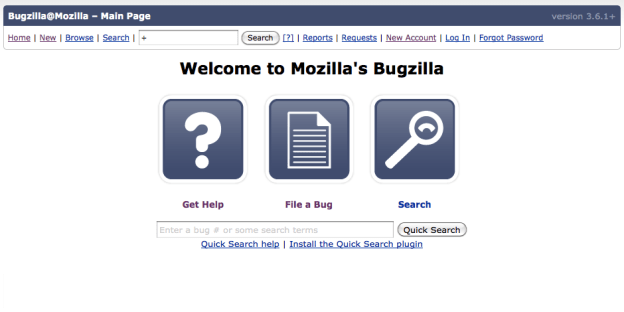
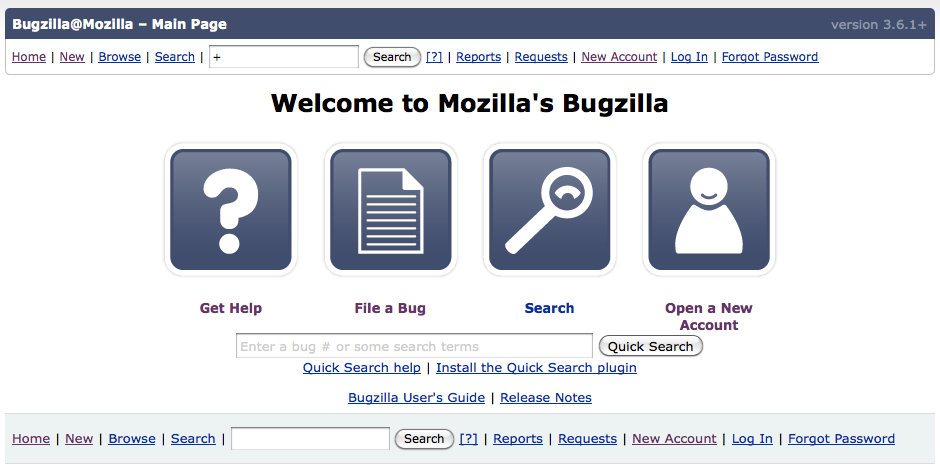
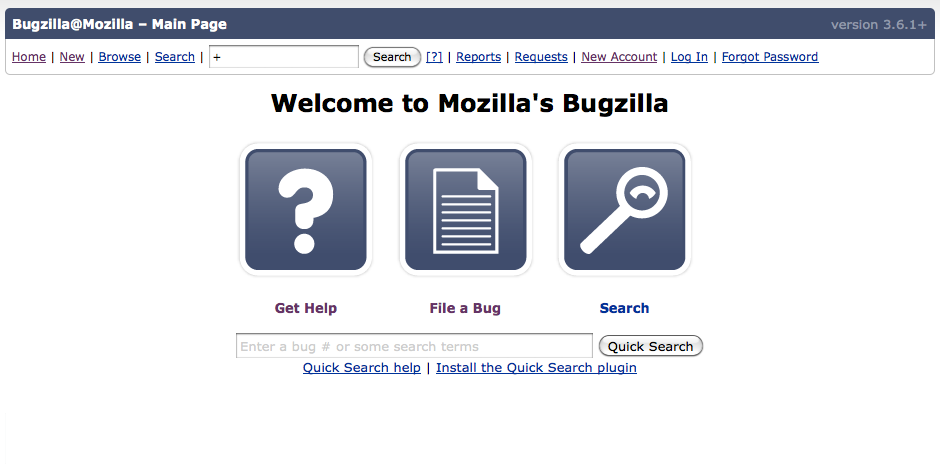
Take for example, the landing page of Bugzilla. It is unclear to me why “Open a new Account” should be on this page. Advanced users will know they want to file a bug, novices (who may be on the wrong site and who should be looking for support) might believe they have to open and account to get support. So why not eliminate the option altogether. You are going to get it anyways if you click on “File a bug.”
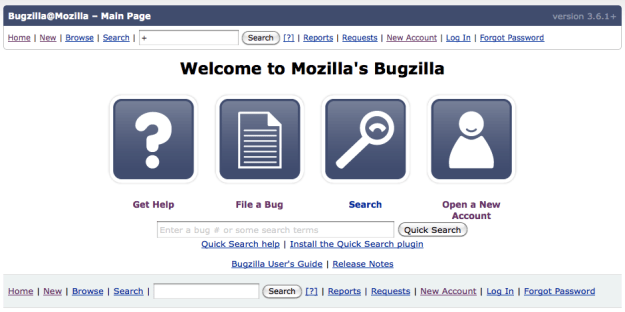
Bugzilla-landing-page

Current

Bugzilla-landing-page-v2

Proposed

In addition, I got rid of the bottom menu bar (which I don’t think is necessary on this screenƒclu given all the features were along the top as well). I also ditched the Release Notes and User Guide for Bugzilla as I had doubts about whether users were, at this point and on this screen, looking for those things)

2. Gather more information about our users (and, while I’m at it, some more simplifying)

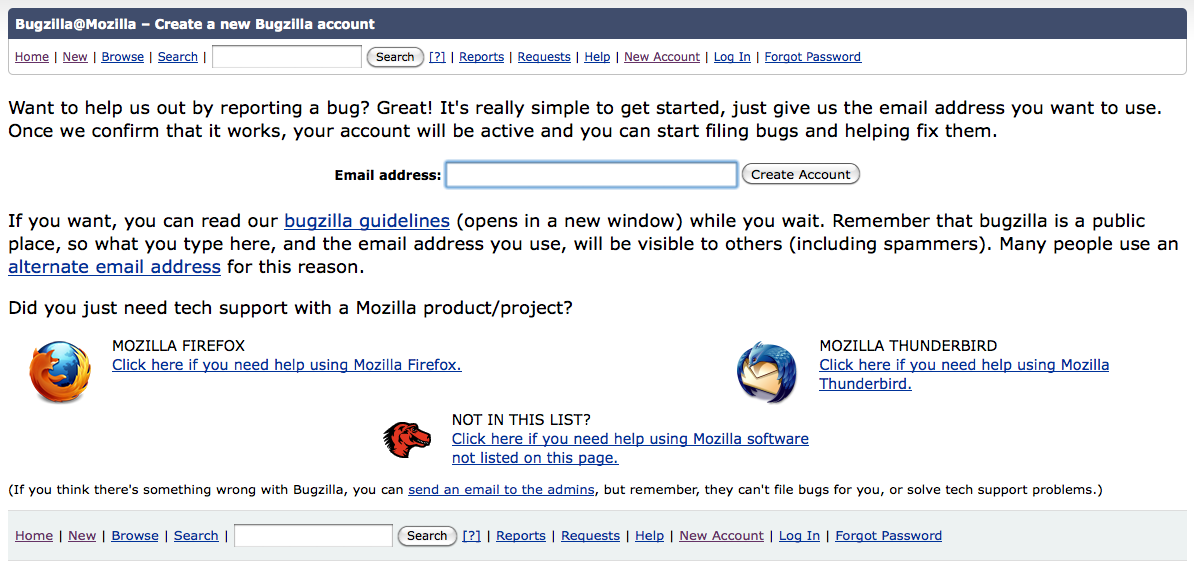
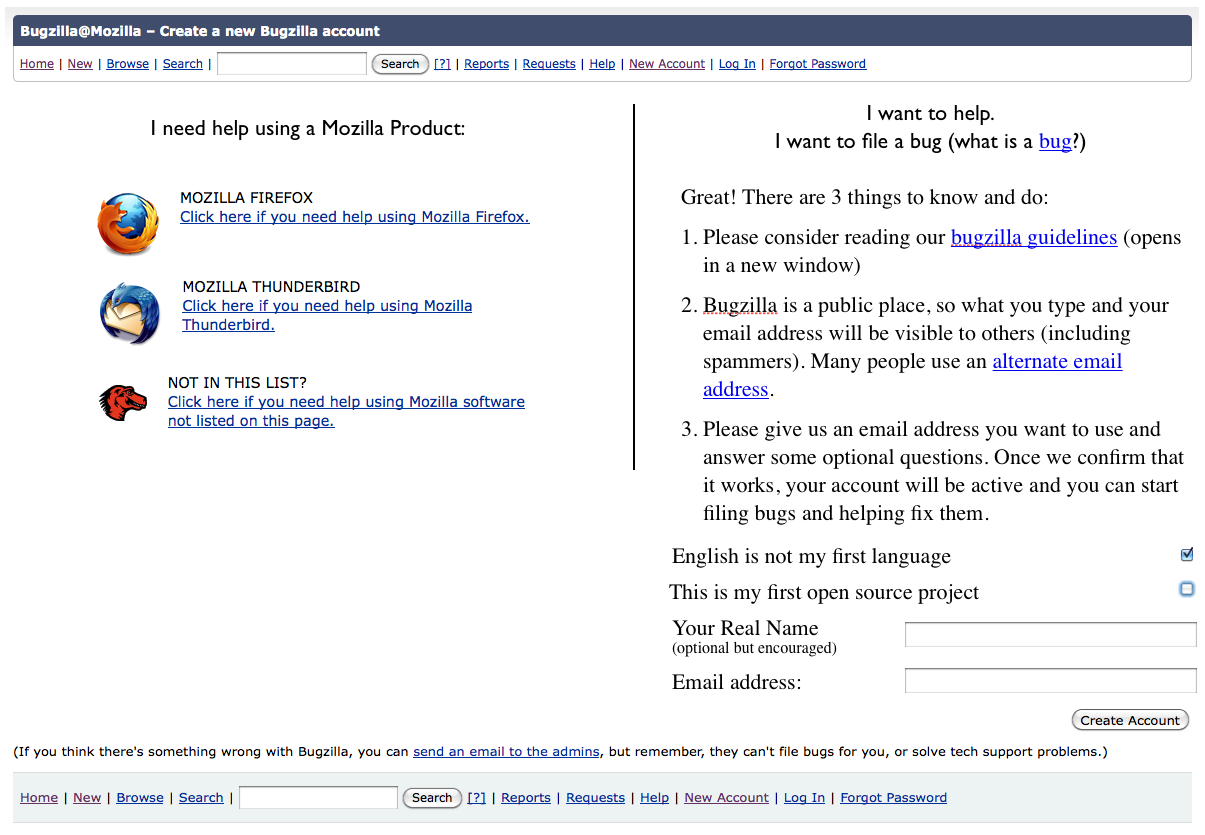
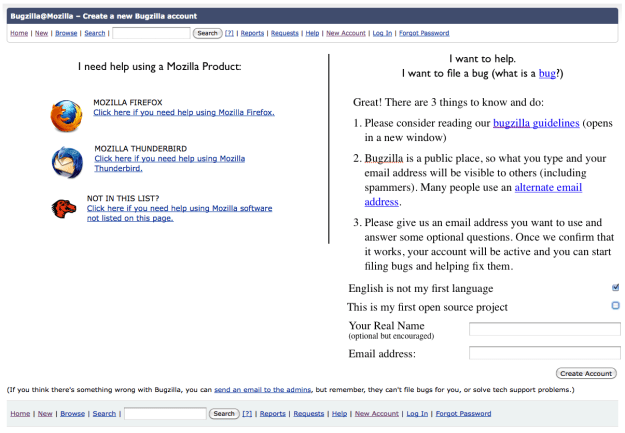
Once you choose to file a bug you get prompted to either log in or create an account. At this point, if you want to create an account. I thought this page was hard to read with the text spanning the whole width, plus, there is some good info we could gather about users at this point (the point it feels they are mostly likely going to add to their profile).
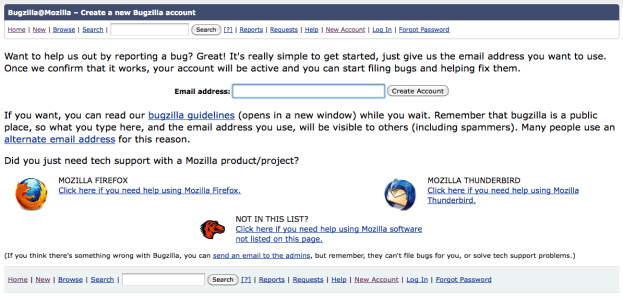
Current
Bugzilla-registration-v2

Proposed

Couple things a like about this proposed screen.

One, if you are a lost user just looking for support we likely snag you before you fill out a bugzilla account. My feeling is the bugzilla is a scary place that most users shouldn’t end up in… we need to give people lots of opportunities to opt for support before diving in, in case that is what they really need.

Second, in this proposed version we tell people to read the bugzilla guidelines and suggest using an alternate email before they punch their email into the email field box.

In addition, we ask the user for their real name now (as opposed to relying on them to fill it out later). This nudge feels important as the more people with real names on the site, the more I think people will develop relationships with one another. Finally we ask people if English is their second language and if this is their first open source project.

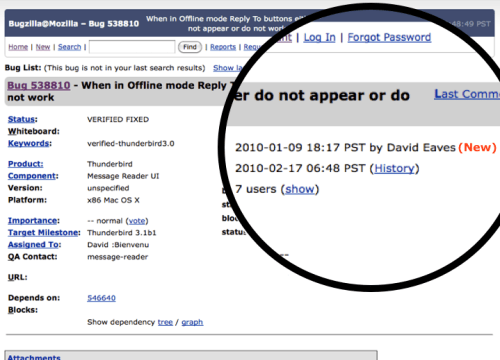
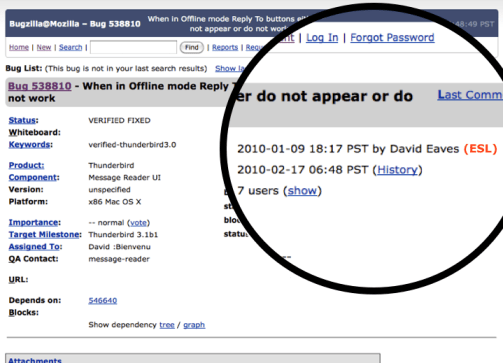
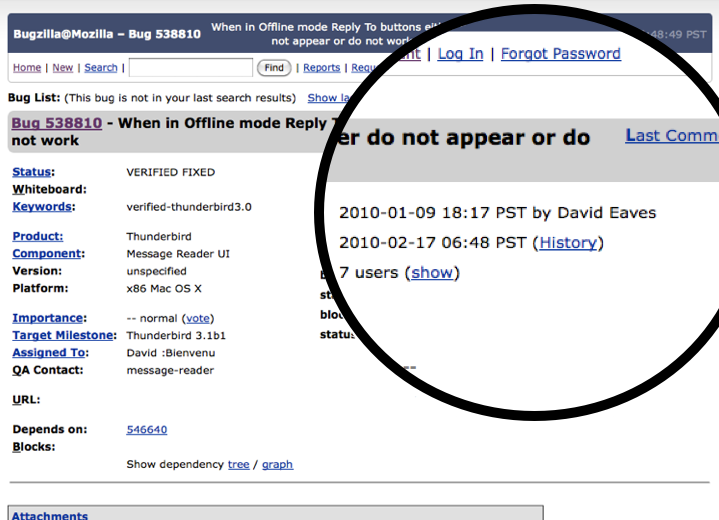
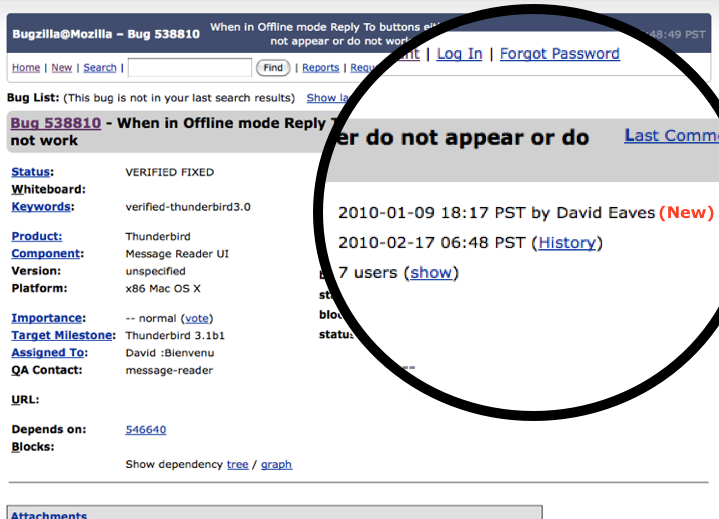
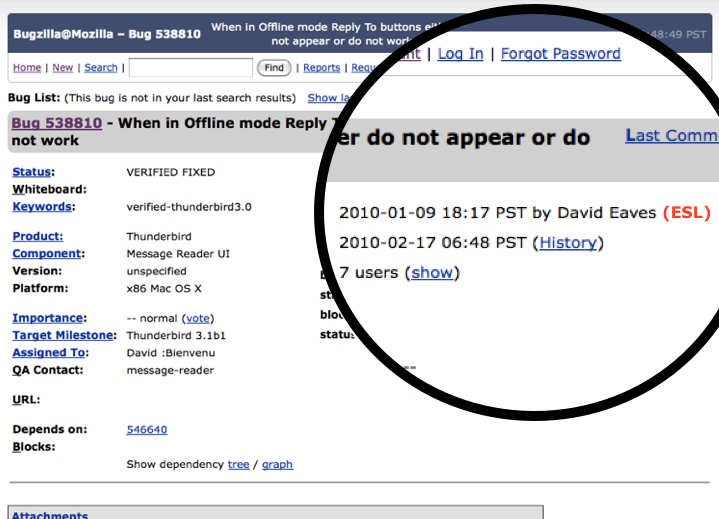
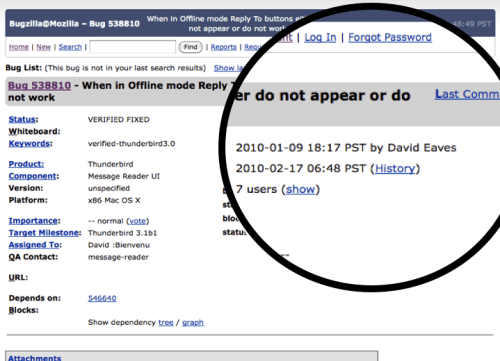
Finally, with the extra data fields we can help flag users as ESL or new and thus in need of more care, patience and help as they on-ramp (see screen shots below). We could even modify the Bugzilla guidelines to inform people to provide newbies and ESL’s with appropriate respect and support.
Bugzilla-Raw1

Current

Bugzilla-New

Proposed

Proposed

I imagine that your “newbie” status would disappear either when you want (some sort of preference in your profile) or after you’ve engaged in a certain amount of activity.

3. Make life easier for users and the triage guys

Here is an idea I had talking with some of the triage guys at the Mozilla Summit.

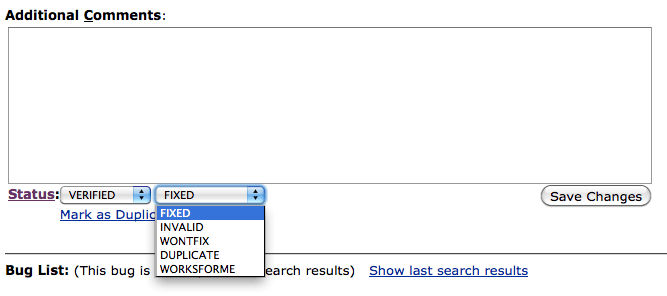
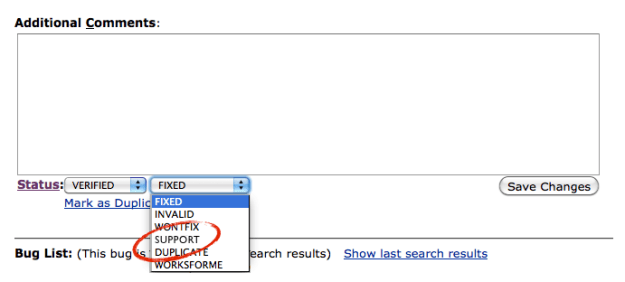
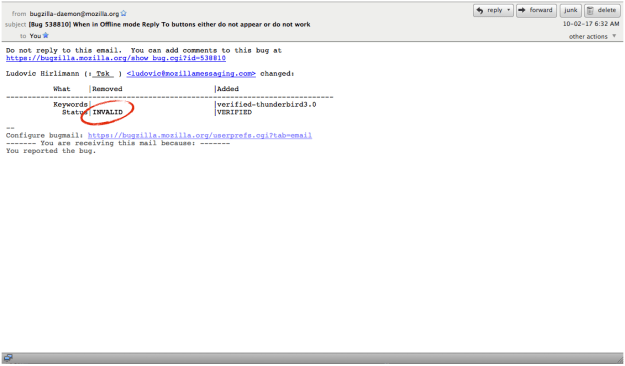
Let’s suppose that someone submits a bug that isn’t really a bug but a support issue. I’m informed that this happens with a high degree of frequency. Would it be nice if, with a click of a mouse, the triage guys could move that bug out of Bugzilla and into a separate database (ideally this would be straight into SUMO, but I respect that this might not be easy – so just moving it to a separate database and de-cluttering bugzilla would be a great first start – the SUMO guys could then create a way to import it). My sense is that this simply requires creating a new resolution field – I’ve opted to call it “Support” but am happy to name it something else.
Current
Status-v2

Proposed

This feels like a simple fix and it would quickly move a lot of bugs that are cluttering up bugzilla… out. This is important as searches for bugs often return many results that are support oriented, making it harder to find the bugs you are actually searching for. Better still, it would get them somewhere where they could more likely help users (who are probably waiting for us to respond).

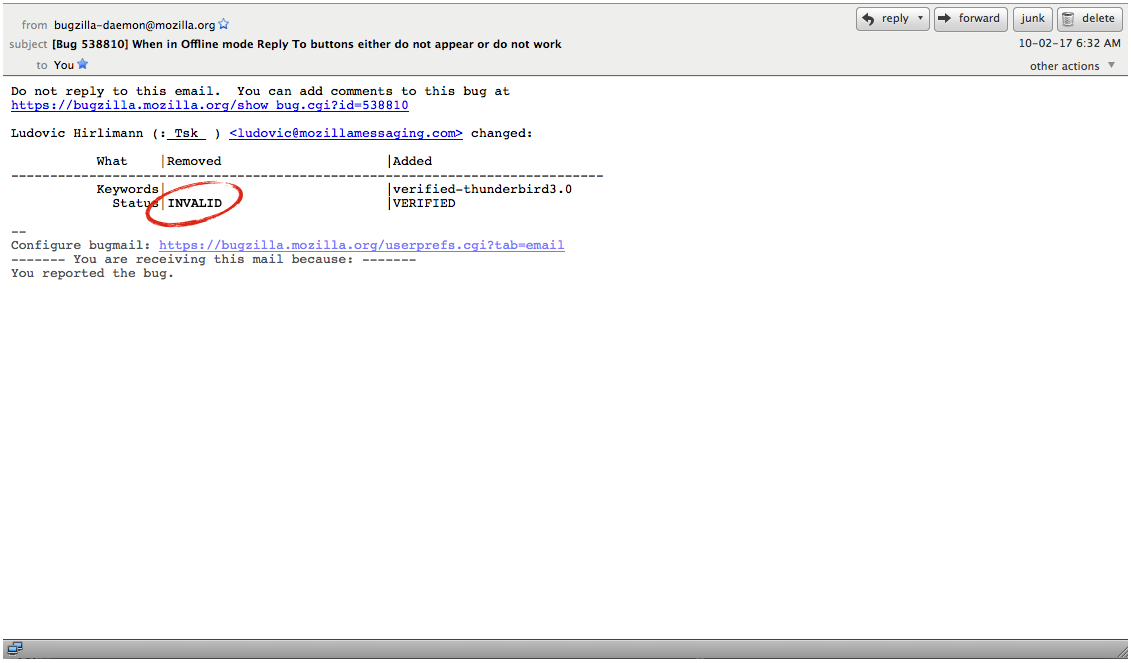
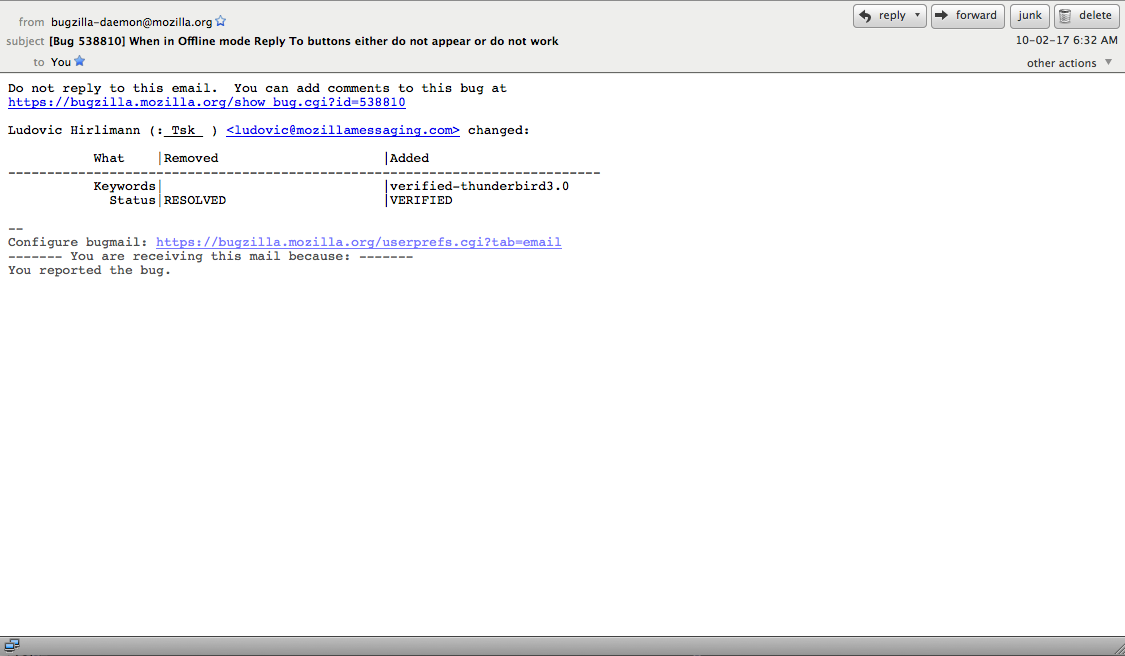
Of course, presently bugzilla will auto generate an email that looks like the first one and this isn’t going to help. So what if we did something else?
unresolved

Current

SUMO-transfer-v2

Proposed

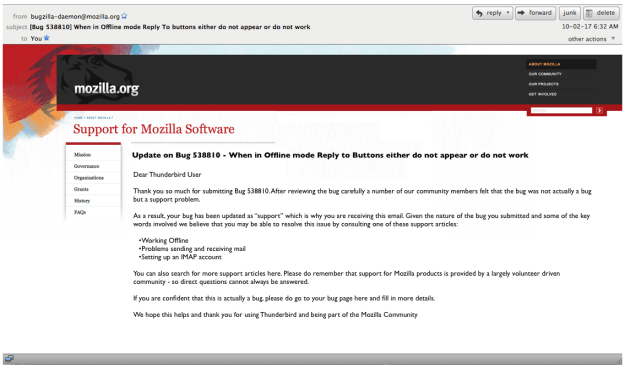
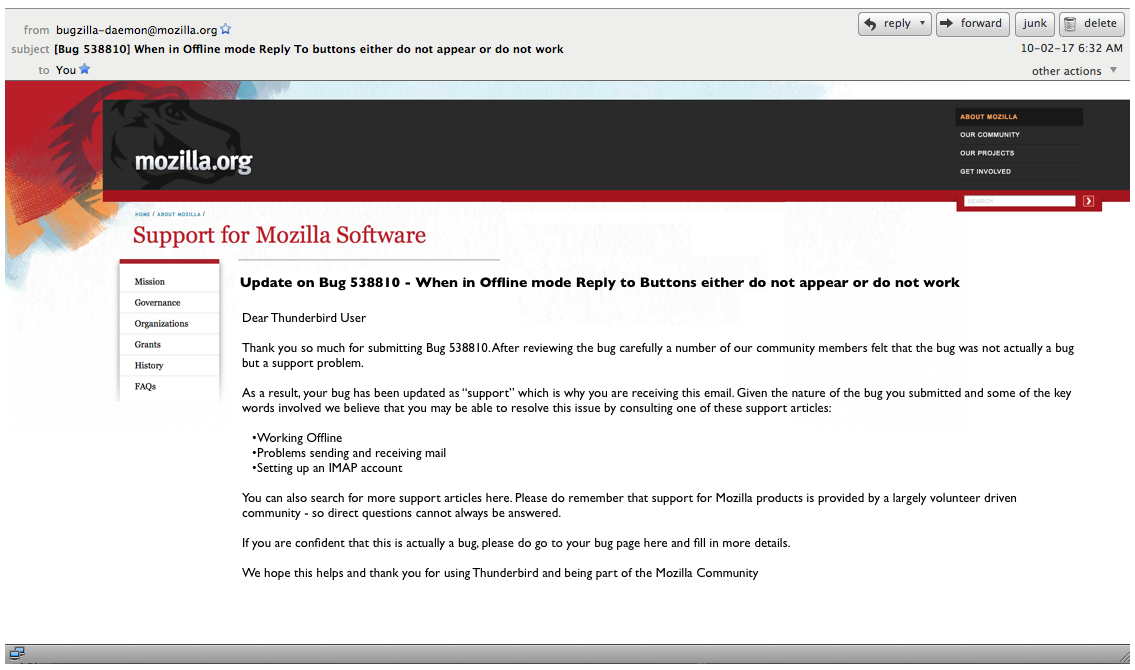
Here is the auto-generated email I think we should be sending users whos bugs get sent to SUMO. I’ve proposed a few things.

First, if these are users who’ve submitted inappropriate bugs and who really need support, giving them a bugzilla email isn’t going to help them, they aren’t even going to know how to read it.

Second, there is an opportunity to explain to them where they should go for help – I haven’t done that explicitly enough in this email – but you get the idea

Third, when the bug gets moved to SUMO it might be possible to do a simple key word analysis of the bug and, from that, determine what are the most likely support articles they are looking for. Why don’t we send them the top 3 or 5 as hyperlinks in the email?

Fourth, if this really is a bug from a more sophisticated user, we give them a hyperlink back to bugzilla so they can make a note or comment.

What I like about this is it is customized engagement at a low cost. More importantly, it helps unclutter things while also making us more responsive and creating a better experience for users.

4. Make Bugzilla Celebrate, enhance our brand and build community

Okay, so here’s the thing that really bugs me about bugzilla. If we want to be onramping people and building community, shouldn’t we celebrate people’s successes? At the moment this is the email you get from Bugzilla when a bug you’ve submitted gets patched:
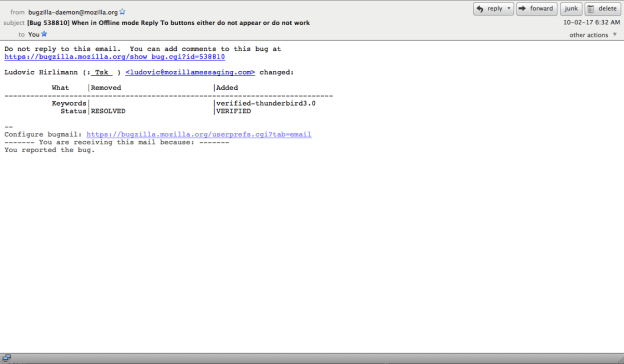
BORING! Here, at the moment of maximum joy, especially for casual or new bugzilla participants we do nothing to engage or celebrate.

This, is what I think the auto-generated bugzilla email should look like.

Congrats-v2

Yes, I agree that hard core community members probably won’t care about these types of bugs, but for more casual participants this is an opportunity to explain how open source and mozilla works (the graphic) as well as a chance to educate them. I’ve even been more explicit about this by offering links to a) explain the open web, b) learn about mozilla and open source; and c) donate to the foundation (given this is a moment of pride for many non-developer end users)

Again, I’m not overly attached to this design per se, it would just be nice to have something fun, celebratory and mozillaesque.

Okay, it is super late and I’m on an early flight tomorrow. Would love feedback on all or any of this for those who’ve made it this far. I’ll be sharing more thoughts, especially on empathetic nudges and community management in bugzilla ASAP.