The Great Crash vs. Emergence (re-mixed)

So it is with impeccable timing that about 3 weeks ago I started listening to John Kenneth Galbraith’s “The Great Crash: 1929.” (Indeed, I wish I had similar impeccable timing when planning my RRSP, 401k and stock purchases). Obviously the events of the last week, and more precisely the events of yesterday make this essential reading for everyone.

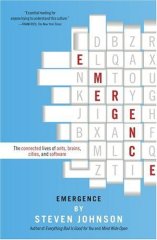
By quirk of luck (due to a recommendation by Mark Surman) I have also been reading Emergence: The Connected Lives of Ants, Brains, Cities, and Software by Steven Johnson. Emergence is about “the way complex systems and patterns arise out of a multiplicity of relatively simple interactions.” Possibly the most easily understood exmaple of emergence is seeing how ants or termites can create complex societies based on a few simple rules.

Interestingly, although Galbraith and Johnson almost certainly never met, and their books were written over 50 years apart, they are fundamentally writing about the same thing.

John Kenneth Galbraith’s The Great Crash is about an emergent system – the speculatory stock market bubble that lead to the 1929 crash. Indeed what makes reading these books simultaneously so interesting is observing how Galbraith describe an emergent system without the language and frameworks available to Johnson 50 years later. Consequently, Galbraith’s book is hints at a larger system even as he struggles to describe how the decisions of hundreds of thousands of individuals could be simultaniously coorindated but not directed. He intuits a distributed system, but simple can’t describe it as accurately as Johnson.

A great example of this struggle is visible when Galbraith’s describes his frustration with others efforts to pin the 1929 crash on a given, or set of, individuals. I’m willing to bet that, sadly, we are about to embark on a similar misadventure: I wager the next congress is going to launch a series of hearings to determine “who” caused our current financial crises. This, as Galbraith pointed out about “The Great Crash”, will be nothing short than a colossal waste of time and energy, one that will distract us from the real challenge. This is not to say illegal activities did not occurr somewhere on wallstreet (or K street) both in recent years and in the years leading up to 1929. I’m certain they did. Nor should they go unpunsished. They should. It is just that then, as well as today, they almost certainly did not cause this crisis. As Galbraith puts it:

“This notion that great misadventures are the work of great and devious adventurers, and that the latter can and must be found if we are to be safe, is a popular one of our time. Since the search for the architect of the Wall Street debacle, we have had a hue and cry for the man who let the Russians into Western Europe, the man who lost China, and the man who thwarted MacArthur in Korea. While this may be a harmless avocation, it does not suggest an especially good view of historical processes. No one was reponsible for the great Wall Street crash. No one engineered the speculation that preceded it. Both were the product of the free choice and decisions of thousands of individuals. The latter were not lead to the slaughter. There were impelled to it by the seminal lunacy which has always seized people who are seized in turn with the notion that they can become very rich. There were many Wall Streeters who helped foster this insanity, and some of them will appear among the heroes of these pages. There was none who caused it.”

There was no one who caused it. Remember that. Galbraith wants to pin it on something large and decentralized but can’t put his finger on what it is. Consider this line “No one engineered the speculation that preceded it. Both were the product of the free choice and decisions of thousands of individuals. The latter were not lead to the slaughter. There were impelled to it by the seminal lunacy which has always seized people who are seized in turn with the notion that they can become very rich.” Throughout his book Galbraith keeps talking about a “collective lunacy” but cannot account for it. As he concedes, the desire to become rich is ever present, something in 1929 triggered a larger hysteria. Some emergent property made it vogue.

This is what we need to understand. In 1929 – as well as today – a group of people lived and worked in a system that had powerful incentives that encouraged them to engage in risky practices (in 1929 it was investing in stock on margin, today it was lending people money who simply could not afford it). Finding the people will achieve little compared to understanding the basic set of rules that created these incentives – removing the people will do little. Managing the incentives will do everything. A big part of this may involve new regulations, but probably more importantly it requires recognizing that whole new business models are required as these shape incentives far more than regulations. No business wants to go through this type of crises again. A business model that insulates them against it will be the one to copy. This is why Umair Haque’s post is so important.

Encouragingly and contrary to popular beleif, Galbraith doesn’t believe that the crash of 1929 caused the Great Depression. Depressingly he sites other problems that lead to the larger crisis – problems some of us might see as familiar:

  • A dramatic and uneven distribution of income (we got that)
  • Poor corporate structures (we got that one too)
  • Poor banking structure (check)
  • A uneven state of the foreign balance (check again, although in reverse)
  • Opaque economic intelligence (not so sure about this one).

Yikes, so we are batting 3, maybe 4 out of 5.

My biggest fear and suspicion is that this bailout, if it occurs. Will probaby not “rescue” the system. It will simply give us breathing room to adapt the system. Certainly that would have been the case in 1929, and history very much looks like an emergent system, beyond the control of a top down state, has once again taken over.

Wikipedia: Community Management as its core competency

Last week Paul Biondich lent me The Starfish and the Spider and I just finished reading it (I know, I didn’t put it in the sidebar). Indeed, a number of people I respect have had great things to say about it – John Lily suggested the book ages ago and I remember reading his review and wanting to pick a copy up.

Tons of exciting ideas in the book. One that excited me most related to an idea (articulated by many people) that I’ve been trying to advance – namely that Community Management is core to open source. Specifically there was this exciting piece on how Jimmy Wales, the “catalyst” behind Wikipedia, spends his time:

Jimmy focuses a great deal of attention on maintaining the health of the Wikipedia community. “I go to speaking engagements all over the world at conferences, and everywhere I go I meet Wikipedia volunteers,” he told us. “Usually we go off to dinner and talk shop about Wikipedia. The Wikipedia gossip is the same all over the world-just the characters are different. The problems that affect community are always the same problems.” When he doesn’t meet the members in person, Jimmy spends “a ton of time writing e-mails internally, to the community, touching base with people, discussing issues that come up on the mailing list.” But “as far as working with Wikipedia, I don’t write articles. Very, very little do I ever edit. But I do engage with people on policy matters and try to settle disputes. (page 112 – paperback edition)

It could be that in starfish organizations the role of managers and leaders isn’t to tell people what to do, but help settle disputes, grease the wheels and make sure that groups are working well. Is this to say other expertise are not needed? Not at all. But it is great to see another take on how soft skills such as dispute management, facilitation, negotiation and mediation may be essential for sustainable success of starfish organization (like open source communities).

Another foreign policy issue not on the election radar

I have a piece in Embassy Magazine today lamenting the fact that US-Canada relations are likely in for some significant changes over the next few years… and we’re unlikely to do much in the way of planning.

Certainly no one on the campaign trail is going to be talking about it.

Embassy, September 24th, 2008
OPED

Why Canada-U.S. Should Be an Election Issue

By David Eaves

Canada’s relationship with the United States has always experienced ebbs and flows. The question is not how do we prevent this cycle, but how Canadian governments choose to manage it?

And manage it we have not. Not since the Trudeau era has Canada been more marginal to debates in Washington. Even the basic elements that once kept the relationship running smoothly—such as quarterly meetings between senior Canadian and American officials—no longer occur. Consequently, when issues arise that relate directly to Canada—such as on the environment, protectionism, or energy security—our voice is frequently absent.

Today, Canada engages the United States not as a strategic partner, but as yet another country with a laundry list of complaints. Be it the border or softwood lumber, our concerns may be justified, but the tone and message is problematic: we have a concern, and you are the cause.

There are understandable reasons for this state of affairs. Over the past eight years, the United States has pursued policies, from Iraq to Kyoto, that, to understate the problem, made the vast majority of Canadians uncomfortable.

But the Bush era is coming to an end. And with elections taking place on both sides of the border, the political map of North America could look dramatically different by the end of November. A McCain or, more dramatically, an Obama administration could mark the beginning of a number of important policy shifts. Issues critical to Canada, and the Canada-U.S. relationship, will likely be reviewed. More importantly, policies that will shape the future of North America will be decided, with or without our participation.

Among the most important of these issues is energy security, something both presidential candidates have stated they will prioritize. As America’s largest energy supplier, Canada will factor significantly in these plans. In addition, at some point, a North American carbon regime will likely emerge, the environmental implications of the tar sands will need to be confronted, businesses will want to further facilitate the movement of goods and people across the border and, of course, Canadian and Americans will need to co-operate to ensure success in Afghanistan, especially as the United States refocuses its energies there. This is to say nothing of the unpredictable events and issues that will inevitably spring up.

And yet, none of the prime ministerial candidates will talk about renewing our relationship with the United States. The subject is simply too unpopular, and the outcome of the U.S. election too unpredictable. So at the very moment, when a plan and vision is most required from our leaders, when the opportunity for renewal is emerging, Canadians are least likely to receive one.

Perhaps others can begin strategizing and preparing. Canadians should hope so, for such a renewal is not only necessary but possible. In a recent Policy Options piece on renewing the Canada-U.S. relationship, Robin Sears notes: “Imagine the vision, the courage and imagination that it took in the harsh winter of European famine of 1947-48 for two powerless French statesmen to sit in a Paris café and begin to plan for a united Europe!”

Today, despite our differences, Canadians and Americans face not even a fraction of the obstacles that confronted Schuman and Monnet, nor do we want to even contemplate a vision half as grand.

Such planning will, as always, require Canadian leadership. Part of this is because of the asymmetric impact of any resolution. For Canadians the magnitude of the challenges is simply fundamental, but to America they are but a few of many pre-occupations. Their chess board is simply vastly more complex. But for domestic reasons, the Canadian public will demand their government lead, not follow, the Americans.

Somewhere in Ottawa, I hope, there is the Canadian equivalent of Schuman or Monnet, who see the opportunity and are planning a strategy to manage the next generation of Canada-U.S. relations. One thing is for certain, no one on the campaign trail will be.

David Eaves is a frequent speaker, consultant and writer on public policy and negotiation.

Pollster Deathmatch (part 2): Ignoring the young people

So it turns out that others are also concerned about the differences between the Nanos poll and the Decima poll. The Ottawa Citizen has run a story about it today.

2 differences apparently account for the gap. One, Decima prompts people with a choice of who they are supporting whereas Nanos asks an open ended question – meaning the responding has to choose. The second is more interesting:

Nanos pays more to get cellphone exchanges included in its calling list. Cell users tend to be young and more transient than those with land-lines, Mr. Nanos says.

So, Nanos sample is actually more representative. Decima is going to be skewed towards older voters. What is more interesting is that this problem isn’t a new one…

Pollster Deathmatch: Who's winning the election?

Anyone notice this? We seem to not only have a battle of political parties, but also a battle of pollsters.

According to Harris/Decima press release of September 21st the Conservatives lead is growing:

Conservatives:39%,
Liberals: 23%
NDP: 17%
Green Party: 11%
BQ: 8%.

However, a press release on the very same day by our friend Nik Nanos (who it is worth remembering predicted the last election within .2%) had the Conservatives lead shrinking:

Conservatives:36%,
Liberals: 31%
NDP: 20%
Green Party 7%
BQ 7%.

Personally, my money is on Nik, but something is going on here. These two polls are in disagreement well outside the margin of error. Liberal support is either at 23% or 31%? A lead of 5% versus 16%? These are huge differences…

When this election is over someone is going to really have egg on their face.

Some foreign policy questions for your candidates

Once again, as Jeffrey Simpson recently pointed out, foreign policy seems to be a non-issue in the election.

It is somewhat understandable. With our soldiers in Afghanistan, the polar ice caps at a record low, our non-compliance of kyoto, the environmental implications of the tar sands, Obama and McCain’s reliance on Canadian oil in their energy security plans and the continued erosion of human rights, its not like foreign policy should be relevant to Canadians.

Well our friends over at Canada’s World are trying to change all that. Better still they have a list of questions they are encouraging people to ask candidates in their riding. Ask a few questions here and few questions there, and suddenly the main stream media might start paying attention.

Understanding Toronto’s Buzz

For a while now I’ve noticed that something exciting is going on in Toronto. There is an energy to the place that is new and different. Social innovators abound, interesting conferences and speeches seem to occur daily, and big ideas are taking shape. Others are noticing it to (via Richard Florida).

csi_logoI know that the story of this transformation is complex, but from someone whose both been a participant and observer of the transition I feel one piece of the puzzle is perhaps easily explained. More interestingly it isn’t making a lot of peoples lists, but the Centre for Social Innovation (CSI) strikes me as a central piece of Toronto’s emergence as a place with buzz.

This idea has been solidified by my reading of Steven Johnson’s Emergence (a fantastic book BTW, but then everything he writes is excellent).

Indeed, Johnson’s opening parable about the story of slime mold provides a perfect metaphor for what has happened:

“Slime mold spends much of its life as thousands of distinct single-celled units, each moving separately from the its other comrades. Under the right conditions, those myriad cells will coalesce again into a single, larger organism…”

emergence

As Stevens explains, for a long time it was not understood what caused the slime mold to shift from single-celled into a larger organism. For a long time it was presumed that certain “leader” or “pacemaker” cells caused other cells to react. Finally, two scientists, Keller and Segel asked “What if the community of slime mold cells were organizing themselves? What if there were no pacemakers?… If the slime cells pumped out enough cyclic AMP (a signaling chemical), clusters of cells would start to form. Cells would begin following trails created by other cells, creating a positive feedback loop that encouraged more cells to join the cluster.” Critically, no single overarching cell was telling everyone else what to do. Instead each cell was evaluating the nutrients available in its immediate environment and adjusting its AMP output accordingly. The result is a bottoms-up system.

Now, while some may relish in referring to Torontonians as slime mold, they should instead wish for a similar fate. I think Toronto has experienced a phase transition like that of slime mold. Like the individual cells of slime mold, a critical mass of social innovators are finally connecting. And rather than secrete a chemical, they are sharing ideas, challenges, and opportunities. These conversations have created a positive feedback loop, attracting still more social innovators, along with philanthropists, venture capitalists and consultants, helping further foster the community that has started to thrive in Toronto. A decentralized, emergent community of social innovation is growing.

CSI has played a critical role in all this by serving as a critical aggregator, by simply providing a place and some basic support, it fostered an environment in which emergent behaviour became possible. Before SCI social innovators probably abounded across Toronto, but were isolated and alone. Today they are busy created webs of complex communities and sub-communities. Toronto has had this aggregation in the finance indsutry for some time, but for social innovators and other creative class entrepreneurs, this community of support is new. As one observer who worked on Canada25 noted to me, even 5 years ago the peer support and interest was not even a fraction of what it is today.

There are lessons here. For Toronto, but also for other cities across Canada. Obviously other factors matter. This isn’t an attempt to be completely reductionist. Toronto’s decent subway system, which allows people (cell!) to easily come together from across a large geography, makes it easier to achieve critical mass. This means similar success in cities like Calgary may be more challenging. For my home town of Vancouver, the jury is still out – transit is getting better, but what about critical mass?. But I continue to have high hopes. Perhaps the Tides Renewal Centre will come to serve a similar function as SCI in Toronto.

Regardless of where you live, Canadians everywhere should take notice. There is a buzz in Toronto, the question is, can we bottle the lightening and reproduce it elsewhere? I’d love to hear of similar projects if anyone knows of any.

Political wikis and constitutional movies

So last week in a post entitled “simple, online, deadly & political” I blogged about “scandalpedia” a site created to highlight the problems and failed promises of the Conservative Party. In the brief post I wondered aloud how long before a similar wiki would appear to tackle McCain and Palin.

Apparently, not long.

Today I stumbled upon McCainpedia, a site run by the democratic party that tracks and exposes the campaign trail lies of John McCain and Sarah Palin. Holding someone to account over what they are saying is not dirty politics – it’s accountability (something all the more necessary since the press has been inconsistent in holding McCain to account for his predilection for truthiness)

On a separate note I finally watch the movie “The Queen.” I’ve been eager to watch it since Andrew Potter wrote an incredibly insightful review that also made the movie even more enjoyable to watch. If you haven’t seen it, or even if you have, I highly recommend reading Potter’s comments.

Changed your lightbulbs? Now let's change some laws…

Just returned Sunday evening from SVI. Interesting times and interesting conversations. One quick action item to share with everyone and anyone.

Tzeporah Berman (featured in our LRC article) has started a new organization called Power Up Canada that seeks to promote the environment as an issue around which people will make their decision at the ballot box.

If you have 30 seconds today, please join (and consider donating money to) Power Up Canada.