Tag Archives: gov20

Calgary Launches Business Plan and Budget App

So this is interesting. The City of Calgary has launched a Business Plan & Budget app for free from iTunes.

It’s a smart move as it creates an easy, “one button” option for citizens to participate in and learn about the city’s financial planning process. You can read (a tiny bit) more at the City of Calgary’s blog.

Looking more closely at the app, it doesn’t offer a huge amount but don’t dismiss it too quickly. Consolidating all the information into a single place and making it available to people on the go is a great starting point. Secondly, it is worth remembering that this is just a starting point – there is obviously lots to be learned about how to engage citizens online – especially using mobile technology. If this is done right, Calgary will be learning these lessons first, which means their 2nd and 3rd generation versions of the app and the process will be more sophisticated while others are left catching up (think of Apple and the iPad).

So while the app is fairly light on features today… I can imagine a future where it becomes significantly more engaging and comprehensive, using open data on the data and city services to show maps of where and how money is spent, as well as post reminders for in person meet ups, tours of facilities, and dial in townhall meetings. The best way to get to these more advanced features is to experiment with getting the lighter features right today. The challenge for Calgary on this front is that it seems to have no plans for sharing much data with the public (that I’ve heard of), it’s open data portal has few offerings and its design is sorely lacking. Ultimately, if you want to consult citizens on planning and the budget it might be nice to go beyond surveys and share more raw data and information with them, it’s a piece of the puzzle I think will be essential. This is something no city seems to be tackling with any gusto and, along with crime data, is emerging as a serious litmus test of a city’s intention to be transparent.

The possibilities that Calgary’s consultation app presents are exciting – and again it is early days – so it will be interesting if developers in Calgary and elsewhere can begin to figuring out how to easily extend and enhance this type of approach. Moreover, it’s nice to see a city venturing out and experimenting with this technology, I hope other cities will not just watch, but start experiments of their own, it’s the best way to learn.


Canada launches data.gc.ca – what works and what is broken

Those on twitter will already know that this morning I had the privilege of conducting a press conference with Minister Day about the launch of data.gc.ca – the Federal Government’s Open Data portal. For those wanting to learn more about open data and why it matters, I suggest this and this blog post, and this article – they outline some of the reasons why open data matters.

In this post I want to review what works, and doesn’t work, about data.gc.ca.

What works

Probably the most important thing about data.gc.ca is that it exists. It means that public servants across the Government of Canada who have data they would like to share can now point to a website that is part of government policy. It is an enormous signal of permission from a central agency that will give a number of people who want to share data permission, a process and a vehicle, by which to do this. That, in of itself, is significant.

Indeed, I was informed that already a number of ministries and individuals are starting to approach those operating the portal asking to share their data. This is exactly the type of outcome we as citizens should want.

Moreover, I’ve been told that the government wants to double the number of data sets, and the number of ministries, involved in the site. So the other part that “works” on this site is the commitment to make it bigger. This is also important, as there have been some open data portals that have launched with great fanfare, only to have the site languish as neither new data sets are added and the data sets on the site are not updated and so fall out of date.

What’s a work in progress

The number of “high value” datasets is, relatively speaking, fairly limited. I’m always cautious about this as, I feel, what constitutes high value varies from user to user. That said, there are clearly data sets that will have greater impact on Canadians: budget data, line item spend data by department (as the UK does), food inspection data, product recall data, pretty much everything on the statscan website, Service Canada locations, postal code data and, mailbox location data, business license data, Canada Revenue data on charities and publicly traded companies are all a few that quickly come to mind, clearly I can imagine many, many more…

I think the transparency, tech, innovation, mobile and online services communities will be watching data.gc.ca closely to see what data sets get added. What is great is that the government is asking people what data sets they’d like to see added. I strongly encourage people to let the government know what they’d like to see, especially when it involves data the government is already sharing, but in unhelpful formats.

What doesn’t work

In a word: the license.

The license on data.gc.ca is deeply, deeply flawed. Some might go so far as to say that the license does not make it data open at all – a critique that I think is fair. I would say this: presently the open data license on data.gc.ca effectively kills any possible business innovation, and severally limits the use in non-profit realms.

The first, and most problematic is this line:

“You shall not use the data made available through the GC Open Data Portal in any way which, in the opinion of Canada, may bring disrepute to or prejudice the reputation of Canada.”

What does this mean? Does it mean that any journalist who writes a story, using data from the portal, that is critical of the government, is in violation of the terms of use? It would appear to be the case. From an accountability and transparency perspective, this is a fatal problem.

But it is also problematic from a business perspective. If one wanted to use a data set to help guide citizens around where they might be well, and poorly, served by their government, would you be in violation? The problem here is that the clause is both sufficiently stifling and sufficiently negative that many businesses will see the risk of using this data simply too great.

UPDATE: Thursday March 17th, 3:30pm, the minister called me to inform me that they would be striking this clause from the contract. This is excellent news and Treasury Board deserves credit for moving quickly. It’s also great recognition that this is a pilot (e.g. beta) project and so hopefully, the other problems mentioned here and in the comments below will also be addressed.

It is worth noting that no other open data portal in the world has this clause.

The second challenging line is:

“you shall not disassemble, decompile except for the specific purpose of recompiling for software compatibility, or in any way attempt to reverse engineer the data made available through the GC Open Data Portal or any part thereof, and you shall not merge or link the data made available through the GC Open Data Portal with any product or database for the purpose of identifying an individual, family or household or in such a fashion that gives the appearance that you may have received or had access to, information held by Canada about any identifiable individual, family or household or about an  organization or business.”

While I understand the intent of this line, it is deeply problematic for several reasons. First, many business models rely on identifying individuals, indeed, frequently individuals ask businesses to do this. Google, for example, knows who I am and offers custom services to me based on the data they have about me. It would appear that terms of use would prevent Google from using Government of Canada data to improve its service even if I have given them permission. Moreover, the future of the digital economy is around providing customized services. While this data has been digitized, it effectively cannot be used as part of the digital economy.

More disconcerting is that these terms apply not only to individuals, but also to organizations and businesses. This means that you cannot use the data to “identify” a business. Well, over at Emitter.ca we use data from Environment Canada to show citizens facilities that pollute near them. Since we identify both the facilities and the companies that use them (not to mention the politicians whose ridings these facilities sit in), are we not in violation of the terms of use? In a similar vein, I’ve talked about how government data could have prevented $3B of tax fraud. Sadly, data from this portal would not have changed that since, in order to have found the fraud, you’d have to have identified the charitable organizations involved. Consequently, this requirement manifestly destroys any accountability the data might create.

It is again worth noting that no other open data portal in the world has this clause.

And finally:

4.1 You shall include and maintain on all reproductions of the data made available through the GC Open Data Portal, produced pursuant to section 3 above, the following notice:

Reproduced and distributed with the permission of the Government of Canada.

4.2 Where any of the data made available through the GC Open Data Portal is contained within a Value-Added Product, you shall include in a prominent location on such Value-Added Product the following notice:

This product has been produced by or for (your name – or corporate name, if applicable) and includes data provided by the Government of Canada.

The incorporation of data sourced from the Government of Canada within this product shall not be construed as constituting an endorsement by the Government of Canada of our product.

or any other notice approved in writing by Canada.

The problem here is that this creates what we call the “Nascar effect.” As you use more and more government data, these “prominent” displays of attribution begin to pile up. If I’m using data from 3 different governments, each that requires attribution, pretty soon all your going to see are the attribution statements, and not the map or other information that you are looking for! I outlined this problem in more detail here. The UK Government has handled this issue much, much more gracefully.

Indeed, speaking of the UK Open Government License, I really wish our government had just copied it wholesale. We have a similar government system and legal systems so I see no reason why it would not easily translate to Canada. It is radically better than what is offered on data.gc.ca and, by adopting it, we might begin to move towards a single government license within Commonwealth countries, which would be a real win. Of course, I’d love it if we adopted the PDDL, but the UK Open Government License would be okay to.

In Summary

The launch of data.gc.ca is an important first step. It gives those of us interested in open data and open government a vehicle by which to get more data open and improve the accountability, transparency as well as business and social innovation. That said, there is much work to be done still: getting more data up and, more importantly, addressing the significant concerns around the license. I have spoken to Treasury Board President Stockwell Day about these concerns and he is very interested and engaged by them. My hope is that with more Canadians expressing their concerns, and with better understanding by ministerial and political staff, we can land on the right license and help find ways to improve the website and program. That’s why we to beta launches in the tech world, hopefully it is something the government will be able to do here too.


Apologies for any typos, trying to get this out quickly, please let me know if you find any.

Launching an Open Data Business: Recollect.net (Vantrash 2.0)

Have you ever forgotten to take the garbage or recycling out? Wouldn’t it be nice if someone sent you a reminder the night before, or the morning of? Maybe an email, or an SMS, or even a phone call?

Now you can set it up so somebody does. Us.

Introducing Recollect: the garbage and recycling collection reminder service.

For People

We’ve got the garbage schedules for a number of Canadian cities big and small (with American ones coming soon) – test our site out to see if we support yours.

You can set up a reminder for the night before – or the day of – your garbage pickup, and we’ll email, text or call you letting you know your garbage day is imminent and what will be picked up (say, recycling, yard waste or garbage). Our email and Twitter reminders are free, and text message and phone calls cost $1.50 a month.

If you think you, your sibling, friends, or your parents might like a service like this, please come check out our website.

It’s simple and we hope you’ll give it a whirl.

For Cities

We don’t think that Recollect is going to change the world, but we do think we can help better manage citizens’ expectations around customer service. For cities (and companies) interested in connecting with their citizens and customers, we have have a number of partnering options we have already started to explore with some cities.

More importantly, if you’d like to see Recollect come to your city, have your garbage schedule and zones available for download – like Edmonton and Vancouver.

On either of these fronts, if you are a politician, city employee or a business owner who needs a reminder service of some kind, please contact us.

Background – an open data municipal business

In June of 2009, as Vancouver was preparing to launch its open data portal I wrote a blog post called How Open Data even makes Garbage collection sexier, easier and cheaper in which I talked about how, using city data, a developer could create a garbage pickup reminder service for Vancouverites. Tim Bray called it his Hello World moment for Open Data. More importantly, Luke Closs and Kevin Jones, two Vancouver programers (and now good friends) took the idea and made it real. The program was called Vantrash, and in two quiet, low-maintenance years – with no advertising or marketing – it garnered over 3000 users.

Last week we retired Vantrash. Today, we launched Recollect.

Yes, Recollect is more beautiful than its predecessor, but more importantly it is going to start serving your community. At a high level, we want to see if we can scale an open data business to a continental level. Can we use open data to serve a range of cities across North America?

At a practical level, the goal of Recollect is more basic: To help make citizens’ lives just a little bit easier by providing them customized reminders for services they use, to the device of their choice, at the time of their choice.

Let’s face it: We are all too busy being parents, holding down jobs or enjoying the limited free time we have to remember things like garbage day or little league schedules. Our job is to make your life easier by finding ways to free our minds of wasting time remembering these small details. If you aren’t trying to remember to take out the garbage, hopefully it means you can spend a little more time thinking about your family, your work or whatever your passion may be.

In short, we believe that city services should be built around your life – and we are trying to take a small step to bring that a little closer to reality.

Again, we don’t expect Recollect to change the world. But we do hope that it will serve as a building block for rethinking the government-user experience that will lay the foundations so that others will be able to change the world.

Sharing Critical Information with the public: Lessons for Governments

Increasingly governments are looking for new and more impactful ways to communicate with citizens. There is a slow but growing awareness that traditional sources of outreach, such as TV stories and newspaper advertisements are either not reaching a significant portion of the population and/or have little impact on raising awareness of a given issue.

The exciting thing about this is that there is some real innovation taking place in governments as they grapple with this challenge. This blog post will look at one example from Canada and talk about why the innovation pioneered to date – while a worthy effort – falls far short of its potential. Specifically, I’m going to talk about how when governments share data, even when they use new technologies, they remain stuck in a government-centric approach that limits effectiveness. The real impact of new technology won’t come until governments begin to think more radically in terms of citizen-centric approaches.

The dilemma around reaching citizens is probably felt most acutely in areas where there is a greater sense of urgency around the information – like, say, in issues relating to health and safety. Consequently, in Canada, it is perhaps not surprising to see that some of the more innovative outreach work has thus been pioneered by the national agency responsible for many of these issues, Health Canada.

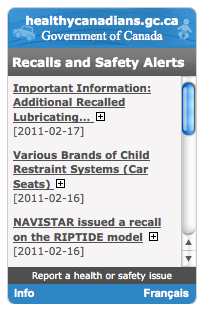
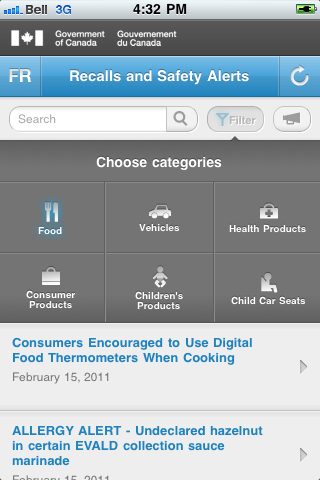
HC-Widgethc-appThe most cutting edge stuff I’ve seen is an effort by Health Canada to share advisories from Health Canada, Transport Canada and the Canadian Food Inspection Agency via three vehicles: an RSS feed, a mobile app available for Blackberry, iPhone (pictured far right) and Android, and finally as a widget (pictured near right) that anyone can install into their blog.

I think all of these are interesting ideas and have much to commend them. It is great to see information of a similar type, from three different agencies, being shared through a single vehicle – this is definitely a step forward from a user’s perspective. It’s also nice to see the government experiment with different vehicles for delivery (mobile and other parties’ websites).

But from a citizen-centric perspective, all these innovations share a common problem: They don’t fundamentally change the citizen’s experience with this information. In other words, they are simply efforts to find new ways to “broadcast” the information. As a result, I predict that these intiatives will have a minimal impact as currently structured. There are two reasons why:

The problem isn’t about access: These tools are predicated on the idea that the problem to conveying this information is about access to the information. It isn’t. The truth is, people don’t care. We can debate about whether they should care but the fact of the matter is, they don’t. Most people won’t pay attention to a product recall until someone dies. In this regard these tools are simply the modern day version of newspaper ads, which, historically, very few people actually paid attention to. We just couldn’t measure it, so we pretended like people read them.

The content misses the mark: Scrape a little deeper on these tools and you’ll notice something. They are all, in essence, press releases. All of these tools, the RSS feed, blog widget and mobile apps, are simply designed to deliver a marginally repackaged press release. Given that people tuned out of newspaper ads, pushing these ads onto them in another device will likely have a limited impact.

As a result, I suspect that those likely to pay attention to these innovations were probably those who were already paying attention. This is okay and even laudable. There is a small segment of people for whom these applications reduce the transactions costs of access. However, with regard to expanding the numbers of Canadians impacted my this information or changing behaviour in a broader sense, these tools have limited impact. To be blunt, no one is checking a mobile application before they buy a product, nor are they reading these types of widgets in a blog, nor is anyone subscribing to an RSS feed of recalls and safety warnings. Those who are, are either being paid to do so (it is a requirement of their job) or are fairly obsessive.

In short, this is a government-centric solution – it seeks to share information the government has, in a context that makes sense to government – it is not citizen-centric, sharing the information in a form that matters to citizens or relevant parties, in a context that makes sense to them.

Again, I want to state while I draw this conclusion I still applaud the people at Health Canada. At least they are trying to do something innovative and creative with their data and information.

So what would a citizen-centric approach look like? Interestingly, it would involve trying to reach out to citizens directly.

People are wrestling with a tsunami of information. We can’t simply broadcast them with information, nor can we expect them to consult a resource every time they are going to make a purchase.

What would make this data far more useful would be to structure it so that others could incorporate it into software and applications that could shape people’s behaviors and/or deliver the information in the right context.

Take this warning, for example: “CERTAIN FOOD HOUSE BRAND TAHINI OF SESAME MAY CONTAIN SALMONELLA BACTERIA” posted on Monday by the Canadian Food Inspection Agency. There is a ton of useful information in this press release including things like:

The geography impacted: Quebec

The product name, size and better still the UPC and LOT codes.

Product Size UPC Lot codes
Tahini of Sesame 400gr 6 210431 486128 Pro : 02/11/2010 and Exp : 01/11/2012
Tahini of Sesame 1000gr 6 210431 486302 Pro: 02/11/2010 and Exp: 01/11/2012
Premium Halawa 400gr 6 210431 466120 Pro: 02/11/2010 and Exp: 01/11/2012
Premium Halawa 1000gr 6 210431 466304 Pro: 02/11/2010 and Exp: 01/11/2012

However, all this information is buried in the text so is hard to parse and reuse.

If the data was structured and easily machine-readable (maybe available as an API, but even as a structured spreadsheet) here’s what I could imagine happening:

  1. Retailers could connect the bar code scanners they use on their shop floors to this data stream. If any cashier swipes this product at a check out counter they would be immediately notified and would prevent the product from being purchased. This we could do today and would be, in my mind, of high value – reducing the time and costs it takes to notify retailers as well as potentially saving lives.
  2. Mobile applications like RedLaser, which people use to scan bar codes and compare product prices could use this data to notify the user that the product they are looking at has been recalled. Apps like RedLaser still have a small user base, but they are growing. Probably not a game changer, but at least context sensitive.
  3. I could install a widget in my browser that, every time I’m on a website that displays that UPC and/or Lot code would notify me that I should not buy that product and that it’s been recalled. Here the potential is significant, especially as people buy more and more goods over the web.
  4. As we move towards having “smart” refrigerators that scan the RFID chips on products to determine what is in the fridge, they could simply notify me via a text message that I need to throw out my jar of Tahini of Sesame. This is a next generation use, but the government would be pushing private sector innovation in the space by providing the necessary and useful data. Every retailer is going to want to sell a “smart” fridge that doubles as a “safe” fridge, telling you when you’ve got a recalled item in it.

These are all far more citizen-centric, since they don’t require citizens to think, act or pay attention. In short, they aren’t broadcast-oriented, they feel customized, filtering information and delivering it where citizens need it, when they need it, sometimes without them even needing to know. (This is the same argument I made in my How Yelp Could Help Save Millions in Healthcare Costs). The most exciting thing about this is that Health Canada already has all the data to do this, it’s just a question of restructuring it so it is of greater use to various consumers of the data – from retailers, to app developers, to appliance manufactuers. This should not cost that much. (Health Canada, I know a guy…)

Another advantage of this approach is that it also gets the Government out of the business of trying to find ways to determine the best and most helpful way to share information. This appears to be a problem the UK government is also interested in solving. Richard A. sent me this excellent link in which a UK government agency appeals to the country’s developers to help imagine how it can better share information not unlike that being broadcast by Health Canada.

However, at the end of the day even this British example falls into the same problem – believing that the information is most helpfully shared through an app. The real benefit of this type of information (and open data in general) won’t be when you can create a single application with it, but when you can embed the information into systems and processes so that it can notify the right person at the right time.

That’s the challenge: abandoning a broadcast mentality and making things available for multiple contexts and easily embeddable. It’s a big culture shift, but for any government interested in truly exploring citizen-centric approach, it’s the key to success.

Open Knowledge Foundation Open Data Advocate

My colleagues over at the Open Knowledge Foundation have been thinking about recruiting an Open Data Advocate, someone who can coordinate a number of the activities they are up to in the open data space. I offered to think about what the role should entail and how that person could be effective. Consequently, in the interests of transparency, fleshing out my thinking and seeing if there might be feed back (feel free to comment openly, or email me personally if you wish to keep it private) I’m laying out my thinking below.

Context

These are exciting times for open government data advocates. Over the past few years a number of countries, cities and international organizations have launched open data portals and implemented open data policies. Many, many more are contemplating joining the fray. What makes this exciting is that some established players (e.g. United States, UK, World Bank) are continue to push forward and will, I suspect, be refining and augmenting their services in the coming months. At the same time there are still a number of laggards (e.g. Canada federally, Southern Europe, Asia) in which mobilizing local communities, engaging with public servants and providing policy support is still the order of the day.

This makes the role of an Open Data Advocate complex. Obviously, helping pull the laggards along is an important task. Alternatively (or in addition) they may need to also be thinking longer term. Where is open data going, what will second and third generation open data portals need to look like (and what policy infrastructure will be needed to support them).

These are two different goals and so either choosing, or balancing, between them will not be easy.

Key Challenges

Some of the key challenges spring quite obviously from that context. But there are also other challenges, I believe to be looming as well. So what do I suspect are the key challenges around open data over the next 1-5 years?

  1. Getting the laggards up and running
  2. Getting governments to use standardized licenses that are truly open (be it the PDDL, CC-0 or one of the other available licenses out there
  3. Cultivating/fostering an eco-system of external data users
  4. Cultivating/fostering an eco-system of internal government user (and vendors) for open data (this is what will really make open data sustainable)
  5. Pushing jurisdictions and vendors towards adopting standard structures for similar types of data (e.g. wouldn’t it be nice if restaurant inspection data from different jurisdictions were structured similarly?)
  6. Raising awareness about abuses of, and the politicization of, data. (e.g. this story about crime data out of New York which has not received nearly enough press)

The Tasks/Leverage Points

There are some basic things that the role will require including:

  1. Overseeing the Working Group on Open Government Data
  2. Managing opengovernmentdata.org
  3. Helping organize the Open Government Data Camp 2011, 2012 and beyond

But what the role will really have to do is figure out the key leverage points that can begin to shift the key challenges listed above in the right direction. The above mentioned tasks may be helpful in doing that… but they may not be. Success is going to be determined but figuring how to shift systems (government, vendor, non-profit, etc…) to advance the cause of open data. This will be no small task.

My sense is that some of these leverage points might include:

  1. Organizing open data hackathons – ideally ones that begin to involve key vendors (both to encourage API development, but also to get them using open data)
  2. Leveraging assets like Civic Commons to get open data policies up on online so that jurisdictions entertaining the issue can copy them
  3. Building open data communities in key countries around the world – particularly in key countries in such as Brasil and India where a combination of solid democratic institutions and a sizable developer community could help trigger changes that will have ramifications beyond their borders (I suspect there are also some key smaller countries – need to think more on that)
  4. I’m sure this list could be enhanced…

Metrics/Deliverables

Obviously resolving the above defined challenges in 1-5 years is probably not realistic. Indeed, resolving many of those issues is probably impossible – it will be a case of ensuring each time we peel back one layer of the onion we are well positioned to tackle the next layer.

Given this, some key metrics by which the Open Knowledge Foundation should evaluate the person in this role might be:

At a high level, possible some metrics might include:

  • Number of open data portals world wide? (number using CKAN?)
  • Number of groups, individuals, cities participating in Opendata hackathons
  • Number of applications/uses of open data
  • Awareness of CKAN and its mission in the public, developer space, government officials, media?
  • Number of government vendors offering open data as part of their solution

More additional deliverables, could include:

  • Running two Global OpenData Hackathons a year?
  • Developing an OKFN consulting arm specializing in open data services/implementation
  • Create an open data implementation policy “in a box” support materials for implementing an open data strategy in government
  • Develop a global network of OKFN chapters to push their local and national governments, share best practices
  • Run opendata bootcamps for public servants and/or activists
  • Create a local open data hackathon in a box kit (to enable local events)
  • Create a local “how to be an open data activist” site
  • Conduct some research on the benefits of open data  to advance the policy debate
  • Create a stronger feedback loop on CKAN’s benefits and weaknesses
  • Create a vehicle to connect VC’s and/or money with open data drive companies and app developers (or at least assess what barriers remain to use open data in business processes).

Okay, I’ll stop there, but if you have thoughts please send them or comment below. Hope this stimulates some thinking among fellow open data geeks.

How Yelp Could Help Save Millions in Health Care Costs

Okay, before I dive in, a few things.

1) Sorry for the lack of posts last week. Life’s been hectic. Between Code for America, a number of projects and a few articles I’m trying to get through, the blogging slipped. Sorry.

2) I’m presenting on Open Data and Open Government to the Canadian Parliament Access to Information, Privacy and Ethics Committee today – more on that later this week

3) I’m excited about this post

When it comes to opening up government data many of us focus on Governments: we cajole, we pressure, we try to persuade them to open up their data. It’s approach we will continue to have to take for a great deal of the data our tax dollars pay to collect and that government’s continue to not share. There is however another model.

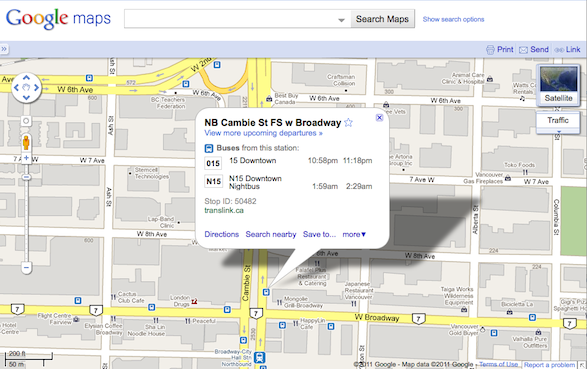
Consider transit data. This data is sought after, intensely useful, and probably the category of data most experimented with by developers. Why is this? Because it has been standardized. Why has it been standardized. Because local government’s (responding to citizen demand) have been desperate to get their transit data integrated with Google Maps (See image).
Screen-shot-2011-01-30-at-10.45.00-PM

It turns out, to get your transit data into Google Maps, Google insists that you submit to them the transit data in a single structured format. Something that has come to be known as the General Transit Feed Specification (GTFS). The great thing about the GTFS is that it isn’t just google that can use it. Anyone can play with data converted into the GTFS. Better still, because the data structure us standardized an application someone develops, or analysis they conduct, can be ported to other cities that share their transit data in a GTFS format (like, say, my home town of Vancouver).

In short, what we have here is a powerful model both for creating open data and standardizing this data across thousands of jurisdictions.

So what does this have to do with Yelp! and Health Care Costs?

For those not in the know Yelp! is a mobile phone location based rating service. I’m particularly a fan of its restaurant locator: it will show you what is nearby and how it has been rated by other users. Handy stuff.

But think bigger.

Most cities in North America inspect restaurants for health violations. This is important stuff. Restaurants with more violations are more likely to transmit diseases and food born illnesses, give people food poisoning and god knows what else. Sadly, in most cases the results of these tests are posted in the most useless place imaginable. The local authorities website.

I’m willing to wager almost anything that the only time anyone visits a food inspection website is after they have been food poisoned. Why? Because they want to know if the jerks have already been cited.

No one checks these agencies websites before choosing a restaurant. Consequently, one of the biggest benefits of the inspection data – shifting market demand to more sanitary options – is lost. And of course, there is real evidence that shows restaurants will improve their sanitation, and people will discriminate against restaurants that get poor ratings from inspectors, when the data is conveniently available. Indeed, in the book Full Disclosure: The Perils and Promise of Transparency Fung, Graham and Weil noted that after Los Angeles required restaurants to post food inspection results, that “Researchers found significant effects in the form of revenue increases for restaurants with high grades and revenue decreases for C-graded (poorly rated) restaurants.” More importantly, the study Fung, Graham and Weil reference also suggested that making the rating system public positively impacted healthcare costs. Again, after inspection results in Los Angeles were posted on restaurant doors (not on some never visited website), the county experienced a reduction in emergency room visits, the most expensive point of contact in the system. As the study notes these were:

an 18.6 percent decline in 1998 (the first year of program operation), a 4.8 percent decline in 1999, and a 5.4 per- cent decline in 2000. This pattern was not observed in the rest of the state.

This is a stunning result.

So, now imagine that rather than just giving contributor generated reviews of restaurants Yelp! actually shared real food inspection data! Think of the impact this would have on the restaurant industry. Suddenly, everyone with a mobile phone and Yelp! (it’s free) could make an informed decision not just about the quality of a restaurant’s food, but also based on its sanitation. Think of the millions (100s of millions?) that could be saved in the United States alone.

All that needs to happen is for a simple first step, Yelp! needs approach one major city – say a New York, or a San Francisco – and work with them to develop a sensible way to share food inspection data. This is what happened with Google Maps and the GTSF, it all started with one city. Once Yelp! develops the feed, call it something generic, like the General Restaurant Inspection Data Feed (GRIDF) and tell the world you are looking for other cities to share the data in that format. If they do, you promise to include it in your platform. I’m willing to bet anything that once one major city has it, other cities will start to clamber to get their food inspection data shared in the GRIDF format. What makes it better still is that it wouldn’t just be Yelp! that could use the data. Any restaurant review website or phone app could use the data – be it Urban Spoon or the New York Times.

The opportunity here is huge. It’s also a win for everyone: Consumers, Health Insurers, Hospitals, Yelp!, Restaurant Inspection Agencies, even responsible Restaurant Owners. It would also be a huge win for Government as platform and open data. Hey Yelp. Call me if you are interested.

What I’m doing at Code for America

For the last two weeks – and for much of January – I’m in San Francisco helping out with Code for America. What’s Code for America? Think Teach for America, but rather than deploying people into classrooms to help provide positive experiences for students and teachers while attempting to shift the culture of school districts, Code for America has fellows work with cities to help develop reusable code to save cities money, make local government as accessible as your favorite website, and help shift the government’s culture around technology.

code-for-america1-150x112The whole affair is powered by a group of 20 amazing fellows and an equally awesome staff that has been working for months to make it all come together. My role – in comparison – is relatively minor, I head up the Code for America Institute – a month long educational program the fellows go through when they first arrive.  I wanted to write about what I’ve been trying to do both because of the openness ideals of Code for America and to share any lessons for others who might attempt a similar effort.

First, to understand what I’m doing, you have to understand the goal. On the surface, to an outsider, the Code for America change process might look something like this:

  1. Get together some crazy talented computer programers (hackers, if you want to make the government folks nervous)
  2. Unleash them on a partner city with a specific need
  3. Take resulting output and share across cities

Which of course, would mistakenly frame the problem as technical. However, Code for America is not about technology. It’s about culture change. The goal is about rethinking and reimagining  government as better, faster, cheaper and adaptive. It’s about helping think of the ways its culture can embrace government as a platform, as open and as highly responsive.

I’m helping (I think) because I’ve enjoyed some success in getting government’s to think differently. I’m not a computer developer and at their core, these successes were never technology problems. The challenge is understanding how the system works, identify the leverage points for making change, develop partners and collaborate to engage those leverage points, and do whatever it takes to ensure it all comes together.

So this is the message and the concept the speakers are trying to impart on the fellows. Or, in other words, my job is to help unleash the already vibrant change agents within the 20 awesome fellows and make them effective in the government context.

So what have we done so far?

We’ve focused on three areas:

1) Understand Government: Some of the fellows are new to government, so we’ve had presentations from local government experts like Jay Nath, Ed Reiskin and Peter Koht as well as the Mayor of Tuscon’s chief of staff (to give a political perspective). And of course, Tim O’Reilly has spoken about how he thinks government must evolve in the 21st century. The goal: understand the system as well as, understand and respect the actors within that system.

2) Initiate & Influence: Whether it is launching you own business (Eric Ries on startups), starting a project (Luke Closs on Vantrash) or understanding what happens when two cultures come together (Caterina Fake on Yahoo buying Flickr) or myself on negotiating, influence and collaboration, our main challenges will not be technical, they will be systems based and social. If we are to build projects and systems that are successful and sustainable we need to ask the right questions and engage with these systems respectfully as we try to shift them.

3) Plan & Focus: Finally, we’ve had experts in planning and organizing. People like Allen Gunn (Gunner) and the folks from Cooper Design, who’ve helped the fellows think about what they want, where they are going, and what they want to achieve. Know thyself, be prepared, have a plan.

The last two weeks will continue to pick up these themes but also give the fellows more time to (a) prepare for the work they will be doing with their partner cities; and (b) give them more opportunities to learn from one another. We’re half way through the institute at this point and I’m hoping the experience has been a rich – if sometimes overwhelming – one. Hopefully I’ll have an update again at the end of the month.

A Response to a Ottawa Gov 2.0 Skeptic

So many, many months ago a Peter R. posted this comment (segments copied below) under a post I’d written titled: Prediction, The Digital Economy Strategy Will Fail if it Isn’t Drafted Collaboratively on GCPEDIA. At first blush Peter’s response felt aggressive. I flipped him an email to say hi and he responded in a very friendly manner. I’ve been meaning to respond for months but, life’s been busy.  However, over the break (and my quest to hit inbox 0) I finally carved out some time –  my fear is that this late response will sound like a counter attack – it isn’t intended as such but rather an effort to respond to a genuine question. I thought it would be valuable to post as many of the points may resonate with supporters and detractors of Gov 2.0 alike. Here’s my responses to the various charges:

The momentum, the energy and the excitement behind collaborative/networked/web 2.0/etc is only matched by the momentum, the energy and the excitement that was behind making money off of leveraged debt instruments in the US.

Agreed, there is a great deal of energy and excitement behind collaborative networks, although I don’t think this is sparked – as ensued, by something analogous to bogus debt instruments. People are excited because of the tangible results created by sharing and/or co-production networks like Wikipedia, Mozilla, Flickr Google search and Google Translate (your results improve based on users data) and Ushahidi inspire people because of the tremendous results they are able to achieve with a smaller footprint of resources. I think the question of what these types of networks and this type of collaboration means to government is an important question – that also means that as people experiment their will be failures – but to equate the entire concept of Gov 2.0 and the above cited organizations, tools and websites with financial instruments that repackaged subprime mortgages is, in my mind, fairly problematic.

David, the onus lies squarely with you to prove that policymakers across government are are incapable of finding good policy solutions WITHOUT letting everyone and his twitting brother chime in their two cents.

Actually the onus doesn’t lie squarely with me. This is a silly statement. In fact, for those of us who believe in collaborative technologies such as GCPEDIA or yammer this sentence is the single most revealing point in the Peter’s entire comment. I invite everyone and anyone to add to my rebuttal, or to Peter’s argument. Even those who argue against me would be proving my point – tools like blogs and GCPEDIA allow ideas and issues to be debated with a greater number of people and a wider set of perspectives. The whole notion that any thought or solution lies solely with one person is the type of thinking that leads to bad government (and pretty much bad anything). I personally believe that the best ideas emerge when they are debated and contested – honed by having flaws exposed and repaired. Moreover this has never been more important than today, when more and more issues cross ministerial divides. Indeed, the very fact that we are having this discussion on my blog, and that Peter deemed it worthy of comment, is a powerful counterpoint this statement.

Equally important, I never said policymakers across government are are incapable of finding good policy solutions. This is serious misinterpretation of what said. I did say that the Digital Economy Strategy would fail (and I’ll happily revise, and soften to say, will likely not be meaningful) unless written on GCPEDIA. I still believe this. I don’t believe you can have people writing policy about how to manage an economy who are outside of and/or don’t understand the tools of that economy. I actually think our public servants can find great policy solutions – if we let them. In fact, most public servants I know spend most of their time trying to track down public servants in other ministries or groups to consult them about the policy they are drafting. In short, they spend all their time trying to network, but using tools of the late 20th century (like email), mid 20th century (telephone), or mid 3rd century BC (the meeting) to do it. I just want to give them more efficient tools – digital tools, like those we use in a digital economy – so they can do what they are already doing.

For the last 8 years I’ve worked in government, I can tell you with absolute certainty (and credibility!) that good policy emerges from sound research and strategic instrument choice. Often (select) public consultations are required, but sometimes none at all. Take 3 simple and highly successful policy applications: seat belts laws, carbon tax, banking regulation. Small groups of policymakers have developed policies (or laws, regs, etc) to brilliant effect….sans web 2.0. So why do we need gcpedia now?

Because the world expects you to do more, faster and with less. I find this logic deeply concerning coming from a public servant. No doubts that government developed policies to brilliant effect before the wide adoption of the computer, or even the telephone. So should we get rid of them too? An increasing number of the world’s major corporations are, or are setting up an internal wiki/collaboration platform, a social networking site, even using microblogging services like Yammer to foster internal collaboration. Indeed, these things help us to do research and develop ideas faster, and I think, better. The question isn’t why do we need GCPEDIA now. The question is why aren’t we investing to make GCPEDIA a better platform? The rest of the world is.

I’ll put this another way: tons of excellent policy solutions are waiting in the shared drives of bureaucrats across all governments.

I agree. Let’s at least put it on a wiki where more people can read them, leverage them and, hopefully, implement them. You sitting on a great idea that three other people in the entire public service have read isn’t a recipe for getting it adopted. Nor is it a good use of Canadian tax dollars. Socializing it is. Hence, social media.

Politics — being what it is — doesn’t generate progressive out solutions for various ideological reasons (applies equally to ndp, lib, con). First, tell us what a “failed” digitial economy strategy (DES) looks like. Second, tell us what components need to be included in the DES for it be successful. Third, show us why gcpedia/wikis offer the only viable means to accumulate the necessary policy ingredients.

For the last part – see my earlier post and above. As for what a failed digital economy strategy looks like – it will be one that is irrelevant. It is one that will go ignored by the majority of people who actually work in the digital economy. Of course, an irrelevant policy will be better than a truly bad one which, which I suspect, is also a real risk based on the proceedings of Canada 3.0. (That conference seemed to be about “how do we save analog business that are about to be destroyed by the digital economy” – a link to one of my favourite posts). And of course I have other metrics that matter to me. That all said, after meeting the public servant in charge of the process at Canada 3.0, I was really, really encouraged – she is very smart and gets it.

She also found the idea of writing the policy on GCPEDIA intriguing. I have my doubts that that is how things are proceeding, but it gives me hope.

Hello 2011! Coding for America, speaking, open data and licenses

Eaves.ca readers – happy new year! Here’s a little but of an overview into how we are kicking off 2011/

Thank you

First, if you are a regular reader…. thank you. Eaves.ca has just entered its 4th year and it all keeps getting more and more rewarding. I write to organize my thoughts and refine my writing skills but it is always most rewarding to see others benefit from/find it of value to read these posts.

Code for America

I’ve just landed San Francisco (literally! I’m sitting on the floor of the airport, catching the free SFO wifi) where I’ll be spending virtually all of January volunteering to help launch Code for America. Why? Because I think the organizations matters, its projects are important and the people are great. I’ve always enjoyed hanging out with technologists with a positive agenda for change (think Mozilla & OpenMRS) and Code for America takes all that fun and combines it with government – one of my other great passions. I hope to update you on the progress the organizations makes and what will be happening over the coming weeks. And yes, I am thinking about how Code for Canada might fit into all this.

Gov 2.0

I’ll also be in Ottawa twice in January. My first trip out is to present on a paper about how to write collaboratively using a wiki. With a little bit of work, I’ll be repositioning this paper to make it about how to draft public policy on a wiki within government (think GCPEDIA). With luck I’ll publish this in something like Policy Options or something similar (maybe US based?). I think this has the potential of being one of my most important pieces of the year and needless to say, I’m excited and will be grateful for feedback, both good and negative.

Open Data and Government

On my second trip to Ottawa I’ll be presenting on Open Data and Open Government to the Standing Committee on Access to Information, Privacy and Ethics. Obviously, I’m honored and thrilled they’ve asked me to come and talk and look forward to helping parliamentarians understand why this issue is so important and how they could make serious progress in short order if they put their minds to the task.

Licenses

So for the last two years we’ve been working hard to get cities to do open data with significant success. This year, may be the year that the Feds (more on that in a later post) and some provinces get in on the game, as well as a larger group of cities. The goal for them will be to build on, and take to the next level, the successes of the first movers like Vancouver, Edmonton, Toronto and Ottawa. This will mean one thing. Doing the licensing better. The Vancouver license, which has been widely copied was a good starting point for governments venturing into unknown territory (e.g. getting their toes wet). But the license has several problems –and there are several significantly better choices out there (I’m look over at you PDDL – which I notice the City of Surrey has adopted, nice work.). So, I think one big goal for 2011 will be to get governments to begin shifting to (ideally) the PDDL and (if necessary) something more equivalent. On this front I’m feeling optimistic as well and will blog on this in the near future.

Lots of other exciting things going on as well – I look forward to sharing them here in the blog soon.

All in all, its hard to to be excited about 2011 and I hope you are too. Thank you so much for being part of all of this.