Tag Archives: government

Parliament, Accountability and you

Yesterday was not a good day for accountability.

Yes, the speaker has spoken. It turns out that the government is accountable to parliament. Everyone seems to be happy. Everyone that is, except me.

While some are understandably happy about the decision the fact is, this is lowest common denominator democracy. Presently the executive – one that ran on the notion of accountability – believes it is accountable to no one. Indeed, it is not even embarrassed to openly argue the case. The good news is that, thankfully, the Speaker has intervened and signaled that, in fact, the government is accountable to at least one group of people, parliamentarians. On the surface, it is more than a little embarrassing to all Canadians that, to avoid accountability, the present government would attempt to break centuries of parliamentary tradition and violate the very rules the sustain our democracy. Again, yesterday is not a high water mark, it is a low water mark for all of us.

But there is something still more disturbing in yesterday’s events. If this government is unwilling to be accountable to elected officials who have the power of tradition and rule of law… How responsive will they be any one else?

And here in lies the bad news. While our government may yet be held accountable to parliament, there is group of people the government has demonstrated it isn’t accountable to. And that is you.

Let’s assume that, like me, you have no parliamentary privilege. No legal team on your side. No access to the speaker of the house to arbitrate your request. What is the likelihood your request for government information – even something not-secret – will be responded to in a timely manner? How accountable do you think your government will be to you?

Sadly, we know the answer. And it is not good. Indeed, what is playing out in the house is a metaphor for what has happened across much of the Canadian government. With each government it becomes harder and harder to know how decisions were made, what has happened, or even the results of a government activity. That is unless the government decides it wants you to know.

In fact, it is not out of the ordinary for citizens to wait months to get information they requested. Of course, this means that by the time they get the information they requested the discussion has moved on or new more relevant information needs to be requested. In short, journalists, academics, businesses and ordinary Canadians remains stuck forever in the dark, their government out of reach, and unwilling to be accountable to the very people who elect them.

Indeed the only thing that is extraordinary about what is happening in parliament is that it is a profoundly ordinary experience for ordinary Canadian who might ask a question of their government. As the Information Commissioner noted in her report to parliament “Seventeen of the 24 institutions completed their requests in 60 days or more.” (The law requires a response within 30 days). And that was if they decided to fulfill the request at all. So far parliament has had to wait 4 months, if the government decides it will hand over the documents at all. And of course, the government may next claim it doesn’t know where the documents are – since apparently they are using a highly sophisticated filing system to manage the war effort.

So, members of parliament, what you are experiencing is what is actually pretty normal for the rest of us. Which is, pretty depressing.

Datadotgc.ca Launched – the opportunity and challenge

Today I’m really pleased to announce that we’ve launched datadotgc.ca, a volunteer driven site I’m collaboratively creating with a small group of friends and, I hope, a growing community that, if you are interested, may include you.

As many of you already know I, and many other people, want our governments to open up and share their data, in useful, structured formats that people can actually use or analyze. Unlike our American and British peers, the Canadian Federal (and provincial…) government(s) currently have no official, coordinated effort to release government data.

I think that should change.

So rather than merely complain that we don’t have a data.gov or data.gov.uk in Canada, we decided to create one ourselves. We can model what we want our governments to do and even create limited versions of the service ourselves. So that is what we are doing with this site. A stab at showing our government, and Canada, what a federal open data portal could and should look like – one that I’m hoping people will want to help make a success.

Some two things to share.

First, what’s our goal for the site?

  • Be an innovative platform that demonstrates how government should share data.
  • Create an incentive for government to share more data by showing ministers, public servants and the public which ministries are sharing data, and which are not.
  • Provide a useful service to citizens interested in open data by bringing it all the government data together into one place to both make it easier to find.

Second, our big challenge.

As Luke C, one datadotgc.ca community member said to me – getting the site up is the easier part. The real challenge is building a community of people who will care for it and help make it a living, growing and evolving success. Here there is lots of work still to be done. But if you feel passionate about open government and are interested in joining our community, we’d love to have you. At the moment, especially as we still get infrastructure to support the community in place, we are convening at a google group here.

So what our some of the things I think are a priority in the short term?

  • Adding or bulk scraping in more data sets so the site more accurately displays what is available
  • Locating data sets that are open and ready to be “liberated”
  • Documenting how to add or scrape in a data set to allow people to help more easily
  • Implement a more formal bug and feature tracker
  • Plus lots of other functionality I know I at least (and I’m sure there are lots more ideas out there) would like to add (like “request a closed data set”)

As Clay Shirky once noted about any open source project, datadotgc.ca is powered by love. If people love the site and love what it is trying to accomplish, then we will have a community interested in helping make it a success. I know I love datadotgc.ca – and so my goal is to help you love it too, and to do everything I can to make it as easy as possible for you to make whatever contribution you’d like to make. Creating a great community is the hardest but best part of any project. We are off to a great start, and I hope to maybe see you on the google group.

Finally, just want to thank everyone who has helped so far, including the fine people at Raised Eyebrow Web Studio, Luke Closs, and a number of fantastic coders from the Open Knowledge Foundation. There are also some great people over at the Datadotgc.ca Google Group who have helped scrape data, tested for bugs and been supportive and helpful in so many ways.

Case Study: How Open data saved Canada $3.2 Billion

Note: I’ll be on TVO’s The Agenda with Steve Paikin tonight talking about Government 2.0.

Why does open data matter? Rather than talk in abstract terms, let me share a well documented but little known story about how open data helped expose one of the biggest tax frauds in Canada’s history.

It begins in early 2007 when a colleague was asked by a client to do an analysis of the charitable sector in Toronto. Considering it a simply consulting project, my colleague called the Canada Revenue Agency (CRA) and asked for all the 2005 T3010s – the Annual Information Returns where charities disclose to the CRA their charitable receipts and other information – in Toronto. After waiting several weeks and answering a few questions, the CRA passed along the requested information.

After spending time cleaning up the data my colleague eventually had a working excel spreadsheet and began to analyze the charitable sector in the Greater Toronto Area. One afternnon, on a lark, they decided to organize the charities by size of tax-receipted charitable donations.

At this point it is important to understand something about scale. The United Way of Greater Toronto is one of the biggest charities in North America, indeed its most recent annual charitable donation drive was the biggest on the continent. In 2008 – the year of the financial crisis started – the United Way of Greater Toronto raised $107.5 million.

So it was with some surprise that after sorting the charities by 2005 donation amounts my colleague discovered that the United Way was not first on the list. It wasn’t even second.

It was third.

This was an enormous surprise. Somewhere in Toronto, without anyone being aware of it, two charities had raised more money than the United Way (which in 2005 raised target of $96.1M). The larger one, the International Charity Association Network (ICAN) raised $248M in 2005. The other, the Choson Kallah Fund of Toronto had receipts of $120M (up from $6M in 2003).

Indeed, four out the top 15 charities on the list, including Millennium Charitable Foundation, Banyan Tree, were unknown to my colleague, someone who had been active in the Toronto charitable community for over a decade.

All told, my colleague estimated that these illegally operating charities alone sheltered roughly Half a billion dollars in 2005. Indeed, newspapers later confirmed that in 2007, fraudulent donations were closer to a billion dollars a year, with some some 3.2 billion dollars illegally sheltered, a sum that accounts for 12% of all charitable giving in Canada.

Think about this. One billion dollars. A year. That is almost .6% of the Federal Government’s annual budget.

My colleague was eager to make sure that CRA was taking action on these organizations, but it didn’t look that way. The tax frauds were still identified by CRA as qualified charities and were still soliciting donors with the endorsement of government. They knew that a call to CRA’s fraud tip line was unlikely to prompt swift action. The Toronto Star had been doing its own investigations into other instances of charity fraud and had been frustrated by CRA’s slow response.

My colleague took a different route. They gave the information to the leadership of the charitable sector and those organizations as a group took it to the leadership at CRA. From late 2007 right through 2009 the CRA charities division – now under new leadership – has systematically shut down charity tax shelters and are continuing to do so.  One by one, International Charity Association Network, Banyan Tree Foundation, Choson Kallah Fund, the Millennium Charitable Foundation and others identified by my colleague have lost their charitable status. A reported $3.2 billion in tax receipts claimed by 100,000 Canadian tax filers have so far been disallowed or are being questioned. A class action suit launched by thousands of donors against the organizers and law firm of Banyan Tree Foundation was recently certified. It’s a first. Perhaps the CRA was already investigating these cases. It must build its cases carefully as, if they end up in court and fail to successfully present their case, they could help legalize a tax loophole. It may just have been moving cautiously. But perhaps it did not know.

This means that, at best, government data – information that should be made more accessible and open in an unfettered and machine readable format – helped reveal one of the largest tax evasion scandals in the country’s history. But if the CRA was already investigating, scrutiny of this data by the public served a different purpose – helping to bring these issues out into the open, forcing CRA to take public action (suspending these organizations’ right to solicit more donations), sooner rather than later.  Essentially from before 2005-2007 dozens of charities were operating illegally. Had the data about their charitable receipts been available for the public’s routine review,  someone in the public might have taken notice and raised a fuss earlier. Perhaps even a website tracking donations might have been launched. This would have exposed those charities that had abnormally large donations with few programs to explain then. Moreover, it might have given some of the 100,000 Canadians now being audited a tool for evaluating the charities they were giving money to.

In the computer world there is something called Linus’ Law, which states: “given enough eyeballs, all bugs (problems) are shallow.” The same could be said about many public policy or corruption issues. For many data sets, citizens should not have to make a request. Nor should we have to answer questions about why we want the data. It should be downloadable in its entirety. Not trapped behind some unhelpful search engine. When data is made readily available in machine readable formats, more eyes can look at it. This means that someone on the ground, in the community (like, say, Toronto) who knows the sector, is more likely to spot something a public servant in another city might not see because they don’t have the right context or bandwidth. And if that public servant is not allowed to talk about the issue, then they can share this information with their fellow citizens.

This is the power of open data: The power to find problems in complicated environments, and possibly even to prevent them from emerging.

The Future of Media in Canada – Thoughts for the Canadian Parliamentary Committee

Yesterday, Google presented to a House of Commons Heritage Committee which has launched a study of “new media.” Already some disturbing squawks have been heard from some of the MPs. For those who believe in an open internet, and in an individuals right to choose, there is no need to be alarmed just yet, but this is definitely worth keeping an eye on. It is however, a good thing that the parliamentary committee is looking at this (finally) since the landscape has radically changed and the Canadian government needs to adjust.

In his SXSWi talk Clay Shirky talked about how abundance changes things. One an item ceases to be scarce – when it is freely available – the dynamics of what we do with it and how we use it radically change.

It is something government’s have a hard time wrestling with. One basic assumption that often (but hardly always) underlies public policy is that one is dealing with how to manage scarce resources like natural resources. But what happens when something that was previously scarce suddenly becomes abundant? The system breaks. This is the central challenge the Heritage Committee MPs need to wrap their heads around.

Why?

Because this is precisely what is happening with the broadcast industry generally and Canadian content rules specifically. And it explains why Canadian content rules are so deeply, deeply broken.

In the old era the Government policy on Canadian content rested on two pillars:

First, the CRTC was able to create scarcity. It controlled the spectrum and could regulate the number of channels. This meant that broadcasters had to do what it said if they wanted to maintain the right to broadcast. This allowed the CRTC to mandate that a certain percentage of content be Canadian (CanCon).

The second pillar was funding. The Government could fund projects that would foster Canadian content. Hence the CBC, the National Film Board of Canada and various other granting bodies.

The problem is, in the digital era, creating scarcity gets a lot more complicated. There are no channels to regulate on the internet. There is just the abundant infinity of internet content. Moreover you can’t force websites to produce or create Canadian content nor can you force Canadians to go to websites that do (at least god hopes that isn’t a crazy idea the committee gets into its head). The scarcity is gone. The Government can no longer compel Canadians to watch Canadian content.

So what does that mean? There are three implications in my mind.

First. Stop telling Canadians what culture is. The most offensive quote from yesterday’s Globe article was, to quote the piece Bloc Québécois MP Carole Lavallée quote:

Bloc Québécois MP Carole Lavallée highlighted the often low-brow, low-budget fare on YouTube. She accused Google of confusing leisure with culture.

“Leisure is people who play Star Wars in their basement and film one another and put that on YouTube,” she said. “ But culture is something else.”

Effectively, she is telling me – the blog and new media writer – and the 100,000s if not millions of other Canadians who have created something that they do not create Canadian culture. Really? I thought the whole point of the Heritage Ministry, and tools like the CBC was to give voice to Canadians. The internet, a tools like YouTube have done more on that front than any Government program of the last 5 decades. Lavallée may not like what she sees, but today, more Canadian content is created and watched around the world, than ever before.

Second. Be prepared to phase out the CRTC. The CRTC’s regulatory capacity depends on being able to create scarcity. If there is no more scarcity, then it seizes to have a lever. Yes, the TV industry is still with us. But for how long? Canadians, like people everywhere, want to watch what they want, when they want. Thanks to the internet, increasingly they can. The CRTC no longer serves the interests of Canadians, it serves to perpetuate both the broadcast industry and the cable industry (yes, even when they fight) by creating a legal scaffolding that props up their business models. Michael Geist understands this – the committee should definitely be talking to him as well.

Third, if the first pillar is dead, the second pillar is going to have to take on a heavier load and in new and creative ways. The recent National Film Board iPhone app is fantastic example of how new media can be used to promote Canadian content. If the Commons committee is really worried about YouTube, why not have Heritage Canada create a “Canadian channel” on YouTube where it can post the best videos by Canadians and about Canada? Maybe it can even offer grants to the video creaters that get the most views on the channel – clearly they’ve demonstrated an ability to attract an audience. Thinking about more micro-grants that will allow communities to create their own content is another possibility. Ultimately, the Government can’t shape demand, or control the vehicle by which supply is delivered. But it can help encourage more supply – or better still reward Canadians who do well online and enable them to create more ambitious content.

The world of new media is significantly democratizing who can create content and what people can watch. Whatever the heritage committee does I hope they don’t try to put the cork back on that bottle. It will, in effect, be muzzling all the new emerging Canadian voices.

Update: Just saw that Sara Bannerman has a very good post about how Canadian content could be regulated online. Like much of what is in her post, but don’t think “regulation” is the right word. Indeed, most of what she asks for makes business sense – people will likely want Canadian filters for searching (be it for books, content, etc…) as long as those filters are optional.

Competitive Bureaucracies: Why is IDRC a Success?

A long time ago a friend of mine was talking about how some organizations thrive by being under constant threat. His favourite example was the US Navy’s Marine Corp. The Marines are, operationally, the cheapest army corp in the United States forces, among the most mobile and, many would argue, possibly the most effective.Why, he asked, do you think the Marine Corp is considered so excellent? Why does it work so hard to excel in every way?

Well, he claimed, it was because the Marines are always an obvious target for budget cutters and larger rivals. If were looking cut duplicating services it would be easy to look over at the Marine Corp and ask… Why does the Navy need an army? Isn’t the army supposed to be our… army?

And trust me, this is a questions the Army asks regularly. Indeed, reading the Wikipedia page about the Marines – one can quickly see how the Marine Corps dissolution has been sought at various points in history:

The Marine Corps combat capabilities in some ways overlap those of the United States Army, the latter having historically viewed the Corps as encroaching on the Army’s capabilities and competing for funding, missions, and renown. The attitude dates back to the founding of the Continental Marines, when General George Washington refused to allow the initial Marine battalions to be drawn from among his Continental Army. Most significantly, in the aftermath of World War II, Army efforts to restructure the American defense establishment included the dissolution of the Corps and the folding of its capabilities into the other services.

So what does this have to do with International Development Research Centre?

I confess that I am not involved in development issues that much. But every time I do stray into the space and am impressed with a project that is innovative or interesting, it seems the IDRC has had a hand in funding it.

For example, readers of this blog know that I’ve become involved with OpenMRS, a community-developed, open-source, enterprise electronic medical record system platform specifically designed for doctors in the developing world. IDRC is a funder. Or, guess who is helping fund a community driven approach to bring connectivity and the internet to developing countries… IDRC is. There have been others over the years that I’ve seen, but can’t remember.

Some of this relates to part of the IDRC’s mission, which centres around the use of Information and Communication Technologies for Development (ICT4D) but I also believe that part of it has to do with the fact that the bigger and more amply funded Canadian International Development Agency is just a kilometer away across the Ottawa river the IDRC must always be demonstrating that it is leaner, faster and more effective to justify its existence.

Just like the Marine corp must always justify its existence by being both excellent, effective and cheap. So to must the IDRC. It is the organization in government that – from what I can tell – is more likely to embrace technology, promote an innovative culture and, to be blunt, get the job done. Why? Because it has to.

This is not a defence of duplication of services (and, to be clear, I do not think that IDRC and CIDA’s services directly overlap – but they do operate in similar spaces). But it cannot be denied that competition helps. But I’m not sure it is enough, either. Sometimes, duplications of services simply leads to two poorly performing institutions. I would love to be able to explore what it is about the IDRC and Marine Corp that enable them to channel the threat to their existence into innovation. Is it history? Was it the personality of their founders? Corporate culture? I suspect it is more than the threat of the budgetary axe wielder. But what… I’m not sure.

Perhaps someone will make it a thesis topic some day. I’m going to give it more thought myself.

Gov 2.0 International: Global Innovation Meeting Local Challenges

Next week I’ll be speaking at Gov 2.0 International, an online conference being hosted by O’Reilly Media.

The conference will be running from noon-2:15 EST with an agenda I’ve copy and pasted from their website (might as well admit it!). The conference is free (hard to beat) but you’ll still need to register, which you can do here.

Agenda

Joel Whitaker

Beyond Borders: Improving Global Diplomacy and Citizen Empowerment with Gov 2.0 Speaker: Joel Whitaker, U.S. Institute of Peace

Joel Whitaker is Senior Advisor to the new Center of Innovation for Science, Technology and Peacebuilding at the US Institute of Peace in Washington, DC. Current projects include peace-gaming and simulations, climate change and conflict, mapping the Middle East blogosphere, science diplomacy in Iraq and Afghanistan, online media in Iraq, and mobile communication tools for conflict-zone NGOs.

David Eaves

Open Government in Canada Speaker: David Eaves, Centre for the Study of Democracy

In this overview of the state of open government in Canada, David will outline where there have been successes and where there have been challenges. He’ll explain why this is the case and what it could mean for other jurisdictions.

Yaron Gamburg

Israel Gov 2.0: from Awareness to Implementation Speaker: Yaron Gamburg, Israel Ministry of Foreign Affairs

Gov 2.0 in Israel is still in its initial stage. There are many initiatives in different agencies, primarily in the central government. However, these initiatives are bottom-up developments, and we need strong sponsors at the senior level of the government to make a significant change.

Dominic Campbell

U.K. Innovations in Gov 2.0 Speaker: Dominic Campbell, FutureGov

This talk will look at Britain’s contribution to the Gov20 agenda, where it started from, who led it and why it took the election of Barack Obama 3000 miles away to spur the government into action.

Program subject to refinement. All talks are 30 minutes, with a 15 minute break at US-PST: 10:00am (US-EST: 1:00pm).

The entire conference will be recorded and made available to attendees free of charge afterwards.

The PM’s Advisory Committee on the Public Service: The Good, The Bad, The Hopeful

On February 25th Paul Tellier and David Emerson – two men whose understanding of Ottawa I have a tremendous amount of respect for – released The Fourth Report of the Prime Minister’s Advisory Committee on the Public Service. It is a document that is worth diving into as these reports will likely serve as reference points for (re)thinking on renewing government for the foreseeable future.

The Bad:

On the rough side, I have a single high-level comment: These reports are likely to be as close as we are going to get in Canada to Australia’s Government 2.0 Taskforce (on which I served as part of the international reference group) or Britain’s Cabinet Office Power of Information Taskforce Report (which would have been tremendous to have been involved in).

To be clear, this is not the fault of the committee. Its terms of reference appear to be much broader. This has to predictable consequences. First, relatively little time is dedicated to the general reorganizing of society being prompted by the now 40 year old internet revolution is only carving out a small role. The committee is thus not able to dive into any detail on how the changing role of information in society, on open data, on the power of self-organization, or the rising power and influence of social media could and should re-shape the public service.

Second, much more time is dedicated to thinking about problems around HR and pay. These are important issues. However, since the vision of the public service remains broadly unchanged, my sense is the reforms, while sometimes large, are ultimately tweaks designed to ensure the continuation of the current model – not prompting a rethink (or the laying of groundwork) for a 21st century public service which will ultimately have to look different to stay relevant.

The best example of the implications of this limited scope can be found under the section “Staying Relevant and Connected.” Here the report has two recommendations, including:

The Public Service must take full advantage of collaborative technologies to facilitate interaction with citizens, partners and stakeholders.

The Public Service should adopt a structured approach to tapping into broad-based external expertise. This includes collaboration and exchanges with universities, social policy organizations, think tanks, other levels of government and jurisdictions, private sector organizations and citizens.

These are good! They are also pretty vague and tame. This isn’t so much renewal as it is a baseline for a functioning 20th century public service. More importantly, given some of the other pieces in the report these appear to be recommendations about how the government can engage in pretty traditional manners (exchanges). Moreover, they are externally focused. The main problem with the public service is that its members aren’t even allowed to use collaborative technologies to interact among themselves so how can they possible be ask to collaborate externally? As I say in my OCAD lecture and my chapter in Open Government: Collaboration, Transparency, and Participation in Practice – a digital citizenry isn’t interested in talking to an analogue government. The change required is first and foremost internal. But advocating for such a change is a major effort – one that will require significant culture and process change – which I haven’t found so far in the report and which is probably beyond its scope.

The Good:

That said, when the report does talk about technology and/or collaboration – it broadly says the right things. For example, in the section Creating A Modern, Enabled Workplace the report says:

creating a workplace that will attract, retain and empower public servants to innovate, collaborate and be responsive to the public. Among other things, this must include the adoption of collaborative technologies that are increasingly widespread in other sectors.

And, perhaps more importantly, under the section Strengthening Policy Capacity: A Relevant and Connected Public Service the report states:

A public service operating in isolation runs the risk of becoming irrelevant. We believe that the quality of policy thinking must be enhanced by additional perspectives from citizens, stakeholders and experts from other jurisdictions and other sectors (e.g. business, academia, non-governmental organizations). We believe sound government policy should be shaped by a full range of perspectives, and policy makers must consistently reach beyond the National Capital Region for input and advice.

Furthermore, the Public Service now has an opportunity to engage Canadians, especially younger ones, through the use of Web 2.0 collaborative technologies such as wikis, blogs and social networking. These offer an excellent way for the Public Service to reach out and connect.

Again, great stuff. Although, my concerns from above should also be reiterated. A networked public service is one that will need new norms as it will function very differently. The task force has little to say about this (again because of their expansive purview and not through their own fault). But this issue must be addressed in full. I frequently argue that one reason public servants are so stressed is that they live double lives. They already live in a networked workplace and play by network rules in order to get their job done, however, they are perpetually told they live in a hierarchy and have to pretend they abide by that more traditional rule set. Double lives are always stressful…

The Hope:

As the committee moves forward it says it will:

…consider and advise on new business models for the Public Service with a view to creating an innovative and productive workforce that continues to deliver increasing value for money by taking advantage of new tools and technology;

I hope that open data, open systems and some of the ideas around a network government I’ve been advocating and talking about along with numerous others, get in front of the committee – these all represent building blocks for a significantly more flexible, innovative and product public service.

Open Government – New Book from O'Reilly Media

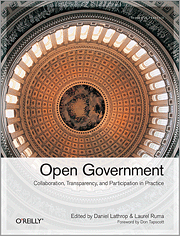
I’m very excited to share I have a chapter in the new O’Reilly Media book Open Government (US Link & CDN Link). I’ve just been told that the book has just come back from the printers and can now be ordered.

Also exciting is that a sample of the book (pictured left) that includes the first 8 chapters can be downloaded as a PDF for free.

The book includes several people and authors I’m excited to be in the company of, including: Tim O’Reilly, Carl Malamud, Ellen Miller, Micah Sifry, Archon Fung and David Weil. My chapter – number 12 – is titled “After the Collapse,” a reference to the Coasean collapse Shirky talks about in Here Comes Everybody. It explores what is beginning to happen (and what is to come) to government and civil services when transaction and coordination costs for doing work dramatically lower. I’ve packed a lot into it, so it is pretty rich with my thinking, and I’m pleased with the result.

If you care about the future of government as well as the radical and amazing possibilities being opened up by new technologies, processes and thinking, then I hope you’ll pick up a copy. I’m not getting paid for it; instead, a majority of the royalties go to the non-profit Global Integrity.

Also, the O’Reilly people are trying to work out a discount for government employees. We all would like the ideas and thinking in this book to go wide and far and around the globe.

Finally, I’d like to give a big thank you to the editors Laurel Ruma and Daniel Lathrop, along with Sarah Schacht of Knowledge as Power, who made it possible for me to contribute.

Today in the Globe: Facebook's Political Reach

I have the following piece published in the Globe and Mail today. It isn’t going to further endear me to Michael Valpy (who is already not impressed with me)… but felt another perspective on the issue was needed. He, like many traditional columnists, is not a fan of social – or digital – media. Indeed, he has argued it is destroying our country’s social cohesion and democracy. Those familiar with me know I feel differently . By allowing us to self-organize, connect to one another and to our politicians, social media is enabling a different and very powerful type kind of social cohesion and democratic expression.

I respect Valpy a lot and hope we get a chance to sit down and talk social media at some point. Given our collective interest in journalism and statements like this, it feels like it would be fruitful for both of us. Hopefully it will happen.

Facebook’s Political Reach

Yesterday, Michael Valpy posted an interesting piece about a Nanos poll showing Canadians – including younger Canadians – question how much influence political Facebook groups should have on any government.

The problem with the piece lies in the headline: “Facebook forums shouldn’t sway government, young Canadians say.” It suggests that online activism – or social media in general – isn’t credible with the public. This, however, isn’t what the poll showed. Indeed, the poll says little about the credibility of Facebook, particularly compared to other forms of political activity. It does, however, say a lot about social media’s dramatic growth in influence over the past five years.

Critically, the poll didn’t compare forms of political activity. If one had done a similar poll asking whether Canadians believe a demonstration should sway the government, or if direct action – such as when Greenpeace hung a banner from Parliament – should alter government policy, would the numbers have been dramatically different? I suspect not. Governments have electoral mandates – something Canadians broadly agree with. Most political activity, both on and offline, is designed to shape public opinion and ultimately, people’s decisions at the ballot box. That is a threat influences government.

Consequently, it may not be the medium that matters as much as the number of people involved. Do people believe the government should pay attention to a 1,000 person rally? Likely not. Should they pay attention to a 10,000 person Facebook group? Likely not as well. But at a certain point, with large enough numbers, almost any medium matters. Would people think that the government should reconsider a policy in the face of 10-million-person petition? Or a five-million-person Facebook group? Possibly. What about a 500,000-person march? Even this might prompt respondents to reconsider their response.

Ultimately, the Globe article jumps to a negative interpretation of Facebook too quickly. This is understandable in that traditional news organizations are still coming to grips with social – and digital – media. But by allowing us to self-organize, connect to one another and to our politicians, social media is enabling a different and very powerful type kind of social cohesion and democratic expression.

More interesting is how split Canadians appear to be over political groups using Facebook “to share ideas, information and to help mobilize their activities” (30 per cent have a positive view, 30 per cent have a negative view and an enormous 40 per cent are undecided). Here is a technology few Canadians knew existed five years ago, and it is already viewed favourably by a third of Canadians as a way to engage with political groups. As people become more familiar with these online activities I suspect comfort levels will rise, since many people often don’t initially understand or like new technologies. This survey shows us online political organizing is moving into the mainstream – perhaps even more mainstream than a protest or a petition.

So should Facebook influence the government? The prorogation debate shows it already can. But do people believe Facebook should be less influential than other (more traditional) forms of political activity? In this, the survey reveals very little. Indeed as Nik Nanos, the pollster who conducted the survey, adds at the end of the piece (and in contrast to the title): “we still haven’t come to grips with what [Facebook groups] really mean.”

Canadian Foreign Policy: The War on Independent Thought

Two stories this week highlight Canada’s rapidly decaying capacity to think, engage and act on foreign policy issues. The first was the Globe’s story Canadian Aid Groups Told to Keep Quiet on Policy Issues, the second is Paul Well’s detailed and devastating account of the implosion of Rights and Democracy, an NGO run by the Federal Government which has seen its entire staff revolt in the face of the political efforts by government to reset its policies.

Both stories hint at a common pattern – that through bullying, funding decisions, appointments and any other means at its disposal – the conservative government is seeking to ensure that any voice in Canada that engages international issues aligns itself with the government’s opinion. In short, this Conservative government is seeking to recentralize Canadian foreign policy. It is an effort that cannot succeed, but in which the attempt will devastate Canada’s influence in the world and negatively impact our capacity to act on the global stage.

Why is this?

Because in the 21st century a country’s foreign policy capacity – especially a small country like Canada – does not spring solely from the size of one’s military and the influence of one’s diplomats. Rather, influence springs from the capacity to tackle and address – increasingly complex – problems. Military might and diplomats can be deeply important but they are increasingly a smaller piece of the puzzle. The real question is, how does a state marshal all the resources and talents at its disposal and focus them on a problem.

In the 19th century the answer was easier. Military might and diplomats were the only tools and so control over these tools – the capacity of a single person (the PM) or group (cabinet) to focus the energy of the state on a problem – was the essence of international influence. But today this is no longer the case. Many of the critical relationships, expertise for addressing problems, volunteering capacity and even funding, lie beyond the control of the state. More importantly, public opinion has become an essential part of any effort. In this world, where the state is only one of many actors, and is one that is frequently looked upon with skepticism, how does one marshal this network or foreign policy ecosystem and attempt to focus it on a problem?

This is the great challenge facing government’s everywhere (especially those of smaller countries where resources outside of government are essential).

The conservative response – outlined above by the Globe and Paul Wells – describes an effort to assert control over these non-state actors and opinion shapers. To bully them into line and force them to not only cooperate with but mimic the government’s priorities.

This strategy will not work.

Over the short term the talent in Canada’s foreign policy network will simply balk. The best will leave for other countries which will seek to engage them on policy, not declare war on independent thought. Today we risk the great “hallowing out” of our foreign policy capacity (and thus international influence) not because the quality of our diplomats or military will decline, but because the quality of our NGO sector will decline.

Moreover, this sector’s international influence depends on independence. Other states and public opinion more generally will not respect Canadian organizations that are seen as merely puppets of the Canadian government. Indeed, expect these types of organizations to see their influence wain to a point where they become insignificant on the international stage. In short, there will be fewer Canadian voices and they will all carry less weight.

Finally however, the ecosystem will adjust. Already many Canadian organizations that work and engage in international issues find it cumbersome to work with Government. People I speak with often eschew CIDA grants since the reporting mechanisms they come with are often more expensive to implement than the value of the grant. Now that Government money is linked with political interference and meddling, an increasing number of organizations will avoid engaging the Canadian government altogether. The result? A NGO sector that is actively hostile – or at best indifferent – to the government and a diminished capacity to coordinate action, research and policy across the Canadian foreign policy ecosystem.  In short, the Canadian government will have no more control over internationally focused resources, but it will have shrunk the country’s collective influence.

In a networked world you can’t control the network, you can only seek to influence it. This government’s actions are a case study in how to lose credibility and sacrifice capacity. If, however, they don’t want a Canada that engages in the world, perhaps, in their mind, it is all worth it.