Tag Archives: open source

5 Ways to get to the Next Million Mozillians

Mark Surman, Executive Director of the Mozilla Foundation has been ruminating on:

how Mozilla can actively encourage large numbers of people to participate on making the web more open and awesome.”

For a long time I’ve been a supporter of the idea that supporters of an Open Web are part of a social movement and that mobilizing these supporters could be a helpful part of a strategy for preserving and promoting the openness of the web. More importantly, I think the rise of open source, and in particular the rise of Mozilla tracks shockingly well against the structure of a social movement.

So if we are interested in increasing interest in the openness of the web and believe that recruiting the next million Mozillians can helps us accomplish that, then I think there are 3 things any strategy must do:

1. Increase the range of stake holders involved (this is part of why I write about women in open source so much) as this gives open web supporters more leverage when negotiating with those who threaten the web’s openness or who influence its development

2. Connect nebulous ideas like “security” and “openness” to tangible experiences people (users?) can relate to and to core values they believe in. (This is why Mark’s “seatbelt moment” narrative is awesome in this regard)

3. Outline actions that stakeholders and supporters can take.

So with the (not always successful) intent to focus on these 3 objectives here are five ideas I think could help us:

Idea 1: Partner with Consumer Reports and help shape the criteria by which they evaluate ISPs

One key to ensuring an open web is ensuring that people’s connection to the web is itself open. ISPs are a critical component in this ecosystem. As some observers have noted, ISPs engage in all sorts of nefarious activities such as bandwidth shaping, throttling, etc… Ensure that the net stays neutral feels like a critical part of ensuring it stays open.

One small way to address this would be make the neutrality of a network part of the evaluation criteria for Consumer Report reviews of ISPs. This would help make the openness of an ISP a competitive, would increase the profile of this problem and would engage a group of people (Consumer Report users) that are probably not generally part of the Mozilla Community.

Idea 2: Invest in an enterprise level support company for Firefox & Thunderbird.

Having a million citizens supporting Firefox and Mozilla is great, but if each of those supporters looks and acts the same then their impact is limited. Successful movements are not just large they are also diverse. This means having a range of stakeholders to help advocate for the open web. One powerful group of stakeholders are large enterprises & governments. They have money, they have clout and they have large user bases. They are also – as far as I can tell – one of the groups that Firefox has had the hardest time achieving market share with.

From my limited experience working with governments, adopting Firefox is difficult. There is no one to sign an SLA with, no dedicated support desk and no assurances problems will be escalated to the right developer within a fixed time period. Many of these challenges are highlighted by Tauvix in the comment section of this post). We could spend our time arguing about whether these issues are legitimate or if those large organizations simply need a culture shift. But such a shift will take a LONG time to materialize, if it ever does.

Finding a way to satisfy the concerns of large organizations – perhaps through a Redhat type model – might be a good way to invest Mozilla Foundation money. Not only could there be a solid return on this investment, but it could bring a number of large powerful companies and governments into the Mozilla camp. These would be important allies in the quest for an open web.

Idea 3: Promote add-ons that increase security, privacy and control in the cloud.

One reason behind Mozilla’s enormous success is that the community has always provided innovative technical solutions to policy/privacy/openness problems. Don’t like they way Microsoft is trying to shape the internet? Here, use a better browser. Don’t want to receive target advertising on website? Here, download this plug-in. Don’t want to see any advertising? Here, download this plug-in. Not sure if a website is safe? Here, use this plug-in. In short, Mozilla has allowed its software to serve as a laboratory to experiment with new and interesting ways to allow users to control their browsing experience.

While not a complete solution, it might be interesting to push the community to explore how Greasemonkey scripts, Jetpack plug-ins, or ordinary plug-ins might provide users with greater control over the cloud. For example, could a plug-in create automatic local backups of google docs on your computer? Could a Thunderbird plugin scan facebook messages and allow users a choice of mediums to respond with (say email). Fostering a “product-line” of cloud specific plug-ins that increase user control over their experience might be an interesting place to start.

Idea 4: Create and brand the idea of an openness audit

As more and more personal data ends up in servers controlled by companies, governments and non-profits there are real concerns around how secure and private this information is. Does anyone know that Google isn’t peeking at your Google docs every once in a while? Do you know if you’ll ever be able to delete your personal information from facebook?

These are legitimate questions. Outlining some guidelines around how companies manage privacy and security and then creating an audit system might be an interesting way to nudge companies towards adopting stronger standards and policies in the cloud. This might also increase public awareness and encourage a upwards spiral among competing service providers. Working with companies like KPMG and Deloitte Mozilla and others could help foster a new type of audit, one that would allow consumers to easily discriminate against cloud service providers that respect their rights, and those that don’t.

Idea 5: Let’s use that Firefox launch screen to create the next million Mozillians

At the moment, when you download and install Firefox the first website you see when you load the program congratulates you on downloading the program, tells you that you are helping keep the internet open and outlines some of Firefox’s new features. We could do more. Why not prompt people to join a “Mozillians” club where they will be kept up to date on threats and opportunities around the open web. Or maybe we should list 3 actions (with hyperlinks) they can take to increase the openness of the web (say, upgrade a friend, send a form letter to their member of congress and read an intro article on internet security?)

With maybe 300+ million people likely to download Firefox 3.5, that’s a lot of people we could be mobilizing to be more active, technically, socially and politically, around an open web.

There’s a start… I’ll keep brainstorming more ideas but in the interim, please feel free to let me know if you think any of these have real problems and/or are bunk.
Remixing Angie Byron to create the next Million Mozillians

As I’ve noted in some previous posts, Angie Byron gave a presentation on getting more women in open source. My feeling is that the systems, culture and tools we put in place to attract more women into open source are the same systems we need to attract lots of new people into open source. Something that would benefit individual open source projects and the open source community in general.

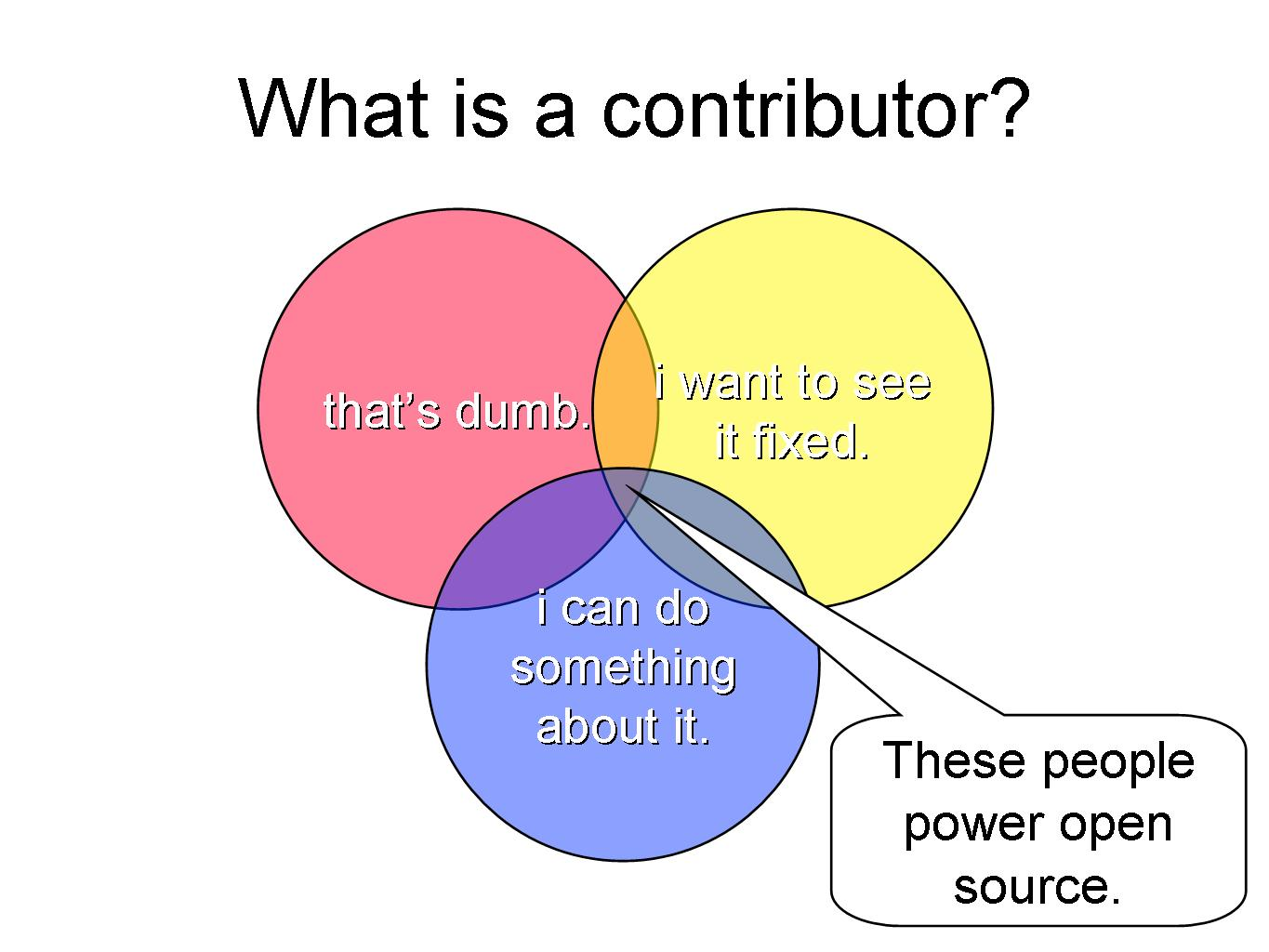
One of the key things Angie talks about is that we often have a specific view of who can participate in open source – something she identifies as a sweet spot of skills and passion:

I suspect that, at the moment, this is broadly true. As a model however, it has limited scale. Not everyone can “do” everything about the problems they care about in an open source project. Worse still, since Open Source participants (rightly) care more about action than talk, those who are interested but insufficiently equipped often get marginalized. This means either a) potential supporters are turned off or away or b) these people become raging uglies who post unhelpful rants and talk about open source projects being “unsupportive” or “unresponsive.” The former is a loss to the projects, the second is a drain.

As I think about Canada25 and some of the work I’ve done helping open source projects manage their community, it isn’t so much that we want to find and more effectively tap into that sweet spot, it’s that we should be trying to figure out how to manage the open source process so we don’t have to exclusively rely on those in the sweet spot.

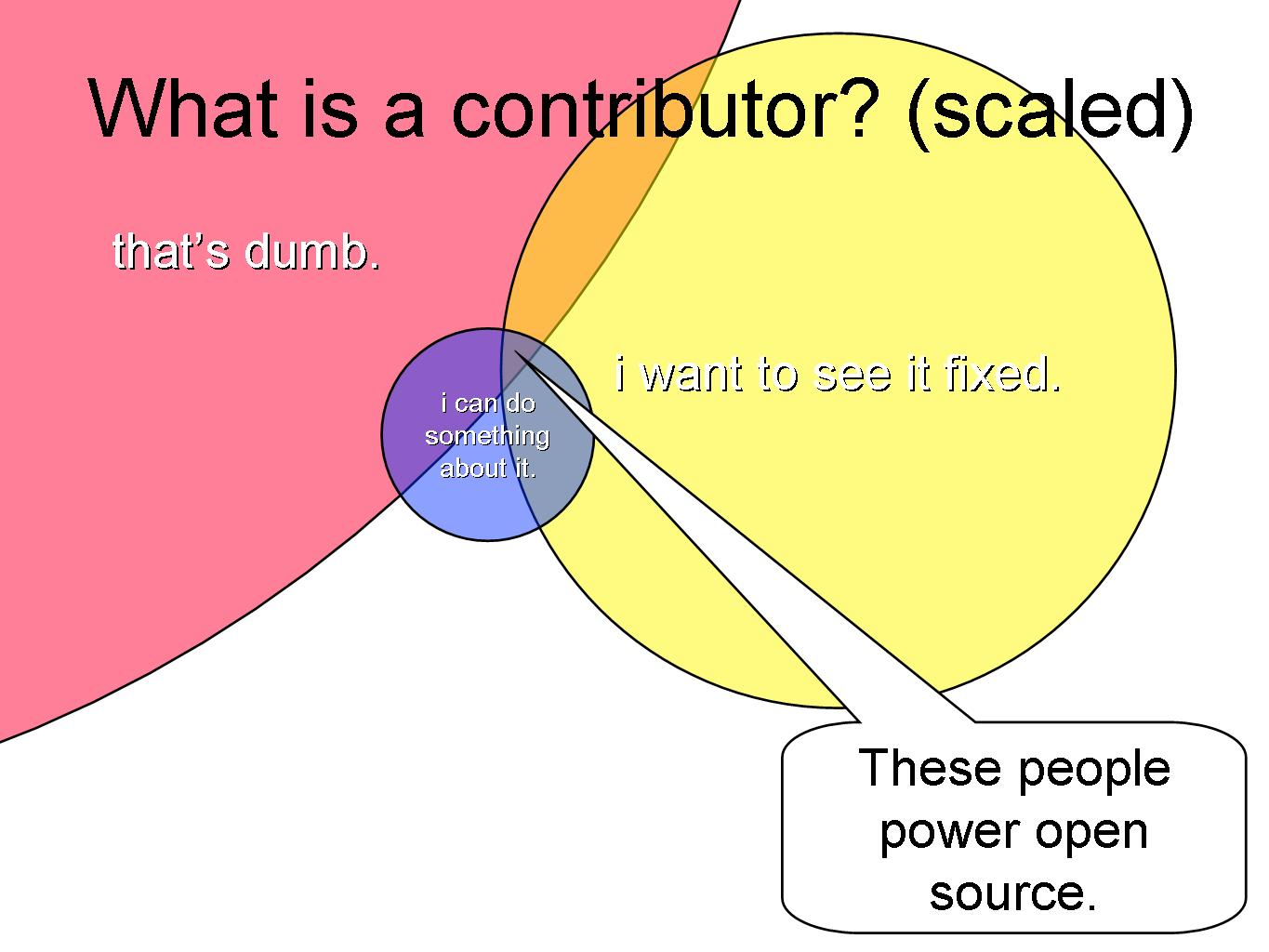
That begins with having a better model of what current contributors look like. To that end I’ve remixed Angie’s slide and tried to make it more to what I think “scale” would look like.

Women in Open Source remixed slide 4The fact is, there are A LOT more people who see of problem/bug/missing feature in open source than those who want to see it fixed or can do something about it. Indeed, for those of us who care about Mozilla, if we want to find the next Million Mozillians, this red group is a good (but not the only) place to start.

The real question is, can we break down problems so rather than relying on (a relatively few) key people we can rely on a process instead? This is, in theory, what tools like Bugzilla are supposed to help us do and what, I suspect, many OS projects spend a lot of time thinking about.

Women in Open Source remixed Slide 5

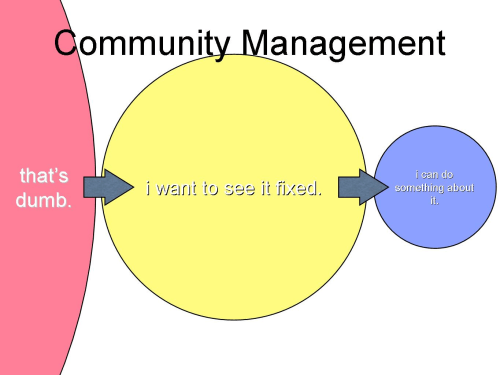
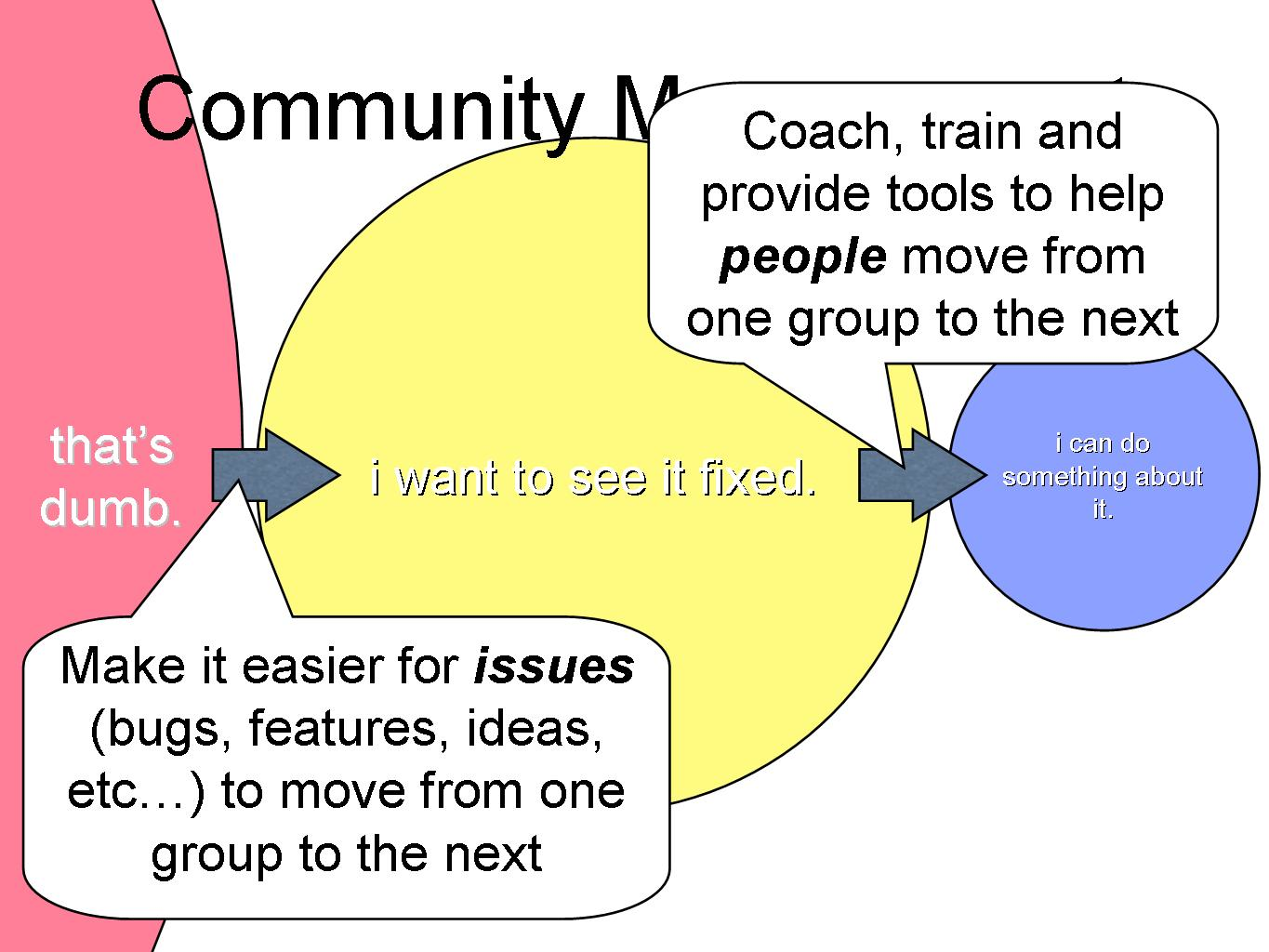
It would be interesting to try to map all the tools that allow us to move ideas and issues from “that’s dumb” to “I want to see it fixed” to “I can do something about it.” How are the people in each phase connected, how can they exchange information and how can they influence one another. More importantly, can we find ways to break the problem down to at least cooperate and possibly even collaborate on these issues.

But the larger issue – and this is where I think it matters to finding the next Million Mozillians, is how do we migrate people up the food chain. How do we shift people from “That’s Dumb” to saying “I want to see it fixed” and from “I want to see it fixed” to “I can do something about it!” This is where I think effective community management has the most to offer – developing a tools, a culture and environment that are encouraging, supportive and still effective and efficient.

Women in Open Source remixed Slide 6

Part of this has to do with finding it easier to accommodate people into a broader set of roles. As Angie Byron (and others) point out, participation isn’t just about coding: It’s about donations, advocacy, documentation, marketing, user support, testing, translations, graphic design, event coordination, bug reports and feature requests, issue queue “farming”, usability, project management, and (among other things) coding. But it is also about nurturing those who have the skills but may sit on the periphery or outside the sweet spot altogether – getting them comfortable with the project, the community and the processes. Often open source projects have a rough and tumble approach to newbies, I’m not sure that this is the best path to growth.

If a given open source community (and I’d argue the open source community writ large) wants to grow, fighting over coders in the sweet spot will be one approach, but its sustainability (and growth) may be more limited. However, figuring out how to task up the other activities so your coders can focus more and more narrowly on just coding may be another, and ultimately more effective route to success. As Angie points out, creating more effective tools is one part of getting there – but it is only one part. Figuring out the culture and soft skills that will get you there is the other.

Articles I'm digesting 24/7/2009

Been a while since I’ve done one of these and I’ve got a lot of great pieces I’ve been reading. So let’s get to it.

Designs on Policy by Allison Arieff (via David B.) and TED Talk: Are we in Control of our own Decisions? by Dan Ariely

I keep hearing about the interaction between policy and design (most flatteringly an architecture professor said I had a designer’s mind” the other day) and so over the past few years I try (with some success) to read as much as I can about design. David B sent me the Arieff piece which, of course, weds my passion for public policy with design. One thing I like is the way the piece doesn’t try to boil the ocean – it doesn’t claim (like in other places) that good design will solve every problem – just that it will help mitigate against it. Most intriguing for me is this line:

“It feels weird to have to defend design’s importance, yet also completely necessary. The United Kingdom has had a policy in place since 1949; Japan since 1956. In countries like Finland, Sweden, South Korea and the Netherlands, design is a no-brainer, reflected by the impeccable elegance, usability and readability of everything in those countries from currency to airport signage.”

A design policy? How civilized. That’s something I could get behind – especially after listening to Dan Ariely’s TED talk which is downright frightening at moments given how susceptible our decisions are (and most disconcerting the decisions of our doctors, dates and who knows whose) to the layout/perception of the choice.

Lost in the Cloud by John Zittrain

A few months ago I was in Ottawa and – surprisingly and unplanned – ended up at a pub with Richard Stallman. I asked him what he thought of Cloud Computing (a term he believes is too vague to be helpful) but was nonetheless viscerally opposed to it. Many of the reasons he cites are covered by Zittrain in this thoughtful piece. The fact is, Cloud Computing (or whatever term you may wish to use) is very convenient and it carries with it huge privacy, security and access challenges. This is potentially the next big challenge for those of us who support and Open Internet – the possibility of the internet being segmented into a series of walled gardens controlled by those who run the cloud servers is real and must be thought through. If you care about public policy and/or are a geek, read this.

Is it Time to Get Rid of the Foreign Service Designation?

Am I reading my own articles? No. I am, however, absorbed by the fascinating and constructive conversation taking place – mostly involving public servants – in the comments section underneath. Here are just some snippets:

  • “For 8 years I worked at DFAIT, observing and participating in the culture within the walls of a building named after a diplomat that Wikipedia states “is generally considered among the most influential Canadians of the 20th century.” Sadly, the elitism (whether earned or not) is only the cause of a bigger problem; lack of desire to collaborate, and almost no desire to change in an era where the only constant is change.”
  • “…as I left the issue of the FS classification was quietly but passionately part of the watercooler discussion. From my perspective, in spite of a nasty AG report on the dismal state of affairs of HR at DFAIT, the department has more pressing problems, such as credibility with central agencies, a coherent sense of mission and talent attraction and retention.”
  • “I am also a bit puzzled by people who saw your piece as an attack on DFAIT – you’re advocating for human resource reform to improve the department, after all. I’m still not sure why you think DFAIT is required though, or why Canadian foreign policy suffers when departments forumulate it without involving DFAIT.”
  • “It’s good to see that even Craig Weichel, President of PAFSO, is open to your suggestion that it might be good to have more foreign service officers circulate through other government departments…”

Putting the Cart Before the Horse by Peter Cowan

A great blog post about the lessons from implementing social media in a government agency. Peter Cowan – an Open Everything alum – is part of the team at Natural Resources Canada team that has been doing amazing work (NRCan is one of the most forward looking ministries in the world in this regard). Peter’s piece focuses on misunderstanding the “business case” for social media and how it often trips up large government bureaucracies. This abbreviated but extended quote on why traditional IT business cases don’t work or aren’t necessary is filled with great thoughts and comments:

“They (Social Media tools) are simple and viral and they cost very little to implement so the traditional requirements for upfront business needs definition to control risk and guide investment are not as important. In fact it would take more time to write a proposal and business case than to just put something out there and see what happens.

More importantly though social media are fundamentally new technologies and the best way to understand their business value is to get them into the hands of the users and have them tell you. To a large degree this is what has happened with the NRCan Wiki. Most of the innovative uses of the wiki came from the employees experimenting. They have not come from a clearly articulated business needs analysis or business case done in advance.

In fact, determining business needs in advance of having a tool in hand may actually lead to status quo approaches and tools. There is the famous Henry Ford… quote goes something like “if I had asked people what they wanted in a car they would have said faster horses”. We social media folks usually deploy this quote to highlight the weakness of focusing too much on responding to people’s perceptions of their existing business needs as a determinant of technology solution since people invariably define their needs in terms of improving the way they are already doing things, not how things could be done in a fundamentally new way.

Genius.

Google’s Microsoft Moment by Anil Dash

A fantastic piece about how Google’s self-perception is causing it to make strategically unsound choices at the same time as its public perception may be radically shifting (from cute fuzzy Gizmo in to mean nasty Stripe). A thoughtful critique and a great read on how the growth and maturation of a company’s culture needs to match its economic growth. I’ve added Anil Dash to by must read blogs – he’s got lots of great content.

Women in Open Source and Florida's Bohemian Index

Just a quick somewhat brief follow up to yesterday’s post on women in open source.

I got lots of great feedback and comments for which I’m grateful and wanted to say one or two things.

First, I recognize the title to the post, particularly the “Canary in a Coal Mine” was far from perfect. The exclusion of women from Open Source is not – as some might read the title – an existential threat to open source. OS communities will not collapse or fail if more women are not included (the broader IT industry seems to continue, for better for worse despite a poor male to female ratio). The point is that growth will, however, be limited. Moreover the success of OS communities  – defined in terms of an active and engaged community, one whose members treat each other well and where differences and disagreements are resolved respectfully and effectively – might also be limited.

Actually I’d go further – Richard Florida found a positive correlation between gay household and regional (especially tech) economic development among cities. This quote is from one of his academic papers on the subject:

Florida and Gates (2001) found a positive association between concentrations of gay households and regional development. This tolerance or open culture premium acts on the demand side by reducing barriers to entry for human capital; increasing the efficiencies of human capital externalities and knowledge spillovers; promoting self-expression and new idea generation; and facilitating entrepreneurial mobilization of resources, thus acting on regional income and real estate prices.

The same hypothesis could could hold true for open source communities with regard to women.  Gay men in America and women in tech are both (sadly still) marginalized groups. As such, women are the canary in the coal mine in that the more women you find in an open source community – the more likely that community is tolerant and open to new ideas and self-expression.  In short, the number of women participants is probably a pretty one good metric of the community’s health.

Second, I think the stats around the post are quite interesting. So far:

Page hits: 600+

Feedburner “reach:” 2379

Tweets: 7 from women, 1 from an aggregator

Comments: 10 comments from 7 people (not including mine). All from women

2 emails: both from men

In short, no men participated publicly the the post. My inclination is not to believe that men in open source don’t see this as an issue (I’m sure some don’t, but I know many do), but I do suspect that many don’t feel like it is safe to talk about. That’s a problem in of itself. (Alternatively, and I accept this as a very real possibility, but my blog may not be popular enough to gain attention – or that people haven’t had a ton of time to respond).

As the author it is important to me that nothing in yesterday’s post lead open source participants to believe (or feel accused of) deliberately excluding women. However, I know that reading it, that accusation can feel like it is (implicitly) there anyway. A key to success in communicating around difficult subjects is to separate impact from intent. Open source communities, and the men who participate within them may not be trying to exclude women or other groups (intent). But that doesn’t mean women aren’t being or shouldn’t feel, excluded (impact). The key is for a community to acknowledge and accept that it can be having an impact without that intent – and the solution is to get really intentional about the skills, tools and culture of the community to change the impact.

It was important to me that yesterday’s post resonate with the women who read it AND that men involved in open source read the post without feeling accused of being sexist or part of a sexist community. The goal is to generate discussion on how we can change the impact since, given most of the people I know in OS, the intent is already there.

Women in Open Source – the canary in the coal mine

The other month I had the pleasure watching Angie Byron give the keynote lecture at Open Web Vancouver on Women in Open Source. The synopsis from Open Web Vancouver:

The open source world is rich with opportunities: Working with people of all cultures from all over the world; Collaborating with some of the biggest and brightest minds on the ultimate solutions to complicated problems; Changing the world by providing free tools for organizations such as non-profits, educational institutions, and governments; Building up marketable skills and practical knowledge.

But yet, so many women are missing out. Why is that? And what can we do to change it? This talk will endeavour to answer these questions, as well as provide tips and strategies for women who want to dip their toe into the waters.

I wish I could embed the video on my blog but alas, it is not possible, so I encourage you to wander over to Angie’s blog and watch the video there.

The important lesson about Angie’s talk is that it isn’t just about women. The power and capacity of an open source community is determined by the quantity and quality of its social capital. If a community fails to invest in either – if it turns off or away qualified people because its culture (however unintentionally) discriminates against a gender, race or group – then it limits its growth and potential. The same is true of a community culture that doesn’t allow certain groups to improve their social capital. These may seem like large, intangible questions, but they are not. I’m sure every open source community turns some people off. Sometimes the reasons are good – the fit might not be right. But sometimes, I’m certain the reasons are not good. And the community may never get the feedback it needs because the moderate, productive person who walks away doesn’t create a scene, they may just quietly disappear (or worse they never showed up to begin with).

So Angie matters not just because women are missing out (although this is true, important and urgent). Angie’s talk matters because women are just the canary in the coal mine. Millions of people are missing out – people with ideas and the ability to make contributions get turned away because of a bad experience, because a community’s culture is off putting, too aggressive, not welcoming or not supportive.

For me its opened up a whole new way of thinking about my writing on open source communities. After Angie’s talk I sought her out as I felt we’d been talking about the same things. I’m interested in developing norms, skills and tools within an open source community that allows more people to participate and collaborate more effective, in short how do we think about community management. Angie is talking about developing open source communities that support and engage women. Working towards solving one helps us solve the other. So if you wake up today and notice there are no (other) women on the IRC channel with you… maybe we should both individually and collectively as a community engage in a little introspection and think about what we could change. Doing so won’t only make the community more inclusive, it will make it more productive and effective as well.

Open Data at the City of Vancouver – An Update 16/7/2009

matrix

For those interested in the progress around the Open Motion (or Open3 as city staff have started to call it) I’ve a little update.

Last week during a visit to city hall to talk about the motion I was shown a preview of the website the city has created to distribute and share data sets. For those unsure what such a website would look like, the baseline and example I’m measuring the city against is, of course, the Washington DC website. At the moment the city’s prospective website looks more like the (also impressive) beta site the City of Nanaimo set up after ChangeCamp – a little simpler and with a lot fewer data sets, but it is the first step.

As an aside kudos to the City of Nanaimo team which has been pushing open data and especially geo-data for quite some time as this must read Time magazine piece (yes, a must read Time magazine piece) will attest.

Anyway… back to Vancouver. The fact that the city has a beta website with a (very) modest amount of data ready to launch is a testament to the hard work and effort of the City’s IT staff. Rarely in my work with government’s have I seen something move so quickly and so needless to say… I’m quite excited. At the moment, I don’t know when the beta data site will go live – there are still a few remaining issues being worked on – but as soon as it launches I will be writing a blog post.

In the interim, big kudos should also go to the City’s Archives who posted a number of videos from the archives online and created it’s own YouTube Channel. They received so much traffic over the videos that the servers almost ground to a halt. Awesome, I say. It just goes to show how much interest there is out there.

Also exciting is that my post on how open data makes garbage collection sexy has inspired two local hackers (Luke and Kevin) to scrape the city’s garbage calendar and hand created digital versions of the city’s garbage maps to create the app I spec’ed out in the blog post. (I’ll have more on that, including links, in a few weeks) Luke also suggested I start recording other app ideas that come to me so over at the Vancouver Data Google group which was created on the fly by local coders in the audience during my and Andrea’s presentation at Open Web Vancouver. I’ve asked people to share their ideas for applications (mobile or desktop) that they’d like to see created with open data.

Sooooo… if there is an app you’d like to see created please post it to the google group or send me an email or write it in the comments below. No guarantees that it will be created but I’m hoping to help organize some hack-a-thons (or as my city friends prefer… code sprints). Having some ideas for people to sink their teeth into is always helpful.

How to predict the "Fixability" of a Bugzilla Submission

bugzilla iconMy friend Diederik van Liere has written a very, very cool jet-pack add-on that calculates the probability a bug report will result in a fixed bug.

The skinny on it is that Diederik’s app bases its prediction on the bug reporter’s experience, their past success rate, the presence of a stack trace and whether the bug reporter is a Mozilla affiliate. These variables appear to be strong and positive predictors of whether a bug will be fixed. The add-on can be downloaded here and its underlying methodology is explained in this blog post.

One way the add-on could be helpful is that it would enable the mozilla community to focus its resources on the most promising bug reports. Volunteer coders with limited time who want to show up and and take ownership over a specific bug would probably find this add-on handy as it would help them spend their precious volunteer time on bugs that are likely well thought through, documented effectively and submitted by someone who will be accessible and able to provide them with input if necessary.

The danger of course, is that a tool like this might further enhance (what I imagine is) a power-law like distribution of bug submitters. The add-on would allow those who are already the most effective bug submitters to get still more attention while first time submitters or those who are still learning may not receive as much sufficient attention (coaching, feedback, support) to improve. Indeed, one powerful way the tool might be used (and which I’m about to talk to Diederik about) is to determine if there are classes of bug submitters who are least likely to be successful. If we can find some common traits among them it might be possible to identify ways to better support them and/or enable them to contribute to the community more effectively. Suddenly a group of people who have expressed interest but have been inadvertently marginalized (not on purpose) could be brought more effectively into the community. Such a group might be the lowest hanging fruit in finding the next million mozillians.

Structurelessness, feminism and open: what open advocates can learn from second wave feminists

Just finished reading feminist activist Jo Freeman’s article, written in 1970, called The Tyranny of Structurelessness. She argues there is no such thing as a structureless group, and that structurelessness tends to be invoked to cover up or obscure — and cannot eliminate — the role, nature, ownership and use of power within a group.

The article is worth reading, especially for advocates of open (open-source and openspace/unconference). Occasionally I hear advocates of open source — and more frequently hear organizers of unconferences/openspaces — argue that because of the open, unstructured nature of the process, they are more democratic than alternatives. Freeman’s article is worth reading as it serves as a useful critique of the limits of open as well as a reminder that open groups, organizations and processes are neither structureless, nor inherently democratic. Claiming either is at best problematic; at worst it places the sustainability of the organization or effort in jeopardy. Moreover, recognizing this reality doesn’t make being open less powerful or useful, but it does allow us to think critically and have honest conversations about to what structures we do want and how we should manage power.

It’s worth recognizing that Freeman wrote this article because she did want feminist organizations to be more democratic (whereas I do not believe open source or unconferences need to be democratic), but this does not make her observations less salient. For example, Freeman’s article opens with an attack on the very notion of structurelessness:

“…to strive for a ‘structureless’ group is as useful and as deceptive, as to aim at an ‘objective’ news story, ‘value-free’ social science or a ‘free’ economy. A ‘laissez-faire’ group is about as realistic as a ‘laissez-faire’ society; the idea becomes a smokescreen for the strong or the lucky to establish unquestioned hegemony over others. This hegemony can easily be established because the idea of ‘structurelessness’ does not prevent the formation of informal structures, but only formal ones.”

This is an important recognition of fact, one that challenges the perspective held by many “open” advocates. In many respects, unconferences and some open source projects are reactions to the challenges and limitations of structure — a move away from top-heavy governance that limits creativity, stifles action and slows the flow of information. I have personally (and on many occasions) been frustrated by the effect that the structure of government bureaucracies can have on new ideas. I have seen how, despite a clear path for how to move an idea to action, the process nonetheless ends up snuffing the idea out before it can be acted upon — or deforms it to the point of uselessness.

But I have also experienced the inverse. I’ve personally experienced the struggle of trying to engage/penetrate an open source community. Who I should talk to, how to present my ideas, where to present them — all often have rules (of which, within Mozilla, I was usually informed by friends on the inside — while occasionally I discovered the rules awkwardly, after grossly violating them). Most open source communities I know of — such as Mozilla or Canada25 —  never claimed (thankfully) to be democratic, but there is an important lesson here. Recognizing the dangers of too much (or rather the wrong) structure is important. But that should not blind us to the other risk — the danger outlined above by Freeman for feminists in 1970: that in our zeal to avoid bad structure, we open advocates begin to pretend that there is no structure, or no need for structure. This is simply never the case. No matter what, a group structure exists, be it informally or formally. The question is rather how we can design a flexible structure that meets our needs and enables those whom we want to participate, to participate easily.

The danger is real. I’ve been to unconferences where there are those who have felt like insiders and others who have known they were outsiders. The same risk – I imagine – exists for open source projects. This isn’t a problem in and of itself – unless those who become insiders start to be  chosen not solely on account of their competence or contribution, but because of their similarities, shared interests, or affableness to the current set of insiders. Indeed, in this regard Freeman talks very intelligently about “elites”:

“Elites are not conspiracies. Seldom does a small group of people get together and try to take over a larger group for its own ends. Elites are nothing more and nothing less than a group of friends who also happen to participate in the same political activities. They would probably maintain their friendship whether or not they were involved in political activities; they would probably be involved in political activities whether or not they maintained their friendships. It is the coincidence of these two phenomena which creates elites in any groups and makes them so difficult to break.”

This is something I have witnessed both within an open source community and at an unconference. And this is not bad per se. One wants the organizers and contributors in open projects to align themselves with the values of the project. At the same time, however, it becomes easy for us to create proxies for shared values — for example, older people don’t get unconferences so we don’t ask them, or gloss over their offers  to help organize. Those who disagree with us becomes labelled trolls. Those who disagree sharply (and ineffectively) are labelled crazy, evil or stupid (or assumed to be suffering from asperger’s syndrom). The challenge here is twofold. First, we need to recognize that while we all strive to be meritocratic when engaging and involving people we are often predisposed to those who act, talk and think like us. For those interested in participation (or, for example, finding the next million mozillians) this is of real interest. If an open source community or an unconference does want to grow (and I’m not saying this should always be a goal), it will probably have to grow beyond its current contributor base. This likely means letting in people who are like those already participating.

The second challenge isn’t to make open source communities more democratic (as Freeman wished for the feminist movement) but to ensure that we recognize that there is power, we acknowledge which individuals hold it, and we make clear how they are held accountable and how that power is transitioned.  This can even be by dictate — but my sense is that whatever the structure, it needs to be widely understood by those involved so they can choose, at a minimum, to opt out (or fork) if they do not agree. As Freeman notes, acting like there is no power, no elite or no structure does not abolish power. “All it does is abdicate the right to demand that those who do exercise power and influence be responsible for it.”

In this regard a few thoughts about structure come to mind:

  1. Clarity around what creates power and influence. Too often participants may not know what allows one to have influence in an open setting. Be clear. If, in an open source community, code is king, state it. And then re-state it. If, in an unconference, having a baseline of knowledge on the conference subject is required, state it. Make it as clear as possible to participants what is valued and never pretend otherwise.
  2. Be clear on who holds what authority, why, and how they are accountable. Again, authority does not have to be derived democratically, but it should be as transparent as possible. “The bargain” about how a group is being governed should be as clear to new contributors and participants as possible so that they know what they are signing for. If that structure is not open to change except by an elite, be honest about it.
  3. Consider encoding ideas 1 and 2 into a social contract that makes “the bargain” completely clear. Knowing how to behave is itself not unimportant. One problem with the “code is king” slogan is that it says nothing about behaviour. By this metric a complete jerk who contributes great code (but possibly turns dozens if not hundreds of other coders off of the project) could become more valued then a less effective contributor who helps new coders become more effective contributors. Codifying and enforcing a minimum rule-set allows a common space to exist.
  4. Facilitate an exit. One of the great things about unconferences and open source is the ability to vote with one’s feet and/or fork. This means those who disagree with the elite (or just the group in general) can create an alternative structure or strike up a new conversation. But ensure that the possibility for this alternative actually exists. I’ve been to unconferences where there was not enough space to create a new conversation – and so dominating conveners tortured the participants with what interested them, not the group. And while many open source projects can be forked, practically doing so is sometimes difficult. But forking – either an open source project or a conference conversation – is an important safety valve on a project. It empowers participants by forcing elites to constantly ensure that community members (and not just the elites) are engaged or risk losing them. I suspect that it is often those who are most committed (a good thing) but feel they do not have another choice (a bad thing) who come to act like resentful trolls, disrupting the community’s work.

Again, to be clear, I’m using Freeman’s piece to highlight that even in “open” systems there are structures and power that needs to be managed. I’m not arguing for unconferences or open source communities to be democratic or given greater structure or governance. I believe in open, transparency and in lightest structures possible for a task. But I also believe that, as advocates of open, we must constantly be testing ourselves and our assumptions, as well as acknowledging and debating practises and ideas that can help us be more effective.

Open Source Journalism at the Guardian

crowd sourcedA few months ago I wrote a piece called the Death of Journalism which talked about how – even if they find a new revenue model – newspapers are in trouble because they are fundamentally opaque institutions. This built on a piece Taylor Owen wrote called Missing the Link about why newspapers don’t understand (or effectively use) the internet.

Today Nicolas T.  sent me this great link that puts some of the ideas found in both pieces into practice. Apparently, in the wake of the MP expense scandal in the United Kingdom, the Guardian has obtained 700,000 documents of MPs’ expenses to identify individual claims. Most MPs probably imagined they can hide their expenses in the sea of data, for what newspaper could devote the resources to searching through them all?

No newspaper could, if by “newspaper” you mean only its staff and not its community of readers. The Guardian, interestingly, has taken on this larger community definition and has crowd sourced the problem by asking its readers to download and read one or a few documents and report back any relevant information.

What makes this exciting is it is one example of how – by being transparent and leveraging the interest and wisdom of their readership – newspapers and media outlets can do better, more indepth, cheaper and more effective journalism. Think of it. First, what was once an impossible journalist endeavor is now possible. Second, a level of accountability previously unimaginable has been created. And third, a constituency of traditional (and possibly new) Guardian readers has been engaged – likely increasing their loyalty.

Indeed, in effect the Guardian has deputizing its readers to be micro-journalists. This is the best example to date of a traditional (or mainstream) media institution warming (or even embracing) at least a limited concept of “the citizen journalists.” I suspect that as institutions find ways to leverage readers and citizen journalists and that the lines between journalist and reader will increasingly blur. Actually it will have to.

Why is that?

Because for the Guardian model to work, they had to strike an agreement (a bargain – as Clay Shirky calls it) with their community. I don’t think anyone would have been satisfied to do this work and then simply hand it back to the Guardian without the right to access their work, or the work of other micro-journalists. Indeed, following the open source model, the guardian has posted the results for every document read and analyzed. This means that the “raw data” and analysis is available to anyone. Anyone of these micro-journalists can now, in turn, read the assemblage of document reviews and write their own story about the MPs expenses. Indeed, I’m willing to wager the some of the most interesting stories about these 700,000 pages will not be written by staff of The Guardian but by other parties assessing the raw data.

So what does that make the Guardian? Is it a repository, a community coordinator, an editorial service…? And what does it make those who write those stories who aren’t employed by the Guardian? Caring about, or getting caught up in these terms and definitions is interesting, but ultimately, it doesn’t matter. The fact is that journalism is being reinvented and this is one compelling model of why the new model can tackle problems the old one couldn’t even contemplate.

Will Firefox’s JetPack let us soar too high?

Recently Mozilla introduced Jetpack, a Firefox add-on that makes it possible to post-process webpages within the web browser. For the non-techies out there, this means that one can now create small software programs that, if installed, can alter a webpages content by changing, adding or removing parts of it before it is displayed on your computer screen.

For the more technically minded, this post-processing of web pages is made possible because JetPack plugins have access to the Document Object Model (DOM). Since the DOM describes the structure and content of a web page, the software can manipulate the webpage’s content after the page is received from the web server but before it is displayed to the user. As a result static web pages, even the ones you do not control, can become dynamic mashups.

This may seem insignificant but it has dramatic implications. For example, imagine a JetPack plugin that overlays a website – say of BarrackObama.com or FoxNews.com – that causes text bubbles that counterspin a story when your mouse hovers over it. The next republican nominee could encourage supporters to download such a hypothetical plugin and then direct their supporters to Obama’s website where each story could be re-spun and links to donating money to the republican campaign could be proffered. They would, in short, dynamically use Obama’s webpage and content as a way to generate money and support. TPM could create a similar Jetpack plugin for the FoxNews website which would do something similar to the title and body text of articles that were false or misleading.

Such plugins would have a dramatic impact on the web experience. First, they would lower costs for staying informed. Being informed would cease to be a matter of spending time searching for alternative sources, but a matter of installing the appropriate JetPack plugin. Second, every site would now be “hijackable” in that, with the right plugin a community could evolve that would alter its content without the permission of the site owner/author. On the flip side, it could also provide site owners with powerful community engagement tools: think open source editing of newspapers, open source editing of magazines, open source editing of television channels.

The ultimate conclusion however is that JetPack continues to tilt power away from the website creators to viewers. Webpage owners will have still less control over how their websites get viewed, used and understood. Effectively anyone who can persuade people to download their JetPack plugin can reappropriate a website – be it BarrackObama.com, FoxNews.com, eBay, or even little old eaves.ca – for their own purposes without the permission of the website owner. How the web eco-system and website developers in particular react to this loss of control will be interesting. Such speculation is difficult. Perhaps there will be no reaction. But one threat is that certain websites place content within proprietary systems like Flash where it would be more difficult for JetPack to alter their contents. More difficult to imagine, but worth discussion, is that some sites might simply not permit Firefox browsers to view their site.

In the interim three obstacles need to be overcome before JetPack realizes its full potential. Currently, only a relatively small community of technically minded people can develop JetPack add-ons. However, once Jetpack becomes an integral part of the Firefox browser this community will grow. Second, at present installing a JetPack plugin triggers a stern security warning that will likely scare many casual users away. Mozilla has hinted at developing a trusted friends system to help users determining whether a plug-in is safe. Such trust systems will probably be necessary to make JetPack a mainstream technology. If such a community can be built, and a system for sorting out trusted and untrustworthy plugins can be developed, then Jetpack might redefine our web experience.

We are in for some interesting times with the launch of Firefox 3.5 and new technologies like JetPack around the corner!

Jetpack is available at jetpack.mozillalabs.com

Diederik van Liere helped write this post and likes to think the world is one big network.