Tag Archives: public policy

It was never about privacy…

So it is becoming increasingly clear that the census decision was never about concern over Canadians privacy, it was about dismantling the state’s capacity to engaged in reasoned, evidence-based public policy.

It is also interesting to see the government trot out new faces to give the same old flawed defence. Flaherty is now running around saying that Canadians will fill in voluntary census for ‘the good of the country.’ Of course, we already know what happens when you make the census voluntary. People don’t fill it out. The Americans tried it and it failed miserably. Of course, maybe Canadians are radically more patriotic than Americans. But given Flaherty’s new found confidence in Canadian patriotism, why assign fines to anything? I mean let’s not chase people down who refuse to pay taxes. Under the new Flaherty plan we can rely on us all doing the right thing out of love for our country.

I shudder to think that this man is our Finance minister. Clearly he doesn’t let facts and lessons interfere with his decision making. It all reminds me of a senior Bush official quote: “When we act, we create our own reality.” It’s a whole lot easier to delude yourself of that, when your get rid of the pesky facts that might show your “reality” is just an illusion. Sigh. Welcome to Libertarian fantasy land.

The good news is that more organizations are beginning to voice their discomfort. Some are even turning to social media. The Canadian Jewish Congress released a YouTube video explaining their opposition.

Better still, Canadians aren’t fools. A growing number or ordinary citizens are showing their disapproval. I think the Globe may be reaching in referring to this poll of senior citizens – but it does suggest that there are some upset people, even among the conservative’s traditional base. It will be interesting to see what happens around polling data over the coming weeks and especially into the fall as more and more Canadians find out about this issue.

What Munir's Resignation means to Public Servants

This came to me from an anonymous email address, but the author claims to be a public servant. No inside gossip or revelation here, but a serious question about how the public service will react to a critical moment.

The independence of Canada’s public service has been a key part of our governing system. It has its advantages and its drawbacks (discussed in some detail most recently by John Ibbitson in Open and Shut) but it has been important. Munir’s resignation reaffirms this system, how his boss and colleagues react will say a lot about whether other public servants feel the value of independence is still core to the public service.

Read on – it’s thoughtful:

Defining moments. For some individuals these are easy to identify, like when a promising young athlete suffers a career-limiting injury.  For others, such moments come later in life, but are no less real or significant.

The resignation of Munir Sheikh from his position as Chief Statistician of Canada is clearly a defining moment for him personally.  He ends a full career in the Public Service on a point of principle.  This principled stance, necessary in his view to protect the integrity of his organization, has brought pride to many public servants, including this author.

But this act may not only be defining for Mr. Sheikh; it also has the potential to impact on the broader public service.  The Public Service mantra is fearless advice and loyal implementation and we tend to be very good at this.  However, it has always been recognized that this only goes so far.  There are limits to loyal implementation.  Clear examples are when a government attempts to unduly benefit either themselves or their friends through government funds.

Deputy ministers (the position of Chief Statistician is one) are often faced with limit-pushing situations, their ability to manage the delicate political-Public Service relationship is key to their success (and survival) as senior public servants.  When these limits are in danger of being exceeded, the deputy minister can rely on delay to allow time to change the ministers’ mind, and/or intervention from the Prime Minister, via the Privy Council Office.  When these fail, the deputy can either acquiesce (partially or fully) or resign.  This is the theory.  However, in practice I cannot recall the last time a deputy resigned on a point of principle (leaving aside the potential reasons for the former Clerk, Kevin Lynch’s retirement).

Mr. Sheikh has attempted to set a new standard – disregarding the advice of a department is fine – publicly undermining the integrity of that advice is not.  It remains to be seen whether this standard will stick or whether it will in future be seen as a high-water mark for deputy integrity that will never be seen again.

The public and private reactions of the Clerk of the Privy Council will have a significant impact on how others view this resignation.  He is the Prime Minister’s deputy minister, who sets the tone and expectation for all other deputies.  He is also the Head of the Public Service, and helps set the tone for all public servants.  What, if anything, will he say about this issue, to the Prime Minister, deputies and ordinary public servants?  How should we comport ourselves when faced with such issues?

Wayne Wouters, this is your opportunity.  Tell us what you think, this can be your defining moment too.

The dangers of narrow cast politics

I am going to very substantially scale back my writing about this issue. I have reached the point where I am wasting my breath. My consolation is that many tens of thousands of Canadians now see this charade for what it is; that this has turned into a very, very bad day at the office for all concerned, including a few strategic geniuses who thought they could narrow-cast their way to electoral gain while the rest of the country missed this story; and that I have managed to shine a bit of a light on some of the most squalid behaviour I have ever witnessed in 20 years as a reporter.

The census?

Wrong.

This was written back on February 24th, 2010 in a fantastic post by Paul Wells about… the Rights & Democracy scandal. Today, the audit promised by the government on that organization has missed three deadlines and is still not been delivered. Today the organization remains in shambles: demoralized, frustrated and tarnished.

This, I fear, could be the fate of Statistics Canada. With the census (and a number of other survey) “a few strategic geniuses” thought that in the dead of summer, on the friday of a long weekend, they could kill something that has become core to legislation and decision making for every level of government, businesses, NGO’s, researchers and ordinary Canadians.

Today we know differently. With a Deputy Minister resigned, the media sniffing blood, the country up in arms and every major newspaper running damning editorials the only difference between the census scandal and the rights and democracy scandal is the size and scope of the impact.

Someone needs to tell the PMO that narrow-cast politics is dead. At least for this government There have simply been too many mistakes and the intelligence of too many Canadians has been insulted too many times to get away with it.

I hope that message gets through. I don’t know how many more times this government intends to narrow-cast a policy to try to pick up a few points with a vested interest group but I do know that we are running out of institutions we can’t afford to have destroyed.

Too… much… irony… must… share…

Okay I’m dying. So many ironic twists to share with people.

Ironic moment 1:

I think this picture says it all…

Ironic moment 2:

So last week I briefly felt what it must be like to be a writer on the Daily Show after showing that at the same time Vancouver Province Editorial Page Editor Gordon Clark was attacking me and those who opposed the decision on the long form census in his column he was simultaneously bragging about his paper’s readership using data that depends on the long form census. Yes, it really was the fun.

Sadly. It gets better. Today, a mere eight days later after his anti-census piece, Clark has a new column about rising teenage happiness levels (this is, of course, a bad thing). But the kicker? Apparently Clark hates StatsCan’s invasive survey’s up until he needs them to write a story. It’s about a statscan survey.

Ironic moment 3:

It looks like Maxime Berner’s has taken over talking about the census for the Government. He’s penned a piece in the Western Standard in which he argues there was significant public support for the change:

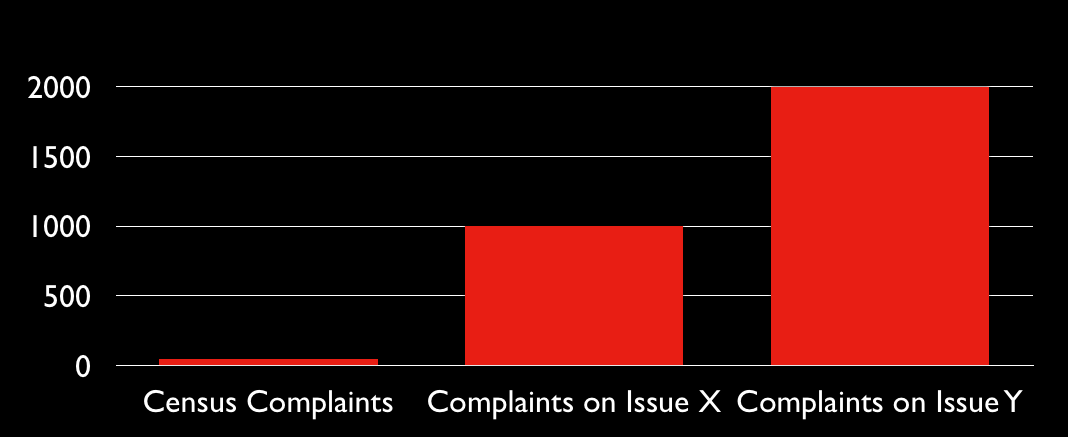
Most people don’t want to be called or be visited at home by a census bureaucrat pressuring them to answer the questions and threatening them with sanctions. They understandably do not want trouble with the government and when they get such threats, they simply comply. Few will officially complain to the government, although when I was Industry minister in 2006 during the previous census, several thousand email messages of complaint were sent to my MP office. (Some people have asked me to show proof of this. It was evidently part of an organized campaign, as my Parliament colleagues and I sometimes receive vast numbers of messages on controversial issues. They are one way among others to gauge the level of public support or opposition to a decision. These messages were obviously not filed for future use by my staff and were deleted.)

Okay, so just to understand. There was a huge protest. But you didn’t do anything about. Didn’t mention it. Didn’t ensure that it make it into the 2006 Census Review. Didn’t even raise the issue in Parliament.

But despite this we should believe and it would all be obvious to us if only you had all those letters still. In short, if only you had… the data. But you stopped collecting and saving it. Just like you want to do with… the census.

Sigh.

Ironic moment 4:

And on CBC radio on Saturday, while explaining why the mandatory long-form agricultural census was not scrapped, Minister Clement said the agricultural census is used for valuable measures “that will help farmers” and “The argument obviously to farming associations and to farmers is, ‘You fill out the form, it’ll help the government help you in your farming activities.'”

Isn’t that the same argument for why the census is important for non-farming activities? Like say planning where to build highways, hospitals, offer new services and pretty much everything government does?

The only difference between farmers and ordinary Canadians is that farmers know how valuable and important the census is. Most Canadians often don’t realize how pervasive census information is in decision-making.

There is of course, another interpretation. Maxime Bernier says the government won’t bend on the census decision to special interest groups like The Government of Quebec, The United Way, the Canadian Medical Association, the Toronto Board of Trade, the Canadian Jewish Congress, the Canadian Association of University Teachers (and many, many others), but maybe they are willing to bend to the Farmer’s lobby?

At some point I think we’ll wake up from this collective nightmare of poor decision making and worse arguments. At least some of the country’s most prominent thinkers are trying to do something.

The evolving tall tales of Minister Clement

It’s been fascinating watching the Industry Minister’s evolving fables around the decision to scrap the long-form census. Since the debate is now coming on three weeks I thought I might be fun to give it a little perspective to show how the Minister has been misleading, and in cases outright lying, to defend his case.

Tale 1: This decision has no implications

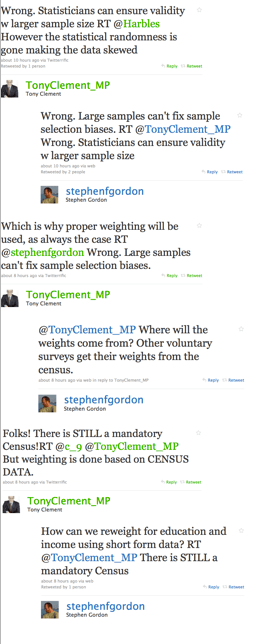
This was the first, and my favourite tall tale. People forget but at the very beginning of this debate the minister claimed the change would have no impact on the effectiveness of the census. In an online discussion with concerned Canadians who pointed out that the data from a voluntary long form census would be rendered useless because of selection bias, the Minister responded: “Wrong. Statisticians can ensure validity w larger sample size.” Of course, any first year undergrad student will tell you, this is not the case. Fortunately, Stephen Gordon a professor at the Laval University was on hand to set the record straight. (see debate to the right).

So the first story… this isn’t a big deal, the government has a way of working around this issue, please move on, nothing to see here… once debunked, tall tale number 2 kicked into gear.

Tale 2: Okay, it does have implications, but the cost is worth bearing because ordinary Canadians demanded it

Once the implications of the decision became obvious the government changed gear. Rather than argue that this had no implications they shifted to claiming the decision was about privacy and that Canadians had been demanding the change. Sadly, no one has been able to produce any records suggesting this is the case. Opposition MPs can’t find any complaints. The Privacy Commissioner has had 3 in the last decade and the number has been declining over time. Statistic Canada’s review of previous census generated no such feedback from the public. The concern has never even been mentioned in parliament by any Conservative MPs.

As a special bonus, Minister Clement has been nicely misleading the public claiming he’s received dozens and dozens of complaints since making the announcement (note, not before). But, of course, if we are taking score since the announcement, there are now at least 80 “radical extremists” organizations like the Government of Quebec, The Canadian Jewish Congress, The Evangelical Fellowship of Canada, The Toronto Board of Trade and the Canada West Foundation along with a petition of 7500 Canadians who oppose the Minister’s decision.

So Canadians have not been demanding this change…

Tale 3: Fine, StatsCan told us to do it

Once it was revealed that this was a bad idea, there is virtually universal opposition to it and that Canadians did not demand it, the strategy again shifted gears. Now there is a new tall tale: Minister Clement has been claiming “StatsCan gave me three options, each of which they thought would work. I chose one of those options, with their recommendation.” Relief! This was never the Minister idea. It was StatCan’s idea and the public’s concern and outrage shouldn’t be directed at the minister, but has the ministry. So wouldn’t it be great if they could defend the decision? Maybe make a statement explaining why the recommended it? Sadly, Minister Clement won’t let them.

However, some excellent reporting by Heather Scoffield of The Canadian Press reveals that actually Statistics Canada did not suggest this change. As she reports:

But multiple sources are telling The Canadian Press that is not exactly what happened. The sources say Statistics Canada made no recommendations and only came up with policy options because they were asked to do so by Clement.

And they say the data gathering federal agency did not specifically recommend going the voluntary route.

Rather, they suggested that either the status quo or the complete eradication of the long list of questions would be the better way to go, several sources said.

The option chosen by the federal cabinet was not at the top of the list of options, the sources said. Instead, StatsCan told ministers if they insisted on going that route, they would have to spend more money and dramatically increase the size of the survey in an attempt to get accurate results.

“It wasn’t recommended,” one source said bluntly.

Okay, so StatsCan isn’t excited about this idea and certainly didn’t recommend it. Indeed they recommended either the status quo or getting rid of it altogether. And that only after they were asked to address an issue that, well, wasn’t an issue in the eyes of Canadians.

My bold prediction on the next tall tale 4: Behold – the mass of Canadians who opposed (something about) the long form census

Having had the previous three tales exposed the government must find a new tact. My suspicion is that they will return to tall tale #2 but with a new twist. This was hinted at over the weekend by Maxime Bernier, who claims that as Industry Minister during the 2006 census, he:

“received an average of 1,000 e-mails a day during the census to my MP office complaining about all that, so I know that Canadians who were obliged to answer that long-form census — very intrusive in their personal lives — I know they were upset.”

Of course there is no record of this, and as Professor Stephen Gordon aptly notes, if this was the case why didn’t the Minister ensure that these concerns were reflected in the review of the 2006 census? It would seem that either there were not the quantity of complains Mr. Bernier claims or, as Minister, he didn’t take them seriously. I for one, believe there were a number of complaints (although not thousands). And that the Conservatives will even attempt to produce them in the hopes reporters will not read them and move on.

But here is the nature of this next tale. These complaints weren’t about the intrusiveness of Government, they were about the use of an American defense contractor, Lockheed Martin, providing the computer systems used to conduct the census to Statistics Canada. Most didn’t understand why jobs were being shipped to America. An even small number of this group was concerned privacy, but not from their Government, from an American defense contractor. So if you are a reporter and the Conservatives claim there were privacy complaints, be sure to dig a little deeper. There were some. Just not the complaints they claim.

One tall tale begets another, and in this case, I suspect we about to get another tsunami of them.

Minister Clement, privacy and (un)balanced views

Just moments ago Industry Minister Tony Clement, in response to growing criticism about his decision to end the mandatory long form census (now the Canadian Medical Association has come out in opposition), again cited “privacy concerns” from Canadians.

To quote Minister Clement via the Globe article:

“Just in the past 48 hours I’ve received dozens and dozens of [letters from] Canadians who despite the adverse publicity … have come forward and said, ‘We agree with your position,’” Mr. Clement said.

“I am not saying it’s every Canadian, but I am saying there are Canadians [who complained] and we should try to accommodate their concerns in a balanced way,” he said.

Of course, the minister made no reference to complaints made before he made his decision. That’s because it is rapidly becoming obvious their were none. The Privacy Commissioner registered just 3 complaints in the last decade. Statistics Canada’s survey about the last census generated no feedback regarding privacy. The minister’s claim about privacy concerns is a sham – he’s veering on the edge of having lied to Canadians. Now he’s trying to cover it up by citing complaints since his decision.

It is great to hear the Minister Clement is interested in Canadians concerns since he made his announcement because in contrast to the few dozen he’s received the rest of the country seems focused on a petition in opposition to his decision that has garnered 5800 Canadians names (and that grows at about 3 names a minute) in the last few days. Will he listen to their voices too?

I can’t say I’m confident. Even with conservatives like C.D. Howe Institute President William Robson speaking in opposition. Why? Two reasons.

First, let’s take a look at the last time the Minister consulted Canadians regarding a decision. How about last year on the issue of copyright, digital locks and circumvention. During this consultation 6641 speaking Canadians spoke against anti-circumvention provisions and a mere 46 Canadians spoke in favour. And yet, the desire of those 46 trumped the 6641. Or how about on Tuesday when Industry Canada suddenly pulled the second most popular discussion (about the census long form) from the Digital Economy Consultation.

It is the second, however, that is more important. I don’t think the Minster is the decision maker. Indeed, I don’t think he even wanted to do this. I don’t always agree with him but Minister Clement seems  smart and even fun. His twitter account is personable and engaging. More interestingly, the Minister allegedly spoke in opposition to this decision behind closed doors. The real decision maker was the Prime Minister. All the more reason why Canadians need to let their unhappiness with this decision known – they need to help Minister Clement reverse it.

Irony, defined

So it appears that the Vancouver Province Editorial Page Editor Gordon Clark is not a fan of either the census or me. In a piece the other day (which someone kindly forwarded on to me) he become the lone person in the country to defend Industry Minister Clement’s decision to end the Long Form Census.

His reason? In his own words:

Clement is right when he says the data from a voluntary form may be more accurate than under the current forced scheme, which resulted, for example, in 55,000 Canadians listing “Jedi” as their religion in the last census. It makes you wonder how accurate the rest of it was despite its $567-million cost. For that kind of money shouldn’t those StatsCan folks be curing cancer or something?

Actually, Clement is not right. There isn’t a statistician in the country who would agree with this opinion. Indeed, I dare Gordon Clark to produce a single statistician at a university, or even a polling firm, who will agree with this statement. I’ve got about a 1000, and indeed, their professional organization, who feel otherwise. So Clark’s defense is built on a lie. But then, since  this whole debate is about replacing facts with opinions, should we be surprised?

But that’s reasoned fact part of this blog post, there’s a juicier little tidbit…

Over at Gordon Clark’s twitter page, take a look at his bio:

See that line that proudly states “The Province, the best-read newspaper in Canada west of Toronto.”

Interesting that, isn’t it?

So how does Gordon know that The Province newspaper is the best read paper west of Toronto? Well, he relies on NADbank, which produces regular reports about newspaper readership. But dig a little deeper. In the technical report that outlines the survey’s methodology I’ll give you one guess on how NADbank ensures it has an accurate cross section of Canadians so that Gordon Clark can accurately and proudly claim his paper is the best-read in Western Canada.

Again… one chance…

How about… the census! Yes, the census – including references to data collected by the long form – is mentioned no less than 20 times in the report and is essential to enabling NADbank to do its survey.

So not only does Gordon Clark wish to replace fact with opinion, he has no idea how the census – especially the long form – impacts almost every aspect of his life, including his ability to brag. Of course, if he wants to he could change his bio to say:

I’m in charge of the editorial pages and write a weekly column for The Province, a newspaper in western Canada that we aren’t really sure how many people read.

But somehow that doesn’t have the same punch, does it?

As an aside, it is worth noting that while NADbank has The Province as the most-read newspaper in western Canada the Canadian Newspaper Association survey shows the Vancouver Sun has a bigger paid circulation (by quite a margin). I suppose if you give away enough free copies, you too can boost your readership…

The Census weak link: What the Liberals, Bloc & NDP should do

Public and the media condemnation of the government’s decision to end the long form census has been universal (see more fun quotes below). Now the political opposition has started to mobilize. The focus of the opposition has been on the secretive nature of the decision and the failure to consult any stakeholders. While this is problematic I’m not sure it is the most ironic and sensitive point. There is actually a much more juicy Achilles heel in this decision, one that might garner press attention.

In explaining the decision (such as in the quote to the Canadian Press below), Minister Clement has repeatedly claimed that MP offices has received numerous complaints about the long form census form:

“Every MP has had complaints like that so this year we decided to at least try another method that could be a sound method that would beat the issue of concern of degradation of data, and deal with the issue of coercion and too much intrusiveness”

The statement suggests broad base support but, ironically, anecdotal and, in theory, untestable.

The fun thing is, it doesn’t have to be that way. The opposition could bring more (and hard) information to this process and expose how the Conservatives are using a lack of information to at best mislead and at worse, lie, to ordinary Canadians. Better still, if the opposition parties have been organized, they should possess that data.

How is this? Well, I’d like to see the Liberals, Bloc and NDP ask each of their MPs to search and count every email and letter from constituents over the past 4 (or some sensible number) years that involved a complaint about the census.

My suspicion is that there are no more than 100 such letters (and, maybe even a lot less, like 10). You could then pick a couple of issues of your choice on which you have received 1000s of letters and which the conservatives have taken no action and put a simple chart up showing how they react to made up issues, but ignore real priorities of ordinary Canadians.

Of course, maybe there has been some massive, secret letter campaign targeted at Conservative only MPs but I think most Canadians will want to know how many letters the Minister and conservative MPs have actually received (sadly I don’t think you can FOI this) and most will suspect it is about as many as other MPs have.

Let’s show that better data leads to better decisions and that a little transparency can go a long way to exposing those who seek to mislead us. The minister says MPs get lots of letters – lets find out how many. And in comparison to what. Moreover, let’s show that those who seek to restrict the gathering of good information are generally those most inclined to use a lack of data to mislead the public and drive agendas that are not in the public interest. Canadians are sensible people, they want a smart government that makes good decisions. This, much more than secrecy, will rub them the wrong way.

The narrative isn’t as neat – but I suspect it could be turned into something more fun and more impactful.

Other fun articles…

Also, the universal condemnation of the Conservatives decision to end the mandatory long term census continues. My newest favourite is an article in the Globe where Derek Cook, Calgary’s the research and social planner at the City of Calgary and in the riding of the Prime Minister Harpers states that “If we don’t have that data at the neighbourhood level, we’re crippled.” Now, in addition to business groups, ngos, think tanks, cities, university researchers we are also seeing even more local and focused organizations such as those representing French Canadian communities, Inuit people and others starting to call for a reversal as well.

Your Government Just Got Dumber: how it happened and why it matters to you

This piece was published in the Globe and Mail today so always nice when you read it there and let them know it matters to you.

Last week the Conservative Government decided that it would kill the mandatory long census form it normally sends out to thousands of Canadians every five years. On the surface such a move may seem unimportant and, to many, uninteresting, but it has significant implications for every Canadian and every small community in Canada.

Here are 3 reasons why this matters to you:

1. The Death of Smart Government

Want to know who the biggest user of census data is? The government. To understand what services are needed, where problems or opportunities may arise, or how an region is changing depends on having accurate data. The federal government, but also the provincial and, most importantly, local governments use Statistics Canada’s data every day to find ways to save tax payers money, improve services and make plans. Now, at the very moment – thanks to computers – governments are finding new ways to use this information more effectively than ever before, it is to be cut off.

To be clear this is a direct attack on the ability of government to make smart decisions. In fact it is an attack on evidence based public policy. Moreover, it was a political decision – it came from the Minister’s office and does not appear to reflect what Statistics Canada either wants or recommends. Of course, some governments prefer not to have information, all that data and evidence gets in the way of legislation and policies that are ineffective, costly and that reward vested interests (I’m looking at you Crime Bill).

2. The Economy is Less Competitive

But it isn’t just government that will suffer. In the 21st century economies data and information are at the heart of economic activity, it is what drives innovation, efficiencies and productivity. Starve our governments, ngo’s, businesses and citizens of data and you limit the wealth a 21st century economy will generate.

Like roads to the 20th century economy, data is the core infrastructure for a 21st century economy. While just a boring public asset, it can nonetheless foster big companies, jobs and efficiencies. Roads spawned GM. Today, people often fail to recognize that the largest company already created by the new economy – Google – is a data company. Google is effective and profitable not because it sells ads, but because it generates and leverages petabytes of data every day from billions of search queries. This allows it to provide all sorts of useful services such as pointing us, with uncanny accuracy, to merchandises and services we want, or better yet, spam we’d like to avoid. It can even predict when communities will experience flu epidemics four months in advance.

And yet, it is astounding that the Minister in charge of Canada’s digital economy, the minister who should understand the role of information in a 21st century economy, is the minister who authorized killing the creation of this data. In doing so he will deprive Canadians and their businesses of information that would make them, and thus our economy, more efficient, productive and profitable. Of course, the big international companies will probably be able to find the money to do their own augmented census, so those that will really suffer will be small and medium size Canadian businesses.

3. Democracy Just got Weaker

Of course, the most important people who could use the data created by the census aren’t government or businesses. It is ordinary Canadians. In theory, the census creates a level playing field in public policy debates. Were Statistics Canada website usable and its data accessible (data, may I remind you we’ve already paid for) then citizens could use this information to fight ineffective legislation, unjust policies, or wasteful practices. In a world where this information won’t exist those who are able to pay for the creation of this information – read large companies – will have an advantage not only over citizens, but over our governments (which of course, won’t have this data anymore either). Today, the ability of ordinary citizens to defend themselves against government and businesses just got weaker.

So who’s to blame? Tony Clement, the Minister of Industry Canada who oversees Statistics Canada, is to blame. His office authorized this decision. But Statistics Canada also shares in the blame. In an era where the internet has flattened the cost of distributing information Statistics Canada: continues to charge citizens for data their tax dollars already paid for; has an unnavigable website where it is impossible to find anything; and often distributes data in formats that are hard to use. In short, for years the department has made its data inaccessible to ordinary Canadians. As a result it isn’t hard to see why most Canadians don’t know about or understand this issue. Sadly, once they do wake up to the cost of this terrible decisions, I fear it will be too late.

Open Canada – Hello Globe and Mail?

Richard Poynder has a wonderful (and detailed) post on his blog Open and Shut about the state of open data in the UK. Much of it covers arguments about why open data matters economically and democratically (the case I’ve been making as well). It is worthwhile reading for policy makers and engaged citizens.

There is however a much more important lesson buried in the article. It is in regard to the role of the Guardian newspaper.

As many of you know I’ve been advocating for Open Data at all levels of government, and in particular, at the federal level. This is why I and others created datadotgc.ca: If the government won’t create an open data portal, we’ll create one for them. The goal of course, was to show them that it already does open data, and that it could do a lot, lot more (there is a v2 of the site in the works that will offer some more, much cooler functionality coming soon).

What is fascinating about Poynder’s article is the important role the Guardian has played in bringing open data to the UK. Consider this small excerpt from his post.

For The Guardian the release of COINS marks a high point in a crusade it began in March 2006, when it published an article called “Give us back our crown jewels” and launched the Free Our Data campaign. Much has happened since. “What would have been unbelievable a few years ago is now commonplace,” The Guardian boasted when reporting on the release of COINS.

Why did The Guardian start the Free Our Data campaign? Because it wanted to draw attention to the fact that governments and government agencies have been using taxpayers’ money to create vast databases containing highly valuable information, and yet have made very little of this information publicly available.

The lesson here is that a national newspaper in the UK played a key role in pressuring a system of government virtually identical to our own (now also governed by a minority, conservative lead government) to release one of the most important data in its possession – the Combined Online Information System (COINS). This on top of postal codes and what we would find in Stats Canada’s databases.

All this leads me to ask one simple question. Where is the Globe and Mail? I’m not sure its editors have written a single piece calling for open data (am I wrong here?). Indeed, I’m not even sure the issue is on their radar. It certainly has done nothing close to launching a “national campaign.” They could do the Canadian economy, democracy and journalism and world of good. Open data can be championed by individual advocates such as myself but having a large media player repeatedly raising the issue, time and time again brings out the type of pressure few individuals can muster.

All this to say, if the Globe ever gets interested, I’m here. Happy to help.