Category Archives: commentary

The Myth of the Open Data Mob: a response to Mike Ananny

I recently discovered that Mike Ananny wrote this response to a piece I initially posted here and then on The Mark titled Let Us Audit Parliament’s Books. I encourage you to read both my piece and Ananny’s thoughtful response. And, in the spirit of dialogue, I have two thoughts in response.

First, Ananny misrepresents the thrust of my argument. He suggests that I only want crowds and that my goal is to replace public institutions with amorphous “crowds.” Nothing could be further from the truth. Indeed, I say, at the end of the article, that the Auditor General should do her own audit – using the same information that is available to everyone. I’m not in favour of replacing institutions with crowds, or democracy with populism. What I am in favour of is ensuring their are checks on institutions.

Second, Ananny creates a straw man of my arguments painting the picture of a single monolithic crowd. These misrepresentation can be found in lines such as this from his piece:

It’s okay that we do this. But in the kind of crowd-sourced audit Eaves describes, who are the “others” that we trust to discover on our behalf and teach us what they learn? At least we know who the auditor general is and how – cumbersome as it might be – she and the government can be replaced.

This is certainly not what I sought to describe nor is what I think I did, but as an author I share responsibility in being clear.

Do I believe there will be no single amorphous crowd? No. I believe there will be the public much like today. And it will discern the debate in the same way it currently does. What does this mean? I suspect that if the expensess were public there might be numerous audits, and that those will find it easiest to earn the public’s trust will be those conducted by “others” who first and foremost declare who they are. The most obvious candidate for this would be the Globe and Mail. (Wouldn’t it be nice if they had access to MP expenses)? Of course, the Globe may not have the resources to go through every line of every MP’s expenses so they may ask people to flag lines that seem to be of particular importance. This is, of course, how  The Guardian newspaper in the UK exposed some of the most problematic expenses in their MP expense scandal. In short, this isn’t a single faceless mob, this is about allowing numerous people, from public institutions to the media to self interested private citizens. Some will self-organize, others will not. But there will be a diversity of perspectives.

Second, and more importantly, is that these competing audits would be good for democracy and for public institutions. I completely agree with Ananny’s quote from Bentham. A perfectly knowledgeable public is a myth. Yes, most of us, on most issues, knowingly or not, do delegate responsibility for forming our beliefs to others. The challenge is, to whom to delegate? Ananny seems confident he knows exactly who it should be (an AG who, actually, only has the power to shame). He wants us to place our faith in a crowd of one – the AG – who no one gets to choose and who herself has no oversight.  I’m interested in a different outcome. We live in a world where it is easier to allow more than one resource to which citizens can delegate their trust. More importantly, by sharing the expenses different parties can assess how others conduct their audit – biases, different assumptions, flaws and more clear comparisons – in short a public debate, could take place. Giving everyone access to MP expenses will, admittedly, be messy, but then so is democracy. The point is you either believe in public debate or you don’t.

Encouragingly, this is ultimately what Ananny seems to want as well, as he states:

I know we don’t have to choose between crowds or experts – I want both – but if it’s a question of emphasis, I’d much rather be the constituent of an AG who can be legally reprimanded and dramatically fired than an unwilling patron of a crowd that may or may not know what it’s doing.

I want both as well. I’d also love to see a supportive infrastructure that helps people contribute to audits. Indeed, this was the thrust of my June 10th piece Learning from Libraries: The Literacy Challenge of Open Data. But you don’t create that infrastructure by not sharing the the accounts openly. As my libraries piece argues, sharing is a precondition to developing such an infrastructure.

So if, as suggested, this is a question of emphasis, why did Ananny choose to use my piece as a launchpad for his own? We seem to be on the same page (we both appear to want to improve public institutions and public debates). I think the ultimate reason lies in this last point. Ananny’s examples refer to crowds or institutions that are deemed expert by somebody. But the public’s trust in an institution or resource or even a crowd isn’t granted or ordained, it is earned. Ananny’s solutions keep returning to the notion that we need to ordain trust and delegate whereas mine is that we need to enable emergent systems so that many actors can attempt to earn trust and we can debate. This is why I agree that the AG’s office should, as he suggests, provide a program to help people learn how to do audits. But I also I think society will be best served when a diversity (of particularly emergent) approaches are possible, perhaps involving actors like accounting firms and universities. This would allow others to be a check on the AG which will enhance, not destroy confidence. But again, this is only possible if we all have access to the information.

And that ultimately is my point. Access to information is a precondition that enables us to engage in better debates, foster systems that support alternative perspectives and also provides a check on public institutions. It is these checks and debate, not blind delegation, that will improve confidence.

On Policy Alpha geeks, network thinking and foreign policy

In the past few weeks the Liberal Party of Canada (LPC) and the Canadian International Council (CIC) both launched new visions for Canada’s foreign policy. Reading each, I’m struck by how much overlap both documents have with Middle to Model Power, the Canada25 report written 5 years ago by over 500 young Canadians from across the country and around the world.

With Middle to Model Power, a group of young people largely self-organized to lay out a vision and selection of ideas around how Canada could rethink its foreign policy. Take a look at this selection from its executive summary, including an overview and the first recommendation:

We submit that Canada should cease assessing its influence on the basis of its size or position within an obsolete global hierarchy. Instead, Canada25 calls on Canadians to look at the world as a network, where influence is based on the capacity of an individual, company, non-governmental organization (NGO) or country to innovate and collaborate. Building on this perspective, we propose that Canada become a Model Power—a country whose influence is linked to its ability to innovate, experiment, and partner; a country that, by presenting itself as a model, invites the world to assess, challenge, borrow from, and contribute to, its efforts.
In pursuit of our vision of Canada as a Model Power, we outline three priorities for action. These, accompanied by some of our recommendations, include:

MAKE CANADA A NETWORK NODE. Enhance the ability of Canadians to create, nurture, and tap into international networks:
• Issue five-year work visas to foreign graduates of Canadian universities • Reach out to Canada’s expatriate community by creating an international network of
Canadian leaders…

You can download the full report here, but you get the idea. Remember this is a group of 23-35 year-olds writing in 2005.

Now, quickly compare this to the summary’s of both the LPC and CIC’s new reports.

The LPC report, called a Global Networks Strategy opens by stating:

Networks define how the world works today, as hierarchies did in the past. Influence is gained through connectedness, and by being at the centre of networks. That is good news for Canada, because we have a reputation for being able to work with others, we have shaped many multilateral organizations, and our population today reflects the diversity of the world. The Global Networks Strategy is designed to leverage these assets. It sets priority areas in which the federal government must collaborate with the full range of players who contribute vigorously – and most often in networks – to Canada’s presence in the world: other governments, non-governmental organizations, the private sector, young Canadians, academia, faith- based groups, artists and others.

And in the CIC report, titled Open Canada: A Global Positioning Strategy for a Networked World, has as one of its opening paragraphs:

Canada will never be the most powerful nation on Earth. But we live in a digital age, where might is measured in knowledge rather than muscularity. If we keep building on our openness—attracting the best and the brightest citizens, generating and exchanging new ideas and new ways of doing things and welcoming investment in our economy—Canada can position itself at the centre of the networked world that is emerging in the 21st century.

And, unsurprisingly, the deeper details of the reports offer many similar prescriptions.

So how, on a shoestring budget, can a group of young Canadians many of whom were not foreign policy experts, write a report that identifies an organizing principle that 5 years both a major political party and one of the country’s newest and best funded think tanks would put at the hearts of their own reports?

A few ideas come to mind:

1) The Medium is the Message: Middle to Model Power was not written on a wiki (in 2005 none of us knew what a wiki was!) but it was written over email. The authors were scattered across the country and the process of organizing local events was relatively decentralized. People raised whatever topics that mattered to them, and during the drafting phase they simple sent me their ideas and we batted them around. There was structure, but were were a pretty flat organization and… we were very connected. For Canada25 a network wasn’t just an idea that emerged out of the process, it was the process. It should hardly be surprising that the way we saw the world reflected how we organized ourselves. (When I say that Canada’s digital economy strategy will fail unless written on GCPEDIA this is part of what I’m hinting at). The medium is the message. It’s hard (but not impossible) to write about networks deep in hierarchy.

2) Look for Policy Alpha Geeks in resource poor environments: So why did Canada25 think in terms of networks? How was it that before Wikinomics or GPS or pretty much most other things I’ve seen, did Canada25 organize itself this way?  Well, it wasn’t because we were strategic or young. It was because we had very little money. We couldn’t afford to organize any other way. To get 500 Canadians around the world to think about foreign policy we had to let them self-organize – we didn’t have an org structure or facilitators to do it for them. We had to take the cheapest tools (email) and over use them. Don’t get me wrong, Canada25 was not poor. Our members were generally very well educated, we had access to computers and the internet and access to interesting people to interview and draw ideas from. But the raw infrastructure we had at our disposal was not significant and it forced us to adopt what I now see were disruptive technologies and processes. We became Policy Alpha Geeks because we had to innovate not to be relevant, but to ensure the project survived.

3) It’s not about the youth: People presume that our thinking emerged because we were young. This is not entirely correct. Again, I submit that we got to thinking about networks because we were operating in a resource weak environment and had exposure to new tools (email) and a risk tolerance to try using them in an ambitious way. This isn’t about age, it just happens that generally it is young people who don’t have lots of resources and are willing to experiment with new tools. Older people, who frequently have more senior titles, generally have access to more resources and so can rely on more established, but more resource intensive tools and processes. But again, this is about mindset, not about age. Indeed, it is really about the innovators’ dilemma in policy making. Don’t believe me? Well, as lead author of Middle to Model Power I can tell you that the most influential book on my thinking was Alvin Toffler’s Future Shock which I read in the month preceding the drafting of the report. It was written in 1970 by an author who was, at the time, 42. In sum, young people can be a good guide, but it is environmental factors that you can replicate, not intrinsic qualities of being young, that allow you to innovate.

Both the LPC and the CIC’s documents are good and indeed, more up to date than Middle to Model Power. But in terms of core organizing principles the three documents are similar. So if you are genuinely interested in this take a look at all three documents. I do think they put forward what could become an emerging centrist consensus regarding organizing principles for Canadian foreign policy. Certainly that was the ambition back in 2005.

Canada's Digital Economy Strategy: Two quick actions you can take

For those interested – or better still, up till now uninterested – in Canada’s digital economy strategy I wanted to write a quick post about some things you can do to help ensure the country moves in the right direction.

First, there are a few proposals on the digital economy strategy consultation website that could do with your vote. If you have time I encourage you to go and read them and, if swayed, to vote for them. They include:

  • Open Access to Canada’s Public Sector Information and Data – Essentially calling for open data at the federal level
  • Government Use and Participation in Open Source – A call for government to save taxpayers money by engaging with and leveraging the opportunity of open source software
  • Improved access to publicly-funded data – I’m actually on the fence on this one. I agree that data from publicly funded research should be made available, however, this is not open government data and I fear that the government will adopt this recommendation and then claim that is does “open data” as the UK and the US. This option would, in fact, be something far, far short of such a claim. Indeed, the first option above is broader and encompasses this recommendation.

Second, go read Michael Geist’s piece Opening Up Canada’s Digital Economy Strategy. It is bang on and I hope to write something shortly that builds upon it.

Finally, and this is on a completely different tack, but if you are up for “clicking your mouse for change,” please also consider joining the facebook group I recently created that encourages people to opt out of receiving the yellow pages. It gives instructions what to do and, the more people who join bigger a message it sends to Yellow Pages – and the people that advertise in them – that this wasteful medium is no longer of interest to consumers (and never gets used anyways).

War makes facists of us all: Would you like to know more?

Starship_TroopersOver the years I’ve taken my lumps from friends for loving Starship Troopers. Most who haven’t seen it assume it is a dumb sci-fi action movie. But listen to the directors commentary and the first two things you’re told is that the movie is about “how war makes fascists of us all” and that the Federal Network “media sequences” are based on US World War II anti-Japanese propaganda films. Now that’s dark.

How dark? Well, I’ve always felt that Starship Troopers was to the film medium what 1984 was to books. Yes both are sci-fi, but more importantly they are bleak looks into how technology and power can merge to create a nightmare future (indeed, on a wild tangent, 1984 may be one of the best arguments for why we need an open web).

So if you’ve never thought of Starship Troopers that way (or any way!) I can’t say enough good things about Scott Tobias’ revisit and analysis of the movie 13 years later. It is brilliant.

In fact, stop reading me, go read him.

Not only a far better articulation than anything I’d have written but it also goes places I’d never gone: Tobias’ observation that Starship Troopers is an allegory for September 11th before it happened is brilliant.

As an aside I also love Tobias’ analysis of Starship Troopers faux network television/internet – the Federal Network:

Yet the key to the Federal Network’s power isn’t necessarily the clips themselves—which feature such great cultural advancements as televised executions (after whiplash-swift justice) and barely censored “censored” violence—but the prompt at the end, “Would you like to know more?” That’s what makes it effective as propaganda: the illusion of knowledge, the illusion of choice, the illusion that people have control over their own destinies.

Sometimes that feels exactly like what we get from CNN/MSNBC and especially FOX News… but then willingly or unwillingly, in the first decade of the 21st century war has already made fascists of us all.

Yellow Pages (and White Pages) are Spam – You can block it

Yellow-pages-are-evilUpdate: I decided to create a facebook group to help people stop getting yellow pages. No pressure to join, just another way to share with others the good news and let Yellow Pages know how ridiculous you think they are. No idea if it will take off, but no harm in trying.

Great news! If you live in Canada you can stop the Yellow Pages from delivering their redundant, wasteful over-sized paper weight to your home. Simply fill out this form.

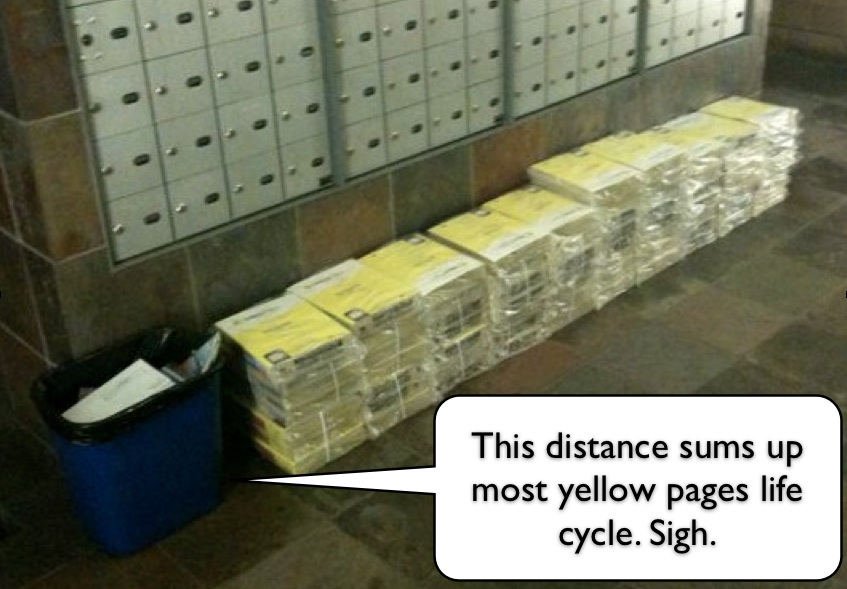
I was renewed in my hunt for such an option after I saw this pile in my friend’s condo. Pretty much everything about this photo makes me angry.

I have not used the Yellow Pages in over a decade and will never, ever, ever, ever use them (even their website which I am decidedly not linking to here) so long as they give them to virtually every Canadian address (I suspect that there are at least 20? 25? million, more? of these things printed every year?

In our world this is spam. It isn’t mail I want, I didn’t ask for it and if I receive it, I delete (recycle) it upon arrival. I only wish the damage done by these books was as limited as online spam.

At least now we can request that it not be delivered. Of course, this solution is far from perfect. Consider that:

1) the fact you have to hand over personal information to a private company to stop receiving a service you never asked for is beyond offensive.

2) this opt out is not permanent. As the Yellow Pages Group FAQ (which is weirdly a PDF and not HTML like the rest of the site) notes:

3. Is my registration permanment?

No. Your registration is valid for two directory deliveries. After that time, you must inform us that you would like to continue to opt-out by completing the same form at http://www.ypg.com/delivery or calling 1-800-268-5637.

3) better still, when, in two years, your opt out expires will Yellow Pages remind you? Or will they simply start sending you yellow pages again? Again their FAQ provides a sad answer:

5. Will Yellow Pages Group send me a notice when the registration period expires?

It will be your responsibility to register again to receive more directories or to be removed from the distribution list after two directory deliveries.

Everything about this company is broken. With luck it will either change or not be with us much longer (also check out its shrinking stock value and declining dividend here).

Apps for Climate Action Update – Lessons and some new sexy data

ttl_A4CAOkay, so I’ll be the first to say that the Apps4Climate Action data catalog has not always been the easiest to navigate and some of the data sets have not been machine readable, or even data at all.

That however, is starting to change.

Indeed, the good news is three fold.

First, the data catalog has been tweaked and has better search and an improved capacity to sort out non-machine readable data sets. A great example of a government starting to think like the web, iterating and learning as the program progresses.

Second, and more importantly, new and better sets are starting to be added to the catalog. Most recently the Community Energy and Emissions Inventories were released in an excel format. This data shows carbon emissions for all sorts of activities and infrastructure at a very granular level. Want to compare the GHG emissions of a duplex in Vancouver versus a duplex in Prince George? Now you can.

Moreover, this is the first time any government has released this type of data at all, not to mention making it machine readable. So not only have the app possibilities (how green is your neighborhood, rate my city, calculate my GHG emissions) all become much more realizable, but any app using this data will be among the first in the world.

Finally, probably one of the most positive outcomes of the app competition to date is largely hidden from the public. The fact that members of the public have been asking for better data or even for data sets at all(!) has made a number of public servants realize the value of making this information public.

Prior to the competition making data public was a compliance problem, something you did but you figured no one would ever look at or read it. Now, for a growing number of public servants, it is an innovation opportunity. Someone may take what the government produces and do something interesting with it. Even if they don’t, someone is nonetheless taking interest in your work – something that has rewards in of itself. This, of course, doesn’t mean that things will improve over night, but it does help advance the goal of getting government to share more machine readable data.

Better still, the government is reaching out to stakeholders in the development community and soliciting advice on how to improve the site and the program, all in a cost-effective manner.

So even within the Apps4Climate Action project we see some of the changes the promise of Government 2.0 holds for us:

  • Feedback from community participants driving the project to adapt
  • Iterations of development conducted “on the fly” during a project or program
  • Success and failures resulting in queries in quick improvements (release of more data, better website)
  • Shifting culture around disclosure and cross sector innovation
  • All on a timeline that can be measured in weeks

Once this project is over I’ll write more on it, but wanted to update people, especially given some of the new data sets that have become available.

And if you are a developer or someone who would like to do a cool visualization with the data, check out the Apps4Climate Action website or drop me an email, happy to talk you through your idea.

Saving Millions: Why Cities should Fork the Kuali Foundation

For those interested in my writing on open source, municipal issues and technology, I want to be blunt: I consider this to be one of the most important posts I’ll write this year.

A few months ago I wrote an article and blog post about “Muniforge,” an idea based on a speech I’d given at a conference in 2009 in which I advocated that cities with common needs should band together and co-develop software to reduce procurement costs and better meet requirements. I continued to believe in the idea, but have recognized that cultural barriers would likely mean it would be difficult to realize.

Last month that all changed. While at Northern Voice I ended up talking to Jens Haeusser an IT strategist at the University of British Columbia and confirmed something I’d long suspected: that some people much smarter than me had already had the same idea and had made it a reality… not among cities but among academic institutions.

The result? The Kuali foundation. “…A growing community of universities, colleges, businesses, and other organizations that have partnered to build and sustain open-source administrative software for higher education, by higher education.”

In other words for the past 5 years over 35 universities in the United States, Canada, Australia and South Africa have been successfully co-developing software.

For cities everywhere interested in controlling spending or reducing costs, this should be an earth shattering revelation – a wake up call – for several reasons:

  • First, a viable working model for muniforge has existed for 5 years and has been a demonstrable success, both in creating high quality software and in saving the participating institutions significant money. Devising a methodology to calculate how much a city could save by co-developing software with an open source license is probably very, very easy.
  • Second, what is also great about universities is that they suffer from many of the challenges of cities. Both have: conservative bureaucracies, limited budgets, and significant legacy systems. In addition, neither have IT as the core competency and both are frequently concerned with licenses, liability and the “owning” intellectual property.
  • Which thirdly, leads to possibly the best part. The Kuali Foundation has already addressed all the critical obstacles to such an endeavour and has developed licensing agreements, policies, decision-making structures, and work flows processes that address necessary for success. Moreover, all of this legal, policy and work infrastructure is itself available to be copied. For free. Right now.
  • Fourth, the Kuali foundation is not a bunch of free-software hippies that depend on the kindness of strangers to patch their software (a stereotype that really must end). Quite the opposite. The Kuali foundation has helped spawn 10 different companies that specialize in implementing and supporting (through SLAs) the software the foundation develops. In other words, the universities have created a group of competing firms dedicated to serving their niche market. Think about that. Rather than deal with vendors who specialize in serving large multinationals and who’ve tweaked their software to (somewhat) work for cities, the foundation has fostered competing service providers (to say it again) within the higher education niche.

As a result, I believe a group of forwarding thinking cities – perhaps starting with those in North America – should fork the Kuali Foundation. That is, they should copy Kuali’s bylaws, it structure, its licenses and pretty much everything else – possibly even the source code for some of its projects – and create a Kuali for cities. Call it Muniforge, or Communiforge or CivicHub or whatever… but create it.

We can radically reduce the costs of software to cities, improve support by creating the right market incentive to help foster companies whose interests are directly aligned with cities and create better software that meets cities unique needs. The question is… will we? All that is required is for CIO’s to being networking and for a few to discover some common needs. One I idea I have immediately is for the City of Nanaimo to apply the Kuali modified Apache license to its council monitoring software package it developed in house, and to upload it to GitHub. That would be a great start – one that could collectively save cities millions.

If you are a city CIO/CTO/Technology Director and are interested in this idea, please check out these links:

The Kuali Foundation homepage

Open Source Collaboration in Higher Education: Guidelines and Report of the Licensing and Policy Framework Summit for Software Sharing in Higher Education by Brad Wheeler and Daniel Greenstein (key architects behind Kuali)

Open Source 2010: Reflections on 2007 by Brad Wheeler (a must read, lots of great tips in here)

Heck, I suggest looking at all of Brad Wheeler’s articles and presentations.

Another overview article on Kuali by University Business

Phillip Ashlock of Open Plans has an overview article of where some cities are heading re open source.

And again, my original article on Muniforge.

If you aren’t already, consider reading the OpenSF blog – these guys are leaders and one way or another will be part of the mix.

Also, if you’re on twitter, consider following Jay Nath and Philip Ashlock.

Half victory in making BC local elections more transparent

Over the past few months the British Columbia government (my home province – or for my American friends – state) has had a taskforce looking at reforming local (municipal) election rules.

During the process I submitted a suggestion to the taskforce outlining why campaign finance data should be made available online and in machine readable format (ie. so you can open it in Microsoft Excel, or Google Docs, for example).

Yesterday the taskforce published their conclusions and… they kind of got it right.

At first blush, things look great… The press release and taskforce homepage list, as one of the core recommendations:

Establish a central role for Elections BC in enforcement of campaign finance rules and in making campaign finance disclosure statements electronically accessible

Looks promising… yes? Right. But note the actual report (which ironically, is only available in PDF, so I can’t link to the specific recommendations… sigh). The recommendation around disclosure reads:

Require campaign finance disclosure information to be published online
and made centrally accessible though Elections BC

and the explanatory text reads:

Many submissions suggested that 120 days is too long to wait for disclosure reports, and that the public should be able to access disclosure information sooner and more easily. Given the Task Force’s related recommendations on Elections BC’s role in overseeing local campaign finance rules, it is suggested that Elections BC act as a central repository of campaign finance disclosure statements. Standardizing disclosure statement forms is of practical importance if the statements are to be published online and centrally available, and would help members of the public, media and academia analyze the information. [my italics]

My take? That the spirit of the recommendation is for campaign finance data be machine readable – that you should be able to download, open, and play with it on your own computer. However, the literally reading of this text suggests that simple scanning account ledgers and sharing them as an image file or unstructured pdf might suffice.

This would be essentially doing the same thing that generally happens presently and so would not mark a step forward. Another equally bad outcome? That the information gets shared in a manner similar to the way federal MP campaign data is shared on Elections Canada website where it cannot be easily downloaded and you are only allowed to look at one candidates financial data at a time. (Elections Canada site is almost designed to prevent you from effectively analyzing campaign finance data).

So in short, the Taskforce members are to be congratulated as I think their intentions were bang on: they want the public to be able to access and analyze campaign finance data. But we will need to continue to monitor this issue carefully as the language is vague enough that the recommendation may not produce the desired outcome.

Gov 2.0 Expo Ignite talk on Open Data as an old idea

First, sorry for the scant blogging this week. Being 6 weeks into a 10 week travel marathon that sees me crossing the continent 9 times the long days finally caught up with me. Also, I’ve been at the O’Reilly Media Gov 2.0 Expo in Washington DC which has been fantastic. Really, a sense of coming home. It has also been great to meet so many people that I’ve corresponded with, admired and/or whose work I’ve simply followed closely. Great moment was spending a hour with Tim Berners-Lee in the speakers lounge talking about open data and meeting up with the Sunlight Foundation team at their offices in DC. Real inspirations all of them.

Tomorrow I’m giving a talk at the Federation of Canadian Municipalities on Open Data and the opportunity of Open Source software, so been busy there to, getting my thoughts together. I consider this one of the most important audiences I’ll talk to this year, this is a group that could transform how cities work in Canada – so I’m looking forward to it.

In the mean time, for those who were not at the Gov 2.0 expo I’ve pasted a clip of my talk below. It’s an ignite talk which means it last 5 minutes, I had to give them 20 slides in advance and those slide move forward every 15 seconds (I’m not controlling them!)

But then… forget my talk! There were a bunch of other (more) fantastic talks that can be found on the Gov 2.0 you-tube page here. I strongly encourage you to check them out!

Articles I'm digesting – 25/5/2010

Been a while since I’ve done one of these. A couple of good ones ranging from the last few months. Big thank you’s to those who sent me these pieces. Always enjoy.

The Meaning of Open by Jonathan Rosenberg, Senior Vice President, Product Management

Went back and re-read this. Every company makes mistakes and Google is no exception (privacy settings on Buzz being everyone’s favourite) but this statement, along with Google’s DataLiberartion.org (which unlike Facebook is designed to ensure you can extract your information from Google’s services) shows why Google enjoys greater confidence than Facebook, Apple or any number of its competitors. If you’re in government, the private or the non-profit sector, read this post. This is how successful 21st century organizations think.

Local Governments Offer Data to Software Tinkerers by Claire Cain Miller (via David Nauman & Andrew Medd)

Another oldie (December 2009 is old?) but a goodie. Describes a little bit of the emerging eco-system for open local government data along with some of the tensions it is creating. Best head in the sand line:

Paul J. Browne, a deputy commissioner of the New York City Police Department, said it releases information about individual accidents to journalists and others who request it, but would not provide software developers with a regularly updated feed. “We provide public information, not data flow for entrepreneurs,” he said.

So… if I understand correctly, the NYPD will only give data to people who ask and prefer to tie up valuable resources filling out individual requests rather than just provide a constant feed that anyone can use. Got it. Uh, and just for the record, those “entrepreneurs” are the next generation of journalists and the people who will make the public information useful. The NYPD’s “public information” is effectively useless, much like that my home town police department offers. Does anyone actually looks at PDF’s and pictures of crimes? That you can only get on a weekly basis? Really? In an era of spreadsheets and google maps… no.

Didacticism in Game Design by Clint Hocking (via Lauren Bacon)

eaves.ca readers meet Clint Hocking. My main sadness in introducing you is that you’ll discover how a truly fantastic, smart blog reads. The only good news for me us that you are hopefully more interested in public policy, open source and things I dwell on than video games, so Clint won’t steal you all away. Just many of you.

A dash of a long post post that is worth reading

As McLuhan says: the medium is the message. When canned, discrete moral choices are rendered in games with such simplicity and lack of humanity, the message we are sending is not the message specific to the content in question (the message in the canned content might be quite beautiful – but it’s not a ludic message) – it is the message inherent in the form in which we’ve presented it: it effectively says that ‘being moral is easy and only takes a moment out of each hour’. To me, this is almost the opposite of the deeper appreciation of humanity we might aim to engender in our audience.

Clint takes video games seriously. And so should you.

The Analytic Mode by David Brooks (via David Brock)

These four lines alone make this piece worth reading. Great lessons for students of policy and politics:

  • The first fiction was that government is a contest between truth and error. In reality, government is usually a contest between competing, unequal truths.
  • The second fiction was that to support a policy is to make it happen. In fact, in government power is exercised through other people. It is only by coaxing, prodding and compromise that presidents [or anyone!] actually get anything done.
  • The third fiction was that we can begin the world anew. In fact, all problems and policies have already been worked by a thousand hands and the clay is mostly dry. Presidents are compelled to work with the material they have before them.
  • The fourth fiction was that leaders know the path ahead. In fact, they have general goals, but the way ahead is pathless and everything is shrouded by uncertainty

The case against non-profit news sites by Bill Wyman (via Andrew Potter)

Yes, much better that news organizations be beholden to a rich elite than paying readers… Finally someone takes on the idea that a bunch of enlightened rich people or better, rich corporate donors, are going to save “the news.” Sometimes it feels like media organizations are willing to do anything they can to avoid actually having to deal with paying customers. Be it using advertisers and relying on rich people to subsidize them, anything appears to be better than actually fighting for customers.

That’s what I love about Demand Media. Some people decry them as creating tons of cheap content, but at least they looked at the market place and said: This is a business model that will work. Moreover, they are responding to a real customer demand – searches in google.

Wyman’s piece also serves as a good counterpoint to the recent Walrus advertising campaign which essentially boiled down to: Canada needs the Walrus and so you should support it. The danger here is that people at the Walrus believe this line: That they are of value and essential to Canada even if no one (or very few people) bought them or read them. I think people should buy The Walrus not because it would be good for the country but because it is engaging, informative and interesting to Canadians (or citizens of any country). I think the Walrus can have great stories (Gary Stephen Ross’s piece A Tale of Two Cities is a case in point), but if you have a 1 year lead time for an article, that’s going to hard to pull off in the internet era, foundation or no foundation. I hope the Walrus stays with us, but Wyman’s article serves up some arguments worth contemplating.