Category Archives: cool links

International Open Data Hackathon Website and Wiki is up

So when I first wrote Let’s Do an International Open Data Hackathon I thought… maybe they’ll be 5 or 6 cities that will want to do one.

That may still be the case, but given the number of visits the blog post experienced and the number of people who registered interest on the etherpad, we may end up with a few more – which would be exciting.

To date people in 33 different cities spanning 16 countries four continents (some really nice guys from India emailed me saying they want to do one, but haven’t connected to the wiki yet) have said they are interested in organizing a hackathon in their home town. Will all of these happen? Who knows. But it is great to see that there is so much interest in an issue that represent an important opportunity.

Exciting.

So, to celebrate the growing interest we’ve launched a website and a wiki to help inform people about the open data hackathon and give them a place to register their interest and organize.

Please, check them out! Feel free to create wiki pages for your cities, to share best practices and ideas on running hackathons, or even just translate materials and content into a parallel page.

Articles I'm Digesting 1/11/2010

Here’s a few articles I recently digested:

Enabling Access and Reuse of Public Sector Information in Canada: Crown Commons Licenses, Copyright, and Public Sector Information by Elizabeth F. Judge

This piece (which you can download as a PDF) is actually a chapter in a book titled: From “Radical Extremism” to “Balanced Copyright” : Canadian Copyright and the Digital Agenda.

This piece provides a fantastic overview on both the how and why Crown Copyright impedes the remixing and repurposing of government information. The only thing confusing to me about the article is that it focuses a great deal on data which, by the author’s own admission, is not covered by Crown Copyright:

With respect to data, Crown copyright does not protect raw data (unprocessed data, such as numbers entered into a database), but it does protect an original expres- sion of the data (for example, an original map is a copyrightable artistic work based on geospatial data) and compilations (including compilations of data), providing that there is an original selection or arrangement of the data (that is, there has been human intervention where skill and judg- ment has been exercised).

Given I often have to explain to government types that data is not covered by Crown Copyright (this is in part why it often has – more restrictive still – licenses attached to it) my only concern about the paper is that because of its strong focus on data it will inadvertently muddy the waters. However, still a good piece and I suspect many who read it will wander away hoping that some change to Crown Copyright legislation will be forthcoming.

The Global Debt Clock by The Economist Intelligence Unit

Few outside of Canada understand how much Canadian politics was dominated by the issue of “the debt” in the 1990s. When Bill Clinton made his first visit to Canada the headlines were more concerned with Canada’s bond rating being downgraded than the visit of the new US president.

The belief, however, that Canada has tamed its debt may be a myth. The challenge may be that it people are starting to wise up to all that downgrading. That the debt has simple shifted from the national (which people historically looked at) to the provincial level (which is rarely calculated into “national” debt). The Economist chart puts things into sharp (and dim?) perspective:

Canada’s public debt: $1,257,953,424,658 or $37,042.44 per person or 82.3% of GDP

America’s public debt: $9,117,200,547,945 or $29,491.12 per person or 62.0% of GDP

Of course Canada’s debt includes health care expenditures which in the United States are (more) born by private citizens, so the debt burden per individual once you factor in private debt may not be closer. But then household debt in Canada is about to overtake that in America so again…

This all said, pretty much every country in the developed world looks ugly in terms of debt… this may, sadly, be the boomers biggest legacy.

Disconnect: Why our politics is so out of touch and what it means for our future by Richard Florida and Jeremy D. Mayer

Written back in 2007 this article deserves a revisit:

“In our view, American politics today is distinguished by one feature: instability. In place of an enduring political force such as post-1896 Republican dominance or the Democrats after Roosevelt in 1932, American politics in recent years has see-sawed back and forth. Twelve years of Reagan-Bush were followed by 8 of Bill Clinton, and then Bush and Rove, now this. And, only 6 of those years saw one party with simultaneous control of the presidency and Congress.

This instability, in our view, stems from one primary source: Our economic system has undergone a tectonic shift, to which the political system is still trying to adapt. Just as our politics was recast a century ago by the forces of the Industrial Revolution, so to is it being reshaped today by the rise of the technology, innovation and creativity as economic forces. The rise of this innovative, knowledge-based Creative Economy is even more significant and more challenging to politics as the Industrial Economy. Today, this sector accounts roughly a third of the American workforce — or roughly 40 million workers – nearly three times the industrial sector and blue-collar working class. What’s more, these creative occupations account for the lion’s share of all wealth generation, accounting for nearly half of all wages and salaries paid in the United States. That’s nearly $2 trillion, or as much as the manufacturing and service sectors combined.

But the creative economy doesn’t just generate phenomenal wealth. It also sorts people across new economic and geographical boundaries and generates inequality between and within states and regions as great as that of the early Industrial Revolution. As a result, we’re living through a period of tumultuous political adjustment.”

and speaking of revisits…

American Backlash by Michael Adams

Offers an alternative explanation regarding the challenges faced by incumbent parties in the US. I remembered this as I was recently reading Wente’s piece about Palin and the Tea Party, where she cites pollster Scott Rasmussen:

“who argues that the major division in the country now is not between the Republicans and Democrats, but between the mainstream public and the political class – the small proportion of the population, perhaps 10 per cent, (including most people who work in mainstream media) that still believes that government tries to serve the public interest, rather than colluding with big business against ordinary people.”

This was, of course, the thesis of Adams book back in 2006. Nice to be ahead of the curve.

Open Data Hackathon page by Volunteers around the world

Hope that there will be a dedicated site for this up this week – have a few people stepping forward on that front. In the interim, please do consider adding you name if you are interested in helping organize one in your city.

Congratulations to Naheed & other fabulous people

(On a separate note, I’m giving a talk tomorrow at 3pm at UBC.)

For those who weren’t paying attention to the Calgary municipal election last night, Naheed Nenshi came out of third place and won the mayoral race. Of course, the articles are already focusing on the wrong things: he’s Muslim, his a minority, etc…

What really matters about Naheed is that he smart, he is about ideas and he’s progressive. That he’s managed to capture the imagination of a place like Calgary speaks volumes both about how hard he campaigned and how cosmopolitan Canada’s urban centres are becoming.

But back to ideas. I first met Naheed way back when he served as lead author of Building Up: Making Canada’s Cities Magnets for Talent and Engines of Development for Canada25. Essentially for as long as I’ve known him he’s cared about cities (and his passion predates my meeting him). There isn’t much more you could want from someone who is about to become your mayor. For me personally, his work became the template for me later when I worked as lead author first on Canada25’s report written at the request of the Privy Council Office and then, of course, on From Middle to Model Power.

It also speaks volumes about the types of people I had the pleasure to meet through Canada25 and watch grow over the years. Indeed, yesterday I ended up having lunch with Chris Kennedy – another Canada25 alum – who as Superintendent of Schools with the West Vancouver School District is also driven by a sense of public service and policy. Alison Loat, Executive Director of Samara, is another passionate believer in public service and public policy. I’m not sure whether to be more impressed by her own work or simply grateful for her unfailing belief and support of me and my work. And Andrew Medd, who gave me what may have become the best advice about blogging when I first started eaves.ca years ago: “Write for yourself, as though no one will read it.” (advice that actually was fact for the first while – you should only blog if you’re prepared to be alone with your thoughts). Of course there are so many I’m not mentioning like Ross Wallace, Debbie Chachra, Mike Morgan…

Watching the celebrations taking place in Calgary, all I can think of is how lucky I was to get to meet some of these people early on and how much I can’t wait to watch them going forward.

On a separate note, it is very much worth looking at MasterMaq’s election website powered by open election data from the city of Edmonton. From Naheed’s election (in which social media paid a powerful role), to the coverage through Twitter (that’s how I followed the events), social media continues to evolve and have an impact, especially at the local level.

Lots of great reading

So with summer having now sped by I haven’t done a reading update in quite some time… here’s a quickie:

1. The Ascent of Money by Niall Ferguson

For a subject that sounds like it should completely bore you – the history of finance – this book is brilliant and, frankly, fun. It’s also timely. The financial system is so old that we often forget that it actually emerged out of something. Money, bonds, stocks, all that good stuff, it hasn’t always been around. WE of course know this, but it is great to actually be walked through how it all emerged, especially when its so wonderful told. It’s also nice to take a look at an old system, like finance, which we are now as comfortable with as the air we breath (even, when at times, it turns toxic and crashes our economy) as so much of my time is spent looking at relatively newer systems – digital networks and the internet. Lots of lessons could be drawn, especially around trust networks (something here for Shirky while he’s at Berkman?).

One additional point. I initially started watching the PBS series by the same name which is based on the book and also hosted by Niall Ferguson but was not really riveted by it. It was somewhat slow moving and lacked the historical depth and arc the book has… so if you saw the TV documentaries and were turned off, not to worry, the book is definitely working picking up.

2. How Government HR Processes are Broken

Check out this fantastic post by an anonymous public servant in Gatineau. It’s a deadly piece about how broken hiring practices are in government and how it’s unsurprising some would be driven away. It would make you laugh if it weren’t making you cry. Got this from a public servant, then after tweeting it, a bunch more noted to me how painfully true it felt to them. Sigh.

3. David McCandless: The Beauty of Data Visualization

It’s hard(er) to do visualizations without open data. Here’s some beautiful ones from England.

We are going to make a better world, nudging and learning

4. An interview with David Mahfouda and Alex Pasternack, creators of a new app for booking/sharing rides in New York

A fantastic interview about how we can share resources to get around more quickly, cheaply and efficiently by using technology. A riff off of Robin’s Chases’ ZipCar idea but its not about sharing cars, but sharing rides. This is the future of urban transportation. That is, of course, if Ontario’s bus companies don’t try to outlaw it.

Links from Gov2.0 Summit talk and bonus material

My 5 minute lightening fast jam packed talk (do I do other formats? answer… yes) from yesterday’s Gov2.0 summit hasn’t yet been has just been posted to youtube. I love that this year the videos have the slides integrated into it.

For those who were, and were not, there yesterday, I wanted to share links to all the great sites and organizations I cited during my talk, I also wanted to share one or two quick stories I didn’t have time to dive into:

VanTrash and 311:

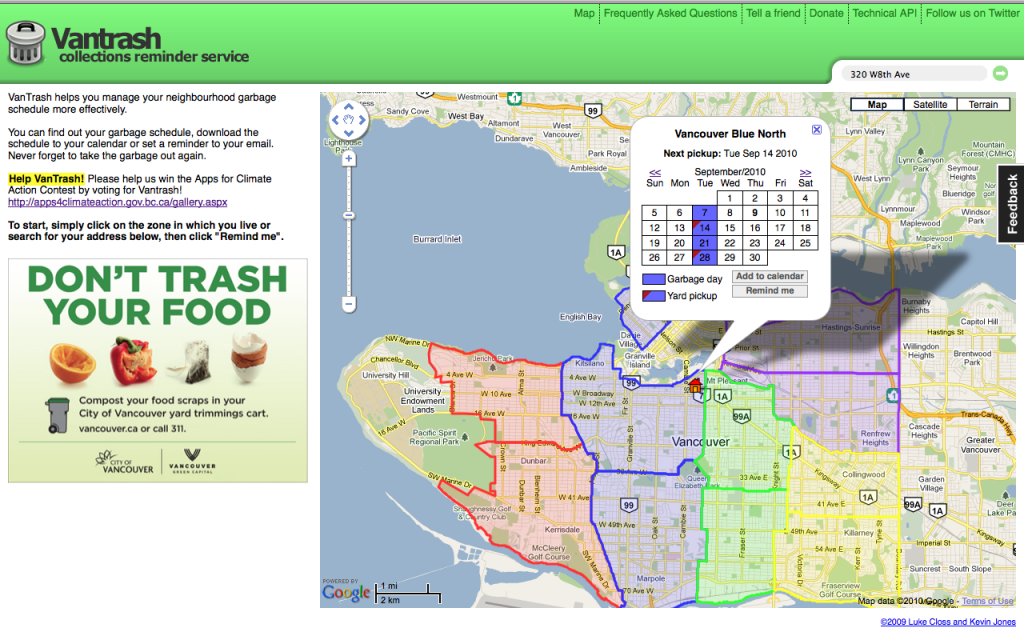
Screen-shot-2010-09-09-at-3.07.32-AM-1024x640As one of the more mature apps in Vancouver using open data Vantrash keeps being showing us how these types of innovations just keep giving back in new and interesting ways.

In addition to being used by over 3000 households (despite never being advertised – this is all word of mouth) it turns out that the city staff are also finding a use for vantrash.

I was recently told that 311 call staff use Vantrash to help trouble shoot incoming calls from residents who are having problems with garbage collection. The first thing one needs to do in such a situation is identify which collection zone the caller lives in – turns out VanTrash is the fastest and more effective way to accomplish this. Simply input the caller’s address into the top right hand field and presto – you know their zone and schedule. Much better than trying to find their address on a physical map that you may or may not have near your station.

TaxiCity, Open Data and Game Development

Another interesting spin off of open data. The TaxiCity development team, which recreated downtown Vancouver in 2-D using data from the open data catalog, noted that creating virtual cities in games could be a lot easier with open data. You could simply randomize the height of buildings and presto an instant virtual city would be ready. While the buildings would still need to be skinned one could recreate cities people know quickly or create fake cities that felt realistic as they’d be based on real plans. More importantly, this process could help reduce the time and resources needed to create virtual cities in games – an innovation that may be of interest to those in the video game industry. Of course, given that Vancouver is a hub for video game development, it is exactly these types of innovations the city wishes to foster and will help sustain Vancouver’s competitive advantage.

Links (in order of appearance in my talk)

Code For America shirt design can be seen in all their glory here and can be ordered here. As a fun aside, I literally took that shirt of Tim O’Reilly’s back! I saw it the day before and said, I’d wear that on stage. Tim overheard me and said he’d give me his if I was serious…

Vancouver’s Open Motion (or Open3, as it is internally referred to by staff) can be read in the city’s PDF version or an HTML version from my blog.

Vancouver’s Open Data Portal is here. keep an eye on this page as new data sets and features are added. You can get RSS feed or email updates on the page, as well as see its update history.

Vantrash the garbage reminder service’s website is here. There’s a distinct mobile interface if you are using your phone to browse.

ParkingMobility, an app that crowdsources the location of disabled parking spaces and enables users to take pictures of cars illegally parked in disabled spots to assist in enforcement.

TaxiCity, the Centre for Digital Media Project sponsored by Bing and Microsoft has its project page here. Links to the sourcecode, documentation, and a ton of other content is also available. Really proud of these guys.

Microsoft’s Internal Vancouver Open Data Challenge fostered a number of apps. Most have been opensourced and so you can get access to the code as well. The apps include:

The Graffiti Analysis written by University of British Columbia undergraduate students can be downloaded from this blog post I posted about their project.

BTA Works – the research arm of Bing Thom Architects has a great website here. You can’t download their report about the future of Vancouver yet (it is still being peer-reviewed) but you can read about it in this local newspaper article.

Long Tail of Public Policy – I talk about this idea in some detail in my chapter on O’Reilly Media’s Open Government. There is also a brief blog post and slide from my blog here.

Vancouver’s Open Data License – is here. Edmonton, Ottawa and Toronto use essentially the exact same thing. Lots that could be done on this front still mind you… Indeed, getting all these cities on a single standard license should be a priority.

Vancouver Data Discussion Group is here. You need to sign in to join but it is open to anyone.

Okay, hope those are interesting and helpful.

Are you a Public Servant? What are your Open Data Challenges?

A number of governments have begun to initiate open data and open government strategies. With more governments moving in this direction a growing number of public servants are beginning to understand the issues, obstacles, challenges and opportunities surrounding open data and open government.

Indeed, these challenges are why many of these public servants frequent this blog.

This is precisely why I’m excited to share that, along with the Sunlight Foundation, the Personal Democracy Forum, Code for America, and GovLoop, I am helping Socrata in a recently launched survey aimed at government employees at the national, regional and local levels in the US and abroad about the progress of Open Data initiatives within their organization.

If you are a government employee please consider taking time to help us understand the state of Open Data in government. The survey is comprehensive, but given how quickly this field and the policy questions that come with it, is expanding, I think the collective result of our work could be useful. So, with that all said, I know you’re busy, but hope you’ll consider taking 10 minutes to fill out the survey. You can find it at: http://www.socrata.com/benchmark-study.

Your friday funny: This blogger is at the wrong blog

For those who haven’t seen it yet, I strongly, strongly, strongly encourage you to watch the “This Drummer is at the Wrong Gig” video embedded below. I discovered the clip a few weeks and have been sharing it with all my friends. It’s awe inspiring, hilarious, amazing and, just keeps getting better and better as you get deeper into the clip.

Watch the drummer. Pure genius.

What’s better, the drummer – Steve Moore – is just flat out nice. Check out this interview with him about his youtube fame. He’s everything you’d want in a bandmate: loyal, talented and doing it for the right reason.

Indeed, the best part of the interview is him talking about how he couldn’t care less about money but how getting the respect from drummers he looks up to is what has been the biggest pay off.

Anyone whose felt passionate about something likely feels the same way. Personally, I hope I blog half as well as this guy drums. And nothing feels better than getting an email or tweet about a blog post from someone I really respect. Those really are the best moments.

Nice work Steve Moore. You’re an inspiration. And just plain awesome.

Creating Open Data Apps: Lessons from Vantrash Creator Luke Closs

Last week, as part of the Apps for Climate Action competition (which is open to anyone in Canada), I interviewed the always awesome Luke Closs. Luke, along with Kevin Jones, created VanTrash, a garbage pick up reminder app that uses open data from the City of Vancouver. In it, Luke shares some of the lessons learned while creating an application using open data.

As the deadline for the Apps for Climate Action competition approaches (August 8th) we thought this might help those who are thinking about throwing their hat in the ring last minute.

Some key lessons from Luke:

  • Don’t boil the ocean: Keep it simple – do one thing really, really well.
  • Get a beta up fast: Try to scope something you can get a rough version working in day or evening – that is a sure sign that it is doable
  • Beta test: On friends and family. A lot.
  • Keep it fun: do something that develops a skill or let’s you explore a technology you’re interested in

Clay Shirky, Connected and Yellow Pages

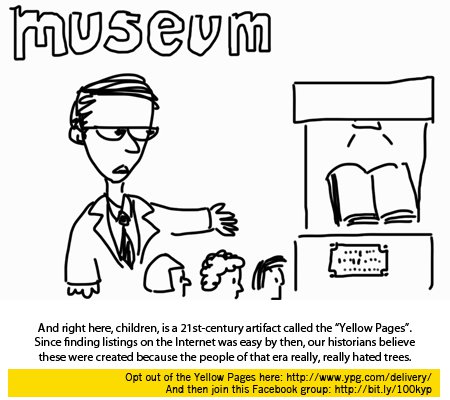
Yellow-pages-comicTwo weeks ago, after seeing Yellow Pages stacked, unused and unwanted in both my own and several friends apartment buildings, I started a Facebook Group entitled 100,000 Canadians who’ve opted out of yellow pages! In two weeks, with friends telling a friend here and there, we’ve grown to 1000 people. So where did this come from and where is it going?

Well, for a number of years there have been petitions against Yellow Pages but obviously they have had little impact and, frankly, I suspect they actually garner few sign-ups. In Connected: How Your Friends’ Friends’ Friends Affect Everything You Feel, Think, and Do Christakis and Fowler show how people are more likely to vote when their friends, and friends’, friends voted. This suggests there is a strong social component to behaviour. Given that many people I talk to want to opt-out, I thought maybe people will be more likely to opt-out if they knew their friends and their friends, friends opt out. And maybe we could help create that cycle. Facebook, because it allows us to connect with our friends and share some online actions we take, felt like a great platform to do this. Indeed, it seemed to me exactly the ingredient that many online petitions (Which don’t allow you to socialize your activity) seemed to be missing. Also, surprisingly, there wasn’t already a Facebook group dedicated to this.

yellow-pages-banIndeed, looking at Yellow Pages own research reaffirmed my belief that such a group could be successful. They claim 61% of Canadians aged 18+ use their directories at least once a month to look up a business. (Interestingly you can’t read the report on which the claim is made). But (a) this felt unlikely and (b) once a month? So people use the yellow pages 12 times a year…? That’s not delivering value, indeed the number is so unimpressive and underwhelming that if that is the best they can offer, I’m sure we can find lots of Canadians who’d prefer to just say no.

So how I have I structured this (admittedly) off the side of my computer and amateur-driven campaign? I’m trying to follow Clay Shirky’s three pieces of advice at the end of Here Comes Everybody. Make clear the promise, the tool and the bargain.

The Promise: the thing that convinces a potential user to become an actual user.

The promise of this Facebook group is: by taking a simple action and sharing it with our friends, we can save a lot of waste and not receive a large (and annoying) piece of spam in our mailbox. The goal here is to keep everything simple. Participating requires very little time, the impact is immediate (you stop receiving the yellow pages) but also can scale significantly (lots of yellow pages may never get printed). Indeed, an extreme possible outcome – should enough people join the group – is breaking the printed yellow pages business model. If a sufficient number of Canadians actually opted out of the yellow pages, it would be hard for advertisers to believe Yellow Pages marketing materials as probably several more million aren’t on facebook, haven’t joined the group, but also find it useless. But, I’m not holding my breath – for now, I’m happy even getting a few thousand people to opt out.

The Tool: what will enable people to do what they actually want to do.

In our case, it is opt out of receiving the yellow pages. So there are two key tools. The first, is Yellow Pages opt-out form. Indeed, this group exists because there’s failure in information distribution. In some ways the group is about socializing this tool that people find helpful. Most people I talk to think the Yellow Pages are a waste and wish they didn’t have to get them. The truth is, you can opt out of receiving them – it was just that nobody knows how. We are fixing that information gap.

The second tool is a way to share the good news with others. Here, thanks to facebook, we leverage their tools, such as invites, status updates, people even upload photos of Yellow Pages siting unwanted in their apartment lobbies, share videos or – as in the case of Rob above – draw cartoons!

An unanticipated tool has been people helping each other out with filling out the form, or giving feedback to Yellow Pages about their service.

The Bargain: Helps clarify what you expect of others and what they can expect of you.

The bargain for this group is possible most interesting. Since I believe the Yellow Pages is spam and that, frankly, no one likes getting unwanted emails here is the bargain I’ve crafted. Users will opt out of the yellow pages and, hopefully, tell a few friends about the group. As group owner, I promise to only reach out to the group 5 times. Once when the group size hits 1000, 5,000, 10,000, 25,000, and (if we are so lucky) 100,000! I don’t want people to feel burdened by this group – I want them to feel liberated, happy and rewarded. Moreover, people’s time is valuable… so not communicating with them is probably the best thing I can do – hence, the self-imposed limits that reflects milestones we can collectively feel proud of achieving.

Going forward

So without spamming our own networks we’ve gotten to 1000 people in two weeks. Fairly good growth. Will we hit 100,000? I don’t know. It is an ambitious goal. Will we break the Yellow Pages business model? Probably less likely. But can we save some trees and save ourselves the hassle of receiving some very bulky and unwanted mail. Yes. And maybe we can show that Canadians don’t use the Yellow Pages. Ultimately, though we can tell a company that the very people it claims to serve just think it is appalling that they spam an entire country with a 400 page book particularly in an era where, as far as I can tell, so few people actually use it.

Oh, and I hope you’ll consider joining the group and telling a few friends.
On Policy Alpha geeks, network thinking and foreign policy

In the past few weeks the Liberal Party of Canada (LPC) and the Canadian International Council (CIC) both launched new visions for Canada’s foreign policy. Reading each, I’m struck by how much overlap both documents have with Middle to Model Power, the Canada25 report written 5 years ago by over 500 young Canadians from across the country and around the world.

With Middle to Model Power, a group of young people largely self-organized to lay out a vision and selection of ideas around how Canada could rethink its foreign policy. Take a look at this selection from its executive summary, including an overview and the first recommendation:

We submit that Canada should cease assessing its influence on the basis of its size or position within an obsolete global hierarchy. Instead, Canada25 calls on Canadians to look at the world as a network, where influence is based on the capacity of an individual, company, non-governmental organization (NGO) or country to innovate and collaborate. Building on this perspective, we propose that Canada become a Model Power—a country whose influence is linked to its ability to innovate, experiment, and partner; a country that, by presenting itself as a model, invites the world to assess, challenge, borrow from, and contribute to, its efforts.
In pursuit of our vision of Canada as a Model Power, we outline three priorities for action. These, accompanied by some of our recommendations, include:

MAKE CANADA A NETWORK NODE. Enhance the ability of Canadians to create, nurture, and tap into international networks:
• Issue five-year work visas to foreign graduates of Canadian universities • Reach out to Canada’s expatriate community by creating an international network of
Canadian leaders…

You can download the full report here, but you get the idea. Remember this is a group of 23-35 year-olds writing in 2005.

Now, quickly compare this to the summary’s of both the LPC and CIC’s new reports.

The LPC report, called a Global Networks Strategy opens by stating:

Networks define how the world works today, as hierarchies did in the past. Influence is gained through connectedness, and by being at the centre of networks. That is good news for Canada, because we have a reputation for being able to work with others, we have shaped many multilateral organizations, and our population today reflects the diversity of the world. The Global Networks Strategy is designed to leverage these assets. It sets priority areas in which the federal government must collaborate with the full range of players who contribute vigorously – and most often in networks – to Canada’s presence in the world: other governments, non-governmental organizations, the private sector, young Canadians, academia, faith- based groups, artists and others.

And in the CIC report, titled Open Canada: A Global Positioning Strategy for a Networked World, has as one of its opening paragraphs:

Canada will never be the most powerful nation on Earth. But we live in a digital age, where might is measured in knowledge rather than muscularity. If we keep building on our openness—attracting the best and the brightest citizens, generating and exchanging new ideas and new ways of doing things and welcoming investment in our economy—Canada can position itself at the centre of the networked world that is emerging in the 21st century.

And, unsurprisingly, the deeper details of the reports offer many similar prescriptions.

So how, on a shoestring budget, can a group of young Canadians many of whom were not foreign policy experts, write a report that identifies an organizing principle that 5 years both a major political party and one of the country’s newest and best funded think tanks would put at the hearts of their own reports?

A few ideas come to mind:

1) The Medium is the Message: Middle to Model Power was not written on a wiki (in 2005 none of us knew what a wiki was!) but it was written over email. The authors were scattered across the country and the process of organizing local events was relatively decentralized. People raised whatever topics that mattered to them, and during the drafting phase they simple sent me their ideas and we batted them around. There was structure, but were were a pretty flat organization and… we were very connected. For Canada25 a network wasn’t just an idea that emerged out of the process, it was the process. It should hardly be surprising that the way we saw the world reflected how we organized ourselves. (When I say that Canada’s digital economy strategy will fail unless written on GCPEDIA this is part of what I’m hinting at). The medium is the message. It’s hard (but not impossible) to write about networks deep in hierarchy.

2) Look for Policy Alpha Geeks in resource poor environments: So why did Canada25 think in terms of networks? How was it that before Wikinomics or GPS or pretty much most other things I’ve seen, did Canada25 organize itself this way?  Well, it wasn’t because we were strategic or young. It was because we had very little money. We couldn’t afford to organize any other way. To get 500 Canadians around the world to think about foreign policy we had to let them self-organize – we didn’t have an org structure or facilitators to do it for them. We had to take the cheapest tools (email) and over use them. Don’t get me wrong, Canada25 was not poor. Our members were generally very well educated, we had access to computers and the internet and access to interesting people to interview and draw ideas from. But the raw infrastructure we had at our disposal was not significant and it forced us to adopt what I now see were disruptive technologies and processes. We became Policy Alpha Geeks because we had to innovate not to be relevant, but to ensure the project survived.

3) It’s not about the youth: People presume that our thinking emerged because we were young. This is not entirely correct. Again, I submit that we got to thinking about networks because we were operating in a resource weak environment and had exposure to new tools (email) and a risk tolerance to try using them in an ambitious way. This isn’t about age, it just happens that generally it is young people who don’t have lots of resources and are willing to experiment with new tools. Older people, who frequently have more senior titles, generally have access to more resources and so can rely on more established, but more resource intensive tools and processes. But again, this is about mindset, not about age. Indeed, it is really about the innovators’ dilemma in policy making. Don’t believe me? Well, as lead author of Middle to Model Power I can tell you that the most influential book on my thinking was Alvin Toffler’s Future Shock which I read in the month preceding the drafting of the report. It was written in 1970 by an author who was, at the time, 42. In sum, young people can be a good guide, but it is environmental factors that you can replicate, not intrinsic qualities of being young, that allow you to innovate.

Both the LPC and the CIC’s documents are good and indeed, more up to date than Middle to Model Power. But in terms of core organizing principles the three documents are similar. So if you are genuinely interested in this take a look at all three documents. I do think they put forward what could become an emerging centrist consensus regarding organizing principles for Canadian foreign policy. Certainly that was the ambition back in 2005.