Category Archives: cool links

Urban Aboriginal Peoples Survey Launched

I’m very excited to share that today is the launch of the Urban Aboriginal Peoples Survey. For the last two years, more than 125 people have been working at various times to make this project a reality – the first ever survey of First Nations, Metis and Inuit who live in Canada’s major urban areas. I was lucky enough to sit on the steering committee of this project and so have had a very, very small role to play in this project. I’m happy to put anyone in touch with the amazing people who made this ambitious project a reality. People like Ginger Gosnell and David Newhouse (who is intelligent, compassionate and wise beyond description) are Canadians everyone should get to know.

Below is the press release that went out earlier today and you should be able to download the report here. This is a tremendously important piece of work as First Nations increasingly live in urban settings – indeed over half of the First Nation population now lives cities. Yes. Over half. And despite this, Canadians know almost nothing about this important group of citizens. Who they are or what they want. In short, there is almost no dialogue. I, like many involved in this project, hope this survey serves as a one starting point for changing that.

Urban Aboriginal peoples (First Nations peoples, Métis, and Inuit) are an increasingly significant social, political and economic presence in Canadian cities today.

First-of-a-kind Research Study takes new, in-depth look at growing population in 11 cities.

TORONTO, April 6, 2010 – An extensive new research study has gone beyond the numbers to capture the values and aspirations of this growing population.

By speaking directly with a representative group of 2,614 First Nations peoples, Métis and Inuit living in major Canadian cities, as well as 2,501 non Aboriginal Canadians, the Environics Institute, led by Michael Adams, has released the Urban Aboriginal Peoples Study (UAPS), which offers Canadians a new perspective of their Aboriginal neighbors living in Canada’s eleven largest cities. In the 2006 Census 1.172 million people self-identified themselves as “Aboriginal”, half of whom (one in two) reported living in urban centres.

“This study is about the future, not the past. The Urban Aboriginal Peoples Study offers Canadians a new picture of Aboriginal peoples in cities. Ideally, the things we have learned will help people understand each other better, have better conversations, and live together better in our urban communities.” ~Michael Adams, President, Environics Institute

Guided by an Advisory Circle, Aboriginal people designed the research themes, methodology, and executed the main survey. The Urban Aboriginal Peoples Study may be downloaded free from www.uaps.ca.

“When urban Aboriginal peoples are researched it’s often about problems like homelessness and sexual exploitation. There are hundreds of thousands of us living in cities, and there are a lot of positive things happening in our communities; it’s not all crises. But unless someone comes along and says, ‘This is interesting. Tell me about your choices; tell me about your community,’ then people don’t notice that they’re part of a wider social change.” ~Ginger Gosnell-Myers, UAPS Project Manager

KEY FINDINGS

For most, the city is home, but urban Aboriginal peoples stay connected to their communities of origin. Six in ten feel a close connection to these communities – links that are integral to strong family and social ties, and to traditional and contemporary Aboriginal culture. Notwithstanding these links, majorities of First Nations peoples, Métis and Inuit consider their current city of residence home (71%), including those who are the first generation of their family to live in their city.

Eight in ten participants said they were “very proud” of their specific Aboriginal identity, i.e., First Nations, Métis or Inuk. Slightly fewer – 70 per cent – said the same about being Canadian.

Urban Aboriginal peoples are seeking to become a significant and visible part of the urban landscape. Six in ten feel they can make their city a better place to live, a proportion similar to non-Aboriginal urban dwellers.

Six in ten were completely or somewhat unworried about losing contact with their culture, while a minority were totally (17 per cent) or somewhat (21 per cent) concerned. As well, by a wide margin (6:1), First Nations peoples, Métis and Inuit think Aboriginal culture in their communities has become stronger rather than weaker in the last five years.

They display a higher tolerance for other cultures than their non-Aboriginal neighbours: 77% of urban Aboriginal peoples believe there is room for a variety of languages and cultures in this country in contrast to 54% of non-Aboriginal urbanites.

Almost all believe they are consistently viewed in negative ways by non-Aboriginal people. Almost three in four participants perceived assumptions about addiction problems, while many felt negative stereotypes about laziness (30 per cent), lack of intelligence (20 per cent) and poverty (20 per cent).

Education is their top priority, and an enduring aspiration for the next generation. Twenty per cent want the next generation to understand the importance of education, 18 per cent hope younger individuals will stay connected to their cultural community and 17 per cent hope the next generation will experience life without racism.)

Money was cited as the No.1 barrier to getting a post-secondary education among 36 per cent of those planning to attend – and 45 per cent of those already enrolled in – a university or college.

Urban Aboriginal peoples do not have great confidence in the criminal justice system in Canada. More than half (55%) have little confidence in the criminal justice system and majorities support the idea of a separate Aboriginal justice system.

A significant minority (4 in 10) feel there is no one Aboriginal organization or National political party that best represent them, or cannot say.

The perspective of non-Aboriginal urban Canadians:

Non-Aboriginal urban Canadians are divided on where Aboriginal people fit in the Canadian mosaic: 54 percent believe Aboriginal people should have special rights and 39 percent think they are just like any other cultural or ethnic group (this divide varies across cities).

Perceptions of the current state of relations between Aboriginal and non-Aboriginal people are divided, but there are signs of optimism.

NA urban Canadians are starting to recognize the urban Aboriginal community and their cultural presence, but have limited knowledge of Aboriginal people and issues, although they do demonstrate a desire to learn more. There is a widespread belief among NA urban Canadians that Aboriginal people experience discrimination.

The Study

Through UAPS, more than100 interviewers, almost all of whom were themselves Aboriginal, conducted 2,614 in- person interviews with Métis, Inuit and First Nations (status and non-status) individuals living in eleven Canadian cities: Vancouver, Calgary, Edmonton, Regina, Saskatoon, Winnipeg, Thunder Bay, Toronto, Montreal, Halifax and Ottawa (Inuit only).

The study also investigated how non-Aboriginal people view Aboriginal people in Canada today through a telephone survey with 2,501 non-Aboriginal urban Canadians living in these same cities (excluding Ottawa).

This first-of-its-kind study, conducted by the Environics Institute, and guided by an Advisory Circle of recognized experts from academia and from Aboriginal communities, is designed to better understand the values, identities, experiences and aspirations of Aboriginal Peoples (First Nations, Métis and Inuit) living in Canadian cities.

Findings and insights from this research are intended to establish a baseline of information on the urban Aboriginal population in Canada, prompt discussion within Aboriginal communities and between Aboriginal and non- Aboriginal peoples, and inform public policy and planning initiatives that pertain to urban Aboriginal peoples.

Major sponsors:
INAC – Federal Interlocutor
Trillium Foundation
Province of Alberta
Province of Saskatchewan
Province of Manitoba/Manitoba Hydro
Province of Ontario (Aboriginal Affairs)

Sponsors:
Canadian Millennium Scholarship Foundation
Calgary Foundation
Elections Canada
The Mental Health Commission
City of Edmonton
City of Toronto
Province of Nova Scotia (Aboriginal Affairs)
Winnipeg Foundation
John Lefebrve
Tides
Edmonton Community Foundation
Toronto Community Foundation
Vancouver Foundation
Halifax Regional Municipality
Inuit Tapiriit Kanatami

Media contact:
Claire M. Tallarico: 416-616-9940, uaps@rogers.com.

The Environics Institute for Survey Research was established in 2006 to sponsor relevant and original public opinion, attitude and social values research related to issues of public policy and social change. We wish to survey those not usually heard from, using questions not usually asked.

Articles I'm Digesting 4/4/2010

Why Hasn’t Scientific Publishing Been Disrupted Already? by Michael Clark

A couple of months ago I gave a talk at the Regenstrief Institute about collaboration and open science. This article sums up one part of the talk – about the evils of closed publishing models in science. Clark writes everything I was thinking plus more, dissecting the problem in a manner that is far more concise that I dreamed of. It is a joy to read.

The challenge? That that making science more open is impossible because of the technology, it is cultural/economic. The entire reward system in science is based around getting published… so while there are ways to share scientific information that would be more efficient (and thus better for both science, scientists and humanity) we are stuck in the 20th (or 19th) century because the culture and institutions of science trap us there. A brilliant read.

Government and the Good Life by Doug Saunders

Saunders article is classic globe – the very reason why I try to get a different perspective on their website. It’s a good read, thought provoking but also, very 20th century. Saunders article is about our quest to reconcile the paradox of “Now we’re all for big government. Yet we do not trust government.” We are again embarking on a question to relearn the lessons of the Great Depression and trust the state once again.

I have my doubts.

Today we aren’t choosing between the market and the state. We recognize that both are essential. But we trust neither, and I suspect, will continue to trust neither. Rather than markets or governments, we are choosing between Open and Closed. Who are the villains of today? Swiss bankers who’ve ripped millions off of families, the Roman Catholic Church that hides and protects priests who molested small children, Government’s that refuse to disclose documents (even to parliament), companies that offer enormous bonuses to executives in confidential board meetings. Who are the heroes? The whistleblowers, the journalists, the computer programmers who make government more transparent… This isn’t about trust. In a world of opacity vs. transparency, it’s about verification. If I have to pick the great paradox, it isn’t about government’s versus markets, its about opacity vs transparency…. where do draw the line. That’s the big questions that we’ll be wrestling with.

Results From Dungeons & Dragons Online Going Free: Revenue Up 500% via Techdirt

Score one for the freemies. Great article about how, after giving the entire game away for free, the game attracted another 1million users and increased revenues by 500%.

The Total Growth of Open Source by Amit Deshpande and Dirk Riehle at SAP Labs

The graph below pretty much sums up the story. Open source projects, both the total number and the amount of code being submitted to them, is growing. Fast. At an exponential rate.

Of course, Government IT departments still can’t even think about Open Source software (more on this later this week) but it is clear that this model for software development is expanding. Nice to read an article that tries to measure this growth accurately.

Interview on the State of Open Gov and Gov 2.0 on O'Reilly Radar

At the moment I’m at the mid-point of an epic 8 city, two and a half week tour de force (Vancouver-Chicago-Ottawa-Edmonton-Toronto-New York City-Toronto-Austin-Indianapolis-Vancouver) with talks happening at most stops (I’ve three today).

As some of you already know, one of today’s talk is part of the online Gov 2.0 International Conference being hosted by O’Reilly Media. Last count I heard was that over 600 people had registered, so hopefully there will be a good turn out over the intertubes. It is free to attend so click on the link about to check it out.

As part of the lead up to the event I did the following interview on O’Reilly Radar, talking about where Canada is in terms of Open Government and Gov 2.0 as well as touching on some of the themes raised in my chapter “After the Collapse” that O’Reilly published in their recently released book: Open Government: Collaboration, Transparency, and Participation in Practice. Interviews like this are fun as they push my thinking – I hope you find it interesting.

On a related but separate note – C-FAX radio personality Murray Langdon interviewed me about my Globe and Mail GCPEDIA article. If you are in Victoria this morning you should be able to catch it.

Open Gov West – Seattle March 26 & 27

For westcoasters interested in and thinking about open government and open data there will be a conference in the pacific northwest bringing together key actors in the area.

Called OpenGovWest will be taking place on March 26th and 27th. A number of interesting people will be in speaking and in attendance include Andrew Hoppin (New York State Senate’s CIO), Sabra Schneider (Webmaster, King County), Bill Schrier(CIO of Seattle) and David Hume, Executive Director, (Citizen Engagement).

There is also, at the moment, an early bird registration that last until March 10th with the discount code of 7gh9.

The conference will be taking place at Seattle City Hall (and will be the first time City Hall chambers will be used to host a conference – it is a beautiful room, which is a bonus…

Some other info for open data and open gov geeks like me…

  • You can follow the conference on Twitter @opengovwest
  • The conference hashtag is #ogw
  • Sponsors who are interested can find out more about sponsoring here.
  • Again, you can register here.

It is great to see a conference of this nature coming to the west coast. Big kudos to Sarah Schacht, the Director of Knowledge As Power, who has made this conference happen.

Gov 2.0 International: Global Innovation Meeting Local Challenges

Next week I’ll be speaking at Gov 2.0 International, an online conference being hosted by O’Reilly Media.

The conference will be running from noon-2:15 EST with an agenda I’ve copy and pasted from their website (might as well admit it!). The conference is free (hard to beat) but you’ll still need to register, which you can do here.

Agenda

Joel Whitaker

Beyond Borders: Improving Global Diplomacy and Citizen Empowerment with Gov 2.0 Speaker: Joel Whitaker, U.S. Institute of Peace

Joel Whitaker is Senior Advisor to the new Center of Innovation for Science, Technology and Peacebuilding at the US Institute of Peace in Washington, DC. Current projects include peace-gaming and simulations, climate change and conflict, mapping the Middle East blogosphere, science diplomacy in Iraq and Afghanistan, online media in Iraq, and mobile communication tools for conflict-zone NGOs.

David Eaves

Open Government in Canada Speaker: David Eaves, Centre for the Study of Democracy

In this overview of the state of open government in Canada, David will outline where there have been successes and where there have been challenges. He’ll explain why this is the case and what it could mean for other jurisdictions.

Yaron Gamburg

Israel Gov 2.0: from Awareness to Implementation Speaker: Yaron Gamburg, Israel Ministry of Foreign Affairs

Gov 2.0 in Israel is still in its initial stage. There are many initiatives in different agencies, primarily in the central government. However, these initiatives are bottom-up developments, and we need strong sponsors at the senior level of the government to make a significant change.

Dominic Campbell

U.K. Innovations in Gov 2.0 Speaker: Dominic Campbell, FutureGov

This talk will look at Britain’s contribution to the Gov20 agenda, where it started from, who led it and why it took the election of Barack Obama 3000 miles away to spur the government into action.

Program subject to refinement. All talks are 30 minutes, with a 15 minute break at US-PST: 10:00am (US-EST: 1:00pm).

The entire conference will be recorded and made available to attendees free of charge afterwards.

Open Government – New Book from O'Reilly Media

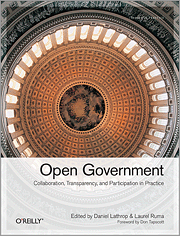
I’m very excited to share I have a chapter in the new O’Reilly Media book Open Government (US Link & CDN Link). I’ve just been told that the book has just come back from the printers and can now be ordered.

Also exciting is that a sample of the book (pictured left) that includes the first 8 chapters can be downloaded as a PDF for free.

The book includes several people and authors I’m excited to be in the company of, including: Tim O’Reilly, Carl Malamud, Ellen Miller, Micah Sifry, Archon Fung and David Weil. My chapter – number 12 – is titled “After the Collapse,” a reference to the Coasean collapse Shirky talks about in Here Comes Everybody. It explores what is beginning to happen (and what is to come) to government and civil services when transaction and coordination costs for doing work dramatically lower. I’ve packed a lot into it, so it is pretty rich with my thinking, and I’m pleased with the result.

If you care about the future of government as well as the radical and amazing possibilities being opened up by new technologies, processes and thinking, then I hope you’ll pick up a copy. I’m not getting paid for it; instead, a majority of the royalties go to the non-profit Global Integrity.

Also, the O’Reilly people are trying to work out a discount for government employees. We all would like the ideas and thinking in this book to go wide and far and around the globe.

Finally, I’d like to give a big thank you to the editors Laurel Ruma and Daniel Lathrop, along with Sarah Schacht of Knowledge as Power, who made it possible for me to contribute.

Carbon Chaos – Celebrating the Launch of an iPhone App

At the beginning of September Gerri Sinclair and I began scheming around me working with a group of her students at the Centre for Digital Media on a project. My initial idea didn’t pan out (more on that in another post) but the students pitched a new idea, one the maintained the original idea of a game that would be fun and that would carry an environmental message.

The result?

Carbon Chaos – an iPhone game designed and built to be fun while educating those who download it about the various advantages and activities of Translink – the transit authority here in the Greater Vancouver area.

And so, with a ton of pride in the students who worked really long hours to create this in a few short weeks here is some beautiful art work they created…

And here is what the game looks like in action…

In short order I hope to share what I learned from the experience and from the students who worked on this (lots of interesting lessons). Needless to say the students deserve infinite praise and I’m eternally grateful to have had the chance to work with them. Amazing, every last one of them. Big thank you’s should also go to their faculty adviser Patrick Pennfather. And finally I know everyone is grateful to TransLink, who sponsored this application and gave it a home. A forward looking organization TransLink, one thinking hard about how technology can transform it – first they opened up their google transit API to the public, then they launched a partnership with Four Square (making each station and a bus a location where you can check in) and of course, they were willing to engage some students on a game they built.

Never, in all my dreams growing up and playing games did I believe that I might one day be a video game producer. Fun, fun, fun. If you have an iPhone, hope you get a chance to download it and see what some emerging developers were able to code up.

Upcoming talks…

A ton of speaking engagements have hit me in the last little bit. Here’s the most up to date list. I think they’ll be some more in the mix soon, but thought I’d throw these out there.

Panelist, Opening up Government Data (Title to be confirmed), Lac Carling 2010, Niagara on the Lake, June 16th, 2010.

Keynote, The Future of Open Government, MISA Annual Conference 2010, Niagara Falls, June 15th, 2010.

Panelist with Michael Geist, Challenges of Open Government in Canada, GOL Communications Victoria, May 28th, 2010.

Speaker, Open Data, Baseball and Government, Gov2.0 Expo Washington, DC, May 26th, 2010.

Panelist with Michael Geist, Challenges of Open Government in Canada, GOL Communications Ottawa, March 25th, 2010.

Panelists, What Guys are Doing to Get Women into Tech, SXSW, Austin TX, March 13, 2010.

Panelists, Social Business Design, Connect IT Conference, Ryerson Business Faculty, March 11th, 2010.

Speaker, Open Government in Canada, O’Reilly’s Gov 2.0 International Online Conference, March 11th, 2010. (details to follow)

Panelist, Panel on Open Government, Centre for Law, Technology, and Society, University of Ottawa, March 5th, 2010 (details to come).

Speaker, Collaboration and Open in Science, Regenstrief Institute, Indiana University, Indianapolis, Feb 17th, 2010.

My Vancouver – Remixing Gary Stephen Ross

If you haven’t read Gary Stephen Ross’s article A Tale of Two Cities in the Walrus, go do it. It is brilliant. Probably the best reflection on Vancouver I’ve read in a long, long time. The piece resonated deeply in a personal way, not only hitting all the right themes about my home city but touching on what about it keeps pushing me away and pulling me back.

(Of course, if you are coming for the Olympics, this is a must read backgrounder.)

I’ve always wanted to write a long form piece on Open Vancouver/Closed Vancouver which ideas in Ross’s piece touch on. So with the lens of that project still in mind I’ve posted some of the piece’s best quotes below as well as some thoughts and the occasional mild remix:

The main reason I moved back was to be close to my family and to explore what I thought was a city on the verge of becoming a place for ideas. It hasn’t been disappointing.

Laugh at the clichés, but understand that leading-edge thinking elsewhere is often the norm here. From North America’s only supervised injection site to a police chief who openly supports the idea of making addiction a public health issue, not a criminal one; from UBC’s breakthroughs in sports medicine to the bold social experiment of the Woodward’s development, which combines public housing with high-end units; from inventors like Phil Nuytten, the father of the underwater Newtsuit, to Internet millionaires like Markus Frind (plentyoffish.com) and Stewart Butterfield (flickr.com); from D-Wave’s breakthrough in quantum computing to Saltworks Technologies’ cost-effective desalination system, Vancouver incubates far more than its share of striking new ideas.

I wasn’t sure of this when I first moved home… But this is a place where ideas get thought. Being part of that is fun. More happens here then people know.

Indeed, if the measure of an idea is how widely it’s disseminated and how passionately it’s embraced, this city is anything but the kayaking, navel-gazing, pot-smoking Lotus Land of popular imagination. It’s a hotbed of entrepreneurship and creativity. “Doesn’t anybody here work?” a visitor joked one October afternoon as we walked past a surprisingly active Kits Beach. Yes, people do work, all the time — just not in head offices, since we have very few. They launch start-ups, they freelance, they find Wi-Fi spots, they unfurl blueprints at Starbucks. They invent, imagine, concoct.

The challenge is that all those ideas don’t create the radiant energy that feeds more ideas. It is hard to feel what is happening in Vancouver. For whatever reason the energy dissipates rather that build and feed others. Is it that too much of it is forced to leave for bigger pastures? Maybe. But at the moment there is something about Vancouver that closes itself not only to outsiders, but to itself.

Ross picks up on this in a quote from Bob Rennie about the failure of Vancouver to leverage its energy and talent.

“‘We need the grand gesture: let’s hire a starchitect, let’s make a statement, let’s go for the splashiest exhibition.’ It grows out of a small-town mentality. We have people here who are royalty in the international art world: Jeff Wall, Ian Wallace, Roy Arden, Brian Jungen. Did you know that Rodney Graham has a major show in Basel this June? But oh no, we couldn’t possibly be good enough to stand on our own merits.”

This is why it sometimes feels like the ideas here go abroad or fade – we don’t incubate or get excited about them.

Part of that is the fault of the cities culture – it is a strangely closed placed. I grew up here but I’ll be the first to say it isn’t always easy meeting people in Vancouver, not like in Toronto (where I can’t stop meeting new people) or Halifax (where everybody is very friendly):

Amid the stereotypes, of course, obscured by them, Vancouverites live substantial, complicated, inaccessible lives. Newcomers say folks here are quick to engage you in a friendly chat but slow to invite you over for dinner. There may be a flaky, hippie vibe to the lineup at Trout Lake Farmers Market on Saturday mornings, but there is a seriousness of purpose as well, an act-on-it conviction that organic tomatoes from the Okanagan are in every way superior to industrial tomatoes from Mexico.

Serious? Maybe. Sometimes the line between seriousness and escapism gets pretty blurry. Many people come to Vancouver to get away – away from the east, away from the head office, away from relatives… away to strike out on their own. And that makes it a city, to a certain degree, of loners. Or at least a city of people who aren’t sure they want you to penetrate their dream.

But the other part of it has to do with the Vancouver’s history which thematically Ross has right…

“Partly it’s that idea of generational wealth that Will and Ariel Durant talk about in The Lessons of History,” says Tom Cooper of City in Focus. “Vancouver’s rich are still in acquisition mode. It’s the third and fourth generation that starts thinking about endowing a chair or funding the arts or charities. We don’t have Carnegies and Rockefellers here, because the wealthy families are still too busy making money to stop and wonder what to do with it.”

…but my feeling is the diagnosis is off (he’s far too nice). It’s not about acquisition. This is a city built with hardworking, sweaty, pioneering (in its day) but conservative money. By that I mean money generated from pulling things off or out of the mountain or ocean. There hasn’t historically been much innovation in mining or logging or fishing – these are relatively conservative industries. And so the money it created is often conservative in that it looks for surefire hits. Projects people know will work before hand. In short, in Vancouver, no one gets fired for flying in three tenors.

Maybe in a bigger city, with more industry and confidence, things would be different. And Ross is smart to point out how small Vancouver actually is.

With a population of about 600,000, it’s a quarter the size of Toronto proper. Edmonton, Calgary, Montreal, and Ottawa have more citizens. Hell, Mississauga has more. Winnipeg has more. Vancouver’s American analogues are not Chicago and New York, but Charlotte, Memphis, El Paso. Include the metro area, and the population swells to 2.2 million, a third of metropolitan Toronto’s. If this city were an actor, it would acquit itself beautifully in a supporting role — Philip Seymour Hoffman before Capote. If it were a fighter, it would be a middleweight, albeit one so slick and well marketed that you think of it as belonging among the heavyweights — any of which would, in fact, clobber it.

To be fair, Vancouver is more dense than Ottawa, Calgary and Edmonton (which is important) but it is also fractured by inlets and rivers. In Toronto probably a million people live within a 10 minute walk of the subway lines… that means a million people have quick access to one another – that’s a lot of connections that can be quickly made, a lot of groups that can easily gather. In Vancouver, it is tougher – although getting better. But Vancouver’s geography may be beautiful, but it is challenging to create a networked city in. Maybe this is why the city has so few of the trappings of a great city:

He rhymes off a list of shortcomings you won’t find in great cities: no downtown university with an adjoining student neighbourhood; no broad pedestrian promenade; no major civic square. A great city is a world unto itself, defying attempts to break it into its constituent elements. Berlin, Rome, New York: these are urban confabulations, memory vying with amnesia, civic magma bubbling and hardening under the weight of history. World-class city? It’s the world, not the city, that gets to decide. Penelope Chester, the daughter of a French publisher, studied in Paris and New York and Boston and travelled the planet before spending a year and a half in Vancouver working for an international NGO. Now based in Liberia, she liked Vancouver but noted that locals “have an exalted sense of their city’s standing in the world, without much experience of the world to support it.”

There is the escapism again. It’s as though the city is gun shy to really face the world, to welcome the harsh sting of criticism, especially when competing on things beyond its beauty. Unchecked the city’s conservative culture could turn it into a Pacific Northwest French Riviera – a play ground and escape for the world’s wealthy. I’m hoping we aim for some kind of green San Francisco/Portland hybrid. But that require competing with our brains. Which we can do, if we choose to. We just have to pick our spaces and align our brains with out values. And hey, when we do it things aren’t that bad:

By the most dependable benchmark we’ve devised — GHGs, or annual greenhouse gas emissions per capita — Vancouver (at 4.9 tonnes) is already the most eco-friendly city in North America, well ahead of New York (10.5 tonnes), Los Angeles (13 tonnes), Seattle (11.5 tonnes), and Toronto (11.6 tonnes). And in just about every reckoning of the world’s eco-friendly cities, Vancouver ranks up there with Reykjavik, Copenhagen, and Malmö.

But being green alone does not make for a great city. It requires a vision, an ability to weave together the different visions of what Vancouver could be, and, most of all, to acknowledge and talk to one another. Here Ross understands Vancouver like few other observers I’ve read. He’s right the Two Solitudes are different in Vancouver. While this city barely even knows its part of a national solitude (Indeed, it often barely knows its part of a country, – national identity isn’t disliked, people are quite found of and proud of being Canadian – its just more that its a vague afterthought) here the Solitudes that matter here are in the city, solitudes of neighbourhoods, wealth and ethnic communities…

You want drug addiction and wrenching, in-your-face psychosis the likes of which you’ll find nowhere else? Stroll through the Downtown Eastside, a twenty-square-block human zoo. Want to visit an Asian enclave that’s a cyberlike parallel universe? Check out the Aberdeen mall in Richmond, south of the city proper: two solitudes, Pacific variety.

Overcoming these solitudes is no insignificant challenge – and maybe the challenge for a city looking to its next step. Do its citizens want to tackle it? I don’t know. Vying to be a great city vs. staying in the velvet rut and settling for a really nice northern Charlotte. The former requires work, the latter… is effortless.

The great paradox of Vancouver is that as green and hippy as it is, it is also the most conservative city in Canada – not in how it votes, but it how it sees itself going forward. If the world tells you you are the best place on earth (which the UN or the Economist does almost every now) the natural question that emerges is… why change anything?

That’s the collective inertia that sometimes defines the place. So much individual talent, but collectively the energy, and the confidence, dissipates too quickly. Every once in a while it doesn’t… and that’s when the magic here really happens. My hope is that we can find a find a way to be like that all the time. That’s what I hope happens when we grow up.