Category Archives: public policy

Three Ways Anyone Can Contribute to Open Data Day

With well over 90 cities now scheduled to partake in Open Data Day and with several events expecting 50+ and even 100+ participants I wanted to outline some thoughts to help people who are thinking about participating but not sure what to expect or if they have anything helpful to offer.

First things first.

You can help. You have something to offer.

Second. You are not alone. Many people are not sure what to expect nor what they will do. If you come with a sense of play, curiosity and a willingness to work with others, you will find something interesting to do. And, of course, you will have amazing local organizer who, from what I’ve seen on the wiki and the web, have worked very hard to find a great venue, put together great agendas and reach out to other great people at the event you’ll be attending.

So here are two things even someone who knows next to nothing can do and five projects to consider exploring:

1. Mock Up Your Idea

Not everyone can code. I can’t code! But coding is only one part of a series of activities that can lead to an interesting project. The first… is thinking of an interesting project.

If you have an idea, one of the simplest and best things you can do is “spec” the idea out. Open up Keynote, Powerpoint, or Google Present and create a fake “screenshot” of what you think your app should look like, describe what it would do, and outline why someone would use it. This is probably the simplest most straightforward thing you can do and the most helpful to get others to undestand and want to be part of your idea. I’ve done this a few times, and on several occasions, developers have taken the idea and created it!

The most important thing is to create something. That way others can read about it, build on it or critique/improve it. If you don’t create something, it can’t grow!

You can see an example here where I used keynote to edit a website to add a feature I thought it needed! (plus a whole blog post describing it)

2. Be an Astronaut. Document what you do.

During a recent hackathon I gave an opening address where I urged participants to “be an astronaut.” Not because astronauts are cool (they are). But because of the ultimate (somewhat depressing) responsibility astronauts have – they document and share everything they do so that the next person doesn’t suffer the same fate as them if anything goes wrong.

Hackathons are an effort to create a fun environment to encourage experimentation and foster learning, but that doesn’t mean people have to leanr the same lesson over and over again.

One of the most helpful thing I’ve seen people do during a hackathon is keep a running blog of what the developers were doing. They documented the steps they took, the ideas they researched and the scripts/libraries/etc… they used.

If the project was interesting, these “documentaries” can be helpful to get others involved. If the project is a disaster then, like an astronaut, your piece can be a warning to others so they don’t repeat your mistakes and try alternatives. Even a failure can inspire others to try something that ends up working. Indeed, that is how a lot of innovation takes place.

3. Identify some data worth scraping or share a new data set

While I love open data, there remains a lot of juicy, good government data that is, well… not open. So locating a juicy data set that you think could help shed new perspectives on a problem or help people take action is itself quite valuable. For example, I’m hoping to find a way to “scrape” (e.g. create a re-usable copy) of the City of Vancouver’s budget as well as the provincial budget.

But we don’t have to just focus on governments. I love the call to action in Oakland for its Open Data Day where they are asking non-profits:

“Do you work for or run an Oakland based nonprofit organization? Do you have data problems? Do you have data needs? Because if you do, we can help!”

I’ve always wanted to find ways to get non-profits involved in open data and just thinking about data analysis, so love that open data day can be a vehicle for this.


CivicOpen: New Name, Old Idea

The other day Zac Townsend published a piece, “Introducing the idea of an open-source suite for municipal governments,” laying out the case for why cities should collaboratively create open source software that can be shared among them.

I think it is a great idea. And I’m thrilled to hear that more people are excited about exploring this model, and think any such discussion would be helped with having some broader context, and more importantly, because any series of posts on this subject that fails to look at previous efforts is, well, doomed to repeat the failures of the past.

Context

I wrote several blog posts making the case for it in 2009. (Rather than CivicOpen, I called it Muniforge.) These post, I’m told, helped influence the creation of CivicCommons, a failed effort to do something similar (and upon which I sat on an advisory board).

Back when I published my posts I thought I was introducing the idea of shared software development in the civic space. It was only shortly after that l learned of Kuali – a simliar effort that was occurring the university sector – and was so enamoured with it I wrote a piece about how we should clone its governance structure and create a simliar organization for the civic space (something that the Kuali leadership told me they would be happy to facilitate). I also tried tried to expose anyone I could to Kuali. I had a Kuali representative speak at the first Code for America Summit and have talked about it from time to time while helping teach the Code for America Fellows at the beginning of each CfA year. I also introduced them to anyone I would meet in municipal IT and helped spur conference calls between them and people in San Francisco, Boston and other cities so they could understand the model better.

But even in 2009 I was not introducing the idea of shared municipal open source projects. While discovering that Kuali existed was great (and perhaps I can be forgiven for my oversight, as they are in the educational and not municipal space) I completely failed to locate the Association des développeurs et utilisateurs de logiciels libres pour les administrations et les collectivités territoriales (ADULLACT) a French project created seven(!) years prior to my piece that does exactly what I described in my Muniforge posts and what Zac describes in his post. (The English translation of ADULLACT’s name is the Association of Developers and Users of Free Software for Governments and Local Authorities; there is no English Wikipedia page that I could see, but a good French version is here.) I know little about why ADULLACT has survived, but their continued existence suggests that they are doing something right – ideas and processes that should inform any post about what a good structure for CivicOpen or another initiative might want to draw upon.

Of course, in addition to these, there are several other groups that have tried – some with little, others with greater, success – to talk about or create open source projects that span cities. Indeed, last year, Berkeley Unviersity’s Smart Cities program proclaiming the Open Source city arrived. In that piece Berkeley references OpenPlans, which has for years tried to do something similar (and was indeed one of the instigators behind CivicCommons – a failed effort to get cities to share code. Here you can read Philip Ashlock, who was then at OpenPlans, talk about the desirability of cities creating and sharing open source code. In addition to CivicCommons, there is CityMart, a private sector actor that seeks to connect cities with solutions, including those that are open source; in essence it could be a catalyst for building municipal open source communities, but, as far as I can tell, it isn’t. (update) There was also the US Federal Government’s Open Code Initiative, which now seems defunct, and Mark Headd of Code for America tells me Google “Government Open Code Collaborative” but to which I can find no information on.

To understand why some models have failed and why some models have succeeded, Andrew Oram’s article in Journal of Information Technology and Politics is another good starting point. There was also some research into these ideas shared at the Major Cities of Europe IT Users Group back in 2009 by James Fogarty and Willoughby that can be read here; this includes several mini-case studies from several cities and a crude, but good, cost-benefit analysis.

And there are other efforts that are more random. Like  The Intelligent/Smart Cities Open Source Community which for “anyone interested on intelligent / smart cities development and looks for applications and solutions which have been successfully implemented in other cities, mainly open source applications.”

Don’t be ahistorical

I share all this for several reasons.

  1. I want Zac to succeed in figuring out a model that works.
  2. I’d love to help.
  3. To note that there has been a lot of thought into this idea already. I myself thought I was breaking ground when I wrote my Muniforge piece back in 2009. I was not. There were a ton of lessons I could have incorporated into that piece that I did not, and previous successes and failures I could have linked to, but didn’t (until at least discovering Kuali).

I get nervous when I see posts – like that on the Ash Centre’s blog – that don’t cite previous efforts and that feel, to put it bluntly, ahistorical. I think laying out a model is a great idea. But we have a lot of data and stories about what works and doesn’t work. To not draw on these examples (or even mention or link to them) seems to be a recipe for repeating the mistakes of the past. There are reasons CivicCommons failed, and why Kuali and ADDULACT have succeeded. I’ve interviewed a number of people at the former (and sadly no one at the latter) and this feels like table stakes before venturing down this path. It also feels like a good way of modelling what you eventually want a municipal/civic open source community to do – build and learn from the social code as well as business and organizational models of those that have failed and succeeded before you. That is the core of what the best and most successful open source (and, frankly many successful non-open source) projects do.

What I’ve learned is that the biggest challenge are not technical, but cultural and institutional. Many cities have policies, explicit or implicit that prevent them from using open source software, to say nothing of co-creating open source software. Indeed, after helping draft the Open Motion adopted by the City of Vancouver, I helped the city revise their procurement policies to address these obstacles. Indeed, drawing on the example mentioned in Zac’s post, you will struggle to find many small and medium sized municipalities that use Linux, or even that let employees install Firefox on computers. Worse, many municipal IT staff have been trained that Open Source is unstable, unreliable and involves questionable people. It is a slow process to reverse these opinions.

Another challenge that needs to be addressed is that many city IT departments have been hollowed out and don’t have the capacity to write much code. For many cities IT is often more about operations and selecting who to procure from, not writing software. So a CivicOpen/Muniforge/CivicCommons/ADULLACT approach will represent a departure into an arena where many cities have little capacity and experience. Many will be reluctant to built this capacity.

There are many more concerns of course and, despite them, I continue to think the idea is worth pursuing.

I also fear this post will be read as a critique. That is not my intent. Zac is an ally and I want to help. Above all, I share the above because   the good news is this isn’t an introduction. There is a rich history of ideas and efforts from which to learn and build upon. We don’t need do this on our own or invent anew. There is a community of us who are thinking about these things and have lessons to share, so let’s share and make this work!

A note to the Ash Centre

As an aside, I’d have loved to linked to this at the bottom of Zac’s post on the Havard Kennedy School Ash Centre website, but webmaster has opted to not allow comments. Even more odd is that it does not show any dates on their posts. Again, fearing I sound critical but just wanted to be constructive, I believe it is important for anyone, but academic institution especially to have dates listed on articles so that we can better understand the timing and context in which they were written. In addition, (and I understand this sentiment may not be shared) but a centre focused on Democratic Governance and Innovation should allow for some form of feedback or interaction, at least some way people can respond to and/or build on the ideas they publish.

#Idlenomore as an existential threat

Almost three years ago (although I only worked up the nerve to post it two years ago, so sensitive is the topic), I wrote a blog post about First Nations youth, and how I suspected they were going to radically alter Canada’s relationship with First Nations, and likely change the very notion of how people understand and think about First Nations peoples.

If you haven’t read that old post, please consider taking a look.

To be clear, I’m not claiming I predicted #idlenomore, but thanks to an amazing opportunity to be part of the Environics Institute and the  Urban Aboriginal Peoples Study, it was plainly obvious to me some tectonic shifts were occurring.

Now I want to go further out on a limb.

Back in May 2010, I said the next First Nations debate won’t include you (e.g. non-aboriginals). And despite what Idle No More looks like, I don’t think it does include most non-First Nations. My sense – which could be completely off-base, but which I posit in my previous post – is that there is an internal debate within the First Nations community about leadership, identity, power, institutions and First Nations’ relationship with Canada. Yes, #idlenomore is about the omnibus bill, and about First Nations’ role in Canada, but it is also about  how First Nations organize and see themselves. And it is fostering conversations and relationships within their community that will not create a single unitary consensus, but that will change the way First Nations relate and talk to the rest of Canada, their expectations of their leadership, and equally importantly, their expectations of us. They will be better prepared for the next conversation they want to have with non-aboriginal Canadians.

It will be exciting. And we non-aboriginals will be utterly unprepared.

This is because we don’t want to talk about these issues. Worse, we don’t know how to. And, most critically, we’re deeply scared to. In the minds of many Canadians, Idle No More represents an existential threat to the notion of Canada.

Why? Because it challenges us in deeply uncomfortable ways.

It challenges core notions of Canadian identity. Canadians believe people should be given a fair chance and that they should be treated equally. A conversation about #idlenomore would force Canadians to engage in a dialogue about equality and fairness on terms we might find uncomfortable. Canadians know many First Nations live in third-world conditions, but they mostly want the government to make the problem go away.

It challenges our sense of history. Few Canadians – and the current government especially – like to explore or understand the role of First Nations in our history. The First World War and our connections to “empire” earn more attention in curriculum than a complex exploration of the fact that Canada is a colony, and has embraced some of the darkest aspects that come with colonialism. There is racism in Canada. There is structural inequity. It doesn’t mean that Canada is racist, or that Canadians are racist. But there is racism. And we can’t even talk about it. Indeed, at present we seem fixated on celebrating pitched battles that defined the state, not the relationships, choices, and elements of our history that define our culture and critically explore who we are as a people.

And it challenges our institutions: Canadians fear that a conversation about First Nations threatens to undermine the role of parliament, of non-aboriginal rights to decide what happens in their community. In Vancouver – a complex place for First Nations/non-First Nations relations – many residents pass a giant glowing billboard erected by First Nations next to the Burrard Street bridge and fear that is the future in a renegotiated world. Don’t underestimate the scope and power of these fears. Just look at Christy Blatchford – a columnist who in one week mocks both the validity of First Nations as entities and the treaties we signed since they “were expected to be in place ‘as long as the sun shines, the grass grows and the river flows,'” and sees no irony in arguing the very next week that the unwillingness of the police to execute a judge’s order to dismantle a First nations barricade is a threat to the rule of law. So clearly, inconvenient treaties with First Nations – cited in our constitution – are disposable, while an order from a provincial judge is sacrosanct. It takes a special sense of privilege to believe these two ideas are compatible. Challenging our institutions will feel threatening, particularly to the beneficiaries of our current system (and let’s face it, non-aboriginals do pretty well by the status quo). This will create fear. Some of the concerns will be legitimate. Just as the fears, concerns and aspirations of First Nations are also legitimate. But fear is not a legitimate reason to avoid having a conversation.

Today, First Nations are having an internal conversation, as well as a debate with the Canadian state. But at some point, this conversation will be had with Canadians writ large. It might not be a single national conversation – it might be a million small ones that happen as an increasingly urban, educated and confident First Nations cohort become co-workers, neighbours and friends of more and more Canadians. And when that conversation happens, my hope is that we’ll recognize that it is an existential threat to what we believed Canada was. And much like #idlenomore is changing First Nations communities, this conversation will create a new understanding of Canada – in the same way a still ongoing conversation about Sikhs, Chinese, Jamaicans and other immigrants changed who we are and how Canadians saw themselves.

I just hope we handle the conversation well. And I confess I have no idea how to get prepared. Engaging the other is never easy, whether you are aboriginal or non-aboriginal. But think about attending a protest; don’t shy away from the articles (though, try to find stuff actually written by someone who is First Nations, rather than a pundit in a newspaper); and mostly, be open to the possibility for conversation and prepare to be triggered, and think about how you want to react when it happens.

So far, New Zealand is the only country I’ve seen that has had this conversation with its indigenous peoples in any meaningful way. I’m working on trying to find out more about how that process – which I’m sure was far from perfect – emerged and took place.

Because maybe it is time non-aboriginals get prepared, too. It would be a basic expression of respect.

The Northern Gateway Brief: Unhappy Political Options & Geo-Political Assessment

I spent much of last week in Alberta which, as anyone who has traveled across Canada knows, is a very different place from BC. While there, it became increasingly clear that talking about the oil sands in general, and the northern gateway pipeline in particular, was verboten. I spent my week in a Fawlty Towers episode: whatever I did… I couldn’t mention the war pipeline.

In Alberta, it seems an article of faith that the pipeline is going to be built. It was interesting contrast since, in British Columbia, it is virtually accepted that the Northern Gateway pipeline is not going to be built (and there is equally great opposition to the Kinder Morgan pipeline). At some point these two realities are going to clash. And that makes for interesting questions.

This post is not designed to be a definitive piece on the subject. I’m not an energy expert and don’t claim to understand this issue as well as others. However, I’ve not read anything like this to date and thought it might be interesting to outline a short intelligence brief for those curious about where things may be headed. Based on conversations I’ve had with people in the natural resource sector, government, environmental groups and first nations this is an effort to explore what I think are the likely scenarios and choices for our government, as well as what it may mean for foreign governments with an interest in the outcome.

Some Assumptions

If, as you begin to read this piece you are saying – err… what does David mean by the pipeline, I suggest a brief scan of the Enbridge Northern Gateway Pipeline, which will run across Northern British Columbia and allow oil from Alberta’s oil sands to be exported from the west coast port of Kitimat. While I won’t talk about them as much, a reader will benefit from being aware of the proposed Kinder Morgan Pipeline expansion and Keystone Pipeline. However, knowing about them is not a strict requirement.

In case anyone takes the time to read what I suspect will be a lengthy post… yes, I, like a large and growing number of BC residents, have deep reservations about the pipeline. My interest here however is less about whether the pipeline will happen – although I dive into that – and more about what I think that means for the choices of various players, which I think is quite interesting.

The New National Energy Policy: Why the Pipeline (Probably) Won’t Happen

I confess, sitting in British Columbia, it is very hard to imagine the pipeline being built. The fact is, most British Columbians – 60% – are opposed to the project, and that number has been growing, not shrinking. Each day, the project becomes more tarnished and unpopular.

At this point, a massive negative backlash against any political party set on ramming the project through British a very real possibility. It is hard to imagine the current government could have handled the communications around this project in a more inept manner. Environmental Minister Joe Oliver’s rant statement effectively labeling anyone opposed or concerned as a radical did more damage than any environmentalist campaign could have imagined. Those concerned about, but open to discussing the pipeline, felt attacked and grew suspicious that they would have no voice. As the polls reveal – they have turned sharply against the project.

The National Energy Program of 1980 – when a Liberal federal government forced Alberta to sell oil to central Canada at below market prices – is political lore in Alberta. It turned the province forever against the Liberals and become a major source of “western” grievance. Of course, British Columbians feel like they now are about to become the victims of a new National Energy policy, one that sees the export of Alberta’s oil subsidized by British Columbia, which will have to assume billions of dollars in environmental and economic risk while seeing relatively little economic benefit.

Given BC is about to acquire six new seats in the House of Commons, holding on to, and acquiring more of those seats is critical to Conservative’s efforts to maintain a majority. The concerns of British Columbians will not be taken lightly – one can imagine the discomfort of the BC caucus in the party. Indeed this August 2012 Abacus poll showed that “In BC… 41% of 2011 Conservative Party voters oppose the pipeline with 21% strongly opposed.”

Terrible Choices

This leaves the Federal Government in an exceedingly sticky position on multiple fronts. The government has, of course, been pushing Canadian oil across the Pacific, which has helped spur significant Asian investment in the oil sands; witness the  $15.1-billion acquisition of Calgary-based Nexen Inc. by China National Offshore Oil Corporation (CNOOC) and $5.2-billion acquisition of Calgary-based Progress Energy Resources by Malaysia’s Petronas.

If the pipeline were now not to be built, the promises of access to Alberta oil across the Pacific would be greatly damaged; so too, I suspect, would be the access to foreign capital needed to develop the capital-intensive oil sands.

On the other hand, if the pipeline were to be built, the Conservatives would be significantly exposed to suffering major, and possible majority-ending losses, in British Columbia.

This means that all the current scenarios are not great for the government.

The first scenario assumes that the National Energy Board (NEB) – which is conducting a review of the pipeline (including an environmental review) – approves the project and that it gets built. This is a disaster. The risks of a new “National Energy Program” this time directed against British Columbia by Conservatives could wipe the party off the political map in BC much as it did the Liberals in Alberta after the 80s.

The second assumes the NEB approves it – however, the pipeline is bogged down for at least 10 years in litigation from First Nations and environmental groups (if not much, much longer). What makes this so friendly is that it may allow the government to appear to support the pipeline while nothing actually happens. It may thus be able to preserve its political base in BC since the facts on the ground don’t change much and can continue to cast its favourite enemies – environmentalists and, less publicly spoken, First Nations – as the enemies of progress. Ranting against the former could serve as a useful rallying cry for fundraising – much like the gun registry – for many years.

That said, foreign investment would probably suffer – how much I don’t know – but it is hard to imagine much Asian money flowing into the oil sands at this point.

Of course, if the NEB doesn’t approve the project, things get worse. Much worse. Now the only way for things to move forward is for the cabinet to overrule or find a workaround of the NEB’s decision (assuming this is possible).

If the Government doesn’t overrule the NEB, it is essentially telling Asia that its promises and commitments to exporting oil are empty. Do not expect a “Team Canada” trade mission to be welcome in the capitals of Malaysia or Beijing any time soon. Worse, expect Alberta – particularly Conservatives in Alberta – to be livid. The implications for the party’s internal dynamics could be significant.

However, if the government does find a way to overrule the NEB, this would constitute a direct attack on the interests of British Columbia. Conservatives would become even less electable than in scenario one. It would be a disaster. It is no wonder that even Joe Oliver – the aforementioned minister with the rant that killed the project – is softly using language that backs away from such an outcome.

The Escape Hatch

This leaves a final – and what I believe to be most probable – scenario. I expect that under intense pressure from the Conservative government, Enbridge will withdraw its proposal before the NEB rules on it.

Why?

Because this would save the government from having to make any of the damning political choices above – choices that would either damage the Conservative base in BC, damage the government’s credibility with foreign investors, or both. Yes, this would be a crushing blow to Enbridge, and significantly embarrassing for the government, but the alternatives are likely much worse, especially if the NEB does not approve the project. Of course, I’ve no idea if Enbridge would go along with such a plan, but I suspect that opposing a sitting government – one stacked with allies – is probably not appealing either.

I’m open to the possibility of being wrong about this; it is, of course, impossible to know the future, but my sense is that the interests and pressures facing the various parties involved leave this as a highly appealing option.

Out of the Frying Pan…

Of course, all of this has even more interesting implications south of the border.

There, President Obama still has to decide whether or not he wishes to approve the Keystone Pipeline, which would connect the oil sands with refineries in the United States. Approval for this pipeline was denied prior to the US election – in part, I believe, so as to not to alienate environmentalists. However, many – including myself – assumed that it would be approved after the election. I assumed in part this was to make the already controversial Gateway project less necessary (I suspect people in BC will be even less interested in Gateway if Keystone is approved) and thereby hurt China’s access to oil while securing more for the US.

However, because of the mismanagement of the Gateway project, the risks of it getting built have vastly diminished. Add on the prediction that the US will likely become self-sufficient in oil within two decades, and the calculus has changed. Now the president could further boost his environmental credentials, not worry about energy and not worry about enhancing China’s involvement in the North America energy market. Whereas I previously thought Keystone was a slam dunk decision, now… I’m not so sure.

If Keystone is not approved, this would be an unmitigated disaster for the government. The Gateway and Kinder Morgan pipelines – along with the political quagmire surrounding them – would become even more significant. Needless to say, if all three failed to materialize it would be hard to imagine much more development in the oil sands, if only because there would be no capacity to get the oil to any market.

You Do It To Yourself

Again, I’m sure there are flaws in the above assessment. What is most unclear to me is if cabinet can “overrule” the NEB or not. Having read some on this, it remains a mystery to me. I’ve assumed it can, but if it cannot, that would change the scenarios or, at least, eliminate some.

What I think is most interesting about all of this is that these wounds were virtually all self-inflicted. By alienating anyone with concerns about the pipeline, the government made enemies out of much of the BC public it needed for support. Of course, Enbridge has been the entity that has had to bear the majority of this negative public opinion. This has been a master stroke, since while Enbridge has been largely incompetent in its communications, it has not been malicious. It is the government, not Enbridge, that has employed an aggressive stance with environmental groups and others.

Either way, supporters of the pipeline will have a hard time blaming others for its likely failure to materialize. The project was always going to be a tough sell in a province that – while big on developing natural resources – has been home to some of the world’s largest environmental protests. But I really couldn’t imagine a worse bungled communications strategy – one that might end up having big implications for Canada’s domestic political scene, but also for its relations in Asia, and south of the border.
Launching the Canadian OGP Civil Society Discussion Group

Dear colleagues,

We are Canadians who have been actively involved with the Open Government Partnership (OGP) process, including by participating in the OGP meeting in Brasilia in April 2012. The OGP is a joint government – civil society initiative to promote greater openness, participation and accountability in countries which have already attained a minimum standard of openness. Canada joined the OGP in September 2011.

Participation by interested stakeholders is a key feature of the design of the OGP. There is equal representation of civil society and government representatives on the lead body of the OGP, the Steering Committee. More importantly, a key mechanism of the OGP is for countries to develop and then implement Action Plans setting out their commitments for moving forward in terms of openness, participation and accountability. Governments are formally required to consult extensively with civil society and other interested stakeholders in developing and delivering on their Action Plans. Civil society will also play a key role in reporting on progress in implementing Action Plans, including through its participation in a parallel Independent Reporting Mechanism, which will present its findings on progress alongside those of the government.

In several countries, civil society groups and other stakeholders have formed networks or coalitions to work together to help ensure effective external input into the development, implementation and evaluation of Action Plans. We are proposing to set up such a network in Canada and we are proposing, as a first step, to establish a discussion list involving external (i.e. non-government) groups and individuals who have a demonstrated commitment to open government and who are interested in getting engaged in this important work. We envisage this as a loose and open network, through which anyone could propose discussions, ideas or action points relating to OGP. The network would have no voice or right of action of its own, and so participation in the network or the discussion list would not involve any obligations or engagements.

As an example of how the network might work, we note that, to date, Canada has not complied with its OGP obligations in the area of consultations. There was very limited civil society or other stakeholder participation in the development of the Action Plan, which Canada presented in Brasilia in April, and there has been little consultation since then on implementation of the Plan. The network might through the e-list discuss this issue and come up with actions which interested groups and/or individuals could participate in (always on a voluntary basis).

Please let us know if you are interested in joining such an initiative. To join, visit: http://lists.opengovcanada.ca/mailman/listinfo/ogp_lists.opengovcanada.ca and follow the subscription instructions. If you have any questions, please send these to admin@ogp.opengovcanaca.ca.

Thanks for your attention and interest in these key issues.

David Eaves,
Open Government Advocate and OpenNorth Board Member
Vancouver, BC

Michael Gurstein Ph.D.
Centre for Community Informatics Research, Development and Training
Vancouver, BC

Toby Mendel
Executive Director, Centre for Law and Democracy
Halifax, NS

The Journal News Gun Map: Open vs. Personal Data

As many readers are likely aware two weeks ago The Journal News, a newspaper just outside of New York city, published a map showing the addresses and names of handgun owners in Westchester and Rockland counties. The map, which was part of a story responding to the tragic shooting in Newtown, Connecticut, was constructed with data the paper acquired through Freedom of Information requests. Since their publication the story has generated enormous public interest, including a tremendous amount of anger from gun owners and supporters. The newspaper and its staff have received death threats, had their home addresses published and details of where their kids attend school published. Today the newspapers headquarters are guarded by… armed guards.

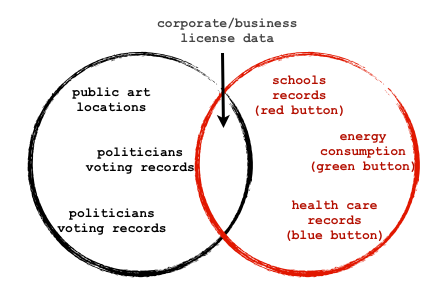
While there is a temptation to talk about this even in terms of open data, I don’t think this is a debate about open data. This is a debate about privacy and policy.

Let me clarify.

There is lots of information governments collect about people – the vast majority of which is not, and should not be available. As both an open data advocate and a gov 2.0 advocate I’m strongly interested in ensuring that – around any given data set – peoples sense of privacy is preserved. There are of course interests that benefit from information being made inaccessible, just as there are interests that benefit from it being made accessible, but when it comes to individually identifying pieces of information, I prefer to be cautious.

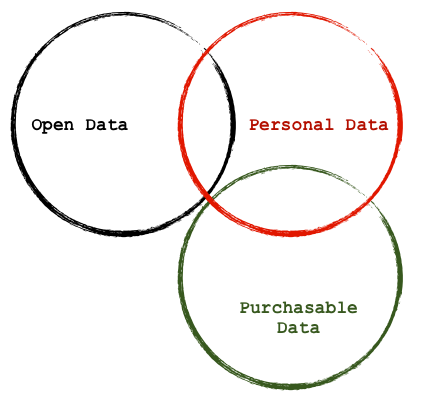
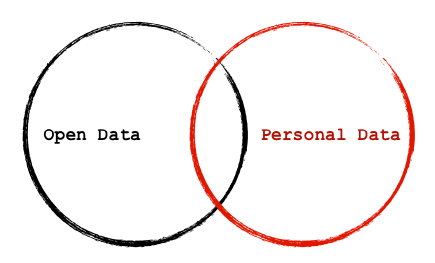
Ven-pers-vs-open

So, from my perspective, it is critical that this debate not get sloppy. This is not about open data. It is about personable identifiable data – and what governments should and should not do with it. Obviously “open” and “personal identifiable” data can overlap, but they are not the same. A great deal of open data has nothing to do with individuals. However, if we allow the two to become synonymous… well… expect a backlash against open data. No one ever gave anyone a blank check to make any and everything open. I don’t expect my personal healthcare or student record to be downloadable by anyone – I suspect you don’t either.

This is why – when I advise governments – I try to focus on data that is the least contentious (e.g. not even at risk of being personally identifying) since this gives public servants, politicians and the public some time to build knowledge and capacity around understand the issues.

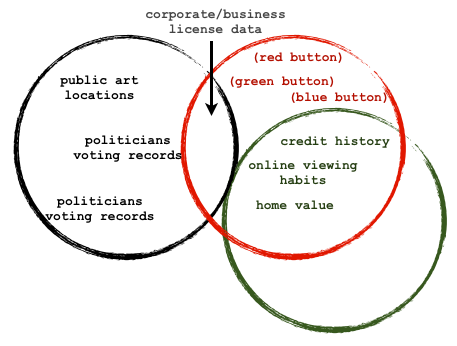
open-vs.-pers-details

This is not to say that no personalbly identifiable data should be made available – the question is, to what end? And the question matters. I suspect privacy played a big part if the outcry and reaction to the Journal’s gun map. But I suspect that for many – particularly strong pro-gun advocates – there was a recognition that this data was being used as a device (of VERY unclear efficacy) to accelerate public support for stricter gun laws. So they object not just to the issue of privacy, but to the usage.

In the case of guns, I don’t know what the right answer is. But here is an example I feel more confident about. Personally I (and many others) believe businesses license data should be open, including personal identifiable data. But again, these are issues that need to be hammered out, debated and the public given choices. This is not where the open data discussion needs to start, and this is certainly not how it should be defined in the public, as it is much, much more that that and includes touches many issues that are far, far less contentious. But we need to be building the capacity – in the public, among politicians and among public servants – to have these conversations, because disclosure, or the lack thereof, will increasingly be a political and policy choice.

And many of these questions will be tricky. I also believe data should be made available in aggregate. While I understand there are risks I believe  researchers should be allowed to use large data sets to try to find out how age or other factors might effective a terrible medical condition, or to gain insights into how graduation rates of at risk groups might be improved. These are big benefits that are – again, for me, worth the risk. But they will of course need to constantly be weighed and debated. What personal data should also be allowed to become open data, under what circumstances and to whose benefit… these are big questions.

So, if you are an open data advocates out there – please don’t let people confuse Open Data with Personal Data. The two can and almost certainly will overlap at times. But that does not make them the same thing. If these two terms become synonymous in the public’s mind in ANY way, it could take years to recover. So educate yourself on privacy issues, and be sure to educate the people you work with. But above all, help them get ready for these debates. More are coming.

Some additional Thoughts

Of course, when it comes to data, if you are really worried about personally identifiable stuff, there is a lot more to fear that isn’t maintained by governments. The world of free and purchasable data contains a lot of goodies (think maps, stock prices, etc…) but there is also plenty of overlap with personal data as well.

3way-ven

Indeed, much of the retaliatory data about the employees of The Journal News was data that was personally identifiable and readily available. A simple look at who I follow on twitter would likely reveal a fair bit about my social graph to anyone. And this isn’t even the juicy stuff. One wonders how many people realize just how much about them can be purchased. Indeed accessing some information has become so common place people don’t even think about it anymore: my understanding is that almost anyone can get a copy of your credit score, right?

3way-ven-detailed

That siad, I recognize the difference between data the state forces you to disclose (gun ownership) and that which you “voluntarily” submit and cede control over so as to take part in a service (facebook friends). I don’t always like the latter, but I recognize it is different from the government – it is one thing to have a monopoly on violence it is another to have a terrible EULA. That said, I suspect that many people would  be disturbed if they saw exactly how many people were tracking all of the things they do online. Mozilla’s Collusion project is a fun – if ultimately fruitless – tool for getting a sense of this. It is worth doing for a day just to see who is watching what you watch and do online.

I share all this not because I want to scare anyone – indeed I suspect these additional notes are old hat to anyone still reading, but recognize how complex the public’s relationship with data is. And as much as it will upset my privacy advocacy friends to hear me say this: my sense is that public is actually still quite comfortable with vast amounts of data about them being collected (Facebook seems to be able to do whatever it wants with almost no impact on usage). Where people get finicky is around how that data gets used. Apparently, be sold to more effectively doesn’t bother them all that much (although I wish some algorithm could figure out that I’ve already bought a fitbit so there ads need no longer follow me all over the web). However, try to use it to take away their guns… and some of them will get very angry. Somewhere in there a line has been drawn. It has all the makings of an epic public policy and corporate policy nightmare.

The South -> North Innovation Path in Government: An Example?

I’ve always felt that a lot of innovation happens where resources are scarcest. Scarcity forces us to think differently, to be efficient and to question traditional (more expensive) models.

This is why I’m always interested to see how local governments in developing economies are handling various problems. There is always an (enormous) risk that these governments will be lured into doing things they way they have been done in developing economies (hello SAP!). Sometimes this makes sense, but often, newer, disruptive and cheaper ways of accomplishing the goal have emerged in the interim.

What I think is really interesting is when a trend started in the global south migrates to the global north. I think I may have just spotted one example.

The other week the City of Boston announced its City Hall to Go trucks – mobile vans that, like food trucks, will drive around the city and be at various civic events available to deliver citizen services on the go! See the video and “menu” below.


city-hall-menu-225x300

This is really cool. In Vancouver we have a huge number of highly successful food carts. It is not hard to imagine an experiment like this as well – particularly in underserved neighborhoods or at the numerous public festivals and public food markets that take place across the city.

But, as the title of this post suggests, Boston is not the first city to do this. This United Nations report points out how the state government of Bahia started to do something similar in the mid 90s in the state capital of Salvador.

In 1994 the Government of Bahia hosted the first of several annual technology fairs in the state capital, Salvador. A few government services were offered there, using new ICT systems (e.g., issuing identification cards). The service was far more efficient and well-received by the public. The idea was then raised: Why not deliver services this way on a regular basis?

…A Mobile Documents SAC also was developed to reach the most remote and deprived communities in Bahia. This Mobile SAC is a large, 18-wheel truck equipped with air-conditioning, TV set, toilets, and a covered waiting area. Inside the truck, four basic citizenship services are provided: issuance of birth certificates, identification card, labor identification card, and criminal record verification.

I feel very much like I’ve read about smaller trucks delivering services in other cities in Brazil as well – I believe one community in Brazil had mobile carts with computers on them that toured neighborhoods so citizens could more effectively participate in online petitions and crowdsourcing projects being run by the local government.

I’m not sure if the success of these projects in developing economy cities influenced the thinking in Boston – if yes, that is interesting. If not, it is still interesting. It suggests that thinking and logic behind this type innovation is occurring in several cities simultaneously, even if when these cities have markedly different levels of GDP per capita and internet access (among many other things). My hope is that those in government will be more and more willing to see how their counterparts elsewhere in the world – no matter where – are doing things. Money is tight for governments everywhere, so good ideas may be more likely to go from those who feel the burden of costs the greatest.

Uber in Vancouver: Some Thoughts for the Passenger Transportation Board

So last week the B.C. Passenger Transportation Board (PTB) effectively shut down Uber in Vancouver by compelling the rides they arrange must charge a minimum $75 a trip, regardless of distance. Shortly after being announced, twitter lit up as Uber notified its customers of the decision and the hashtag #UberVanLove began directing angry (and deserved) tweets at government officials.

My thoughts on all this are evolving but I think the PTB has made a poor decision and hope that a compromise can be found.

Here’s a long piece explaining why.

Uber is different. Most people think that Uber is simply a new middleman, trying to cut out the current dispatchers (or work with them). This is not true, they are much more than that. As you can read in this Time magazine article, Uber is not just about connecting riders with drivers. For example:

Abyzov says the company has a “science team” working on dispatch algorithms to produce a predictive heat-map that helps local car companies and their drivers better anticipate rider demand. “We’re helping our partners build successful small businesses,”

So let’s be clear. This is about a learning company that is figuring out how to preposition cars in neighborhoods because it can anticipate demand. As far as I know (or have experienced) There is no taxi or town-car company in the lower-mainland that is even thinking that way. And this type of thinking has big implications. In San Francisco, it means the average wait time for an Uber car is 3 minutes.

Think about that for a second (I’m looking at you PTB).

This means that:

  • Efficiency: People are getting around the city much faster – increasing their productivity. For a city trying to compete globally, this matters.
  • Reliable: I’ve had taxi companies not commit to send me a car when I’m not at a fixed address because they assume I’ll hop in a roaming taxi before the one I ordered arrives. Because Uber let’s you rate the taxi, but also lets the taxi rate you, it increases the reliability of both taxis and passengers. This means fewer taxies chasing passengers who aren’t there, and fewer passengers left stranded by untrusting dispatchers.
  • Fewer cars: People are much more likely to get out of their car (or not own one at all) if they know they have reliable alternatives. Public transit and car sharing are important to this, and a highly effective car service, available at one’s finger tips would be a powerful addition to the mix. Speaking of reliable: a 3 minute average is pretty god damn reliable. Certainly more reliable than the taxi experience many receive in Vancouver.
  • Greener: Pre-positioning cars in neighborhoods where you can predict demand means fewer cars trolling for fares. In addition, because they are nearer to their fares, Uber cars are doubly more efficient. This means fewer carbon emissions. Also, more Uber rides means less pressure on downtown parking and, as I mentioned above, possibly fewer cars on the road.
  • Serve more neighborhoods: When you can predict demand it means you’ll better serve those pesky “under-served” suburban neighbourhoods Rather than having everybody chasing fares in the busiest part of town, you can be more strategic about how you deploy your cars.
  • Convient: Using the app is just easier. I can order a taxi in a crowded bar without having to talk to (and thus be misheard) by the dispatcher. As a user, the thing I’ve loved most about Uber is that when you book a car, you get to see where it is. So rather than relying on the dispatcher “assuring” you the car is only 5 minutes away, you can see on the make exactly where it is. (This is a bonus for those with awkward addresses, I’ve actually guided lost drivers to my location when I’ve been in a complicated cul-de-sac).

The other mistake is to assume that Uber is about town cars. Here in Vancouver the cosy oligarchy of taxis companies – and (from what I understand) the complete lack of independent taxis – means that they don’t want to work with Uber. And yet, while I’m an Uber user I’ve actually only used its town-car service once (to try it out), I mostly use Uber for taxis – while traveling on business in Toronto. Again, there are benefits.

  • Foreigner friendly: As someone less familiar with street addresses in Toronto, and totally unaware of taxi phone numbers, Uber locates me and brings a taxi to me. I don’t have to know much about my address. This makes it exceedingly tourist friendly. In addition, drivers are rated… so I can choose not to use poorly rated drivers – a major benefit. Last time I checked, tourism was big business in Vancouver. Wouldn’t it be nice if we made our city even easier to navigate for tourists?
  • Better for independent drivers: While some observers rail that Uber is a “foreign firm” it could be a valuable supplier for independent taxi drivers (were we to have any). As such, it might support a broader taxi driver community, one that was not beholden to one of the four players in our market. That, one would think, would be good for taxi drivers (but admittedly, potentially less good for big four companies who presently can take $522 taxi license the city issues and then resell it to drivers for $250,000-$500,000 per shift. That’s a pretty serious mark up. And while I’m sure it is great for the taxi companies… it is less clear to me how the city government, taxpayer, taxi user, or taxi drivers. Feels like a lot of lost tax revenue, or expensive barrier to entry. Heaven forbid we break up that arrangement. For more on the shady world of the taxi business in Vancouver, I suggest you read this excellent article by Luke Brocki.

The PTB should engage Uber and find a compromise because you know, I know, and everyone knows, that the types of innovations I describe above aren’t going to emerge organically out of the taxi industry in Vancouver (or, in any city for that matter). Kill Uber and you kill any incentive for the taxi industry to engage with the future. And frankly, that’s a pretty crappy outcome for everyone who takes taxis.

But, it gets worse. The PTB needs to know that failing to engage in Uber won’t make this problem go away. Uber is a downright straightforward problem/opportunity to manage. What is the PTB going to do when Hailo, Lyft, or SideCar elects to expand to Vancouver? Will we have to sit back and watch with envy as Torontonians, New Yorkers, San Franciscans, Londoners, Washingtonians (the list goes on and on) and others enjoy these services?

I’m not saying the PTB should accomodate Uber, I’m saying the PTB needs a strategy to accomodate a whole wave of innovators that are going to descend on the transportation business. Uber is just an opportunity to being figuring this out. Sticking your head in the sand isn’t going to make these issues go away. More disruptive alternatives are on the way. You’d better start engaging this stuff today, while we passengers only hate you a little bit.

Vancouverites deserve a world class taxi and town car service. One that innovates and offers world class service. Today we have a company that is trying to do that, and more that are likely on the way. It would be nice if we had a PTB that worked with them rather than against them.

Some Additional Thought and Caveats on this Piece and this Issue.

1. Minister’s Response.

To describe the response by the minister responsible, Mary Polak as disappointing would be an understatement. Given she appoints the PTB and likely has some influence, she washed her hands of the issue so fast it she has little interest understanding what is actually going on. (For those who are upset at the PTB decision, I’d focus your tweets at her – particularly as she has gotten off relatively lightly.). My hope is that her, or someone in her staff, will see this piece and see that this issue won’t be going away, it is going to get bigger.

2. Some Thoughts on Uber

For those who who don’t like Uber and those interested in a little history:

Firstly. Yes, I am aware that Uber founder Travis Kalanick is a both fan of Ayn Rand and a fairly uncompromising person. Personally, I’m not a fan Ayn Rand’s writings. I think her books are terrible and that her understanding of how markets and society work (to say nothing of human relationships) is deeply, deeply flawed and certainly lacks nuance. And while some people use this as a basis to write mean articles about Kalanick I think it is a pretty poor line of attack. While I may disagree with its founders ideology (if that is what it is), I’m much more interested in the company’s impact and business model.

In regards to Kalanick being hardheaded (or other, less flattering descriptors), I’m aware of that too. Of course, the people who judge him are usually those who have not tried to do a start up, much less one that tries to alter a sometimes more than 100 year old industry that does not always benefit consumers (or its drivers). Do I agree with Uber’s approach? Not always. I think they screwed up badly in New York. At the same time, in many cities, I think they have had little choice. The current operators – who, let me remind you, compose a market oligarchy – are not exactly interested in innovation or new entrants. If you are going to try to change the way taxi service is delivered… being hardheaded is probably a job requirement. The fact that some taxi companies go after them is not a sign of them being a bully, it could be a sign that they will make the market place more competitive. Nor do I think that they mobilize their users makes them a “bully.” I find it interesting to contrast Uber with the case of PickupPal, a Canadian company that was equally at odds with similar transportation rules and who also started a massive petition (and ultimately had the law changed – much to the chagrin of bus companies). It’s noteworthy that PickupPal is not portrayed as the bully and is indeed celebrated as the triumph of the consumer over the vested interests of the status quo players.

3. Other Reading

Finally, Karen Fung has a good piece about the complexity of transport policy that I don’t really think makes the case for not letting Uber into the market, but is worth the read.

Also, as I mentioned in the piece, Luke Brocki’s piece, Taxiland, is definitely worth reading.

4. Poorly Formed Tweets

Oh, and I was disappointed to see this tweet by a journalist who I normally find quite thoughtful. A desire for more buses and for services like Uber are hardly mutually exclusive. Indeed, trying to pit the two options against each strikes me as downright counter productive. I’m in favour of all solutions that make increase options and diminish the dependency on car ownership. I’m happy to pay more taxes for better bus service, and at the same time, Uber strikes me as another (low cost) way to spark innovation and increase options.

Proactive Disclosure – An Example of Doing it Wrong from Shared Service Canada

Just got flagged about this precious example of doing proactive disclosure wrong.

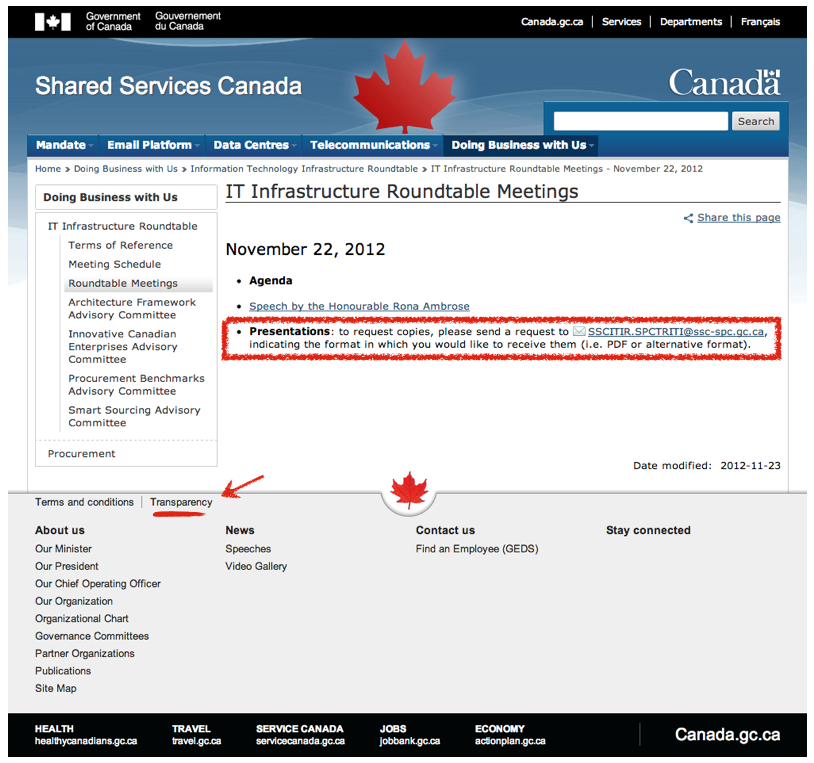
So here is a Shared Service Canada website dedicated the Roundtable on Information Technology Infrastructure. Obviously this is a topic of real interest to me – I write a fair bit about delivering (or failing to deliver) government service online effectively. I think it is great that Service Canada is reaching out to the private sector to try to learn lessons. Sadly, some of the links on the site didn’t work for me, specifically the important sounding: Summary of Discussions: Shared Services Canada Information and Communications Technology Sector Engagement Process.

But that is not the best part. Take a look at the website below. In one glance the entirety of the challenge of rethinking communications and government transparency  is nicely summed up.
proactive-nonedisclosure2

Apparently, if you want a copy of the presentation the Minister made to the committee you have to request it.

That’s odd, since really, the cost of making it downloadable is essentially zero. While the cost of emailing someone and making them get it back to you, is well, a colossal waste of my, and that public servants, time. (Indeed, to demonstrate this to the government, I hope that everyone of my readers requests this document).

There are, in my mind, two explanations for this. The first, more ominous one, is that someone wants to create barriers to getting this document. Maybe that is the case – who knows.

The second, less ominous, but in some ways more depressing answer is that this is simply standard protocol, or worse, that no one involved in this site has the know how or access rights to upload the document.

Noted added 6 mins after posting: There is also a third reason, less innocuous than reasons one and two. That being that the government cannot post the document unless it is in both official languages. And since this presentation is only available in (likely) english, it cannot be posted. This actually feels the most likely and will be teeing up a whole new post shortly on bilingualism and transparency. The number of times I’m told a document or data set can’t be proactively shared because of language issues is frustratingly frequent. I’ve spoken to the Language Commissioner on this and believe more dialogue is required. Bilingualism cannot be an excuse for a poor experience, or worse, opaque government.

In either case, it is a sad outcome. Either our government is maliciously trying to make it difficult to get information to Canadians (true of most governments) or they don’t know how to.

Of course, you may be saying… but David – who cares if there is an added step to geting this document that is slightly inconvenient? Well, let me remind you THIS IS SHARED SERVICE CANADA AND IT IS ABOUT A COMMITTEE FOCUSED ON DELIVERING ONLINE SERVICES (INTERNALLY AND EXTERNALLY) MORE EFFECTIVELY. If there was one place where you wanted to show you were responsive, proactive and reducing the transaction costs to citizens… the kind of approach you were going to use to make all government service more efficient and effective… this would be it.

The icing on the cake? There is that beautiful “transparency” button right below the text that talks about how the government is interested in proactive disclosure (see screenshot below). I love the text here – this is exactly what I want my government to be doing.

And yet, this is experience, while I’m sure conforming to the letter of the policy, feels like it violates pretty much everything around the spirit of proactive disclosure. This is after all a document that has already been made public… and now we are requiring citizens to request it.

We have a lot of work to do.

Ontario's Open Data Policy: The Good, The Bad, The Ugly and the (Missed?) Opportunity

Yesterday the province of Ontario launched its Open Data portal. This is great news and is the culmination of a lot of work by a number of good people. The real work behind getting open data program launched is, by and large, invisible to the public, but it is essential – and so congratulations are in order for those who helped out.

Clearly this open data portal is in its early stages – something the province is upfront about. As a result, I’m less concerned with the number of data sets on the site (which however, needs to, and should, grow over time). Hopefully the good people in the government of Ontario have some surprises for us around interesting data sets.

Nor am I concerned about the layout of the site (which needs to, and should, improve over time – for example, once you start browsing the data you end up on this URL and there is no obvious path back to the open data landing page, it makes navigating the site hard).

In fact, unlike some I find any shortcomings in the website downright encouraging. Hopefully it means that speed, iteration and an attitude to ship early has won out over media obsessive, rigid, risk adverse approach governments all to often take. Time will tell if my optimism is warranted.

What I do want to focus on is the license since this is a core piece of infrastructure to an open data initiative. Indeed, it is the license that determines whether the data is actually open or closed. And I think we should be less forgiving of errors in this regard than in the past. It was one thing if you launched in the early days of open data two or four years ago. But we aren’t in early days anymore. There over 200 government open data portal around the world. We’ve crossed the chasm people. Not getting the license right is not a “beta” mistake any more. It’s just a mistake.

So what can we say about the Ontario Open Data license?

First, the Good

There is lots of good things to be said about it. It clearly keys off the UK’s Open Government License much like BC’s license did as does the proposed Canadian Open Government License. This means that above all, it is written in  plain english and is easily understood. In addition, the general format is familiar to many people interested in open data.

The other good thing about the license (pointed out to me by the always sharp Jason Birch) is that it’s attribution clause is softer than the UK, BC or even the proposed Federal Government license. Ontario uses the term “should” whereas the others use the term “must.”

Sadly, this one improvement pales in comparison to some of the problems and, most importantly the potentially lost opportunity I urgently highlight at the bottom of this post.

The Bad

While this license does have many good qualities initiated by the UK, it does suffer from some major flaws. The most notable comes in this line:

Ontario does not guarantee the continued supply of the Datasets, updates or corrections or that they are or will be accurate, useful, complete, current or free and clear of any possible third party copyright, moral right, other intellectual property right or other claim.

Basically this line kills the possibility that any business, non-profit or charity will ever use this data in any real sense. Hobbyests, geeks, academics will of course use it but this provision is deeply flawed.

Why?

Well, let me explain what it means. This says that the government cannot be held accountable to only release data it has the right to release. For example: say the government has software that tracks road repair data and it starts to release it and, happily all sorts of companies and app developers use it to help predict traffic and do other useful things. But then, one day the vendor that provided that road repair tracking software suddenly discovers in the fine print of the contract that they, not the government, own that data! Well! All those companies, non-profits and app developers are suddenly using proprietary data, not (open) government data. And the vendor would be entirely in its rights to go either sue them, or demand a license fee in exchange of letting them continue to use the data.

Now, I understand why the government is doing this. It doesn’t want to be liable if such a mistake is made. But, of course, if they don’t want to absorbe the risk, that risk doesn’t magically disappear, it transfers to the data user. But of course they have no way of managing that risk! Those users don’t know what the contracts say and what the obligations are, the party best positioned to figure that out is the government! Essentially this line transfers a risk to the party (in this case the user) that is least able to manage it. You are left asking yourself, what business, charity or non-profit is going to invest hundreds of thousands of dollars (or more) and people time to build a product, service or analysis around an asset (government data) that it might suddenly discover it doesn’t have the right to use?

The government is the only organization that can clear the rights. If it is unwilling to do so, then I think we need to question whether this is actually open data.

The Ugly

But of course the really ugly part of the license (which caused me to go on a bit of a twitter rant) comes early. Here it is:

If you do any of the above you must ensure that the following conditions are met:

  • your use of the Datasets causes no harm to others.

Wowzers.

This clause is so deeply problematic it is hard to know where to begin.

First, what is the definition of harm? If I use open data from the  Ontario government to rate hospitals and the some hospitals are sub-standard am I “harming” the hospital? Its workers? The community? The Ministry of Health?

So then who decides what the definition is? Well, since the Government of Ontario is the licensor of the data… it would seem to suggest that they do. Whatever the standing government of the data wants to decree is a “harm” suddenly becomes legit. Basically this clause could be used to strip many users – particularly those interested in using the data as a tool for accountability – of their right to use the data, simply because it makes the licensor (e.g. the government) uncomfortable.

A brief history lesson here for the lawyers who inserted this clause. Back in in March of 2011 when the Federal Government launched data.gc.ca they had a similar clause in their license. It read as follows:

“You shall not use the data made available through the GC Open Data Portal in any way which, in the opinion of Canada, may bring disrepute to or prejudice the reputation of Canada.”

While the language is a little more blunt, its effect was the same. After the press conference launching the site I sat down with Stockwell Day (who was the Minister responsible at the time) for 45 minutes and walked him through the various problems with their license.

After our conversations, guess how long it took for that clause to be removed from the license? 3 hours.

If this license is going to be taken seriously, that clause is going to have to go, otherwise, it risks being a laughing stock and a case study of what not to do in Open Government workshops around the world.

(An aside: What was particularly nice was the Minister Day personally called my cell phone to let me know that he’d removed that clause a few hours after our conversation. I’ve disagreed with Day on many, many, many things, but was deeply impressed by his knowledge of the open data file and his commitment to its ideals. Certainly his ability to change the license represents one of the fastest changes to policy I’ve ever witnessed.)

The (Missed?) Opportunity

What is ultimately disappointing about the Ontario license however is that it was never needed. Why every jurisdiction feels the need to invent its own license is always beyond me. What, beyond the softening of the attribution clause, has the Ontario license added to the Open Data world. Not much that I can see. And, as I’ve noted above, it many ways it is a step back.

You know data users would really like? A common license. That would make it MUCH easier to user data from the federal government, the government of Ontario and the Toronto City government all at the same time and not worry about compatibility issues and whether you are telling the end user the right thing or not. In this regard the addition of another license is a major step backwards. Yes, let me repeat that for other jurisdictions thinking about doing open data: The addition of another new license is a major step backwards.

Given that the Federal Government has proposed a new Open Government License that is virtually identical to this license but has less problematic language, why not simply use it? It would make the lives of the people who this license is supposed to enable  – the policy wonks, the innovators, the app developers, the data geeks – lives so much easier.

That opportunity still exists. The Government of Ontario could still elect to work with the Feds around a common license. Indeed given that the Ontario Open Data portal says they are asking for advice on how to improve this program, I implore, indeed beg, that you consider doing that. It would be wonderful if we could move to a single license in this country, and if a partnership between the Federal Government and Ontario might give such an initiative real momentum and weight. If not, into the balkanized abyss of a thousand licenses we wil stumble.