Category Archives: public service sector renewal

How Tories could do transparency – Globe and Mail

Today’s blog post appears in the Globe and Mail. You can read it there (please do, also give it a vote).

How Tories could do transparency

Britain’s new Conservative government did something on Friday that Canadians would fine impossible to imagine. After a brief video announcement from Prime Minister David Cameron about the importance of the event, Francis Maude, Minister of the Cabinet Office, and Tim Berners-Lee, inventor of the World Wide Web, announced that henceforth the spending data for every British ministry on anything over £25,000 (about $40,000) would be available for anyone in the world to download. The initial release of information revealed thousands and thousands of lines of data and almost £80-billion (about $129.75-billion) in spending. And starting in January, every ministry must update the data once a month.

For the British Conservative Party, this is a strategic move. Faced with a massive deficit, the government is enlisting the help of all Britons to identify any waste. More importantly, however, they see releasing data as a means by which to control government spending. Indeed, Mr. Maude argues: “When you are forced to account for the money you spend, you spend it more wisely. We believe that publishing this data will lead to better decision-making in government and will ultimately help us save money.” And they might be right. Already, organizations like Timetric, the Guardian newspaper and the Open Knowledge Foundation have visualized, organized and indexed the data so it is easier for ordinary citizens understand and explore how their government spends their money.

These external sites are often more powerful than what the government has. After observing the way these sites handle the data, the minister noted how he wished he’d had access to them while negotiating with some of the government’s largest contractors.

For Canadians, the Conservative-Liberal Democrat coalition government is but a distant example of a world that a truly transparent government could – and should – create. In contrast, Stephen Harper’s Conservatives seem stuck in a trap described by Mr. Maude in his opening sentences: “Opposition parties are always remarkably keen on greater government transparency, but this enthusiasm mysteriously tends to diminish once they actually gain power.” Canada’s Conservatives have been shy about sharing any information with anyone. Afghan detainee files aren’t shared with Parliament; stimulus package accounts were not emailed to the Parliamentary Budget Office, but uselessly handed over in 4,476 printed pages. Even the Auditor-General is denied MP expense data. All this as access-to-information wait times exceed critical levels and Canada, unlike the United States, Britain , Australia and New Zealand, languishes with no open-data policy. Only once has the government pro-actively shared real “data,” when it shared some stimulus data that could be downloaded.

The irony is not only that the Tories ran on an agenda of accountability and transparency, but that – as their British counterparts understand – actually implementing a transparency and open-data policy may be one of the best ways to stamp a conservative legacy on the government’s future. Moreover, it could be a very popular move.

During the digital economy strategy consultations, open data was the second-most popular suggestion. Interestingly, it would appear the Liberals are prepared to explore the opportunity. They are the only party with a formal policy on open data that matches the standards recently set by Britain and, increasingly, in the United States.

Open data will eventually come to Canada. When, however, is unclear. In the meantime it is our colleagues elsewhere that will reap the benefits of savings, improved analysis and better civic engagement. So until Mr. Harper’s team changes its mind, Canadians must look abroad to see what a Conservative government that actually believes in transparency could look like.

David Eaves is a public-policy entrepreneur, open government activist and negotiation expert based in Vancouver


Patch Culture, Government and why Small Government Advocates are expensive

So earlier today I saw this post by Kevin Gaudet, Federal Director of the Canadian Taxpayers Federation and retweeted by Andrew Coyne (one of the country’s best commentators).

It pretty much sums up why Governments (incorrectly) fear open data and open government:

Screen-shot-2010-11-17-at-6.57.05-AM

The link is to a story on The Sun’s website: Government agencies caught advertising on sex sites!!!! (okay, the exclamation marks are mine).

This is exactly the type of headline every public servant and politician is terrified of. The details, of course, aren’t nearly as salacious. A screenshot Photoforum.ru reveals its a stock photo website (which probably does violate all sorts of copyrights) and, I am sure, there are some photos, somewhere on the site, of nude women, much like there are on say Flickr or Facebook.

Screen-shot-2010-11-17-at-7.09.04-AM1


Three interesting things here:

1. The challenge: Non-stories suck time and energy. The government, of course, didn’t choose to advertise on Photoforum.ru. It hired an agency, Cossette, that placed the ads through Google AdSense. (this is actually the good part of the story – great to hear that the government is using Google AdSense which is a cheap and effective way to advertise). But today, I assure you that dozens of public servants, at least one member of the Heritage Minister’s political staff and a few Canada Post employees are spending the next few days running around like chickens with their heads cut off trying to find out how an ad in a $5000 contract ended up on a relatively harmless site. The total cost of all that investigative work and the reports they will generate to address this “scandal” will probably cost taxpayers $10,000s, if not $100,000s in staff time and energy. No wonder governments fear disclosure. The distraction and cost in time and energy needed to fix a non-story is enormous.

2. The diagnosis: The accountability systems trap: What’s interesting of course, is everybody is acting rationally. The Sun (while stretching the truth) is reporting on the misuse (however minor) of taxpayer dollars. Same with the Canadian Taxpayers Federation (CTF). But the solutions are terrible. The CTF demand that the government eliminate all advertising is nonsensical. We can debate whether every ad is needed, but a flat out ban is silly. There are lots of things governments need to inform citizens about. So we can talk about reducing the government’s ad budget, but this news story doesn’t advance that aim either. Indeed, the Canadian Taxpayers and the Sun have, indirectly, helped inflate the cost of government. As noted, the government, acting rationally, now has dozens of people spending their time solving a crisis around a some minor ad campaigns.

So we have a system where everyone is behaving rationally. But the outcome are terrible. This is the scandal. Indeed, if one were really concerned about the effective spending of taxpayer dollars what one would quickly realize that what’s actually broken here isn’t government advertising, it’s the process by which governments react to and address problems.

3. One Approach: Patch-Culture and Open Data. So it is understandable that government types fear disclosure as, presently, they often seeing it leading to the above situtation.

But what’s interesting is that we could handle it differently.

This same story, in the software world, would have been quite different. The Sun article would have simple been understand as someone pointing out a (minor) bug. The software developers (in the case the public servants) would have patched it (which they did, ending the ads deployment to these sites) and the whole thing would have been a non-event. But at least, for minimal cost and effort, the software (ad program) would be better making both the developers (public servants/politicians) and users (taxpayers) happy. So why is it so different with government?

Two reasons.

First. Government’s pretend that everything they do is perfect. They live with an industrial worldview where you had to get something perfect before launching it since you were going to stamp out 100,000 copies of the things and any bug would get replicated that many times. Of course, very little of government is like this, much more of it is like software where you can make fixes along the way. What makes software so great (although sometimes frustrating too) is that they acknowledge this and so patch it on the fly. Patch-culture – as my friend David Humphrey likes to call it – where people help software get better by point out flaws, and even offering solutions, is exactly what our government needs to learn.

Second. People jump to the worst conclusions because governments appear secretive. Because they don’t proactively disclose (and because Access to Information process is sooooo slow) they always look like they are hiding something. Consequently, when people find mistakes they presume people have been hiding it, trying to cover it up and/or that it was made with some malicious intent. In an open source community, when people find a bug, they often assume it was a (dumb) mistake – not a nefarious plot to do achieve some dubious ends. Open data makes a patch culture easier to create because when you share what you are doing it is hard to believe you have some evil intent. Yes, people may just assume you are dumb – but that is actually better than evil (especially for powerful institutions like government).

Open data is about changing the culture everywhere, both inside and outside government. It won’t do it over night and it won’t do it perfectly but it can help. And it’s a shift we need to make.

Conclusion

I could easily have imagined the above story playing differently in world where patch culture has taken shape within government. Someone discovers the ads on photoforum.ru, thinks it is an error (someone made a dumb choice), submits a bug to the government, the ads are removed, the bug is patched, everybody is happy and… no wasteful non-story about government spending.

Indeed, we could have instead allocated all that wasted time and energy to have the debate the CTF actually wants to have: how much of the budget should go towards advertising.

What we need to be thinking about is what is the system we are in, what are the incentives it creates for the various actors and then think of the system we’d like, and figure out how to get from here to there. I think Open Data is an important (but not exclusive) part of the puzzle for changing the relationship between the government, the press and citizens. It may even create some new problems, but I think they will be better, less costly and more interesting problems then the ones we have now, we are frankly destroying budgets and the institutions we need to serve us.

Is Government Funding the Kiss of Death?

Over the past few years/months talking to various people in the charitable and non-profit sector a recurring theme has emerged: More and more of them are either eschewing government funding or trying to find ways to do so.

Given that governments are the largest source of funding… why would they do this?

The reason is simple. The overhead of administering, overseeing and reporting back on (particularly federal and provincial) government grants or awards has become so onerous that the costs of oversight are increasingly greater than the value of the grant itself. This is particularly true of smaller grants (in the 5 digit range) but still true of even 6 figure awards. In addition to oversight, many people in the sector inform me that governments are not only looking more closely at how recipients spend the money they receive but are increasingly assertive in specifying how they should spend it.

So, in sum, it’s not hard to see why organizations want to walk away. The costs of the money is increasingly too great. On the one hand, compliance means more and more money is diverted to administration – rather than the core mission of the group – and increasing oversight means a loss of autonomy. Consequently, less money can go towards innovative, but riskier, new approaches that might yield better outcomes, or greater efficiencies.

The outcome, I fear, is a non-profit and charitable sector that starts to cleave in two.

On the one side will be non-profits (like those of some colleagues I know) that see eschewing government money as the only way to stay nimble, innovative and independent. These groups will either find progressive granting organizations, wealthy individuals or alternative ways create revenues. Freed to spend their funds as they see best, the most effective will achieve escape velocity and be able to operate for long periods of time without needing to consider government funding.

On the other side, there risks being those locked into government dependency. Unable to fund new projects and innovative approaches that might attract new external funding, they will be trapped in a government deathgrip, forced to adopt traditional approaches and take on excessive overhead, all in order to meet their funding obligations. In short, they will need to mirror the very bureaucracy that not being independent from was what was supposed to give them a competitive advantage.

On the one hand, this is the kind of situation that makes me jealous of the United States with its large pool of private foundations and granting organizations that ensure innovation thrives in the non-profit/charitable sector. But that is a structural difference smaller countries like Canada will not be able to overcome. We need our government’s to be smarter since we can’t replicate the American model.

This is made all the more difficult since those who’ve achieved escape velocity want little to do with government, while those dependent on government funding are probably the least likely (or empowered) to speak up. Sadly, no one wants to upset the government… (why bite the hand that feeds, even if the fruit is poisoned?) so we live in a world of silence on this issue.

I’ll confess, I’m somewhat stumped by the issue but I am worried about it. This country depends on non-profits more than people realize… anything that hampers their effectiveness is a collective drain on productivity, efficiency and competitiveness, to say nothing of social justice.

Launching datadotgc.ca 2.0 – bigger, better and in the clouds

Back in April of this year we launched datadotgc.ca – an unofficial open data portal for federal government data.

At a time when only a handful of cities had open data portals and the words “open data” were not being even talked about in Ottawa, we saw the site as a way to change the conversation and demonstrate the opportunity in front of us. Our goal was to:

  • Be an innovative platform that demonstrates how government should share data.
  • Create an incentive for government to share more data by showing ministers, public servants and the public which ministries are sharing data, and which are not.
  • Provide a useful service to citizens interested in open data by bringing it all the government data together into one place to both make it easier to find.

In every way we have achieved this goal. Today the conversation about open data in Ottawa is very different. I’ve demoed datadotgc.ca to the CIO’s of the federal government’s ministries and numerous other stakeholders and an increasing number of people understand that, in many important ways, the policy infrastructure for doing open data already exists since datadotgc.ca show the government is already doing open data. More importantly, a growing number of people recognize it is the right thing to do.

Today, I’m pleased to share that thanks to our friends at Microsoft & Raised Eyebrow Web Studio and some key volunteers, we are taking our project to the next level and launching Datadotgc.ca 2.0.

So what is new?

In short, rather than just pointing to the 300 or so data sets that exist on federal government websites members may now upload datasets to datadotg.ca where we can both host them and offer custom APIs. This is made possible since we have integrated Microsoft’s Azure cloud-based Open Government Data Initiative into the website.

So what does this mean? It means people can add government data sets, or even mash up government data sets with their own data to create interest visualization, apps or websites. Already some of our core users have started to experiment with this feature. London Ontario’s transit data can be found on Datadotgc.ca making it easier to build mobile apps, and a group of us have taken Environment Canada’s facility pollution data, uploaded it and are using the API to create an interesting app we’ll be launching shortly.

So we are excited. We still have work to do around documentation and tracking some more federal data sets we know are out there but, we’ve gone live since nothing helps us develop like having users and people telling us what is, and isn’t working.

But more importantly, we want to go live to show Canadians and our governments, what is possible. Again, our goal remains the same – to push the government’s thinking about what is possible around open data by modeling what should be done. I believe we’ve already shifted the conversation – with luck, datadotgc.ca v2 will help shift it further and faster.

Finally, I can never thank our partners and volunteers enough for helping make this happen.

When Measuring the Digital Economy, Measure the (Creative) Destruction Too

Yesterday I had a great lunch with Justin Kozuch of the Pixels to Product research study which aims “to create a classification system for Canada’s digital media industry and shed light on the industry’s size and scope.”

I think the idea of measuring the size and scope of Canada’s digital media industry is a fantastic idea. Plenty of people – including many governments – are probably very curious about this.

But one thought I had was: if we really want to impress on governments the importance of the digital economy, don’t measure it’s size. Measure its creative destructive/disruptive power.

In short, measure the amount of the “normal” economy it has destroyed.

Think of every newspaper subscription canceled, every print shop closed, every board game not played, every add not filmed, whatever… but think of all the money saved by businesses and consumers because the digital made their options dramatically cheaper.

I’m not sure what the methodology for such a measurement would look like, or even if it is possible. But it would be helpful.

I suspect the new digital businesses that replace them are smaller and more efficient. Indeed, they often have to be dramatically so to justify the switching cost. This is part of what makes them disruptive. Take, for example, Google. Did you know it only has 20,000 employees? I always find that an incredible figure. These 20,000 people are creating systems that are wiping out (and creating) whole industries.

I say all this because often the digital replacement of the economy won’t (initially) be as big as what it replaced – that’s the whole point. The risk is governments and economic planning groups will look at the current size of the digital economy and be… unimpressed. Measuring destruction might be one way to change the nature of the conversation, to show them how big this part of the economy really is and why they need to give it serious consideration.

Rethinking Wikipedia contributions rates

About a year ago news stories began to surface that wikipedia was losing more contributors that it was gaining. These stories were based on the research of Felipe Ortega who had downloaded and analyzed millions the data of contributors.

This is a question of importance to all of us. Crowdsourcing has been a powerful and disruptive force socially and economically in the short history of the web. Organizations like Wikipedia and Mozilla (at the large end of the scale) and millions of much smaller examples have destroyed old business models, spawned new industries and redefined the idea about how we can work together. Understand how the communities grow and evolve is of paramount importance.

In response to Ortega’s research Wikipedia posted a response on its blog that challenged the methodology and offered some clarity:

First, it’s important to note that Dr. Ortega’s study of editing patterns defines as an editor anyone who has made a single edit, however experimental. This results in a total count of three million editors across all languages.  In our own analytics, we choose to define editors as people who have made at least 5 edits. By our narrower definition, just under a million people can be counted as editors across all languages combined.  Both numbers include both active and inactive editors.  It’s not yet clear how the patterns observed in Dr. Ortega’s analysis could change if focused only on editors who have moved past initial experimentation.

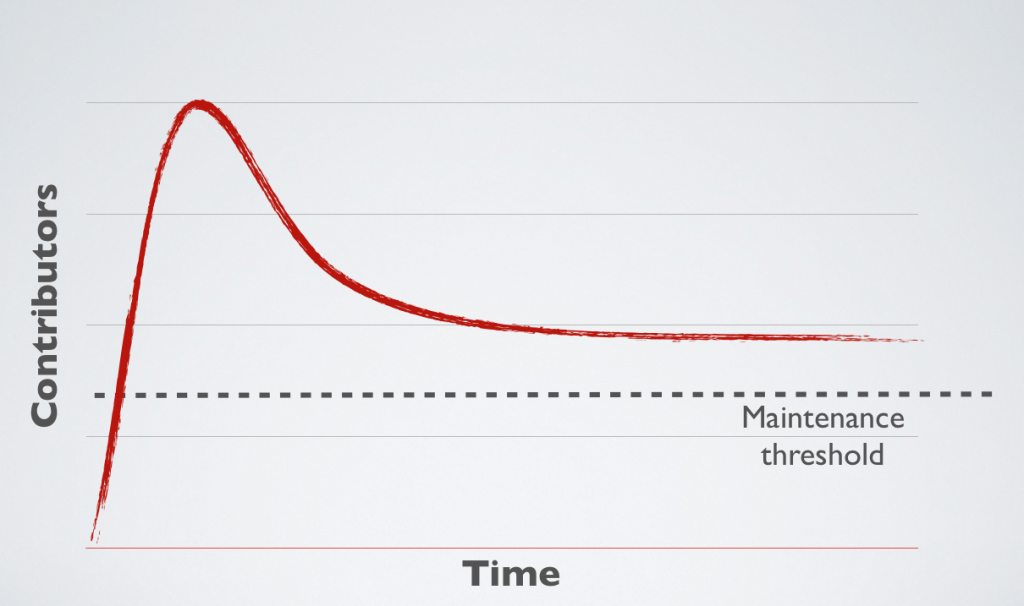
This is actually quite fair. But the specifics are less interesting then the overall trend described by the Wikmedia Foundation. It’s worth noting that no open source or peer production project can grow infinitely. There is (a) a finite number of people in the world and (b) a finite amount of work that any system can absorb. At some point participation must stabilize. I’ve tried to illustrate this trend in the graphic below.

Open-Source-Lifecyclev2.0021-1024x606

As luck would have it, my friend Diederik Van Liere was recently hired by the Wikimedia Foundation to help them get a better understanding of editor patterns on Wikipedia – how many editors are joining and leaving the community at any given moment, and over time.

I’ve been thinking about Diederik’s research and three things have come to mind to me when I look at the above chart:

1. The question isn’t how do you ensure continued growth, nor is it always how do you stop decline. It’s about ensuring the continuity of the project.

Rapid growth should probably be expected of an open source or peer production project in the early stage that has LOTS of buzz around it (like Wikipedia was back in 2005). There’s lots of work to be done (so many articles HAVEN’T been written).

Decline may also be reasonable after the initial burst. I suspect many open source lose developers after the product moves out of beta. Indeed, some research Diederik and I have done of the Firefox community suggests this is the case.

Consequently, it might be worth inverting his research question. In addition to figuring out participation rates, figure out what is the minimum critical mass of contributors needed to sustain the project. For example, how many editors does wikipedia need to at a minimum (a) prevent vandals from destroying the current article inventory and/or at the maximum (b) sustain an article update and growth rate that sustains the current rate of traffic rate (which notably continues to grow significantly). The purpose of wikipedia is not to have many or few editors, it is to maintain the world’s most comprehensive and accurate encyclopedia.

I’ve represented this minimum critical mass in the graphic above with a “Maintenance threshold” line. Figuring out the metric for that feels like it may be more important than participation rates independently as such as metric could form the basis for a dashboard that would tell you a lot about the health of the project.

2. There might be an interesting equation describing participation rates

Another thing that struck me was that each open source project may have a participation quotient. A number that describes the amount of participation required to sustain a given unit of work in the project. For example, in wikipedia, it may be that every new page that is added needs 0.000001 new editors in order to be sustained. If page growth exceeds editors (or the community shrinks) at a certain point the project size outstrips the capacity of the community to sustain it. I can think of a few variables that might help ascertain this quotient – and I accept it wouldn’t be a fixed number. Change the technologies or rules around participation and you might make increase the effectiveness of a given participant (lowering the quotient) or you might make it harder to sustain work (raising the quotient). Indeed, the trend of a participation quotient would itself be interesting to monitor… projects will have to continue to find innovative ways to keep it constant even as the projects article archive or code base gets more complex.

3. Finding a test case – study a wiki or open source project in the decline phase

One things about open source projects is that they rarely die. Indeed, there are lots of open source projects out there that are the walking zombies. A small, dedicated community struggles to keep a code base intact and functioning that is much too large for it to manage. My sense is that peer production/open source projects can collapse (would MySpace count as an example?) but the rarely collapse and die.

Diederik suggested that maybe one should study a wiki or open source project that has died. The fact that they rarely do is actually a good thing from a research perspective as it means that the infrastructure (and thus the data about the history of participation) is often still intact – ready to be downloaded and analyzed. By finding such a community we might be able to (a) ascertain what “maintenance threshold” of the project was at its peak, (b) see how its “participation quotient” evolved (or didn’t evolve) over time and, most importantly (c) see if there are subtle clues or actions that could serve as predictors of decline or collapse. Obviously, in some cases these might be exogenous forces (e.g. new technologies or processes made the project obsolete) but these could probably be controlled for.

Anyways, hopefully there is lots here for metric geeks and community managers to chew on. These are only some preliminary thoughts so I hope to flesh them out some more with friends.

The Open Data Debate Arrives in Ottawa

The Liberals are promising to create an open data portal – opendata.gc.ca – much like President Obama has done in the United States and both Gordon Brown and David Cameron have done in the United Kingdom.

It’s a savvy move.

In May 2010 when it launched a public consultation on the Digital Economy, the government invited the public to submit proposals and vote on them. Two of the top three most voted ideas involved asking the government to open up access to government collected data. Three months after the submissions have closed it appears the opposition has decided to act on Canadians wishes and release a 21st century open government strategy that reflects these popular demands.

Today, at 1pm EST, I’ve discovered the Liberals will announce that, if elected, they will adopt a government-wide directive in which “the default position for all departments and agencies will be for the release of information to the public, both proactively and responsively, after privacy and other legal requirements are met.”

There is much that both ordinary citizens and advocates of greater government transparency will like in the proposal. Not only have the Liberals mirrored the most aggressive parts of President Obama’s transparency initiatives they are also promising some specific and aggressive policies of their own. In addition to promising to launching opendata.gc.ca to share government data the document proposes the creation of accesstoinformation.gc.ca where citizens could search past and current access to information requests as well as see response times. A third website, entitled accountablespending.gc.ca is also proposed. It would allow government grants, contributions and contracts to be searched.

The announcement brings to the Canadian political debate an exciting issue that first gained broad notoriety in early 2009 when Tim Berners-Lee, the inventor of the world wide web, called on the world’s governments to share their data. By May of that year the United States launched data.gov and in September of 2009 the British Government launched data.gov.uk both of which garnered significant domestic attention. In addition, dozens of cities around the world – including Vancouver, Edmonton and, most recently, Ottawa – have launched websites where they shared information that local charities, non-profits, businesses and ordinary citizens might find useful.

Today, citizens in these jurisdictions enjoy improved access to government information about the economy, government spending, access to information requests, and statistical data. In the United States developers have created websites that empower citizens by enabling them to analyze government data or see what government data exists about their community while a British program alerts citizens to restaurant’s health inspections scores.  The benefit however, not limited to improved transparency and accountability. An independent British estimated that open data could contribute as much as £6 billion to British economy. Canada’s computer developers, journalists and entrepreneurs have been left wondering, when will their government give them access to the data their tax dollars paid to collect?

One obvious intent of the Liberals is to reposition themselves at the forefront of a debate around government transparency and accountability. This is ground that has traditionally been Conservative, but with the cancellation of the long form census, the single source jet fighter contract and, more recently, allegations that construction contracts were awarded to conservative party donors, is once again contestable.

What will be interesting to see is the Conservative response. It’s been rumored the government has explored an open data portal but to date there has been no announcement. Open data is one area where, often, support exists across the political spectrum. In the United Kingdom Gordon Brown’s Labour government launched data.gov.uk but David Cameron’s Conservative government has pursued the project more aggressively still, forcing the release of additional and higher value data to the public. A failure to adopt open data would be tragedy – it would cause Canada to lag in an important space that is beginning to reshape how governments work together and how they serve and interact with citizens. But perhaps most obviously, open data and open government shouldn’t be a partisan issue.

OpenGovWest (BC edition): Are you out west?

Something good is taking shape in my backyard…

From the city of Vancouver’s open data portal to Apps 4 Climate Action to the Water legislation blog, a great deal of the leadership and cutting edge work in open government is taking place in BC. Many places across the country and around the world look to what is happening on the west coast and are trying to draw lessons and see how it can be replicated.

Recognizing this fact a number of great people have been working behind the scenes for the last couple of months pulling together a conference to share this successes, talk about challenges and opportunities and generally think about what could happen next. The conference…? OpenGovWest BC.

If you are in BC and interested in open government, open data and gov 2.0, here’s a conference designed and built for you.

A number of speakers have already been publicly confirmed, others are, apparently, being held as surprises. There are also slots open for presentations if you have a project you’d like to share with the community out west.

The conference will be taking place on November 10th in Victoria, BC – if you are out west and feel passionate about these topics the same way I do, I hope you’ll consider coming.

And while we are talking about conferences, I also want to share Open Government Data Camp that will be happening in London, UK on November 18th and 19th. I’m excited to say I’ll be there with our friends from the Open Knowledge Foundation and the Sunlight Foundation, along with numerous others. Harder to get too, but also likely to be quite, quite fun…

Rethinking Freedom of Information Requests: from Bugzilla to AccessZilla

Last week I gave a talk at the Conference for Parliamentarians hosted by the Information Commission as part of Right to Know Week.

During the panel I noted that, if we are interested in improving response times for Freedom of Information (FOI) requests (or, in Canada, Access to Information (ATIP) requests) why doesn’t the Office of the Information Commissioner use a bugzilla type software to track requests?

Such a system would have a number of serious advantages, including:

  1. Requests would be public (although the identity of the requester could remain anonymous), this means if numerous people request the same document they could bandwagon onto a single request
  2. Requests would be searchable – this would make it easier to find documents already released and requests already completed
  3. You could track performance in real time – you could see how quickly different ministries, individuals, groups, etc… respond to FOI/ATIP requests, you could even sort performance by keywords, requester or time of the year
  4. You could see who specifically is holding up a request

In short such a system would bring a lot of transparency to the process itself and, I suspect, would provide a powerful incentive for ministries and individuals to improve their performance in responding to requests.

For those unfamiliar with Bugzilla it is an open source software application used by a number of projects to track “bugs” and feature requests in the software. So, for example, if you notice the software has a bug, you register it in Bugzilla, and then, if you are lucky and/or if the bug is really important, so intrepid developer will come along and develop a patch for it. Posted below, for example, is a bug I submitted for Thunderbird, an email client developed by Mozilla. It’s not as intuitive as it could be but you can get the general sense of things: when I submitted the bug (2010-01-09), who developed the patch (David Bienvenu), it’s current status (Fixed), etc…

ATIPPER

Interestingly, an FOI or ATIP request really isn’t that different than a “bug” in a software program. In many ways, bugzilla is just a complex and collaborative “to do” list manager. I could imagine it wouldn’t be that hard to reskin it so that it could be used to manage and monitor access to information requests. Indeed, I suspect there might even be a community of volunteers who would be willing to work with the Office of the Information Commissioner to help make it happen.

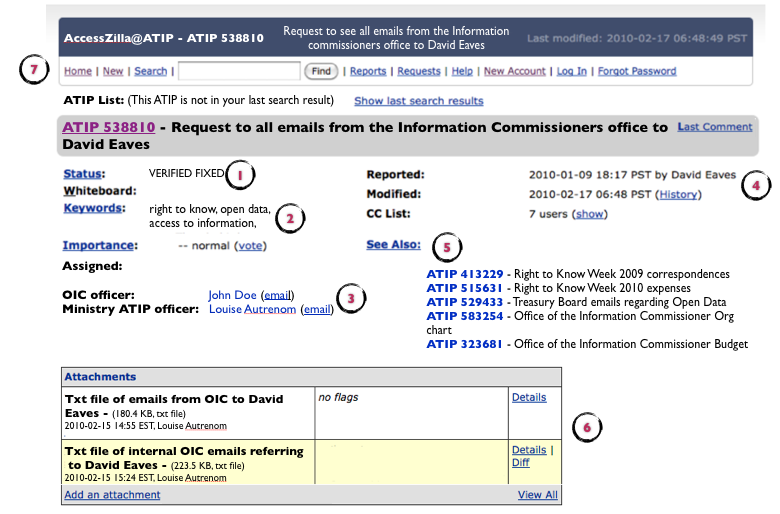
Below I’ve done a mock up of what I think revamped Bugzilla, (renamed AccessZilla) might look like. I’m put numbers next to some of the features so that I can explain in detail about them below.

ATIPPER-OIC1

So what are some of the features I’ve included?

1. Status: Now an ATIP request can be marked with a status, these might be as simple as submitted, in process, under review, fixed and verified fixed (meaning the submitter has confirmed they’ve received it). This alone would allow the Information Commissioner, the submitter, and the public to track how long an individual request (or an aggregate of requests) stay in each part of the process.

2.Keywords: Wouldn’t it be nice to search of other FOR/ATIP requests with similar keywords? Perhaps someone has submitted a request for a document that is similar to your own, but not something you knew existed or had thought of… Keywords could be a powerful way to find government documents.

3. Individual accountability: Now you can see who is monitoring the request on behalf of the Office of the information commissioner and who is the ATIP officer within the Ministry. If the rules permitted then potential the public servants involved in the document might have their names attached here as well (or maybe this option will only be available to those who log on as ATIP officers.

4. Logs: You would be able to see the last time the request was modified. This might include getting the documents ready, expressing concern about privacy or confidentiality, or simply asking for clarification about the request.

5. Related requests: Like keywords, but more sophisticated. Why not have the software look at the words and people involved in the request and suggest other, completed requests, that it thinks might similar in type and therefor of interest to the user. Seems obvious.

6. Simple and reusable resolution: Once the ATIP officer has the documentation, they can simply upload it as an attachment to the request. This way not only can the original user quickly download the document, but anyone subsequent user who stumbles upon the request during a search could download the documents. Better still any public servant who has unclassified documents that might relate to the request can simply upload them directly as well.

7. Search: This feels pretty obvious… it would certainly make citizens life much easier and be the basic ante for any government that claims to be interested in transparency and accountability.

8. Visualizing it (not shown): The nice thing about all of these features is that the data coming out of them could be visualized. We could generate realt time charts showing average response time by ministry, list of respondees by speed from slowest to fastest, even something as mundane as most searched keywords. The point being that with visualizations is that a governments performance around transparency and accountability becomes more accessible to the general public.

It may be that there is much better software out there for doing this (like JIRA), I’m definitely open do suggestions. What I like about bugzilla is that it can be hosted, it’s free and its open source. Mostly however, software like this creates an opportunity for the Office of the Information Commissioner in Canada, and access to information managers around the world, to alter the incentives for governments to complete FOI/ATIP requests as well as make it easier for citizens to find out information about their government. It could be a fascinating project to reskin bugzilla (or some other software platform) to do this. Maybe even a Information Commissioners from around the world could pool their funds to sponsor such a reskinning of bugzilla…

From Public Servant to Public Insurgent

Are you a public insurgent?

Today, a generation of young people are arriving into the public service familiar with all sorts of tools – especially online and social media driven tools – that they have become accustomed to using. Tools like wikis, survey monkeys, doodle, instant messaging or websites like wikipedia, or issue specific blogs enable them to be more productive, more efficient and more knowledgeable.

And yet, when they arrive in their office they are told: “You cannot use those tools here.”

In short, they are told: “Don’t be efficient.”

You can, of course, imagine the impact on moral of having a boss tell you that you must do you work in a manner that is slower and less effective then you might otherwise do. Indeed, today, in the public service and even in many large organizations, we may be experiencing the first generation of a work force that is able to accomplish coordination and knowledge building tasks faster at home than at work.

Some, when confronted with this choice simple resign themselves to the power of their organizations rules and become less efficient. Others (and I suspect not an insignificant number), begin the process of looking for their next job. But what I find particularly interesting is a tinier segment who –  as dedicated employees, that love the public service and who want to be as effective as possible – believe in their mission so strongly that they neither leave, nor do they adhere to the rules. They become public insurgents and do some of their work outside the governments infrastructure.

Having spoken about government 2.0 and the future of the public service innumerable times now I have, on several occasions, run into individuals or even groups, of these public insurgents. Sometimes they installed a wiki behind the firewall, sometimes they grab their laptop and head to a cafe so they can visit websites that are useful, but blocked by their ministry, sometimes they simple send around a survey monkey in contravention of an IT policy. The offenses range from the minor to the significant. But in each case these individuals are motivated by the fact that this is the most, and sometimes only, way to do the task they’ve been handed in an effective way. More interesting is that sometimes their acts of rebellion create a debate that causes the organization to embrace the tools they secretly use, sometimes they it doesn’t and they continue to toil in secret.

I find this trend – one that I think may be growing – fascinating.

So my question to you is… are you a public insurgent? If you are I’d love to hear your story. Please post it in the comments (using an anonymous handle) or send me an email.