Category Archives: technology

My Mozilla Summit 2010 Talk: Making the Army of Awesome more Awesome

This summer I had the enormous pleasure and privilege of both being at the Mozilla Summit and of being selected to give a lightening talk.

Embedded below is the talk – it’s five minutes so won’t take long to watch and is a short and updated version of my community management presentation. There are tons of people to thank for this talk, Diederik Van Liere, David Ascher and Mike Beltzner come to mind immediately, but there are many others as well. It also builds off a number of posts, including some old gems like this one and this one.

I’ve embedded a YouTube video of it, and the slide deck is a little further down.

Why Blockbuster’s success in Canada is a bad news story

I noticed today in the Globe that while Blockbuster (the movie rental company) has declared bankruptcy in the United States, here in Canada the branch of the company is doing fine, indeed it is still profitable:

Blockbuster Canada vice-president and general manager Barry Guest said in a statement early Thursday that its operations are still profitable. “Blockbuster Canada operates independently of the U.S. and is financially stable,” he said.

So how can this be a bad news story?

Clues to the answer lie deeper in the article, in this paragraph:

Once a home entertainment powerhouse in the United States, Blockbuster has been losing market share and money for years as more Americans rent DVDs from subscription service Netflix Inc. and popularity surged for streaming video over the Internet.

Let’s be clear, Blockbuster in Canada is profitable not because it has been innovative. Not because it has reinvented itself in a digital era. Not because it has been visionary. Blockbuster is okay because the innovations and services that have devastated its southern partner basically aren’t available in Canada. In short, when it comes to rolling out cutting edge services (or even kind-of cutting edge services) in the digital media/infrastructure space Canada falls short.

bbcanada1This, of course, is well documented (hello cellphone contracts!) and it is the real story here! How can Canada – and Canadian companies – expect to be leaders in the digital space (I’m looking at you, forthcoming Digital Economy Strategy) if even the most mainstream services available in the US (mainstream enough to destroy an incumbent) haven’t even made it north of the border? Domestically, who are we competing with, competitors from an analog era? This is not a marketplace that is likely to produce the next Tivo, Netflix or whatever.

This story feels like a metaphor for pretty much everything that is wrong with innovation and competitiveness in this space in Canada, right down to the fact that we appear to celebrating the ongoing success of blockbuster. Sigh.

Good Backgrounder on Open Data for Cities – (Looking at You #VoteTO)

Yesterday the Martin Prosperity Institute released another installment of its Toronto Election 2010 discussion papers, this one focused on Open Data.

For citizens of any city this is a fantastic primer on what open data is, why it matters and, in the case of Toronto, why it should be an election issue in the upcoming civic election.

Full disclosure: I did sit down with the paper’s authors at the Institute – Kimberly Silk and Jacqueline Whyte Appleby – to talk about a number of the critical aspects surrounding this issue. Their depth and experience in municipal and regional issues has produced an invaluable resource. I hope citizens of cities everywhere are able to make use of it, but I also hope that citizens of Toronto use it to ask questions of the candidates for Mayor and council.

Again, you can download the report here.

For those not familiar with the Institute, you can read more about it here (excerpt below):

The Lloyd & Delphine Martin Prosperity Institute is the world’s leading think-tank on the role of sub-national factors – location, place and city-regions – in global economic prosperity. Led by Director Richard Florida , we take an integrated view of prosperity, looking beyond economic measures to include the importance of quality of place and the development of people’s creative potential.

Links from Gov2.0 Summit talk and bonus material

My 5 minute lightening fast jam packed talk (do I do other formats? answer… yes) from yesterday’s Gov2.0 summit hasn’t yet been has just been posted to youtube. I love that this year the videos have the slides integrated into it.

For those who were, and were not, there yesterday, I wanted to share links to all the great sites and organizations I cited during my talk, I also wanted to share one or two quick stories I didn’t have time to dive into:

VanTrash and 311:

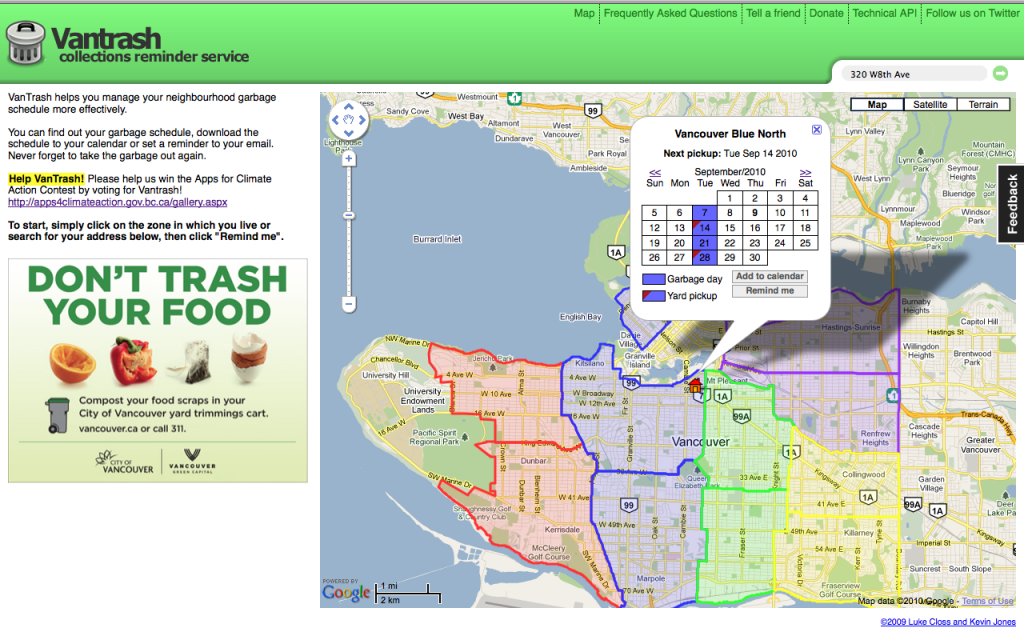
Screen-shot-2010-09-09-at-3.07.32-AM-1024x640As one of the more mature apps in Vancouver using open data Vantrash keeps being showing us how these types of innovations just keep giving back in new and interesting ways.

In addition to being used by over 3000 households (despite never being advertised – this is all word of mouth) it turns out that the city staff are also finding a use for vantrash.

I was recently told that 311 call staff use Vantrash to help trouble shoot incoming calls from residents who are having problems with garbage collection. The first thing one needs to do in such a situation is identify which collection zone the caller lives in – turns out VanTrash is the fastest and more effective way to accomplish this. Simply input the caller’s address into the top right hand field and presto – you know their zone and schedule. Much better than trying to find their address on a physical map that you may or may not have near your station.

TaxiCity, Open Data and Game Development

Another interesting spin off of open data. The TaxiCity development team, which recreated downtown Vancouver in 2-D using data from the open data catalog, noted that creating virtual cities in games could be a lot easier with open data. You could simply randomize the height of buildings and presto an instant virtual city would be ready. While the buildings would still need to be skinned one could recreate cities people know quickly or create fake cities that felt realistic as they’d be based on real plans. More importantly, this process could help reduce the time and resources needed to create virtual cities in games – an innovation that may be of interest to those in the video game industry. Of course, given that Vancouver is a hub for video game development, it is exactly these types of innovations the city wishes to foster and will help sustain Vancouver’s competitive advantage.

Links (in order of appearance in my talk)

Code For America shirt design can be seen in all their glory here and can be ordered here. As a fun aside, I literally took that shirt of Tim O’Reilly’s back! I saw it the day before and said, I’d wear that on stage. Tim overheard me and said he’d give me his if I was serious…

Vancouver’s Open Motion (or Open3, as it is internally referred to by staff) can be read in the city’s PDF version or an HTML version from my blog.

Vancouver’s Open Data Portal is here. keep an eye on this page as new data sets and features are added. You can get RSS feed or email updates on the page, as well as see its update history.

Vantrash the garbage reminder service’s website is here. There’s a distinct mobile interface if you are using your phone to browse.

ParkingMobility, an app that crowdsources the location of disabled parking spaces and enables users to take pictures of cars illegally parked in disabled spots to assist in enforcement.

TaxiCity, the Centre for Digital Media Project sponsored by Bing and Microsoft has its project page here. Links to the sourcecode, documentation, and a ton of other content is also available. Really proud of these guys.

Microsoft’s Internal Vancouver Open Data Challenge fostered a number of apps. Most have been opensourced and so you can get access to the code as well. The apps include:

The Graffiti Analysis written by University of British Columbia undergraduate students can be downloaded from this blog post I posted about their project.

BTA Works – the research arm of Bing Thom Architects has a great website here. You can’t download their report about the future of Vancouver yet (it is still being peer-reviewed) but you can read about it in this local newspaper article.

Long Tail of Public Policy – I talk about this idea in some detail in my chapter on O’Reilly Media’s Open Government. There is also a brief blog post and slide from my blog here.

Vancouver’s Open Data License – is here. Edmonton, Ottawa and Toronto use essentially the exact same thing. Lots that could be done on this front still mind you… Indeed, getting all these cities on a single standard license should be a priority.

Vancouver Data Discussion Group is here. You need to sign in to join but it is open to anyone.

Okay, hope those are interesting and helpful.

Are you a Public Servant? What are your Open Data Challenges?

A number of governments have begun to initiate open data and open government strategies. With more governments moving in this direction a growing number of public servants are beginning to understand the issues, obstacles, challenges and opportunities surrounding open data and open government.

Indeed, these challenges are why many of these public servants frequent this blog.

This is precisely why I’m excited to share that, along with the Sunlight Foundation, the Personal Democracy Forum, Code for America, and GovLoop, I am helping Socrata in a recently launched survey aimed at government employees at the national, regional and local levels in the US and abroad about the progress of Open Data initiatives within their organization.

If you are a government employee please consider taking time to help us understand the state of Open Data in government. The survey is comprehensive, but given how quickly this field and the policy questions that come with it, is expanding, I think the collective result of our work could be useful. So, with that all said, I know you’re busy, but hope you’ll consider taking 10 minutes to fill out the survey. You can find it at: http://www.socrata.com/benchmark-study.

The Web and the End of Forgetting: the upside of down

A reader recently pointed me to a fantastic article in the New York Times entitled The Web and the End of Forgetting which talks about the downside of a world where one’s history is permanently recorded on the web. It paints of the dangers of a world where one can never escape one’s past – where mistakes from college rear their head in interviews and where bad choices constrain the ability to start anew.

It is, frankly, a terrifying view of the world.

I also think it is both overblown and, imagines a world where the technology changes, but our social condition does not. Indeed, the reader sent me the piece because it reminded him of a talk and subsequent blog post I wrote exactly a year ago on the same topic.

But let’s take the worse case scenario at face value. While the ability to start anew is important, at times I look forward to a world where there is a little more history. A world where choices and arguments can be traced. A world of personal accountability.

Broadcast media fostered a world where one could argue one position and then, a few months later, take the exact opposite stand. Without easily accessible indexes and archives discerning these patterns was difficult, if not impossible. With digitization, that has all changed.

The Daily Show remains the archetype example of this. The entire show is predicated on having a rich archival history of all the major network and cable news broadcasts and having the capacity, on a nightly basis, to put the raw hypocrisy of pundits and politicians on display.

The danger of course, is if this is brought to the personal level. The NYT article identifies and focuses on them. But what of the upsides? In a world where reputation matters, people may become more thoughtful. It will be interesting to witness a world where grandparents have to explain to their grandchildren why they were climate change deniers on their Facebook page. Or why you did, or didn’t join a given political campaign, or protest against a certain cause.

Ultimately, I think all this remembering leads to a more forgiving society, at least in personal and familial relationships, but the world of pundits and bloggers and politicans may become tougher. Those who found themselves very much on the wrong side of history, may have a hard time living it down. The next version of the daily show may await us all. But not saying anything may not be a safe strategy either. Those who have no history, who never said anything at anytime, may not be seen relevant, or worse, could be seen as having no convictions or beliefs.

I loved the New York Times article, but it looked at society as a place where social values will remain unchanged, where we won’t adapt to our technology and place greater emphasis on new values. I can imagine a world where our children may say – how did you have friends with so little personal history? It may not be our ideal world, but then, our grandparents world wasn’t one I would have wanted to live in either.

Creating Open Data Apps: Lessons from Vantrash Creator Luke Closs

Last week, as part of the Apps for Climate Action competition (which is open to anyone in Canada), I interviewed the always awesome Luke Closs. Luke, along with Kevin Jones, created VanTrash, a garbage pick up reminder app that uses open data from the City of Vancouver. In it, Luke shares some of the lessons learned while creating an application using open data.

As the deadline for the Apps for Climate Action competition approaches (August 8th) we thought this might help those who are thinking about throwing their hat in the ring last minute.

Some key lessons from Luke:

  • Don’t boil the ocean: Keep it simple – do one thing really, really well.
  • Get a beta up fast: Try to scope something you can get a rough version working in day or evening – that is a sure sign that it is doable
  • Beta test: On friends and family. A lot.
  • Keep it fun: do something that develops a skill or let’s you explore a technology you’re interested in

Some thoughts on improving Bugzilla

One of the keys to making an open source project work is getting feedback from users and developers about problems (bugs) in the code or system. Mozilla (the organization behind Firefox and Thunderbird) uses Bugzilla, but organizations have developed a variety of systems for dealing with this issue. For example, many cities use 311. I’m going to talk about Bugzilla and Mozilla in this case, but I think the lessons can be applied more broadly for some of my policy geek friends.

So first, some first principles. Why does getting the system right matter? A few reasons come to mind:

  1. Engagement: For many people Bugzilla is their first contact with “the community.” We should want users to have a good experience so they feel some affinity towards us and we should want developers to have a great experience so that they want to deepen their level of participation and engagement.
  2. Efficiency: If you have the wrong or incomplete information it is hard (or impossible) to solve a problem, wasting the precious time of volunteer contributors.

I also concede that these two objectives may not always be congruent. Indeed, at times there may be trade offs between them… but I think there is a lot that can be done to improve both.

I’ve probably got more ideas than can fit (or should fit) into one post so I’m going to unload a few. I’ve got more that relate to the negotiation and empathetic approaches I talked about at the Mozilla Summit.

One additional thought. Please feel free to dump all over these. Some changes many not be as simple as I’ve assumed. Others may break or contravene important features I’m not aware of. Happy to engage people on these, please do not see them as an end point, but rather a beginning. My main goal with this first batch of suggestions was to find things that felt easier to do and so could be implemented quickly if there was interest and would help reduce transactions costs right away.

1. Simplifying Menus

First. I thought there were some simple changes that could render the interface cleaner and friendlier. It’s pretty text heavy – which is great for advanced users, but less inviting for newer users. More importantly however, we could streamline things to make it easier for people to onboard.

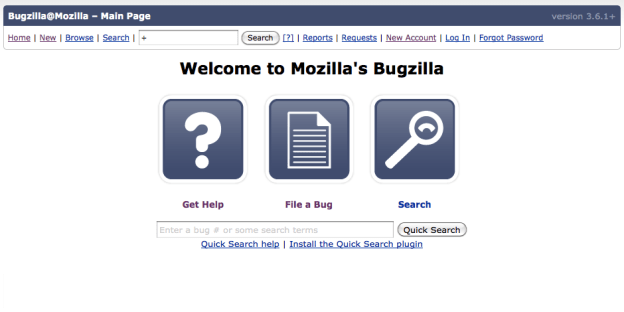
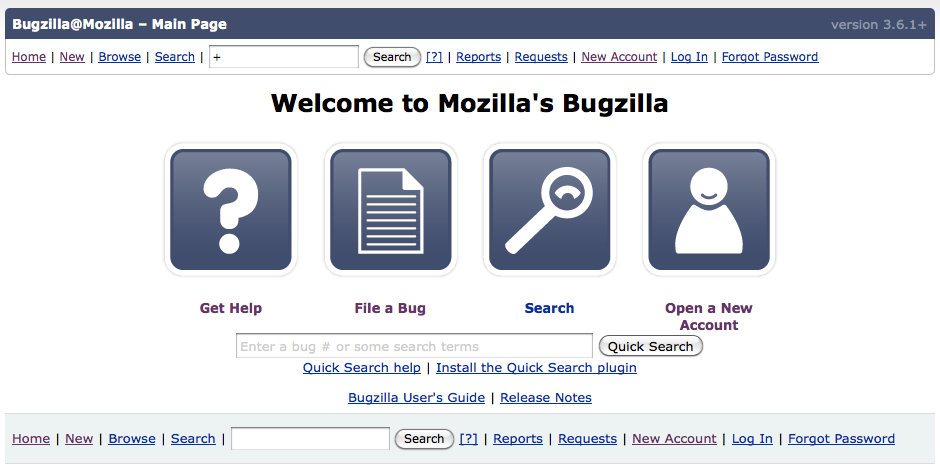
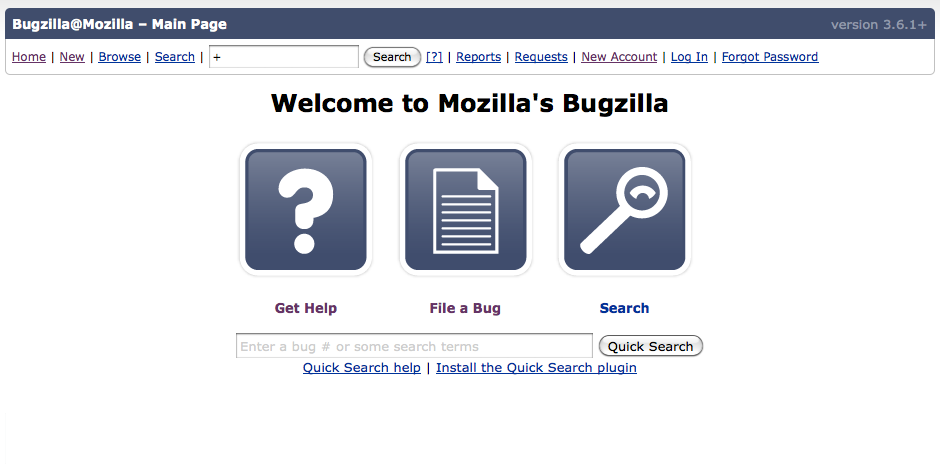
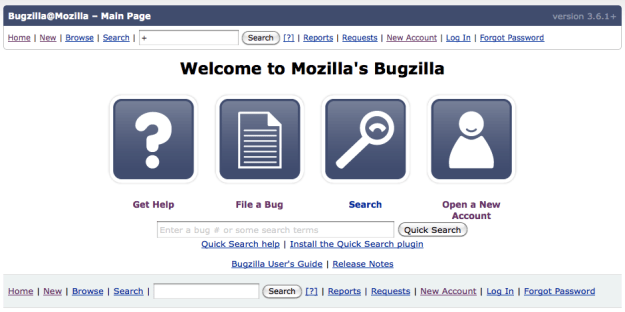
Take for example, the landing page of Bugzilla. It is unclear to me why “Open a new Account” should be on this page. Advanced users will know they want to file a bug, novices (who may be on the wrong site and who should be looking for support) might believe they have to open and account to get support. So why not eliminate the option altogether. You are going to get it anyways if you click on “File a bug.”
Bugzilla-landing-page

Current

Bugzilla-landing-page-v2

Proposed

In addition, I got rid of the bottom menu bar (which I don’t think is necessary on this screenƒclu given all the features were along the top as well). I also ditched the Release Notes and User Guide for Bugzilla as I had doubts about whether users were, at this point and on this screen, looking for those things)

2. Gather more information about our users (and, while I’m at it, some more simplifying)

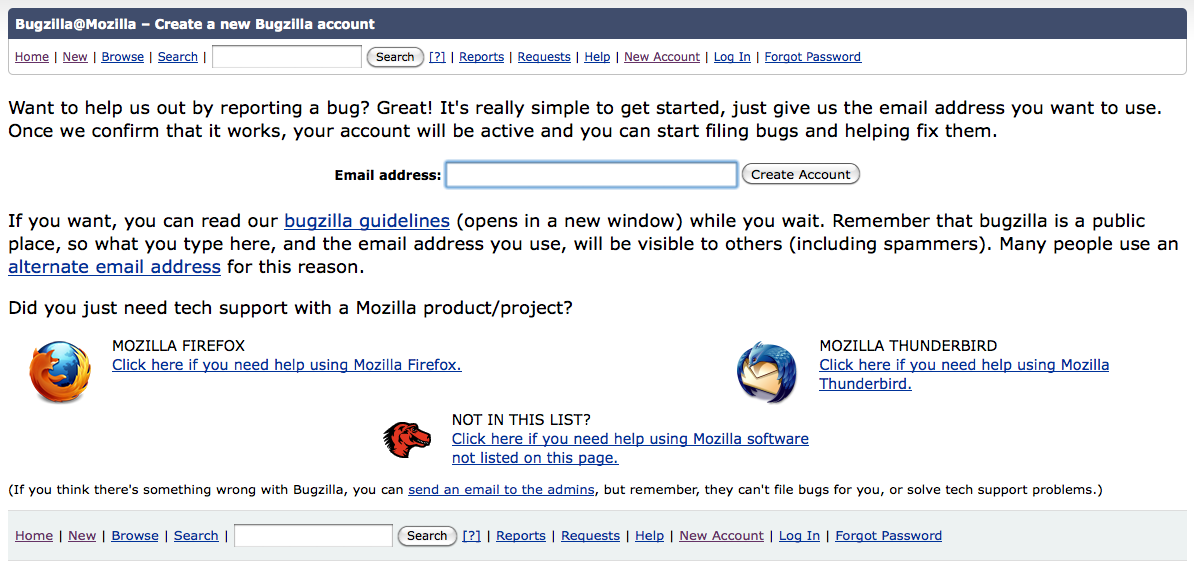
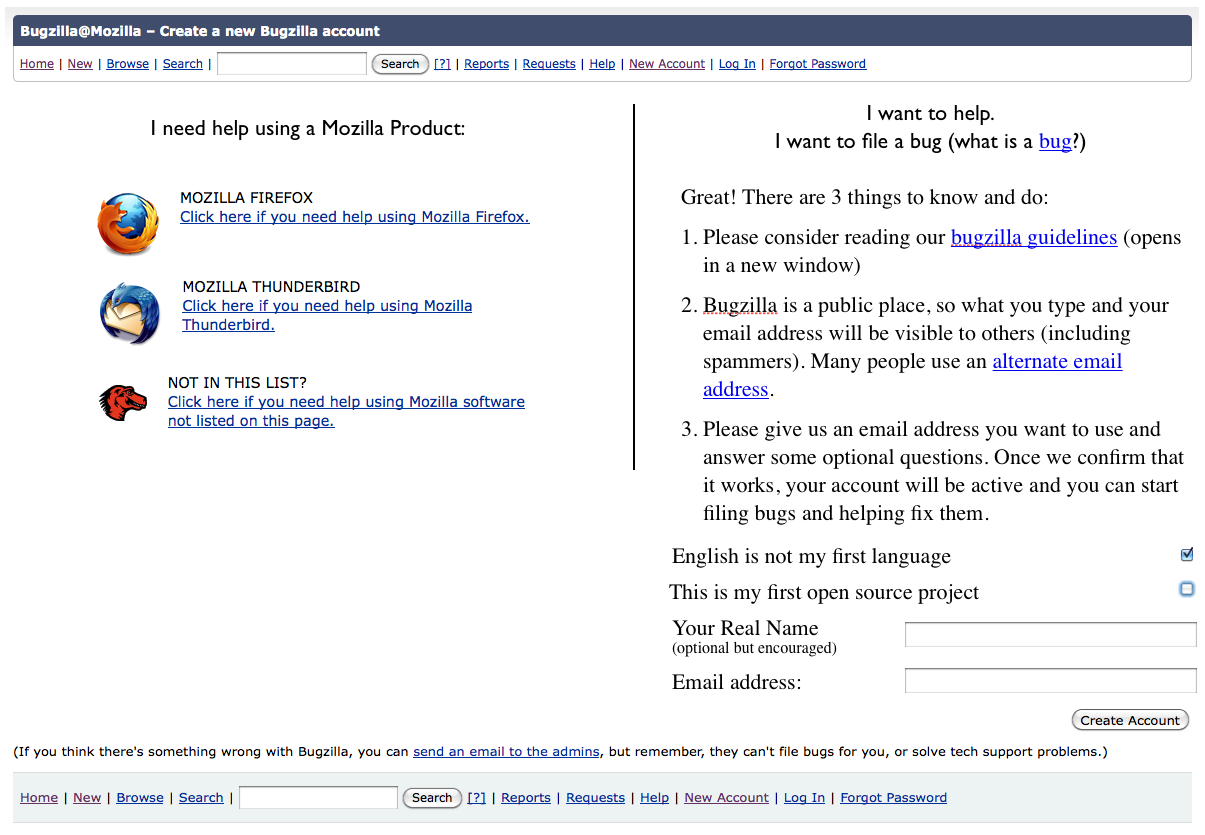
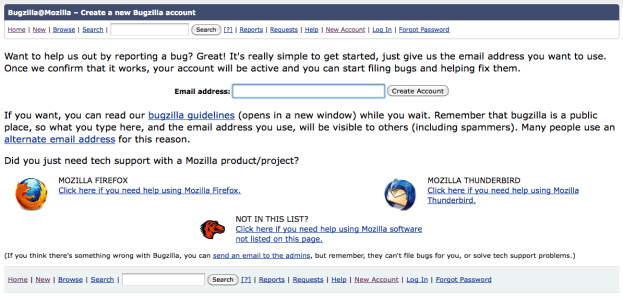
Once you choose to file a bug you get prompted to either log in or create an account. At this point, if you want to create an account. I thought this page was hard to read with the text spanning the whole width, plus, there is some good info we could gather about users at this point (the point it feels they are mostly likely going to add to their profile).
Current
Bugzilla-registration-v2

Proposed

Couple things a like about this proposed screen.

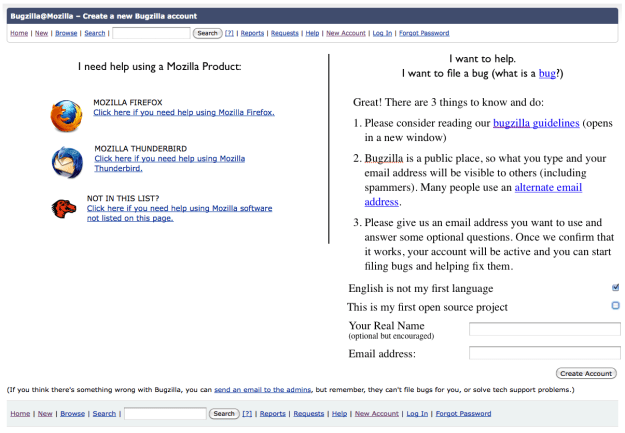
One, if you are a lost user just looking for support we likely snag you before you fill out a bugzilla account. My feeling is the bugzilla is a scary place that most users shouldn’t end up in… we need to give people lots of opportunities to opt for support before diving in, in case that is what they really need.

Second, in this proposed version we tell people to read the bugzilla guidelines and suggest using an alternate email before they punch their email into the email field box.

In addition, we ask the user for their real name now (as opposed to relying on them to fill it out later). This nudge feels important as the more people with real names on the site, the more I think people will develop relationships with one another. Finally we ask people if English is their second language and if this is their first open source project.

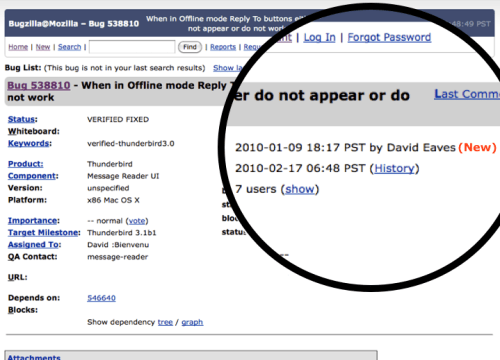
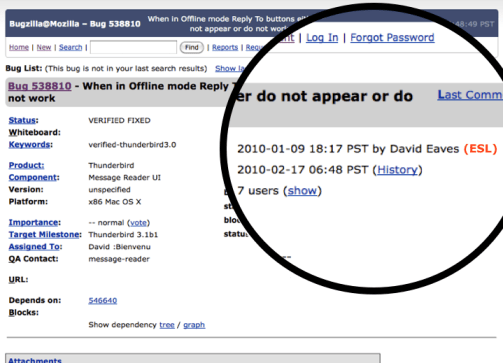
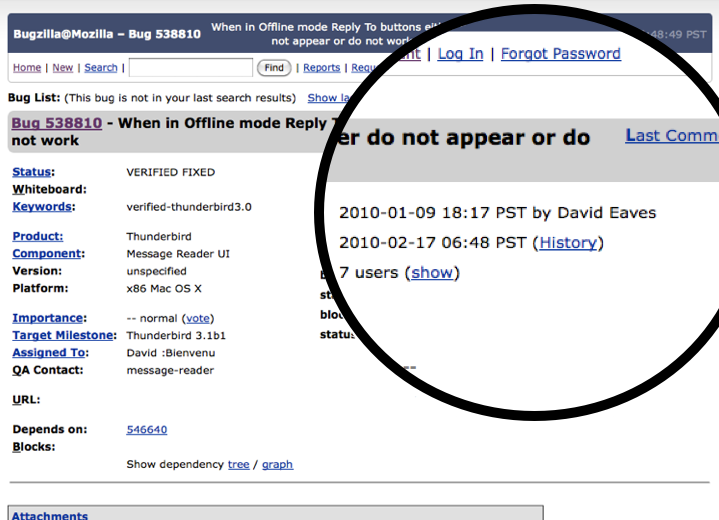
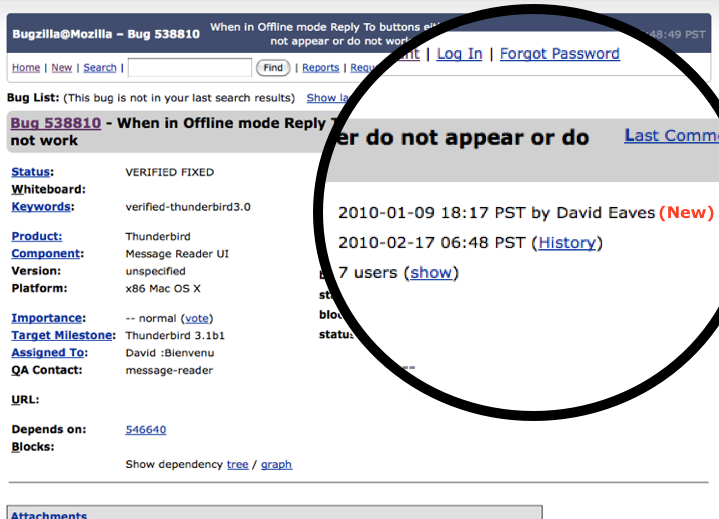
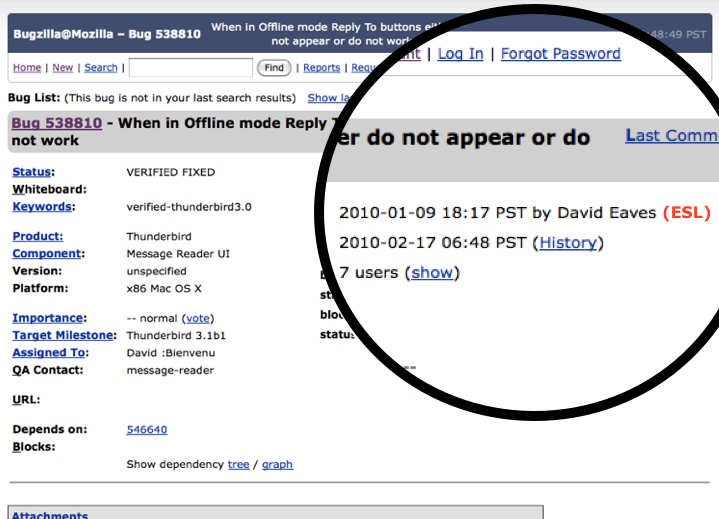
Finally, with the extra data fields we can help flag users as ESL or new and thus in need of more care, patience and help as they on-ramp (see screen shots below). We could even modify the Bugzilla guidelines to inform people to provide newbies and ESL’s with appropriate respect and support.
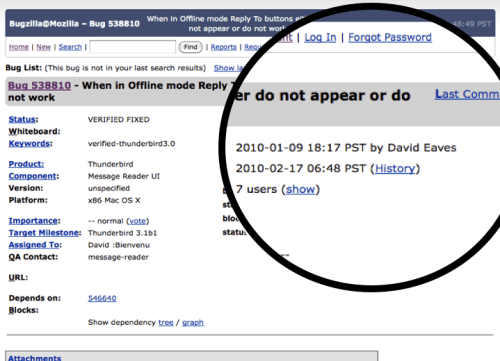
Bugzilla-Raw1

Current

Bugzilla-New

Proposed

Proposed

I imagine that your “newbie” status would disappear either when you want (some sort of preference in your profile) or after you’ve engaged in a certain amount of activity.

3. Make life easier for users and the triage guys

Here is an idea I had talking with some of the triage guys at the Mozilla Summit.

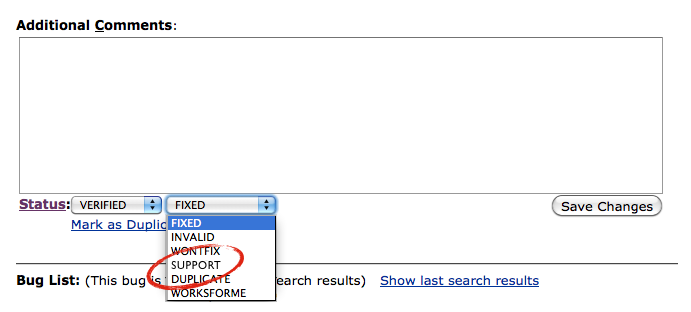
Let’s suppose that someone submits a bug that isn’t really a bug but a support issue. I’m informed that this happens with a high degree of frequency. Would it be nice if, with a click of a mouse, the triage guys could move that bug out of Bugzilla and into a separate database (ideally this would be straight into SUMO, but I respect that this might not be easy – so just moving it to a separate database and de-cluttering bugzilla would be a great first start – the SUMO guys could then create a way to import it). My sense is that this simply requires creating a new resolution field – I’ve opted to call it “Support” but am happy to name it something else.
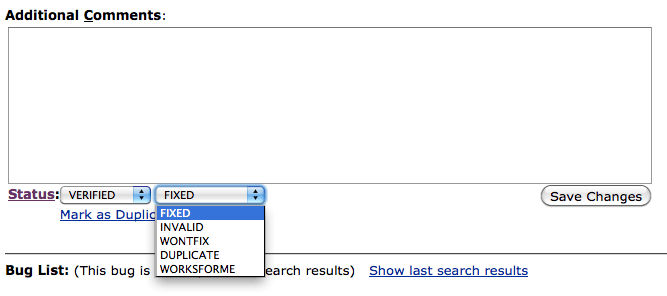
Current
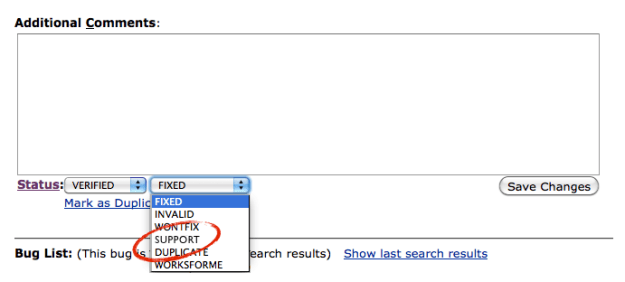
Status-v2

Proposed

This feels like a simple fix and it would quickly move a lot of bugs that are cluttering up bugzilla… out. This is important as searches for bugs often return many results that are support oriented, making it harder to find the bugs you are actually searching for. Better still, it would get them somewhere where they could more likely help users (who are probably waiting for us to respond).

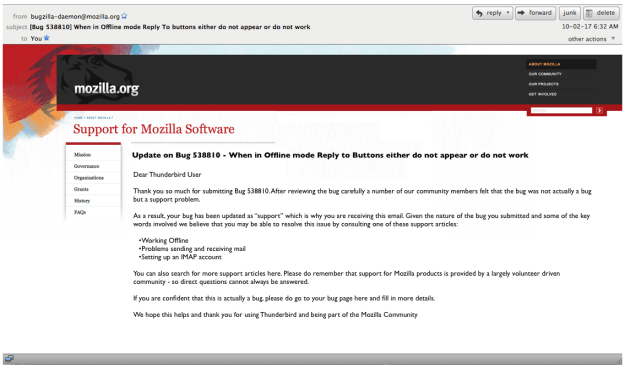
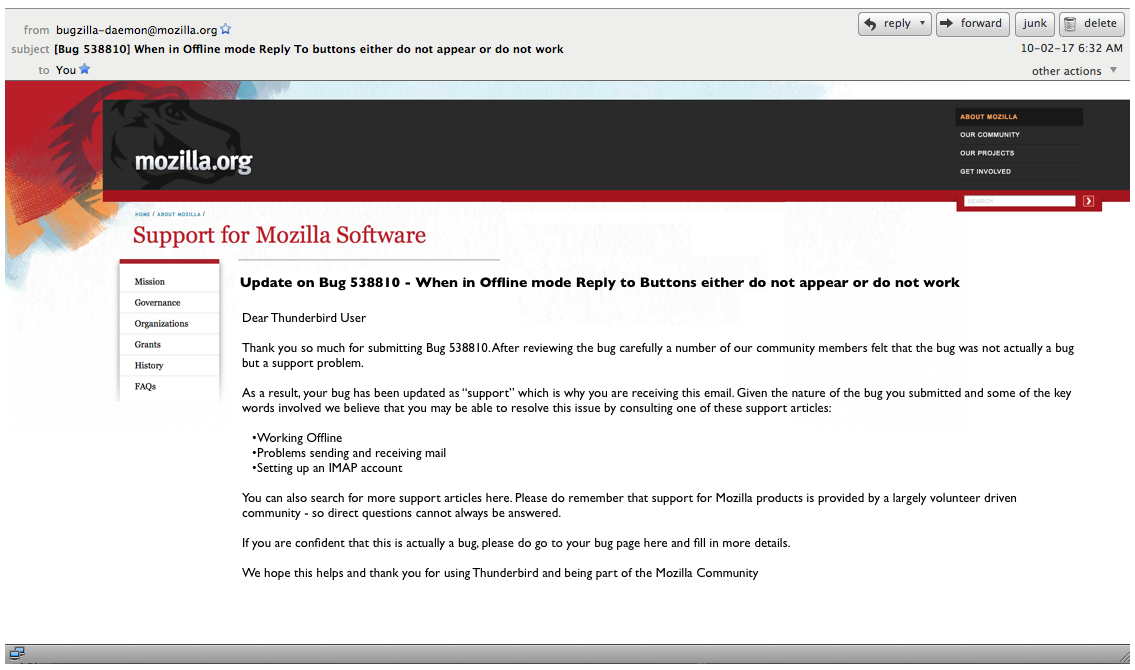
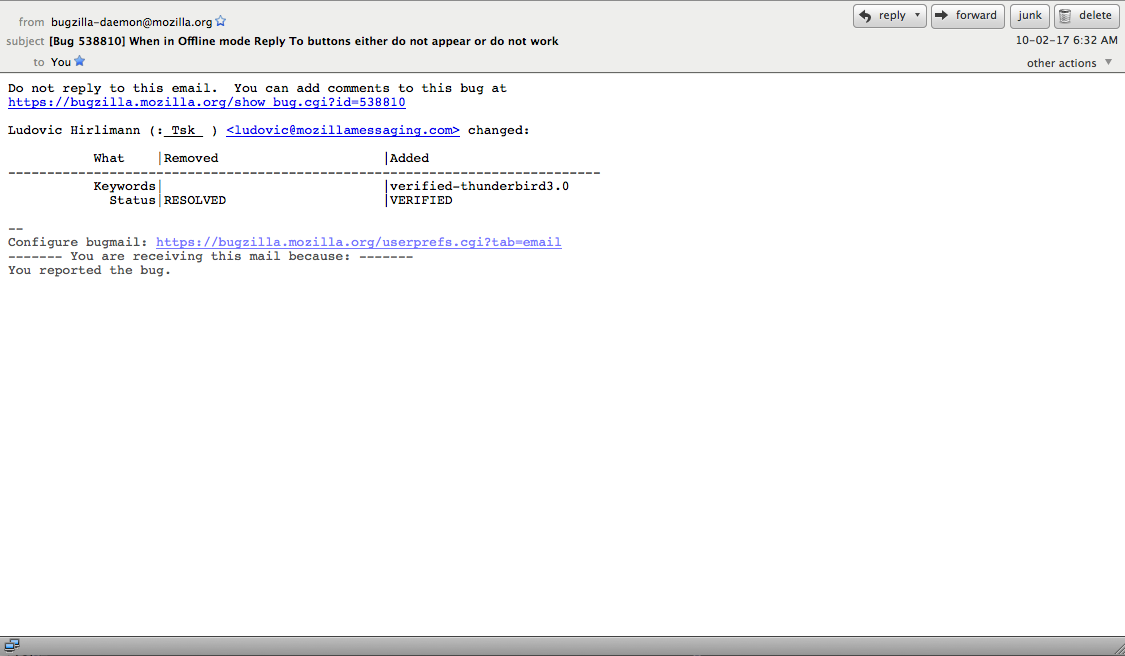
Of course, presently bugzilla will auto generate an email that looks like the first one and this isn’t going to help. So what if we did something else?
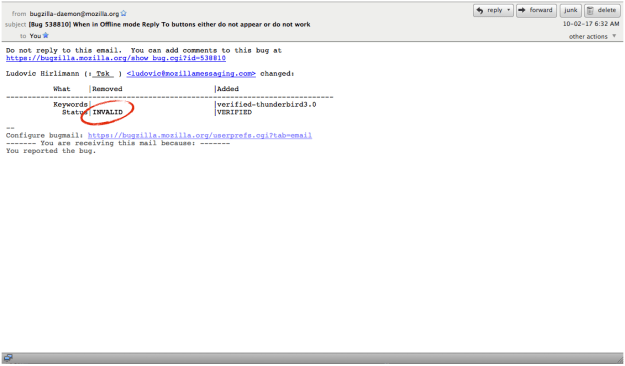
unresolved

Current

SUMO-transfer-v2

Proposed

Here is the auto-generated email I think we should be sending users whos bugs get sent to SUMO. I’ve proposed a few things.

First, if these are users who’ve submitted inappropriate bugs and who really need support, giving them a bugzilla email isn’t going to help them, they aren’t even going to know how to read it.

Second, there is an opportunity to explain to them where they should go for help – I haven’t done that explicitly enough in this email – but you get the idea

Third, when the bug gets moved to SUMO it might be possible to do a simple key word analysis of the bug and, from that, determine what are the most likely support articles they are looking for. Why don’t we send them the top 3 or 5 as hyperlinks in the email?

Fourth, if this really is a bug from a more sophisticated user, we give them a hyperlink back to bugzilla so they can make a note or comment.

What I like about this is it is customized engagement at a low cost. More importantly, it helps unclutter things while also making us more responsive and creating a better experience for users.

4. Make Bugzilla Celebrate, enhance our brand and build community

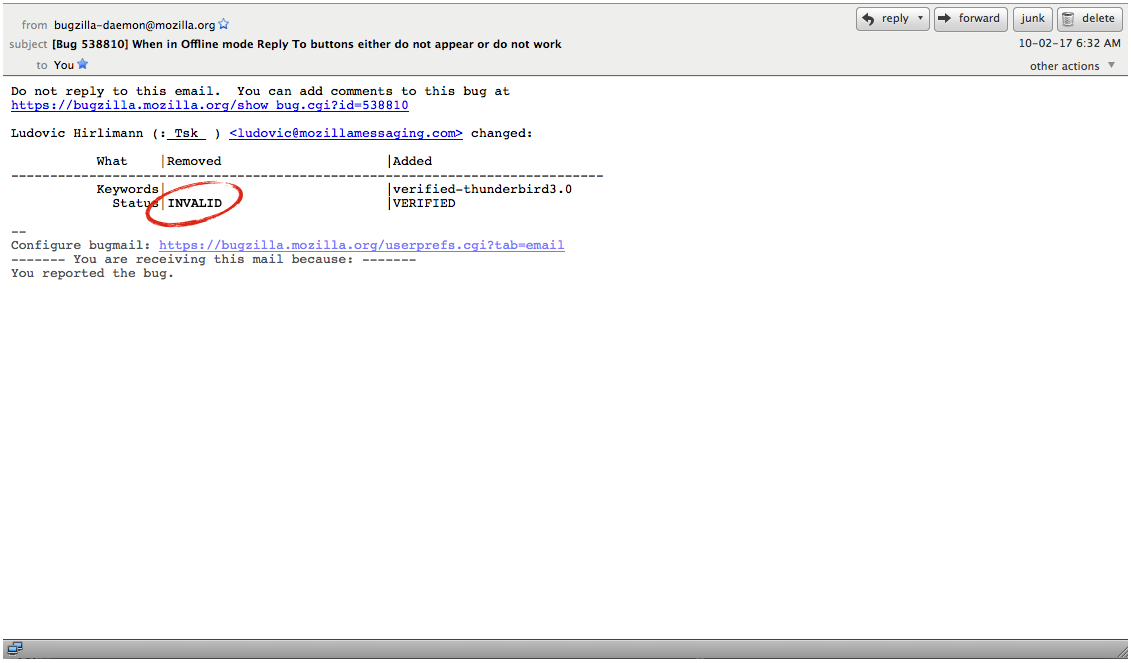
Okay, so here’s the thing that really bugs me about bugzilla. If we want to be onramping people and building community, shouldn’t we celebrate people’s successes? At the moment this is the email you get from Bugzilla when a bug you’ve submitted gets patched:
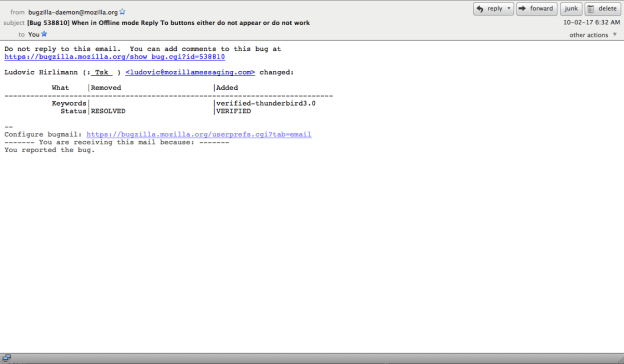
BORING! Here, at the moment of maximum joy, especially for casual or new bugzilla participants we do nothing to engage or celebrate.

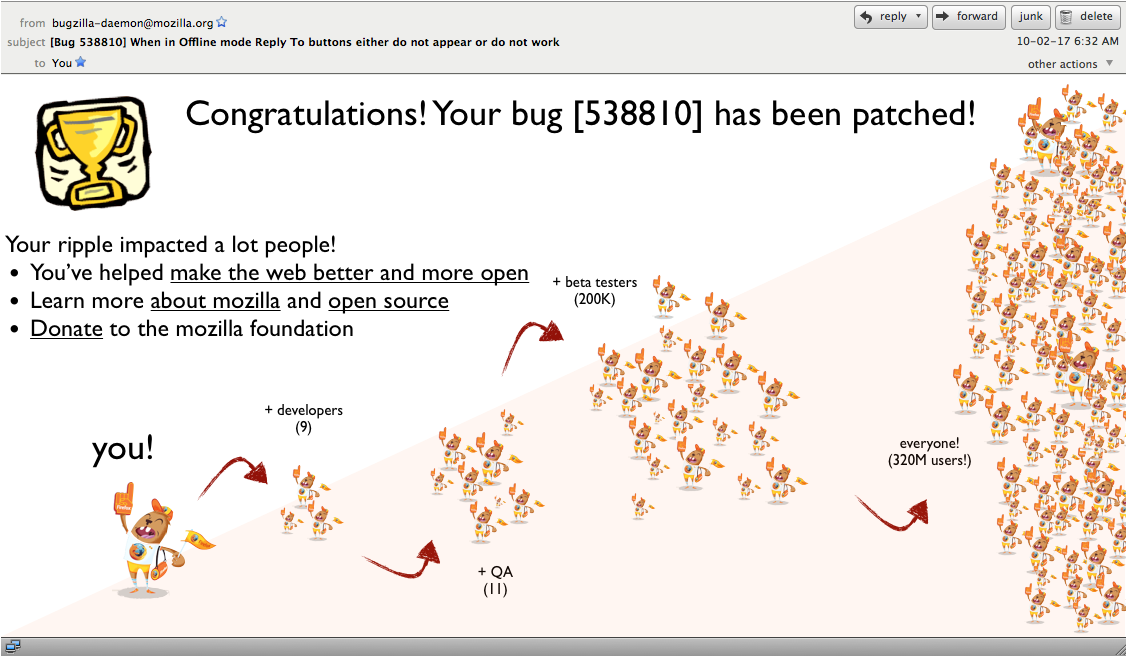
This, is what I think the auto-generated bugzilla email should look like.
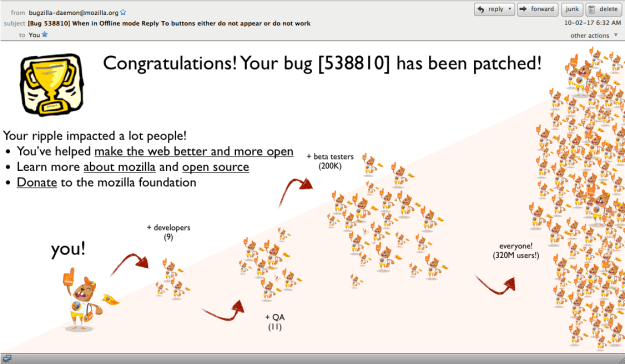
Congrats-v2

Yes, I agree that hard core community members probably won’t care about these types of bugs, but for more casual participants this is an opportunity to explain how open source and mozilla works (the graphic) as well as a chance to educate them. I’ve even been more explicit about this by offering links to a) explain the open web, b) learn about mozilla and open source; and c) donate to the foundation (given this is a moment of pride for many non-developer end users)

Again, I’m not overly attached to this design per se, it would just be nice to have something fun, celebratory and mozillaesque.

Okay, it is super late and I’m on an early flight tomorrow. Would love feedback on all or any of this for those who’ve made it this far. I’ll be sharing more thoughts, especially on empathetic nudges and community management in bugzilla ASAP.

Awesome Interactions: More on my Mozilla Summit 2010 Ignite Talk

Last week I had the distinct pleasure of being at the Mozilla Summit.

This is a gathering of about 650ish people from innumerable countries around the world to talk about Mozilla, the future of the open web, the various Mozilla products (such as Firefox and Thunderbird). As Mozilla is a distributed community of thousands of people from around the world and the summit only takes place every two years, it as one participant memorably put it, “an opportunity to engage in two years of pent up water cooler talk.”

As a follow up for the summit I’ve two things I wanted to share.

First, for those who enjoyed my Ignite talk on community management entitled Making the Army of Awesome More Awesome I’ve uploaded my slides to slideshare. (Not the most flattering picture of me giving the talk, but the only one I could find on flickr…)

I’m hoping, once the summit organizers have taken a much deserved break, to get video and audio of the presentation and I’ll create slidecast and post it to this blog.

Also, if you found the talk engaging, there is a longer version of that talk where I dive a little deeper into some of the theory I mention at the end. It is a talk David Humphrey kindly asked me to give back at FSOSS a few yeas ago called Community Management: Open Source’s Core Competency.

Second, both in my talk and during the incredible time I had speaking with a number of people in the Mozilla community I brainstormed a ton of ideas. I’m committed to documenting those and sharing them. Here’s a list of some of them, in the coming week I hope to blog on each, and ideally all of these.

1. Improve the link between Bugzilla and SUMO

2. Auto-generate help topics in the Help pull down menu

3. Ask people when they download Firefox or Thunderbird if they’ll volunteer to do bug confirmation

4. Add “Newbie” to new Bugzilla registers

5. Add “ESL” (English as a second language) to Bugzilla accounts that request it

6. Rethinking data.mozilla.org and fostering a research community

7. Segment Bugzilla submitters into groups that might be engaged differently

8. Reboot Diederik Van Liere’s jet pack add-on that predicts bug patch success

8b. Add on a crowdsourcing app to call out negative language or behaviour

9. Retool questions asked in Bugzilla to “nudge” users to better responses

10. Develop an inquire, paraphrase, acknowledge and advocate crowdsourcing identfier jet pack add on for bugzilla

11. plus more, but lets start with these…

Ministerial Twitter Battle! $130M tax payer dollars wasted! Conspiracy theories!

Who knew the census could be so exciting.

Yesterday, I published Why you should care about the sudden demise of the mandatory long census form on the Globe and Mail website (also can be found here on this blog).

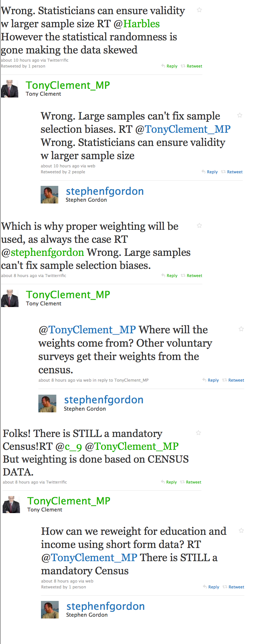
One interesting impact of the piece was that it generated the following debate between the Minister and a Laval Statistics Professor. Ultimately the professor’s concerns that the data generated by a voluntary long form remain unresolved. In short, as the former chief statistician of Statistics Canada also noted, a $100 million dollar survey may generate useless data.

UPDATE: Turns out there is now a petition to save the long form census here.

In addition to the online debate here are some other interesting facts about the end of the mandatory long census form:

1. It will be more expensive to implement.

For a government that is supposed to be fiscally conservative, ending the mandatory form could actually cost Canadian Tax Payers an additional $30 Million. As the Canadian Press reports:

“The cost of the change could reach $30 million, says Statistics Canada: $5 million for the additional mailout, and $25 million in case there is a major problem in getting people to respond.”

So, to sum up: Canadians will pay more to get data that risks being useless and skewed. Total waste of tax payer dollars: $130M.

2. No one can identify who wanted this change, not even the Minister.

Again, from the same Canadian Press article:

Industry Minister Tony Clement acknowledged in an interview that no consultations were undertaken on the decision.

He said it was based on the fact that many Canadians had complained of the coercive and intrusive nature of the census, but Clement had not seen polling on the issue.

How many Canadians? What is clear is that a large number of people are stepping forward to say this was a bad idea. So far every major municipality – through the Federation of Canadian Municipalities – is complaining about the decision, so to is both the Canadian and the Toronto Associations of Business Economists, the Canadian Council on Social Development and the Canadian Association of University Teachers and numerous academics and of course, the former chief statistician of Canada who says he would have quit rather than carry out the order to end the mandatory long census form.

3. So who has complained? (this is the best part)

So far all the stories about Canadians who have complained about the census refer to two individuals. The Canadian Press story (Which has been reprinted in several forms in a number of newspapers) references Sandra Finley, a Saskatoon activist who is still fighting in court after refusing to fill out the 2006 census. In addition to Ms. Finley, the Globe also referenced Don Rogers, a Kingston, Ont., man who mounted the “Count Me Out” campaign against the census.

In both cases the protesters core problem was not the coercive or intrusive nature of the census (the concern the minister seeks to address) but the fact the Statistics Canada bought software from defence manufacturer Lockheed Martin back in 2003. Indeed, the Count Me Out website is plastered with a hodge podge of conspiracy theories NAFTA, Lockheed Martin and the Canadian census funding ballistic missile tests.

Is this the complaint upon which the minister is grounding his decision?

4. Canada is alone

As far as the former Chief Statistician can tell, no other country in the world has a voluntary portion to its census.

Taken these four issues one is left wondering – is this how cabinet decisions are made?

Update 9:17am July 7th

Liberals issue a press release stating that:

“If the Conservatives don’t reverse their decision, Liberals are prepared to explore the introduction of an amendment to the Statistics Act to ensure a comprehensive, mandatory long-form stays,” said Ms. Jennings. “This decision, made in secret, without any consultation, is dangerous because the information that will be lost is used to help Canadians in their daily lives – particularly our most vulnerable citizens.”

Update 8:30am July 7th

Other articles raising concerns about this decision:

Winnipeg Free-Press: Anti-census crusader not satisfied with federal axing of long form

Globe and Mail: Tories Scrap Mandatory Long Form Census

Saskatoon Star-Phoenix: Detailed census data invaluable for sound policy

Montreal Gazette: Canadians must be able to count on Statistics Canada

Vancouver Sun Editorial: Canada needs its citizens to stand up and be counted

Victoria Times Colonist: Census shortcut bad for Canada

Edmonton Journal: Ridiculous to scrap key census data

(Plus many more who ran the Canadian Press story and others I just didn’t paste in here).

Articles supportive about this decision:

zero