Innovation at the Bottom of the Pyramid: The Olyset Net in Africa

BoP-200x300A few years ago I read C.K. Prahalad’s The Fortune at the Bottom of the Pyramid: Eradicating Poverty Through Profits, a stunning book about how development can take place and successful economies can emerge even in the poorest of places. Prahalad presents case after case of how companies conducted research and supported innovations at a cost point that helped foster products that could serve some of the desperately poor populations in the world.

The other day my friend John McArthur twittered about this company – which has invented a Permethrin laced mosquito bed net guaranteed to last at least five years (testing shows it often lasts 7). Better yet, it is significantly stronger than polyester nets being both tear-proof, wash-proof and never requiring treatment.

This alone would be a great news story. But it is the economy behind the net that is equally exciting. The manufacturing of the Olyset Net is creating jobs in Africa:

Production in Africa began in 2003 when Sumitomo Chemical provided a royalty-free technology license to A to Z Textile Mills in Arusha, Tanzania. Tanzanian production was further expanded in 2008 when Sumitomo Chemical celebrated the official opening of a 50:50 joint venture factory, expanding our partnership with A to Z in East Africa. From 2009, global production capacity will exceed 40 million nets per annum, with around 50% manufactured in Africa. Furthermore, Sumitomo Chemical has recently committed to expanding production into Nigeria, the African country with the greatest malaria burden. Once production is established in Nigeria, global capacity will be 60 million Olyset nets.

Olyset-netThe news section of the website has still more good news. A Sumitomo Chemical Partnership with an Ethiopian Business will create 300 jobs in Kombolcha, Ethiopia. Is this development? Or is it Foreign Direct Investment creating jobs, feeding the African economy and helping solving one of the greatest scourges on the continent.

If you find this compelling, take a look at John’s newest Huffington Post piece where he outlines the new research and study Masters program he and Millennium Promise are helping create around the world.

A Neo-Progressive Manifesto

This piece builds on my thoughts regarding Umair Haque’s Generation M Manifesto.

Dear conservatives on the Left and Right – and those beholden to them.

We would like to break up with you.

Every day, we see a widening gap in how you and we understand the world — and what we want from it. It’s been a long time coming but we have irreconcilable differences.

You wanted big, fat, universal and eternal institutions. We want renewable, transparent, responsive, and people-oriented organizations.

You turned politics into a divisive word. We want open, engaged and deep democracy — everywhere.

You wanted financial fundamentalism – be it unrestricted, unregulated capitalism or protected and subsidized industrialism. We believe in a post-industrial economy: a shift from the hierarchical to decentralized with the use of markets as a progressive policy tool.

You wanted big growth, measured only by GDP. We want smart growth and real value, built by people with character, dignity and courage.

You wanted organizations hidden behind veils of secrecy. We want open institutions, fit for survival, designed to grow and share wealth, that seek to create markets, not own them.

You believed in top-down and trickle-down. We believe in emergent and bottom-up.

You prized biggie size life: McMansions, gas guzzlers, and McFood. We want a sustainable, humanized life.

You let citizens devolve into consumers and users. We want citizens to be hackers, creators and… citizens.

You’ve claimed the choice is between a winner take all society or a no winner society. We want an eco-system that rewards talent, ideas, productivity and collaboration – we want a meritocracy.

You wanted a culture that is controlled by the past. We want a free culture that builds on the past.

You’ve wanted to protect monopolies or protect jobs. We want an economy that allows for creative destruction.

You wanted exurbs, sprawl, and gated anti-communities. We want a society built around sustainable communities.

You wanted more money, credit and leverage — to consume ravenously. We want to be great at doing stuff that matters.

There’s a tectonic shift rocking the social, political, and economic landscape. We are pro-ams, we are creatives, we are hackers, we are neo-progressives and we are legion.

Who are neo-progressives? We are engaged. We start non-governmental organizations, work internationally, create social enterprises, volunteer in our communities, start socially conscious businesses and advocate outside of organized politics. We are a growing number of people who act differently – doing meaningful stuff that matters the most.

Neo-progressives are those of us who have not found a natural home on the left or the right of traditional politics and are increasingly returning to the core values of historical progressivism, using evidence-based public policy to help ensure the equality of opportunity in a market-based economy.

Everywhere we look, we see an explosion of neo-progressive businesses, NGOs, open-source communities, local initiatives, and government. Who are the neo-progressive role models? Obama, kind of. Larry and Sergey. The Threadless, Etsy, and Flickr peeps. Ev, Biz, and the Twitter crew who made Tehran 2.0 possible. Calvin Helin, Wendy Kopp and Teach for America, Tzeporah Berman and the ForestEthics crew as well as Mitchell Baker and the Mozilla community. The folks at Kiva, Talking Points Memo, and FindtheFarmer. Anita Roddick, Margot Fraser, Muhammad Yunus, Hernando de Soto Polar and Jeff Sachs are like the grandparents of neo-progressivism. There are tons where these innovators came from.

The creative destruction neo-progressives want isn’t just awesome — it’s vitally necessary. And if you think it all sound idealistic, think again.

We face global warming, a financial meltdown, a de-industrializing economy, increasing inequality (both nationally and internationally) and the possibility of catastrophic terrorism.

But the real crisis is the same one that confronted us in the late 18th century and in the mid 20th century and it isn’t going away, changing, or “morphing.” It’s the same old crisis — and it’s growing.

You’ve failed to recognize it for what it really is. It is in our institutions: the rules by which our economy is organized.

But increasingly they’re your institutions, not ours. You made inherited them but you failed to renew them and now they’re broken. Here’s what we mean:

“… For example, the auto industry has cut back production so far that inventories have begun to shrink — even in the face of historically weak demand for motor vehicles. As the economy stabilizes, just slowing the pace of this inventory shrinkage will boost gross domestic product, or GDP, which is the nation’s total output of goods and services.”

Clearing the backlog of SUVs built on 30-year-old technology is going to pump up GDP? So what? There couldn’t be a clearer example of why GDP is a totally flawed concept, an obsolete institution. We don’t need more land yachts clogging our roads: we need a 21st Century auto industry.

We were (kind of) kidding about seceding before. Here’s what it looks like to us: every era has a challenge, and this is ours: to renew what’s been given us and create what wasn’t — to ensure we foster a sustainable shared prosperity.

Anyone — young or old — can answer it. Neo-progressivism is about ensuring governing and economic institutions once again reflect progressive values. It is more about what you do and who you are than where you fit on a broken political spectrum. So the question is this: do you still belong to the 20th century – or the 21st?

The Neo-Progressive Manifesto Prelude (or why Generation M must be remixed)

On Wednesday Umair Haque’s posted a Manifesto for Generation M. The post has received some praise and some serious criticism.

I’d be lying if I said the post didn’t resonate with me on certain level – heck, that is why I remixed it (lightly) on Friday night. Many of the manifesto’s ideas and links – and above all, its message of institutional failure – tapped into the challenges and issues Taylor and I sought to weave together in Progressivism’s End: How the Left is Killing Progressive Politics.

Now, at the end of the weekend, having reflected on it further alone, with friends and with Taylor, there is still lots I agree with. We do face a crisis of institutions and, frankly, there are a large number of people who would like to simply dial back the clock (some 10 years, others 35) and say – that’s it, problem solved. I believe Umair is saying that isn’t going to work. And I agree with him.

So having said that, I’ve got two observations and a final mega-remix to make to the Generation M Manifesto.

1. It Ain’t a Generational Divide

In reading the comments (especially this one) and talking with friends I was reminded how Taylor and I shied away from using a generational analysis like that adopted by Umair. This was an explicit choice. Our piece is about the death of progressive politics and what we believe is emerging in its place – it is the kind of narrative that, on the surface, appears to lend itself intuitively to generational divide. But the divide is not generational. First, let’s be honest, there are lots of Social Darwinian, self-centered, materially driven people in every generation.

Consider Canada, which many falsely believe is broadly immune to such thinking despite producing Mark Steyn. But consider the research in Sex in the Snow by Michael Adams. Drawing from his social values surveys, Adams concluded that Gen X could be divided into 5 “tribes.” Two of these tribes – the ‘New Aquarians‘ (13% of Gen Xers) and the ‘Autonomous Post-Materialists‘ (20%) would probably find the ideas in Umair’s Manifesto (as well as, hopefully, Taylor and I’s piece) resonate with them. However, among the other three ‘Gen X’ tribes, many of the ‘Aimless Dependents‘ (27%), the ‘Thrill-Seeking Materialists‘ (25%) and ‘Social Hedonists‘ (13%) would likely fall along a spectrum defined at one extreme by mild interest and the other by outright hostility. Still more would probably feel complete indifference to either Umair’s Manifesto or our piece.

This breakdown is true among Baby Boomers as well. I suspect that Autonomous Rebels (25% of boomers) and Connected Enthusiasts (14%) would be more inclined to identify with much of the Manifesto while Anxious Communitarians, (20% ) and Disengaged Darwinists, (41%) would be less inclined.

In short, a generational analysis simply isn’t accurate. But that is only the half of it. The other reason Taylor and I shied away from generational analysis because such an analysis is likely to hamper the development of a self-identifying and self-organizing group to champion and implement the ideas we (and Umair) highlight. While the Manifesto will inspire some, it’s analytical lens will, however, also alienate potential allies while simultaneously assuming those potentially indifferent or even hostile to its ideas are in agreement. If there is going to be a movement, it is wise to know who’s in, who’s out, and who doesn’t care.

2. It’s About Values

What is notably absent from Umair’s manifesto is any mention of values. It’s not that they aren’t there – it’s that they are left implicit. The values I see reflected in Umair’s post aren’t new; in fact they are quite old. This is the central piece to Taylor and I’s argument – that progressives have become more attached to the institutions they inherited than to the values those institutions were built to serve:

The rise of industrial capitalism during the 19th century led to a series of tense societal changes. These included the emergence of an urban working class, increasing inequality and the new possibility of total war. In response, three generations of pragmatically driven “progressives” emerged. Opposing both the socialist left and the laissez-faire right, they championed values such as equality of opportunity, meritocracy, government transparency and empirical inquiry.

This is the source of the crisis. It is not that one generation held values that another didn’t. It’s that the institutions we inherited don’t always reflect those values in a world where globalization, technology and social values have altered how we work, play and live. Taylor and I (and I suspect Umair) are frustrated because we see enormous time, money and energy being spent in an effort to architect our economy, our government and our public spaces to serve and preserve these institutions, rather than ensuring these institutions support us and an economy, government and public space we believe are essential for a prosperous and sustainable future.

So the question becomes how to ensure the values of equality of opportunity, meritocracy, government transparency, empircal inquiry – along with human rights, and the environment, get imbued into the policies, institutions, communities and companies we will inherit and create? It feels like the first step is to articulate them clearly. This way, when some of these new institutions begin to change we’ll know it is time to reform, abandon or simply move on.

3. Post-Potter Authenticity; and Where are the Women?

Finally, some quick hits. In a post-Rebel Sell world we need to be really careful about talking about authenticity. Even the “authentic” is constructed…  (If you haven’t read The Rebel Sell – go find a copy. Heath and Potter are brilliant).

Also, where are the women? Umair’s manifesto lists Generation Mers but there is almost nary a women among them. (I only counted one – Flickr had a female co-founder).

Gen M is about passion, responsibility, authenticity, and challenging yesterday’s way of everything. Everywhere I look, I see an explosion of Gen M businesses, NGOs, open-source communities, local initiatives, government. Who’s Gen M? Obama, kind of. Larry and Sergey. The Threadless, Etsy, and Flickr guys. Ev, Biz and the Twitter crew. Tehran 2.0. The folks at Kiva, Talking Points Memo, and FindtheFarmer. Shigeru Miyamoto, Steve Jobs, Muhammad Yunus, and Jeff Sachs are like the grandpas of Gen M. There are tons where these innovators came from.

I’m sure this is a problem that can be crowd sourced – but it had better happen quickly. In our piece, Taylor and I used Tzeporah Berman (Environmental Activisit), Calvin Helin (First Nations Lawyer) and Dan Florizone (Public Servant) as cases. Here I think is another place the manifesto could do with more examples – those doing work in the non-profit and government sector.

A real remix

Again – there are a lot of people who are going to jump on Umair. Indeed on some sites the Law of Fail has already been reached:

Once a web community has decided to dislike a person, topic, or idea, the conversation will shift from criticizing the idea to become a competition about who can be most scathing in their condemnation.

I’m not one of them. I understand why Umair is frustrated. I’m not certain that a generational analysis is the right approach but I do agree that we are not sufficiently wrestling with the question of how we redesign market regulation, democratic institutions, financial regulation, etc… to help foster the communities, environment and economy we want for the 21st century.

So with this in mind I’m going to take another cut at remixing the Manifesto. Indeed, it may be so dramatically different it is simply a re-purposing.  Increasingly, I sense that we’ve got to put values back into the equation and tackle figure out what are the cleavages in our society that do distinguish those opposed to reform from those in favour – in short, I’m going to remix it into a Neo-Progressive Manifesto.

The Generation M Manifesto (Re-mixed v.1)

I’ve always been a big Umair fan and think you should to. He writes about everything Taylor and I were getting at in our piece about The Death of Progressive Politics and the need for a neo-progressive movement.

On Wednesday Umair Haque published The Generation M Manifesto on his blog. In the very best spirit of Generation M he asked others to edit and re-mix the manifesto. I’ve added a few lines (all my edits are in red), removed the reference to “I” (underlying thinking: this is a manifesto for a group), removed the “I thinks” (this is no time to hedge ourselves)

I want to think about this more but here’s my first crack.

Addendum: I’ve actually done a lot more thinking on the Manifesto and re-mixed it more significantly here.

—-
Dear Old People Who Run the World,

My generation would like to break up with you.

Everyday, I we see a widening gap in how you and we understand the world — and what we want from it. It’s been a long time coming but I think we have irreconcilable differences.

You wanted big, fat, lazy “business.” We want small, responsive, micro-scale commerce.

You turned politics into a dirty word. We want authentic, deep democracy — everywhere.

You wanted financial fundamentalism. We want an economics that makes sense for people — not just banks.

You wanted shareholder value — built by tough-guy CEOs. We want real value, built by people with character, dignity, and courage.

You wanted organizations hidden behind a veils of secrecy. We want open institutions, fit for survival, designed to grow and share wealth, that seek to create markets, not own them.

You wanted an invisible hand — it became a digital the sleight of hand. Today’s markets are those where the majority of trades are done literally robotically. We want a visible transparent handshake: to trust and to be trusted.

You wanted growth — faster. We want to slow down — so we can become better.

You didn’t care which communities were capsized, or which lives were sunk. We want a rising tide that lifts all boats.

You wanted to biggie size life: McMansions, Hummers, and McFood. We want to humanize life.

You let citizens be devolve into consumers and users. We want citizens to be hackers, creators and… citizens.

You wanted a culture that is controlled by the past. We want a free culture that builds on the past.

You wanted exurbs, sprawl, and gated anti-communities. We want a society built on authentic around sustainable communities.

You wanted more money, credit and leverage — to consume ravenously. We want to be great at doing stuff that matters.

You sacrificed the meaningful for the material: you sold out the very things that made us great for trivial gewgaws, trinkets, and gadgets. We’re not for sale: we’re learning to once again do what is meaningful.

There’s a tectonic shift rocking the social, political, and economic landscape. The last two points above are what express it most concisely. I hate labels, but I’m going to employ a flawed, imperfect one: Generation “M.” We are pro-ams, we are creatives, we are neo-progressives, we are hackers, we are Generation “M” and we are legion.

What do the “M”s in Generation M stand for? The first is for a movement. It’s a little bit about age — but mostly about a growing number of people who are acting very differently. They are doing meaningful stuff that matters the most. Those are the second, third, and fourth “M”s.

Gen M is about passion, responsibility, authenticity, and challenging yesterday’s way of everything. Everywhere I look, I see an explosion of Gen M businesses, NGOs, open-source communities, local initiatives, government. Who’s Gen M? Obama, kind of. Larry and Sergey. The Threadless, Etsy, and Flickr guys. Ev, Biz and the Twitter crew. Tehran 2.0. The folks at Kiva, Talking Points Memo, and FindtheFarmer. Shigeru Miyamoto, Steve Jobs, Muhammad Yunus, and Jeff Sachs are like the grandpas of Gen M. There are tons where these innovators came from.

Gen M isn’t just kind of awesome — it’s vitally necessary. If you think the “M”s sound idealistic, think again.

The great crisis isn’t going away, changing, or “morphing.” It’s the same old crisis — and it’s growing.

You’ve failed to recognize it for what it really is. It is, as I’ve repeatedly pointed out, in our institutions: the rules by which our economy is organized.

But increasingly they’re your institutions, not ours. You made inherited them but you failed to renew them and now they’re broken. Here’s what I we mean:

“… For example, the auto industry has cut back production so far that inventories have begun to shrink — even in the face of historically weak demand for motor vehicles. As the economy stabilizes, just slowing the pace of this inventory shrinkage will boost gross domestic product, or GDP, which is the nation’s total output of goods and services.”

Clearing the backlog of SUVs built on 30-year-old technology is going to pump up GDP? So what? There couldn’t be a clearer example of why GDP is a totally flawed concept, an obsolete institution. We don’t need more land yachts clogging our roads: we need a 21st Century auto industry.

I was We were (kind of) kidding about seceding before. Here’s what it looks like to me us: every generation has a challenge, and this, I think, is ours: to foot the bill for yesterday’s profligacy — and to create, instead, an authentically, sustainable shared prosperity.

Anyone — young or old — can answer it. Generation M is more about what you do and who you are than when you were born. So the question is this: do you still belong to the 20th century – or the 21st?

Love,

Umair and the Edge Economy Community

How to predict the "Fixability" of a Bugzilla Submission

bugzilla iconMy friend Diederik van Liere has written a very, very cool jet-pack add-on that calculates the probability a bug report will result in a fixed bug.

The skinny on it is that Diederik’s app bases its prediction on the bug reporter’s experience, their past success rate, the presence of a stack trace and whether the bug reporter is a Mozilla affiliate. These variables appear to be strong and positive predictors of whether a bug will be fixed. The add-on can be downloaded here and its underlying methodology is explained in this blog post.

One way the add-on could be helpful is that it would enable the mozilla community to focus its resources on the most promising bug reports. Volunteer coders with limited time who want to show up and and take ownership over a specific bug would probably find this add-on handy as it would help them spend their precious volunteer time on bugs that are likely well thought through, documented effectively and submitted by someone who will be accessible and able to provide them with input if necessary.

The danger of course, is that a tool like this might further enhance (what I imagine is) a power-law like distribution of bug submitters. The add-on would allow those who are already the most effective bug submitters to get still more attention while first time submitters or those who are still learning may not receive as much sufficient attention (coaching, feedback, support) to improve. Indeed, one powerful way the tool might be used (and which I’m about to talk to Diederik about) is to determine if there are classes of bug submitters who are least likely to be successful. If we can find some common traits among them it might be possible to identify ways to better support them and/or enable them to contribute to the community more effectively. Suddenly a group of people who have expressed interest but have been inadvertently marginalized (not on purpose) could be brought more effectively into the community. Such a group might be the lowest hanging fruit in finding the next million mozillians.

Negotiating – how not to manage tension

Last week Rob Cottingham pointed me to ReadWriteStart piece entitled Learn to Negotiate and Close. It’s filled with some good – if unfortunately titled – advice particularly around focusing on listening and not derailing a deal by talking too much (“Two Ears, One Mouth”) as well as speaking to your client/prospective partner’s interests (“Wait Until You Hear Them Scream”). One section, however entitled “Using Tension to your Advantage” felt problematic and tweaked the negotiation consultant in me.

For example, in that section they advocate:

Donald Trump (the real-estate developer), in his book “The Art of the Deal,” talks about guiding the other side to the point that they really want the deal and think it is in the bag. Then he backs off and demands major concessions. Smart buyers everywhere have learned some variation of this tactic.

This is when you get a knot in your stomach and may witness table-banging and raised voices. All of this unpleasant stuff is good news. Experienced deal closers recognize these as signs that a deal is closing. The absence of these signs is actually a cause for concern!

One thread running through all good negotiations is some sign of real pain from the buyer that leaves you confident you are not leaving too much money on the table. Of course, the buyer knows you will be looking for this and will send signals that you have reached their limit. The skill comes in differentiating between fake pain, as in “This is well above our budget, and my boss will kill me if I agree,” and the real thing. The buyer will also be looking for the same signs from you.

From my experience negotiating, this statement is fraught with problems – and can be downright dangerous as advice. Here are a few reasons why:

Shifting Goals

First, unless you are a deeply skilled mind reader, “reading the signs” isn’t an executable strategy. Indeed, the real risk with this strategy is that by adopting it, you shift your goal. You cease to be focused on creating a deal that you would find acceptable and start trying to identify the deal you think your counterpart will be willing to accept. You metric for success moves from what you want (or need), to what you think you think they will accept.

The fact is, you will never know the limit of what you counterpart is willing to accept until they are walking away – and even then, maybe it’s all part of an act? This belief that a good negotiator can tell the difference is simply untrue. Maybe you can read when they are bluffing and when they are not… but I’m willing to bet that however good you think you are, you can’t read them that well. Indeed, you probably have no idea what is going on in their head (just like they probably don’t know what’s going on in your head).

Promotes poor communication

This is the other part of this approach that is problematic. It promotes poor communication, and to be blunt, lying. If I think you are looking for signals that I’ve reached my limit – I’m going to send you those signals, whether you’ve reached my limit or not. In essence, I’m going to lie to you. And if I’m lying about that… what else might I be lying about? This is the dynamic that this approach helps reinforce. Rather than a negotiation that allows us to brainstorm creative solutions or identify what is really important we spend our time dancing around the issues and pour our energy in to focusing on “what signals we are sending?” and trying to “read” them.

The fact is once you tell me something is a deal breaker, and then you compromise on it – I learn that dealbreakers for you aren’t really dealbreakers, they are just efforts to manipulate me. Do that more than once and my trust in anything you say will quickly erode… which will inevitably lead to me to ask myself: why am I doing business with you?

Break down trust

The fact that poor communication breaks down trust isn’t academic. Good negotiations can only occur if there is some basic degree of trust. My willingness to share information, to brainstorm, to see the problem from your perspective are all made easier if I believe I can trust you. Breakdown trust, and you breakdown the very environment needed to create wealth and good outcomes.

If Trump tried to pull that last minute deal changing arrangement on me I’d consider walking away or throwing a bunch of my own last minute demands into the mix. Indeed, I’ve had this happen to clients before and I advise them to say: “Wow, it sounds like you’d like to change the terms of the agreement I thought we’d already agreed upon. If you aren’t happy with those terms I’m willing to reopen the negotiation over them, but have a bunch of terms I’d like to see renegotiated as well. If those issues back to the table, I think I’ll bring forward a number of my own as well.” This usually shuts this strategy down – while they may want to renegotiate pieces of the deal they aren’t thrilled with, they probably aren’t willing to do so at the risk of also renegotiating the parts of the deal they are thrilled with. There is a reason you’ve both come this far – you both believe the deal is mutually acceptable.

The real danger with the Trump strategy however (and the reason I’d seriously consider walking away) is that it underestimates the risks of exploiting the tension.  While some people might cave to Trump, I’d be asking myself the question: do I want to do business with someone who is going to constantly try to exploit me rather than work with me? Maybe Trump’s deals are always purely transactional and he’s never going to work with his counterpart on an ongoing basis. But many deals I work on don’t complete the relationship between the two parties, they start the relationship. Do you want a business partner you can trust, or one that is always seeking not to create wealth, but hive it off for themselves? Worst still – what I am teaching Trump? Every time he adds last minute changes, even if I only cave on one or two of them, I’m teaching him to make last minute demands. I’m helping make this problem worse in the future not better. All this to say that if you don’t have some basic level of trust in the person you are going to work with, are you going to share critical information? Are they going to share it with you? What is the likelihood of your business taking off in that environment? Not that good, I suspect.

Stay focus on your interests and goals

For me, exploiting the tension runs real risk of derailing the negotiation or worse, the relationship with your counterpart (nothing is more toxic than an agreement between two parties in which they hate each other/don’t trust each other, it’s pretty much guaranteed everybody will lose money in that situation). Obviously I have lots of advice around negotiating, but two things I like to keep front and centre are:

First, identify what will make you happy. In short, know your goal – what you need and why. Money is important, but so are other things: stability, duration, trust, good process, the capacity to withstand surprises. All of these (and countless others) might be important to you – figure out what really matters. In addition identify external benchmarks – outcomes from other similar deals – that you can use as reference points. Few deals are genuinely new, most deals are structured around what has occurred before. These are powerful reference points that can be persuasive to the other side (and to your own sense of fairness)

Second, create conditions for a good negotiation. The how you negotiation is as important as the what you negotiate. What irks me about the above advice is that is advocates for a how that promotes poor communication and erodes trust. You and your counterpart can set the rules for how you are going to work together – make sure you do. And remember, you are constantly modelling behaviour regarding how you expect your counterpart to act. Ultimately, some negotiations are going to get nasty – but they don’t all have to be that way and it starts by not assuming they have to be nasty.

Ultimately you can spend your time trying to “read” your counterparts or your can create an environment where you can just ask them. My preference is to focus on the later. In doing so you’re more likely to develop creative outcomes and grow the value of the deal.

sell big-ticket deals, you don’t need that many to reach your revenue targets. If you are getting venture capital to power your dreams, you may need to close only one deal for your venture to succeed. But these deals take a long time to close, almost never less than three months and often twelve months or more. By the time you enter the “closing zone,” you and your teammates have expended a lot of time and energy, your company is relying on you to close the deal, and you are starting to think about what you will do once the deal closes.

This is an exhilarating, scary, dangerous time. Exhilarating because you are so close to a big “high five” success. Scary because if you lose now when you can almost taste success, the disappointment will be bitter. Dangerous because a smart buyer could easily exploit your intense desire to close the deal and force major concessions out of you.

Donald Trump (the real-estate developer), in his book “The Art of the Deal,” talks about guiding the other side to the point that they really want the deal and think it is in the bag. Then he backs off and demands major concessions. Smart buyers everywhere have learned some variation of this tactic.

This is when you get a knot in your stomach and may witness table-banging and raised voices. All of this unpleasant stuff is good news. Experienced deal closers recognize these as signs that a deal is closing. The absence of these signs is actually a cause for concern!

One thread running through all good negotiations is some sign of real pain from the buyer that leaves you confident you are not leaving too much money on the table. Of course, the buyer knows you will be looking for this and will send signals that you have reached their limit. The skill comes in differentiating between fake pain, as in “This is well above our budget, and my boss will kill me if I agree,” and the real thing. The buyer will also be looking for the same signs from you.

Losing your temper is usually not good. It implies a lack of control and usually signals fear and weakness rather than strength. However, sometimes it can be very effective. Negotiators use many tactics to simulate table-banging without killing the deal. You can use the old good cop/bad cop routine, or the “My intransigent boss will never agree to this” line, or you could use a stalking horse to lay down a negotiating line.

Your tactic will depend on the specifics of the sale, but the one constant is that when your stomach gets in a knot, you have probably entered the closing zone, and that is good. We were engineered for fight or flight for a reason!

Structurelessness, feminism and open: what open advocates can learn from second wave feminists

Just finished reading feminist activist Jo Freeman’s article, written in 1970, called The Tyranny of Structurelessness. She argues there is no such thing as a structureless group, and that structurelessness tends to be invoked to cover up or obscure — and cannot eliminate — the role, nature, ownership and use of power within a group.

The article is worth reading, especially for advocates of open (open-source and openspace/unconference). Occasionally I hear advocates of open source — and more frequently hear organizers of unconferences/openspaces — argue that because of the open, unstructured nature of the process, they are more democratic than alternatives. Freeman’s article is worth reading as it serves as a useful critique of the limits of open as well as a reminder that open groups, organizations and processes are neither structureless, nor inherently democratic. Claiming either is at best problematic; at worst it places the sustainability of the organization or effort in jeopardy. Moreover, recognizing this reality doesn’t make being open less powerful or useful, but it does allow us to think critically and have honest conversations about to what structures we do want and how we should manage power.

It’s worth recognizing that Freeman wrote this article because she did want feminist organizations to be more democratic (whereas I do not believe open source or unconferences need to be democratic), but this does not make her observations less salient. For example, Freeman’s article opens with an attack on the very notion of structurelessness:

“…to strive for a ‘structureless’ group is as useful and as deceptive, as to aim at an ‘objective’ news story, ‘value-free’ social science or a ‘free’ economy. A ‘laissez-faire’ group is about as realistic as a ‘laissez-faire’ society; the idea becomes a smokescreen for the strong or the lucky to establish unquestioned hegemony over others. This hegemony can easily be established because the idea of ‘structurelessness’ does not prevent the formation of informal structures, but only formal ones.”

This is an important recognition of fact, one that challenges the perspective held by many “open” advocates. In many respects, unconferences and some open source projects are reactions to the challenges and limitations of structure — a move away from top-heavy governance that limits creativity, stifles action and slows the flow of information. I have personally (and on many occasions) been frustrated by the effect that the structure of government bureaucracies can have on new ideas. I have seen how, despite a clear path for how to move an idea to action, the process nonetheless ends up snuffing the idea out before it can be acted upon — or deforms it to the point of uselessness.

But I have also experienced the inverse. I’ve personally experienced the struggle of trying to engage/penetrate an open source community. Who I should talk to, how to present my ideas, where to present them — all often have rules (of which, within Mozilla, I was usually informed by friends on the inside — while occasionally I discovered the rules awkwardly, after grossly violating them). Most open source communities I know of — such as Mozilla or Canada25 —  never claimed (thankfully) to be democratic, but there is an important lesson here. Recognizing the dangers of too much (or rather the wrong) structure is important. But that should not blind us to the other risk — the danger outlined above by Freeman for feminists in 1970: that in our zeal to avoid bad structure, we open advocates begin to pretend that there is no structure, or no need for structure. This is simply never the case. No matter what, a group structure exists, be it informally or formally. The question is rather how we can design a flexible structure that meets our needs and enables those whom we want to participate, to participate easily.

The danger is real. I’ve been to unconferences where there are those who have felt like insiders and others who have known they were outsiders. The same risk – I imagine – exists for open source projects. This isn’t a problem in and of itself – unless those who become insiders start to be  chosen not solely on account of their competence or contribution, but because of their similarities, shared interests, or affableness to the current set of insiders. Indeed, in this regard Freeman talks very intelligently about “elites”:

“Elites are not conspiracies. Seldom does a small group of people get together and try to take over a larger group for its own ends. Elites are nothing more and nothing less than a group of friends who also happen to participate in the same political activities. They would probably maintain their friendship whether or not they were involved in political activities; they would probably be involved in political activities whether or not they maintained their friendships. It is the coincidence of these two phenomena which creates elites in any groups and makes them so difficult to break.”

This is something I have witnessed both within an open source community and at an unconference. And this is not bad per se. One wants the organizers and contributors in open projects to align themselves with the values of the project. At the same time, however, it becomes easy for us to create proxies for shared values — for example, older people don’t get unconferences so we don’t ask them, or gloss over their offers  to help organize. Those who disagree with us becomes labelled trolls. Those who disagree sharply (and ineffectively) are labelled crazy, evil or stupid (or assumed to be suffering from asperger’s syndrom). The challenge here is twofold. First, we need to recognize that while we all strive to be meritocratic when engaging and involving people we are often predisposed to those who act, talk and think like us. For those interested in participation (or, for example, finding the next million mozillians) this is of real interest. If an open source community or an unconference does want to grow (and I’m not saying this should always be a goal), it will probably have to grow beyond its current contributor base. This likely means letting in people who are like those already participating.

The second challenge isn’t to make open source communities more democratic (as Freeman wished for the feminist movement) but to ensure that we recognize that there is power, we acknowledge which individuals hold it, and we make clear how they are held accountable and how that power is transitioned.  This can even be by dictate — but my sense is that whatever the structure, it needs to be widely understood by those involved so they can choose, at a minimum, to opt out (or fork) if they do not agree. As Freeman notes, acting like there is no power, no elite or no structure does not abolish power. “All it does is abdicate the right to demand that those who do exercise power and influence be responsible for it.”

In this regard a few thoughts about structure come to mind:

  1. Clarity around what creates power and influence. Too often participants may not know what allows one to have influence in an open setting. Be clear. If, in an open source community, code is king, state it. And then re-state it. If, in an unconference, having a baseline of knowledge on the conference subject is required, state it. Make it as clear as possible to participants what is valued and never pretend otherwise.
  2. Be clear on who holds what authority, why, and how they are accountable. Again, authority does not have to be derived democratically, but it should be as transparent as possible. “The bargain” about how a group is being governed should be as clear to new contributors and participants as possible so that they know what they are signing for. If that structure is not open to change except by an elite, be honest about it.
  3. Consider encoding ideas 1 and 2 into a social contract that makes “the bargain” completely clear. Knowing how to behave is itself not unimportant. One problem with the “code is king” slogan is that it says nothing about behaviour. By this metric a complete jerk who contributes great code (but possibly turns dozens if not hundreds of other coders off of the project) could become more valued then a less effective contributor who helps new coders become more effective contributors. Codifying and enforcing a minimum rule-set allows a common space to exist.
  4. Facilitate an exit. One of the great things about unconferences and open source is the ability to vote with one’s feet and/or fork. This means those who disagree with the elite (or just the group in general) can create an alternative structure or strike up a new conversation. But ensure that the possibility for this alternative actually exists. I’ve been to unconferences where there was not enough space to create a new conversation – and so dominating conveners tortured the participants with what interested them, not the group. And while many open source projects can be forked, practically doing so is sometimes difficult. But forking – either an open source project or a conference conversation – is an important safety valve on a project. It empowers participants by forcing elites to constantly ensure that community members (and not just the elites) are engaged or risk losing them. I suspect that it is often those who are most committed (a good thing) but feel they do not have another choice (a bad thing) who come to act like resentful trolls, disrupting the community’s work.

Again, to be clear, I’m using Freeman’s piece to highlight that even in “open” systems there are structures and power that needs to be managed. I’m not arguing for unconferences or open source communities to be democratic or given greater structure or governance. I believe in open, transparency and in lightest structures possible for a task. But I also believe that, as advocates of open, we must constantly be testing ourselves and our assumptions, as well as acknowledging and debating practises and ideas that can help us be more effective.

Chicago's green roofs and our failed stimulus

I was completely floored (and excited) to read this article about how the Sears Tower in Chicago (recently renamed the Willis Tower) is to undergo a $350M green retrofit that will give it a green roof and it’s own wind turbines. This will reduce the energy consumed by the tower by 80% and its water consumption will drop by 24 million gallons.

As this blog notes:

the U.S Department of State estimates that buildings account for an estimated 36 percent of overall energy use, 65 percent of electricity consumption, 30 percent of all greenhouse gas emissions and 12 percent of water use in America. Green improvements to Sears Tower are aimed at reducing electricity use by 80% in just four years, equating to 68 million kilowatt hours or 150,000 barrels of oil per year. The architects firm responsible for the retro-design, Adrian Smith + Gordon Gill Architecture, has also designed a 50 storey highly sustainable tower to accompany Sears Tower on its south side which will draw power from the improved efficiency measures and work as a net-zero energy development.

So this renovation – which is to start immediately (note the shovel readiness of it) this project will:

  • create a more efficient and thus profitable building (benefiting Chicago businesses and the tax base)
  • reduce US consumption of oil by 150,000 barrels a year (reducing cash outflows and helping America’s balance of trade)
  • will immediately create 3600 jobs yo complete the work (in the construction industry, which has been hard hit by the financial crises)
  • help train and provide practical experience to, construction workers, contractors, design firms & others in creating green buildings (position them for the next economy)

This is a stimulus plan that works. Recently I argued we need a stimulus plan that is low of carbs and fat on data… this is just another example of the types of shovel ready projects that leave a legacy. Canada’s plan to date? Pave some roads and build some bridges all so that we can burn more gas moving cars around.

Using a media bias tool to calculate our political "drift"

Nicolas T. sent me a cool link to Fairspin, a website where readers rate the bias of news articles.

This is the type of site that works better the more people who use it – the larger the readership the more likely the bias measurement will reflect that of the population’s.  Indeed this is the sites biggest challenge – it could be taken over by readers of a certain political stripe who over rate the news bias  against them, discrediting the sites ranking system.

Looking over the site I got an additional thought. The Vancouver Sun and/or the Globe and Mail sometimes have an editorial from 50 or 100 years ago. This got me thinking that it might be interesting for a site like this is to take random stories that were rated on the site and put them back to users in 2, 5 and 10 years. The reason to do this is to see if readers in 10 years rate the bias differently then they do today. This might give us an additional read to see how what is perceived as “right” and “left” evolve over time.

How Open Data even makes Garbage collection sexier, easier and cheaper

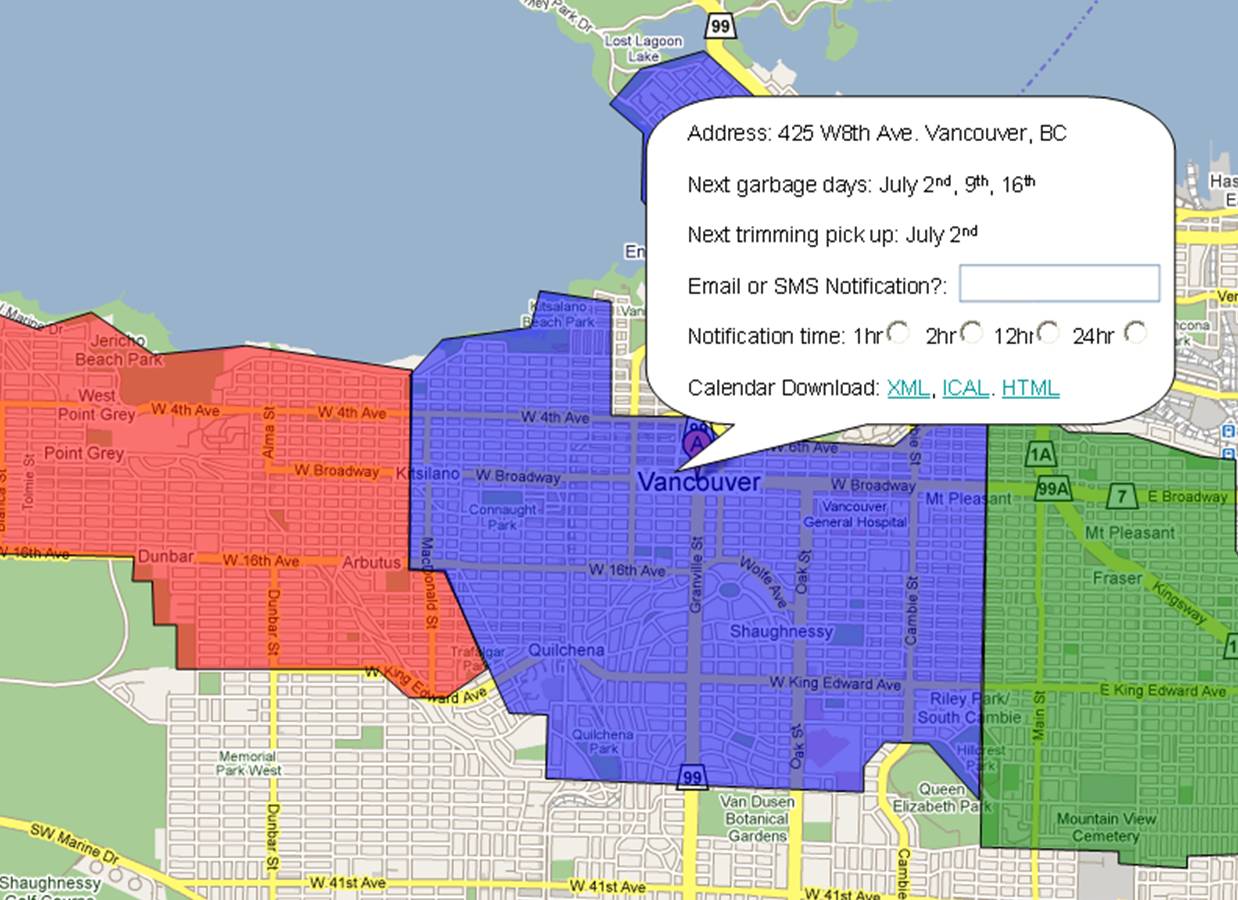
So presently the City of Vancouver only shares its garbage schedule (which it divides into north and south) as a PDF file. This is a pity as it means that no one can build any apps around it. Imagine a website or Iphone app that mashed up google maps with a constantly up to date city garbage pick up schedule. With such a application one could:

  • Simply punch in your address and find out your garbage zone (no more guessing if you live on the border of a zone)
  • Get an email or SMS notification 15 minutes, 1 hour, 12 hours (whenever!) before pick up
  • Download the garbage schedule into your calendar using XML, HTML or ICAL

Garbage-App

Let’s face it, everyone could do with a garbage day reminder. I can imagine that there are 1000’s of Vancouverites who’d sign up for an email notification.

Maybe this seems all very simply, nice but unimportant. But this is more than just creating convenience. What are the implications for such an application?

For citizens:

  • Let’s face it, for many of us, it would be a convenient and nice to get a reminder of when the garbage is going to be picked up
  • It would improve citizen’s appreciation for city services
  • It might also increase the likelihood citizen will recycle as the notification would enable them to better plan and prepare for garbage pick up

For the city & taxpayers

  • Every day 100s of Vancouverites forget to put out there garbage out for pick up. If garbage isn’t picked up, it piles up. This creates several new risks and costs to the city including: increasing likelihood of rodents and health hazards and an increased risk that some residents will dispose of their garbage inappropriately/illegally
  • When garbage is not put out an expensive city asset (the garbage truck, fuel, garbage men) all pass by unused. This means that taxpayers money is not used as efficiently as it could.
  • Moreover,  when garbage isn’t put out there will be twice as much at the house the next week. Multiply that by 100’s of houses and the very quickly the city must deploy extra garbage trucks to deal with this unusually large volume of garbage – costing city taxpayers.

What would be the total value/savings of such an application? Hard to gauge. But add up, time saved by citizens better able to plan around garbage pick up, a small reduction in illegal garbage disposal, a small increase in recycling, slight increase in garbage pick up efficiency and I’m sure the total value would be in the low millions, and the direct savings for the city in the low $100,000 per year. That is not insignificant – especially if all the city had to do was free the data and allow an intrepid hacker to code up the website.

Of course it doesn’t end there. A reliable source tells me the city collects far more data about garbage collection. For example when the driver can’t pick up the garbage can, they make an entry on their device as to why (e.g., it is under a tree). This entry is sent via a wireless connection back to a City database, and includes the highly precise coordinates of the truck at that moment. Then when a resident calls in to find out why the crew did not pick up the garbage can from their residence, the operator can bring up the address on a map and pinpoint the problem.

Such data could also be on the website in an option with something like “Why didn’t my garbage get picked up?” By sharing this data the city could reduce its call volume (and thus costs). With open data, the possibilities, savings and convenience is endless.