Walter & Duncan Gordon Foundation’s Global Fellowship

global youth fellowshipThe annual tradition continues! This is a post I always enjoy is putting up.

The Walter and Duncan Gordon Foundation has put out its call for applications for the 2009 Global  Fellowship program. The Fellowships are targeted towards emerging Canadian leaders who demonstrate potential to enhance Canada’s role on the world stage. The Fellowships will provide successful candidates with a cash award of $20,000 as well as other forms of support.

To be eligible for consideration, applicants must be Canadian citizens or permanent residents between 24 – 35 years of age with previous international experience – paid or volunteer. They also need to demonstrate a sustained commitment to international issues through studies, career choices and volunteer activities.

Application Deadline: Thursday, April 15th, 2009 by 5:00 p.m. EST

More information about the Fellowship programme, including application forms, guidelines and information on current and past Fellows, can be found on their website.

An International Baccalaureate Growth Strategy

I recently ran into a teacher from my high school who has been active in the advancement and growth of the International Baccalaureate program (IB). I participated in the IB program – as a certificate, not a diploma candidate – I believe it was a great experience. The program was demanding and interesting.  Equally important, it helped prepare me more effectively for university.

The encounter – and the conversation – got me thinking about how IB should plan its expansion. Clearly one option is that it could expand in a uniform manner – pitching itself to districts in a more or less uniform manner. This is not their approach, and nor should it be. The fact is, some places in North America are going to be more receptive to IB than others. One option would be concentrating resources in places where the ground is most fertile and where success more readily achievable. In its strategic plan however, IB makes it clear that it does not want to only serve an educated elite. Consequentially I would advocate for a two pronged approach. One strategy for places where IB is going to be a relatively easy sell. Another for more hostile environments, where attitudes and resources will be harder to mobilize or change.

The only question remains. How to identify the two regions?

The answer, I believe, could reside in Richard Florida’s creative class maps.

If I were to imagine the type of parent interested in IB, it is likely one that believes in science, wants what is best for their child, has a broad, generally progressive, outlook on the world. They are probably interested in AP, but are even keener on something better. In short, present day IB kids are creative class kids. Their parents recognize the value of a strong education, and can generally afford the extra taxes currently necessary to subsidize such an education. Fortunately, Florida has mapped where the creative class lives in the United States. These maps are essentially demarcate the dividing line between areas that will be receptive and areas that will be more challenging for IB to establish itself. In short, IB should devise a “creative class” strategy and an “elsewhere” strategy. The two areas are likely very different in the questions that will need to be addressed, the allies located and mobilized, and the resources that will need to be marshaled.

(note: apparently IB is big in Texas, something that initially surprised me, but a look at this map suggests that, depending on where the IB schools are located, Texas is indeed fertile ground.)

Internationally, I might use Florida’s spiky world maps such as the one below which denotes patents per 10,000 people by region. The higher the spike, the greater the number of patents and the places where IB can most likely adopt it’s creative class strategy. The valley’s will probably require a different approach.

It would be fascinating to cross reference IB programs against these maps. I suspect there is already a high degree of correlation. Perhaps I’ll ask if they have any maps…

Wedding Open Source to Government Service Delivery

One of the challenges I’m most interested in is how we can wed “open” systems to government hierarchies. In a lecture series I’ve developed for Health Canada I’ve developed a way of explaining how we do this already with our 911 service.

To begin, I like using 911 as an example because people are familiar and comfortable with it. More importantly, virtually everyone agrees that it is not only an essential piece of modern government service but also among the most effective.

What is interesting is that 911, unlike many government programs, relies on constant citizen input.  It is a system that has been architected to be participatory. Indeed it only works because it is participatory – without citizen input the system falls apart. Specifically, it aggregates, very effectively, the long-tail 0f knowledge within a community to deliver, with pin point accuracy, an essential service to the location it is needed at a time it is needed.

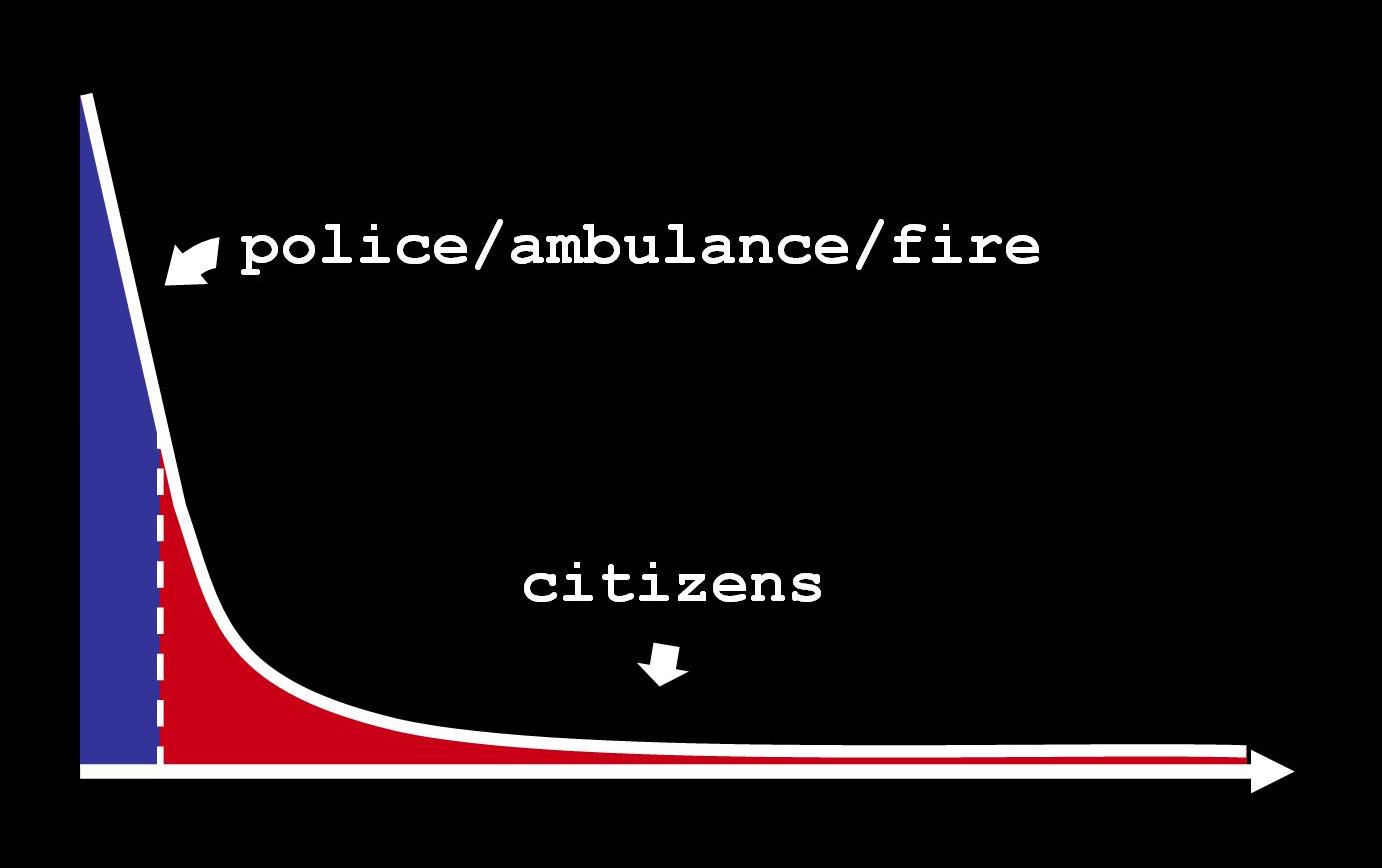
I’ve visualized in this slide below (explanation below the fold)

long tail public policy

Imagine the white curve represents all of the police, fire and ambulance interventions in a city. Many of the most critical interventions are ones the police force and ambulance service determine themselves (shaded blue). For example, the police are involved in an investigation that results in a big arrest, or the ambulance parks outside an Eagles reunion concert knowing that some of the boomers in attendance will be “over-served” and will suffer a heart attack.

However, while investigations and predictable events may account for some police/fire/ambulatory actions (and possibly those that receive the most press attention) the vast majority of arrests, fire fights and medical interventions result from plain old 911 calls made by ordinary citizens (shaded red). True, many of these are false alarms, or are resolved with minimal effort (a fire extinguisher deals with the problem, or minor amount of drugs are confiscated but no arrests made). But the sheer quantity of these calls means that while the average quality may be low, they still account for the bulk of successful (however defined) interventions. Viewed in this light 911 is a knowledge aggregator, collecting knowledge from citizens to determine where police cars, fire trucks and ambulances need to go.

Thus to find a system that leverages citizens knowledge and is architected for participation we don’t need to invent something new – there are existing systems, like 911, that we can learn from.

With this in mind, two important lessons about 911 leap out at me:

1) It is a self-interested system: While many 911 callers are concerned citizens calling about someone else I suspect the majority of calls – and the most accurate calls – are initiated by those directly or immediately impacted by a situation. People who have been robbed, are suffering from a heart attack, or who have a fire in their kitchen are highly incented to call 911. Consequently, the system leverages our self interest, although it also allows for good Samaritans to contribute as well.

2) It is narrowly focused in its construct: 911 doesn’t ask callers or permit callers to talk about the nature of justice, the history of fire, or the research evidence supporting a given medical condition. It seeks a very narrow set of data points: the nature of the problem and its location. This is helpful to both emergency response officials and citizens. It limits the quantity of data for the former and helps minimize the demands on the latter.

These, I believe, are the secret ingredients to citizen engagement of the future. A passive type of engagement that seeks specific, painless information/preferences/knoweldge from citizens to augment or redistribute services more effectively.

It isn’t sexy, but it works. Indeed we have 20 years of evidence showing us how well it works with regards to one of our most important services.

Some of my favourite Vancouverites on Net Neutrality

A couple of Vancouverites can be seen below talking about the danger currently facing the future of the internet here in Canada as our government allows the telco’s to determine who will be the winners and losers of the digital age.

If you haven’t already I’d strongly encourage you to head over to the “SaveourNet.ca” facebook group and become a member.

broadcast artists in a communication world

Just a brief follow up on yesterday’s piece. One reader yesterday pointed out that the CRTC did “get the internet” and that it was the interveners – The Alliance of Canadian Cinema, Television and Radio Artists (ACTRA) that “didn’t get it.” I think there is lots to dive into about the CRTC but part of his point is well taken. Check out this problematic quote from ACTRA:

“The Internet is just another media-distribution platform like any other that we’ve had,” said Stephen Waddell, executive director of the Alliance of Canadian Cinema, Television and Radio Artists. “And in our view, if the CRTC doesn’t give some opportunity to Canadian content to have a place on that platform, we’re going to be immersed in non-Canadian content.”

The number of problems with this statement are almost overwhelming. Building on some of the reasons I discussed yesterday the internet is not like any other distribution platform. Rather than analyze it line by line, I thought I would hand things over to Clay Shirky, who in Here Comes Everybody explains how our  friends at ACTRA are caught in the same dilemma as scribes at the end of the 15th century:

Consider the position of a scribe in the early 1400s. The ability to write, one of the crowning achievements of human inventiveness, was difficult to attain and, as a result, rare. Only a tiny fraction of the populace could actually write… In this environment a small band of scribes performed the essential service of refreshing cultural memory. By hand-copying new editions of existing manuscripts, they performed a task that could be preformed no other way. The scribe was the bulwark against great intellectual loss…

…Now consider the position of the scribe at the end of the 1400s. Johannes Guttenburg’s invention of movable type in the middle of the century created a sudden and massive reduction in the difficulty of reproducing a written work… a scribe, someone who has given his life over to literacy as a cardinal virtue, would be conflicted about the meaning of movable type. After all, if books are good, then surely more books are better. But at the same time the very scarcity of literacy was what gave scribal efforts its primacy, and the scribal way of life was based on this scarcity…

…The spread of literacy after the invention of movable type ensured not the success of the scribal profession but its end. Instead of mass professionalization, the spread of literacy was a process of mass amateurization. The term “scribe” didn’t get extended to everyone who could read and write. Instead it simply disappeared, as it no longer denoted a professional class.

This is what the internet has done to radio, television and cinema professionals. It has radically lowered the barriers for the creation of Canadian content.

So do we lament the loss of scribes? Not at all – we are liberated because today we can all write. Has the acerage quality declined? Possibly, we aren’t all writing Dante’s Inferno. But the best writing is way, way better (and better paying as well).

Will we lament the loss of television, cinema and radio (I doubt they will disappear completely) no. Something new and more interesting will arise to replace it. With the end of scribes we didn’t writers, instead we gained something far more valuable, the growth of contemporary authors! (who in 1350 could have imagined a world of authors, book stores, top 10 best seller lists?)

Now, imagine if there had been a tax on every printing press to pay for scribes to continue copying books… that would have just made books more expensive and less accessible.

We must acknowledge ACTRA fear of the new world. However self-serving, it is rational and genuine. Everything is going to be unpredictable for a while. But the future also the opportunity for something new an amazing – unimaginable ways for new types artists and mediums to describe the human condition and touch our souls. Just because it won’t be the way it has been done – through the broadcast mediums of radio, television, and cinema – doesn’t mean that it won’t be good. Indeed, I predict, that once the dust has settled, there will be more artists, producers, actors, and creatives in general, many of who will continue to get paid well. It’s just that the line between amateur and professional will be more blurred. There may even be a role for a professional association – although I imagine it will look, much, much different. Scary, yes. But also unavoidable.

The CRTC’s broadcast nationalism won’t matter in a networked world

nocrtcWoke up today was confronted by yet another headline demonstrating why the Canadian Radio-television and Telecommunications Commission (CRTC) must go.

For those who’ve never heard of the CRTC, it is the government agency that regulates Canadian broadcasting and telecommunications activities, the best-known of which is probably the Canadian content rules.

At the core of the proposal is a fundamental misunderstanding of the internet. The CRTC wishes to treat it like a broadcast medium – one where there are distinct roles of creators and consumers. Happily for us, this is not what the internet is. Instead it is what Clay Shirky describes as a communications medium – one where we are all talking to one another and where the distinction between creator and consumer has broken down.

So with that lens in mind, I encourage you to read the article. Below is my analysis:

Amid fears that Canada’s culture is being drowned in a sea of online video from around the world, federal regulators are looking at setting up a $100-million fund to support homegrown programming on the Internet… under a scenario proposed yesterday, Internet service providers could be asked to surrender 3 per cent of their subscriber revenue – roughly $100-million – to a fund that would help produce Canadian programs for the Web.

Is Canadian content being drowned out in a sea of online videos? I suppose. But so is everybody’s. It is the nature of the medium. What % of content on the internet is American, Indian, Chinese? Does it matter? Not really. Because people don’t surf the internet like they surf the radio or television – most often the seek out content. But the CRTC is used to a certain % of content being Canadian on the radio and television because it controlled how much content ended up on those mediums. This is their frame and why they can’t understand the internet.

Ironically, even though we don’t know what % of online content is Canadian what the CRTC cannot grasp is that since the advent of the internet ordinary Canadian both produced more content and – I’ll wager – consumed more Canadian content than ever before. Think of all the blogs, videos, podcasts made by ordinary Canadians that are sharing Canadian stories over the web. Think of this blog. Ensuring Canadian stories get shared is core to the CRTC’s mandate. And yet, for all their discussion about Canadian content the CRTC does not include content created by all those Canadians who’ve previously could never tell their stories.

Why? Because none of us have title of “producer” or “writer” or “actor” in the CRTC’s eyes. We (Canadians) don’t count as culture.

More ironically, the one thing you often can’t find online (and/or has been slow to get online) is the very media the CRTC does count as culture and that it seeks to protect – the Canadian TV and radio shows broadcast on CTV, CBC and Global. These artifacts of the broadcast era have fought or denied the existence if the internet, who have been the slowest to make their content available to us, now want us to foot the bill for creating their content.

What I can be certain of is that the $100 million raised by the CRTC will not go towards Canadians telling their story on the web. My blog, your blog, your podcast, or your video of the play you wrote, none of these will never see the CRTC’s money. Instead a public servant somewhere in Ottawa will determine what is “Canadian” not so we can promote Canadians stories, but so that we can prop the old and dying business model of broadcast media – the expensive production facilities, the hierarchies of managers and staffers that are necessary to produce older media like television.

Nor is this is not about protecting artists – writers, actors, singers – they all thrived before the advent of television, and they will thrive after its demise in ways we cannot imagine. Again, this is not about them. It is about an industry trying to prop up a dying broadcast medium and a government agency trying to assert control over what can be defined as Canadian.

Both are problematic and have no place in a networked world. As a closing counter factual, imagine a tax on your phone designed to raised funds to ensure a certain % of all phone calls in the world were being conducted by Canadians. A fund designed to pay people to make “Canadian” phone calls. That is what this is. At the very time when we need the internet to be free and as cheap as possible so those with the fewest resources can make use of it to tell their stories, organize protests, create a new business or just find a job, we are going to try to make it more expensive.

In short. Are Canadians lost in a sea of content? Yes. And they are thriving in it. More Canadian stories are being told than ever before. Moreover, I never watched Canadian content on television, but today I read numerous Canadian blogs, and listen to the occasional podcast. I never consumed so much Canadian media in my life.  Moreover, never has Canadian content been so widely viewed. Readers of even this small blog come from around the world.

What we don’t need is a tax that makes it more expensive for ordinary Canadians to tell their stories. We don’t need a levy that props up a dying business model. We don’t need a government agency that defines what is “Canadian culture.” Arguing against this proposal is not the most important battle of our time, but it is worth fighting against. Today Canadian culture is a free culture, increasingly defined and created by Canadians. That’s the promise of the internet, why would we fight that?

The internet is messy, fun and imperfect, just like us

Last October 23rd David Weinberger gave the 2008 Bertha Bassam Lecture at the University of Toronto. I happened to be in Toronto but only found out about the lecture on the 24th. Fortunately Taylor pointed out that the lecture is online.

I’ve never met David Weinberger (his blog is here) but I hope to one day. I maintain his book – Small Pieces Loosely Joined – remains one of, if not the best book written about the internet and society. Everything is Miscellaneous is a fantastic read as well.

The Bertha Bassam lecture is classic Weinberger: smart, accessible, argumentative and fun. But what I love most about Weinberger is how he constantly reminds us that the internet is us…  and that, as a result, it is profoundly human: messy, fun, argumentative, and above all imperfect. Indeed, the point is so beautifully made in this lecture I felt a little emotional listening to it.

Contrast that to the experience of listening to someone like Andrew Keen, a Weinberger critic who this lecture again throws into stark relief. After reflecting on Weinberger, Keen dislikes the internet and web 2.0 mostly because I think he dislikes people. It may sound harsh but if you ever hear him speak – or even read his writing – it is smart, argumentative and interesting, but it oozes with an anger and condescension that is definitely contemptuous and sometimes even borders on hatred. If the debate is reduced to whether or not we should, however imperfectly, try to connect to and learn from one another or whether we should just hold others in contempt, I think Weinberger is going to win every time. At least, I know where I stand.

Indeed, this blog is a triumph of Weinberger’s internet humanism. It is a small effort to write, to share, and to celebrate the complexity and opportunity of the world with those I know and those I don’t, but who share a similar sense of possibility. Will millions read this blog. No. But I enjoy the connections, old and new, I make with the much more modest number of people who do.

I hope you’ll watch this lecture or, if you haven’t the time, download the audio to your ipod and listen to it during your commute home. (lacking the slides won’t have a big impact)

Articles I'm digesting – Feb 13 2009

New Planets & an Unknown Object Discovered Beyond the Solar System

Future telescopes such as NASA’s Kepler, set for launch in 2009, would be able to discover dozens or hundreds of Earth-like worlds. The Space Interferometry Mission (SIM), to be launched early in the next decade, consists of multiple telescopes placed along a 30 foot structure. With an unprecedented resolution approaching the physical limits of optics, the SIM is so sensitive that it almost defies belief: orbiting the earth, it can detect the motion of a lantern being waved by an astronaut on Mars.

The last sentence says it all. My mind = blown.

Fareed Zakaria – Worthwhile Canadian Initiative (via Sameer Vasta)

Canada has done more than survive this financial crisis. The country is positively thriving in it. Canadian banks are well capitalized and poised to take advantage of opportunities that American and European banks cannot seize. The Toronto Dominion Bank, for example, was the 15th-largest bank in North America one year ago. Now it is the fifth-largest. It hasn’t grown in size; the others have all shrunk.

So what accounts for the genius of the Canadians? Common sense. Over the past 15 years, as the United States and Europe loosened regulations on their financial industries, the Canadians refused to follow suit, seeing the old rules as useful shock absorbers. Canadian banks are typically leveraged at 18 to 1—compared with U.S. banks at 26 to 1 and European banks at a frightening 61 to 1. Partly this reflects Canada’s more risk-averse business culture, but it is also a product of old-fashioned rules on banking.

I’ve always thought Zakaria was one of the smartest commentators in the US. I’ve unbelievably excited he has his own show on CNN. Finally a show where real ideas are discussed not by pundits but by actual wonks. His show single-handedly elevates the entire CNN brand. Now he’s saying nice things about us. Hopefully we won’t let it go to our heads.

How the Crash Will Reshape America: The Last Crisis of the Factory Towns by Richard Florida.

When work disappears, city populations don’t always decline as fast as you might expect. Detroit, astonishingly, is still the 11th-largest city in the U.S. “If you no longer can sell your property, how can you move elsewhere?” said Robin Boyle, an urban-planning professor at Wayne State University, in a December Associated Press article. But then he answered his own question: “Some people just switch out the lights and leave—property values have gone so low, walking away is no longer such a difficult option.”

Perhaps Detroit has reached a tipping point, and will become a ghost town. I’d certainly expect it to shrink faster in the next few years than it has in the past few. But more than likely, many people will stay—those with no means and few obvious prospects elsewhere, those with close family ties nearby, some number of young professionals and creative types looking to take advantage of the city’s low housing prices. Still, as its population density dips further, the city’s struggle to provide services and prevent blight across an ever-emptier landscape will only intensify.

Many of the old industrial clusters are dying and we’ll have to manage this decline while helping figure out what the next wave will look like. This is part of the reason why think the federal government’s failure to invest in green technology/innovation will stand as one of the biggest lost opportunities of the century. At the peak of a financial crises and at the moment when our cities – particularly our mid-sized cities – need to think about what their economies will look like for the next 100 years (think renewable energy, green roofs/architecture, mobile computing, next-generation social services) we’ve plowed $30B into 20th century buildings and roads. Hopefully the good news of Zakaria will outweigh the bad news from Florida. I hope so, since it appears this crisis won’t be sufficiently significant to spur us to rethink our future.

Upcoming talks

Starting next week things are going to get busy for a few days. I’ve a number of upcoming talks and would be interested in feedback, stories, ideas for any and/or all of them.

Future of the Public Service: I will be doing a series of lectures/seminars on the future of the public service for Health Canada in Vancouver, Ottawa, Edmonton and possibly Montreal or Toronto in mid-march. I’ve got a number of ideas and themes I intend to talk on – technology, generational change, and open source – but am of course always looking for others.

If you have a story or an article suggestion please do pass them along. Personal stories of frustration and angst, or conversely success and empowerment, in the public service are always deeply appreciated.

US NOW panel:  I’ll be part of a panel discussion at a screening of Us Now, a documentary that tells the stories of online networks that are challenging the existing notion of hierarchy.

When: FEB 20th 2009 — 7pm
Where: SFU Harbour Centre — Room 1900
You can register (for free!) here.

Northern Voice: Finally, I’ll be doing a presentation with Rebecca Bollwitt on Dealing with angry comments, Trolls, Spammers, and Sock Puppets at this year’s Northern Voice.

Northern Voice is a two-day, non-profit personal blogging and social media conference held annually in Vancouver.

When: February 20th and 21st
Where: Forestry Sciences Centre, 2424 Main Mall, UBC main campus
You can register for Northern Voice here.

Thoughts, ideas, articles and other inspirations on any or all of these are always welcome!