Cultural theories of risk and the rise of emergence systems

My (very cool) friend Alex T. recently introduced me to the grid/group typology. As explained in wikipedia:

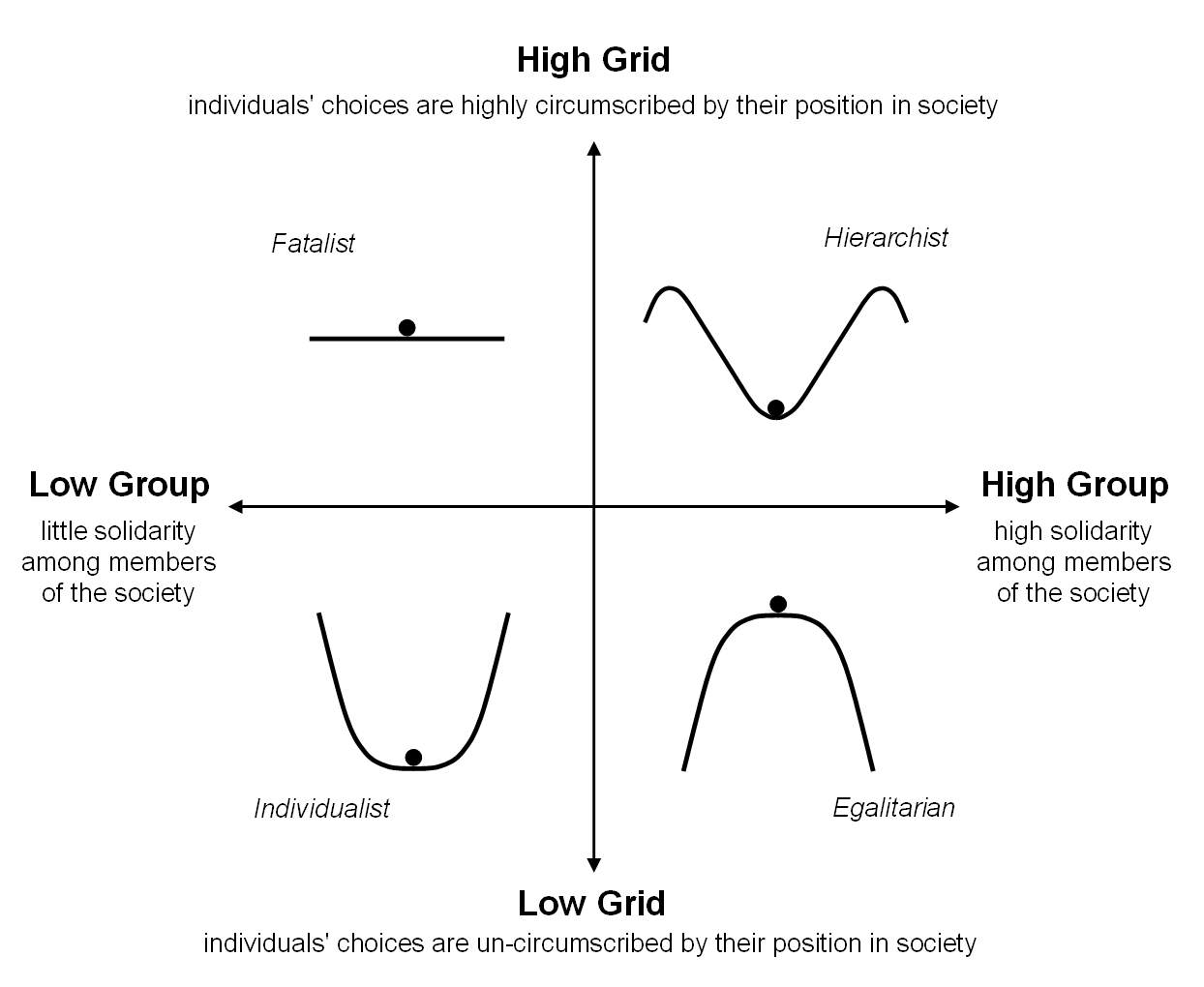
Mary Douglas, an anthropologist studying traditional African religion observed that different societies feared different sorts of threats, and that these differences correlated with differences in their social structure. Later, Douglas argued that social structures differ along two principal axes: “grid” and “group (see graph).”

The important things is – if your society organized itself along one of these structures – it is challenging, if not impossible to see a solution outside of that structure. What I think is exciting is that the egalitarian mode of thinking – thanks to the internet and social software – may be ascendant, explaining some of the reason market based systems (individualists) and bureaucracy based systems (hierarchist) feel threatened.
Grid vs Group

From Christopher Hood: The Art of The State (again via wikipedia):

Fatalists feel isolated in a world that imposes arbitrary constraints on them. They view nature as a ball on a flat surface, rolling randomly in any direction. There is little they can do to control their situation, and resign themselves to riding out whatever fate throws at them.

Hierarchist see a society with a well-defined role for each member. Thus , they believe in the need for a well-defined system of rules, and fear social deviance (such as crime) that disrupts those rules. Hierarchists see nature as “perverse/tolerant”: it can be exploited within certain limits, but if those limits are exceeded the system will collapse. They thus rely heavily on experts, who can identify those limits and establish rules to keep society within proper bounds.

Individualist see their choices as unconstrained by society and they lack close ties to other people. They value individual initiative in the marketplace, and fear threats like war that would hamper free exchange. The individualist view of nature as resilient. Like a ball resting at the bottom of a cup, nature will return to its original stable position after any disturbance. Thus, individualists embrace trial-and-error, as they have confidence that the system will fix itself in the end.

Arguably, much of the left-right axis of our politics is a battle between Individualists on the right (let the market rule!) and Hierarchists on the left (government oversight!) with fatalists abstaining (what’s the point?).

Hood’s description of Egalitarians is intriguing mostly because I think it is quite narrow and, if slightly tweaked, could help describe the rise of an important new block of voters (part of the neo-progressive movement Taylor and I write about).

Hood description (again, via wikipedia)

Egalitarians experience low grid and high group. They live in voluntary associations where everyone is equal and the good of the group comes before the good of any individual. In order to maintain their solidarity, egalitarians are sensitive to low probability-high consequence risks (such as nuclear power), and use them to paint a picture of impending apocalypse. Risk and Culture was, in part, a polemic against the environmental movement, which Douglas and Wildavsky saw as sharing the worldview and social organization of religious cults. Egalitarians see nature as fragile, like a ball balanced precariously on an overturned cup. Any small disturbance will send it crashing down. Thus egalitarians advocate the precautionary principle and cling to traditional ways of life that have proven to be sustainable, rather than risking disaster by trying new technologies.

Hood describes the Egalitarian way as one with high levels of cooperation within a group that is socially distinct from the outside world and which relies on dynamic rules set through constant debate and case-specific solutions to every issue as it arises.

Hood’s contempt is well placed. Many tightly held communities facing what they believe to be massive threats can indeed take on cult-like characteristics. But that is not their only possibility. Indeed, societies that organize along these lines have new powerful tools – namely the internet – to use to organize themselves. More importantly, these communities can coordinate themselves and achieve powerful outcomes even with weak bonds. Many of the “egalitarians” I see today are those creating projects that seek to engage citizens and pool individual resources to address collective problems. Indeed, many open-source projects fit this mold very well.

More importantly, most of these projects are not cult-like, but are self-organizing and emergent. They see that a situation (like the environment or the open web) is vulnerable and they don’t believe a) it is self-correcting (like individualists) b) it can be perfectly moderated or controlled by top down systems (like hierarchists); or c) that collective or individual action is futile (like fatalists).

There are few examples of egalitarians (or emergents) that spring to mind as successful – certainly the organizational and political discourse has been dominated by hierarchists and individualists. Maybe this explains why people have such a hard time defining new forms of organisation – like open-source projects. They are trying to peg their participants as either right-wing market loving individualists or left-wing regulation loving hierarchists. The fact is they are neither. While hardly uniform, my experience is that they are often libertarians (low-grid) who believe in free-association, collaboration and emergent systems (high-group).

The increased manifestation of this new structure in society could diversify how we perceive and try to solve problems. But in the short term observers (like pundits on CNN) will continue to try to put force this peg of a new circular group into an old square hole.


Atlanta: the good, the bad, the ugly

So it’s been an intense week of blogging and writing, two posts I’m proud of and an op-ed I’m even more pleased with. Good times! On the lighter side, I’m just finishing up two days in Atlanta that started badly but have become really enjoyable.

The bad was the taxi ride in. After asking the driver if I could pay with a Visa before getting in the taxi he then said (mid-trip!) I was supposed to have done all this special stuff at the airport (something the hotel concierge said sounded fishy). I’m so tired of American cities where taxis don’t take Visa… Toronto, Calgary, Vancouver, even Montreal most of the time, take Visa no problem. What is up with that? (Other than the obvious tax evasion that dealing only in cash allows you to engage in).

The ugly of Atlanta is the traffic. If ever there was a case for more robust public transit, Atlanta has to be the definitive case study. It is gridlock in the town… incredible.

The good is pretty much everything else during this trip. The crew I’m working with are nice fun guys. I’m at the “W” hotel where the staff (right down to the repair men) are the nicest I’ve ever met (and the most fun). The client took me out to see the Thrashers play the Penguins (that’s a hockey game for non-canadian readers) and I got to see Sid the Kid score from about 30 feet away. Brilliant. And the hockey fans here are awesome – good spirited and up for a laugh. Atlanta is also surprisingly racially integrated – I’m not citing facts here, just casual observation, so I could be dead wrong on that one.

Best of all it’s been nice getting a steady stream of emails about yesterday’s piece (which they told us would only be online, but then somebody emailed Taylor saying they saw it in the paper… so now we’re just confused, but happy – anyone know for sure?).

Next stop Ottawa to give a talk on public service sector renewal to Stats Canada and do a few brown bag lunches. See you Monday!

Real Renewal – Creating a post-boomer Liberal Party

Taylor Owen and I published an op-ed entitled “Real Renewal” in today’s Toronto Star. You can comment on the piece here.

—-

OPINION

How about real Liberal renewal?

Nov 20, 2008 04:30 AM

David Eaves
Taylor Owen

In the weeks since one of its worst ever electoral performances, the conversation within the Liberal Party of Canada has rightly turned to renewal. To date, the establishment consensus suggests two options: shift right and recapture the ideological “centre,” or unite the left and merge the votes of the Greens, NDP and Liberals.

Neither choice, however, represents renewal. Both are simply electoral tactics focused on the next election. Neither necessitates a rethinking of first principles, nor encourages reflection on how liberalism, and its agenda, must evolve to create a 21st century vision that will speak to Canadians.

Consequentially, both approaches are likely to alienate a new generation of activists, thinkers and policy-makers whose new ideas and energy are essential to transcending the country’s staid political debates.

Take for example our friends and colleagues. Confronted with parties whose politics, policies and priorities are perceived as out of touch and ineffective, many have simply opted out of organized politics. But many are deeply engaged. They start or work at non-governmental organizations, volunteer internationally, create social enterprises or advocate outside of organized politics. Among our peers, the progressive spirit is strong, but progressive politics is not.

To progressives searching for a political home a united left offers few new opportunities.

While acknowledging the left was instrumental in creating many of the social programs Canadians have come to trust – many of today’s emerging progressives see a left that is often loath to reform or rethink them in the face of globalization, the telecommunication revolution, and a changing citizenry. In the last election voters faced an ideological paradox. The more left the advocates, the more entrenched they were against innovation and reform, even when such reforms would serve progressive values.

Seen this way, the NDP’s vision is in many ways a conservative one – a vision of Canada locked in the 1960s or worse, the 1930s. This conservatism of the left – even if found under one tent – will not inspire forward looking progressives, or Canadians in general.

Nor will moving to the centre attract new people or inspire new ideas.

Centrism requires there to something inherently good in the position between two ideological poles. Rather than compromise between the conservatism of the left and the right, many of our peers want pragmatic policies and ideas based on a governing philosophy rather than political gamesmanship.

Take how Barack Obama has mobilized a new generation of progressives. He inspires not because he compromises between the left and right, but because he offers pragmatic policy solutions, unrestricted by ideology. Obama’s watershed speeches – “Ebenezer Baptist Church,” “Yes We Can” and “A More Perfect Union” – are powerful because they transcend the ideological divides of the past 40 years.

How then could the Liberal party attract new people and ideas? The first step is to understand that we are on the cusp of a neo-progressive revolution.

While traditional progressives promoted their values to smooth the transition from agrarian to industrial capitalism and to spread the latter’s benefits, a neo-progressive Liberal party should seek to manage the shift from the industrial to the knowledge economy. In short, to develop a New Deal for the 21st century.

This would mean, like their progressive forbearers identifying new political axes around which a new governing coalition – drawn from both the left and right – could be built.

These emerging political axes include open versus closed systems, evidence-based policy versus ideology, meritocratic governance versus patronage, open and fair markets versus isolationism, and emergent networks versus hierarchies. It is these political distinctions, not the old left versus right, that increasingly resonate among those we talk to.

Such a shift will not be easy for the Liberal party. Transformative politics requires a painful process of introspection and a willingness to let go of past battles. The Liberal party, however, continues to treat “renewal” as a side process. For example, after Paul Martin’s 2006 defeat party insiders chose 30 issues they felt were critical, and then a select group wrote reports on each. Little technology was used, neither the membership nor the public was engaged, and almost none of the reports were released to the public.

The result: Few new people were attracted to the party, almost no rigorous debates were stimulated and Liberals were unable to articulate a new progressive agenda.

This recent history offers one critical lesson. If Liberals are serious about renewal, the process can’t just be about the tactics for winning the next election, but about making progressive politics relevant to the 21st century.

David Eaves is a fellow at the Queen’s University’s Centre of the Study of Democracy. Taylor Owen is a Trudeau Scholar at the University of Oxford.

Canadian Foreign Policy as a Disruptive innovation problem

After having a long brain storm session with some people interested in the future of Canadian Foreign Policy was inspired to write this thought experiment.

Perhaps a helpful way to frame our current Foreign Policy ennui is to see the Canadian Department of Foreign Affairs and International Trade (DFAIT) as facing a challenge analogous to that discussed in The Innovators Dilemma – sometimes referred to as disruptive innovation.

Disruptive innovations are products or services that rather than simply evolving, overturn the existing dominant approach in a marketplace. Often the disruptive innovations starts off serving the low end of the market but it eventually matures and serves more demanding and larger clients pushing the established players out of business.

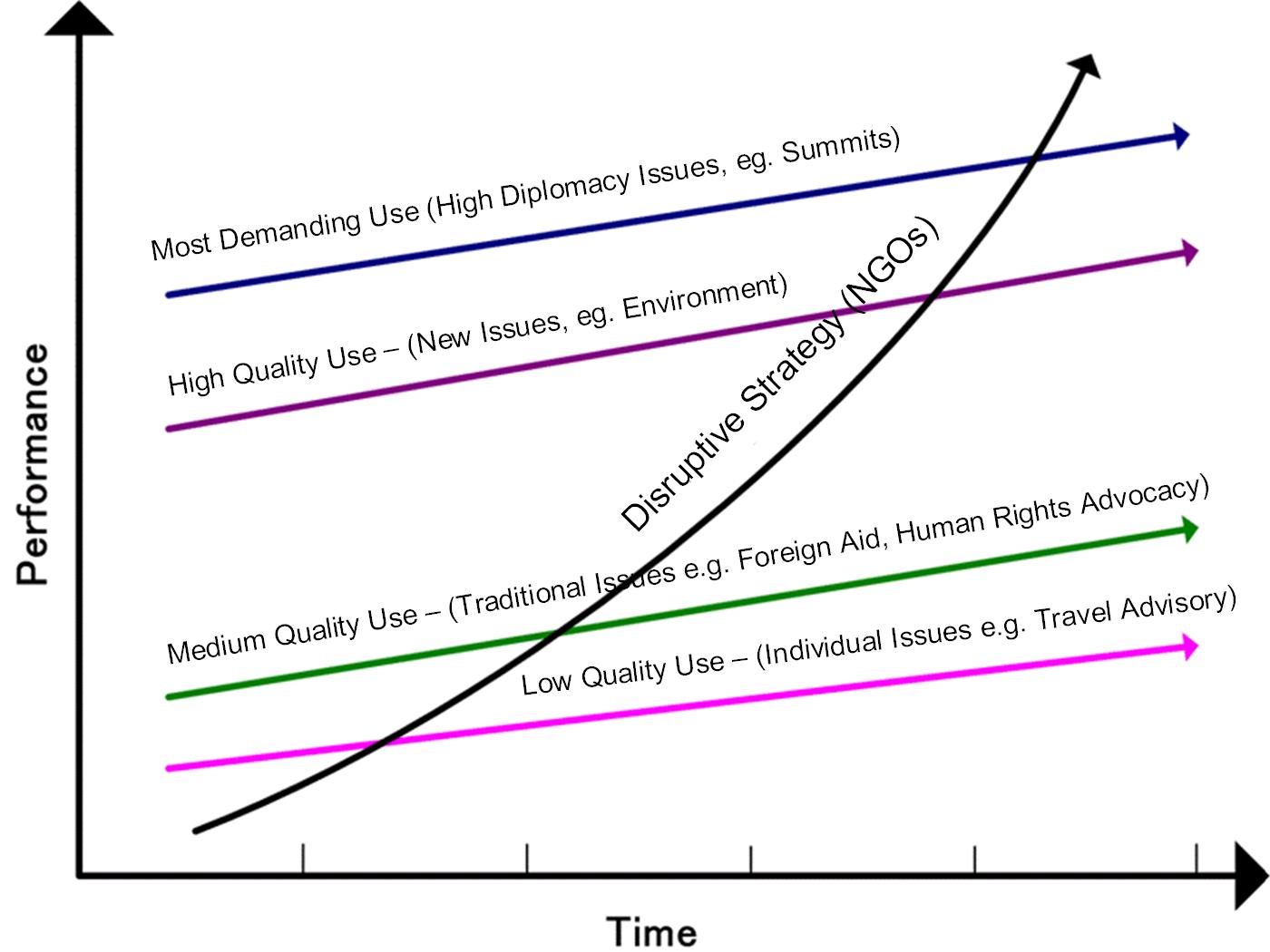
What does this have to do with DFAIT? Consider the graph below (a play on the wikipedia page graph). It used to be that DFAIT served four segments – from low quality all the through to the most demanding use. And yet, over the past decades other actors – sometimes in the private sector, but more frequently NGOs – began to offer services that more effectively deliver what political masters, or more often, citizens, were looking for. At first this was true merely of the lowest tier, travel agencies and news groups began to tell people where was safe and unsafe to travel and so the government ceased being a primary resource for this. Then NGOs began to effectively deliver services in the more traditional areas of advocacy and programs. Increasingly the government has retreated from that space. More recently, you’ve seen NGOs actually take the lead by moving into new areas of debate and creating supporting documentation for critical actors. At the same time you’ve seen other ministries become significantly more active in the management of “international files” that overlap with their areas of focus (eg. Health or the Environment).


Disruptive 3

This is classic innovators’ dilemma. A challenge to DFAIT from a community using a strategy that initially seemed marginal (and even helpful because it alleviated it of performing mundane tasks) has evolved into a true competitor, appealing (usually more effectively) not only for the hearts and minds of Canadians, but for the attention of other ministries and key influencers.

The real question is how does DFAIT compete? Again this is a thought experiment – I’m regularly impressed by the work done my people (many of them friends) at DFAIT. But the department has suffered over the past decade. It should be asking itself: can a (and how should a) centralized bureaucracy compete against an ecosystem of NGOs and other actors? DFAIT may be able to retreat to performing in only the “most demanding use” areas – but there is no guarantee that even this space is completely safe (although the government will maintain a monopoly on certain areas).

The real challenge as outlined in the Innovators Dilemma is that innovation is often difficult, if not impossible for the incumbent actor. One thing that gives me hope is that the department may shrink, helping it become more nimble. For example, I’m pleased to hear that International Trade may be heading over to Industry Canada. This makes all the sense in the world – can anyone today legitimately claim that there is a real difference between domestic and international industrial policy?

Smaller, leaner, and more partner oriented. I suspect one way or another this is the future of Foreign Policy. The question is, can Foreign Affairs innovate its way into that space? The author of the innovators dilemma isn’t optimistic – but then they were writing about private companies that could go bankrupt, not government ministries that can live on as the undead for extended periods of time… hardly an outcome Canadians or our Foreign Service officers, deserve.

The New World Order: Flat, Spiky or Divided?


Just started Who’s Your City by Richard Florida out of personal interest but also to better figure out why it is the Vancouver sometimes works, and sometimes really doesn’t work. Figuring out that puzzle, and doing something is part of the reason I joined Vision (and yes, I’m still recovering from the victory celebrations).

I’m already sensing a convergence between Florida and some of my other favourite authors – namely Friedman (who Florida references) and Thomas Barnett (author of The Pentagon’s New Map among other books).

All three are noticing the same thing, and are even writing along similar veins, but there remain important distinctions, with important policy implications.

Flat: Friedman (whom I’m least familiar with) says the world is flat, that innovation, industry, commerce, etc… can now happen anywhere, so we have to prepare for a flat world. Here, I’d argue the core unit of analysis is the individual. We are all free agents, able to do anything or be anything, so we’re going increasingly going to start doing it anywhere. Yes, Friedman believes that governments and industry have massively important roles, but he ultimately sees a world where any place can become a place where people can prosper. If they agitate for it and build it.

Spiky: Florida’s analysis is that world is quite spiky, dominated by a set of mega-regions and super-cities where the bulk of the economic activity and culture is produced. These hubs are connected to one another and largely uncaring of the enormous economic valleys that separate them. For Florida, the fundamental unit of analysis is the city (or mega-region). These determine where power and influence will flow. Importantly, mega-regions cannot be constructed overnight – indeed there is a powerful self-reinforcing mechanism at work. Mega-regions attract talent from around the world, both further increasing their status and starving smaller cities and regions of the key resource – social capital – they need to grow. Individuals are important – but only in so far as they cluster. Countries are important too – in the Friedman sense that they create a generally favourable atmosphere – but they are not critical to the equation.

Divided: Barnett sees a divided world. One on the one side is the Functioning Core, characterized by economic interdependence and incentives to abide by rules, one the other is the Non-Integrated Gap characterized by unstable leadership and absence of international trade and weaker incentives to abide by international rule sets. Barnett’s primary unit of analysis is the state. He is principally concerned with the impact of globalization (and the rule-sets it creates) on state actors – how it constrains them and incents them to behave certain ways. In this world citizens are influence, but it is connectivity, largely (but hardly completely) determined by the state that matters most. Convince a state to connect with the world, and it’s path towards free market democracy (or some close variant) is predetermined.

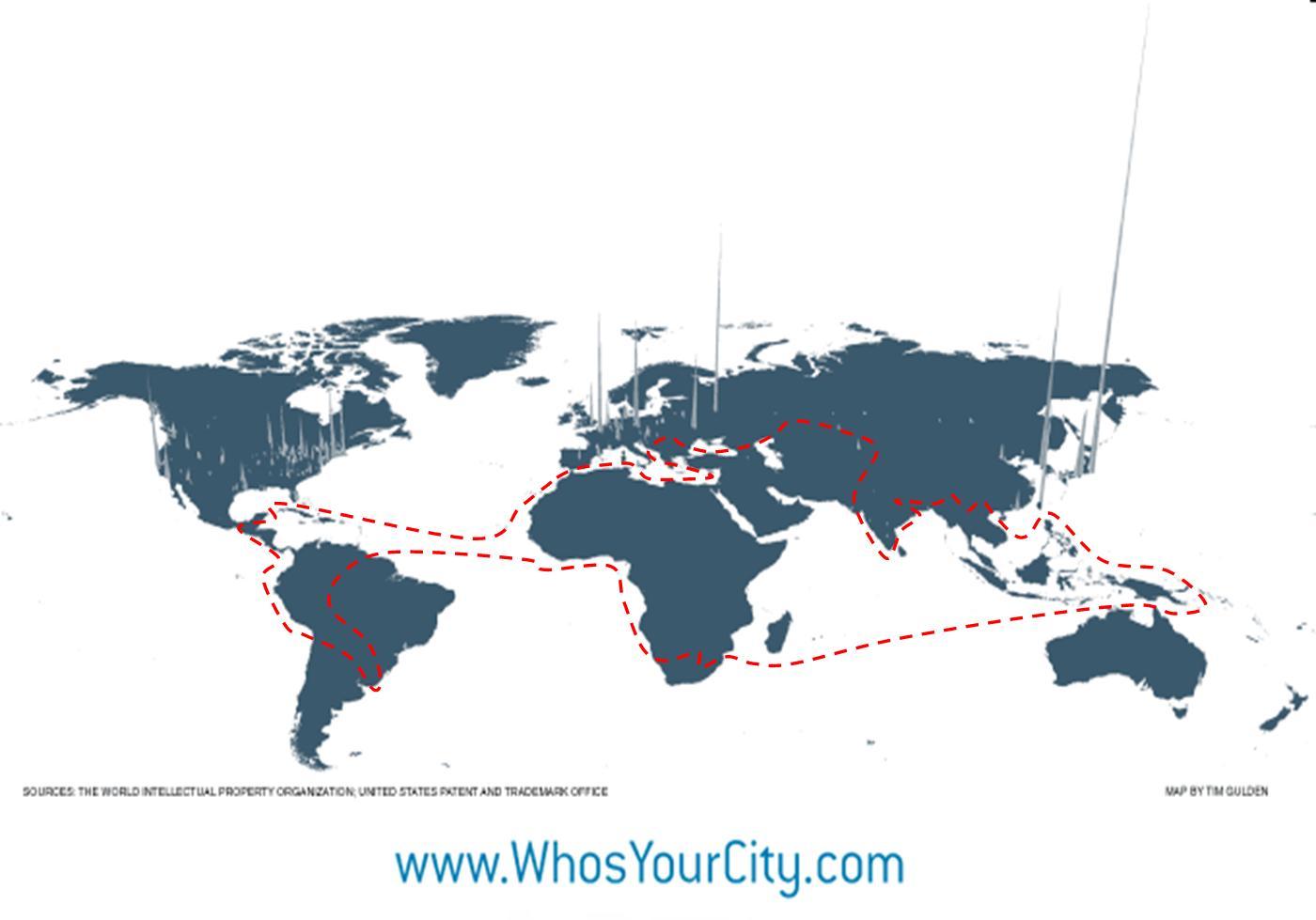
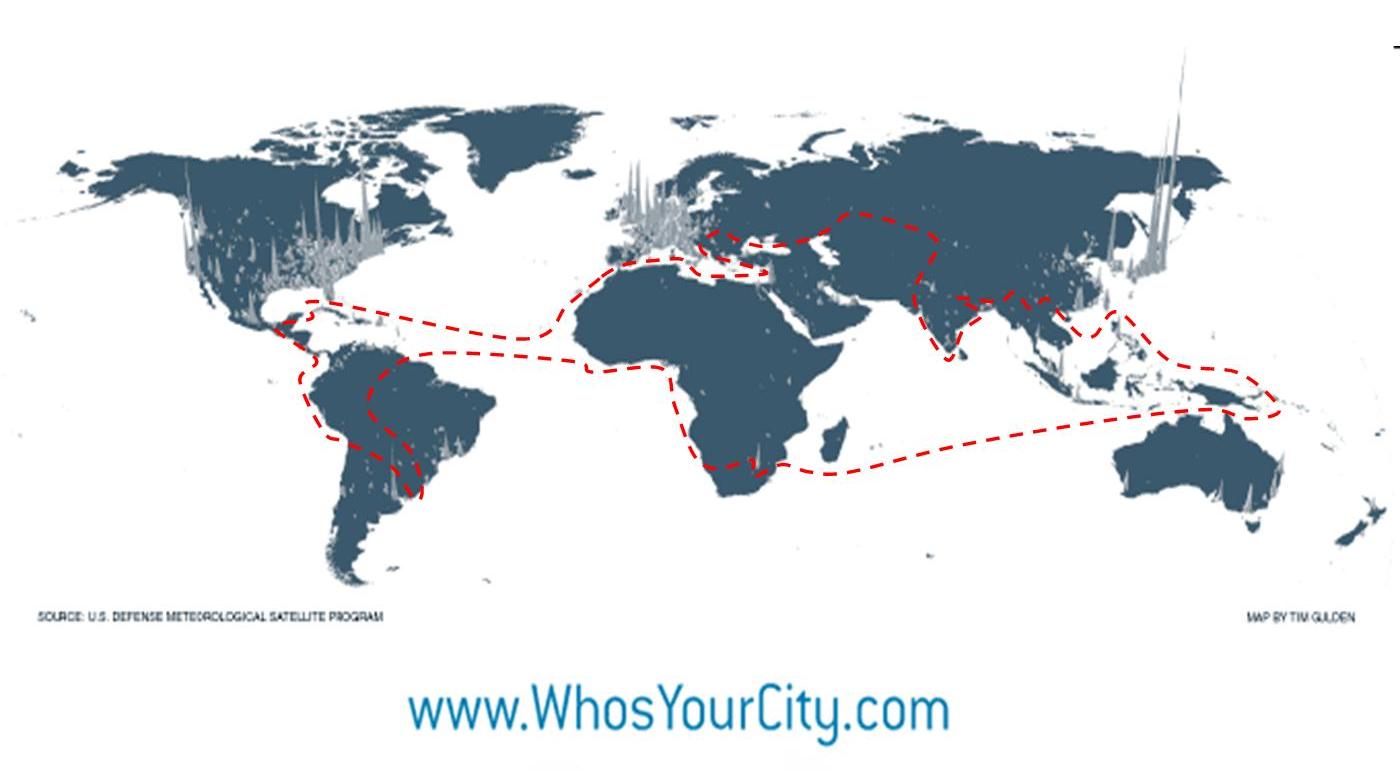
I had so much fun mashing up the Firefox download map with Barnett’s map (and had an incredible response) I thought I’d try to do the same again but with these three authors. Below is a Flat World, overlaid with Spiky depiction of where the most innovation (patents) occurs, overlaid with Barnett’s division between the Function Core and the Non-Integrated Gap. Hoping to write more about these three views of the world over the coming weeks.

What’s interesting about the map’s below is that Barnett and Florida correlate quite nicely. And while they are complimentary I think it Florida’s reinforces the best critique of Barnett’s map I’ve read to date:

“Connectedness is a network property and networks are fractal not contiguous. There is no contiguous region that is disconnected. Within each disconnected country there are islands of connection and within each connected country there are islands of disconnection. This is true at all levels, continents, nations, regions, cities, and companies, right down to individuals. There are terrorist cells in US cities fighting to disconnect the world and Journalists with satellite cell phones in remotest Afghanistan, Iraq, and Somalia working to connect everything.”

I’m willing to bet almost anything that Florida’s maps follow a power law distribution. And the above description – well in Florida’s map there are valleys of non-innovation and non-connectivity within Barnett’s Core. The question is: Can the Mega-Regions assert enough control over these values to ensure their rule-sets are followed?

Innovation (# of patents)

Flat spiky and divided

Connectivity (Light Based Regional Product per Square Kilometer)

Flat spiky and divided (econ)


Quote of the day

“I think nobody really loves America more than black Americans, because black Americans loved America even when America didn’t love us back”

– Jamal Simmons

I was fortunate enough to see Jamal Simmons give the keynote at yesterday’s Canadian-American Business Council luncheon and this line really just floored me. In fact, I think I and a few others in the room almost got emotional when he said it. It’s difficult to imagine the pain induced by that kind of rejection from a community you care so much about.

e-governance: How the White House may evolve

The other day Taylor emailed me this article on how the internet, and the communities it enables, may reshape politics in America.

What really struck me however was the subtle but important differences in language between the incoming Obama administration and the outgoing Bush administration. The quotes below say it all: On one side you have advisers talking about the internet as a tool to enable transparency and engagement. The subtext, citizens become an extension of government – helping improve program delivery. On the other side you have someone talking about the internet as a broadcast tool, a way to “get the message out.” Here, citizens are separate from government and merely passive recipients of “a message” or data the white house wants it to see.

Check it:

Craig Newmark, founder of online classifieds site craigslist.com, served as a technology adviser to Obama and is an advocate for a more open and responsive government.

“In New York and San Francisco there are so-called ‘311’ programs,” he said. “The idea is that it’s customer service for local government and if you need a pothole fixed you contact 311.

“Well let’s start expanding 311 systems to all of government,” he said.

“There’s also the whole transparency thing,” Newmark added. “The Internet is all about transparency. The first phase is the election campaign then, afterwards, getting some real grass-roots democracy in there.”

David Almacy, who served as Internet and e-communications director for President George W. Bush, said the Internet is “a very powerful tool in communicating the president’s agenda.”

“The Internet is basically a 24-hour seven-day-a-week spokesperson,”
Almacy said. “While we’re sleeping at night it’s still available for those who are searching on energy legislation or the war on terror or the war in Iraq.”

Twittering the Vancouver Election

For those living in Vancouver, or interested in Vancouver politics, the CBC will be hosting a debate tomorrow between Vision Vancouver Mayoralty candidate Gregor Robertson and his NPA counterpart.

For those listening in on or attending the debate, the CBC is interested in hearing your immediate thoughts and feedback via twitter – simply tag your tweet: #cbcmayorsdebate and the CBC may pick it up. Thoughtful comments about Gregor, concerns about the city, or respectfully expressed concerns about NPA spin are particularly appreciated.

For those interested in the debate it is taking place tomorrow, Wednesday, November 12, from 7:30 – 9:00 p.m. at the SFU’s Segal Graduate School of Business, 500 Granville St.. It will also be broadcast live on CBC Radio One (690AM) in Vancouver and streamed live over “the interweb” at cbc.ca/bc.

If you are a vision supporter – we are in crunch time. Please do vote!  Also consider donating some money or volunteering for our e-day get out the vote initiative and, to have fun, get yourself on “the map!”

Re: The Daily Show, Post-Bush

Andrew Sullivan chimes in on the future of the Daily Show in a post-Bush era. Apparently, some people don’t think it can survive – that they simply can’t or won’t take on an Obama presidency.

I think this grossely misunderstands what the Daily Show is about and who it targets.

My sense is that politicians are not the target of the Daily Show. It’s the media.

Jon Steward didn’t go an plead with the DNC and RNC to pressure their politicians to be nicer to one another or to behave differently, he went on CrossFire and berated the hacks and pundits. My sense is that it is the Media – with its inane low quality, unidimensional and uncritical reporting – that is the real target of the Daily Show. Politicians (plus celebrities, and whoever else is unfortunate to get in the way) are simply the topic they use to launch these attacks.

Consequently, I don’t think the Daily Show is going anywhere. While the discourse coming out of the White House is probably about to get a whole lot more nuanced and interesting those reporting on the activities of the White House are probably going to be just as inane tomorrow as they were yesterday. Jon’s target is no less juicy. More importantly, I think there are enough people who don’t trust the MSM that an audience will be guaranteed…

Liberal Renewal: Indentify good questions, not answers

The following was a memo I wrote for some friends back in May, 2006 as the Liberal Renewal Commission was just getting going. I was sensing that we needed a process that was emergent – one that leveraged its reputation (and meager resources) not to do something top down, but facilitate something bottom-up.

Recently a friend asked me to dig it up. After a little touch up, I thought I’d post it, as I believe much of it is as true to today as it was two years ago.

Memo: How Can the Liberal Party Renewal Committee maximize its impact?

Most Liberals agree the party needs to re-examine its policies, priorities and ideology to ascertain what, if anything, must change to enable the it to regain office.

The process and output of the Renewal Committee will determine its reception both among party members and the leadership candidates. This one pager assessment will argue that, to maximize its impact the committee should help define the debate liberals – through their leadership candidates – must have, not resolve it.

A robust output that outlines a new liberal party platform will likely have little impact. First, leadership candidates will be disinclined to use it. Adopting the committee’s recommendations could either damage the candidates credibility as an innovative thinker (they are ‘borrowing’ someone else’s work) or, more likely, candidates will ignore the recommendations as they won’t allow them to distinguish themselves from their opponents. Second, for a liberal party platform to be credible it must, in some capacity, emerge and/or receive buy-in from the grassroots of the party. This isn’t a plea for wide spread consultations. However, the opposite, hand picking a group of ‘best and brightest’ risks alienating members not included in the process and undermines the democratic ideals that should be core to the party’s DNA. Sitting on the civic engagement committee, I am forced to wonder how does this process measure up against the standards of engagement our policy recommendations will suggest for government programs?

How then can the Renewal Committee have impact, in the midst of a leadership race and without conducting broad, time consuming and questionably helpful consultations?

The liberal party does not need answers. The key to solving any problem, including the renewal of the Liberal Party and the creation of a platform, it is in ascertaining the right questions. The Renewal Committee should thus do two things: 1) Determine what, for each sub-committee topic, are the three emerging questions ANY political party must possess answers for to be the dominant Canadian political force in the 21st century. 2) Provide some criteria for an effective answers and some initial insights. Committee members could then publicly sign a letter committing themselves to pressing the leadership candidates for answers to each of the questions – a test to their capacity for leadership of the party and country for not just the next election, but for the 21st century.

This approach will maximize the impact of the committee by enabling it to provoke a real debate within the leadership race and, ultimately, among party members. If the commission simply provides answers it will  alienate the leadership candidates and the party at large. By asking questions it can attempt to position itself as a force for thinking about and opening up, the debate over liberalism and ideas. Moreover, by asking questions it enables all members to participate in this process – by proposing answers – and can ensure that the issues the committee believes to be essential to renewal are placed front and centre.