Tag Archives: canada

Open Data – USA vs. Canada

open-data-300x224When it comes to Open Data in Canada and the United States, things appear to be similar. Both countries have several municipalities with Open Data portals: Washington, D.C., San Francisco, and now New York City in the US, Vancouver and Nanaimo in Canada with Toronto, Edmonton, Calgary and Ottawa thinking about or initiating plans.

But the similarities end there. In particular there is a real, yawning gap at the federal level. America has data.gov but here in Canada there is no movement on the Open Data front. There are some open data sets, but nothing comprehensive, and nothing that follows is dedicated to following the three laws of open data. No data.gc.ca in the works. Not even a discussion. Why is that?

As esoteric as it may sound, I believe the root of the issues lies in the country’s differing political philosophies. Let me explain.

It is important to remember that the United States was founded on the notion of popular sovereignty. As such its sovereignty lies with the people, or as Wikipedia nicely puts it:

The American Revolution marked a departure in the concept of popular sovereignty as it had been discussed and employed in the European historical context. With their Revolution, Americans substituted the sovereignty in the person of the English king, George III, with a collective sovereign—composed of the people. Henceforth, American revolutionaries by and large agreed and were committed to the principle that governments were legitimate only if they rested on popular sovereignty – that is, the sovereignty of the people. (italics are mine)

Thus data created by the US government is, quite literally, the people’s data. Yes, nothing legally prevents the US government from charging for information and data but the country’s organizing philosophy empowers citizens to stand up and say – this is our data, we’d like it please. In the United States the burden is on the government to explain why it is withholding that which the people own (a tradition that admittedly is hardly perfect as anyone alive from the years 2000-2008 will attest to).  But don’t underestimate the power of this norm. Its manifestations are everywhere, such as in the legal requirement that any document created by the United States government be published in the public domain (e.g. it cannot have any copyright restrictions placed on it) or in America’s vastly superior Freedom of Information laws.

This is very different notion of sovereignty than exists in Canada. This country never deviated from the European context described above. Sovereignty in Canada does not lie with the people, indeed, it resides in King George the III’s descendant, the present day Queen of England. The government’s data isn’t your, mine, or “our” data. It’s hers. Which means it is at her discretion, or more specifically, the discretion of her government servants, to decide when and if it should be shared. This is the (radically different) context under which our government (both the political and public service), and its expectations around disclosure, have evolved. As an example, note that government documents in Canada are not public domain, they are published under a Crown Copyright that, while less restrictive than copyright, nonetheless constrains reuse (no satire allowed!) and is a constant reminder of the fact that Canadian citizens don’t own what their tax dollars create. The Queen does.

The second reason why open data has a harder time taking root in Canada is because of the structure of our government. In America, new projects are easier to kick start because the executive welds greater control over the public service. The Open Data initiative that started in Washington, D.C. spread quickly to the White House because its champion and mastermind, the District’s of Columbia’s CTO Vivek Kundra, was appointed Federal CIO by President Obama. Yes, Open Data tapped into an instinctual reflex to disclose that (I believe) is stronger down south than here, but it was executed because America’s executive branch is able to appoint officials much deeper into government (for those who care, in Canada Deputy Ministers are often appointed, but in the United States appointments go much deeper, down into the Assistant Deputy and even into the Director General level). Both systems have merits, and this is not a critic of Canada’s approach, simply an observation. However, it does mean that a new priority, like open data, can be acted upon quickly and decisively in the US. (For more on these difference I recommend reading John Ibbitson’s book Open & Shut).

These difference have several powerful implications for open data in Canada.

As a first principle, if Canadians care about open data we will need to begin fostering norms in our government, among ourselves, and in our politicians, that support the idea that what our government creates (especially in terms of research and data) is ours and that we should not only have unfettered access to it, but the right to analyze and repurpose it. The point here isn’t just that this is a right, but that open data enhances democracy, increases participation and civic engagement and strengthens our economy. Enhancing this norm is a significant national challenge, one that will take years to succeed. But instilling it into the culture of our public service, our civic discourse and our political process is essential. In the end, we have to ask ourselves – in a way our American counterparts aren’t likely to (but need to) – do we want an open country?

This means that secondly, Canadians are going to have to engage in a level of education of – particularly senior – public servants on open data that is much broader and more comprehensive than our American counterparts had to. In the US, an executive fiat and appointment has so far smoothed the implementation of open data solutions. That will likely not work here. We have many, many, many allies in the public service who believe in open data (and who understand it is integral to public service sector renewal). The key is to spread that knowledge and support upwards, to educate senior decision-makers, especially those at the DG, ADM and DM level to whom both the technology and concept is essentially foreign. It is critical that these decision-makers become comfortable with and understand the benefits of open data quickly. If not we are unlikely to keep pace with (or even follow) our American counterparts, something, I believe is essential for our government and economy.

Second, Canadians are going to have to mobilize to push for open data as a political issue. Even if senior public servants get comfortable with the idea, it is unlikely there will be action unless politicians understand that Canadians want both greater transparency and the opportunity to build new services and applications on government data.

(I’d also argue that another reason why Open Data has taken root in the US more quickly than here is the nature of its economy. As a country that thrives on services and high tech, open data is the basic ingredient that helps drive growth and innovation. Consequently, there is increasing corporate support for open data. Canada, in contrast, with its emphasis on natural resources, does not have a corporate culture that recognizes these benefits as readily.)
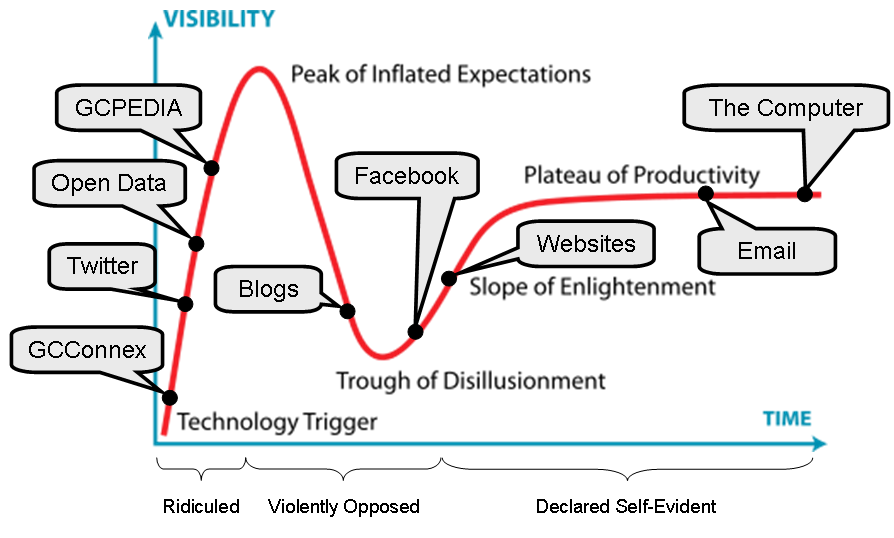
Mapping Government 2.0 against the Hype Curve

Last week Andrea DiMaio wrote an interesting post on how Government 2.0 may be approaching the peak of the hype cycle. I’d never seen the hype cycle before and it looked fun, so I thought it might be interesting to try to map where I believe some current Canadian government 2.0 projects, a few older technologies, and a few web 2.0 technologies in general, are against this chart from a government perspective.

My suspicion is that we haven’t even begun to dip into the Trough of Disillusionment with most true Web 2.0 government projects (GCPEDIA & GCConnex). However, I think governments have overcome their paranoia about facebook, but are still very wary… that said I’ve noticed some government ministries have started to use facebook as a communication tool with the public. Blogs however (which are perfectly okay for public servants to create internally) are still viewed with suspicion – internally they are almost never used. But then, heck, given the cluttered nature of most government website (and the fact that finding info is hard), I think it is clear that we are still working our way up the “Slope of Enlightenment” on this web 1.0 technology.

Gov 20 hype curve 3

Those who’ve seen me speak know I much I love Arthur Schopenhauer‘s three stages of truth:

“All truth passes through three stages. First, it is ridiculed. Second, it is violently opposed. Third, it is accepted as being self-evident.”

So I’ve also included how I think the three stages map against this chart too.

So in sum… in  my view there is good news for Government 2.0 projects – visibility is still increasing. Unfortunately there is also some bad news: prepare for increased violent opposition…

The Valpy Social Media debate

So a few days ago I posted this response (a cleaner version to be found here at The Mark) to a piece Michael Valpy wrote in the Globe about how social media threatened the social cohesion of the country. My problem with Mr. Valpy’s piece is that it framed the question in the most negative light – seeing only the downside (and in some cases imagined) consequences of social media and none its positives. I was reminded of Steven Johnson’s delightful and intelligent counter-factual that describes a world where video games precede, and are then displaced by, books. One senses that if we lived in a universe where social media preceded main stream media Mr. Valpy would be writing columns worrying about the loss of the country’s small, rich and diverse conversations, crushed by the emergence a dominant agenda, curated by a small elite.

I was initially excited to hear that Mr. Valpy was writing a response in The Mark. Sadly, his piece wasn’t really a response. It addressed none of my critiques. Instead it focused primarily on repeating his original argument, but more slowly, and with bigger words.

I’ve re-read all three pieces and still feel good about my contribution. My main concern is that when reading the counterfactual at the end of my piece, many people have come to assume I look forward to the decline of main stream media (MSM). Nothing could be further from the truth. Yes, I believe in the potential of social media and, when I stepin  my counterparts shoes, I also see that MSM offers us a great deal. At the same time, I don’t believe MSM is the sole generator of social cohesion, national identity, or democracy. All three existed before the arrival of MSM and, should it come to pass, will survive its decline.

As a newspaper columnist I can imagine it is frightening to see your audience splintered into smaller fragments. At the same time however, I am surprised that a national commentator can’t see how unhealthy this imaginary social cohesion was, and how unsafe the public space was for many people. Remember, this is an article that paints, in a concerning tone, the passing of a world where people, to paraphrase Mr. Valpy, attended a modern version of Mass to become aware of what others thought they should be aware of. That is not a description of an active and engaged citizenry. That is a description of sheep. Well now the sheep are awakening. Yes it is scary, yes there are unknowns, and yes there is fragmentation. But there are also enormous positives, positives I wish Mr. Valpy and others at the Globe would include in their commentary. If they did they and their readers might see what I and those I work with see: the opportunity for something that it is better than what was on offer before, no matter how rosy a picture he paints of the past.

Ultimately, I think Mr. Valpy and I do share common ground. He sees “A glorious objective” in Michale Ignatieff”s call for a public space:

“Isaiah Berlin described this sense of belonging well. He said that to feel at home is to feel that people understand not only what you say, but also what you mean.”

I too believe this is a noble aim. But, while we stand on common ground, I fear Mr. Valpy and I look away in different directions (I would be interested in trying to reconcile these views – and have said as much to him). My reading of his piece leads me to believe that he looks into the past and posits that not only is such a state possible, but suggests we once achieved it. That there was a  Canada where people understood what one another were saying and meant, but that it is slipping away.

For me, I think any such past was more illusion than mirror.

I look forward and see not the realization of Ignatieff’s glorious objective, but an enhanced ability to pursue it. There are no countries where  people understand what each other say and mean. Only countries where citizens are good or bad at committing to try to understand what each other say and mean. In other words, home isn’t where you are understood, it is where others are prepared to go out of their way to understand you.

The opportunity of social media is it gives citizens – The People Formerly Known as the Audience – the ability to increase the range of views about which they want to be understood. This can lead to disagreements (such as the one the Valpy and I are having now) but it also forces us to face the fact that others do not understand, or agree, with what we say or mean. Whether it is disagreeing or agreeing however, the hall mark of social media has been its ability to expose us to new communities – to connect people with others who share interests and care about issues we’ve both long cared for ourselves, or have just discovered. As much as I like my country when its citizens are held to together by a common passport and newspaper, I like it even more when it is held together by a dense weave of overlapping, interconnected, conflicting and ever changing communities around hobbies, politics, personal interests, books, culture, and a million other things. Communities where new voices can be heard and new expressions of the Canadian identity can be manifested.

The promise of social media is its ability to complexify our story, and our relationships with one another. Ultimately, I see that complexity being much more interesting than illusions cast by crude mirrors reflecting only what their holders decide should be seen. Will social media be able to hold up some new “mirror”? I suspect yes, but ultimately don’t know. But whether it can or cannot, I feel optimistic that the ascendancy of social media doesn’t mean the end of our social cohesion.

Neo-Progressive Alert: The NDP as risk-averse conservatives

As some of my readers know, I’m always interested in articles that highlight how all the political parties in Canada (and the US?) have become conservative. Not necessarily in the sense that they want to roll back government, but in the sense that they cannot not imagine some new future.

I think the classic example of that in Canada is the NDP which seems stuck in trying to remake the country as it was in the 1950s. This opinion piece in the Star by McMaster Assistant Professor David Goutor touches on the theme of a conservative NDP party, to scared to take a stand.

At the most basic level, today’s NDP is a truly remarkable phenomenon: it is a fourth-place party, usually stuck in the teens in the polls, and purporting to represent the most marginalized groups in society – yet it has become stubbornly risk-averse, acting as if it has too much to lose to speak out strongly on many key issues facing the country.

When it comes to strategy, the NDP was certainly bold in lunging for power through the coalition. It also has a notable amount of talent in its parliamentary caucus, with even right-wing commentators praising NDP MPs for being knowledgeable and performing effectively in parliamentary committees.

But when it comes to the party’s main policies, a mind-numbing blandness has set in. There are few instances where the NDP has boldly taken a controversial position on a key issue.

If you have visited the NDP’s website frequently in the last couple of years, you were much more likely to read about credit card rates, bank fees, and insurance premiums than central economic, social, or foreign-policy questions.

A particularly deep part of the NDP’s rut is that avoiding controversy has become to be seen as the “pragmatic” approach. Standing out on major issues, meanwhile, is viewed as the “radical” approach that will keep the NDP on the fringes. But if pragmatism means anything, it is paying attention to results. The results of the recent “pragmatic” approach are in, and they are dispiriting.

I suspect (but could be wrong) that Goutor would disagree with my and Taylor’s neo-progressive thesis and that our understanding of why we believe the NDP are conservative are markedly different. My assumption(potentially deeply flawed) is that I’m sure Goutor wishes the NDP was more aggressive in re-invoking the 1950’s (a more planned economy, closed off from the world with labour forming a bigger part of the pie) But the fact is, for many Canadians going back isn’t desirable, moreover the party doesn’t know what going forward means and so is flailing around in the present, going after small wins without a grand vision appears to be the order of the day.

This isn’t to say the other parties are significantly better off, the challenge is just more noticeable with the NDP.

Postscript – I notice the NDP never got around to debating the motion about the name change. My sense is that this means it got killed… in the way you’d expect from a democratic party, by procedural means.

The Canadian Government's War on Science

For those who did not catch this excellent piece in the Toronto Star I encourage you to take a look.

During the Bush era the Canadian war on science was an embarrassing side show to that of its more wildly offensive southern neighbour which regularly silenced scientists, withheld reports, or simply appointed “expert” panels whose credentials were dubious but whose members could be counted on to produce the “right” answer. Indeed, these sad events are well chronicled in Politics And Science In The Bush Administration drafted for Representative Henry Waxman. (This, as an aside, is what happens when you give elected representatives real research budgets – they look into all sorts of issues to keep the government of the day honest. A similar study by a Canadian MP would have stretched their resources beyond their limit).

But just in case you think the Canadian context is radically different, remember that our government has installed unqualified dependents of the oil industry to government scientific bodies. It has censored government scientists, preventing them from talking about their research at scientific conferences. It has barred officials from talking about climate change or harm reduction strategies for drug users. (It even banned one public servant from talking about a fictional book he”d written on climate change). It also disingenuously claims “more research is needed” on issues and then either cuts research programs that look into these questions or attempt to manipulate the process to produce outcomes that align with what they already believe (see the above Toronto Star piece).

This is the sad state of science and policy development in Canada. We alone in the world retain a government that is not interested in uncovering what is actually happening, but in fabricating a reality that conforms to an ideologically pre-determined world view. Our government’s two great allies, the Bush administration in the United States and the John Howard’s government in Australia, have moved on.

Today science is regaining its rightful place in the policy development process as evidenced by Obama’s inauguration speech:

The state of the economy calls for action, bold and swift, and we will act—not only to create new jobs, but to lay a new foundation for growth. We will build the roads and bridges, the electric grids and digital lines that feed our commerce and bind us together. We will restore science to its rightful place, and wield technology’s wonders to raise health care’s quality and lower its cost. We will harness the sun and the winds and the soil to fuel our cars and run our factories. And we will transform our schools and colleges and universities to meet the demands of a new age.

The mention is short and quick, but it was a powerful signal that, for scientists, the Bush era was over. Suddenly science mattered again in the United States. For the Canadian government this line is still more ominous. Their war on science can no longer hide in the shadow of Bush. And none to soon. As a believer in the power of effective public policy the undermining of science has been an attack on the effectiveness of good government. If our government doesn’t believe in science, how are we then to measure success, on what basis are we to decide which policies are more effective?

Oh, and don’t think the world isn’t noticing. You really have to work extra hard to prompt the world’s preeminent scientific journal – Nature – to write a special oped about how your government has become anti-science.

A couple of other fun links regarding our government’s war on science:

Tony Clement, who happily is not longer the Canadian Minister of Health received a swift rebuke for accusing doctors that work at Insite of being unethical.

Gary Goodyear Canada’s Scientific Minister is a creationist. Best response to this sad state of affairs is the incredulous Brian Alters, founder and director of the Evolution Education Research Centre at McGill University in Montreal. He noted this is akin to asking someone “‘Do you believe the world is flat?’ and he doesn’t answer on religious grounds…”

The Rat Pack of Public Service Sector Renewal

As many of you know I spend a lot of time thinking about public service sector renewal – that’s a wonkish term for renewing the public service. I do it because I think the public service is one of the most important institutions in the country since it affects everything we do, pretty much every day.

Over the past few years I’ve met more and more people who are equally passionate about this issue. Some I’ve met in person, others I’ve just chatted with by email. But, over the last 4 years I’ve watched a small group of bloggers – a rat pack of public service sector renewal – emerge. We’re scattered across the country and have come to from different angles but we all care about how our government is, how it should be, and how we can get to from the first place to the latter.

This is no easy task. I’m outside of government so it’s easier for me to speak truth to power. That’s why I’m so impressed with the other rat packers, in pursuit of making government better some have put their jobs on the line from time to time. I’d encourage you to go check our their blogs and give them a read.

The CPSR rat pack:

Me: as my readers know, my own thinking on public service sector renewal tends to focus on public policy development, and how it is going to be impacted by demographic change, technology, social media, networks and emergent systems.

Nick Charney’s blog CPSRenewal is one of the best blogs on public service sector renewal out there. Nick often does a weekly roundup of CPSR articles and blog posts, interviews with public servants and generally shares his thoughts.

Etienne Laliberte is one of the bravest public servants I know. A couple of years ago he wrote “An Inconvenient Renewal” in which shared his thoughts on renewal. Most important, his is probably the only document I’ve seen that treats renewal as a management problem, not a policy problem (something I’ve discussed in the past and intend to talk about again shortly). You can catch him at his blog as well.

A couple of other people I think of as being part of the Rat Pack include Peter Cowan – an OpenEverything alumnus – whose part of a team doing very interesting work with social media tools at Natural Resources Canada.

Thomas Kearney, who doesn’t blog, but is amazing nonetheless, has been a big part of the work behind GCPEDIA.

There’s Laura Wesley’s who’s got a great blog over at Results for Canadians: Measuring Success in Government. Nice to have someone concerned with how we measure success!

And finally there is the outspoken Douglas Bastien at Government of Canada 2.0, ready to tell it as it is and take no prisoners.

I know there are more people than just those I’ve mentioned, but these are the group I know and who’ve always been kind about letting an semi-outsider like me in. If you care about Canadian public service sector renewal (twitter hashtag #cpsr) then I hop you’ll add their RSS feeds to your reader.

Feeding the next economy – Give us a stimulus that stimulates, not placates

Last December – as the debates over the stimulus packages were just beginning, I wrote a piece on why the wrong stimulus today could fail us tomorrow. Well, today has become tomorrow, and we are failing.

A stimulus package should be an investment. It should create new industries and markets, it should find help create efficiencies and improve productivity, in short, in should help the economy grow in a sustainable manner. In the last depression the government accomplished this by funding infrastructure necessary for the 20th century economy, things like roads and highways for cars and transportation, power stations and grids for cities and industry, university buildings for education. Today, we already have much of that infrastructure and – while some of it needs to be renewed – we need to be focusing on what infrastructure is needed for the next economy – the digital economy – that will carry us out of this recession.

So what powers the digital economy? It isn’t coal, steel or cars and power (although these things are necessary), it’s data and connectivity.

Data is the plankton of the new economy. It seems plentiful, tiny and insignificant. But a whole ecosystem of companies, large and small are emerging to feed off of it and support our next economy. People often fail to recognize that the largest company already created by the new economy – Google – is a data company.  Google is effective, rich and powerful not because it sells ads… but because it generates petaflops of data everyday from billions of search queries. This allows it to know more about our society, and sometimes us individually – the merchandise we like, the services we want, the spam we’ll receive, even if the likelihood we’ll get sick in 4 months – than we know about yourself. Give people access to data and they will use it to become more efficient (freeing up more money to reinvest) and to create new services and opportunities (creating new jobs and profits).

Look no further than the City of Washington DC. It created a publicly available database of city collected and created data and asked local individuals and companies to use it. The result? A $50,000 dollar investment in changing processes and offering prize money has so far yielded $2.3M in value. That’s a 46 times return on investment in one year.

Now imagine that at a national level. Imagine Statistics Canada making all its data available freely (since taxpayers have already paid for its creation). As I outlined in a talk to StatsCan last year, not only would this make them a more important ministry, it could foster billions in savings, investments and new jobs all for a tiny sum. Let’s pick a truly excessive number, say $100M (.2% of the stimulus package) and imagine that’s this would be the cost for Statistics Canada to free all its data and provide in formats usable for webpages, cellphones and applications. Even if such a stimulus were only 20% as effective as Washington’s open data project it would still yield $460M in one year of new (not saved) jobs, and improved economic efficiencies and competitiveness. Over a decade, billions in new wealth would be created.

Compare this to our current course of action. To date much of our stimulus has been spent propping up (not creating) industries that are in death spirals such as logging, newspapers, and the auto-sector. The money spent isn’t about creating new or better jobs, it is simply being spent to keep jobs. Indeed, Andrew Coyne calculates that each auto-job saved cost us just under 2 million dollars. It will take years, if not decades, for such an investment to pay off, if it ever does. Worse still, the Canadian economy will be no more efficient or profitable as a result. While we are at it we might as well be giving Canadians money to buy land-line telephones to stimulate the telecommunications sector.

Oh, and it case you are wondering, the Americans already give out much of their government data for free and they are starting to give away more and more. This is a competitive race we are already losing, and only falling further and further behind.

Canada needs a better stimulus, one that is low on carbon and fat on data. Sadly, I fear our current government lacks the vision and creativity to give us what we need to prepare for the 21st century. So far we are off to an ominous start.

Why Canada’s public services need faith

As I mentioned the otherday, I recently finished Thomas S. Kuhn’s classic 1962 book “The Structure of Scientific Revolutions.” For those unfamiliar with the text, it is the book that gave us the important and oft over-used term, “paradigm shift.”

Here, in this book about how progress is made in the sciences I was completely floored by this paragraph in penultimate chapter: The Resolution of Revolutions.

…the issue is which paradigm should in the future guide research on problems many of which neither competitor can yet claim to resolve completely. A decision between alternate ways of practicing science is called for, and in the circumstances that decision must be based less on past achievement than on future promise. The man who embraces a new paradigm at an early stage must often do so in defiance of the evidence provided by problem-solving. He must, that is, have faith that the new paradigm will succeed with the many large problems that confront it, knowing only that the old paradigm has failed with a few. A decision of that kind can only be made on faith. (pages 157-158/3rd edition)

This describes precisely how I feel about Public Service Sector Renewal (reforming the public service). When I talk and write about an open and networked government I understand it raises questions around accountability, ministerial responsibility and human resource management. I’m aware that these are “large problems” for which our present structure has some – albeit highly imperfect and I’d argue, quickly eroding – answers.

Moreover it is true, that if we decided on how and if to reform government based solely on the performance of past models then we would always choose the status quo. The corporate hierarchy has served us well. Any new model will appear, relatively speaking, untested. But a growing number of us know that the status quo is unsustainable.

I know that any new system, however slight the change, will bring with it new challenges and questions, but the paralyzing and untenable problems with the current system will ultimately outweigh these unknowns – even in an organization as conservative as the public service. Ultimately, I am saying that a new system can succeed with many large problems confronting it even as the old system has failed only with a few.

So, as odd as it is to admit, I am, in part, acting on faith. Not only that, I believe the public service is going to learn to have faith as well. Why? Because in the end we won’t have a choice – the old problems this system cannot solve will demand it. We will have to change, and that will mean, someone, somewhere in the public service have put their foot forward into the unknown.

Indeed, many already have.

RCMP and Vatican: The downfall of hierarchical and opaque organizations

I’m on the road which is basically the only time I watch TV news and was pleased that I did this evening since I caught Terry Milewski’s excellent follow up piece on the how the RCMP has dealt (or in this case, not dealt) with investigating its own officers over the death of Polish traveler Robert Dziekanski.

The thing that really struck me about Milewski’s story was how much it appeared to suggest that the RCMPs method for dealing with problematic individuals parallels that of the Vatican’s. In the 70’s, 80’s and 90’s the Vatican regularly moved priests it knew was molesting children from diocese to diocese. Priests like Father John Gagan, who molested dozens and dozens of people were never suspended or ordered to take treatment. They were simply shuffled around and the problem was covered up.

The retired RCMP officers in Milewski’s piece suggest that a similar practice occurs within the RCMP. For example, one of the officers involved in the death of Robert Dziekanski, Corporal Benjamin Robinson (who subsequently, has allegedly been involved in a drinking and driving incident which resulted in a death and in which he fled the scene) has apparently experienced a number of challenges in his previous posts. The point here is not to assess Corporal Robinson, but a system that promoted and moved him around rather than offer him needed support.

What is most scary for Canadians is that the RCMP does not appear to understand how quickly the public’s loss of faith could grow and thus manifest into a real crises of confidence in the organization. Consider the recent past of RCMP scandals:

In isolation, each scandal is not a problem. Collectively, given people’s capacity to use the internet to create coalitions and mobilize, resistance to bureaucratic, authoritarian and opaque institutions can crystallize very, very quickly.

Clay Shirky offers one of the best examples of this in his book, Here Comes Everybody where he talks about the rise of Voice of the Faithful – a catholic protest group formed in reaction to the pedophile priest scandal in 2002. Here is Shirky discussing the issue in an interview:

Because in 2002, Father John Gagan, a pedophile priest in Boston, was brought to trial and The Boston Globe covered the story. And during the course of this trial and then the subsequent outrage, this little group formed in a basement in January, called Voice of the Faithful. It was basically outraged Catholics who wanted to do something.

By that summer, they went from 30 people in a church basement to 25,000 members in 21 countries around the world. Now, groups don’t grow that fast, or they didn’t prior to the Internet.

And one of the really remarkable things that I think demonstrated how quickly the Catholic outrage solidified into this reaction – and Voice of the Faithful was instrumental in both changing Vatican policy but also getting several high-level bishops and archbishops to resign their posts because of the bad handling of the pedophile scandal.

The Catholic Church very much wanted to say, this is a one-off. This is an unusual case. But, in fact, almost exactly 10 years before, in 1992, something almost identical happened. In that case, the priest’s name was Porter. But it took place in the same diocese in Massachusetts. Bishop Law was the same person in charge. The Boston Globe was the same newspaper reporting.

But in that case, it just blew over. Part of the difference between ’92 and 2002, which is to say, between failure to reform the Church and at least partial success in reforming the Church, is that in ’92 The Boston Globe wasn’t really global. It was a local paper. There was no way for coverage in the Boston area to suddenly become of global importance.

The other part of the story is that it isn’t just about consuming media. It’s actually about doing something about it. Everybody who read about Voice of the Faithful in one of these stories could join online, they could make a donation immediately, and that changed from a big gap between thought and action in ’92 to a very small gap between thought and action in 2002.

Canadians are increasingly losing faith in the RCMP. And much like many Boston Catholics lost faith in the Vatican, they should be. It is an organization fraught with challenges, that has little, or at least very poor, civilian oversight.

The problem for the RCMP is that, increasingly, Canadians have the capacity to mobilize over this issue and the organization’s response to challenges to its authority have not been well received. Today, a rag tag and splintered group of people ranging from anti-rape activists, first nation advocates, the polish community, human and citizen right advocates and harm reduction advocates could be the proverbial 30 people in a basement Shirky talks about in his Voice of the Faithful example. When those concerned with the RCMP coalesce, it may appear to happen quickly and grow exponentially. My hope remains that the RCMP addresses its issues before this happens. My fear, is that without pressure, it won’t.

Ultimately, authoritarian and opaque institutions such as the RCMP and the Vatican will continue to have relevance in a world of networked enabled citizens, but I suspect that their freedom to operate unobserved and unquestioned will become increasingly constrained. Another painful transition is ahead, but one that is long overdue and necessary.

It's a brave man who advocates against R2P at the U of O…

…and my friend Matteo Legrenzi – assistant professor at the Graduate School of Public and International Affairs of the University of Ottawa – appears to be just the guy. Remember, this is the University at which Allan Rock is president.

Recently Matteo penned this critical piece on R2P in the Ottawa Citizen. In his trademark style it has some notable harsh lines including:

Occasionally calls to mobilize Canada’s diplomatic network in support of such notions reverberate through Ottawa. The current government is perceived as not incisive enough in the promotion of these “emerging” norms in international relations.

Admittedly, these calls more often than not come from retired politicians who are not in charge of Canada’s foreign policy, let alone world affairs. They are part of that wider syndrome that affects many individuals involved in policy-making after they retire: We are sorry we did not save the world while we were in charge, but let us tell you exactly how to go about it now that we are out of office.

and, because he is an expert on Middle Eastern issues, this quote:

In many Muslim-majority countries such as Egypt, opposition to R2P is the only thing that unites the government and the Islamist opposition.

Matteo and I don’t always agree but I do always enjoy his blunt assessments of Canada’s foreign policy. There is a strain of thinking in Canadian foreign policy that is more obsessed with pursuing the perfect ideal than pragmatically finding solution that works. This is something I’ve occasionally tried to write about. Matteo’s assessments is far tougher, and is the type of piece few Canadians are willing to voice and fewer still like to hear (especially in Ottawa).

What makes Matteo tough is that there is truth to his assessment. Contrary to what some politicians preach R2P is unpopular in many parts of the world and it is not established international norm. George Bush spent 8 years believing that the world could become a certain way if he simply believed and acted that it was as such… it was a dangerous strategy that had devastating results. A similar strategy, even if motivated by what we believe are more noble intentions, will also be fraught with danger.

I know not everyone will agree with Matteo’s analysis, but even those who disagree with his prescription should at least take away that one lesson: reality may bite, but we can never ignore it.