Tag Archives: canadian politics

The Census weak link: What the Liberals, Bloc & NDP should do

Public and the media condemnation of the government’s decision to end the long form census has been universal (see more fun quotes below). Now the political opposition has started to mobilize. The focus of the opposition has been on the secretive nature of the decision and the failure to consult any stakeholders. While this is problematic I’m not sure it is the most ironic and sensitive point. There is actually a much more juicy Achilles heel in this decision, one that might garner press attention.

In explaining the decision (such as in the quote to the Canadian Press below), Minister Clement has repeatedly claimed that MP offices has received numerous complaints about the long form census form:

“Every MP has had complaints like that so this year we decided to at least try another method that could be a sound method that would beat the issue of concern of degradation of data, and deal with the issue of coercion and too much intrusiveness”

The statement suggests broad base support but, ironically, anecdotal and, in theory, untestable.

The fun thing is, it doesn’t have to be that way. The opposition could bring more (and hard) information to this process and expose how the Conservatives are using a lack of information to at best mislead and at worse, lie, to ordinary Canadians. Better still, if the opposition parties have been organized, they should possess that data.

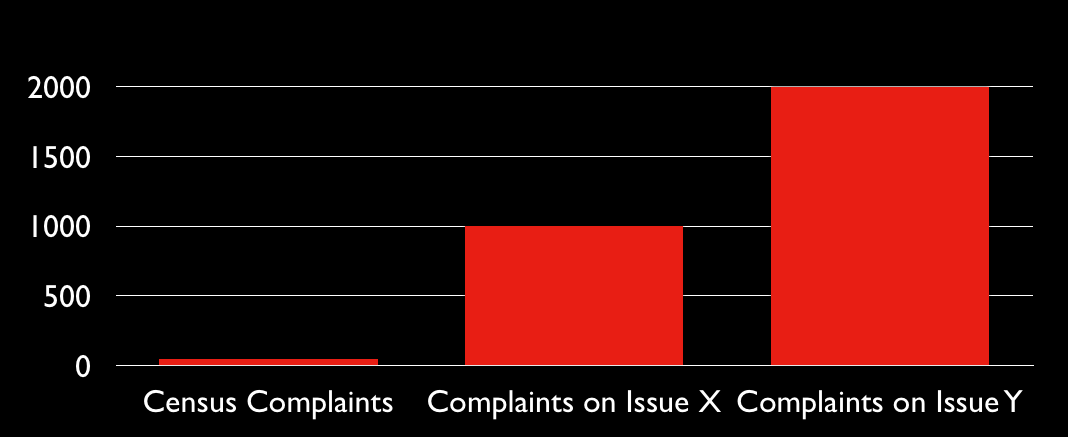
How is this? Well, I’d like to see the Liberals, Bloc and NDP ask each of their MPs to search and count every email and letter from constituents over the past 4 (or some sensible number) years that involved a complaint about the census.

My suspicion is that there are no more than 100 such letters (and, maybe even a lot less, like 10). You could then pick a couple of issues of your choice on which you have received 1000s of letters and which the conservatives have taken no action and put a simple chart up showing how they react to made up issues, but ignore real priorities of ordinary Canadians.

Of course, maybe there has been some massive, secret letter campaign targeted at Conservative only MPs but I think most Canadians will want to know how many letters the Minister and conservative MPs have actually received (sadly I don’t think you can FOI this) and most will suspect it is about as many as other MPs have.

Let’s show that better data leads to better decisions and that a little transparency can go a long way to exposing those who seek to mislead us. The minister says MPs get lots of letters – lets find out how many. And in comparison to what. Moreover, let’s show that those who seek to restrict the gathering of good information are generally those most inclined to use a lack of data to mislead the public and drive agendas that are not in the public interest. Canadians are sensible people, they want a smart government that makes good decisions. This, much more than secrecy, will rub them the wrong way.

The narrative isn’t as neat – but I suspect it could be turned into something more fun and more impactful.

Other fun articles…

Also, the universal condemnation of the Conservatives decision to end the mandatory long term census continues. My newest favourite is an article in the Globe where Derek Cook, Calgary’s the research and social planner at the City of Calgary and in the riding of the Prime Minister Harpers states that “If we don’t have that data at the neighbourhood level, we’re crippled.” Now, in addition to business groups, ngos, think tanks, cities, university researchers we are also seeing even more local and focused organizations such as those representing French Canadian communities, Inuit people and others starting to call for a reversal as well.

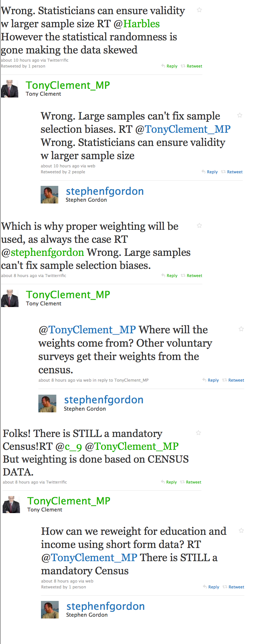
Ministerial Twitter Battle! $130M tax payer dollars wasted! Conspiracy theories!

Who knew the census could be so exciting.

Yesterday, I published Why you should care about the sudden demise of the mandatory long census form on the Globe and Mail website (also can be found here on this blog).

One interesting impact of the piece was that it generated the following debate between the Minister and a Laval Statistics Professor. Ultimately the professor’s concerns that the data generated by a voluntary long form remain unresolved. In short, as the former chief statistician of Statistics Canada also noted, a $100 million dollar survey may generate useless data.

UPDATE: Turns out there is now a petition to save the long form census here.

In addition to the online debate here are some other interesting facts about the end of the mandatory long census form:

1. It will be more expensive to implement.

For a government that is supposed to be fiscally conservative, ending the mandatory form could actually cost Canadian Tax Payers an additional $30 Million. As the Canadian Press reports:

“The cost of the change could reach $30 million, says Statistics Canada: $5 million for the additional mailout, and $25 million in case there is a major problem in getting people to respond.”

So, to sum up: Canadians will pay more to get data that risks being useless and skewed. Total waste of tax payer dollars: $130M.

2. No one can identify who wanted this change, not even the Minister.

Again, from the same Canadian Press article:

Industry Minister Tony Clement acknowledged in an interview that no consultations were undertaken on the decision.

He said it was based on the fact that many Canadians had complained of the coercive and intrusive nature of the census, but Clement had not seen polling on the issue.

How many Canadians? What is clear is that a large number of people are stepping forward to say this was a bad idea. So far every major municipality – through the Federation of Canadian Municipalities – is complaining about the decision, so to is both the Canadian and the Toronto Associations of Business Economists, the Canadian Council on Social Development and the Canadian Association of University Teachers and numerous academics and of course, the former chief statistician of Canada who says he would have quit rather than carry out the order to end the mandatory long census form.

3. So who has complained? (this is the best part)

So far all the stories about Canadians who have complained about the census refer to two individuals. The Canadian Press story (Which has been reprinted in several forms in a number of newspapers) references Sandra Finley, a Saskatoon activist who is still fighting in court after refusing to fill out the 2006 census. In addition to Ms. Finley, the Globe also referenced Don Rogers, a Kingston, Ont., man who mounted the “Count Me Out” campaign against the census.

In both cases the protesters core problem was not the coercive or intrusive nature of the census (the concern the minister seeks to address) but the fact the Statistics Canada bought software from defence manufacturer Lockheed Martin back in 2003. Indeed, the Count Me Out website is plastered with a hodge podge of conspiracy theories NAFTA, Lockheed Martin and the Canadian census funding ballistic missile tests.

Is this the complaint upon which the minister is grounding his decision?

4. Canada is alone

As far as the former Chief Statistician can tell, no other country in the world has a voluntary portion to its census.

Taken these four issues one is left wondering – is this how cabinet decisions are made?

Update 9:17am July 7th

Liberals issue a press release stating that:

“If the Conservatives don’t reverse their decision, Liberals are prepared to explore the introduction of an amendment to the Statistics Act to ensure a comprehensive, mandatory long-form stays,” said Ms. Jennings. “This decision, made in secret, without any consultation, is dangerous because the information that will be lost is used to help Canadians in their daily lives – particularly our most vulnerable citizens.”

Update 8:30am July 7th

Other articles raising concerns about this decision:

Winnipeg Free-Press: Anti-census crusader not satisfied with federal axing of long form

Globe and Mail: Tories Scrap Mandatory Long Form Census

Saskatoon Star-Phoenix: Detailed census data invaluable for sound policy

Montreal Gazette: Canadians must be able to count on Statistics Canada

Vancouver Sun Editorial: Canada needs its citizens to stand up and be counted

Victoria Times Colonist: Census shortcut bad for Canada

Edmonton Journal: Ridiculous to scrap key census data

(Plus many more who ran the Canadian Press story and others I just didn’t paste in here).

Articles supportive about this decision:

zero

Your Government Just Got Dumber: how it happened and why it matters to you

This piece was published in the Globe and Mail today so always nice when you read it there and let them know it matters to you.

Last week the Conservative Government decided that it would kill the mandatory long census form it normally sends out to thousands of Canadians every five years. On the surface such a move may seem unimportant and, to many, uninteresting, but it has significant implications for every Canadian and every small community in Canada.

Here are 3 reasons why this matters to you:

1. The Death of Smart Government

Want to know who the biggest user of census data is? The government. To understand what services are needed, where problems or opportunities may arise, or how an region is changing depends on having accurate data. The federal government, but also the provincial and, most importantly, local governments use Statistics Canada’s data every day to find ways to save tax payers money, improve services and make plans. Now, at the very moment – thanks to computers – governments are finding new ways to use this information more effectively than ever before, it is to be cut off.

To be clear this is a direct attack on the ability of government to make smart decisions. In fact it is an attack on evidence based public policy. Moreover, it was a political decision – it came from the Minister’s office and does not appear to reflect what Statistics Canada either wants or recommends. Of course, some governments prefer not to have information, all that data and evidence gets in the way of legislation and policies that are ineffective, costly and that reward vested interests (I’m looking at you Crime Bill).

2. The Economy is Less Competitive

But it isn’t just government that will suffer. In the 21st century economies data and information are at the heart of economic activity, it is what drives innovation, efficiencies and productivity. Starve our governments, ngo’s, businesses and citizens of data and you limit the wealth a 21st century economy will generate.

Like roads to the 20th century economy, data is the core infrastructure for a 21st century economy. While just a boring public asset, it can nonetheless foster big companies, jobs and efficiencies. Roads spawned GM. Today, people often fail to recognize that the largest company already created by the new economy – Google – is a data company. Google is effective and profitable not because it sells ads, but because it generates and leverages petabytes of data every day from billions of search queries. This allows it to provide all sorts of useful services such as pointing us, with uncanny accuracy, to merchandises and services we want, or better yet, spam we’d like to avoid. It can even predict when communities will experience flu epidemics four months in advance.

And yet, it is astounding that the Minister in charge of Canada’s digital economy, the minister who should understand the role of information in a 21st century economy, is the minister who authorized killing the creation of this data. In doing so he will deprive Canadians and their businesses of information that would make them, and thus our economy, more efficient, productive and profitable. Of course, the big international companies will probably be able to find the money to do their own augmented census, so those that will really suffer will be small and medium size Canadian businesses.

3. Democracy Just got Weaker

Of course, the most important people who could use the data created by the census aren’t government or businesses. It is ordinary Canadians. In theory, the census creates a level playing field in public policy debates. Were Statistics Canada website usable and its data accessible (data, may I remind you we’ve already paid for) then citizens could use this information to fight ineffective legislation, unjust policies, or wasteful practices. In a world where this information won’t exist those who are able to pay for the creation of this information – read large companies – will have an advantage not only over citizens, but over our governments (which of course, won’t have this data anymore either). Today, the ability of ordinary citizens to defend themselves against government and businesses just got weaker.

So who’s to blame? Tony Clement, the Minister of Industry Canada who oversees Statistics Canada, is to blame. His office authorized this decision. But Statistics Canada also shares in the blame. In an era where the internet has flattened the cost of distributing information Statistics Canada: continues to charge citizens for data their tax dollars already paid for; has an unnavigable website where it is impossible to find anything; and often distributes data in formats that are hard to use. In short, for years the department has made its data inaccessible to ordinary Canadians. As a result it isn’t hard to see why most Canadians don’t know about or understand this issue. Sadly, once they do wake up to the cost of this terrible decisions, I fear it will be too late.

When Police Lie

The single most important tool police have in their arsenal isn’t a gun, it isn’t baton, it isn’t even their badge. It is public confidence.

It is this confidence that ensures the public they can have faith in some of the most important and powerful public servants they meet in their day to day lives, and more importantly, it is vested in hands that will prioritize the rule of law over violence.

This, however, breaks down when police lie.

This week, as far as I can tell, the Toronto Police Chief Bill Blair has been caught in two lies. First, in claiming the policy had legal authority to detain people within 5 meters of the perimeter fence at the G20, second, when they put confiscated weapons on display that had been found on “protesters.”

Worse still, was his defense.

Asked Tuesday if there actually was a five-metre rule given the ministry’s clarification, Toronto Police Chief Bill Blair smiled and said, “No, but I was trying to keep the criminals out.”

The police have more than a tough job. Consider the idiocy they had to deal with during the G20. Take, for example, Anti-Capitalist Convergence spokesperson Mathieu Francoeur’s claim that vandalism and violent protests were “not violence” but “a means of expression and doesn’t compare to the economic and state violence we’re subjected to.” Yes, it drives me crazy too. Of all the ills in the world to choose from, violence against a state that provides welfare, free health-care and subsidized education just never seems to make my top 10 list…

But the best weapon against this idiocy is honest and upfront police force. Admittedly, this contributes to what makes their job hard, but citizens expect the police to follow the law and behave ethically. That, more than a gun, a badge, or a uniform, this code of conduct is what separates them from everyone else – from the criminals, and even, ordinary citizens. We expect, and we need them to model behaviour.

Mistakes I can understand. Poor decisions under stress I can understand. But deliberately misleading the public I cannot understand, nor do I think there are many who will condone it. Is lying now an appropriate strategy for dealing with the public? If a police force – and more importantly, its chief – is willing to mislead us about weapons captured and the nature of the law during the G20, what will they lie about at other times?  Perhaps when I get pulled over? Or when my 21 year cousin accidentally bumps into an officer who is having a bad day? Do I believe the Toronto police force is on a slippery slope? No. But I don’t want them on the slope at all.

Today, it feels we are a long, long way away from the era of the trusted and honest Mountie (side note about the RCMP, it has the dubious distinction of having a whole wikipedia page dedicated to some of scandals) and the erosion of this trust may be one of the biggest causalities of the G20 Summit.

yellow-pages-banCanadian? Hope you’ll also consider opting out of receiving the yellow pages. Facebook group and instructions on how to save some trees here.

Open Canada – Hello Globe and Mail?

Richard Poynder has a wonderful (and detailed) post on his blog Open and Shut about the state of open data in the UK. Much of it covers arguments about why open data matters economically and democratically (the case I’ve been making as well). It is worthwhile reading for policy makers and engaged citizens.

There is however a much more important lesson buried in the article. It is in regard to the role of the Guardian newspaper.

As many of you know I’ve been advocating for Open Data at all levels of government, and in particular, at the federal level. This is why I and others created datadotgc.ca: If the government won’t create an open data portal, we’ll create one for them. The goal of course, was to show them that it already does open data, and that it could do a lot, lot more (there is a v2 of the site in the works that will offer some more, much cooler functionality coming soon).

What is fascinating about Poynder’s article is the important role the Guardian has played in bringing open data to the UK. Consider this small excerpt from his post.

For The Guardian the release of COINS marks a high point in a crusade it began in March 2006, when it published an article called “Give us back our crown jewels” and launched the Free Our Data campaign. Much has happened since. “What would have been unbelievable a few years ago is now commonplace,” The Guardian boasted when reporting on the release of COINS.

Why did The Guardian start the Free Our Data campaign? Because it wanted to draw attention to the fact that governments and government agencies have been using taxpayers’ money to create vast databases containing highly valuable information, and yet have made very little of this information publicly available.

The lesson here is that a national newspaper in the UK played a key role in pressuring a system of government virtually identical to our own (now also governed by a minority, conservative lead government) to release one of the most important data in its possession – the Combined Online Information System (COINS). This on top of postal codes and what we would find in Stats Canada’s databases.

All this leads me to ask one simple question. Where is the Globe and Mail? I’m not sure its editors have written a single piece calling for open data (am I wrong here?). Indeed, I’m not even sure the issue is on their radar. It certainly has done nothing close to launching a “national campaign.” They could do the Canadian economy, democracy and journalism and world of good. Open data can be championed by individual advocates such as myself but having a large media player repeatedly raising the issue, time and time again brings out the type of pressure few individuals can muster.

All this to say, if the Globe ever gets interested, I’m here. Happy to help.

Minister Moore and the Myth of Market Forces

Last week was a bad week for the government on the copyright front. The government recently tabled legislation to reform copyright and the man in charge of the file, Heritage Minister James Moore, gave a speech at the International Chamber of Commerce in which he decried those who questioned the bill as “radical extremists.” The comment was a none-too-veiled attack at people like University of Ottawa Professor Michael Geist who have championed for reasonable copyright reform and who, like many Canadians, are concerned about some aspects of the proposed bill.

Unfortunately for the Minister, things got worse from there.

First, the Minister denied making the comment in messages to two different individuals who inquired about it:

Still worse, the Minister got into a online debate with Cory Doctorow, a bestselling writer (he won the Ontario White Pine Award for best book last year and his current novel For the Win is on the Canadian bestseller lists) and the type of person whose interests the Heritage Minister is supposed to engage and advocate on behalf of, not get into fights with.

In a confusing 140 character back and forth that lasted a few minutes, the minister oddly defended Apple and insulted Google (I’ve captured the whole debate here thanks to the excellent people at bettween). But unnoticed in the debate is an astonishing fact: the Minister seems unaware of both the task at hand and the implications of the legislation.

The following innocuous tweet summed up his position:

Indeed, in the Minister’s 22 tweets in the conversation he uses the term “market forces” six times and the theme of “letting the market or consumers decide” is in over half his tweets.

I too believe that consumers should choose what they want. But if the Minister were a true free market advocate he wouldn’t believe in copyright reform. Indeed, he wouldn’t believe in copyright at all. In a true free market, there’d be no copyright legislation because the market would decide how to deal with intellectual property.

Copyright law exists in order to regulate and shape a market because we don’t think market forces work. In short, the Minister’s legislation is creating the marketplace. Normally I would celebrate his claims of being in favour of “letting consumers decide” since this legislation will determine what these choices will and won’t be. However, the Twitter debate should leave Canadians concerned since this legislation limits consumer choices long before products reach the shelves.

Indeed, as Doctorow points out, the proposed legislation actually kills concepts created by the marketplace – like Creative Commons – that give creators control over how their works can be shared and re-used:

But advocates like Cory Doctorow and Michael Geist aren’t just concerned about the Minister’s internal contradictions in defending his own legislation. They have practical concerns that the bill narrows the choice for both consumers and creators.

Specifically, they are concerned with the legislation’s handling of what are called “digital locks.” Digital locks are software embedded into a DVD of your favourite movie or a music file you buy from iTunes that prevents you from making a copy. Previously it was legal for you to make a backup copy of your favourite tape or CD, but with a digital lock, this not only becomes practically more difficult, it becomes illegal.

Cory Doctorow outlines his concerns with digital locks in this excellent blog post:

They [digital locks] transfer power to technology firms at the expense of copyright holders. The proposed Canadian rules on digital locks mirror the US version in that they ban breaking a digital lock for virtually any reason. So even if you’re trying to do something legal (say, ripping a CD to put it on your MP3 player), you’re still on the wrong side of the law if you break a digital lock to do it.

But it gets worse. Digital locks don’t just harm content consumers (the very people people Minister Moore says he is trying to provide with “choice”); they harm content creators even more:

Here’s what that means for creators: if Apple, or Microsoft, or Google, or TiVo, or any other tech company happens to sell my works with a digital lock, only they can give you permission to take the digital lock off. The person who created the work and the company that published it have no say in the matter.

So that’s Minister Moore’s version of “author’s rights” — any tech company that happens to load my books on their device or in their software ends up usurping my copyrights. I may have written the book, sweated over it, poured my heart into it — but all my rights are as nothing alongside the rights that Apple, Microsoft, Sony and the other DRM tech-giants get merely by assembling some electronics in a Chinese sweatshop.

That’s the “creativity” that the new Canadian copyright law rewards: writing an ebook reader, designing a tablet, building a phone. Those “creators” get more say in the destiny of Canadian artists’ copyrights than the artists themselves.

In short, the digital lock provisions reward neither consumers nor creators. Instead, they give the greatest rights and rewards to the one group of people in the equation whose rights are least important: distributors.

That a Heritage Minister doesn’t understand this is troubling. That he would accuse those who seek to point out this fact and raise awareness to it as “radical extremists” is scandalous. Canadians have entrusted in this person the responsibility for creating a marketplace that rewards creativity, content creation and innovation while protecting the rights of consumers. At the moment, we have a minister who shuts out the very two groups he claims to protect while wrapping himself in a false cloak of the “free market.” It is an ominous start for the debate over copyright reform and the minister has only himself to blame.

The Myth of the Open Data Mob: a response to Mike Ananny

I recently discovered that Mike Ananny wrote this response to a piece I initially posted here and then on The Mark titled Let Us Audit Parliament’s Books. I encourage you to read both my piece and Ananny’s thoughtful response. And, in the spirit of dialogue, I have two thoughts in response.

First, Ananny misrepresents the thrust of my argument. He suggests that I only want crowds and that my goal is to replace public institutions with amorphous “crowds.” Nothing could be further from the truth. Indeed, I say, at the end of the article, that the Auditor General should do her own audit – using the same information that is available to everyone. I’m not in favour of replacing institutions with crowds, or democracy with populism. What I am in favour of is ensuring their are checks on institutions.

Second, Ananny creates a straw man of my arguments painting the picture of a single monolithic crowd. These misrepresentation can be found in lines such as this from his piece:

It’s okay that we do this. But in the kind of crowd-sourced audit Eaves describes, who are the “others” that we trust to discover on our behalf and teach us what they learn? At least we know who the auditor general is and how – cumbersome as it might be – she and the government can be replaced.

This is certainly not what I sought to describe nor is what I think I did, but as an author I share responsibility in being clear.

Do I believe there will be no single amorphous crowd? No. I believe there will be the public much like today. And it will discern the debate in the same way it currently does. What does this mean? I suspect that if the expensess were public there might be numerous audits, and that those will find it easiest to earn the public’s trust will be those conducted by “others” who first and foremost declare who they are. The most obvious candidate for this would be the Globe and Mail. (Wouldn’t it be nice if they had access to MP expenses)? Of course, the Globe may not have the resources to go through every line of every MP’s expenses so they may ask people to flag lines that seem to be of particular importance. This is, of course, how  The Guardian newspaper in the UK exposed some of the most problematic expenses in their MP expense scandal. In short, this isn’t a single faceless mob, this is about allowing numerous people, from public institutions to the media to self interested private citizens. Some will self-organize, others will not. But there will be a diversity of perspectives.

Second, and more importantly, is that these competing audits would be good for democracy and for public institutions. I completely agree with Ananny’s quote from Bentham. A perfectly knowledgeable public is a myth. Yes, most of us, on most issues, knowingly or not, do delegate responsibility for forming our beliefs to others. The challenge is, to whom to delegate? Ananny seems confident he knows exactly who it should be (an AG who, actually, only has the power to shame). He wants us to place our faith in a crowd of one – the AG – who no one gets to choose and who herself has no oversight.  I’m interested in a different outcome. We live in a world where it is easier to allow more than one resource to which citizens can delegate their trust. More importantly, by sharing the expenses different parties can assess how others conduct their audit – biases, different assumptions, flaws and more clear comparisons – in short a public debate, could take place. Giving everyone access to MP expenses will, admittedly, be messy, but then so is democracy. The point is you either believe in public debate or you don’t.

Encouragingly, this is ultimately what Ananny seems to want as well, as he states:

I know we don’t have to choose between crowds or experts – I want both – but if it’s a question of emphasis, I’d much rather be the constituent of an AG who can be legally reprimanded and dramatically fired than an unwilling patron of a crowd that may or may not know what it’s doing.

I want both as well. I’d also love to see a supportive infrastructure that helps people contribute to audits. Indeed, this was the thrust of my June 10th piece Learning from Libraries: The Literacy Challenge of Open Data. But you don’t create that infrastructure by not sharing the the accounts openly. As my libraries piece argues, sharing is a precondition to developing such an infrastructure.

So if, as suggested, this is a question of emphasis, why did Ananny choose to use my piece as a launchpad for his own? We seem to be on the same page (we both appear to want to improve public institutions and public debates). I think the ultimate reason lies in this last point. Ananny’s examples refer to crowds or institutions that are deemed expert by somebody. But the public’s trust in an institution or resource or even a crowd isn’t granted or ordained, it is earned. Ananny’s solutions keep returning to the notion that we need to ordain trust and delegate whereas mine is that we need to enable emergent systems so that many actors can attempt to earn trust and we can debate. This is why I agree that the AG’s office should, as he suggests, provide a program to help people learn how to do audits. But I also I think society will be best served when a diversity (of particularly emergent) approaches are possible, perhaps involving actors like accounting firms and universities. This would allow others to be a check on the AG which will enhance, not destroy confidence. But again, this is only possible if we all have access to the information.

And that ultimately is my point. Access to information is a precondition that enables us to engage in better debates, foster systems that support alternative perspectives and also provides a check on public institutions. It is these checks and debate, not blind delegation, that will improve confidence.

Gun Registry vs. "Truth in Sentencing" – when policy is divorced from evidence

So, this morning Kevin Page, Parliamentary Budget Officer, reports that the “Truth in Sentencing” legislation will cost Canadians $5.1B to implement between now and 2016. Essentially, Canadians will pay an extra billion dollars a year on a program that most experts agree will do nothing to reduce crime or make Canadians safer.

It seems worth looking back at this point at the Gun Registry, which the conservatives bemoaned as been an ineffective boondoggle, but of course it also ended up costing an additional billion dollars a year to manage, and it is equally unclear if it has made Canadians any safer (that said it has helped police officers who use it 10,000 times a day, but whether this help is worth $1B or if that money could have been better spent elsewhere is unclear).

The point here is fear and ideology can do terrible things to budgets (not to mention social outcomes, a billion dollars – not to mention TWO billion dollars – a year on certain social programs could do a lot to prevent crime). In both cases we have policies that appeal to values of a base (tough on guns vs. tough on crime) when in reality this is merely posturing (lets spend money to look like we are stopping gun violence vs. lets spend money to look like we are stopping crime). Tracking guns and locking away criminals feels like it has a direct impact so it must be effective whereas offering more drug and alcohol rehab programs or after school programs is indirect so must be less effective. But notice its what we feel, not what is actually empirically demonstrable. So should we lose all hope in the ability of politicians to pursue effective public policy?

I say no…

While billion dollar lessons are painful to learn (Ontario, e-health and proprietary software is another one that comes to mind) they can be salutary in getting everybody to refocus on what’s effective which means getting back to the evidence. What will be interesting is to see if the Conservative government can adapt. For this government the challenge will be greater as ideology has trumped evidence for most of the past few years. Remember this is the government that has decried Insite, the supervised injection, despite the evidence that it works and even had a Minister (Clement when he was at Health) rant about how the Canadian Medical Association and its doctors were unethical for supporting it. They were of course, just supporting the best medical practice and outcome. So, this could be a long road to travel.

Of course, if they fight the tide, I suspect that the prison boondoggle could turn into their version of the gun registry (especially coming on the heels of the G20 fake lake). But I suspect that ideological fervor in the face of budget realities has a much shorter road… to opposition. So structurally, they’ll be pushed down the road whether they want it or not. Either way, it will make for some interesting political and policy watching.

On Policy Alpha geeks, network thinking and foreign policy

In the past few weeks the Liberal Party of Canada (LPC) and the Canadian International Council (CIC) both launched new visions for Canada’s foreign policy. Reading each, I’m struck by how much overlap both documents have with Middle to Model Power, the Canada25 report written 5 years ago by over 500 young Canadians from across the country and around the world.

With Middle to Model Power, a group of young people largely self-organized to lay out a vision and selection of ideas around how Canada could rethink its foreign policy. Take a look at this selection from its executive summary, including an overview and the first recommendation:

We submit that Canada should cease assessing its influence on the basis of its size or position within an obsolete global hierarchy. Instead, Canada25 calls on Canadians to look at the world as a network, where influence is based on the capacity of an individual, company, non-governmental organization (NGO) or country to innovate and collaborate. Building on this perspective, we propose that Canada become a Model Power—a country whose influence is linked to its ability to innovate, experiment, and partner; a country that, by presenting itself as a model, invites the world to assess, challenge, borrow from, and contribute to, its efforts.
In pursuit of our vision of Canada as a Model Power, we outline three priorities for action. These, accompanied by some of our recommendations, include:

MAKE CANADA A NETWORK NODE. Enhance the ability of Canadians to create, nurture, and tap into international networks:
• Issue five-year work visas to foreign graduates of Canadian universities • Reach out to Canada’s expatriate community by creating an international network of
Canadian leaders…

You can download the full report here, but you get the idea. Remember this is a group of 23-35 year-olds writing in 2005.

Now, quickly compare this to the summary’s of both the LPC and CIC’s new reports.

The LPC report, called a Global Networks Strategy opens by stating:

Networks define how the world works today, as hierarchies did in the past. Influence is gained through connectedness, and by being at the centre of networks. That is good news for Canada, because we have a reputation for being able to work with others, we have shaped many multilateral organizations, and our population today reflects the diversity of the world. The Global Networks Strategy is designed to leverage these assets. It sets priority areas in which the federal government must collaborate with the full range of players who contribute vigorously – and most often in networks – to Canada’s presence in the world: other governments, non-governmental organizations, the private sector, young Canadians, academia, faith- based groups, artists and others.

And in the CIC report, titled Open Canada: A Global Positioning Strategy for a Networked World, has as one of its opening paragraphs:

Canada will never be the most powerful nation on Earth. But we live in a digital age, where might is measured in knowledge rather than muscularity. If we keep building on our openness—attracting the best and the brightest citizens, generating and exchanging new ideas and new ways of doing things and welcoming investment in our economy—Canada can position itself at the centre of the networked world that is emerging in the 21st century.

And, unsurprisingly, the deeper details of the reports offer many similar prescriptions.

So how, on a shoestring budget, can a group of young Canadians many of whom were not foreign policy experts, write a report that identifies an organizing principle that 5 years both a major political party and one of the country’s newest and best funded think tanks would put at the hearts of their own reports?

A few ideas come to mind:

1) The Medium is the Message: Middle to Model Power was not written on a wiki (in 2005 none of us knew what a wiki was!) but it was written over email. The authors were scattered across the country and the process of organizing local events was relatively decentralized. People raised whatever topics that mattered to them, and during the drafting phase they simple sent me their ideas and we batted them around. There was structure, but were were a pretty flat organization and… we were very connected. For Canada25 a network wasn’t just an idea that emerged out of the process, it was the process. It should hardly be surprising that the way we saw the world reflected how we organized ourselves. (When I say that Canada’s digital economy strategy will fail unless written on GCPEDIA this is part of what I’m hinting at). The medium is the message. It’s hard (but not impossible) to write about networks deep in hierarchy.

2) Look for Policy Alpha Geeks in resource poor environments: So why did Canada25 think in terms of networks? How was it that before Wikinomics or GPS or pretty much most other things I’ve seen, did Canada25 organize itself this way?  Well, it wasn’t because we were strategic or young. It was because we had very little money. We couldn’t afford to organize any other way. To get 500 Canadians around the world to think about foreign policy we had to let them self-organize – we didn’t have an org structure or facilitators to do it for them. We had to take the cheapest tools (email) and over use them. Don’t get me wrong, Canada25 was not poor. Our members were generally very well educated, we had access to computers and the internet and access to interesting people to interview and draw ideas from. But the raw infrastructure we had at our disposal was not significant and it forced us to adopt what I now see were disruptive technologies and processes. We became Policy Alpha Geeks because we had to innovate not to be relevant, but to ensure the project survived.

3) It’s not about the youth: People presume that our thinking emerged because we were young. This is not entirely correct. Again, I submit that we got to thinking about networks because we were operating in a resource weak environment and had exposure to new tools (email) and a risk tolerance to try using them in an ambitious way. This isn’t about age, it just happens that generally it is young people who don’t have lots of resources and are willing to experiment with new tools. Older people, who frequently have more senior titles, generally have access to more resources and so can rely on more established, but more resource intensive tools and processes. But again, this is about mindset, not about age. Indeed, it is really about the innovators’ dilemma in policy making. Don’t believe me? Well, as lead author of Middle to Model Power I can tell you that the most influential book on my thinking was Alvin Toffler’s Future Shock which I read in the month preceding the drafting of the report. It was written in 1970 by an author who was, at the time, 42. In sum, young people can be a good guide, but it is environmental factors that you can replicate, not intrinsic qualities of being young, that allow you to innovate.

Both the LPC and the CIC’s documents are good and indeed, more up to date than Middle to Model Power. But in terms of core organizing principles the three documents are similar. So if you are genuinely interested in this take a look at all three documents. I do think they put forward what could become an emerging centrist consensus regarding organizing principles for Canadian foreign policy. Certainly that was the ambition back in 2005.
On Journalism & Crowdsourcing: the good, the bad, the ugly

Last week the Vancouver Sun (my local paper) launched a laudable experiment. They took all of the campaign finance data from the last round of municipal elections in the Lower Mainland (the Greater Vancouver area in Canada) and posted a significant amount of it on their website. This is exactly the type of thing I’ve been hoping that newspapers would do more of in Canada (much like British newspapers – especially The Guardian – have done). I do think there are some instructive lessons, so here is a brief list of what I think is good, bad and ugly about the experiment.

The Good:

That it is being done at all. For newspapers in Canada to do anything other than simply repackage text that was (or wasn’t) going to end up in the newsprint sadly still counts as innovation here. Seriously, someone should be applauding the Vancouver sun team. I am. I hope you will to. Moreover, enabling people to do some rudimentary searches is interesting – mostly as people will want to see who the biggest donors are. Of course, no surprise to learn that in many cases the biggest donors in municipal elections (developers) give to all the major parties or players… just to cover their bets. Also interesting is that they’ve invited readers to add “If you find something interesting in the database that you want to share with other readers, go to The Sun’s Money & Influence blog at vancouversun.com/influence and post a comment” and is looking for people to sniff out news stories.

While it is great that the Vancouver Sun has compiled this data, it will be interesting to see who, if anyone uses their data. A major barrier here is the social contract between the paper and those it is looking to engage. The paper won’t actually let you access the data – only run basic searches. This is because they don’t want readers running off and doing something interesting with the data on another website. But this constraint also means you can’t visualize it, (for example put it into a spread sheet and graph) or try to analyze it in some interesting ways. Increasingly our world isn’t one where we tell the story in words, we tell is visually with graphs, charts and visuals… that is the real opportunity here.

I know a few people who would love to do something interesting with the data (like John Jensen or Luke Closs), if they could access it. I also understand that the Vancouver Sun wants the discussion to take place on their page. But if you want people to use the data and do something interesting with it, you have to let them access it: that means downloading it or offering up an API (This is what The Guardian, a newspaper that is serious about letting people use their data, does.). What the Sun could have done was distribute it with an attribution license, so that anybody who used the API had to at least link back to The Sun. But I don’t know a single person out there who with or without a license wouldn’t have linked back to the Sun, thanked them, and driven a bunch a traffic to them. Moreover, if The Sun had a more open approach, it could have likely even enlisted people to to data entry on campaign donations in other districts around the province. Instead, many of the pages for this story sit blank. There are few comment but some like these two that are not relevant and the occasional gem like this one). There is also one from John Jensen, open data hackathon regular who has been trying to visualize this data for months but been unable to since typing up all the data has been time consuming.

At the end of the day, if you want readers to create content for you, to sniff out stories and sift through data, you have to trust them, and that means giving them real access. I can imagine that feels scary. But I think it would work out.

The Ugly:

The really ugly part about this story is that the Vancouver Sun needed to do all this data entry in the first place. Since campaigns are legally required to track donations most track them using… MicroSoft Excel. Then, because the province requires that candidates disclose donations the city in which the candidate is running insists that they submit the list of donations in print. Then that form gets scanned and saved as a PDF. If, of course, the province’s campaign finance law’s were changed so as to require you to submit your donations in an electronic format, then all of the data entry the Sun had to do would disappear and suddenly anyone could search and analyze campaign donations. In short, even though this system is suppose to create transparency, we’ve architected it to be opaque. The information is all disclosed, we’ve just ensured that it is very difficult and expensive to sort through. I’m sadly, not confident that the BC Election Task Force is going to change that although I did submit this as a recommendation.

Some Ideas:

1) I’d encourage the Vancouver Sun to make available the database they’ve cobbled together. I think if they did, I know I would be willing to help bring together volunteers to add donation data from more municipalities and to help create some nice visualizations of the data. I also think it would spark a larger discussion both on their website, and elsewhere across the internet (and possibly even other mediums) around the province. This could become a major issue. I even suspect that there would be a number of people at the next open data hackathon who would take this issue up.

2) Less appealing is to scrape the data set off the Vancouver Sun’s website and then do something interesting with it. I would, of course, encourage whoever did that to attribute the good work of the Vancouver Sun, link back to them and even encourage readers to go and participate in their discussion forum.