Tag Archives: government

On Governments and Intellectual Property (or why we move slowly)

David H. sent me this short and fantastic article from Wired magazine last week.

The article discusses the travails of Mathew Burton, a former analyst and software programmer at the Department of Defense who spent years trying to get the software he wrote into the hands of those who desperately needed it. But alas, no one could figure out the licensing rights for the software it was supposed to work with… so it never went anywhere. Today Mathew has (unsurprisingly) left Defense and has open sourced the code so that anyone can use it. The lesson? The tangled mess of navigating all the license agreements isn’t protecting anyone and certainly not the public. It’s just preventing interesting new and derivative works from being used to render American safer.

In short, the crises here doesn’t have to do with size of government, but in a misplaced desire by many governments to protect “intellectual property.”

Now I understand the need of government to protect physical property. A forest, for example, can only be logged once every few generations, so allocating that resource efficiently matters. But intellectual property? Things like documents, data, and software code? It’s use is not diminished when someone uses it. Indeed, often its value increases when numerous people start to use it.

But rather than give to tax payers the intellectual property their tax dollars already paid for, our governments lock them down. Today, under the false belief that they are protecting themselves and potential revenue streams (that have never materialized) our governments copyright, patent and license all sorts of intellectual property our tax dollars paid for. In short, we treat ideas like we treat forests, something that only a handful of people can use and benefit from.

This has three happy consequences.

First, ideas and innovations are more expensive and spread more slowly. Remember the goal of innovation is not to license technology, its to use technology to enable us to be happier, safer or more productive (or ideally all three!). When our governments license technology that accomplishes one or all of these things they are, in fact, restricting the number of people who can benefit by giving a single actor a monopoly to sell this service (again, one tax payers funded to develop!) to tax payers or (worse) back to the government.

Second, we end up wasting a colossal amount of money on lawyers. With our governments pretending to be a corporation, managing all this intellectual property tax payers funded to develop, we naturally require an army of lawyers to protect and license it!

Finally, many governments are locked out of open source projects and communities. Since, by policy, many governments require that they own any code they, or their contractors develop, they cannot contribute to open source projects (in which the code is by definition, not owned but shared). This means free, scalable and customizable software and products that small companies like Google are forbidden within government. Instead they (and by they, I mean us) have to pay for proprietary solutions.

At some point I’d love to read more about how government got into the intellectual property businesses. I imagine it is a history paved with good intentions. However, the more I reflect on it, the more I wonder why the first order question of “why do governments have intellectual property” never gets asked. The costs are high and the benefits seem quite low. Maybe it’s time we radically rethink this.

Your Government *did* just get dumber… (that was fast)

Want to know who the biggest user of census data is? Government. To understand what services are needed, where problems or opportunities arise, or how a region is changing depends on having accurate data. The federal government, but also the provincial and, most importantly, local governments use Statistics Canada’s data every day to find ways to save taxpayers money, improve services and make plans. Now, at the very moment that governments are finding new ways to use this information more effectively than ever before, it is being cut off.

This is a direct attack on the ability of government to make smart decisions. It is an attack on evidence-based public policy. Moreover, it was a political decision – it came from the minister’s office and does not appear to reflect what Statistics Canada either wants or recommends. Of course, some governments prefer not to have information; all that data and evidence gets in the way of legislation and policies that are ineffective, costly and that reward vested interests (I’m looking at you, tough-on-crime agenda).

I wrote this on July 6th at the very beginning of the census scandal. What’s amazing is the short period of time it took for it to take on reality.

This week in a trainwreck of a press conference that pretty much every media outlet (save the ever loyal National Post) has mocked, Stockwell Day showed what the world of post-evidence based public policy will look like.

And what does it look like? Like a $5.1-billion a year increase in spending on prisons for a country with a declining crime rate in which 94% of Canadians survey feel safe.

Here is a scheme that only becomes defensible once you get rid of the evidence. Why? Because once you do that you can just make stuff up. Which is pretty much what the minister did. Take a look at John Geddes beautiful article which outlines how the Minister mislead the public about jail terms for criminals who conduct home invasions (they’ve gotten longer, not shorter).

Of course, for Conservatives the whole reason for getting rid of the census was that it was supposed to curtail big government. Stephen Taylor – Conservative blogger and cheerleader – says as much in his National Post Column. The beginning of the end of the Canadian welfare state. What was his line? “If it can’t be measured, future governments can’t pander.” It took about 9 days to disprove that thesis. A $5.1-billion dollar a year increase to create prison capacity for a falling crime rate is the case in point. Turns out even if you can’t measure it you can still do something about it. Just badly.

This isn’t the end of big government. It isn’t even the end of pandering governments. It’s just the beginning of blind government.

As an aside the people who should be most scared about this are the provincial governments. They just got made blind and didn’t even ask for it. It is also obvious that the Feds are going to push all sorts of spending on to them (like on prisons) that they didn’t ask for and don’t need. If they were smart, the provinces that have spoken out on the census (all of them except Alberta, BC and Saskatchewan) should announce they will conduct an independent census using the long form. This way they’ll actually have data to push back against the (now blind) federal government with. Better still, the provinces could license the aggregate data to make it free for everyone… except the feds, who when they come asking for the data (which of course they will) can be charge a big fat licensing fee. Perhaps a post worth fleshing out.

David Akin: Live by the poll, Die by the…

The other week David Akin penned a commentary piece about an Ipsos-Reid poll that showed Canadians were evenly split about the census issue. It was trotted forward as proof positive that this was a non-issue that the press was blowing out of proportion.

Well, things have changed.

A more recent Angus-Reid poll shows that the numbers are shifting. Those opposed to the government’s decision (47%) has stayed constant but, in contrast to the poll Akin cited, Canadians have possibly become more aware of the issue and support has dwindled to 38% per cent. But dig deeper and the story is gets more interesting. Only one-in-four Canadians (24%) agree with the Conservatives assertion that the Long Form Census is intrusive and 58% think it yields data that is important to make policy decisions in all areas of public service, and should remain mandatory.

But wait for it… even among conservatives there is little agreement with the government. Only 31% of conservative votes agreed that “The long form census is intrusive and Canadians should not be forced to answer it” whereas 58% agreed with the statement that “The long form census yields data that is important to make policy decisions in all areas of public service, and should remain mandatory.”

And, to project into the future, things are not likely to get better. Most premiers have spoken out against the long form census decision and it will likely come up at an upcoming premiers conference. So, when citizens were asked:

“As you may know, some provincial premiers have criticized the federal government’s decision to eliminate the mandatory long form census, and the head of Statistics Canada has quit his post. Thinking about this, what do you think the federal government should do?”

the numbers jump even higher against the government’s decision with 52% saying the government should reverse and only 27% saying it should stay the course. And, once again, conservative voters are displeased with the outcome with 42% of them opposed to the governments decisions and 39% in favour.

If you are going to live by the poll, you must be prepared to die by the poll. So, given this new data, I’m hoping that David Akin will consider writing a new column about how this issue is starting to become relevant and may even be negatively affecting conservative poll numbers.

The Census weak link: What the Liberals, Bloc & NDP should do

Public and the media condemnation of the government’s decision to end the long form census has been universal (see more fun quotes below). Now the political opposition has started to mobilize. The focus of the opposition has been on the secretive nature of the decision and the failure to consult any stakeholders. While this is problematic I’m not sure it is the most ironic and sensitive point. There is actually a much more juicy Achilles heel in this decision, one that might garner press attention.

In explaining the decision (such as in the quote to the Canadian Press below), Minister Clement has repeatedly claimed that MP offices has received numerous complaints about the long form census form:

“Every MP has had complaints like that so this year we decided to at least try another method that could be a sound method that would beat the issue of concern of degradation of data, and deal with the issue of coercion and too much intrusiveness”

The statement suggests broad base support but, ironically, anecdotal and, in theory, untestable.

The fun thing is, it doesn’t have to be that way. The opposition could bring more (and hard) information to this process and expose how the Conservatives are using a lack of information to at best mislead and at worse, lie, to ordinary Canadians. Better still, if the opposition parties have been organized, they should possess that data.

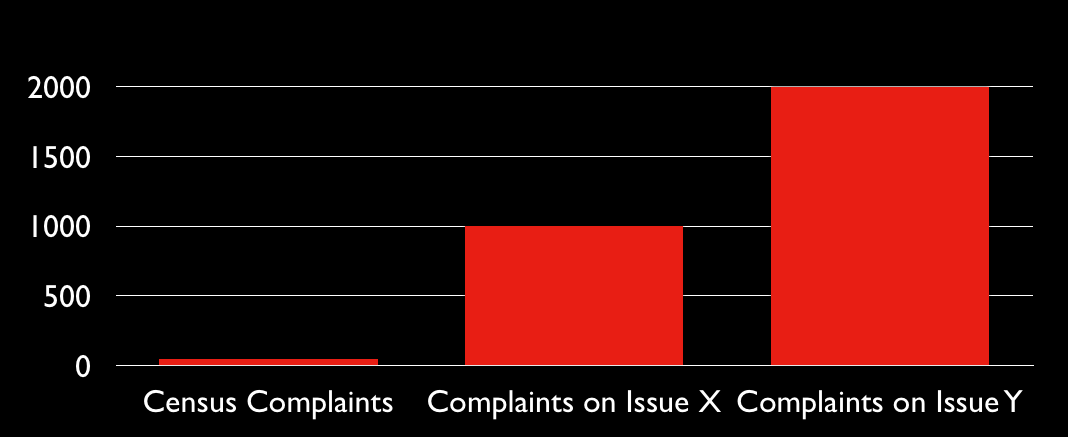
How is this? Well, I’d like to see the Liberals, Bloc and NDP ask each of their MPs to search and count every email and letter from constituents over the past 4 (or some sensible number) years that involved a complaint about the census.

My suspicion is that there are no more than 100 such letters (and, maybe even a lot less, like 10). You could then pick a couple of issues of your choice on which you have received 1000s of letters and which the conservatives have taken no action and put a simple chart up showing how they react to made up issues, but ignore real priorities of ordinary Canadians.

Of course, maybe there has been some massive, secret letter campaign targeted at Conservative only MPs but I think most Canadians will want to know how many letters the Minister and conservative MPs have actually received (sadly I don’t think you can FOI this) and most will suspect it is about as many as other MPs have.

Let’s show that better data leads to better decisions and that a little transparency can go a long way to exposing those who seek to mislead us. The minister says MPs get lots of letters – lets find out how many. And in comparison to what. Moreover, let’s show that those who seek to restrict the gathering of good information are generally those most inclined to use a lack of data to mislead the public and drive agendas that are not in the public interest. Canadians are sensible people, they want a smart government that makes good decisions. This, much more than secrecy, will rub them the wrong way.

The narrative isn’t as neat – but I suspect it could be turned into something more fun and more impactful.

Other fun articles…

Also, the universal condemnation of the Conservatives decision to end the mandatory long term census continues. My newest favourite is an article in the Globe where Derek Cook, Calgary’s the research and social planner at the City of Calgary and in the riding of the Prime Minister Harpers states that “If we don’t have that data at the neighbourhood level, we’re crippled.” Now, in addition to business groups, ngos, think tanks, cities, university researchers we are also seeing even more local and focused organizations such as those representing French Canadian communities, Inuit people and others starting to call for a reversal as well.

How to Engage with Social Media: An Example

The other week I wrote a blog post titled Canadian Governments: How to Waste millions online ($30M and Counting) in which I argued that OpenID should be the cornerstone of the government’s online identification system. The post generated a lot of online discussion, much of which was of very high quality and deeply thoughtful. On occasion, comments can enhance and even exceed a post’s initial value, and I’d argue this is one of these cases – something that is always a joy when it happens.

There was however, one comment that struck me as particularly important, not only because it was thoughtful, but because the type of comment is so rare. This is because it came from a government official. In this case, from Dave Nikolejsin, the CIO of the Government of British Columbia.

Everything about Mr. Nikolejsin’s comment deserves to be studied and understood by those in the public and private sector seeking to understand how to engage the public online. His comment is a perfect case of how and why governments should allow public servants to comment on blogs that tackle issues they are themselves addressing.

What makes Mr. Nikolejsin’s comment (which I’ve reprinted below) so effective? Let me break out the key components:

  1. It’s curious: Given the nature of my blog post a respondent could easily have gone on the offensive and merely countered claims they disagreed with. Instead Mr Nikolejsin remains open and curious about the ideas in the post and its claims. This makes readers and other commentators less likely to attack and more likely to engage and seek to understand.
  2. It seeks to return to first principles: The comment is effective because it is concise and it tackles the specific issues raised by the post. But part of what really makes it shine is how it seeks to identify first principles by talking about different approaches to online ID’s. Rather than ending up arguing about solutions, the post engages readers to identify what assumptions they may or may not have in common with one another. This won’t necessarily makes people more likely to agree, but they’ll end up debating the right thing (goals, assumptions) rather than the wrong thing (specific solutions).
  3. It links to further readings: Rather than try to explain everything in his response, the comment instead links to relevant work. This keeps the comment shorter and more readable, while also providing those who care about this issue (like me) with resources to learn more.
  4. It solicits feedback: “I really encourage you to take a look at the education link and tell me what you think.Frequently comments simply retort points in the original post they disagree with. This can reinforce the sense that the two parties are in opposition. Mr. Nikolejsin and I actually agree far more than we disagree: we both want a secure, cost effective, and user friendly online ID management system for government. By asking for feedback he implicitly recognizes this and is asking me to be a partner, not an antagonist.
  5. It is light: One thing about the web is that it is deeply human. Overly formal statements looks canned and cause people to tune out. This comment is intelligent and serious with its content, but remains light and human in its style. I get the sense a human wrote this, not a communications department. People like engaging with humans. They don’t like engaging with communication departments.
  6. Community Feedback: The comment has already sparked a number of responses which contain supportive thoughts, suggestions and questions, including some by those working in municipalities, as experts in the field and citizen users. It’s actually a pretty decent group of people there – the kind a government would want to engage.

In short, this is a comment that sought to engage. And I can tell you, it has been deeply, deeply successful. I know that some of what I wrote might have been difficult to read but after reading Mr. Nikolejsin’s comments, I’m much more likely to bend over backwards to help him out. Isn’t this what any government would want of its citizens?

Now, am I suggesting that governments should respond to every blog post out there? Definitely not. But there were a number of good comments on this post and the readership in terms of who was showing up makes commenting on a post likely worthwhile.

I’ve a number of thoughts on the comment that I hope to post shortly. But first, I wanted to repost the comment, which you can also read in the original post’s thread here.

Dave Nikolejsin <dave.nikolejsin@gov.bc.ca> (unregistered) wrote: Thanks for this post David – I think it’s excellent that this debate is happening, but I do need to set the record straight on what we here in BC are doing (and not doing).

First and foremost, you certainly got my attention with the title of your post! I was reading with interest to see who in Canada was wasting $30M – imagine my surprise when I saw it was me! Since I know that we’ve only spent about 1% of that so far I asked Ian what exactly it was he presented at the MISA conference you mentioned (Ian works for me). While we would certainly like someone to give us $30M, we are not sure where you got the idea we currently have such plans.

That said I would like to tell you what we are up to and really encourage the debate that your post started. I personally think that figuring out how we will get some sort of Identity layer on the Internet is one of the most important (and vexing) issues of our day. First, just to be clear, we have absolutely nothing against OpenID. I think it has a place in the solution set we need, but as others have noted we do have some issues using foreign authentication services to access government services here in BC simply because we have legislation against any personal info related to gov services crossing the border. I do like Jeff’s thinking about whom in Canada can/will issue OpenID’s here. It is worth thinking about a key difference we see emerging between us and the USA. In Canada it seems that Government’s will issue on line identity claims just like we issue the paper/plastic documents we all use to prove our Identities (driver’s licenses, birth certificates, passports, SIN’s, etc.). In the USA it seems that claims will be issued by the private sector (PayPal, Google, Equifax, banks, etc.). I’m not sure why this is, but perhaps it speaks to some combination of culture, role of government, trust, and the debacle that REALID has become.

Another issue I see with OpenID relates to the level of assurance you get with an OpenID. As you will know if you look at the pilots that are underway in US Gov, or look at what you can access with an OpenID right now, they are all pretty safe. In other words “good enough” assurance of who you are is ok, and if someone (either the OpenID site or the relying site) makes a mistake it’s no big deal. For much of what government does this is actually an acceptable level of assurance. We just need a “good enough” sense of who you are, and we need to know it’s the same person who was on the site before. However, we ALSO need to solve the MUCH harder problem of HIGH ASSURANCE on-line transactions. All Government’s want to put very high-value services on-line like allowing people access to their personal health information, their kids report cards, driver’s license renewals, even voting some day, and to do these things we have to REALLY be sure who’s on the other end of the Internet. In order to do that someone (we think government) needs to vouch (on-line) that you are really you. The key to our ability to do so is not technology, or picking one solution over the other, the key is the ID proofing experience that happens BEFORE the tech is applied. It’s worth noting that even the OpenID guys are starting to think about OpenID v.Next (http://self-issued.info/?p=256) because they agree with the assurance level limitation of the current implementation of OpenID. And OpenID v.Next will not be backward compatible with OpenID.

Think about it – why is the Driver’s License the best, most accepted form of ID in the “paper” world. It’s because they have the best ID proofing practices. They bring you to a counter, check your foundation documents (birth cert., Card Card, etc.), take your picture and digitally compare it to all the other pictures in the database to make sure you don’t have another DL under another name, etc. Here in BC we have a similar set of processes (minus the picture) under our Personal BCeID service (https://www.bceid.ca/register/personal/). We are now working on “claims enabling” BCeID and doing all the architecture and standards work necessary to make this work for our services. Take a look at this work here (http://www.cio.gov.bc.ca/cio/idim/index.page?).

I really encourage you to take a look at the education link and tell me what you think. Also, the standards package is getting very strong feedback from vendors and standards groups like the ICF, OIX, OASIS and Kantara folks. This is really early days and we are really trying to make sure we get it right – and spend the minimum by tracking to Internet standards and solutions wherever possible.

Sorry for the long post, but like I said – this is important stuff (at least to me!) Keep the fires burning!

Thanks – Dave.

Half victory in making BC local elections more transparent

Over the past few months the British Columbia government (my home province – or for my American friends – state) has had a taskforce looking at reforming local (municipal) election rules.

During the process I submitted a suggestion to the taskforce outlining why campaign finance data should be made available online and in machine readable format (ie. so you can open it in Microsoft Excel, or Google Docs, for example).

Yesterday the taskforce published their conclusions and… they kind of got it right.

At first blush, things look great… The press release and taskforce homepage list, as one of the core recommendations:

Establish a central role for Elections BC in enforcement of campaign finance rules and in making campaign finance disclosure statements electronically accessible

Looks promising… yes? Right. But note the actual report (which ironically, is only available in PDF, so I can’t link to the specific recommendations… sigh). The recommendation around disclosure reads:

Require campaign finance disclosure information to be published online
and made centrally accessible though Elections BC

and the explanatory text reads:

Many submissions suggested that 120 days is too long to wait for disclosure reports, and that the public should be able to access disclosure information sooner and more easily. Given the Task Force’s related recommendations on Elections BC’s role in overseeing local campaign finance rules, it is suggested that Elections BC act as a central repository of campaign finance disclosure statements. Standardizing disclosure statement forms is of practical importance if the statements are to be published online and centrally available, and would help members of the public, media and academia analyze the information. [my italics]

My take? That the spirit of the recommendation is for campaign finance data be machine readable – that you should be able to download, open, and play with it on your own computer. However, the literally reading of this text suggests that simple scanning account ledgers and sharing them as an image file or unstructured pdf might suffice.

This would be essentially doing the same thing that generally happens presently and so would not mark a step forward. Another equally bad outcome? That the information gets shared in a manner similar to the way federal MP campaign data is shared on Elections Canada website where it cannot be easily downloaded and you are only allowed to look at one candidates financial data at a time. (Elections Canada site is almost designed to prevent you from effectively analyzing campaign finance data).

So in short, the Taskforce members are to be congratulated as I think their intentions were bang on: they want the public to be able to access and analyze campaign finance data. But we will need to continue to monitor this issue carefully as the language is vague enough that the recommendation may not produce the desired outcome.

Canadian Governments: How to waste millions online ($30M and counting)

Back from DC and Toronto I’m feeling recharged and reinvigorated. The Gov 2.0 expo was fantastic, it was great to meet colleagues from around the world in person. The FCM AGM was equally exciting with a great turnout for our session on Government 2.0 and lots of engagement from the attendees.

So, now that I’m in a good mood, it’s only natural that I’m suddenly burning up about some awesomely poor decisions being made at the provincial level and that may also may be in the process of being made at the federal level.

Last year at the BC Chapter of the Municipal Information Systems Association conference I stumbled, by chance, into a session run by the British Columbia government about a single login system it was creating for government website. So I get that this sounds mundane but check this out: it would means that if you live in BC you’ll have a single login name and password when accessing any provincial government service. Convenient! Better still, the government was telling the municipalities that this system (still in development) could work for their websites too. So only one user name and password to access any government service in BC! It all sounds like $30 million (the number I think they quoted) well spent.

So what could be wrong with this…?

How about the fact that such a system already exists. For free.

Yes, OpenID, is a system that has been created to do just this. It’s free and licensed for use by anyone. Better still, it’s been adopted by a number of small institutions such as Google, Yahoo, AOL, PayPal, and Verisign and… none other than the US government which recently began a pilot adoption of it.

So let me ask you: Do you think the login system designed by the BC government is going to be more, or less secure that that an open source system that enjoys the support of Google, Yahoo, AOL, PayPal, Verisign and the US Government? Moreover, do we think that the security concerns these organizations have regarding their clients and citizens are less strict than those of the BC government?

I suspect not.

But that isn’t going to prevent us from sinking millions into a system that will be less secure and will costs millions more to sustain over the coming decades (since we’ll be the only ones using it… we’ll have to have uniquely trained people to sustain it!).

Of course, it gets worse. While the BC government is designing its own system, rumour has it that the Federal Government is looking into replacing Epass; it’s own aging website login system which, by the by, does not work with Firefox, a web browser used by only a quarter of all Canadians. Of course, I’m willing to bet almost anything that no one is even contemplating using OpenID. Instead, we will sink 10’s of millions of dollars (if not more…) into a system. Of course, what’s $100 million of taxpayer dollars…

Oh, and today’s my birthday! And despite the tone of this post I’m actually in a really good mood and have had a great time with friends, family and loved ones. And where will I be today…? At 30,000 ft flying to Ottawa for GovCamp Canada. Isn’t that appropriate? :)

Open Data: An Example of the Long Tail of Public Policy at Work

VancouverGraffiti_AnalysisAs many readers know, Vancouver passed what has locally been termed the Open3 motion a year ago and has had a open data portal up and running for several months.

Around the world much of the focus of open data initiatives have focused on the development of applications like Vancouver’s Vantrash, Washington DC’s Stumble Safely or Toronto’s Childcare locator. But the other use of data portals is to actually better understand and analyze phenomena in a city – all of which can potentially lead to a broader diversity of perspectives, better public policy and a more informed public and/or decision makers.

I was thus pleased to find out about another example of what I’ve been calling the Long Tail of Public Policy when I received an email from Victor Ngo, a student at the University of British Columbia who just completed his 2nd year in the Human Geography program with an Urban Studies focus (He’s also a co-op student looking for a summer job – nudge to the City of Vancouver).

It turns out that last month, he and two classmates did a project on graffiti occurrence and its relationship to land use, crime rates, and socio-economic variables. As Victor shared with me:

It was a group project I did with two other members in March/April. It was for an introductory GIS class and given our knowledge, our analysis was certainly not as robust and refined as it could have been. But having been responsible for GIS analysis part of the project, I’m proud of what we accomplished.

The “Graffiti sites” shapefile was very instrumental to my project. I’m a big fan of the site and I’ll be using it more in the future as I continue my studies.

So here we have University students in Vancouver using real city data to work on projects that could provide some insights, all while learning. This is another small example of why open data matters. This is the future of public policy development. Today Victor may be a student, less certain about the quality of his work (don’t underestimate yourself, Victor) but tomorrow he could be working for government, a think tank, a consulting firm, an insurance company or a citizen advocacy group. But wherever he is, the open data portal will be a resource he will want to turn to.

With Victor’s permission I’ve uploaded his report, Graffiti in the Urban Everyday – Comparing Graffiti Occurrence with Crime Rates, Land Use, and Socio-Economic Indicators in Vancouver, to my site so anyone can download it. Victor has said he’d love to get people’s feedback on it.

And what was the main drawback of using the open data? There wasn’t enough of it.

…one thing I would have liked was better crime statistics, in particular, the data for the actual location of crime occurrence. It would have certainly made our analysis more refined. The weekly Crime Maps that the VPD publishes is an example of what I mean:

http://vancouver.ca/police/CrimeMaps/index.htm

You’re able to see the actual location where the crime was committed. We had to tabulate data from summary tables found at:

http://vancouver.ca/police/organization/planning-research-audit/neighbourhood-statistics.html

To translate: essentially the city releases this information in a non-machine-readable format, meaning that citizens, public servants at other levels of government and (I’m willing to wager) City of Vancouver public servants outside the police department have to recreate the data in a digital format. What a colossal waste of time and energy. Why not just share the data in a structured digital way? The city already makes it public, why not make it useful as well? This is what Washington DC (search crime) and San Francisco have done.

I hope that more apps get created in Vancouver, but as a public policy geek, I’m also hoping that more reports like these (and the one Bing Thom architects published on the future of Vancouver also using data from the open data catalog) get published. Ultimately, more people learning, thinking, writing and seeking solutions to our challenges will create a smarter, more vibrant and more successful city. Isn’t that what you’d want your city government (or any government, really…) to do?

Banned Blogs

So I’m fed up. I’m tired of hearing about fantastic blogs written by fantastic people that are banned by different federal departments of the Canadian public service.

Banned you say? Isn’t that a little dramatic?

No! I mean banned.

The IT departments of several federal governments block certain websites that are deemed to have inappropriate or non-work related content. Typically these include sites like Facebook, Gmail and of course, various porn sites (a list of well known mainstream sites that are blocked can be found here).

I’ve known for a while that my site – eaves.ca – is blocked by several departments and it hasn’t bothered me (I’ve always felt that blocking someone increase people’s interest in them), But as whispers about the number of blogs blocked grows, I find the practice puzzling and disturbing. These are not casual blogs. One might think this is limited to casual or personel blogs but many of the blogs I hear about are on public policy or the public service. They may even contain interesting insights that could help public servants. They are not sites that contain pornographic material, games or other content that could be construed as leisure (as enjoyable as I know reading my blog is…).

So, in an effort to get a better grasp of the scope and depth of the problem I’d like your help to put together a list. On eaves.ca I’ve created a new page – entitled “Banned Blogs” that lists blogs and the Canadian Federal Government Ministries that ban them. If you are a public servant and you know of a blog that is blocked from your computer please send me a note. If you know a public servant, ask them to check their favourite blogs. If you know of a site that is blocked you can send me an email, at tweet, or an anonymous comment on this blog, I’ll add it to the list. It would be fantastic to get a sense of who is blocked and by which departments. Maybe we’ll even knock some sense into some IT policies.

Maybe.

(Post script: Douglas B. has some great suggestions about how to deal with blocked sites and lists some of the ancient policies that could help public servants fight this trend).

Digital Economy Strategy: Why we risk asking the wrong question

Far better an approximate answer to the right question, than the exact answer to the wrong question, which can always be made precise….

John Tukey

I’ve always admired Paul Erdos, the wandering mathematician who I first learned about by reading his obituary in the Economist back in 1996 (and later learned was a friend and frequent house guest of my grandfather’s). What I remember best about that economist obituary was how one of his students talking about his genius not lying in his capacity to produce mathematical proofs, but in his ability to ask the right question, which set events in motion so that the proof could be found at all.

It is with that idea in mind that I turn to the Canada 3.0 conference here in Stratford Ontario where I’ve been invited to take part in a meeting with industry types and policy leaders to talk about what Canada must do to become a leading digital nation by 2017. The intent is to build on last year’s Stratford Declaration and develop an action plan.

So what do I think we need to do? First, I think we need to ask the right question.

I think we need to stop talking about a digital as the future.

This whole conversation isn’t about being a digital country. It isn’t about a future where everything is going to be digitized. That isn’t the challenge. It is already happening. It’s done. It’s over. Canada is already well on its way to becoming digital. Anyone who uses MS Word to write a document is digital. I’ve been submitting papers using a word processor since high school (this comes from a place of privilege, something I’ll loop back to). Worse, talking about digital means talking about technology like servers or standards or business models like Bell, or Google or Music Producers and all the other things that don’t matter.

The dirty truth is that Canada’s digital future isn’t about digital. What is special isn’t that everything is being digitized. It’s that everything is being connected. The web isn’t interesting because you can read it on a computer screen. It is special because of hyperlinks – that information is connected to other information (again, something the newspaper have yet to figure out). So this is a conversation about connectivity. It is about the policy and legal structure needed when me, you, information, and places, when everything, everywhere is connected to everything else, everywhere persistently. That’s the big change.

So if a digital economy strategy is really about a networked economy strategy, and what makes a networked economy work better is stronger and more effective connectivity, then the challenge isn’t about what happens when something shifts from physical to digital. It is about how we promote the connectivity of everything to everything in a fair manner. How do we make ourselves the most networked country, in the physical, legally and policy terms. This is the challenge.

Viewed in this frame. We do indeed have some serious challenges and are already far behind many others when it comes to connectivity if we want to be a global leader by 2017. So what are the key issues limiting or preventing connectivity and what are the consequences of a networked economy we need to be worried about? How about:

  • Expensive and poor broadband and mobile access in (in both remote and urban communities)
  • Throttling and threats to Net Neutrality
  • Using copyright as a vehicle to limit the connectivity of information (ACTA) or threaten peoples right to connect
  • Using copyright as a vehicle to protect business models built on limiting peoples capacity to connect to innovations and ideas
  • Government’s that don’t connect their employees to one another and the public
  • It’s also about connective rights. Individual rights to limit connectivity to privacy, and right to freely associate and disassociate

So what are the three things we need to start thinking about immediately?

If connectivity is the source of innovation, wealth and prosperity then how do we ensure that Canadians are the most connected citizens in the world?

1)    a net neutral broadband and mobile market place where the costs of access are the lowest in the world.

That is would be a source of enormous competitive advantage and a critical stepping stone to ensuring access to education and an innovation fueled economy. Sadly, we have work to do. Take for example, the fact that we have the worst cell phone penetration rates in the developed world. This at a time when cellphone internet access is overtaking desktop internet access.

But more importantly, I was lucky to be able to use a word processor 20 years ago. Today, not having access to the internet is tantamount to preventing a child from being able to go to the library, or worse, preventing them from learning to read. Affordable access is not a rural or urban issue. It’s a rights and basic education issue.

Equally important is that the network remain a neutral platform upon which anyone can innovate. The country that allows its networks to grant (or sell) certain companies or individuals special privileges is one that one that will quickly fall behind the innovation curve. New companies and business models inevitable displace established players. If those established players are allowed to snuff out new ideas before they mature, then there will be no new players. No innovation. No new jobs. No competitive advantage.

2)    A copyright regime that enables the distribution of ideas and the creation of new culture.

Here I am in Stratford, Ontario, home of the Stratford Shakespeare Festival, one of the biggest open source festivals in the country. Every year the city celebrates plays that, because they are in the public domain, can be remixed, re-interpreted, and used without anyone’s permission to create new derivative cultural works (as well as bring joy and economic prosperity to untold people). A copyright regime that overly impedes the connectivity of works to one another (no fair use!) or the connectivity of people to ideas is one that will limit innovation in Canada.

A networked economy is not just one that connects people to a network. That is a broadcast economy. A networked economy is one that allows people to connect works together to create new works. Copyright should protect creators of content, but it should do so to benefit the creators, not support vast industries that market, sell, and repackage these works long after the original creator is dead. As Lawrence Lessig so eloquently put it:

  • Creativity and innovation always builds on the past.
  • The past always tries to control the creativity that builds upon it.
  • Free societies enable the future by limiting this power of the past.
  • Ours is less and less a free society.

A networked economy limits the past to enable the future.

3)    A government that uses a networked approach to creating a strategy for a connected economy.

An agrarian economy was managed using papyrus, an industrial economy was managed via printing press, typewriters and carbon copy paper. A digital economy strategy and managing policies were created on Microsoft Word and with email. A Network Economy can and only will be successfully managed and regulated when those trying to regulate it stop using siloed, industrial modes of production, and instead start thinking and organizing like a network. Not to ring an old bell, but today, that means drafting the policy, from beginning to end, on GCPEDIA, the only platform where federal public servants can actually organize in a network.

Managing an industrial economy would have been impossible using hand written papyrus, not just because the tools could not have handled the volume and complexity of the work but because the underlying forms of thinking and organizing that are shaped by that tool are so different from how an industrial economy works.

I’m going to predict it right now. Until a digital economy strategy is drafted using online but internally-connected tools like wikis, it will fail. I say this not because the people working on it will not be intelligent, but because they won’t be thinking in a connected way. It will be like horse and buggy users trying to devise what a policy framework for cars should look like. It will suck and terrible, terrible decisions will be made.

In summary, these are the three things I think the federal government needs to be focused on if we are going to create a digital economy strategy that positions us to be leaders by 2017. This is the infrastructure that needs to be in place to ensure that we maximize our capacity to connect each other and our work and reap the benefits of that network.