Tag Archives: government

Withholding FOI requests: In the Private Sector, that's fraud

It was with enormous interest I read on the Globe’s website about a conservative Ministerial Aide “unrealeasing” a document requested by The Canadian Press through an Access to Information request (The Access to Information Act ensures that citizens can request information about the government’s activities).

A federal cabinet minister’s aide killed the release of a sensitive report requested under freedom-of-information in a case eerily similar to a notorious incident in the sponsorship scandal.

What I find fascinating is the neither the minister (now at Natural Resources Canada) or the aide have been asked to resign.

Let’s be abundantly clear, if this were the private sector and a CEO was caught deliberately withholding material information from a shareholder… that would constitute either fraud and/or a violation of whichever provincial securities laws he/she was bound by. Moreover, such a crime that could carry with it a prison sentence.

And yet here, in the most cavalier manner, one of the most basic trusts that ensure accountability in our system is violated with almost no repercussions.

The story does have its dark humour (and a embarrassingly feeble attempt at an excuse):

Mr. Paradis’s current communications director said Mr. Togneri’s intervention was to suggest the Access to Information section offer fewer pages to the requester without charge rather than the entire 137 pages for a fee of $27.40, which had already been paid.

“He went through and thought that a huge section of a very big report wasn’t relevant and that you should be given the option of paying to get it or get the (smaller) chapter” without charge, Margaux Stastny said in an interview. “No one can overrule Access officers.”

The options were never provided to the requester, however. Instead, the department simply sent the censored report and refunded the fee.

Yes, I too am always comforted to know that my government is thinking of me and trying to save me a few pennies by ensuring I don’t see information they know I need not waste my time on.

I, of course, have another solution for how the photo copying money could be saved. What about emailing a digital copy of the report? Of course Access to Information requests (called ATIP or FOI for those in the US) are always handed out in paper, just to ensure you can’t do anything too useful with them… oh and to help ensure that they are late in delivering them.

So while, in this case, the Minister’s staff has committed an enormous gaffe – one that should have (and yet probably won’t) political implications, it is also a window into a broader problem:

FOI = broken.

I belong to a generation that gets information in .3ms (length of a google search) if you take 80 days to get my request to me (and edit it/censor it), you are a bug I will route around. This isn’t just the end of accountability in government, this is the end of the relevancy of government.

The Most Dangerous Website in Ottawa

What is the more dangerous website in Ottawa? Here’s a secret. It isn’t a x-rated site, or loaded with tips and tricks on how to make weapons or break the law. It isn’t – contrary to what some politician might feel – even a newswebsite.

No, the most dangerous website in Ottawa is much, much, more boring than that.

The most dangerous website is actually a small site run by the Federal Accountability Initiative for Reform or FAIR (see you are yawning already).

But one simple page on the site, entitled Some Canadian Whistleblowers, is potentially the most damaging website in Ottawa. In one swoop the site is a devastating critique of a Conservative Government (and Liberal Government before it) that ran on accountability but that crushes those who seek to advocate for it, it is damning appraisal of a public service that is willing to turn on its own and even wreck the careers of public servants and citizens who try to prevent the defrauding of Canadian taxpayers or ensure the integrity of our government, and it is a cautionary tale to public servants who may be tempted – by their ethics and good judgment – to speak out when they see something is deeply wrong about how the country is being run.

Consider this, of the 29 Whistleblowers highlighted on the website:

  • one public works employee and a group of five RCMP employees who spoke out together have the appearances of a happy ending. (The RCMP employees were publicly commended by a parliamentary committee and the public works official ran for office).
  • 7 were attacked by the public service but ultimately have managed to keep their jobs but their careers have been negatively impacted.
  • 15 more found themselves turfed out of their jobs, often by the very authorities that should have protected them.
  • The final person – Richard Colvin – still has his job, but the Conservative Government has effectively muzzled him by refusing to pay his legal fees (as he is entitled).

One might suspect that these stories have political angles to them, like that of Dr. John O’Connor, an Alberta doctor, who work uncovered unusually high rates of cancers among the residents of Fort Chipewyan, in the Athabasca oil patch. As the site details:

His findings contributed to concerns that oil extraction operations may be contaminating the environment with carcinogenic chemicals.

In what was perceived as an attempt to muzzle him, Health Canada doctors lodged four complaints against O’Connor with his professional body – charges which could have resulted in the loss of his licence. Doctors were alarmed by this incident, since such reports from doctors in the field have been vital to the detection of new diseases such as AIDS. Consequently, in 2007 the Canadian Medical Association passed a resolution (#103) calling for whistleblower protection for doctors – apparently to protect them from Health Canada.

But these are actually more isolated incidents. The real lesson from the website is that your story doesn’t need to be political in nature at all – all you really need to do ruin your career is speak out. Indeed, from the stories on the FAIR website, it is easy to see that if you are a public servant and you note illegal or unethical activities to your supervisors you may seriously damage your career. Should those supervisors ignore you and you opt to go public with those allegations – your career will be literally or effectively over (regardless of whether or not those accusations end up being true).

This is why this is the most dangerous website in Ottawa. Politicians (particularly Conservative politicians) don’t want you to see it, the Public Service doesn’t want to have to explain it, and Canadian citizens and public servants don’t want to end up on it.

Is this the future of accountability in Ottawa?

BC Government's blog on renewing the Water Act

On Friday the Government of British Columbia announced that it was beginning the process to renew the province’s water act. This is, in of itself, important and good.

More interesting however, is that the government has chosen to launch a blog to discuss ideas, prospective changes and generally engage the public on water issues.

It is, of course, early days. I’m not one to jump up and proclaim instant success nor pick apart the effort and find its faults after a single post. What I will say is that this type of experimentation in public engagement and policy development is long overdue. It is exciting to see a major government in Canada tentatively begin to explore how online technology and social media might enhance policy development as more (hopefully) than just a communication exercise. Even if it does not radically alter the process – or even if it does not go well – at least this government is experimenting and beginning learn what will work and what won’t. I hope and suspect other jurisdictions will be watching closely.

If you are such a government-type and are wondering what it is about the site that gives me hope… let me briefly list three things:

  1. Site design: Unlike most government websites which OVERWHELM you with information, menus and links, this one is (relatively) simple.
  2. Social media: A sidebar with recent comments! A tag cloud! RSS feed! Things that most blogs and website have had for years and yet… seem to elude government websites.
  3. An effective platform (bonus points for being open source): This may be the first time I’ve seen an official government website in Canada use wordpress (which, by the by, is free to download). When running a blog wordpress is certainly my choice (quite literally) and has been a godsend. The choice of wordpress also explains a lot of why point #2 is possible.

So… promising start. Now, what would I like to see happen around the government’s blog?

Well, if you want to engage the public why not give them data that you are using internally? It would be great to get recent and historic flow rate data from major rivers in BC. And what about water consumption rates by industry/sector but also perhaps by region and by city and dare we ask… by neighborhood? It would also be interesting to share the assumptions about future growth so that professors, thinktanks and those who care deeply about water issues could challenge and test them. Of course the government could share all this data on its upcoming Apps For Climate Change data portal (more on that soon). If we were really lucky, some web superstar like this guy, would create some cool visualization to help the public understand what is happening to water around the province and what the future holds.

In short, having a blog is a fantastic first start, but lets use it to share information so that citizens can do their own analysis using their own assumptions with the same data sets the government is using. That would certainly elevate the quality of the discussion on the site.

All in all, the potential for a site like this is significant. I hope the water geeks show up in force and are able to engage in a helpful manner.

Upcoming talk: Toronto Innovation Showcase

Just a little FYI to let people know I’m going to be in Toronto on Monday, November 2nd for the City of Toronto’s Innovation Showcase.

I’ll be doing a panel Open Government with Maryantonett Flumian (President of the Institute On Governance, I remember meeting her when she was Deputy Minister of Service Canada), Nick Vitalari (Executive Vice President at nGenera), and Peter Corbett (CEO of iStrategyLabs – which runs the Apps for Democracy Competitions for Washington DC).

The Showcase will be running November 2nd and 3rd and our panel will be on Monday the 2nd from 10:15am until noon in the City Council chambers. Registration is free for those who’d like to come and for those interested but not in Toronto, you will be able to watch a live webcast of the event online from their website. You’ll also be able to follow the event on twitter hashtags #TOshowcase and #opendataTO

The goal of the showcase is to provide:

“a venue for you to come and meet with your colleagues to discuss these questions, hear their success stories, share experiences about opportunities and challenges in the public sector using social media, propose suggestions, exchange information on IT and trends, create connections, knowledge, tools and policies that address the increased demand by citizens for better public service, transparency, civic engagement and democratic empowerment.”

Should be fun – hope to catch you there and to have something fun to blog about after it’s over.

Spark Interview on VanTrash – The Open Source Garbage Reminder Service

A couple of weeks ago I was interviewed by the CBC’s Nora Young for her show Spark:  a weekly audio blog of smart and unexpected trendwatching about the way technology affects our lives and world.

The interview (which was fun!) dives a little deeper into some of the cool ways citizens – in working to make their lives better – can make cool things happen (and improve their community) when government’s make their data freely available. The interview focuses mostly on VanTrash, the free garbage reminder service created by Luke Closs and Kevin Jones based on a blog post I wrote. It’s been getting a lot of positive feedback and is helping make the lives of Vancouverites just a little less hectic.

You can read more about the episode here and listen to it on CBC radio at 1:05 local time in most parts of Canada and 4:05 on the west coast.

You can download a podcast of the Spark episode here or listen to it on the web here.

If you live in Vancouver – check out VanTrash.ca and sign up! (or sign your parents or neighbour up!) Never forget to take the garbage out again. It works a whole lot better than this approach my friends mom uses for her:

Van trash reminder

Open Data – USA vs. Canada

open-data-300x224When it comes to Open Data in Canada and the United States, things appear to be similar. Both countries have several municipalities with Open Data portals: Washington, D.C., San Francisco, and now New York City in the US, Vancouver and Nanaimo in Canada with Toronto, Edmonton, Calgary and Ottawa thinking about or initiating plans.

But the similarities end there. In particular there is a real, yawning gap at the federal level. America has data.gov but here in Canada there is no movement on the Open Data front. There are some open data sets, but nothing comprehensive, and nothing that follows is dedicated to following the three laws of open data. No data.gc.ca in the works. Not even a discussion. Why is that?

As esoteric as it may sound, I believe the root of the issues lies in the country’s differing political philosophies. Let me explain.

It is important to remember that the United States was founded on the notion of popular sovereignty. As such its sovereignty lies with the people, or as Wikipedia nicely puts it:

The American Revolution marked a departure in the concept of popular sovereignty as it had been discussed and employed in the European historical context. With their Revolution, Americans substituted the sovereignty in the person of the English king, George III, with a collective sovereign—composed of the people. Henceforth, American revolutionaries by and large agreed and were committed to the principle that governments were legitimate only if they rested on popular sovereignty – that is, the sovereignty of the people. (italics are mine)

Thus data created by the US government is, quite literally, the people’s data. Yes, nothing legally prevents the US government from charging for information and data but the country’s organizing philosophy empowers citizens to stand up and say – this is our data, we’d like it please. In the United States the burden is on the government to explain why it is withholding that which the people own (a tradition that admittedly is hardly perfect as anyone alive from the years 2000-2008 will attest to).  But don’t underestimate the power of this norm. Its manifestations are everywhere, such as in the legal requirement that any document created by the United States government be published in the public domain (e.g. it cannot have any copyright restrictions placed on it) or in America’s vastly superior Freedom of Information laws.

This is very different notion of sovereignty than exists in Canada. This country never deviated from the European context described above. Sovereignty in Canada does not lie with the people, indeed, it resides in King George the III’s descendant, the present day Queen of England. The government’s data isn’t your, mine, or “our” data. It’s hers. Which means it is at her discretion, or more specifically, the discretion of her government servants, to decide when and if it should be shared. This is the (radically different) context under which our government (both the political and public service), and its expectations around disclosure, have evolved. As an example, note that government documents in Canada are not public domain, they are published under a Crown Copyright that, while less restrictive than copyright, nonetheless constrains reuse (no satire allowed!) and is a constant reminder of the fact that Canadian citizens don’t own what their tax dollars create. The Queen does.

The second reason why open data has a harder time taking root in Canada is because of the structure of our government. In America, new projects are easier to kick start because the executive welds greater control over the public service. The Open Data initiative that started in Washington, D.C. spread quickly to the White House because its champion and mastermind, the District’s of Columbia’s CTO Vivek Kundra, was appointed Federal CIO by President Obama. Yes, Open Data tapped into an instinctual reflex to disclose that (I believe) is stronger down south than here, but it was executed because America’s executive branch is able to appoint officials much deeper into government (for those who care, in Canada Deputy Ministers are often appointed, but in the United States appointments go much deeper, down into the Assistant Deputy and even into the Director General level). Both systems have merits, and this is not a critic of Canada’s approach, simply an observation. However, it does mean that a new priority, like open data, can be acted upon quickly and decisively in the US. (For more on these difference I recommend reading John Ibbitson’s book Open & Shut).

These difference have several powerful implications for open data in Canada.

As a first principle, if Canadians care about open data we will need to begin fostering norms in our government, among ourselves, and in our politicians, that support the idea that what our government creates (especially in terms of research and data) is ours and that we should not only have unfettered access to it, but the right to analyze and repurpose it. The point here isn’t just that this is a right, but that open data enhances democracy, increases participation and civic engagement and strengthens our economy. Enhancing this norm is a significant national challenge, one that will take years to succeed. But instilling it into the culture of our public service, our civic discourse and our political process is essential. In the end, we have to ask ourselves – in a way our American counterparts aren’t likely to (but need to) – do we want an open country?

This means that secondly, Canadians are going to have to engage in a level of education of – particularly senior – public servants on open data that is much broader and more comprehensive than our American counterparts had to. In the US, an executive fiat and appointment has so far smoothed the implementation of open data solutions. That will likely not work here. We have many, many, many allies in the public service who believe in open data (and who understand it is integral to public service sector renewal). The key is to spread that knowledge and support upwards, to educate senior decision-makers, especially those at the DG, ADM and DM level to whom both the technology and concept is essentially foreign. It is critical that these decision-makers become comfortable with and understand the benefits of open data quickly. If not we are unlikely to keep pace with (or even follow) our American counterparts, something, I believe is essential for our government and economy.

Second, Canadians are going to have to mobilize to push for open data as a political issue. Even if senior public servants get comfortable with the idea, it is unlikely there will be action unless politicians understand that Canadians want both greater transparency and the opportunity to build new services and applications on government data.

(I’d also argue that another reason why Open Data has taken root in the US more quickly than here is the nature of its economy. As a country that thrives on services and high tech, open data is the basic ingredient that helps drive growth and innovation. Consequently, there is increasing corporate support for open data. Canada, in contrast, with its emphasis on natural resources, does not have a corporate culture that recognizes these benefits as readily.)

Emergent Systems in Government: Let's put the horse before the cart

Yesterday Paul McDowall, Knowledge Management Advisor at the Government’s School of the Public Service and chairperson of the Interdepartmental Knowledge Management Forum, wrote the following comment in response to a blog post from several months ago entitled “How GCPEDIA will save the public service.”

I’ve posted his comment – feel free to read it or skip it and go straight to my analysis below. In summary, what makes McDowall’s comments interesting isn’t just the argument (or its reactionary nature) but the underlying perspective/assumptions that drives it. It serves as a wonderful example of the tension between how the traditional hierarchical nature of the public service and some evolving emergent models that challenging this approach.

So first, McDowall:

Will GCPEDIA save the public service, or capture all the tacit knowledge that will walk out the door? No, of course not! To suggest otherwise is, frankly, naive hyperbole.

As great and as promising as GCPEDIA and other Web 2.0 tools are, tools will never save the public service. People are the public service and only people have the capacity to save the public service, and it will take a whole lot more to improve the weak areas of the public service than a tool. Things like leadership play a pretty important role in organizational effectiveness. There are many good Organizational Excellence models (I have researched this area) and they all include people and leadership as two elements, but funny enough, tools aren’t included. Why? Because it is not so much a tool issue as it is a craftsman issue.

With respect to your comment about tacit knowledge and social capital (not the same things by the way), I think it may be helfpul to brush up on what tacit knowledge is, and what Knowledge Management is.

It is unquestionably true that the public service continues to face a potential impact from demographic changes that are both extremely significant and yet unquantified. It is also unquestionably true that most public service organizations haven’t truly understood or addressed these potential impacts, to say nothing of the potential of improving their effectiness right NOW from better Knowledge Management (productivity, innovation, etc).

These issues need to be addressed by public service leaders in an intelligent and thoughtful manner. Tools can and certainly should help but only when wielded by craftsmen and women. For too long vendors have made grandiose and unrealizable promises about their ‘solutions’. I thought we had learned our lessons from all that experience.
Let’s not get the cart before the horse, shall we?

Paul McDowall
Knowledge Management Advisor and chairperson of the Interdepartmental Knowledge Management Forum

McDowall’s main concern appears to be that GCPEDIA doesn’t have a clear purpose and, more importantly, doesn’t serve a specific leadership objective. (If you are wondering how I gleaned that from the above, well, I cheated, I called McDowall to ask him more about his comment since the nature of his concern wasn’t clear to me). For those used to an era where IT projects were planned out from the beginning, everything was figured out in advance, and the needs of the leadership were the paramount priority, GCPEDIA would be disconcerting. Indeed, the very idea of unleashing people willy-nilly on a system would be an anathema. In short, when McDowall says, don’t put the horse before the cart, what he’s saying is, “you’ve rolled out a tool, and you don’t even know what you are going to use it for!”

This would appear to be rational concern. Except, many of the rules that underlay this type of thinking are disappearing. Indeed, had this type of thinking been adhered to, the web would not have developed.

First, The economics have changed. There was a time when IT projects necessarily costed tens of millions of dollars.  But GCPEDIA was built on a (free) open source platform using a handful of internal FTEs (making McDowell’s comments about vendors even more confusing). Indeed GCPEDIA has cost the public service virtually nothing to create. One invests in planning so as to avoid expensive or ineffective deployments. But if the costs of deployment are virtually zero and failure really isn’t that traumatic then… why waste time and years planning? Release, test, and adapt (or kill the project).

Second, with projects like this become cheap to deploy another important shift takes place. Users – not their bosses or a distant IT overlord – decide a) if they want to participate and b) co-develop and decide what is useful. This has powerful implications. It means that you had better serve a real (not perceived or mandated) need, and that, if successful, you’d better be prepared to evolve quickly. This, interestingly, is how that usefully little tool called the World Wide Web evolved. Read the original proposal to create the World Wide Web. IT departments of the world didn’t all collectively and suddenly decide that people should be made to use the web. No! It grew organically responding to demand. In addition, there is very little in it that talks about how we use the web today, users of the web (us!) have helped it evolve so that it serves us more effectively.

This is probably the biggest disconnect between McDowell and myself. He believes GCPEDIA is problematic (or at least won’t do the things I think it will do) because it doesn’t serve the leadership. I think it will work because it does something much better, it serves actual users – public servants (and thus, contrary to his argument, is very much about people). This includes, critically, capturing tacit knowledge and converting it into formal – HTML encoded – knowledge that helps build social capital (I do, actually, know the difference between the two).

Indeed, the last thing we need is a more leadership oriented public service, what we need is an employee centric public service. One that enables those who are actually doing the work to communicate, collaborate and work, more effectively. In this regard, I think GCPEDIA is demonstrating that it is effective (although it is still is very early days) with logarithmic growth, 8000+ users and 200 more signing up every week (all with virtually no promotional budget). Clearly some public servants are finding it to be at worst interesting, and at best, deeply enabling.

The Three Laws of Open Government Data

Yesterday, at the Right To Know Week panel discussion – Conference for Parliamentarians: Transparency in the Digital Era – organized by the Office of the Information Commissioner I shared three laws for Open Government Data that I’d devised on the flight from Vancouver.

The Three Laws of Open Government Data:

  1. If it can’t be spidered or indexed, it doesn’t exist
  2. If it isn’t available in open and machine readable format, it can’t engage
  3. If a legal framework doesn’t allow it to be repurposed, it doesn’t empower

To explain, (1) basically means: Can I find it? If Google (and/or other search engines) can’t find it, it essentially doesn’t exist for most citizens. So you’d better ensure that you are optimized to be crawled by all sorts of search engine spiders.

After I’ve found it, (2) notes that, to be useful, I need to be able to play with the data. Consequently, I need to be able to pull or download it in a useful format (e.g. an API, subscription feed, or a documented file). Citizens need data in a form that lets them mash it up with Google Maps or other data sets, or analyze in Excel. This is essentially the difference between VanMaps (look, but don’t play) and the Vancouver Data Portal, (look, take and play!). Citizens who can’t play with information are citizens who are disengaged/marginalized from the discussion.

Finally, even if I can find it and play with it, (3) highlights that I need a legal framework that allows me to share what I’ve created, to mobilize other citizens, provide a new service or just point out an interesting fact. This is the difference between Canada’s House of Parliament’s information (which, due to crown copyright, you can take, play with, but don’t you dare share or re-publish) and say, Whitehouse.gov which “pursuant to federal law, government-produced materials appearing on this site are not copyright protected.”

Find, Play and Share. That’s want we want.

Of course, a brief scan of the internet has revealed that others have also been thinking about this as well. There is this excellent 8 Principle of Open Government Data that are more detailed, and admittedly better, especially for a CIO level and lower conversation.  But for talking to politicians (or Deputy Ministers or CEOs), like those in attendance during yesterday’s panel or, later that afternoon, the Speaker of the House, I found the simplicity of three resonated more strongly; it is a simpler list they can remember and demand.

Today: "right to know" panel for parliamentarians

Today from 10am-12am EST I’ll be a panelist for Conference for Parliamentarians: Transparency in the Digital Era a panel convened by the Office of the Information Commissioner as part of Right to Know Week. Apparently the Canadian School of Public Service will provide access to this conference as part of its Armchair Discussions (www.righttoknow.ca).

More on the panel:

This conference aims to engage Parliamentarians in a debate and reflection on the new paradigm that the digital world has introduced for the right to know. Greater transparency in the digital era requires more than sound information management and the use of state-of-the-art information technology. It calls for a fundamental change of attitudes from disclosing information on a need-to-know basis to managing information with the presumption of disclosure as the default mode. How can public institutions trigger and accelerate this change of attitudes for the benefit of Canadians?

For those who are interested you can see my slides (sans audio, I’m afraid) below.

Mapping Government 2.0 against the Hype Curve

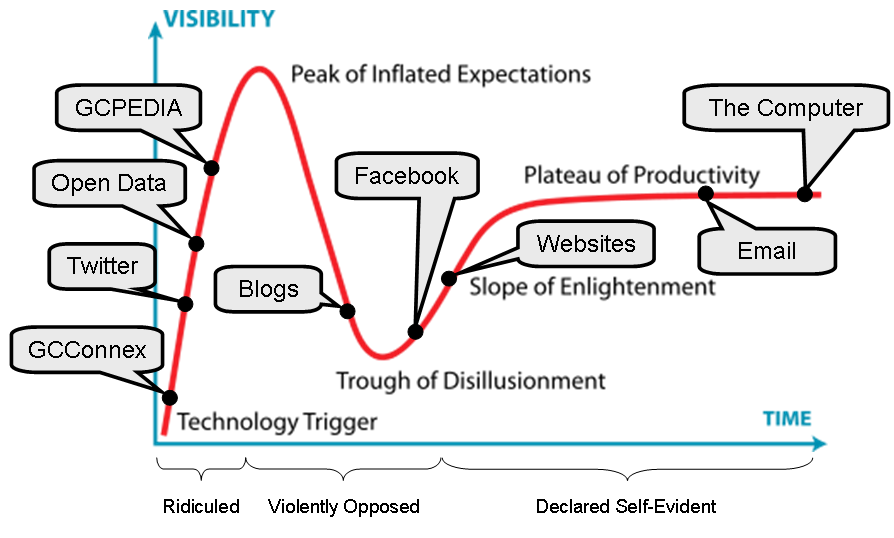
Last week Andrea DiMaio wrote an interesting post on how Government 2.0 may be approaching the peak of the hype cycle. I’d never seen the hype cycle before and it looked fun, so I thought it might be interesting to try to map where I believe some current Canadian government 2.0 projects, a few older technologies, and a few web 2.0 technologies in general, are against this chart from a government perspective.

My suspicion is that we haven’t even begun to dip into the Trough of Disillusionment with most true Web 2.0 government projects (GCPEDIA & GCConnex). However, I think governments have overcome their paranoia about facebook, but are still very wary… that said I’ve noticed some government ministries have started to use facebook as a communication tool with the public. Blogs however (which are perfectly okay for public servants to create internally) are still viewed with suspicion – internally they are almost never used. But then, heck, given the cluttered nature of most government website (and the fact that finding info is hard), I think it is clear that we are still working our way up the “Slope of Enlightenment” on this web 1.0 technology.

Gov 20 hype curve 3

Those who’ve seen me speak know I much I love Arthur Schopenhauer‘s three stages of truth:

“All truth passes through three stages. First, it is ridiculed. Second, it is violently opposed. Third, it is accepted as being self-evident.”

So I’ve also included how I think the three stages map against this chart too.

So in sum… in  my view there is good news for Government 2.0 projects – visibility is still increasing. Unfortunately there is also some bad news: prepare for increased violent opposition…