Tag Archives: mozilla

Remixing Angie Byron to create the next Million Mozillians

As I’ve noted in some previous posts, Angie Byron gave a presentation on getting more women in open source. My feeling is that the systems, culture and tools we put in place to attract more women into open source are the same systems we need to attract lots of new people into open source. Something that would benefit individual open source projects and the open source community in general.

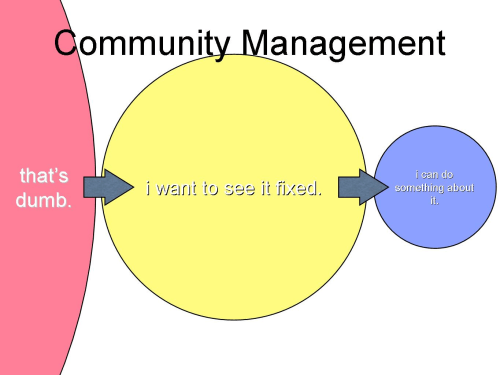
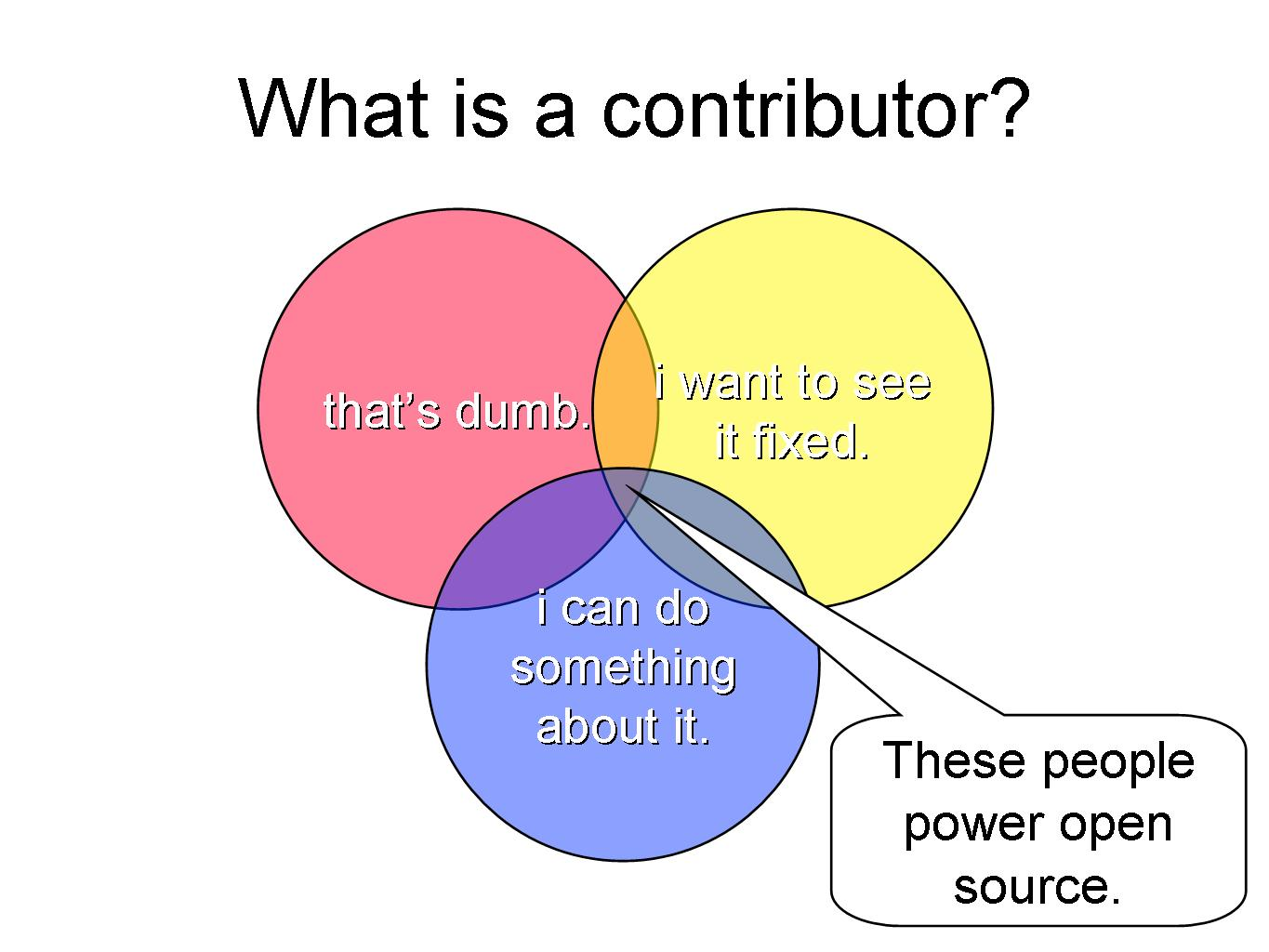
One of the key things Angie talks about is that we often have a specific view of who can participate in open source – something she identifies as a sweet spot of skills and passion:

I suspect that, at the moment, this is broadly true. As a model however, it has limited scale. Not everyone can “do” everything about the problems they care about in an open source project. Worse still, since Open Source participants (rightly) care more about action than talk, those who are interested but insufficiently equipped often get marginalized. This means either a) potential supporters are turned off or away or b) these people become raging uglies who post unhelpful rants and talk about open source projects being “unsupportive” or “unresponsive.” The former is a loss to the projects, the second is a drain.

As I think about Canada25 and some of the work I’ve done helping open source projects manage their community, it isn’t so much that we want to find and more effectively tap into that sweet spot, it’s that we should be trying to figure out how to manage the open source process so we don’t have to exclusively rely on those in the sweet spot.

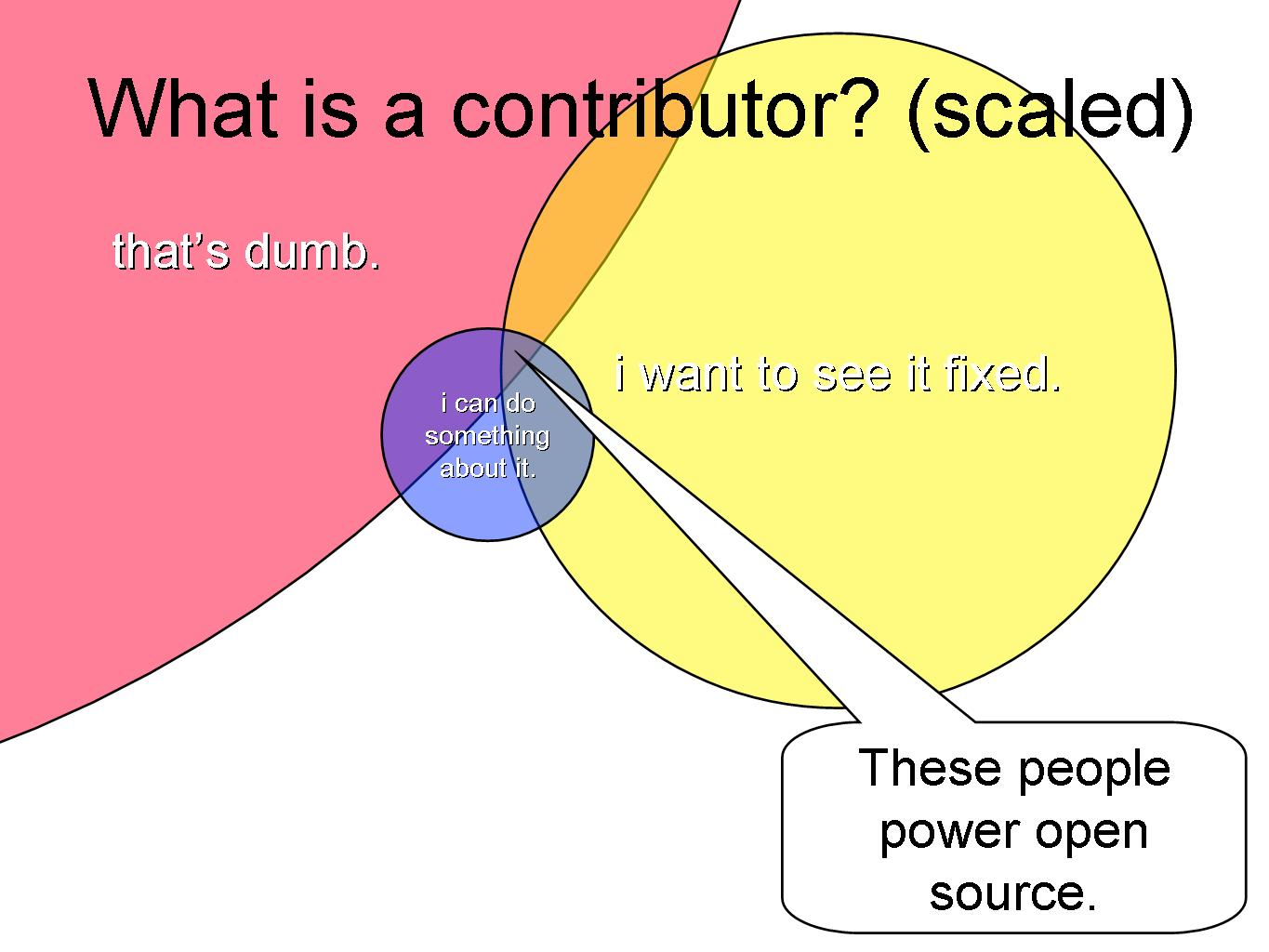
That begins with having a better model of what current contributors look like. To that end I’ve remixed Angie’s slide and tried to make it more to what I think “scale” would look like.

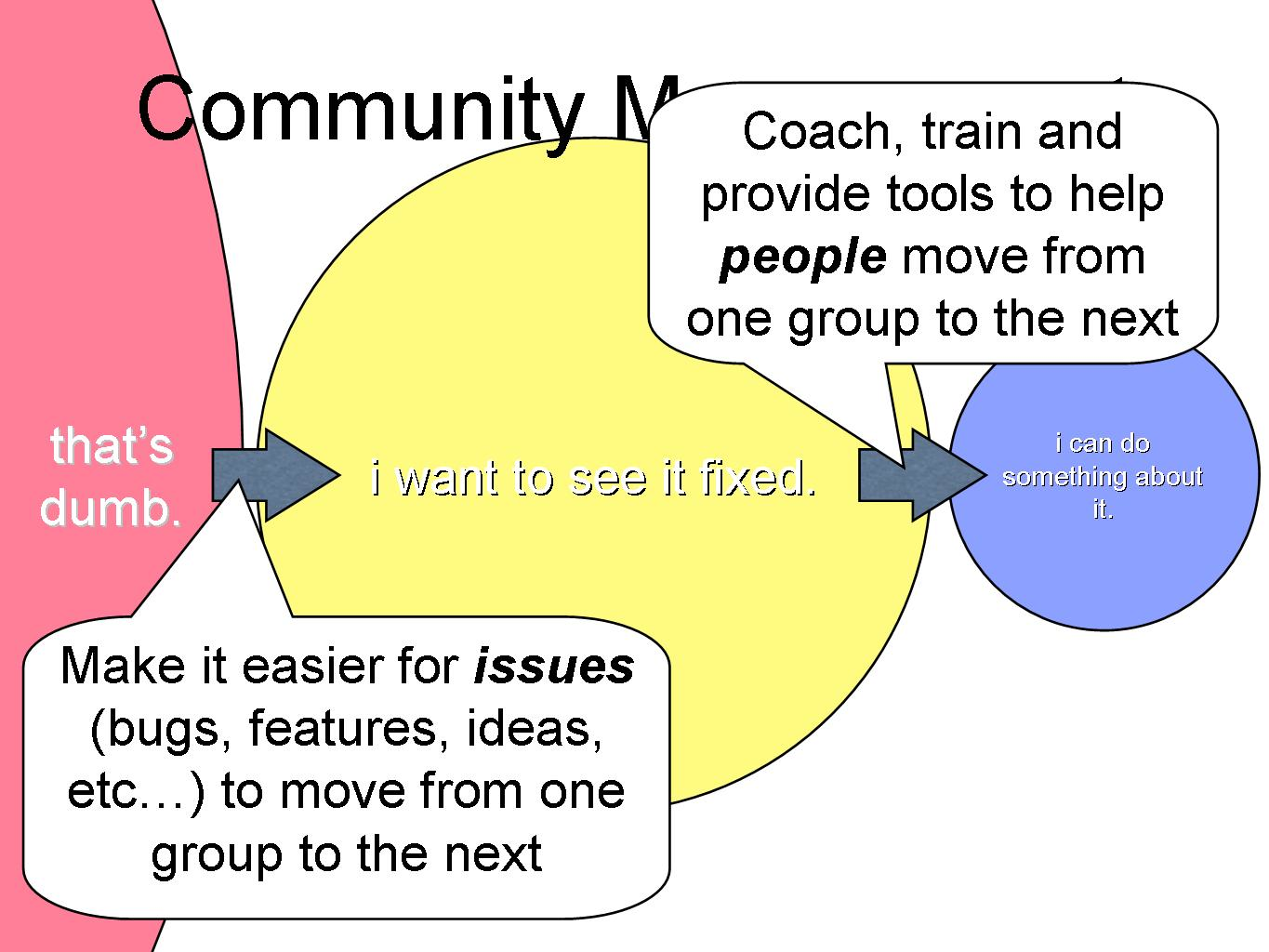
Women in Open Source remixed slide 4The fact is, there are A LOT more people who see of problem/bug/missing feature in open source than those who want to see it fixed or can do something about it. Indeed, for those of us who care about Mozilla, if we want to find the next Million Mozillians, this red group is a good (but not the only) place to start.

The real question is, can we break down problems so rather than relying on (a relatively few) key people we can rely on a process instead? This is, in theory, what tools like Bugzilla are supposed to help us do and what, I suspect, many OS projects spend a lot of time thinking about.

Women in Open Source remixed Slide 5

It would be interesting to try to map all the tools that allow us to move ideas and issues from “that’s dumb” to “I want to see it fixed” to “I can do something about it.” How are the people in each phase connected, how can they exchange information and how can they influence one another. More importantly, can we find ways to break the problem down to at least cooperate and possibly even collaborate on these issues.

But the larger issue – and this is where I think it matters to finding the next Million Mozillians, is how do we migrate people up the food chain. How do we shift people from “That’s Dumb” to saying “I want to see it fixed” and from “I want to see it fixed” to “I can do something about it!” This is where I think effective community management has the most to offer – developing a tools, a culture and environment that are encouraging, supportive and still effective and efficient.

Women in Open Source remixed Slide 6

Part of this has to do with finding it easier to accommodate people into a broader set of roles. As Angie Byron (and others) point out, participation isn’t just about coding: It’s about donations, advocacy, documentation, marketing, user support, testing, translations, graphic design, event coordination, bug reports and feature requests, issue queue “farming”, usability, project management, and (among other things) coding. But it is also about nurturing those who have the skills but may sit on the periphery or outside the sweet spot altogether – getting them comfortable with the project, the community and the processes. Often open source projects have a rough and tumble approach to newbies, I’m not sure that this is the best path to growth.

If a given open source community (and I’d argue the open source community writ large) wants to grow, fighting over coders in the sweet spot will be one approach, but its sustainability (and growth) may be more limited. However, figuring out how to task up the other activities so your coders can focus more and more narrowly on just coding may be another, and ultimately more effective route to success. As Angie points out, creating more effective tools is one part of getting there – but it is only one part. Figuring out the culture and soft skills that will get you there is the other.

Women in Open Source and Florida's Bohemian Index

Just a quick somewhat brief follow up to yesterday’s post on women in open source.

I got lots of great feedback and comments for which I’m grateful and wanted to say one or two things.

First, I recognize the title to the post, particularly the “Canary in a Coal Mine” was far from perfect. The exclusion of women from Open Source is not – as some might read the title – an existential threat to open source. OS communities will not collapse or fail if more women are not included (the broader IT industry seems to continue, for better for worse despite a poor male to female ratio). The point is that growth will, however, be limited. Moreover the success of OS communities  – defined in terms of an active and engaged community, one whose members treat each other well and where differences and disagreements are resolved respectfully and effectively – might also be limited.

Actually I’d go further – Richard Florida found a positive correlation between gay household and regional (especially tech) economic development among cities. This quote is from one of his academic papers on the subject:

Florida and Gates (2001) found a positive association between concentrations of gay households and regional development. This tolerance or open culture premium acts on the demand side by reducing barriers to entry for human capital; increasing the efficiencies of human capital externalities and knowledge spillovers; promoting self-expression and new idea generation; and facilitating entrepreneurial mobilization of resources, thus acting on regional income and real estate prices.

The same hypothesis could could hold true for open source communities with regard to women.  Gay men in America and women in tech are both (sadly still) marginalized groups. As such, women are the canary in the coal mine in that the more women you find in an open source community – the more likely that community is tolerant and open to new ideas and self-expression.  In short, the number of women participants is probably a pretty one good metric of the community’s health.

Second, I think the stats around the post are quite interesting. So far:

Page hits: 600+

Feedburner “reach:” 2379

Tweets: 7 from women, 1 from an aggregator

Comments: 10 comments from 7 people (not including mine). All from women

2 emails: both from men

In short, no men participated publicly the the post. My inclination is not to believe that men in open source don’t see this as an issue (I’m sure some don’t, but I know many do), but I do suspect that many don’t feel like it is safe to talk about. That’s a problem in of itself. (Alternatively, and I accept this as a very real possibility, but my blog may not be popular enough to gain attention – or that people haven’t had a ton of time to respond).

As the author it is important to me that nothing in yesterday’s post lead open source participants to believe (or feel accused of) deliberately excluding women. However, I know that reading it, that accusation can feel like it is (implicitly) there anyway. A key to success in communicating around difficult subjects is to separate impact from intent. Open source communities, and the men who participate within them may not be trying to exclude women or other groups (intent). But that doesn’t mean women aren’t being or shouldn’t feel, excluded (impact). The key is for a community to acknowledge and accept that it can be having an impact without that intent – and the solution is to get really intentional about the skills, tools and culture of the community to change the impact.

It was important to me that yesterday’s post resonate with the women who read it AND that men involved in open source read the post without feeling accused of being sexist or part of a sexist community. The goal is to generate discussion on how we can change the impact since, given most of the people I know in OS, the intent is already there.

Women in Open Source – the canary in the coal mine

The other month I had the pleasure watching Angie Byron give the keynote lecture at Open Web Vancouver on Women in Open Source. The synopsis from Open Web Vancouver:

The open source world is rich with opportunities: Working with people of all cultures from all over the world; Collaborating with some of the biggest and brightest minds on the ultimate solutions to complicated problems; Changing the world by providing free tools for organizations such as non-profits, educational institutions, and governments; Building up marketable skills and practical knowledge.

But yet, so many women are missing out. Why is that? And what can we do to change it? This talk will endeavour to answer these questions, as well as provide tips and strategies for women who want to dip their toe into the waters.

I wish I could embed the video on my blog but alas, it is not possible, so I encourage you to wander over to Angie’s blog and watch the video there.

The important lesson about Angie’s talk is that it isn’t just about women. The power and capacity of an open source community is determined by the quantity and quality of its social capital. If a community fails to invest in either – if it turns off or away qualified people because its culture (however unintentionally) discriminates against a gender, race or group – then it limits its growth and potential. The same is true of a community culture that doesn’t allow certain groups to improve their social capital. These may seem like large, intangible questions, but they are not. I’m sure every open source community turns some people off. Sometimes the reasons are good – the fit might not be right. But sometimes, I’m certain the reasons are not good. And the community may never get the feedback it needs because the moderate, productive person who walks away doesn’t create a scene, they may just quietly disappear (or worse they never showed up to begin with).

So Angie matters not just because women are missing out (although this is true, important and urgent). Angie’s talk matters because women are just the canary in the coal mine. Millions of people are missing out – people with ideas and the ability to make contributions get turned away because of a bad experience, because a community’s culture is off putting, too aggressive, not welcoming or not supportive.

For me its opened up a whole new way of thinking about my writing on open source communities. After Angie’s talk I sought her out as I felt we’d been talking about the same things. I’m interested in developing norms, skills and tools within an open source community that allows more people to participate and collaborate more effective, in short how do we think about community management. Angie is talking about developing open source communities that support and engage women. Working towards solving one helps us solve the other. So if you wake up today and notice there are no (other) women on the IRC channel with you… maybe we should both individually and collectively as a community engage in a little introspection and think about what we could change. Doing so won’t only make the community more inclusive, it will make it more productive and effective as well.

Open Data at the City of Vancouver – An Update 16/7/2009

matrix

For those interested in the progress around the Open Motion (or Open3 as city staff have started to call it) I’ve a little update.

Last week during a visit to city hall to talk about the motion I was shown a preview of the website the city has created to distribute and share data sets. For those unsure what such a website would look like, the baseline and example I’m measuring the city against is, of course, the Washington DC website. At the moment the city’s prospective website looks more like the (also impressive) beta site the City of Nanaimo set up after ChangeCamp – a little simpler and with a lot fewer data sets, but it is the first step.

As an aside kudos to the City of Nanaimo team which has been pushing open data and especially geo-data for quite some time as this must read Time magazine piece (yes, a must read Time magazine piece) will attest.

Anyway… back to Vancouver. The fact that the city has a beta website with a (very) modest amount of data ready to launch is a testament to the hard work and effort of the City’s IT staff. Rarely in my work with government’s have I seen something move so quickly and so needless to say… I’m quite excited. At the moment, I don’t know when the beta data site will go live – there are still a few remaining issues being worked on – but as soon as it launches I will be writing a blog post.

In the interim, big kudos should also go to the City’s Archives who posted a number of videos from the archives online and created it’s own YouTube Channel. They received so much traffic over the videos that the servers almost ground to a halt. Awesome, I say. It just goes to show how much interest there is out there.

Also exciting is that my post on how open data makes garbage collection sexy has inspired two local hackers (Luke and Kevin) to scrape the city’s garbage calendar and hand created digital versions of the city’s garbage maps to create the app I spec’ed out in the blog post. (I’ll have more on that, including links, in a few weeks) Luke also suggested I start recording other app ideas that come to me so over at the Vancouver Data Google group which was created on the fly by local coders in the audience during my and Andrea’s presentation at Open Web Vancouver. I’ve asked people to share their ideas for applications (mobile or desktop) that they’d like to see created with open data.

Sooooo… if there is an app you’d like to see created please post it to the google group or send me an email or write it in the comments below. No guarantees that it will be created but I’m hoping to help organize some hack-a-thons (or as my city friends prefer… code sprints). Having some ideas for people to sink their teeth into is always helpful.

How to predict the "Fixability" of a Bugzilla Submission

bugzilla iconMy friend Diederik van Liere has written a very, very cool jet-pack add-on that calculates the probability a bug report will result in a fixed bug.

The skinny on it is that Diederik’s app bases its prediction on the bug reporter’s experience, their past success rate, the presence of a stack trace and whether the bug reporter is a Mozilla affiliate. These variables appear to be strong and positive predictors of whether a bug will be fixed. The add-on can be downloaded here and its underlying methodology is explained in this blog post.

One way the add-on could be helpful is that it would enable the mozilla community to focus its resources on the most promising bug reports. Volunteer coders with limited time who want to show up and and take ownership over a specific bug would probably find this add-on handy as it would help them spend their precious volunteer time on bugs that are likely well thought through, documented effectively and submitted by someone who will be accessible and able to provide them with input if necessary.

The danger of course, is that a tool like this might further enhance (what I imagine is) a power-law like distribution of bug submitters. The add-on would allow those who are already the most effective bug submitters to get still more attention while first time submitters or those who are still learning may not receive as much sufficient attention (coaching, feedback, support) to improve. Indeed, one powerful way the tool might be used (and which I’m about to talk to Diederik about) is to determine if there are classes of bug submitters who are least likely to be successful. If we can find some common traits among them it might be possible to identify ways to better support them and/or enable them to contribute to the community more effectively. Suddenly a group of people who have expressed interest but have been inadvertently marginalized (not on purpose) could be brought more effectively into the community. Such a group might be the lowest hanging fruit in finding the next million mozillians.

Negotiating – how not to manage tension

Last week Rob Cottingham pointed me to ReadWriteStart piece entitled Learn to Negotiate and Close. It’s filled with some good – if unfortunately titled – advice particularly around focusing on listening and not derailing a deal by talking too much (“Two Ears, One Mouth”) as well as speaking to your client/prospective partner’s interests (“Wait Until You Hear Them Scream”). One section, however entitled “Using Tension to your Advantage” felt problematic and tweaked the negotiation consultant in me.

For example, in that section they advocate:

Donald Trump (the real-estate developer), in his book “The Art of the Deal,” talks about guiding the other side to the point that they really want the deal and think it is in the bag. Then he backs off and demands major concessions. Smart buyers everywhere have learned some variation of this tactic.

This is when you get a knot in your stomach and may witness table-banging and raised voices. All of this unpleasant stuff is good news. Experienced deal closers recognize these as signs that a deal is closing. The absence of these signs is actually a cause for concern!

One thread running through all good negotiations is some sign of real pain from the buyer that leaves you confident you are not leaving too much money on the table. Of course, the buyer knows you will be looking for this and will send signals that you have reached their limit. The skill comes in differentiating between fake pain, as in “This is well above our budget, and my boss will kill me if I agree,” and the real thing. The buyer will also be looking for the same signs from you.

From my experience negotiating, this statement is fraught with problems – and can be downright dangerous as advice. Here are a few reasons why:

Shifting Goals

First, unless you are a deeply skilled mind reader, “reading the signs” isn’t an executable strategy. Indeed, the real risk with this strategy is that by adopting it, you shift your goal. You cease to be focused on creating a deal that you would find acceptable and start trying to identify the deal you think your counterpart will be willing to accept. You metric for success moves from what you want (or need), to what you think you think they will accept.

The fact is, you will never know the limit of what you counterpart is willing to accept until they are walking away – and even then, maybe it’s all part of an act? This belief that a good negotiator can tell the difference is simply untrue. Maybe you can read when they are bluffing and when they are not… but I’m willing to bet that however good you think you are, you can’t read them that well. Indeed, you probably have no idea what is going on in their head (just like they probably don’t know what’s going on in your head).

Promotes poor communication

This is the other part of this approach that is problematic. It promotes poor communication, and to be blunt, lying. If I think you are looking for signals that I’ve reached my limit – I’m going to send you those signals, whether you’ve reached my limit or not. In essence, I’m going to lie to you. And if I’m lying about that… what else might I be lying about? This is the dynamic that this approach helps reinforce. Rather than a negotiation that allows us to brainstorm creative solutions or identify what is really important we spend our time dancing around the issues and pour our energy in to focusing on “what signals we are sending?” and trying to “read” them.

The fact is once you tell me something is a deal breaker, and then you compromise on it – I learn that dealbreakers for you aren’t really dealbreakers, they are just efforts to manipulate me. Do that more than once and my trust in anything you say will quickly erode… which will inevitably lead to me to ask myself: why am I doing business with you?

Break down trust

The fact that poor communication breaks down trust isn’t academic. Good negotiations can only occur if there is some basic degree of trust. My willingness to share information, to brainstorm, to see the problem from your perspective are all made easier if I believe I can trust you. Breakdown trust, and you breakdown the very environment needed to create wealth and good outcomes.

If Trump tried to pull that last minute deal changing arrangement on me I’d consider walking away or throwing a bunch of my own last minute demands into the mix. Indeed, I’ve had this happen to clients before and I advise them to say: “Wow, it sounds like you’d like to change the terms of the agreement I thought we’d already agreed upon. If you aren’t happy with those terms I’m willing to reopen the negotiation over them, but have a bunch of terms I’d like to see renegotiated as well. If those issues back to the table, I think I’ll bring forward a number of my own as well.” This usually shuts this strategy down – while they may want to renegotiate pieces of the deal they aren’t thrilled with, they probably aren’t willing to do so at the risk of also renegotiating the parts of the deal they are thrilled with. There is a reason you’ve both come this far – you both believe the deal is mutually acceptable.

The real danger with the Trump strategy however (and the reason I’d seriously consider walking away) is that it underestimates the risks of exploiting the tension.  While some people might cave to Trump, I’d be asking myself the question: do I want to do business with someone who is going to constantly try to exploit me rather than work with me? Maybe Trump’s deals are always purely transactional and he’s never going to work with his counterpart on an ongoing basis. But many deals I work on don’t complete the relationship between the two parties, they start the relationship. Do you want a business partner you can trust, or one that is always seeking not to create wealth, but hive it off for themselves? Worst still – what I am teaching Trump? Every time he adds last minute changes, even if I only cave on one or two of them, I’m teaching him to make last minute demands. I’m helping make this problem worse in the future not better. All this to say that if you don’t have some basic level of trust in the person you are going to work with, are you going to share critical information? Are they going to share it with you? What is the likelihood of your business taking off in that environment? Not that good, I suspect.

Stay focus on your interests and goals

For me, exploiting the tension runs real risk of derailing the negotiation or worse, the relationship with your counterpart (nothing is more toxic than an agreement between two parties in which they hate each other/don’t trust each other, it’s pretty much guaranteed everybody will lose money in that situation). Obviously I have lots of advice around negotiating, but two things I like to keep front and centre are:

First, identify what will make you happy. In short, know your goal – what you need and why. Money is important, but so are other things: stability, duration, trust, good process, the capacity to withstand surprises. All of these (and countless others) might be important to you – figure out what really matters. In addition identify external benchmarks – outcomes from other similar deals – that you can use as reference points. Few deals are genuinely new, most deals are structured around what has occurred before. These are powerful reference points that can be persuasive to the other side (and to your own sense of fairness)

Second, create conditions for a good negotiation. The how you negotiation is as important as the what you negotiate. What irks me about the above advice is that is advocates for a how that promotes poor communication and erodes trust. You and your counterpart can set the rules for how you are going to work together – make sure you do. And remember, you are constantly modelling behaviour regarding how you expect your counterpart to act. Ultimately, some negotiations are going to get nasty – but they don’t all have to be that way and it starts by not assuming they have to be nasty.

Ultimately you can spend your time trying to “read” your counterparts or your can create an environment where you can just ask them. My preference is to focus on the later. In doing so you’re more likely to develop creative outcomes and grow the value of the deal.

sell big-ticket deals, you don’t need that many to reach your revenue targets. If you are getting venture capital to power your dreams, you may need to close only one deal for your venture to succeed. But these deals take a long time to close, almost never less than three months and often twelve months or more. By the time you enter the “closing zone,” you and your teammates have expended a lot of time and energy, your company is relying on you to close the deal, and you are starting to think about what you will do once the deal closes.

This is an exhilarating, scary, dangerous time. Exhilarating because you are so close to a big “high five” success. Scary because if you lose now when you can almost taste success, the disappointment will be bitter. Dangerous because a smart buyer could easily exploit your intense desire to close the deal and force major concessions out of you.

Donald Trump (the real-estate developer), in his book “The Art of the Deal,” talks about guiding the other side to the point that they really want the deal and think it is in the bag. Then he backs off and demands major concessions. Smart buyers everywhere have learned some variation of this tactic.

This is when you get a knot in your stomach and may witness table-banging and raised voices. All of this unpleasant stuff is good news. Experienced deal closers recognize these as signs that a deal is closing. The absence of these signs is actually a cause for concern!

One thread running through all good negotiations is some sign of real pain from the buyer that leaves you confident you are not leaving too much money on the table. Of course, the buyer knows you will be looking for this and will send signals that you have reached their limit. The skill comes in differentiating between fake pain, as in “This is well above our budget, and my boss will kill me if I agree,” and the real thing. The buyer will also be looking for the same signs from you.

Losing your temper is usually not good. It implies a lack of control and usually signals fear and weakness rather than strength. However, sometimes it can be very effective. Negotiators use many tactics to simulate table-banging without killing the deal. You can use the old good cop/bad cop routine, or the “My intransigent boss will never agree to this” line, or you could use a stalking horse to lay down a negotiating line.

Your tactic will depend on the specifics of the sale, but the one constant is that when your stomach gets in a knot, you have probably entered the closing zone, and that is good. We were engineered for fight or flight for a reason!
Structurelessness, feminism and open: what open advocates can learn from second wave feminists

Just finished reading feminist activist Jo Freeman’s article, written in 1970, called The Tyranny of Structurelessness. She argues there is no such thing as a structureless group, and that structurelessness tends to be invoked to cover up or obscure — and cannot eliminate — the role, nature, ownership and use of power within a group.

The article is worth reading, especially for advocates of open (open-source and openspace/unconference). Occasionally I hear advocates of open source — and more frequently hear organizers of unconferences/openspaces — argue that because of the open, unstructured nature of the process, they are more democratic than alternatives. Freeman’s article is worth reading as it serves as a useful critique of the limits of open as well as a reminder that open groups, organizations and processes are neither structureless, nor inherently democratic. Claiming either is at best problematic; at worst it places the sustainability of the organization or effort in jeopardy. Moreover, recognizing this reality doesn’t make being open less powerful or useful, but it does allow us to think critically and have honest conversations about to what structures we do want and how we should manage power.

It’s worth recognizing that Freeman wrote this article because she did want feminist organizations to be more democratic (whereas I do not believe open source or unconferences need to be democratic), but this does not make her observations less salient. For example, Freeman’s article opens with an attack on the very notion of structurelessness:

“…to strive for a ‘structureless’ group is as useful and as deceptive, as to aim at an ‘objective’ news story, ‘value-free’ social science or a ‘free’ economy. A ‘laissez-faire’ group is about as realistic as a ‘laissez-faire’ society; the idea becomes a smokescreen for the strong or the lucky to establish unquestioned hegemony over others. This hegemony can easily be established because the idea of ‘structurelessness’ does not prevent the formation of informal structures, but only formal ones.”

This is an important recognition of fact, one that challenges the perspective held by many “open” advocates. In many respects, unconferences and some open source projects are reactions to the challenges and limitations of structure — a move away from top-heavy governance that limits creativity, stifles action and slows the flow of information. I have personally (and on many occasions) been frustrated by the effect that the structure of government bureaucracies can have on new ideas. I have seen how, despite a clear path for how to move an idea to action, the process nonetheless ends up snuffing the idea out before it can be acted upon — or deforms it to the point of uselessness.

But I have also experienced the inverse. I’ve personally experienced the struggle of trying to engage/penetrate an open source community. Who I should talk to, how to present my ideas, where to present them — all often have rules (of which, within Mozilla, I was usually informed by friends on the inside — while occasionally I discovered the rules awkwardly, after grossly violating them). Most open source communities I know of — such as Mozilla or Canada25 —  never claimed (thankfully) to be democratic, but there is an important lesson here. Recognizing the dangers of too much (or rather the wrong) structure is important. But that should not blind us to the other risk — the danger outlined above by Freeman for feminists in 1970: that in our zeal to avoid bad structure, we open advocates begin to pretend that there is no structure, or no need for structure. This is simply never the case. No matter what, a group structure exists, be it informally or formally. The question is rather how we can design a flexible structure that meets our needs and enables those whom we want to participate, to participate easily.

The danger is real. I’ve been to unconferences where there are those who have felt like insiders and others who have known they were outsiders. The same risk – I imagine – exists for open source projects. This isn’t a problem in and of itself – unless those who become insiders start to be  chosen not solely on account of their competence or contribution, but because of their similarities, shared interests, or affableness to the current set of insiders. Indeed, in this regard Freeman talks very intelligently about “elites”:

“Elites are not conspiracies. Seldom does a small group of people get together and try to take over a larger group for its own ends. Elites are nothing more and nothing less than a group of friends who also happen to participate in the same political activities. They would probably maintain their friendship whether or not they were involved in political activities; they would probably be involved in political activities whether or not they maintained their friendships. It is the coincidence of these two phenomena which creates elites in any groups and makes them so difficult to break.”

This is something I have witnessed both within an open source community and at an unconference. And this is not bad per se. One wants the organizers and contributors in open projects to align themselves with the values of the project. At the same time, however, it becomes easy for us to create proxies for shared values — for example, older people don’t get unconferences so we don’t ask them, or gloss over their offers  to help organize. Those who disagree with us becomes labelled trolls. Those who disagree sharply (and ineffectively) are labelled crazy, evil or stupid (or assumed to be suffering from asperger’s syndrom). The challenge here is twofold. First, we need to recognize that while we all strive to be meritocratic when engaging and involving people we are often predisposed to those who act, talk and think like us. For those interested in participation (or, for example, finding the next million mozillians) this is of real interest. If an open source community or an unconference does want to grow (and I’m not saying this should always be a goal), it will probably have to grow beyond its current contributor base. This likely means letting in people who are like those already participating.

The second challenge isn’t to make open source communities more democratic (as Freeman wished for the feminist movement) but to ensure that we recognize that there is power, we acknowledge which individuals hold it, and we make clear how they are held accountable and how that power is transitioned.  This can even be by dictate — but my sense is that whatever the structure, it needs to be widely understood by those involved so they can choose, at a minimum, to opt out (or fork) if they do not agree. As Freeman notes, acting like there is no power, no elite or no structure does not abolish power. “All it does is abdicate the right to demand that those who do exercise power and influence be responsible for it.”

In this regard a few thoughts about structure come to mind:

  1. Clarity around what creates power and influence. Too often participants may not know what allows one to have influence in an open setting. Be clear. If, in an open source community, code is king, state it. And then re-state it. If, in an unconference, having a baseline of knowledge on the conference subject is required, state it. Make it as clear as possible to participants what is valued and never pretend otherwise.
  2. Be clear on who holds what authority, why, and how they are accountable. Again, authority does not have to be derived democratically, but it should be as transparent as possible. “The bargain” about how a group is being governed should be as clear to new contributors and participants as possible so that they know what they are signing for. If that structure is not open to change except by an elite, be honest about it.
  3. Consider encoding ideas 1 and 2 into a social contract that makes “the bargain” completely clear. Knowing how to behave is itself not unimportant. One problem with the “code is king” slogan is that it says nothing about behaviour. By this metric a complete jerk who contributes great code (but possibly turns dozens if not hundreds of other coders off of the project) could become more valued then a less effective contributor who helps new coders become more effective contributors. Codifying and enforcing a minimum rule-set allows a common space to exist.
  4. Facilitate an exit. One of the great things about unconferences and open source is the ability to vote with one’s feet and/or fork. This means those who disagree with the elite (or just the group in general) can create an alternative structure or strike up a new conversation. But ensure that the possibility for this alternative actually exists. I’ve been to unconferences where there was not enough space to create a new conversation – and so dominating conveners tortured the participants with what interested them, not the group. And while many open source projects can be forked, practically doing so is sometimes difficult. But forking – either an open source project or a conference conversation – is an important safety valve on a project. It empowers participants by forcing elites to constantly ensure that community members (and not just the elites) are engaged or risk losing them. I suspect that it is often those who are most committed (a good thing) but feel they do not have another choice (a bad thing) who come to act like resentful trolls, disrupting the community’s work.

Again, to be clear, I’m using Freeman’s piece to highlight that even in “open” systems there are structures and power that needs to be managed. I’m not arguing for unconferences or open source communities to be democratic or given greater structure or governance. I believe in open, transparency and in lightest structures possible for a task. But I also believe that, as advocates of open, we must constantly be testing ourselves and our assumptions, as well as acknowledging and debating practises and ideas that can help us be more effective.

Will Firefox’s JetPack let us soar too high?

Recently Mozilla introduced Jetpack, a Firefox add-on that makes it possible to post-process webpages within the web browser. For the non-techies out there, this means that one can now create small software programs that, if installed, can alter a webpages content by changing, adding or removing parts of it before it is displayed on your computer screen.

For the more technically minded, this post-processing of web pages is made possible because JetPack plugins have access to the Document Object Model (DOM). Since the DOM describes the structure and content of a web page, the software can manipulate the webpage’s content after the page is received from the web server but before it is displayed to the user. As a result static web pages, even the ones you do not control, can become dynamic mashups.

This may seem insignificant but it has dramatic implications. For example, imagine a JetPack plugin that overlays a website – say of BarrackObama.com or FoxNews.com – that causes text bubbles that counterspin a story when your mouse hovers over it. The next republican nominee could encourage supporters to download such a hypothetical plugin and then direct their supporters to Obama’s website where each story could be re-spun and links to donating money to the republican campaign could be proffered. They would, in short, dynamically use Obama’s webpage and content as a way to generate money and support. TPM could create a similar Jetpack plugin for the FoxNews website which would do something similar to the title and body text of articles that were false or misleading.

Such plugins would have a dramatic impact on the web experience. First, they would lower costs for staying informed. Being informed would cease to be a matter of spending time searching for alternative sources, but a matter of installing the appropriate JetPack plugin. Second, every site would now be “hijackable” in that, with the right plugin a community could evolve that would alter its content without the permission of the site owner/author. On the flip side, it could also provide site owners with powerful community engagement tools: think open source editing of newspapers, open source editing of magazines, open source editing of television channels.

The ultimate conclusion however is that JetPack continues to tilt power away from the website creators to viewers. Webpage owners will have still less control over how their websites get viewed, used and understood. Effectively anyone who can persuade people to download their JetPack plugin can reappropriate a website – be it BarrackObama.com, FoxNews.com, eBay, or even little old eaves.ca – for their own purposes without the permission of the website owner. How the web eco-system and website developers in particular react to this loss of control will be interesting. Such speculation is difficult. Perhaps there will be no reaction. But one threat is that certain websites place content within proprietary systems like Flash where it would be more difficult for JetPack to alter their contents. More difficult to imagine, but worth discussion, is that some sites might simply not permit Firefox browsers to view their site.

In the interim three obstacles need to be overcome before JetPack realizes its full potential. Currently, only a relatively small community of technically minded people can develop JetPack add-ons. However, once Jetpack becomes an integral part of the Firefox browser this community will grow. Second, at present installing a JetPack plugin triggers a stern security warning that will likely scare many casual users away. Mozilla has hinted at developing a trusted friends system to help users determining whether a plug-in is safe. Such trust systems will probably be necessary to make JetPack a mainstream technology. If such a community can be built, and a system for sorting out trusted and untrustworthy plugins can be developed, then Jetpack might redefine our web experience.

We are in for some interesting times with the launch of Firefox 3.5 and new technologies like JetPack around the corner!

Jetpack is available at jetpack.mozillalabs.com

Diederik van Liere helped write this post and likes to think the world is one big network.

PublicVoice Interview on "Open," Government and Citizen Engagement

A couple of weeks ago I was interviewed by Maclean’s columnist Scott Feschuk for PublicVoice.tv on what the rise of “open” systems and the continuing evolution of information technology will mean for the future of both government and citizen engagement.

Cleverly, they’ve kept these videos nice and short – it’s all designed to be short and punchy. There will be five 1-3 minute videos in a all and so far the first two have been posted. You can see them here and here.

Sadly, the lighting isn’t all that flattering… consider yourself warned.

why collaborative skills matter in open source

For the past several years now I’ve been talking about how community management – broadly defined as enhancing a community’s collaborative skills, establishing and modeling behaviour/culture and embedding development tools and communications mediums with prompts that “nudge” us towards collaborative behaviour – is imperative to the success of open source communities. (For those interested in this, my FSOSS 2008 on the subject has been slidecasted here, and is on on google video here.

Re-reading Shirkly’s latest book, Here Comes Everybody, has re-affirmed my thinking. Indeed, it’s made me more aggressive. Why? Consider these two paragraphs:

This ability of the traditional management structure to simplify coordination helps answer one of the most famous questions in all of economics: If markets are such a good idea, why do we have organizations at all? Why can’t all exchanges of value happen in the market? This question originally was posed by Ronald Coase in 1937 in his famous paper “The Nature of the Firm,” wherein he also offered the first coherent explanation of the value of hierarchical organization. Coase realized that workers could simply contract with one another, selling their labor, and buying the labor of others in turn, in a market, without needing any managerial oversight. However, a completely open market for labor, reasoned Coase, would underperform labor in firms because of the transaction costs, and in particular the costs of discovering the options and making and enforcing agreements among the participating parties. The more people are involved in a given task, the more potential agreements need to be negotiated to do anything, and the greater the transaction costs…

And later, Shirky essentially describes the thesis of his book:

But what if transaction costs don’t fall moderately? What if they collapse. This scenario is harder to predict from Coase’s original work, at it used to be purely academic. Now’s it not, because it is happening, or rather it has already happened, and we’re starting to see the results.

My conclusion: the lower the transaction costs, the greater the playing field will favour self-organizations systems like open source communities and the less it will favour large proprietary producers.

This is why open source communities should (and do) work collectively to reduce transaction costs among their members. Enabling the further collapse of transaction costs tilts the landscape in our favour. Sometimes, this can be down in the way we architect the software. Indeed, this is why – in FirefoxAdd-Ons are so powerful. The Add-On functionality dramatically reduces transaction costs by creating a dependable and predictable platform, essentially allowing coders to work in isolation from one another (the difference between collaborative vs. cooperative). This strategy has been among the most successful. It is important and should be pursued, but it cannot help collapse transaction costs for all parts of a project – especially the base code.

But what more can be done? There are likely diminishing returns to re-architecting the software and in finding new, easier ways, to connect developers to one another. The areas I think offer real promise include:

  • fostering cultures within open source communities that reward collaborative (low transaction cost) behaviour,
  • promoting leaders who model collaborative (low transaction cost) behaviour
  • developing tools and communications mediums/methods that prompt participants to improve the noise to signal, minimize misunderstandings, limit unnecessary conflict, and help resolve differences quickly and effectively (the idea being that all of these outcomes lower transactions costs).

This is why I continue to think about how to port over the ideas, theories and tools from the negotiation/collaboration field, into the open source space.

For open source communities, eliminating transaction costs is a source of strategic advantage – one that we should find ways to exploit ruthlessly.