Tag Archives: open government

Opening Parliament and other big announcements

This is going to be an exciting week for online activists seeking to make government more open and engaged.

First off, openparliament.ca launched yesterday. This is a fantastic site with a lot going for it – go check it out (after reading my other updates!). And huge kudos to its creator Michael Mulley. Just another great example of how our democratic institutions can be hacked to better serve our needs – to make them more open, accessible and engaging. There is a ton of stuff that could be built on top of Michael’s and others – like Howdtheyvote, sites. I’ve written more about this in a piece on the Globe’s website titled If You Won’t Tell Us About Our MPs Well Do It For You.

Second, as follow on to the launch of openparliament.ca, I’ve been meaning to share for some time that I’ve been having conversations with the House of Parliament IT staff over the past couple of months. About a month ago parliament IT staff agreed to start sharing the Hansard, MP’s bios, committee calendars and a range of other information via XML (sorry for not sharing this sooner, things have been a little crazy). They informed me that they would start doing this before the year is over – so I suspect it won’t happen in the next couple of months, but will happen at some point in the next 6 months. This is a huge step forward for the house and hopefully not the last (also, there is no movement on the senate as of yet). There are still a ton more ways that information about the proceedings of Canada’s democracy could be made more easily available, but we have some important momentum with great sites like those listed above, and internal recognition to share more data. I’ll be having further conversations with some of the staff over the coming months so will try to update people on progress as I find out.

Finally, I am gearing up to launch datadotgc.ca. This is a project I’ve been working on for quite some time with a number of old and new allies. Sadly, the Canadian government does not have an open data policy and there is no political effort to create a data.gc.ca like that created by the Obama administration (http://www.data.gov/) or of the British Government (http://data.gov.uk/). So, I along with a few friends have decided to create one for them. I’ll have an official post on this tomorrow. Needless to same, I’m excited. We are still looking for people to help us populate the site with open government data sets – and have even located some that we need help scraping – so if you are interested in contributing feel free to join the datadotgc.ca google group and we can get you password access to the site.

Fixing the Access to Information System in Government

A few weeks ago I came across this piece about Freedom of Information Act requests (FOIA) in the United States. These are requests made by the public (usually by curious citizens and reporters) to get access to government documents. In Canada, there is a similar act – called Access to Information Act and the Privacy Act (ATIP) – that does more or less the same thing but has a slightly differently named and was passed almost two decades later.

Frequently, in talks I’ve given, I’m mentioned how the ATIP process is deeply broken. It frequently takes months for an ATIP request to be processed. Moreover, there is growing evidence that political staff have been interfering with the ATIP process, violating rules to ensure that citizens do not get the information they legally have a right to.

There is an old line about the internet, first quoted by John Gilmore: “The Net interprets censorship as damage and routes around it.” I think the same may increasingly true about government. Whether documents are actually be censored by conservative staffers or whether they simply take 6 months to arrive – in either case, for anyone who grew up with google – these are acts of censorship. For a growing number of people, an opaque and slow moving government is simple “damage” that must be routed around. That isn’t always possible, but where it is, people will ignore government. This is not a good outcome – having a generation of citizens growing up ignoring government is a disaster from a recruiting perspective, but also from a regulatory compliance, legal and democratic engagement perspective.

So, I was fascinated to read, in Government Executive, how Open Data and posting information online (in Machine Readable formats) can radically reduce the pressure of the FOIA or ATIP process. Radically reduce it. Indeed, the Environmental Protection Agency in the US claims it reduced FOIA requests by 96%! As the article states:

Larry Gottesman, national FOIA officer for the Environmental Protection Agency, said emerging technologies present significant opportunities for agencies trying to eliminate FOIA pileups. EPA has reduced its pending requests by about 96 percent, in part by creating databases of popular information. The agency’s online reading rooms reduce the need to file a request in the first place, according to Gottesman.

The key here is not using PDFs to share information and not to have lame search engines that limit what citizens can search, or that return information in a manner that makes it hard to analyze or search. Just give us all the information and let us use our own search tools. That should always be at least one option. It will help government reduce the insane ATIP burden that sucks up precious resources and it will help citizens find what they need faster.

ATIP is broken, but there are ways to make it much, much better using technology.

Getting Political Parties to think about Open Government/Data

Next week the Liberals will be hosting a “Thinkers Conference” in Montreal. In preparation for the event the party has been hosting articles outlining ideas for Canada’s 150th anniversary. Because of my work around open government and open data they asked if I would pen a piece on the subject for them.

I agreed.

The odds of getting open data increase dramatically if politicians get behind the initiative (it certainly helped a great deal here in Vancouver with both the Mayor and Councilor Reimer being vocal advocates). So, since they asked, I wrote.

You can read the piece here (et, en francais, ici). More importantly, if you have a moment, please consider leaving a comment under the piece. Political parties react to what voters and citizens say matters – so having a number of people react to the piece would send a message that citizens want better, more open government, as well as a strategy for building a 21st century economy.

Also, my piece from yesterday ended up in the Globe in case you missed it.

Interview on the State of Open Gov and Gov 2.0 on O'Reilly Radar

At the moment I’m at the mid-point of an epic 8 city, two and a half week tour de force (Vancouver-Chicago-Ottawa-Edmonton-Toronto-New York City-Toronto-Austin-Indianapolis-Vancouver) with talks happening at most stops (I’ve three today).

As some of you already know, one of today’s talk is part of the online Gov 2.0 International Conference being hosted by O’Reilly Media. Last count I heard was that over 600 people had registered, so hopefully there will be a good turn out over the intertubes. It is free to attend so click on the link about to check it out.

As part of the lead up to the event I did the following interview on O’Reilly Radar, talking about where Canada is in terms of Open Government and Gov 2.0 as well as touching on some of the themes raised in my chapter “After the Collapse” that O’Reilly published in their recently released book: Open Government: Collaboration, Transparency, and Participation in Practice. Interviews like this are fun as they push my thinking – I hope you find it interesting.

On a related but separate note – C-FAX radio personality Murray Langdon interviewed me about my Globe and Mail GCPEDIA article. If you are in Victoria this morning you should be able to catch it.

Open Gov West – Seattle March 26 & 27

For westcoasters interested in and thinking about open government and open data there will be a conference in the pacific northwest bringing together key actors in the area.

Called OpenGovWest will be taking place on March 26th and 27th. A number of interesting people will be in speaking and in attendance include Andrew Hoppin (New York State Senate’s CIO), Sabra Schneider (Webmaster, King County), Bill Schrier(CIO of Seattle) and David Hume, Executive Director, (Citizen Engagement).

There is also, at the moment, an early bird registration that last until March 10th with the discount code of 7gh9.

The conference will be taking place at Seattle City Hall (and will be the first time City Hall chambers will be used to host a conference – it is a beautiful room, which is a bonus…

Some other info for open data and open gov geeks like me…

  • You can follow the conference on Twitter @opengovwest
  • The conference hashtag is #ogw
  • Sponsors who are interested can find out more about sponsoring here.
  • Again, you can register here.

It is great to see a conference of this nature coming to the west coast. Big kudos to Sarah Schacht, the Director of Knowledge As Power, who has made this conference happen.

Gov 2.0 International: Global Innovation Meeting Local Challenges

Next week I’ll be speaking at Gov 2.0 International, an online conference being hosted by O’Reilly Media.

The conference will be running from noon-2:15 EST with an agenda I’ve copy and pasted from their website (might as well admit it!). The conference is free (hard to beat) but you’ll still need to register, which you can do here.

Agenda

Joel Whitaker

Beyond Borders: Improving Global Diplomacy and Citizen Empowerment with Gov 2.0 Speaker: Joel Whitaker, U.S. Institute of Peace

Joel Whitaker is Senior Advisor to the new Center of Innovation for Science, Technology and Peacebuilding at the US Institute of Peace in Washington, DC. Current projects include peace-gaming and simulations, climate change and conflict, mapping the Middle East blogosphere, science diplomacy in Iraq and Afghanistan, online media in Iraq, and mobile communication tools for conflict-zone NGOs.

David Eaves

Open Government in Canada Speaker: David Eaves, Centre for the Study of Democracy

In this overview of the state of open government in Canada, David will outline where there have been successes and where there have been challenges. He’ll explain why this is the case and what it could mean for other jurisdictions.

Yaron Gamburg

Israel Gov 2.0: from Awareness to Implementation Speaker: Yaron Gamburg, Israel Ministry of Foreign Affairs

Gov 2.0 in Israel is still in its initial stage. There are many initiatives in different agencies, primarily in the central government. However, these initiatives are bottom-up developments, and we need strong sponsors at the senior level of the government to make a significant change.

Dominic Campbell

U.K. Innovations in Gov 2.0 Speaker: Dominic Campbell, FutureGov

This talk will look at Britain’s contribution to the Gov20 agenda, where it started from, who led it and why it took the election of Barack Obama 3000 miles away to spur the government into action.

Program subject to refinement. All talks are 30 minutes, with a 15 minute break at US-PST: 10:00am (US-EST: 1:00pm).

The entire conference will be recorded and made available to attendees free of charge afterwards.

The PM’s Advisory Committee on the Public Service: The Good, The Bad, The Hopeful

On February 25th Paul Tellier and David Emerson – two men whose understanding of Ottawa I have a tremendous amount of respect for – released The Fourth Report of the Prime Minister’s Advisory Committee on the Public Service. It is a document that is worth diving into as these reports will likely serve as reference points for (re)thinking on renewing government for the foreseeable future.

The Bad:

On the rough side, I have a single high-level comment: These reports are likely to be as close as we are going to get in Canada to Australia’s Government 2.0 Taskforce (on which I served as part of the international reference group) or Britain’s Cabinet Office Power of Information Taskforce Report (which would have been tremendous to have been involved in).

To be clear, this is not the fault of the committee. Its terms of reference appear to be much broader. This has to predictable consequences. First, relatively little time is dedicated to the general reorganizing of society being prompted by the now 40 year old internet revolution is only carving out a small role. The committee is thus not able to dive into any detail on how the changing role of information in society, on open data, on the power of self-organization, or the rising power and influence of social media could and should re-shape the public service.

Second, much more time is dedicated to thinking about problems around HR and pay. These are important issues. However, since the vision of the public service remains broadly unchanged, my sense is the reforms, while sometimes large, are ultimately tweaks designed to ensure the continuation of the current model – not prompting a rethink (or the laying of groundwork) for a 21st century public service which will ultimately have to look different to stay relevant.

The best example of the implications of this limited scope can be found under the section “Staying Relevant and Connected.” Here the report has two recommendations, including:

The Public Service must take full advantage of collaborative technologies to facilitate interaction with citizens, partners and stakeholders.

The Public Service should adopt a structured approach to tapping into broad-based external expertise. This includes collaboration and exchanges with universities, social policy organizations, think tanks, other levels of government and jurisdictions, private sector organizations and citizens.

These are good! They are also pretty vague and tame. This isn’t so much renewal as it is a baseline for a functioning 20th century public service. More importantly, given some of the other pieces in the report these appear to be recommendations about how the government can engage in pretty traditional manners (exchanges). Moreover, they are externally focused. The main problem with the public service is that its members aren’t even allowed to use collaborative technologies to interact among themselves so how can they possible be ask to collaborate externally? As I say in my OCAD lecture and my chapter in Open Government: Collaboration, Transparency, and Participation in Practice – a digital citizenry isn’t interested in talking to an analogue government. The change required is first and foremost internal. But advocating for such a change is a major effort – one that will require significant culture and process change – which I haven’t found so far in the report and which is probably beyond its scope.

The Good:

That said, when the report does talk about technology and/or collaboration – it broadly says the right things. For example, in the section Creating A Modern, Enabled Workplace the report says:

creating a workplace that will attract, retain and empower public servants to innovate, collaborate and be responsive to the public. Among other things, this must include the adoption of collaborative technologies that are increasingly widespread in other sectors.

And, perhaps more importantly, under the section Strengthening Policy Capacity: A Relevant and Connected Public Service the report states:

A public service operating in isolation runs the risk of becoming irrelevant. We believe that the quality of policy thinking must be enhanced by additional perspectives from citizens, stakeholders and experts from other jurisdictions and other sectors (e.g. business, academia, non-governmental organizations). We believe sound government policy should be shaped by a full range of perspectives, and policy makers must consistently reach beyond the National Capital Region for input and advice.

Furthermore, the Public Service now has an opportunity to engage Canadians, especially younger ones, through the use of Web 2.0 collaborative technologies such as wikis, blogs and social networking. These offer an excellent way for the Public Service to reach out and connect.

Again, great stuff. Although, my concerns from above should also be reiterated. A networked public service is one that will need new norms as it will function very differently. The task force has little to say about this (again because of their expansive purview and not through their own fault). But this issue must be addressed in full. I frequently argue that one reason public servants are so stressed is that they live double lives. They already live in a networked workplace and play by network rules in order to get their job done, however, they are perpetually told they live in a hierarchy and have to pretend they abide by that more traditional rule set. Double lives are always stressful…

The Hope:

As the committee moves forward it says it will:

…consider and advise on new business models for the Public Service with a view to creating an innovative and productive workforce that continues to deliver increasing value for money by taking advantage of new tools and technology;

I hope that open data, open systems and some of the ideas around a network government I’ve been advocating and talking about along with numerous others, get in front of the committee – these all represent building blocks for a significantly more flexible, innovative and product public service.

Open Government – New Book from O'Reilly Media

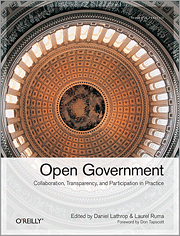
I’m very excited to share I have a chapter in the new O’Reilly Media book Open Government (US Link & CDN Link). I’ve just been told that the book has just come back from the printers and can now be ordered.

Also exciting is that a sample of the book (pictured left) that includes the first 8 chapters can be downloaded as a PDF for free.

The book includes several people and authors I’m excited to be in the company of, including: Tim O’Reilly, Carl Malamud, Ellen Miller, Micah Sifry, Archon Fung and David Weil. My chapter – number 12 – is titled “After the Collapse,” a reference to the Coasean collapse Shirky talks about in Here Comes Everybody. It explores what is beginning to happen (and what is to come) to government and civil services when transaction and coordination costs for doing work dramatically lower. I’ve packed a lot into it, so it is pretty rich with my thinking, and I’m pleased with the result.

If you care about the future of government as well as the radical and amazing possibilities being opened up by new technologies, processes and thinking, then I hope you’ll pick up a copy. I’m not getting paid for it; instead, a majority of the royalties go to the non-profit Global Integrity.

Also, the O’Reilly people are trying to work out a discount for government employees. We all would like the ideas and thinking in this book to go wide and far and around the globe.

Finally, I’d like to give a big thank you to the editors Laurel Ruma and Daniel Lathrop, along with Sarah Schacht of Knowledge as Power, who made it possible for me to contribute.

Eaves.ca Blogging Moment #2 (2009 Edition): The Three Laws of Open Data go Global

Back in 2007 I published a list of top ten blogging moments – times I felt blogging resulted in something fun or interesting. I got numerous notes from friends who found it fun to read (though some were not fans) so I’m giving it another go. Even without these moments it has been rewarding, but it is nice to reflect on them to understand why spending so many hours, often late at night, trying to post 4 times a week can give you something back that no paycheck can offer. Moreover, this is a chance to celebrate some good fortune and link to people who’ve made this project a little more fun. So here we go…

Eaves.ca Blogging Moment #2 (2009 Edition): The Three Laws of Open Data go Global

In preparation for a panel presentation to parliamentarians hosted by the Office of the Information Commissioner, I wrote this piece titled “The Three Laws of Open Data.” The piece gets a lot of web traffic and interest.

Better still, the previously mentioned Australian Government 2.0 Taskforce includes the three laws in their final report.

Also nice: Tim O’Reilly – tech guru, publisher and open government champion – mentions it during his GTEC keynote in Ottawa.

Best yet, after putting out the request on twitter several volunteers from around the world translate the 3 laws into seven languages! (German, Russian, Japanese, Chinese, Dutch, Spanish and Catalan)

    Hurray again for the internet!

    My Unfinished Business Talk in Toronto

    ocad logoI’m really pleased to share that I’ll be giving a talk at the Ontario College of Art & Design this January 14th, 2010. The talk is one I’ve been giving for government officials a fair bit of late – it is on how technology, open methodologies and social change are creating powerful pressures for reform within our government bureaucracies. The ideas in it also form the basis of a chapter I’ve written for the upcoming O’Reilly Media book on Open Government due out in January (in the US, assuming here in Canada too – more on this in a later post).

    I completely thrilled to be giving a talk at OCAD and especially want to thank Michael Anton Dila for making this all happen. It was his idea, and he pushed me to make it happen. It is especially of Michael and OCAD since they have kept the talk free and open to the public.

    The talk details are below and you can register here. More exciting has been the interest in the talk – I saw that 100 tickets disappeared in the first 4 hours yesterday – people care about government and policy!

    We have much unfinished business with our government – look forward to digging into it.

    ABOUT UNFINISHED BUSINESS

    The Unfinished Lecture is a monthly event hosted by the Strategic Innovation Lab at OCAD and sponsored by Torch Partnership. Part of the Unfinished Business initiative, the lectures are intended to generate an open conversation about strategic innovation in the business and design of commercial enterprises and public organizations.

    AFTER THE COLLAPSE: Technology, Open and the Future of Government

    What do Facebook, 911 and NASA all have in common? They all offer us a window into how our industrial era government may be redesigned for the digital age. In this lecture David Eaves will look at how open methodologies, technology and social change is reshaping the way public service and policy development will be organized and delivered in the future: more distributed, adaptive and useful to an increasingly tech savvy public. Whether a interested designer, a disruptive programmer, a restless public servant or a curious citizen David will push your thinking on what the future has in store for the one institution we all rely on: Government.
    As a closing remark, I’d also like to thank Health Canada & Samara, both of who asked me to put my thoughts on this subject together into a single talk.
    Hope to see you in Toronto.