Tag Archives: opendata

Right to Know Week – going on Right Now

So, for those not in the know (…groan) this week is Right to Know Week.

Right to Know (RTK) Week is and internationally designated week with events taking place around the world. It is designed to improve people’s awareness of their rights to access government information and the role such access plays in democracy and good governance. Here in Canada there is an entire week’s worth of events planned and it is easy to find out what’s happening near you.

Last year, during RTK Week I was invited to speak in Ottawa on a panel for parliamentarians. My talk, called Government Transparency in a Digital Age (blog post about it & slideshare link) seemed to go well and the Information Commissioner soon after started quoting some of my ideas and writings in her speeches and testimony/reports to parliamentary. Unsurprisingly, she has become a fantastic ally and champion in the cause for open data. Indeed, most recently, the Federal Information Commissioner, along with all the her provincial counterparts, released a joint statement calling on their respective governments to proactively disclosing information “in open, accessible and reusable formats.”

What is interesting about all this, is that over the course of the last year the RTK community – as witnessed by the Information Commissioners transformation – has begun to understand why “the digital” is radically transforming what access means and how it can work. There is an opportunity to significantly enlarge the number and type of allies in the cause of “open government.” But for this transformation to take place, the traditional players will need to continue to rethink and revise both their roles and their relationships with these new players. This is something I hope to pick up on in my talk.

So yes… this year, I’ll be back in Ottawa again.

I’ll once again be part of the Conference for Parliamentarians-Balancing Openness and the Public Interest in Protecting Information panel, which I’ll be doing with:

  • David Ferriero, Archivist of the United States
  • Vanessa Brinkmann, Counsel, Initial Request Staff, Office of Information Policy, U.S. Department of Justice; and
  • James Travers of the Toronto Star

Perhaps even more exciting than the panel I’m on though is the panel that shows how quickly both this week and the Information Officer’s are trying to transform. Consider that, this year, RTK will include a panel on open data titled Push or Pull: Liberating Government Information” it will be chaired by Microsoft’s John Weigelt and have on it:

  • Nathalie Des Rosiers, General Counsel, Canadian Civil Liberties Association
  • Toby Mendel, Executive Director of the Centre for Law and Democracy
  • Kady O’Malley, Parliamentary blogger for CBC.ca’s Inside Politics blog
  • Jeff Sallot, Carleton University journalism instructor and former Globe and Mail journalist

Sadly I have a prior commitment back in Vancouver so won’t be there in person, but hope to check it out online, hope you will too.

Welcome to Right to Know Week. Hope you’ll join in the fray.
Good Backgrounder on Open Data for Cities – (Looking at You #VoteTO)

Yesterday the Martin Prosperity Institute released another installment of its Toronto Election 2010 discussion papers, this one focused on Open Data.

For citizens of any city this is a fantastic primer on what open data is, why it matters and, in the case of Toronto, why it should be an election issue in the upcoming civic election.

Full disclosure: I did sit down with the paper’s authors at the Institute – Kimberly Silk and Jacqueline Whyte Appleby – to talk about a number of the critical aspects surrounding this issue. Their depth and experience in municipal and regional issues has produced an invaluable resource. I hope citizens of cities everywhere are able to make use of it, but I also hope that citizens of Toronto use it to ask questions of the candidates for Mayor and council.

Again, you can download the report here.

For those not familiar with the Institute, you can read more about it here (excerpt below):

The Lloyd & Delphine Martin Prosperity Institute is the world’s leading think-tank on the role of sub-national factors – location, place and city-regions – in global economic prosperity. Led by Director Richard Florida , we take an integrated view of prosperity, looking beyond economic measures to include the importance of quality of place and the development of people’s creative potential.

Does your Government (and thus you) actually own its data?

For those who missed it, there was fascinating legal analysis of Public Engines, Inc. effort to sue ReportSee, Inc. the other day on the Berkman centre’s Citizen Media Law Project blog.

If you haven’t read it, I encourage you to take a look. It’s more than a legal brief. It is a cautionary tale for every government official.

Why is this?

The story is as such. Public Engines Inc is paid by police departments to collect and analyze their crime data. Given this privileged position Public Engines strips the data of privacy related information and, through a service called CrimeReports.com, it allows citizens to see maps of it and so forth.

The problem is, this isn’t actually open data. As I argue in the three laws of open data (and the good folks at Berkman seem to share my sense of humour) crime data for cities that contract with Public Engines Inc isn’t open. You can look at the data, but you can’t touch it. Worst still… don’t even think about playing with it (unless you are doing so ON crimereports.com website, in a way that their license lets you – its all quite constraining stuff).

And herein lies Reportsee Inc’s big mistake. It scraped this data from CrimeReports.com and offered it up in a competing manner.

The legal analysis on the post is very much worth reading. At the end of the day, everyone is behaving rationally. Public Engine Inc is trying to protect its monopoly on crime data, and the investment it has made in cleaning it up of private information. Reportsee is simply trying to access what is public data the only place where – in many instances – it appears to be being made available.

The real party to blame here are governments that signed this agreements and that don’t understand that data is both a strategic and public asset. Understandably the smart people at Berkman understood this and jumped all over it:

The bottom line is that this sort of dispute could be avoided if government agencies are more proactive and farsighted when negotiating terms with third-party providers of data management services. In particular, government agencies should maintain control over the resulting data, or at a minimum, require that the contractor permit a wide range of uses of the data. It’s not just in the public interest of promoting government transparency and accountability. It’s also in the agencies’ interest to streamline its public records requests. The agencies are already paying for the data management services anyway, why spend even more government resources in order to respond to redundant public records requests?

Indeed, the post notes that:

…that government agencies often pay third parties to collect, compile and maintain public records data in useful formats, and who may retain rights over the data. This isn’t the first time a third-party data contractor has stepped in the way of a commercial use of data feeds. In the Bay Area a few years ago, Routsey’s iPhone app making use of data feeds with bus and train arrival times got in a jam when the contractor providing the data to MUNI, the public transportation agency, asserted its rights to the data.

So, if you are a government official, this is the critical lesson. Many vendors know that if they control the data, they control you. They’ve got you locked into to buying their software and possible even locked in to buying their consulting services. More importantly, they now have a monopoly over what the public can learn about services and information their tax dollars paid to deliver and collect. No government would ever allow the New York Times or the Globe and Mail to become the exclusive distributor of government information. And yet, everyday, governments sign contracts with software vendors that effectively does just this but with something more basic than information, the raw data. Frightening enough stuff for governments. Still more frightening for us citizens.

Also, having heard tale after tale of government legal offices fighting open data initiatives, I’m reminded of how I wish some government lawyers would take the time they spend preventing the public from accessing public data and reallocate it towards preventing publicly funded data from becoming the monopoly assets of private vendors.

Links from Gov2.0 Summit talk and bonus material

My 5 minute lightening fast jam packed talk (do I do other formats? answer… yes) from yesterday’s Gov2.0 summit hasn’t yet been has just been posted to youtube. I love that this year the videos have the slides integrated into it.

For those who were, and were not, there yesterday, I wanted to share links to all the great sites and organizations I cited during my talk, I also wanted to share one or two quick stories I didn’t have time to dive into:

VanTrash and 311:

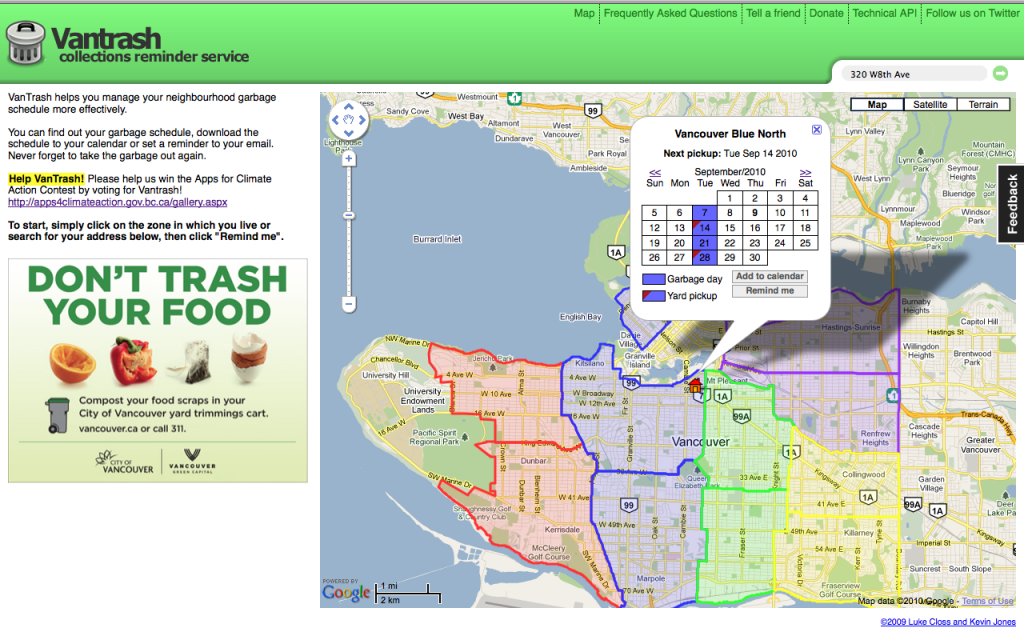
Screen-shot-2010-09-09-at-3.07.32-AM-1024x640As one of the more mature apps in Vancouver using open data Vantrash keeps being showing us how these types of innovations just keep giving back in new and interesting ways.

In addition to being used by over 3000 households (despite never being advertised – this is all word of mouth) it turns out that the city staff are also finding a use for vantrash.

I was recently told that 311 call staff use Vantrash to help trouble shoot incoming calls from residents who are having problems with garbage collection. The first thing one needs to do in such a situation is identify which collection zone the caller lives in – turns out VanTrash is the fastest and more effective way to accomplish this. Simply input the caller’s address into the top right hand field and presto – you know their zone and schedule. Much better than trying to find their address on a physical map that you may or may not have near your station.

TaxiCity, Open Data and Game Development

Another interesting spin off of open data. The TaxiCity development team, which recreated downtown Vancouver in 2-D using data from the open data catalog, noted that creating virtual cities in games could be a lot easier with open data. You could simply randomize the height of buildings and presto an instant virtual city would be ready. While the buildings would still need to be skinned one could recreate cities people know quickly or create fake cities that felt realistic as they’d be based on real plans. More importantly, this process could help reduce the time and resources needed to create virtual cities in games – an innovation that may be of interest to those in the video game industry. Of course, given that Vancouver is a hub for video game development, it is exactly these types of innovations the city wishes to foster and will help sustain Vancouver’s competitive advantage.

Links (in order of appearance in my talk)

Code For America shirt design can be seen in all their glory here and can be ordered here. As a fun aside, I literally took that shirt of Tim O’Reilly’s back! I saw it the day before and said, I’d wear that on stage. Tim overheard me and said he’d give me his if I was serious…

Vancouver’s Open Motion (or Open3, as it is internally referred to by staff) can be read in the city’s PDF version or an HTML version from my blog.

Vancouver’s Open Data Portal is here. keep an eye on this page as new data sets and features are added. You can get RSS feed or email updates on the page, as well as see its update history.

Vantrash the garbage reminder service’s website is here. There’s a distinct mobile interface if you are using your phone to browse.

ParkingMobility, an app that crowdsources the location of disabled parking spaces and enables users to take pictures of cars illegally parked in disabled spots to assist in enforcement.

TaxiCity, the Centre for Digital Media Project sponsored by Bing and Microsoft has its project page here. Links to the sourcecode, documentation, and a ton of other content is also available. Really proud of these guys.

Microsoft’s Internal Vancouver Open Data Challenge fostered a number of apps. Most have been opensourced and so you can get access to the code as well. The apps include:

The Graffiti Analysis written by University of British Columbia undergraduate students can be downloaded from this blog post I posted about their project.

BTA Works – the research arm of Bing Thom Architects has a great website here. You can’t download their report about the future of Vancouver yet (it is still being peer-reviewed) but you can read about it in this local newspaper article.

Long Tail of Public Policy – I talk about this idea in some detail in my chapter on O’Reilly Media’s Open Government. There is also a brief blog post and slide from my blog here.

Vancouver’s Open Data License – is here. Edmonton, Ottawa and Toronto use essentially the exact same thing. Lots that could be done on this front still mind you… Indeed, getting all these cities on a single standard license should be a priority.

Vancouver Data Discussion Group is here. You need to sign in to join but it is open to anyone.

Okay, hope those are interesting and helpful.

Canada's emerging opendata mashups (plus some ideas)

Over at IT World Canada, Jennifer Kavur has put together a list of 25 sites and apps for Open Government. What’s fantastic about this list is it demonstrates to government officials and politicians that there is a desire, here in Canada, to take government data and do interesting things with it.

Whether driven by developers like Michael Mulley or Morgan Peers who just want to improve democracy and have fun, or whether it is by those like Jeff Aramini who want to start a business and make money, the appetite to do something is real, and it is growing. Indeed, the number of apps and sites is far greater than 25 including simple mashups like CSEDEV’s environment Canada pollution data display or the 17 apps recently created as part of the Apps For Climate Action competition.

What is all the more remarkable is that this growth is happening even as there is little government data available. Yes, a number of cities have made data available, but provincially and especially federally there is almost no concerted effort to make data easy to use. Indeed, many of the sites cited by Kavur have to “scrape” the data of government websites, a laborious process that can easily break if the government website changes structure. It begs the question, what would happen if the data were accessible?

As an aside, two data sets I’m surprised no one has done much with are both located on the Toronto website: Road Restriction data and DineSafe data. Given how poor the city’s beta road restriction website is and the generally high interest in traffic news, I’d have thought that one of the local papers or media companies would have paid someone to develop an iPhone app or a widget for their website using this data. It is one thing commuters and consumers want to know more about.

As for DineSafe, I’m also surprised that no one in Toronto has approached the eatsure developers and asked them if they can port the site to Toronto. I’m still more surprised that a local restaurant review website has developed a widget that shows you to the DineSafe rating of a restaurant on its review page. Or that an company like urbanspoon or yelp hasn’t hired an iPhone app developer to integrate this data into their app…

Good times for Open Data in Canada. But if the feds and provinces were on board it could be much, much better…