Tag Archives: public policy

Province of BC launches Open Data Catalog: What works

As revealed yesterday, the province of British Columbia became the first provincial government in Canada to launch an open data portal.

It’s still early but here are some things that I think they’ve gotten right.

1. License: Getting it Right (part 1)

Before anything else happens, this is probably the single biggest good news story for Canadians interested in the opportunities around open data. If the license is broken, it pretty much doesn’t matter how good the data is, it essential gets put in a legal straightjacket and cannot be used. For BC open data portal this happily, is not the case.

There’s actually two good news stories here.

The first is that the license is good. Obviously my preference would be for everything to be unlicensed and in the public domain as it is in the United States. Short of that however, the most progressive license out there is the UK Government’s Open Government License for Public Sector Information. Happily the BC government has essentially copied it. This means that many of that BC’s open data can be used for commercial purposes, political advocacy, personal use and so forth. In short the restrictions are minimal and, I believe, acceptable. The license addresses the concerns I raised back in March when I said 2011 would be the year of Open Data licenses in Canada.

2. License: The Virtuous Convergence (part 2)

The other great thing is that this is a standardized license. The BC government didn’t invent something new they copied something that already worked. This is music to the ears of many as it means applications and analysis developed in British Columbia can be ported to other jurisdictions that use the same license seamlessly. At the moment, that means all of the United Kingdom. There has been some talk of making the UK Open Government Licenses (OGL) a standard that can be used across the commonwealth – that, in my mind, would be a fantastic outcome.

My hope is that this will also put pressure on other jurisdictions to either improve their licenses or converge them with BC/UK or adopt a better license still. With the exception of the City of Surrey, which uses the PDDL license, the BC government’s license far superior to the licenses being used by other jurisdictions:  – the municipal licenses based on Vancouver’s license (used by Vancouver, Edmonton, Ottawa, Toronto and a few others) and the Federal Government’s open data license (used by Treasury Board and CIDA) are both much more restrictive. Indeed, my real hope is that BC’s move will snap the Federal Government out of their funk, make them realize their own licenses are confusing, problematic and a waste of time, and encourage them to contribute to making the UK’s OGL a new standard for all of Canada. It would be much better than what they have on offer.

3. Tools for non-developers

Another nice thing about the data.gov.bc.ca website is that it provides tools for non-developers, so that they can play with, and learn from, some of the data. This is, of course, standard fare on most newer open data portals – indeed, it’s seems to be the primary focus on Socrata, a company that specializes in creating open government data portals. The goal everywhere is to increase the number of people who can make use of the data.

4. Meaty Data – Including Public Accounts

One of the charges sometimes leveled against open data portals is that they don’t publish data that is important, or that could drive substantive public policy debates. While this is not true of what has happened in the UK and the United States, that charge probably is someone fair in Canada. While I’m still exploring the data available on data.gov.bc.ca one thing seems clear, there is a commitment to getting the more “high-value” data sets out to the public. For example, I’ve already noticed you can download the Consolidated Revenue Fund Detailed Schedules of Payments-FYE10-Suppliers which for the fiscal year 2009-2010 details the payees who received $25,000 or more from the government. I also noticed that the Provincial Obstacles to Fish Passage are available for download – something I hope our friends in the environmental movement will find helpful. There is also an entire section dedicated to data on the provincial educational system, I’ll be exploring that in more detail.

Wanted to publish this for now, definitely keen to hear about others thoughts and comments on the data portal, data sets you find interesting and helpful, or anything else. If you are building an app using this data, or doing an analysis that is made easier because of the data on this site, I’d love to hear from you.

This is a big step for the province. I’m sure I’ll discover some shortcomings as I dive deeper, but this is a solid start and, I hope, an example to other provinces about what is possible.

Using Data to Make Firefox Better: A mini-case study for your organization

I love Mozilla. Any reader of this blog knows it. I believe in its mission, I find the organization totally fascinating and its processes engrossing. So much so I spend a lot of time thinking about it – and hopefully, finding ways to contribute.

I’m also a big believer in data. I believe in the power of evidence-based public policy (hence my passion about the long-form census) and in the ability of data to help organizations develop better products, and people make smarter decisions.

Happily, a few months ago I was able to merge these two passions: analyzing data in an effort to help Mozilla understand how to improve Firefox. It was fun. But more importantly, the process says a lot about the potential for innovation open to organizations that cultivate an engaged user community.

So what happened?

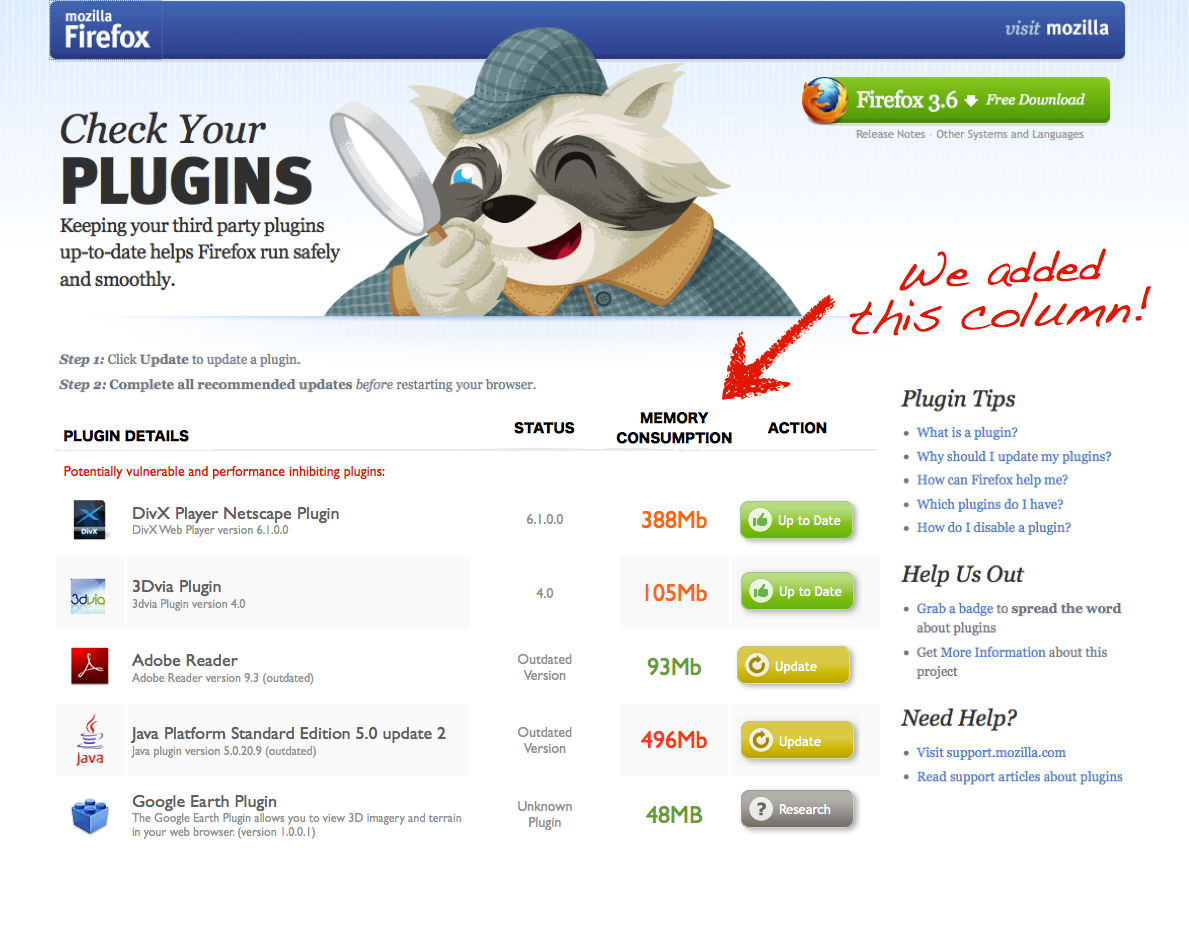
In November 2010, Mozilla launched a visualization competition that asked: How do People Use Firefox? As part of the competition, they shared anonymous data collected from Test Pilot users (people who agreed to share anonymous usage data with Mozilla). Working with my friend (and quant genius) Diederik Van Liere, we analyzed the impact of add-on memory consumption on browser performance to find out which add-ons use the most memory and thus are most likely slowing down the browser (and frustrating users!). (You can read about our submission here).

But doing the analysis wasn’t enough. We wanted Mozilla engineers to know we thought that users should be shown the results – so they could make more informed choices about which add-ons they download. Our hope was to put pressure on add-on developers to make sure they weren’t ruining Firefox for their users. To do that we visualized the data by making a mock up of their website – with our data inserted.

FF-memory-visualizations2.001

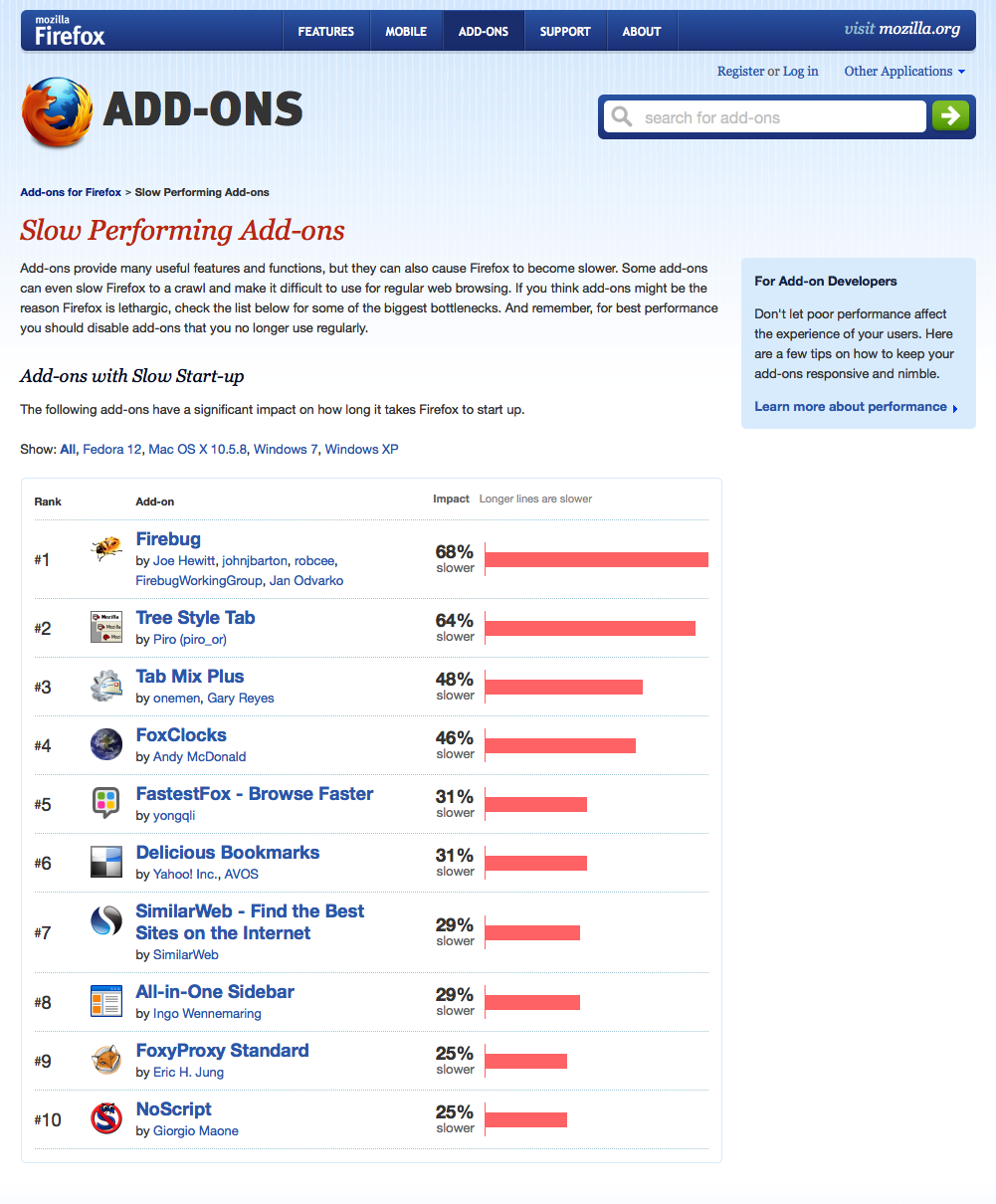
For our efforts, we won an honourable mention. But winning a prize is far, far less cool than actually changing behaviour or encouraging an actual change. So last week, during a trip to Mozilla’s offices in Mountain View, I was thrilled when one of the engineers pointed out that the add-on site now has a page where they list add-ons that most slow down Firefox’s start up time.

Slow-Performing-Add-ons-Add-ons-for-Firefox_1310962746129

(Sidebar: Anyone else find it ironic that “FastestFox: Browse Faster” is #5?)

This is awesome! Better still, in April, Mozilla launched an add-on performance improvement initiative to help reduce the negative impact add-ons can have on Firefox. I have no idea if our submission to the visualization competition helped kick-start this project; I’m sure there were many smart people at Mozilla already thinking about this. Maybe it was already underway? But I like to believe our ideas helped push their thinking – or, at least, validated some of their ideas. And of course, I hope it continues to. I still believe that the above-cited data shouldn’t be hidden on a webpage well off the beaten path, but should be located right next to every add-on. That’s the best way to create the right feedback loops, and is in line with Mozilla’s manifesto – empowering users.

Some lessons (for Mozilla, companies, non-profits and governments)

First lesson. Innovation comes from everywhere. So why aren’t you tapping into it? Diederik and I are all too happy to dedicate some cycles to thinking about ways to make Firefox better. If you run an organization that has a community of interested people larger than your employee base (I’m looking at you, governments), why aren’t you finding targeted ways to engage them, not in endless brainstorming exercises, but in innovation challenges?

Second, get strategic about using data. A lot of people (including myself) talk about open data. Open data is good. But it can’t hurt to be strategic about it as well. I tried to argue for this in the government and healthcare space with this blog post. Data-driven decisions can be made in lots of places; what you need to ask yourself is: What data are you collecting about your product and processes? What, of that data, could you share, to empower your employees, users, suppliers, customers, whoever, to make better decisions? My sense is that the companies (and governments) of the future are going to be those that react both quickly and intelligently to emerging challenges and opportunities. One key to being competitive will be to have better data to inform decisions. (Again, this is the same reason why, over the next two decades, you can expect my country to start making worse and worse decisions about social policy and the economy – they simply won’t know what is going on).

Third, if you are going to share, get a data portal. In fact, Mozilla needs an open data portal (there is a blog post that is coming). Mozilla has always relied on volunteer contributors to help write Firefox and submit patches to bugs. The same is true for analyzing its products and processes. An open data portal would enable more people to help find ways to keep Firefox competitive. Of course, this is also true for governments and non-profits (to help find efficiencies and new services) and for companies.

Finally, reward good behaviour. If contributors submit something you end up using… let them know! Maybe the idea Diederik and I submitted never informed anything the add-on group was doing; maybe it did. But if it did… why not let us know? We are so pumped about the work they are doing, we’d love to hear more about it. Finding out by accident seems like a lost opportunity to engage interested stakeholders. Moreover, back at the time, Diederik was thinking about his next steps – now he works for the Wikimedia Foundation. But it made me realize how an innovation challenge could be a great way to spot talent.

If the Prime Minister Wants Accountable Healthcare, let's make it Transparent too

Over at the Beyond the Commons blog Aaron Wherry has a series of quotes from recent speeches on healthcare by Canadian Prime Minister Stephen Harper in which the one constant keyword is… accountability.

Who can blame him?

Take everyone promising to limit growth to a still unsustainable 6% (gulp) and throw in some dubiously costly projects ($1 billion spent on e-health records in Ontario when an open source solution – VistA – could likely have been implemented at a fraction of the cost) and the obvious question is… what is the country going to do about healthcare costs?

I don’t want to claim that open data can solve the problem. It can’t. There isn’t going to be a single solution. But I think it could help spread best practices, improve customer choice and service as well as possibly yield other potential benefits.

Anyone who’s been around me for the last month knows about my restaurant inspection open data example (which could also yield healthcare savings) but I think we can go bigger. A Federal Government that is serious about accountability in Healthcare needs to build a system where that accountability isn’t just between the provinces and the feds, it needs to be between the Healthcare system and its users; us.

Since the feds usually attach several provisions to their healthcare dollars, the one I’d like to see is an open data provision. One where provinces, and hospitals are required to track and make open a whole set of performance data, in machine readable formats, in a common national standard, that anyone in Canada (or around the world) can download and access.

Some of the data I’d love to see mandated to be tracked and shared, includes:

  • Emergency Room wait times – in real time.
  • Wait times, by hospital, for a variety of operations
  • All budget data, down to the hospital or even unit level, let’s allow the public to do a cost/patient analysis for every unit in the country
  • Survival rates for various surgeries (obviously controversial since some hospitals that have the lowest rates are actually the best since they get the hardest cases – but let’s trust the public with the data)
  • Inspection data – especially if we launched something akin to the Institute for Health Management’s Protecting 5 Millions Lives Campaign
  • I’m confident there is much, much more…

I can imagine a slew of services and analysis that emerge from these, if nothing than a citizenry that is better informed about the true state of its healthcare system. Even something as simple as being able to check ER wait times at all the hospitals near you, so you can drive to the one where the wait times are shortest. That would be nice.

Of course, if the Prime Minister wants to go beyond accountability and think about how data could directly reduce costs, he might take a look at one initiative launched south of the border.

If he did, he might be persuaded to demand that the provinces share a set of anonymized patient records to see if academics or others in the country might be able to build better models for how we should manage healthcare costs. In January of this year I witnessed the launch of the $3 million dollar Heritage Health Prize at the O’Reilly Strata Conference in San Diego. It is a stunningly ambitious, but realistic effort. As the press release notes:

Contestants in the challenge will be provided with a data set consisting of the de-identified medical records of 100,000 patients from the 2008 calendar year. Contestants will then be required to create a predictive algorithm to predict who was hospitalized during the 2009 calendar year. HPN will award the $3 million prize(more than twice what is paid for the Nobel Prize in medicine) to the first participant or team that passes the required level of predictive accuracy. In addition, there will be milestone prizes along the way, which will be awarded to teams leading the competition at various points in time.

In essence Heritage Health is doing to patient management what Netflix (through the $1M Netflix prize) did to movie selections. It’s crowdsourcing the problem to get better results.

The problem is, any algorithm developed by the winners of the Heritage Health Prize will belong to… Heritage Health. This means the benefits of this innovation cannot benefit Canadians (nor anyone else). So why not launch a prize of our own. We have more data, I suspect our data is better (not limited to a single state) and we could place the winning algorithm in the public domain so that it can benefit all of humanity. If Canadian data helped find efficiencies that lowered healthcare costs and improved healthcare outcomes for everyone in the world… it could be the biggest contribution to global healthcare by Canada since Federick Banting discovered insulin and rescued diabetics everywhere.

Of course, open data, and sharing (even anonymized) patient data would be a radical experiment for government, something new, bold and different. But 6% growth is itself unsustainable and Canadians need to see that their government can do something bold, new and innovative. These initiatives would fit the bill.

TorStar Op-ed: Liberals have to create a next political centre

This past Saturday the Toronto Star published the following piece by Taylor Owen and myself on its op-ed page. Thought I’d put it here for those who might have missed it.

Liberals have to create a new political centre

Canadians may have once valued the Liberal party, but they reject what it has become. The reason is simple. The centre is dead. Worse still, Liberals let it die. What once was the pragmatic core of Canadian politics, today is a wasteland devoid of an imaginative, progressive vision, occupied by a largely obsolete electoral strategy.

Don’t believe us? Consider the issues the Liberal party managed over the 20th century. The creation of universal health care and the social safety net. The management of the Canada-U.S. relationship by balancing opportunities for Canadian businesses with our desire to preserve our identity. Engaging Quebec and seeking to affirm its place within the country. Cultivating multiculturalism while simultaneously securing individual rights in a charter. Fostering peacekeeping to ensure local conflicts did not escalate into nuclear confrontation.

These were significant accomplishments that defined three generations of Canadians. They are also no longer relevant.

Today Canadians, especially young Canadians, are confident about themselves and their identity — no longer is there a “lament for a nation.” The sovereignty movement, while not dead, struggles. Individual rights continue to erode discrimination and the hierarchical relationships that impeded free expression and liberty. While some progressives continue to bang these drums, no one should be surprised that they no longer resonate.

In other cases, the solutions offered in the 20th century are no longer relevant. Canadians know — as health care threatens to eat up 50 per cent of provincial budgets and service levels remain mixed — that their health-care system is broken. Young Canadians don’t even pretend to believe a pension system will exist for them. Anyone can see that peacekeeping cannot solve today’s international conflicts.

On all of these issues, the traditional offerings of progressive rings hollow. But there is an opportunity for progressives. An opportunity to build a new centre. A centre that moves beyond the debate between conservatives of the right and conservatives of the left.

On the right is a Conservative party that, at its core, doesn’t believe in the federal government. It’s a vision for Canada grounded in the 1860s, of a minimalist government that is responsible for little beyond law and order and defence. Its appeal is the offer to dismantle the parts of the system that are broken, but in so doing it will leave behind many of those who are protected and enabled by the government.

On the left is a party whose vision is to return Canada to the 1960s. It’s a world of a strong national government, of an even bigger health-care system, social safety net and welfare state. Its appeal is a defence of the status quo at all costs, which in the long run will be many. The conservatism of the left means protecting what is unsustainable. It is the unreformed arc of old ideas.

If there is going to be a new centre between these conservative poles, Liberals will need to stop lying to themselves — and to Canadians. They need to acknowledge — loudly and publicly — that they failed to reform the institutions of the 20th century and, as a consequence, health care is broken and the welfare state as presently constructed is financially insatiable. A progressive future lies in taking these challenges head on rather that passively avoiding them.

Moreover, a modern progressive view of government needs to meet the consumer expectations created by Google, Apple and WestJet. Fast, effective, personalized, friendly. In short, progressives need a vision that not only safeguards citizens against the extremes of a globalizing market, but also meets the rising expectations Canadians have of services in the 21st century — all this in a manner that will be sustainable given 21st century budgets and demographics.

No party has figured out how to accomplish this, on the left or the right. And trolling through 20th or 19th century ideologies probably isn’t going to get us there.

The future for progressives rests in figuring out the political axes of the 21st century around which new solutions can be mined and new coalitions built.

We suspect these will include open vs. closed systems; evidence-based policy vs. ideology; meritocratic governance vs. patronage; open and fair markets vs. isolationism; sustainability vs. disposability, and emergent networks vs. hierarchies. It is these political distinctions, not the old left versus right, that increasingly resonate among those we speak to.

The challenge is enormous but progressives have done it before. In the 19th century, the rise of industrial capitalism led to a series of tense societal changes, including the emergence of an urban working class, increasing inequality and the terrifying possibility of total war.

A centrist party turned out to be the place where three generations of pragmatically driven progressives were able to lead nearly a century of Canadian politics. Doing this again will require starting from scratch, but that is the task at hand.

David Eaves is a specialist on public policy, collaboration and open source methodologies.

Taylor Owen is a Banting Fellow at the Liu Institute for Global Issues at the University of British Columbia

City of Vancouver Wins Top Innovator Award from BC Business

To be clear, this is not top innovator among governments, this is top innovator among all organizations – for-profit, non-profit and government – in the province.

You can see the award write up here.

As the article states, Vancouver Open-Data initiative “floored the [judging] panel.” Indeed, one panellist stated: “I have never seen a municipality open to new ideas in my life. When was the last time any level of government said, Here are our books; fill your boots?”

Back in October BC Business asked me to write a think piece explaining open data, I ended up penning this piece entitled “The Difference Data Makes”. It fantastic to see the business community recognizing the potential of open data and how it could transform both the way government works, and the opportunities it poses for the private and non-profit organizations as well as citizens.

It’s a great data for the City of Vancouver and for Open Data.

Calgary Launches Business Plan and Budget App

So this is interesting. The City of Calgary has launched a Business Plan & Budget app for free from iTunes.

It’s a smart move as it creates an easy, “one button” option for citizens to participate in and learn about the city’s financial planning process. You can read (a tiny bit) more at the City of Calgary’s blog.

Looking more closely at the app, it doesn’t offer a huge amount but don’t dismiss it too quickly. Consolidating all the information into a single place and making it available to people on the go is a great starting point. Secondly, it is worth remembering that this is just a starting point – there is obviously lots to be learned about how to engage citizens online – especially using mobile technology. If this is done right, Calgary will be learning these lessons first, which means their 2nd and 3rd generation versions of the app and the process will be more sophisticated while others are left catching up (think of Apple and the iPad).

So while the app is fairly light on features today… I can imagine a future where it becomes significantly more engaging and comprehensive, using open data on the data and city services to show maps of where and how money is spent, as well as post reminders for in person meet ups, tours of facilities, and dial in townhall meetings. The best way to get to these more advanced features is to experiment with getting the lighter features right today. The challenge for Calgary on this front is that it seems to have no plans for sharing much data with the public (that I’ve heard of), it’s open data portal has few offerings and its design is sorely lacking. Ultimately, if you want to consult citizens on planning and the budget it might be nice to go beyond surveys and share more raw data and information with them, it’s a piece of the puzzle I think will be essential. This is something no city seems to be tackling with any gusto and, along with crime data, is emerging as a serious litmus test of a city’s intention to be transparent.

The possibilities that Calgary’s consultation app presents are exciting – and again it is early days – so it will be interesting if developers in Calgary and elsewhere can begin to figuring out how to easily extend and enhance this type of approach. Moreover, it’s nice to see a city venturing out and experimenting with this technology, I hope other cities will not just watch, but start experiments of their own, it’s the best way to learn.


MP Jim Abbott: The Face of the Sad State of Open Data in Canada

“I guess my attack to this has always been from the perspective of are we working in a bubble. In other words, when this was… under this initiative by the President, how quick was the takeup by the population at large? Not by the people that we affectionately call geeks, or people who don’t have a life, or don’t come up out of the dark, or whatever. The average person walking through Times Square I guess is what I’m trying to say. How quick was their take up, and in fact has there been a takeup?”

Jim Abbott, ETHI Meeting No. 47, Open Government Study, March 2, 2011

Yes, the above quote comes from Jim Abbott, Member of Parliament (Conservative) for Kootenay—Columbia during the testimony of Beth Noveck, President Obama’s former Deputy Chief Technology Officer for Open Government (her statement can be found here). You can see the remarks in the online video here, at around the 1:17:50 mark.

First, I want to be clear. This is disappointing, not on a political level, but on an individual level. During my testimony for the ETHI committee (which I intend to blog about) I found members of all parties – NDP, Liberal, Bloc Quebecois and Conservative – deeply interested in the subject matter, asking thoughtful questions and expressing legitimate concerns. Indeed, I was struck by Pierre Poilievre, the Conservative MP for Napean-Carleton, who asked a number of engaging questions, particularly around licenses. That’s a level of sophistication around the issue that many people don’t care to ask about. Moreover, many of the committee members grasped the economic and social opportunity around open data.

Jim Abbott, in contrast, may believe that describing technologists and geeks as people who “don’t have a life” or “don’t come up out of the dark” is affectionate, but I’m not so sure these stereotypes are so endearing, especially given how they aren’t true. Moreover, his comments are particularly unfortunate as it’s the people he (affectionately) demeans who created RIM, OpenText, Cognos, and thousands of other successful technology companies that pump billions into the Canadian economy, employ hundreds of thousands, and do actually impact the “person on the street.” But a few simple demeaning words can make one forget these contributions or worse, make them sound insignificant.

Of course, it will be the work of these people that creates the open data applications that, in the US at least, already impact the average person walking through Times Square (consider this lifesaving app that was created by a hacker using opendata). Indeed, there are a growing number of businesses consuming and using open data, some even valued in the billions of dollars and used by millions of americans every day.

The sad part is they will only be available to the people in Times Square, or Trafalgar Square or on the Champs-Élysées since the Americans, British and French all have national open data portals (among numerous other countries). There will be no uptake for people on Wellington St., Queen St., Robson St. or wherever, since without a national open data portal in Canada, there can be no uptake. (It’s not easy to be behind the French government on an issue related to the digital economy, but we’ve somehow managed).

But forget the economic opportunity. There is also the question of government transparency and accountability. What makes the above statement so disappointing is that it exposes how an MP who for so long railed for greater transparency in government, has suddenly decided that transparency is no longer important unless “there is sufficient uptake.”

One wonders what Jim Abbott of 2000 would say of Jim Abbott of 2011? Because back in a pre-2001 era Jim Abbott had fantastic quotes like this:

I suggest in the strongest way possible to the minister that even if we can get him to clear up the history of the Canada Information Office, which I do not have a lot of hope for but I am asking for, from this point forward there must be proper transparency of the Canada Information Office. The country needs openness and transparency because democracy cannot be true democracy without openness and transparency.

Jim Abbott, June 8th, 2000 / 11:10 a.m.

and this

Second, the difficulty the government has created with the Canada Information Office is that many of the contracts and much of the ongoing activity have been conducted in a way that does not befit what we are in Canada, which is a democracy. In a democracy the people depend on the people in the Chamber to hold the government accountable for the affairs of the government and to be as transparent as possible.

Jim Abbott, June 8th, 2000 / 11:10 a.m.

and this

It will never have the transparency that it must have in a democracy. It is just absolutely unacceptable.

Jim Abbott, June 16th, 1995 / 3:25 p.m.

I could go on…

(If you are wondering how I was able to dig up these quotes, please check out OpenParliament.ca – it really is extraordinary tool and again, shows the power of open (parliamentary) data).

But more importantly, and on point, it seems to me that Jim Abbott from the year 2000 would see open data as a important way to ensure greater transparency. Wouldn’t it have been nice if the Canada Information Office had had its budget and expenditures available as open data? Wouldn’t that have brought about some of the accountability the 2000 Jim Abbott would have sought? Sadly, and strangely, Jim Abbott of 2011 no longer seems to feel that way.

Yes, if only he could meet Jim Abbott of 2000, I think they’d have a great debate.

Of course, Jim Abbott of 2000 can’t meet Jim Abbott of 2011, and so it is up to us to (re)educate him. And on that front, I have, so far, clearly failed the tech community, the open data community and the government accountability community. Hopefully with time and more effort, that will change. Maybe next time I’m in Ottawa, Jim Abbott and I can grab coffee and I can try again.

Today in the Toronto Star: End the silence on aid

Sorry for the cross post – I have this piece today on the opinion page of the Toronto Star. They’ve actually done a nice graphic for it so do encourage you to check it out.

End the silence on aid

For the past two weeks, Canadians have slowly watched the minister of international development, Bev Oda, implode. Caught in a slowly escalating scandal, it’s become clear that the minister misled Parliament — and the public — about how the government chooses whom it funds to do international development work.

The scandal around Oda, however, is a metaphor for a much larger problem in Canada’s foreign aid. The world is dividing itself into donors who hold forth an open model of evidence, accountability and, above all, transparency, and those who cling to a model of patronage, ideology and opacity.

So the question is: Where will Canada land on this debate? So far, the answer is not promising.

Internationally, the Kairos decision suggests Canada is on the wrong side of the divide. Indeed, the gap between CIDA and the world’s leading institutions is growing. Consider a recent report by the U.K.-based international advocacy group Publish What You Fund. Of the 30 institutions assessed in its 2010 report on aid transparency, the Canadian International Development Agency ranked 23rd. Among countries, Canada ranked 15th out of 22 (the Netherlands, U.K. and Ireland held the top three spots).

We are, by any metric, near the bottom of the pack. For a country and a government that prides itself on accountability and transparency, it’s a damning assessment.

What’s all the more frustrating is that transparency isn’t just about accountability. It’s about effectiveness and saving taxpayers’ money — something our major allies have already figured out.

So while Canada’s international development minister fights allegations of making the decision-making process more opaque, a coalition of leading countries is moving forward — without Canada — to do the opposite.

Take, for example, the newly founded International Aid Transparency Initiative (IATI). A coalition of donor governments, developing countries and NGOs, the IATI has a single goal: to improve aid effectiveness by making information about aid spending easier to access, use and understand.

It’s a deeply pragmatic exercise, one far removed from the partisan politics around aid seen in Canada. In one of its first reports, it outlines how setting up systems to make aid data available would involve a one-time cost of between $50,000 and $500,000, but would save taxpayers in countries like Canada several times that amount every year.

Part of these savings would come just from reducing bureaucracy. Making data publicly available would eliminate the need for civil servants to respond to duplicate information requests from international organizations, other governments and Canadian organizations. Instead, the relevant information could just be downloaded. It’s the kind of efficiency we expect from our government.

It’s also the kind of transparency Canadians are starting to see elsewhere. The World Bank — at one time loathed for its opacity — has made transparency a core value of its operations. It recently launched an open data portal where it shares enormous quantities of information on the global economy and aid projects. It has also promised much more and is slowly rolling out a “mapping for results” website where every project the bank funds and how much money it receives can be viewed on a downloadable map.

Canada sits on the sidelines while others move forward implementing proposals that could — ironically — fund several Kairoses every year.

The costs aren’t borne just by taxpayers, but also by Canadian NGOs. They have to provide the same information, but in different forms, to every government and organization that funds them. This means aid workers spend precious time and money filling out CIDA’s unique forms. Repeat this cost over the hundreds of projects that CIDA funds and the collective waste is enormous.

Perhaps more importantly, making our aid more transparent and accessible would close another gap — our inability to measure our effectiveness. One of the reasons countries like the U.K., Denmark and Sweden have signed up to the International Aid Transparency Initiative is so they can more easily compare the projects they fund with one another. These are countries that are serious about getting bang for their buck — they want to compare the evidence, see which projects work, and which ones fail.

It’s a lesson leading Canadian organizations are taking to heart. Engineers Without Borders, for example, regularly publishes a “failure report” in which it outlines which of its projects didn’t work and why. This honest, open and evidence-based approach to development is exactly what we need to demand of our government. Anything less constitutes a waste of our tax dollars.

And yet, the current debate in Parliament suggests we may be mapping a different route — one of opaque, ideologically driven development that is blind to both effectiveness and accountability. This serves neither Canadians nor donor recipients well.

Regardless of whether Oda resigns, Canadians should not lose sight of the larger issue and opportunity. We are in the midst of a global movement for international development aid transparency.

The benefits are clear, our allies are present, and even five of our focus recipient countries have signed up. And yet, Canada is nowhere to be found.

Lessons from fashion's free culture: Johanna Blakley on TED.com

This TEDx talk by Johanna Blakley is pure gold (thank you Jonathan Brun for passing it along). It’s a wonderful dissection – all while using the fashion industry as a case study – of how patents and licenses are not only unnecessary for innovation but can actually impede it.

What I found particularly fascinating is Johanna’s claim that long ago the US courts decided that clothing was “too utilitarian” to have copyright and patents applied to it. Of course, we could say that of a number of industries today – the software industry coming to mind right off the bat (can anyone imagine a world without software?).

The presentation seems to confirm another thought I’ve held – weaker copyright and patents protections do not reduce or eliminate peoples incentive to innovate. Quite the opposite. It both liberates innovation and increases its rate as others are able to copy and reuse one another. In addition, it makes brands stronger, not weaker. In a world where anybody can copy anybody, innovation and the capacity to execute matters. Indeed, it is the only thing that matters.

It would be nice if, here in Canada, the Ministers of Heritage (James Moore) and Industry (Tony Clement) would watch and learn from this video – and the feedback they received from ordinary Canadians. If we want industries as vibrant and profitable as the fashion industry, it may require us to think a little differently about copyright reform.

Sharing Critical Information with the public: Lessons for Governments

Increasingly governments are looking for new and more impactful ways to communicate with citizens. There is a slow but growing awareness that traditional sources of outreach, such as TV stories and newspaper advertisements are either not reaching a significant portion of the population and/or have little impact on raising awareness of a given issue.

The exciting thing about this is that there is some real innovation taking place in governments as they grapple with this challenge. This blog post will look at one example from Canada and talk about why the innovation pioneered to date – while a worthy effort – falls far short of its potential. Specifically, I’m going to talk about how when governments share data, even when they use new technologies, they remain stuck in a government-centric approach that limits effectiveness. The real impact of new technology won’t come until governments begin to think more radically in terms of citizen-centric approaches.

The dilemma around reaching citizens is probably felt most acutely in areas where there is a greater sense of urgency around the information – like, say, in issues relating to health and safety. Consequently, in Canada, it is perhaps not surprising to see that some of the more innovative outreach work has thus been pioneered by the national agency responsible for many of these issues, Health Canada.

HC-Widgethc-appThe most cutting edge stuff I’ve seen is an effort by Health Canada to share advisories from Health Canada, Transport Canada and the Canadian Food Inspection Agency via three vehicles: an RSS feed, a mobile app available for Blackberry, iPhone (pictured far right) and Android, and finally as a widget (pictured near right) that anyone can install into their blog.

I think all of these are interesting ideas and have much to commend them. It is great to see information of a similar type, from three different agencies, being shared through a single vehicle – this is definitely a step forward from a user’s perspective. It’s also nice to see the government experiment with different vehicles for delivery (mobile and other parties’ websites).

But from a citizen-centric perspective, all these innovations share a common problem: They don’t fundamentally change the citizen’s experience with this information. In other words, they are simply efforts to find new ways to “broadcast” the information. As a result, I predict that these intiatives will have a minimal impact as currently structured. There are two reasons why:

The problem isn’t about access: These tools are predicated on the idea that the problem to conveying this information is about access to the information. It isn’t. The truth is, people don’t care. We can debate about whether they should care but the fact of the matter is, they don’t. Most people won’t pay attention to a product recall until someone dies. In this regard these tools are simply the modern day version of newspaper ads, which, historically, very few people actually paid attention to. We just couldn’t measure it, so we pretended like people read them.

The content misses the mark: Scrape a little deeper on these tools and you’ll notice something. They are all, in essence, press releases. All of these tools, the RSS feed, blog widget and mobile apps, are simply designed to deliver a marginally repackaged press release. Given that people tuned out of newspaper ads, pushing these ads onto them in another device will likely have a limited impact.

As a result, I suspect that those likely to pay attention to these innovations were probably those who were already paying attention. This is okay and even laudable. There is a small segment of people for whom these applications reduce the transactions costs of access. However, with regard to expanding the numbers of Canadians impacted my this information or changing behaviour in a broader sense, these tools have limited impact. To be blunt, no one is checking a mobile application before they buy a product, nor are they reading these types of widgets in a blog, nor is anyone subscribing to an RSS feed of recalls and safety warnings. Those who are, are either being paid to do so (it is a requirement of their job) or are fairly obsessive.

In short, this is a government-centric solution – it seeks to share information the government has, in a context that makes sense to government – it is not citizen-centric, sharing the information in a form that matters to citizens or relevant parties, in a context that makes sense to them.

Again, I want to state while I draw this conclusion I still applaud the people at Health Canada. At least they are trying to do something innovative and creative with their data and information.

So what would a citizen-centric approach look like? Interestingly, it would involve trying to reach out to citizens directly.

People are wrestling with a tsunami of information. We can’t simply broadcast them with information, nor can we expect them to consult a resource every time they are going to make a purchase.

What would make this data far more useful would be to structure it so that others could incorporate it into software and applications that could shape people’s behaviors and/or deliver the information in the right context.

Take this warning, for example: “CERTAIN FOOD HOUSE BRAND TAHINI OF SESAME MAY CONTAIN SALMONELLA BACTERIA” posted on Monday by the Canadian Food Inspection Agency. There is a ton of useful information in this press release including things like:

The geography impacted: Quebec

The product name, size and better still the UPC and LOT codes.

Product Size UPC Lot codes
Tahini of Sesame 400gr 6 210431 486128 Pro : 02/11/2010 and Exp : 01/11/2012
Tahini of Sesame 1000gr 6 210431 486302 Pro: 02/11/2010 and Exp: 01/11/2012
Premium Halawa 400gr 6 210431 466120 Pro: 02/11/2010 and Exp: 01/11/2012
Premium Halawa 1000gr 6 210431 466304 Pro: 02/11/2010 and Exp: 01/11/2012

However, all this information is buried in the text so is hard to parse and reuse.

If the data was structured and easily machine-readable (maybe available as an API, but even as a structured spreadsheet) here’s what I could imagine happening:

  1. Retailers could connect the bar code scanners they use on their shop floors to this data stream. If any cashier swipes this product at a check out counter they would be immediately notified and would prevent the product from being purchased. This we could do today and would be, in my mind, of high value – reducing the time and costs it takes to notify retailers as well as potentially saving lives.
  2. Mobile applications like RedLaser, which people use to scan bar codes and compare product prices could use this data to notify the user that the product they are looking at has been recalled. Apps like RedLaser still have a small user base, but they are growing. Probably not a game changer, but at least context sensitive.
  3. I could install a widget in my browser that, every time I’m on a website that displays that UPC and/or Lot code would notify me that I should not buy that product and that it’s been recalled. Here the potential is significant, especially as people buy more and more goods over the web.
  4. As we move towards having “smart” refrigerators that scan the RFID chips on products to determine what is in the fridge, they could simply notify me via a text message that I need to throw out my jar of Tahini of Sesame. This is a next generation use, but the government would be pushing private sector innovation in the space by providing the necessary and useful data. Every retailer is going to want to sell a “smart” fridge that doubles as a “safe” fridge, telling you when you’ve got a recalled item in it.

These are all far more citizen-centric, since they don’t require citizens to think, act or pay attention. In short, they aren’t broadcast-oriented, they feel customized, filtering information and delivering it where citizens need it, when they need it, sometimes without them even needing to know. (This is the same argument I made in my How Yelp Could Help Save Millions in Healthcare Costs). The most exciting thing about this is that Health Canada already has all the data to do this, it’s just a question of restructuring it so it is of greater use to various consumers of the data – from retailers, to app developers, to appliance manufactuers. This should not cost that much. (Health Canada, I know a guy…)

Another advantage of this approach is that it also gets the Government out of the business of trying to find ways to determine the best and most helpful way to share information. This appears to be a problem the UK government is also interested in solving. Richard A. sent me this excellent link in which a UK government agency appeals to the country’s developers to help imagine how it can better share information not unlike that being broadcast by Health Canada.

However, at the end of the day even this British example falls into the same problem – believing that the information is most helpfully shared through an app. The real benefit of this type of information (and open data in general) won’t be when you can create a single application with it, but when you can embed the information into systems and processes so that it can notify the right person at the right time.

That’s the challenge: abandoning a broadcast mentality and making things available for multiple contexts and easily embeddable. It’s a big culture shift, but for any government interested in truly exploring citizen-centric approach, it’s the key to success.