Tag Archives: technology

who is going to cover city hall? we will…

More follow up on the future of democracy and the media. In the comments one reader – Karen – commented:

So….which of you brilliant Gen Y bloggers is going to sit at local park board meetings to find out how they are spending your tax money? Just wondering.

I don’t care whether newspapers live or die. It’s just a medium. (Yes, the singular of “media.”) It may well be it’s an outdated medium. It’s certainly a wasteful, expensive and environmentally harmful medium.

However, when newspapers die (so what? good riddance) the services that newspapers have traditionally supplied – such as serving as watchdogs for even the smallest municipalities, taxing bodies and so on – remain necessary to a functioning democracy. What happens when governments make decisions with no one watching?

And it’s tedious, people. Maybe some of you are experienced with this. Sitting through three-hour meeting of county commissioners, poring through stacks of facts and figures, following up to ask questions, finding alternate points of view – this is time consuming and not a whole lot of fun. When there are no reporters at these meetings, who will do this? Do you think it is no longer necessary? Will citizen journalists spend hours – unpaid – going line by line over the police board’s budget?

Well, according to Frances Bula, one of Vancouver’s finest journalist’s focused on local politics (she used to work at the Vancouver Sun, and now freelances for several publications, including the Globe and Mail) it is us who are covering this “small” stories. In a recent post entitled “When did civic politics get so interesting?” she states:

It’s hard to remember, but in those days, no one cared about city hall. It used to be me and a couple of Chinese-language-media reporters who would hang out in the pews at city council chambers on Tuesdays. When I went to the committee meetings on Thursday, I was usually the only reporter there. People coming to speak to council issues sometimes thought I was the recording secretary. And it was like that for quite a long time. Years and years, really, although Allen Garr started writing for the Courier after a while so then there was, thankfully, one more person.

This week in Vancouver, when city hall was stuffed like a turkey with news — the budget, cracking down on crummy SROs, whether to allow mixed martial arts events, police budgets being wrecked by gang investigations, Councillor Suzanne Anton grilling the mayor like he was a naughty boy about campaign financing — there were as many reporters and outlets covering the events as at any session of the provincial legislature…

…So, even though I now can’t get a seat at the media table these days if I come late to council, and it feels sometimes like everyone is falling over each other to get the latest little tidbit from the city, it’s okay — and even kind of fun — that it’s crowded.

But then this is what Shirly predicted would happen once the we understood the size of the cognitive surplus that is out there…

Blogging: Dealing with difficult comments

Embedded below is an abridged version (10 minutes!) of my 2009 Northern Voice presentation on managing and engaging the community the develops around one’s blog. Specifically, one goals of this presentation was to pull in some of the thinking from the negotiation and conflict management space and see how it might apply to dealing with people who comment on your blog. Hopefully, people will find it interesting.

Finally, a key lesson that came to me while developing the presentation is that most blogs, social media projects, and online projects in general, really need a social contract – or as Skirky describes it, a bargain – that the organizer and the community agree to. Often such contracts (or bargains) are strongly implied, but I believe it is occasionally helpful to make them explicit – particularly on blogs or projects that deal with contentious (politics) or complicated (many open source projects) issues.

At 8:43 in the presentation I talk about what I believe is the implicit bargain on my site. I think about codifying it, especially as a I get more and more commentors. That said, the community that has developed around this blog – mostly of people I’ve never met –  is fantastic, so there hasn’t been an overwhelming need.

Finally thank you to Bruce Sharpe for posting a video of the presentation.

So, I hope this brief presentation is helpful to some of you.

(Notice how many people are coughing! You can tell it was winter time!)

Healthcare innovation

m2graphicThis link (via Gayle D.) is pure awesome. Turns out someone has decided to offer prescription drugs via an ATM. For policy wonks, this has all the hallmarks of a disruptive innovation.

I suspect that in the pharmaceutical industry the 80/20 rule is in effect. That being 80% of  patients are using only 20% of the available drugs. So a small number of drugs account for the vast majority of all prescriptions filled. That means you could service a huge part of the market with only a handful of drugs on hand.

This is precisely what this ATM for drugs allows you to do. Moreover, it allows you to do it faster, cheaper and with a better experience for customers. That is precisely what a disruptive innovation is.

Indeed, you can see the early signs of its disruptive nature in the way it is being talked about.

The Canadian Pharmacists’ Association has endorsed the machine, but it appears oblivious to the machine’s implications (despite the very clear case study of the decline of bank tellers after the introduction of ATMs – although perhaps the idea of pharmacists comparing themselves to bank tellers is so threatening that they ignored that data):

Some pharmacists will undoubtedly feel threatened by the technology, says Jeff Poston, executive director of the Canadian Pharmacists’ Association.

But he predicts the machines will have only a niche role, likely in remote communities that have limited pharmacy services, since the devices offer patients a “lesser” form of communication with the druggist.

“I tend to think the face-to-face encounter with the pharmacist would win hands down,” he said.

Niche role? I suppose, if you count 80% of the pharmacy business as niche. I suspect this service will take off – and we’ll need fewer pharmacists. On the flip side, the pharmacists we keep will have to very good since they’ll be focused on the more dangerous, complicated and difficult prescriptions – which really is the best use of their time.

What about people’s alleged preference for face-to-face encounters? Perhaps this is a preference. But how strong is that preference? For me, it isn’t so strong that I’m willing to hang around in the pharmacy for 30 minutes while my prescription is being filled, or worse, to come back they next day. I suspect that the overwhelming majority of us will use the ATMs – just like we do at the bank.

Indeed, the president of the company that creates the ATMs for drugs – who is quoted later in the article – knows what’s really going on:

Just over 800 patients used the machines at Sunnybrook to obtain 1,200 prescriptions between June and September. A survey of 108 of them indicated that more than 95% received their drug in less than five minutes and would use PharmaTrust again, said Peter Suma, president of PCA. None of the prescriptions was incorrectly filled, he said.

Not everyone, however, was able to take advantage of the pharmaceutical ATMs. About a third of patients who tried discovered that their medicine was not available, said Dr. Domb, though PCA offers to deliver those orders to the patient’s home the next day.

Despite such limitations, Mr. Suma predicts his kiosks will be embraced by consumers accustomed to instant, technologically aided service, especially when the devices are “deployed ubiquitously.”

95% satisfaction rate? This technology is killer. And check out the different perspectives of the two quotes.

On the one hand, the industry expert and entrenched actor (the pharmacists association executive director) believes the ATMs will be restricted to a niche market (such as rural markets). In contrast, the disruptor (the president of PCA) sees these machines as being “deployed ubiquitously.”

They can’t both be right.

Journalism in an Open Era (follow up link)

Been getting a number of great comments and emails from people on the post on Journalism in an Open Era.

Another blogger I meant to link to he’s ideas on the future of organizations I find smart, edgy and thoughtful is Umair Haque, the Director of the Havas Media Lab who blogs for the Harvard Business Review.

In a piece entitled How to Build a Next-Generation Business Now, Haque’s concludes that the problem that dragged down wall street is in part, the same one that is killing (or transforming to be nicer) journalism. My journalism in an open era piece is set, in part, on the belief that the gut wrenching changes we are experiencing economically are part of a transition to a new rule-set, one that will favour, and possibility require, more “open” institutions and business models. This will require – in part – a new journalism but also real leadership in the private, public and non-profit sector (the type Henry Mintzberg raged about in his excellent oped in the Globe and Mail).

Here’s Haque (bold and italic text is mine) on the subject:

The first step in building next-generation businesses is to recognize the real problem boardrooms face – that we’ve moved beyond strategy decay. Building next-gen businesses depends on recognizing that they are not about new business models or even new strategies.

The stunningly total meltdown we just witnessed in the investment banking sector – the end of Wall St as we know it – was something far darker and more remarkable. It wasn’t simple business model obsolescence – an old business model being superseded by a more efficient or productive one. The problem the investment banks had wasn’t at the level of business models – it had little to do with revenue streams, customer segmentation, or value propositions.

And neither was it what Gary Hamel has termed “strategy decay” – imitation and commoditization eroding the returns to a once-defensible strategic position, scarce resource, or painstakingly built core competence.

It was something bigger and more vital: institutional decay. Investment banks failed not just as businesses, but as financial institutions that were supposedly built to last. It was ultimately how they were organized and managed as economic institutions – poor incentives, near-total opacity, zero responsibility, absolute myopia – that was the problem. The rot was in their DNA, in their institutional makeup, not in their strategies or business models.

The point is this: the central challenge 21st century boardrooms must face is not reinventing strategies, or business models, but reinventing businesses as institutions.

Old stuff is breaking fast. The rot is in the DNA – we may, in may circumstances, need a new institutional make up. And the new rule sets need to be understood quickly. Are we coming into an Open Era? I don’t know, but I think open and/or transparent organizations are going to have a leg up.

How GCPEDIA will save the public service

GCPediaGCPEDIA (also check out this link) is one of the most exciting projects going on in the public service. If you don’t know what GCPEDIA is – check out the links. It is a massive wiki where public servants can share knowledge, publish their current work, or collaborate on projects. I think it is one of two revolutionary changes going on that will transform how the public service works (more on this another time).

I know some supporters out there fear that GCPEDIA – if it becomes too successful – will be shut down by senior executives. These supporters fear the idea of public servants sharing information with one another will simply prove to be too threatening to some entrenched interests. I recognize the concern, but I think it is ultimately flawed for two reasons.

The less important reason is that it appears a growing number of senior public servants “get it.” They understand that this technology – and more importantly the social changes in how people work and organize themselves that come along with them – are here to stay. Moreover, killing this type of project would simply send the worst possible message about public service sector renewal – it would be an admission that any real efforts at modernizing the public service are nothing more than window dressing. Good news for GCPEDIA supporters – but also not really the key determinant.

The second, and pivotal reason, is that GCPEDIA is going to save the public service.

I’m not joking.

Experts and observers of the Public Service has been talking for the last decade about the demographic tsunami that is going to hit the public service. The tsunami has to do with age. In short, a lot of people are going to retire. In 2006 52% of public servants are 44-65. in 1981 it was 38%, in 1991 it was 32%. Among executives the average ages are higher still. EX-1’s (the most junior executive level) has an average age of 50, Ex 2’s are at 51.9, Ex 3’s at 52.7 and Ex 4’s at 54.1. (numbers from David Zussman – link is a powerpoint deck)

Remember these are average ages.

In short, there are a lot of people who, at some point in the next 10 years, are going to leave the public service. Indeed, in the nightmare scenario, they all leave within a short period of time – say 1-2 years, and suddenly an enormous amount of knowledge and institutional memory walks out the door with them. Such a loss would have staggering implications. Some will be good – new ways of thinking may become easier. But most will be negative, the amount of work and knowledge that will have to be redone to regain the lost institutional memory and knowledge cannot be underestimated.

GCPEDIA is the public service’s best, and perhaps only, effective way to capture the social capital of an entire generation in an indexed and searchable database that future generations can leverage and add to. 10’s of millions of man-hours, and possible far more, are at stake.

This is why GCPEDIA will survive. We can’t afford for it not to.

As an aside, this has one dramatic implication. People are already leaving so we need to populate GCPEDIA faster. Indeed, if I were a Deputy Minister I would immediately create a 5 person communications team whose sole purpose was two fold. First to spread the word about the existence of GCPEDIA as well as help and encourage people to contribute to it. Second, this team would actually interview key boomers who may not be comfortable with the technology and transcribe their work for them onto the wiki. Every department has a legend who is an ES-6 and who will retire an ES-6 but everybody knows that they know everything about everything that ever happened, why it happened and why it matters. It’s that person everybody wants to consult with in the cafeteria. Get that person, and find a way to get their knowledge into the wiki, before their pension vests.

Twitter: Poor man's email or smart man's timesaver?

I’ve noticed more than a few people commenting about Google CEO Eric Schmidt’s recent quote about Twitter:

“Speaking as a computer scientist, I view all of these as sort of poor man’s email systems”

Apparently he made the statement at Morgan Stanley’s technology conference (Live notes here via Dan Frommer). I’m sensing that a number of people – especially twitter fans – feel like the statement was a little harsh. Perhaps, but taken in a broader context of his statement I don’ think that was his intention.

“In other words, they have aspects of an email system, but they don’t have a full offering. To me, the question about companies like Twitter is: Do they fundamentally evolve as sort of a note phenomenon, or do they fundamentally evolve to have storage, revocation, identity, and all the other aspects that traditional email systems have? Or do email systems themselves broaden what they do to take on some of that characteristic?”

What is interesting is that Schmidt is comparing Twitter to email – as opposed to what people usually compare it to, blogs (hence the term micro-blogging).

I actually love twitter comparing twitter to an email platform because it’s key constraint – that it limits users to messages of 140 characters or less – becomes a key benefit (although one with risks).

What I love about twitter is that it forces writers to be concise. Really concise. This inturn maximizes efficiency for readers. What is it Mark Twain said?  “I didn’t have time to write a short letter, so I wrote a long one instead.” Rather than having one, or even thousands or readers read something that is excessively long, the lone drafter must take the time and energy to make it short. This saves lots of people time and energy. By saying what you’ve got to say in 140 characters, you may work more, but everybody saves.

Of course, this creates two risks: First, Twitter is totally inappropriate for all sorts of communications that require nuance and detail. So you’ve got to figure out what requires detail and nuance and what does not. (and there is a surprising amount of communication that does not – but the mistakes can be painful) Second, in addition to nuance and detail, the short comings generally associated with email – the opportunity for misunderstanding, taking things out of context, triggering someone emotionally – are still present. However, they are probably about the same since, interestingly, because people recognize you only have 140 characters they may be more forgiving in reading your tweet than they are in reading an email.

So Twitter may be a poor man’s email, but it can allow for much more efficient communication because it shifts the time costs from the reader to the writer. Schmidt is right to point out that that creates limitations and challenges, but it also creates huge opportunities. There are a ton of emails I’d prefer to get as Tweets… now if only I could download them into my email application…

Wedding Open Source to Government Service Delivery

One of the challenges I’m most interested in is how we can wed “open” systems to government hierarchies. In a lecture series I’ve developed for Health Canada I’ve developed a way of explaining how we do this already with our 911 service.

To begin, I like using 911 as an example because people are familiar and comfortable with it. More importantly, virtually everyone agrees that it is not only an essential piece of modern government service but also among the most effective.

What is interesting is that 911, unlike many government programs, relies on constant citizen input.  It is a system that has been architected to be participatory. Indeed it only works because it is participatory – without citizen input the system falls apart. Specifically, it aggregates, very effectively, the long-tail 0f knowledge within a community to deliver, with pin point accuracy, an essential service to the location it is needed at a time it is needed.

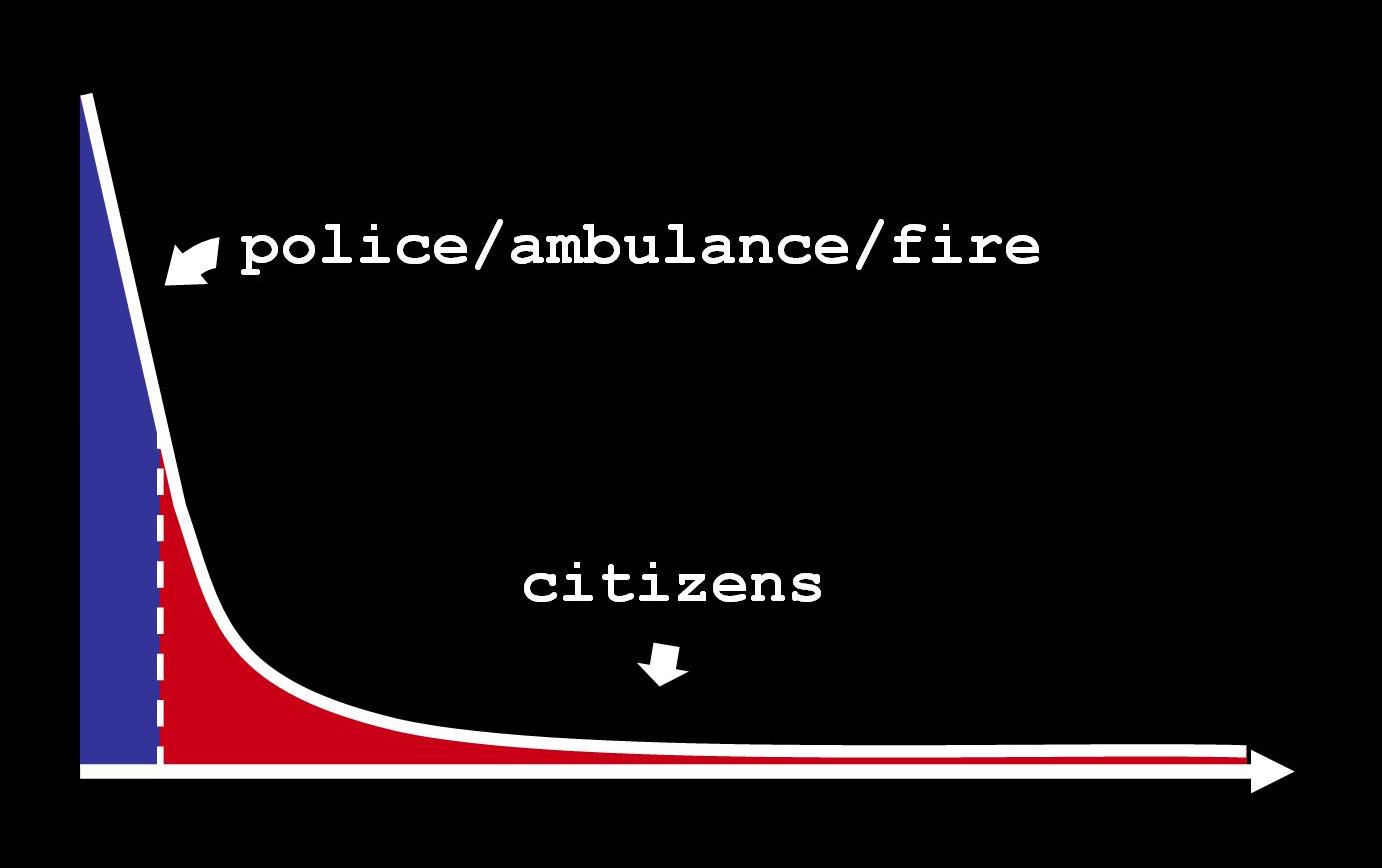
I’ve visualized in this slide below (explanation below the fold)

long tail public policy

Imagine the white curve represents all of the police, fire and ambulance interventions in a city. Many of the most critical interventions are ones the police force and ambulance service determine themselves (shaded blue). For example, the police are involved in an investigation that results in a big arrest, or the ambulance parks outside an Eagles reunion concert knowing that some of the boomers in attendance will be “over-served” and will suffer a heart attack.

However, while investigations and predictable events may account for some police/fire/ambulatory actions (and possibly those that receive the most press attention) the vast majority of arrests, fire fights and medical interventions result from plain old 911 calls made by ordinary citizens (shaded red). True, many of these are false alarms, or are resolved with minimal effort (a fire extinguisher deals with the problem, or minor amount of drugs are confiscated but no arrests made). But the sheer quantity of these calls means that while the average quality may be low, they still account for the bulk of successful (however defined) interventions. Viewed in this light 911 is a knowledge aggregator, collecting knowledge from citizens to determine where police cars, fire trucks and ambulances need to go.

Thus to find a system that leverages citizens knowledge and is architected for participation we don’t need to invent something new – there are existing systems, like 911, that we can learn from.

With this in mind, two important lessons about 911 leap out at me:

1) It is a self-interested system: While many 911 callers are concerned citizens calling about someone else I suspect the majority of calls – and the most accurate calls – are initiated by those directly or immediately impacted by a situation. People who have been robbed, are suffering from a heart attack, or who have a fire in their kitchen are highly incented to call 911. Consequently, the system leverages our self interest, although it also allows for good Samaritans to contribute as well.

2) It is narrowly focused in its construct: 911 doesn’t ask callers or permit callers to talk about the nature of justice, the history of fire, or the research evidence supporting a given medical condition. It seeks a very narrow set of data points: the nature of the problem and its location. This is helpful to both emergency response officials and citizens. It limits the quantity of data for the former and helps minimize the demands on the latter.

These, I believe, are the secret ingredients to citizen engagement of the future. A passive type of engagement that seeks specific, painless information/preferences/knoweldge from citizens to augment or redistribute services more effectively.

It isn’t sexy, but it works. Indeed we have 20 years of evidence showing us how well it works with regards to one of our most important services.

Some of my favourite Vancouverites on Net Neutrality

A couple of Vancouverites can be seen below talking about the danger currently facing the future of the internet here in Canada as our government allows the telco’s to determine who will be the winners and losers of the digital age.

If you haven’t already I’d strongly encourage you to head over to the “SaveourNet.ca” facebook group and become a member.

broadcast artists in a communication world

Just a brief follow up on yesterday’s piece. One reader yesterday pointed out that the CRTC did “get the internet” and that it was the interveners – The Alliance of Canadian Cinema, Television and Radio Artists (ACTRA) that “didn’t get it.” I think there is lots to dive into about the CRTC but part of his point is well taken. Check out this problematic quote from ACTRA:

“The Internet is just another media-distribution platform like any other that we’ve had,” said Stephen Waddell, executive director of the Alliance of Canadian Cinema, Television and Radio Artists. “And in our view, if the CRTC doesn’t give some opportunity to Canadian content to have a place on that platform, we’re going to be immersed in non-Canadian content.”

The number of problems with this statement are almost overwhelming. Building on some of the reasons I discussed yesterday the internet is not like any other distribution platform. Rather than analyze it line by line, I thought I would hand things over to Clay Shirky, who in Here Comes Everybody explains how our  friends at ACTRA are caught in the same dilemma as scribes at the end of the 15th century:

Consider the position of a scribe in the early 1400s. The ability to write, one of the crowning achievements of human inventiveness, was difficult to attain and, as a result, rare. Only a tiny fraction of the populace could actually write… In this environment a small band of scribes performed the essential service of refreshing cultural memory. By hand-copying new editions of existing manuscripts, they performed a task that could be preformed no other way. The scribe was the bulwark against great intellectual loss…

…Now consider the position of the scribe at the end of the 1400s. Johannes Guttenburg’s invention of movable type in the middle of the century created a sudden and massive reduction in the difficulty of reproducing a written work… a scribe, someone who has given his life over to literacy as a cardinal virtue, would be conflicted about the meaning of movable type. After all, if books are good, then surely more books are better. But at the same time the very scarcity of literacy was what gave scribal efforts its primacy, and the scribal way of life was based on this scarcity…

…The spread of literacy after the invention of movable type ensured not the success of the scribal profession but its end. Instead of mass professionalization, the spread of literacy was a process of mass amateurization. The term “scribe” didn’t get extended to everyone who could read and write. Instead it simply disappeared, as it no longer denoted a professional class.

This is what the internet has done to radio, television and cinema professionals. It has radically lowered the barriers for the creation of Canadian content.

So do we lament the loss of scribes? Not at all – we are liberated because today we can all write. Has the acerage quality declined? Possibly, we aren’t all writing Dante’s Inferno. But the best writing is way, way better (and better paying as well).

Will we lament the loss of television, cinema and radio (I doubt they will disappear completely) no. Something new and more interesting will arise to replace it. With the end of scribes we didn’t writers, instead we gained something far more valuable, the growth of contemporary authors! (who in 1350 could have imagined a world of authors, book stores, top 10 best seller lists?)

Now, imagine if there had been a tax on every printing press to pay for scribes to continue copying books… that would have just made books more expensive and less accessible.

We must acknowledge ACTRA fear of the new world. However self-serving, it is rational and genuine. Everything is going to be unpredictable for a while. But the future also the opportunity for something new an amazing – unimaginable ways for new types artists and mediums to describe the human condition and touch our souls. Just because it won’t be the way it has been done – through the broadcast mediums of radio, television, and cinema – doesn’t mean that it won’t be good. Indeed, I predict, that once the dust has settled, there will be more artists, producers, actors, and creatives in general, many of who will continue to get paid well. It’s just that the line between amateur and professional will be more blurred. There may even be a role for a professional association – although I imagine it will look, much, much different. Scary, yes. But also unavoidable.