Yearly Archives: 2010

Minister Clement, privacy and (un)balanced views

Just moments ago Industry Minister Tony Clement, in response to growing criticism about his decision to end the mandatory long form census (now the Canadian Medical Association has come out in opposition), again cited “privacy concerns” from Canadians.

To quote Minister Clement via the Globe article:

“Just in the past 48 hours I’ve received dozens and dozens of [letters from] Canadians who despite the adverse publicity … have come forward and said, ‘We agree with your position,’” Mr. Clement said.

“I am not saying it’s every Canadian, but I am saying there are Canadians [who complained] and we should try to accommodate their concerns in a balanced way,” he said.

Of course, the minister made no reference to complaints made before he made his decision. That’s because it is rapidly becoming obvious their were none. The Privacy Commissioner registered just 3 complaints in the last decade. Statistics Canada’s survey about the last census generated no feedback regarding privacy. The minister’s claim about privacy concerns is a sham – he’s veering on the edge of having lied to Canadians. Now he’s trying to cover it up by citing complaints since his decision.

It is great to hear the Minister Clement is interested in Canadians concerns since he made his announcement because in contrast to the few dozen he’s received the rest of the country seems focused on a petition in opposition to his decision that has garnered 5800 Canadians names (and that grows at about 3 names a minute) in the last few days. Will he listen to their voices too?

I can’t say I’m confident. Even with conservatives like C.D. Howe Institute President William Robson speaking in opposition. Why? Two reasons.

First, let’s take a look at the last time the Minister consulted Canadians regarding a decision. How about last year on the issue of copyright, digital locks and circumvention. During this consultation 6641 speaking Canadians spoke against anti-circumvention provisions and a mere 46 Canadians spoke in favour. And yet, the desire of those 46 trumped the 6641. Or how about on Tuesday when Industry Canada suddenly pulled the second most popular discussion (about the census long form) from the Digital Economy Consultation.

It is the second, however, that is more important. I don’t think the Minster is the decision maker. Indeed, I don’t think he even wanted to do this. I don’t always agree with him but Minister Clement seems  smart and even fun. His twitter account is personable and engaging. More interestingly, the Minister allegedly spoke in opposition to this decision behind closed doors. The real decision maker was the Prime Minister. All the more reason why Canadians need to let their unhappiness with this decision known – they need to help Minister Clement reverse it.

Awesome Interactions: More on my Mozilla Summit 2010 Ignite Talk

Last week I had the distinct pleasure of being at the Mozilla Summit.

This is a gathering of about 650ish people from innumerable countries around the world to talk about Mozilla, the future of the open web, the various Mozilla products (such as Firefox and Thunderbird). As Mozilla is a distributed community of thousands of people from around the world and the summit only takes place every two years, it as one participant memorably put it, “an opportunity to engage in two years of pent up water cooler talk.”

As a follow up for the summit I’ve two things I wanted to share.

First, for those who enjoyed my Ignite talk on community management entitled Making the Army of Awesome More Awesome I’ve uploaded my slides to slideshare. (Not the most flattering picture of me giving the talk, but the only one I could find on flickr…)

I’m hoping, once the summit organizers have taken a much deserved break, to get video and audio of the presentation and I’ll create slidecast and post it to this blog.

Also, if you found the talk engaging, there is a longer version of that talk where I dive a little deeper into some of the theory I mention at the end. It is a talk David Humphrey kindly asked me to give back at FSOSS a few yeas ago called Community Management: Open Source’s Core Competency.

Second, both in my talk and during the incredible time I had speaking with a number of people in the Mozilla community I brainstormed a ton of ideas. I’m committed to documenting those and sharing them. Here’s a list of some of them, in the coming week I hope to blog on each, and ideally all of these.

1. Improve the link between Bugzilla and SUMO

2. Auto-generate help topics in the Help pull down menu

3. Ask people when they download Firefox or Thunderbird if they’ll volunteer to do bug confirmation

4. Add “Newbie” to new Bugzilla registers

5. Add “ESL” (English as a second language) to Bugzilla accounts that request it

6. Rethinking data.mozilla.org and fostering a research community

7. Segment Bugzilla submitters into groups that might be engaged differently

8. Reboot Diederik Van Liere’s jet pack add-on that predicts bug patch success

8b. Add on a crowdsourcing app to call out negative language or behaviour

9. Retool questions asked in Bugzilla to “nudge” users to better responses

10. Develop an inquire, paraphrase, acknowledge and advocate crowdsourcing identfier jet pack add on for bugzilla

11. plus more, but lets start with these…

Irony, defined

So it appears that the Vancouver Province Editorial Page Editor Gordon Clark is not a fan of either the census or me. In a piece the other day (which someone kindly forwarded on to me) he become the lone person in the country to defend Industry Minister Clement’s decision to end the Long Form Census.

His reason? In his own words:

Clement is right when he says the data from a voluntary form may be more accurate than under the current forced scheme, which resulted, for example, in 55,000 Canadians listing “Jedi” as their religion in the last census. It makes you wonder how accurate the rest of it was despite its $567-million cost. For that kind of money shouldn’t those StatsCan folks be curing cancer or something?

Actually, Clement is not right. There isn’t a statistician in the country who would agree with this opinion. Indeed, I dare Gordon Clark to produce a single statistician at a university, or even a polling firm, who will agree with this statement. I’ve got about a 1000, and indeed, their professional organization, who feel otherwise. So Clark’s defense is built on a lie. But then, since  this whole debate is about replacing facts with opinions, should we be surprised?

But that’s reasoned fact part of this blog post, there’s a juicier little tidbit…

Over at Gordon Clark’s twitter page, take a look at his bio:

See that line that proudly states “The Province, the best-read newspaper in Canada west of Toronto.”

Interesting that, isn’t it?

So how does Gordon know that The Province newspaper is the best read paper west of Toronto? Well, he relies on NADbank, which produces regular reports about newspaper readership. But dig a little deeper. In the technical report that outlines the survey’s methodology I’ll give you one guess on how NADbank ensures it has an accurate cross section of Canadians so that Gordon Clark can accurately and proudly claim his paper is the best-read in Western Canada.

Again… one chance…

How about… the census! Yes, the census – including references to data collected by the long form – is mentioned no less than 20 times in the report and is essential to enabling NADbank to do its survey.

So not only does Gordon Clark wish to replace fact with opinion, he has no idea how the census – especially the long form – impacts almost every aspect of his life, including his ability to brag. Of course, if he wants to he could change his bio to say:

I’m in charge of the editorial pages and write a weekly column for The Province, a newspaper in western Canada that we aren’t really sure how many people read.

But somehow that doesn’t have the same punch, does it?

As an aside, it is worth noting that while NADbank has The Province as the most-read newspaper in western Canada the Canadian Newspaper Association survey shows the Vancouver Sun has a bigger paid circulation (by quite a margin). I suppose if you give away enough free copies, you too can boost your readership…

We want to consult, until you say something we don't like

So I really, really, really, wanted to write about something else, but Tony Clement’s staff is making it hard not to.

I woke up this morning to discover that, at some point over the weekend “an online discussion about Canada’s census mysteriously vanished from a federal consultation on the digital economy.” See the full article here with some fantastic coverage by Jennifer Ditchburn.

So what has happened?

Well, for the past few months the government has been running an online consultations about the digital economy, asking people what they think should be done. During this process, Canadians, who must register, can vote ideas up or down.

Well, since the digital economy is part of the information economy (information – like that created by the census), someone suggested that part of the digital economy strategy should to reinstate the long form census. The proposal, only submitted a few days ago (others have been around for months) garnered enough votes to quickly shoot up and become the number 2 proposal on the site.

So rather than engage the 360+ Canadians who voted for the proposal (far more than who ever likely complained about the Long Form Census) the government simply removed the discussion from the site. If you know the specific URL you can still get to it, but there is no link to the discussion from anywhere else on the site.

So, in short, the government’s definition of a “public consultation” is to say we want to consult and hear from you, until you say something we don’t like. Then we will bury it.

How are Canadians supposed to have confidence that any contributions will be listened to and engaged. This seems to confirm what many citizens suspected after the copyright consultation: That this process is a sham, and that the government isn’t looking for ideas, but that it has its own agenda and is going to pursue it regardless of what Canadians ask or tell it.

So, in summary, when the data (in this case the votes) don’t support your conclusions, the solution is to get rid of the data. Kind of like the Long Form Census.

If you want you can still go to the discussion and vote up the recommendation that the government keep the long form census. It could end up that the most requested contribution is one the Government tries to hide and denies exists.

The Census weak link: What the Liberals, Bloc & NDP should do

Public and the media condemnation of the government’s decision to end the long form census has been universal (see more fun quotes below). Now the political opposition has started to mobilize. The focus of the opposition has been on the secretive nature of the decision and the failure to consult any stakeholders. While this is problematic I’m not sure it is the most ironic and sensitive point. There is actually a much more juicy Achilles heel in this decision, one that might garner press attention.

In explaining the decision (such as in the quote to the Canadian Press below), Minister Clement has repeatedly claimed that MP offices has received numerous complaints about the long form census form:

“Every MP has had complaints like that so this year we decided to at least try another method that could be a sound method that would beat the issue of concern of degradation of data, and deal with the issue of coercion and too much intrusiveness”

The statement suggests broad base support but, ironically, anecdotal and, in theory, untestable.

The fun thing is, it doesn’t have to be that way. The opposition could bring more (and hard) information to this process and expose how the Conservatives are using a lack of information to at best mislead and at worse, lie, to ordinary Canadians. Better still, if the opposition parties have been organized, they should possess that data.

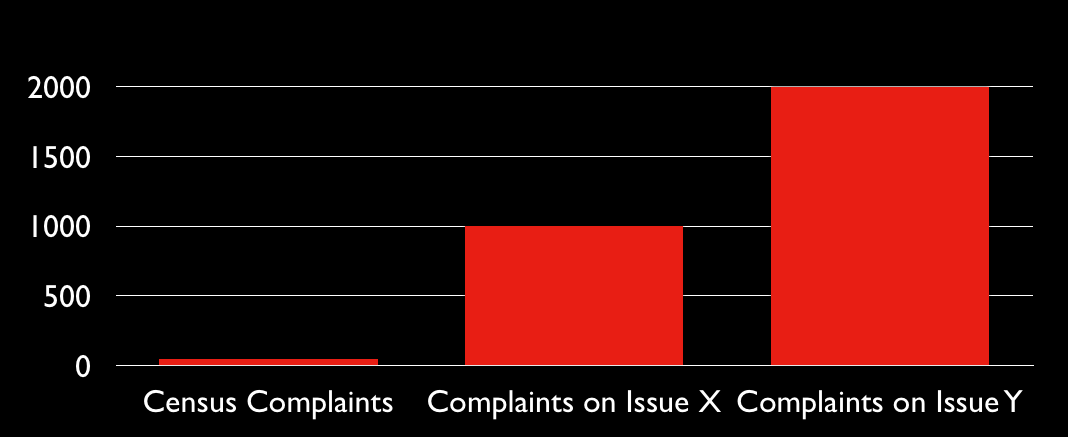
How is this? Well, I’d like to see the Liberals, Bloc and NDP ask each of their MPs to search and count every email and letter from constituents over the past 4 (or some sensible number) years that involved a complaint about the census.

My suspicion is that there are no more than 100 such letters (and, maybe even a lot less, like 10). You could then pick a couple of issues of your choice on which you have received 1000s of letters and which the conservatives have taken no action and put a simple chart up showing how they react to made up issues, but ignore real priorities of ordinary Canadians.

Of course, maybe there has been some massive, secret letter campaign targeted at Conservative only MPs but I think most Canadians will want to know how many letters the Minister and conservative MPs have actually received (sadly I don’t think you can FOI this) and most will suspect it is about as many as other MPs have.

Let’s show that better data leads to better decisions and that a little transparency can go a long way to exposing those who seek to mislead us. The minister says MPs get lots of letters – lets find out how many. And in comparison to what. Moreover, let’s show that those who seek to restrict the gathering of good information are generally those most inclined to use a lack of data to mislead the public and drive agendas that are not in the public interest. Canadians are sensible people, they want a smart government that makes good decisions. This, much more than secrecy, will rub them the wrong way.

The narrative isn’t as neat – but I suspect it could be turned into something more fun and more impactful.

Other fun articles…

Also, the universal condemnation of the Conservatives decision to end the mandatory long term census continues. My newest favourite is an article in the Globe where Derek Cook, Calgary’s the research and social planner at the City of Calgary and in the riding of the Prime Minister Harpers states that “If we don’t have that data at the neighbourhood level, we’re crippled.” Now, in addition to business groups, ngos, think tanks, cities, university researchers we are also seeing even more local and focused organizations such as those representing French Canadian communities, Inuit people and others starting to call for a reversal as well.

Ministerial Twitter Battle! $130M tax payer dollars wasted! Conspiracy theories!

Who knew the census could be so exciting.

Yesterday, I published Why you should care about the sudden demise of the mandatory long census form on the Globe and Mail website (also can be found here on this blog).

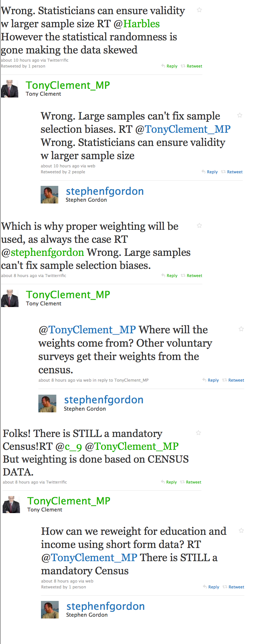
One interesting impact of the piece was that it generated the following debate between the Minister and a Laval Statistics Professor. Ultimately the professor’s concerns that the data generated by a voluntary long form remain unresolved. In short, as the former chief statistician of Statistics Canada also noted, a $100 million dollar survey may generate useless data.

UPDATE: Turns out there is now a petition to save the long form census here.

In addition to the online debate here are some other interesting facts about the end of the mandatory long census form:

1. It will be more expensive to implement.

For a government that is supposed to be fiscally conservative, ending the mandatory form could actually cost Canadian Tax Payers an additional $30 Million. As the Canadian Press reports:

“The cost of the change could reach $30 million, says Statistics Canada: $5 million for the additional mailout, and $25 million in case there is a major problem in getting people to respond.”

So, to sum up: Canadians will pay more to get data that risks being useless and skewed. Total waste of tax payer dollars: $130M.

2. No one can identify who wanted this change, not even the Minister.

Again, from the same Canadian Press article:

Industry Minister Tony Clement acknowledged in an interview that no consultations were undertaken on the decision.

He said it was based on the fact that many Canadians had complained of the coercive and intrusive nature of the census, but Clement had not seen polling on the issue.

How many Canadians? What is clear is that a large number of people are stepping forward to say this was a bad idea. So far every major municipality – through the Federation of Canadian Municipalities – is complaining about the decision, so to is both the Canadian and the Toronto Associations of Business Economists, the Canadian Council on Social Development and the Canadian Association of University Teachers and numerous academics and of course, the former chief statistician of Canada who says he would have quit rather than carry out the order to end the mandatory long census form.

3. So who has complained? (this is the best part)

So far all the stories about Canadians who have complained about the census refer to two individuals. The Canadian Press story (Which has been reprinted in several forms in a number of newspapers) references Sandra Finley, a Saskatoon activist who is still fighting in court after refusing to fill out the 2006 census. In addition to Ms. Finley, the Globe also referenced Don Rogers, a Kingston, Ont., man who mounted the “Count Me Out” campaign against the census.

In both cases the protesters core problem was not the coercive or intrusive nature of the census (the concern the minister seeks to address) but the fact the Statistics Canada bought software from defence manufacturer Lockheed Martin back in 2003. Indeed, the Count Me Out website is plastered with a hodge podge of conspiracy theories NAFTA, Lockheed Martin and the Canadian census funding ballistic missile tests.

Is this the complaint upon which the minister is grounding his decision?

4. Canada is alone

As far as the former Chief Statistician can tell, no other country in the world has a voluntary portion to its census.

Taken these four issues one is left wondering – is this how cabinet decisions are made?

Update 9:17am July 7th

Liberals issue a press release stating that:

“If the Conservatives don’t reverse their decision, Liberals are prepared to explore the introduction of an amendment to the Statistics Act to ensure a comprehensive, mandatory long-form stays,” said Ms. Jennings. “This decision, made in secret, without any consultation, is dangerous because the information that will be lost is used to help Canadians in their daily lives – particularly our most vulnerable citizens.”

Update 8:30am July 7th

Other articles raising concerns about this decision:

Winnipeg Free-Press: Anti-census crusader not satisfied with federal axing of long form

Globe and Mail: Tories Scrap Mandatory Long Form Census

Saskatoon Star-Phoenix: Detailed census data invaluable for sound policy

Montreal Gazette: Canadians must be able to count on Statistics Canada

Vancouver Sun Editorial: Canada needs its citizens to stand up and be counted

Victoria Times Colonist: Census shortcut bad for Canada

Edmonton Journal: Ridiculous to scrap key census data

(Plus many more who ran the Canadian Press story and others I just didn’t paste in here).

Articles supportive about this decision:

zero

Your Government Just Got Dumber: how it happened and why it matters to you

This piece was published in the Globe and Mail today so always nice when you read it there and let them know it matters to you.

Last week the Conservative Government decided that it would kill the mandatory long census form it normally sends out to thousands of Canadians every five years. On the surface such a move may seem unimportant and, to many, uninteresting, but it has significant implications for every Canadian and every small community in Canada.

Here are 3 reasons why this matters to you:

1. The Death of Smart Government

Want to know who the biggest user of census data is? The government. To understand what services are needed, where problems or opportunities may arise, or how an region is changing depends on having accurate data. The federal government, but also the provincial and, most importantly, local governments use Statistics Canada’s data every day to find ways to save tax payers money, improve services and make plans. Now, at the very moment – thanks to computers – governments are finding new ways to use this information more effectively than ever before, it is to be cut off.

To be clear this is a direct attack on the ability of government to make smart decisions. In fact it is an attack on evidence based public policy. Moreover, it was a political decision – it came from the Minister’s office and does not appear to reflect what Statistics Canada either wants or recommends. Of course, some governments prefer not to have information, all that data and evidence gets in the way of legislation and policies that are ineffective, costly and that reward vested interests (I’m looking at you Crime Bill).

2. The Economy is Less Competitive

But it isn’t just government that will suffer. In the 21st century economies data and information are at the heart of economic activity, it is what drives innovation, efficiencies and productivity. Starve our governments, ngo’s, businesses and citizens of data and you limit the wealth a 21st century economy will generate.

Like roads to the 20th century economy, data is the core infrastructure for a 21st century economy. While just a boring public asset, it can nonetheless foster big companies, jobs and efficiencies. Roads spawned GM. Today, people often fail to recognize that the largest company already created by the new economy – Google – is a data company. Google is effective and profitable not because it sells ads, but because it generates and leverages petabytes of data every day from billions of search queries. This allows it to provide all sorts of useful services such as pointing us, with uncanny accuracy, to merchandises and services we want, or better yet, spam we’d like to avoid. It can even predict when communities will experience flu epidemics four months in advance.

And yet, it is astounding that the Minister in charge of Canada’s digital economy, the minister who should understand the role of information in a 21st century economy, is the minister who authorized killing the creation of this data. In doing so he will deprive Canadians and their businesses of information that would make them, and thus our economy, more efficient, productive and profitable. Of course, the big international companies will probably be able to find the money to do their own augmented census, so those that will really suffer will be small and medium size Canadian businesses.

3. Democracy Just got Weaker

Of course, the most important people who could use the data created by the census aren’t government or businesses. It is ordinary Canadians. In theory, the census creates a level playing field in public policy debates. Were Statistics Canada website usable and its data accessible (data, may I remind you we’ve already paid for) then citizens could use this information to fight ineffective legislation, unjust policies, or wasteful practices. In a world where this information won’t exist those who are able to pay for the creation of this information – read large companies – will have an advantage not only over citizens, but over our governments (which of course, won’t have this data anymore either). Today, the ability of ordinary citizens to defend themselves against government and businesses just got weaker.

So who’s to blame? Tony Clement, the Minister of Industry Canada who oversees Statistics Canada, is to blame. His office authorized this decision. But Statistics Canada also shares in the blame. In an era where the internet has flattened the cost of distributing information Statistics Canada: continues to charge citizens for data their tax dollars already paid for; has an unnavigable website where it is impossible to find anything; and often distributes data in formats that are hard to use. In short, for years the department has made its data inaccessible to ordinary Canadians. As a result it isn’t hard to see why most Canadians don’t know about or understand this issue. Sadly, once they do wake up to the cost of this terrible decisions, I fear it will be too late.

Clay Shirky, Connected and Yellow Pages

Yellow-pages-comicTwo weeks ago, after seeing Yellow Pages stacked, unused and unwanted in both my own and several friends apartment buildings, I started a Facebook Group entitled 100,000 Canadians who’ve opted out of yellow pages! In two weeks, with friends telling a friend here and there, we’ve grown to 1000 people. So where did this come from and where is it going?

Well, for a number of years there have been petitions against Yellow Pages but obviously they have had little impact and, frankly, I suspect they actually garner few sign-ups. In Connected: How Your Friends’ Friends’ Friends Affect Everything You Feel, Think, and Do Christakis and Fowler show how people are more likely to vote when their friends, and friends’, friends voted. This suggests there is a strong social component to behaviour. Given that many people I talk to want to opt-out, I thought maybe people will be more likely to opt-out if they knew their friends and their friends, friends opt out. And maybe we could help create that cycle. Facebook, because it allows us to connect with our friends and share some online actions we take, felt like a great platform to do this. Indeed, it seemed to me exactly the ingredient that many online petitions (Which don’t allow you to socialize your activity) seemed to be missing. Also, surprisingly, there wasn’t already a Facebook group dedicated to this.

yellow-pages-banIndeed, looking at Yellow Pages own research reaffirmed my belief that such a group could be successful. They claim 61% of Canadians aged 18+ use their directories at least once a month to look up a business. (Interestingly you can’t read the report on which the claim is made). But (a) this felt unlikely and (b) once a month? So people use the yellow pages 12 times a year…? That’s not delivering value, indeed the number is so unimpressive and underwhelming that if that is the best they can offer, I’m sure we can find lots of Canadians who’d prefer to just say no.

So how I have I structured this (admittedly) off the side of my computer and amateur-driven campaign? I’m trying to follow Clay Shirky’s three pieces of advice at the end of Here Comes Everybody. Make clear the promise, the tool and the bargain.

The Promise: the thing that convinces a potential user to become an actual user.

The promise of this Facebook group is: by taking a simple action and sharing it with our friends, we can save a lot of waste and not receive a large (and annoying) piece of spam in our mailbox. The goal here is to keep everything simple. Participating requires very little time, the impact is immediate (you stop receiving the yellow pages) but also can scale significantly (lots of yellow pages may never get printed). Indeed, an extreme possible outcome – should enough people join the group – is breaking the printed yellow pages business model. If a sufficient number of Canadians actually opted out of the yellow pages, it would be hard for advertisers to believe Yellow Pages marketing materials as probably several more million aren’t on facebook, haven’t joined the group, but also find it useless. But, I’m not holding my breath – for now, I’m happy even getting a few thousand people to opt out.

The Tool: what will enable people to do what they actually want to do.

In our case, it is opt out of receiving the yellow pages. So there are two key tools. The first, is Yellow Pages opt-out form. Indeed, this group exists because there’s failure in information distribution. In some ways the group is about socializing this tool that people find helpful. Most people I talk to think the Yellow Pages are a waste and wish they didn’t have to get them. The truth is, you can opt out of receiving them – it was just that nobody knows how. We are fixing that information gap.

The second tool is a way to share the good news with others. Here, thanks to facebook, we leverage their tools, such as invites, status updates, people even upload photos of Yellow Pages siting unwanted in their apartment lobbies, share videos or – as in the case of Rob above – draw cartoons!

An unanticipated tool has been people helping each other out with filling out the form, or giving feedback to Yellow Pages about their service.

The Bargain: Helps clarify what you expect of others and what they can expect of you.

The bargain for this group is possible most interesting. Since I believe the Yellow Pages is spam and that, frankly, no one likes getting unwanted emails here is the bargain I’ve crafted. Users will opt out of the yellow pages and, hopefully, tell a few friends about the group. As group owner, I promise to only reach out to the group 5 times. Once when the group size hits 1000, 5,000, 10,000, 25,000, and (if we are so lucky) 100,000! I don’t want people to feel burdened by this group – I want them to feel liberated, happy and rewarded. Moreover, people’s time is valuable… so not communicating with them is probably the best thing I can do – hence, the self-imposed limits that reflects milestones we can collectively feel proud of achieving.

Going forward

So without spamming our own networks we’ve gotten to 1000 people in two weeks. Fairly good growth. Will we hit 100,000? I don’t know. It is an ambitious goal. Will we break the Yellow Pages business model? Probably less likely. But can we save some trees and save ourselves the hassle of receiving some very bulky and unwanted mail. Yes. And maybe we can show that Canadians don’t use the Yellow Pages. Ultimately, though we can tell a company that the very people it claims to serve just think it is appalling that they spam an entire country with a 400 page book particularly in an era where, as far as I can tell, so few people actually use it.

Oh, and I hope you’ll consider joining the group and telling a few friends.

When Police Lie

The single most important tool police have in their arsenal isn’t a gun, it isn’t baton, it isn’t even their badge. It is public confidence.

It is this confidence that ensures the public they can have faith in some of the most important and powerful public servants they meet in their day to day lives, and more importantly, it is vested in hands that will prioritize the rule of law over violence.

This, however, breaks down when police lie.

This week, as far as I can tell, the Toronto Police Chief Bill Blair has been caught in two lies. First, in claiming the policy had legal authority to detain people within 5 meters of the perimeter fence at the G20, second, when they put confiscated weapons on display that had been found on “protesters.”

Worse still, was his defense.

Asked Tuesday if there actually was a five-metre rule given the ministry’s clarification, Toronto Police Chief Bill Blair smiled and said, “No, but I was trying to keep the criminals out.”

The police have more than a tough job. Consider the idiocy they had to deal with during the G20. Take, for example, Anti-Capitalist Convergence spokesperson Mathieu Francoeur’s claim that vandalism and violent protests were “not violence” but “a means of expression and doesn’t compare to the economic and state violence we’re subjected to.” Yes, it drives me crazy too. Of all the ills in the world to choose from, violence against a state that provides welfare, free health-care and subsidized education just never seems to make my top 10 list…

But the best weapon against this idiocy is honest and upfront police force. Admittedly, this contributes to what makes their job hard, but citizens expect the police to follow the law and behave ethically. That, more than a gun, a badge, or a uniform, this code of conduct is what separates them from everyone else – from the criminals, and even, ordinary citizens. We expect, and we need them to model behaviour.

Mistakes I can understand. Poor decisions under stress I can understand. But deliberately misleading the public I cannot understand, nor do I think there are many who will condone it. Is lying now an appropriate strategy for dealing with the public? If a police force – and more importantly, its chief – is willing to mislead us about weapons captured and the nature of the law during the G20, what will they lie about at other times?  Perhaps when I get pulled over? Or when my 21 year cousin accidentally bumps into an officer who is having a bad day? Do I believe the Toronto police force is on a slippery slope? No. But I don’t want them on the slope at all.

Today, it feels we are a long, long way away from the era of the trusted and honest Mountie (side note about the RCMP, it has the dubious distinction of having a whole wikipedia page dedicated to some of scandals) and the erosion of this trust may be one of the biggest causalities of the G20 Summit.

yellow-pages-banCanadian? Hope you’ll also consider opting out of receiving the yellow pages. Facebook group and instructions on how to save some trees here.

Open Canada – Hello Globe and Mail?

Richard Poynder has a wonderful (and detailed) post on his blog Open and Shut about the state of open data in the UK. Much of it covers arguments about why open data matters economically and democratically (the case I’ve been making as well). It is worthwhile reading for policy makers and engaged citizens.

There is however a much more important lesson buried in the article. It is in regard to the role of the Guardian newspaper.

As many of you know I’ve been advocating for Open Data at all levels of government, and in particular, at the federal level. This is why I and others created datadotgc.ca: If the government won’t create an open data portal, we’ll create one for them. The goal of course, was to show them that it already does open data, and that it could do a lot, lot more (there is a v2 of the site in the works that will offer some more, much cooler functionality coming soon).

What is fascinating about Poynder’s article is the important role the Guardian has played in bringing open data to the UK. Consider this small excerpt from his post.

For The Guardian the release of COINS marks a high point in a crusade it began in March 2006, when it published an article called “Give us back our crown jewels” and launched the Free Our Data campaign. Much has happened since. “What would have been unbelievable a few years ago is now commonplace,” The Guardian boasted when reporting on the release of COINS.

Why did The Guardian start the Free Our Data campaign? Because it wanted to draw attention to the fact that governments and government agencies have been using taxpayers’ money to create vast databases containing highly valuable information, and yet have made very little of this information publicly available.

The lesson here is that a national newspaper in the UK played a key role in pressuring a system of government virtually identical to our own (now also governed by a minority, conservative lead government) to release one of the most important data in its possession – the Combined Online Information System (COINS). This on top of postal codes and what we would find in Stats Canada’s databases.

All this leads me to ask one simple question. Where is the Globe and Mail? I’m not sure its editors have written a single piece calling for open data (am I wrong here?). Indeed, I’m not even sure the issue is on their radar. It certainly has done nothing close to launching a “national campaign.” They could do the Canadian economy, democracy and journalism and world of good. Open data can be championed by individual advocates such as myself but having a large media player repeatedly raising the issue, time and time again brings out the type of pressure few individuals can muster.

All this to say, if the Globe ever gets interested, I’m here. Happy to help.