Category Archives: public policy

Does your Government (and thus you) actually own its data?

For those who missed it, there was fascinating legal analysis of Public Engines, Inc. effort to sue ReportSee, Inc. the other day on the Berkman centre’s Citizen Media Law Project blog.

If you haven’t read it, I encourage you to take a look. It’s more than a legal brief. It is a cautionary tale for every government official.

Why is this?

The story is as such. Public Engines Inc is paid by police departments to collect and analyze their crime data. Given this privileged position Public Engines strips the data of privacy related information and, through a service called CrimeReports.com, it allows citizens to see maps of it and so forth.

The problem is, this isn’t actually open data. As I argue in the three laws of open data (and the good folks at Berkman seem to share my sense of humour) crime data for cities that contract with Public Engines Inc isn’t open. You can look at the data, but you can’t touch it. Worst still… don’t even think about playing with it (unless you are doing so ON crimereports.com website, in a way that their license lets you – its all quite constraining stuff).

And herein lies Reportsee Inc’s big mistake. It scraped this data from CrimeReports.com and offered it up in a competing manner.

The legal analysis on the post is very much worth reading. At the end of the day, everyone is behaving rationally. Public Engine Inc is trying to protect its monopoly on crime data, and the investment it has made in cleaning it up of private information. Reportsee is simply trying to access what is public data the only place where – in many instances – it appears to be being made available.

The real party to blame here are governments that signed this agreements and that don’t understand that data is both a strategic and public asset. Understandably the smart people at Berkman understood this and jumped all over it:

The bottom line is that this sort of dispute could be avoided if government agencies are more proactive and farsighted when negotiating terms with third-party providers of data management services. In particular, government agencies should maintain control over the resulting data, or at a minimum, require that the contractor permit a wide range of uses of the data. It’s not just in the public interest of promoting government transparency and accountability. It’s also in the agencies’ interest to streamline its public records requests. The agencies are already paying for the data management services anyway, why spend even more government resources in order to respond to redundant public records requests?

Indeed, the post notes that:

…that government agencies often pay third parties to collect, compile and maintain public records data in useful formats, and who may retain rights over the data. This isn’t the first time a third-party data contractor has stepped in the way of a commercial use of data feeds. In the Bay Area a few years ago, Routsey’s iPhone app making use of data feeds with bus and train arrival times got in a jam when the contractor providing the data to MUNI, the public transportation agency, asserted its rights to the data.

So, if you are a government official, this is the critical lesson. Many vendors know that if they control the data, they control you. They’ve got you locked into to buying their software and possible even locked in to buying their consulting services. More importantly, they now have a monopoly over what the public can learn about services and information their tax dollars paid to deliver and collect. No government would ever allow the New York Times or the Globe and Mail to become the exclusive distributor of government information. And yet, everyday, governments sign contracts with software vendors that effectively does just this but with something more basic than information, the raw data. Frightening enough stuff for governments. Still more frightening for us citizens.

Also, having heard tale after tale of government legal offices fighting open data initiatives, I’m reminded of how I wish some government lawyers would take the time they spend preventing the public from accessing public data and reallocate it towards preventing publicly funded data from becoming the monopoly assets of private vendors.

Getting Government Right Behind the Firewall

The other week I stumbled on this fantastic piece by Susan Oh of Ragan.com about a 50 day effort by the BC government to relaunch its intranet set.

Yes, 50 days.

If you run a large organization’s intranet site I encourage to read the piece. (Alternatively, if you are forced (or begged) to use one, forward this article to someone in charge). The measured results are great – essentially a doubling in pretty much all the things you want to double (like participation) – but what is really nice is how quick and affordable the whole project was, something rarely seen in most bureaucracies.

Here is an intranet for 30,000 employees, that “was rebuilt from top to bottom within 50 days with only three developers who were learning the open-source platform Drupal as they as went along.”

I beg someone in the BC government to produce an example of such a significant roleout being accomplished with so few resources. Indeed, it sounds eerily similar to GCPEDIA (available to 300,000 people using open source software and 1 FTE, plus some begged and borrowed resources) and OPSPedia (a test project also using open source software with tiny rollout costs). Notice a pattern?

Across our governments (not to mention a number of large conservative companies) there are tiny pockets where resourceful teams find a leader or project manager willing to buck the idea that a software implementations must be a multi-year, multimillion dollar roll out. And they are making the lives of public servants better. God knows our public servants need better tools, and quickly. Even the set of tools being offered in the BC examples weren’t that mind-blowing, pretty basic stuff for anyone operating as a knowledge worker.

I’m not even saying that what you do has to be open source (although clearly, the above examples show that it can allow one to move speedily and cheaply) but I suspect that the number of people (and the type of person) interested in government would shift quickly if, internally, they had this set of tools at their disposal. (Would love to talk to someone at Canada’s Food Inspection Agency about their experience with Socialtext)

The fact is, you can. And, of course, this quickly get us to the real problem… most governments and large corporations don’t know how to deal with the cultural and power implications of these tools.

We’ll we’d better get busy experimenting and trying cause knowledge workers will go where they can use their and their peers brains most effectively. Increasingly, that isn’t government. I know I’m a fan of the long tail of public policy, but we’ve got to fix government behind the firewall, otherwise their won’t be a government behind the firewall to fix.

Census Update: It's the Economy, Stupid

Yesterday during a press conference newly minted House leader John Baird announced “The next few months will be sharply focused on Canadians’ No. 1 priority: jobs and the economy… The economic recovery remains fragile and it is increasingly clear that we are not out of the woods yet.”

Fantastic news.

I just hope someone sends Industry Minister Tony Clement the memo.

The effects and impacts of ending the mandatory long form census continues to spill out with a number of Canada’s most senior business and economic leaders pointing out how the decision will negatively impact the economy and… job growth.

First, there was Bank of Canada Governor Mark Carney (voted one of the most influential people in the world by Time Magazine) noting that the bank relies on data found in the mandatory long form to assess the economy and, presumably, to inform decisions on interest rates and other issues. The bank’s capacity to make informed decisions has now been compromised – not exactly a win for jobs or the economy.

As an interesting side note, Carney goes on to say that this may cause the bank to have to supplement StatsCan’s research with its own. Expect to hear more and more statements like this from Government agencies (which are still allowed to talk to the press) as more and more ministries and agencies get plunged into the dark regarding what is going on in the country and are no longer able to assess programs and issues they’ve been tasked to monitor. Various arms of the government (and thus you, taxpayer) will be spending 10s if not 100s of millions to pay for Industry Minister Clement’s mistake.

Then, in the same Globe article in which Carney makes these statements, Roger Martin, dean of the Rotman School of Management notes that ending the long form census hampers Canadian companies capacity to both compete globally and boost productivity. More damning, and further echoing arguments I’ve been making here, he states it will prevent Canadians from having “a sophisticated economy that uses information to its best.” Unkind words from one of the world’s recognized business leaders.

Sadly, it doesn’t end there. The always excellent Stephen Gordon lists the emerging academic literature chronicling the havoc the demise of the long form census is about to wreck. Especially relevant is “The Importance of the Long-Form Census to Canada” by UBC economists David Green and Kevin Milligan. Interestingly, it turns out that the Canadian Mortgage and Housing Corporation uses long form data to fulfill its legislative mandate, and also by local governments and private sector actors to learn about trends in housing. Something that might be of interest to those concerned about the economy and jobs given Canada is rumored to possible have a housing bubble.

Still more damning is how Green and Milligan show the mandatory long form serves as the foundation for the Labour Force Survey (LFS) from which we derive unemployment levels. Compromising the long form survey has, in short, compromised our ability to assess how many Canadians actually have jobs, something that, if you really believed Canadians felt the economy and jobs were the number 1 priority, your government should care about measuring accurately.

Maybe John Baird will sit down with Tony Clement and the Prime Minister and explain to them how, if the economy and jobs are priority 1 then perhaps the government should rethink its decision on the long form census.

Just don’t hold your breath. Instead, do write another email or letter to your local MP. Our country’s economic recovery and competitiveness is being eroded by a government either too dumb to understand the implications of its decision and too stubborn to admit a mistake. Those of us who will be paying the price should remind them of how they can best serve their own priorities.

Collaborate: "Governments don't do that"

The other day while enjoying breakfast with a consultant friend I heard her talk of about how smaller local governments didn’t have the resources to afford her, or her firms services.

Hogwash I thought! Fresh from the launch of CivicCommons.com at the Gov2.0 Summit I jumped in and asked, surely a couple of the smaller municipalities with similar needs could come together, jointly spec out a project and pool their budgets. It seems like a win-win-win, budgets go further, better services are offered and, well, of less interest but still nice, my friend gets to work on rolling out some nice technologies in the community in which she lives.

The response?

“Government’s doesn’t work that way.”

Followed up by…

“Why would we work with one of those other communities, they are our competitors.”

Once you’ve stopped screaming at your monitor… (yes, I’m happy to give you a few seconds to vent that frustration) let me try to explain in as cool as a manor as possible why this makes no sense. And while I don’t live in the numerous municipalities that border on Vancouver, if you do, consider writing you local councillor/mayor. I think your IT department is wasting your tax dollars.

First, government’s don’t work that way? Really? So an opportunity arises for you to save money and offer better services to your citizens and you’re going to say no because the process offends you in some way? I’m pretty sure there’s a chamber full of council people and a mayor who feel pretty differently about that.

The fact is, that governing a city is going to get more complicated. The expectations of citizens are going to become greater. There is going to be a gap, and no amount of budget is going to cover it. Citizens increasingly have access to top tier services on the web – they know what first class systems look like. They look like Google, Amazon, Travelocity, etc… and vary rarely your municipal website site and the services it offers. It almost doesn’t matter where you are reading this from, I’m willing to bet your city’s site isn’t world class. Thanks to the web however your citizens, even the ones who never leave your bedroom community, are globe traveling super consumers of the web. They are getting faster, better and more effective service on and off the web. You might want to consider this because as the IT director in a city of 500,000 people you probably don’t have the resources to keep up.

Okay, so sharing a budget to be able to build better online infrastructure (or whatever) for your city makes sense. But now you’re thinking – we can’t work with that neighboring community… their our competitors.

Stop. Stop right there.

That community is not your competitor. Let me tell you right now. No one is moving to West Van over Burnaby because their website is better, or their garbage service is more efficient. They certainly aren’t moving because you offer webbased forms on your city’s website and the other guys (annoyingly) make you print out a PDF. That’s not influencing the 250K-500K decision about where I live. Basically, if it doesn’t involve the quality of the school it probably isn’t factoring in.

Hell even other cities like Toronto, Calgary or Seattle aren’t your competitor. If anyone is moving there it’s likely because of family or a job. Maybe if you really got efficient then a marginally lower muncipal tax would help, but if that were the case, then partner with as many cities as possible and benefit from some collaborative economies of scale… cause now you kicking the but of the 99% of cities that aren’t collaborating and sharing costs.

And, of course, this isn’t limited to cities. Pretty much any level of government could benefit from pooling budgets to sponsor some commonly speced out projects.

It’s depressing to see that the biggest challenge to driving down the costs of running a city (or any government) aren’t going to technological, but a cultural obsession with the belief that everybody else is different, competing and not as good as us.

Saving Cities Millions: Introducing CivicCommons.com

Last year, after speaking at the MISA West conference I blogged about an idea I’d called Muniforge (It was also published in the Municipal Information Systems Association’s journal Municipal Interface but behind a paywall). The idea was to create a repository like SourceForge that could host open source software code developed by and/or for cities to share with one another. A few months later I followed it up with another post Saving Millions: Why Cities should Fork the Kuali Foundation which chronicled how a coalition of universities have been doing something similar (they call it community source) and have been saving themselves millions of dollars.

Last week at the Gov 2.0 Summit in Washington, DC my friends over at OpenPlans, with who I’ve exchanged many thoughts about this idea, along with the City of Washington DC brought this idea to life with the launch of Civic Commons. It’s an exciting project that has involved the work of a lot of people: Phillip Ashlock at OpenPlans who isn’t in the video below deserves a great deal of congratulations, as does the team over at Code for America who were also not on the stage.

At the moment Civic Commons is a sort of whitepages for open sourced civic government applications and policies. It doesn’t actually host the software it just points you to where the licenses and code reside (say, for example, at GitHub). There are lots of great tools out there for collaborating on software that don’t need replicating, instead Civic Commons is trying to foster community, a place where cities can find projects they’d like to leverage or contribute to.

The video below outlines it all in more detail. If you find it interesting (or want to skip it and get to that action right away) take a look at the Civic Commons.com website, there are already a number of applications being shared and worked on. I’m also thrilled to share that I’ve been asked to be an adviser to Civic Commons, so more on that and what it means for non-American cities, after the video.

One thing that comes through when looking at this video is the sense this is a distinctly American project. Nothing could be further from the truth. Indeed, during a planning meeting on Thursday I mentioned that a few Canadian cities have contacted me about software applications they would like to make open source to share with other municipalities, everyone and especially Bryan Sivak (CIO for Washington, DC) was keen that other countries join and partake in Civic Commons.

It may end up that municipalities in other countries wish to create their own independent project. That is fine (I’m in favour of diverse approaches), but in the interim I’m keen to have some international participation early on so that processes and issues it raises will be addressed and baked into the project early on. If you work at a city and are thinking that you’d like to add a project feel free to contact me, but also don’t be afraid to just go straight to the site and add it directly!

Anyway, just to sum up, I’m over the moon excited about this project and hope it will turn out. I’ve been hoping something like this would be launched since writing about Muniforge and am excited to both see it happening and be involved.

Least Shocking Headline: Our Government Ignored Data about the Census

Since the resignation of Deputy Minister Munir Sheikh and his public repudiation of voluntary long form census it has become clear that Industry Minister Clement has – at best – been misleading the public about the advice he received from statscan.

Now more evidence has emerged showing how the Government was well informed about the significant problems their plan would create. As Steven Chase of the Globe and Mail writes:

For instance, the real 2006 census long-form found that renting households as a percentage of the population in Canada had dropped by 3.08 percentage points from the 2001 census.

But when the Statscan study simulated the results of a voluntary 2006 long-form – which reflect the lower response rates expected in optional surveys – it got a markedly different answer. Calculations instead indicated that rented dwellings in Canada as a share of the population declined by 8.07 percentage points from 2001.

The difference – nearly five percentage points – suggests a voluntary survey in 2006 would have massively undercounted renting households.

So a mere 150% difference. Which, of course, might affect how every city in Canada considered zoning issues and adjust policies around the housing and rentals stock.

Again, if the Government wants to scrap the long-form census, that’s their prerogative. And I suppose we can’t be surprised that a government that wants less data and information to inform decisions would ignore data that showed them the negative consequence of their proposal. I mean, when you’ve already decided evidence doesn’t matter in crime policy, health policy and a myriad of other issues, you aren’t suddenly going to decide the collecting evidence is important…

But if that is your conclusion, stick with it! Don’t lie to me and the Canadian public and claim it won’t have a dramatic impact on the quality of data the Government collects or an impact on how policy and services for Canadians are affected.

And, of course, given how sensitive the decision is, and how it will cascade down and impact businesses, non-profits, local, provincial and federal government decision making, I wish we’d had a chance to debate the merits of it before the decision was made. Who knows, such a debate might not have just saved the long form census, it might have save government a 10-point decline in the polls.

Links from Gov2.0 Summit talk and bonus material

My 5 minute lightening fast jam packed talk (do I do other formats? answer… yes) from yesterday’s Gov2.0 summit hasn’t yet been has just been posted to youtube. I love that this year the videos have the slides integrated into it.

For those who were, and were not, there yesterday, I wanted to share links to all the great sites and organizations I cited during my talk, I also wanted to share one or two quick stories I didn’t have time to dive into:

VanTrash and 311:

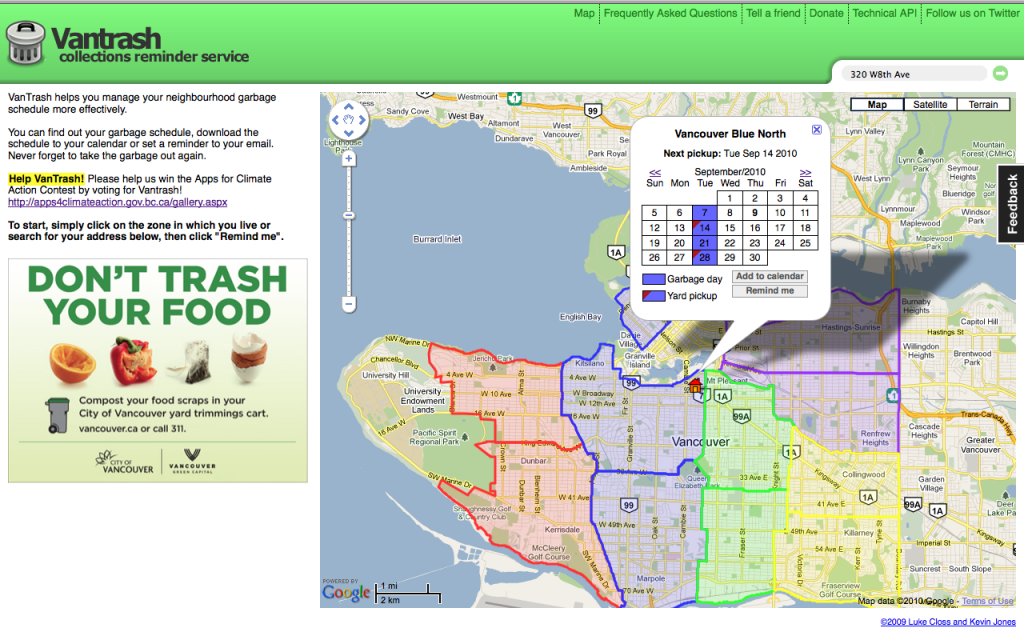
Screen-shot-2010-09-09-at-3.07.32-AM-1024x640As one of the more mature apps in Vancouver using open data Vantrash keeps being showing us how these types of innovations just keep giving back in new and interesting ways.

In addition to being used by over 3000 households (despite never being advertised – this is all word of mouth) it turns out that the city staff are also finding a use for vantrash.

I was recently told that 311 call staff use Vantrash to help trouble shoot incoming calls from residents who are having problems with garbage collection. The first thing one needs to do in such a situation is identify which collection zone the caller lives in – turns out VanTrash is the fastest and more effective way to accomplish this. Simply input the caller’s address into the top right hand field and presto – you know their zone and schedule. Much better than trying to find their address on a physical map that you may or may not have near your station.

TaxiCity, Open Data and Game Development

Another interesting spin off of open data. The TaxiCity development team, which recreated downtown Vancouver in 2-D using data from the open data catalog, noted that creating virtual cities in games could be a lot easier with open data. You could simply randomize the height of buildings and presto an instant virtual city would be ready. While the buildings would still need to be skinned one could recreate cities people know quickly or create fake cities that felt realistic as they’d be based on real plans. More importantly, this process could help reduce the time and resources needed to create virtual cities in games – an innovation that may be of interest to those in the video game industry. Of course, given that Vancouver is a hub for video game development, it is exactly these types of innovations the city wishes to foster and will help sustain Vancouver’s competitive advantage.

Links (in order of appearance in my talk)

Code For America shirt design can be seen in all their glory here and can be ordered here. As a fun aside, I literally took that shirt of Tim O’Reilly’s back! I saw it the day before and said, I’d wear that on stage. Tim overheard me and said he’d give me his if I was serious…

Vancouver’s Open Motion (or Open3, as it is internally referred to by staff) can be read in the city’s PDF version or an HTML version from my blog.

Vancouver’s Open Data Portal is here. keep an eye on this page as new data sets and features are added. You can get RSS feed or email updates on the page, as well as see its update history.

Vantrash the garbage reminder service’s website is here. There’s a distinct mobile interface if you are using your phone to browse.

ParkingMobility, an app that crowdsources the location of disabled parking spaces and enables users to take pictures of cars illegally parked in disabled spots to assist in enforcement.

TaxiCity, the Centre for Digital Media Project sponsored by Bing and Microsoft has its project page here. Links to the sourcecode, documentation, and a ton of other content is also available. Really proud of these guys.

Microsoft’s Internal Vancouver Open Data Challenge fostered a number of apps. Most have been opensourced and so you can get access to the code as well. The apps include:

The Graffiti Analysis written by University of British Columbia undergraduate students can be downloaded from this blog post I posted about their project.

BTA Works – the research arm of Bing Thom Architects has a great website here. You can’t download their report about the future of Vancouver yet (it is still being peer-reviewed) but you can read about it in this local newspaper article.

Long Tail of Public Policy – I talk about this idea in some detail in my chapter on O’Reilly Media’s Open Government. There is also a brief blog post and slide from my blog here.

Vancouver’s Open Data License – is here. Edmonton, Ottawa and Toronto use essentially the exact same thing. Lots that could be done on this front still mind you… Indeed, getting all these cities on a single standard license should be a priority.

Vancouver Data Discussion Group is here. You need to sign in to join but it is open to anyone.

Okay, hope those are interesting and helpful.

The Challenge of Open Data and Metrics

One promise of open data is its ability to inform citizens and consumers about the quality of local services. At the Gov 2.0 Summit yesterday the US Department of Health and Human Resources announced it was releasing data on hospitals, nursing homes and clinics in the hopes that developers will create applications that show citizens and consumers how their local hospitals stacks up against others. In short, how good, or even how safe, is their local hospital?

In Canada we already have some experience with this type of measuring. The Fraser Institute publishes an annual report card of schools performance in Alberta, BC, Ontario and Washington. (For those unfamiliar with the Fraser Institute it is a right-wing think tank based in Vancouver with, shall we say, dubious research credentials but strong ideological and fundraising goals.

Perhaps unsurprisingly, private schools do rather well in the Fraser Institute’s report card. Indeed it would appear (and I may be off by one here) that the t0p 18 schools on the list are all private. This does support a narrative that private schools are inherently better than state run schools that would be consistent with the Fraser Institute’s outlook. But, of course, that would be a difficult conclusion to sustain. Private schools tend to be populated with kids from wealthy families with better educated parents and have been given a blessed head start in life. Also, and not noted in the report card, is that many private schools are comfortable turfing out under-performing or unruly students. This means that the “delayed advancement rate,” one critical metric of a schools performance, is dramatically less impacted than a public school that cannot as easily send students packing.

Indeed, the Fraser Institute’s report card is rife with problems, something that teachers unions and, say,  equally ideological but left-oriented think tanks like the Centre for Policy Alternatives are all too happy to point out.

While I loath the Fraser Institute’s simplistic report card and think it is of dubious value to parents I do like that they are at least trying to give parents some tool by which to measure schools. The notion that schools, teachers and education quality can’t be measured, or are too complicated to measure is untenable. I suspect few parent – especially those in say, jobs where they are evaluated – believe it. Nor does such a position help parents assess the quality of education their child is receiving. While they understand, may be sympathetic to or even agree that this is a complicated issue it seems clear based on the success of Ontario’s school locator that many parents want and like these tools.

Ultimately the problem here isn’t the open data (despite what critics of the Ontario Government’s school comparison website would have you believe). Besides, are we now going to hide or suppress data so that parents can’t assess their kids schools? Nor is the problem school report cards per se. If anything is the problem it is that the Fraser Institute has had the field all to itself to play in. If teachers groups, other think tanks, or any other group believes that the Fraser Institute’s report cards are not too crude, why not design a better one? The data is available (and the government could easily be pressured to make more of it available). Why don’t teacher’s groups share with parents the metrics by which they believe parents should evaluate and compare schools? What this issue could use is some healthy competition and debate – one that generated more options and tools for parents.

The challenge for government is to make data more easily available. By making educational data more accessible, less time, IT skills and energy is needed to organize the data and precious resources can instead be focused on developing and visualizing the scoring methodology. This is certainly seems to be Health and Human Services approach: lower transaction costs, galvanize a variety of assessment applications and foster a healthy debate. It would be nice if ministries of education in Canada took a similar view.

But the second half of that challenge is also important, and groups outside of government need to recognize they can have a role, and the consequence of not participating. The mistake is to ask how to deal with groups like the Fraser Institute that use crude metrics, instead we need to encourage more groups and encourage our own organizations to contribute to the debate, to give it more nuance, and create better tools. Leaving the field to the Fraser Institute is a dangerous strategy, one that will serve few people. This is even more the case since in the future we are likely to have more, not less data about education, health and a myriad of other services and programs.

So, the challenge for readers is – will your organization participate?


Census Update and other chuckles

Sorry for the lack of posts this week, blog was offline for a bit. (For geeks out there, I now have a company managing my blog for me and we we’re moving from a shared hosting service to a virtual private server – I should have less down time in the future – very excited).

Sadly, in that time there have been a bunch of fascinating developments on the census. As some of you may be aware a new poll by EKOS emerged today that has the Liberals and Conservatives dead even. More interesting however is how the census is playing a key role in the shift:

In seeking an explanation for these movements, we need look no further than the government’s ill-received decision to end the mandatory long form census. Not only does the shift of the highly educated support this conclusion, but a direct question on public approval for this decision provides compelling evidence that this move precipitated the current woes that the Conservative Party now faces.

When asked whether they felt that the privacy intrusion of the census justified a voluntary census or whether the lack of representativeness would cost us vital data, a clear majority of the public (56%) picked the latter (compared 26% who felt the mandatory long form was a violation of privacy). Even among Tory supporters, this appeal is not selling and there is an overwhelming lean to disapproval in the rest of the spectrum. Opposition to this decision is strongest among the university educated.

Of course, one of the retorts from pundits in favour of scrapping the long form census has been that only a few people care about this issue, it won’t matter in the medium term and it certainly won’t impact any election. For example:

Two things: I still standby my thesis that I believe that chucking mandatory nature of the long-form is a move to dismantle the welfare state (and that this is a move in the right direction). And two, nobody cares outside of the beehive. It’s the media that is pushing the story outside of the beehive walls propelled by the loud buzz of special interests.

Sigh, I suppose that 56% of  Canadians represent “a special interest.”

For me, both groups (56% and 26%) have legitimate concerns. As such, efforts by those in favour of this decision opposition as “special interest” driven are wrong and, frankly, disingenuous. Happily, they have failed. Indeed, the more these pundits try, the more they seem to make this a wedge issue in favour of those opposed to the decision. Mostly, I just think it would have been nice to have the issue debated before a decision was made.

More interesting has been another effort to defend trashing the long form census. I think Jack Mintz has thoroughly damaged his credibility with a terrible, contradictory and misleading op-ed in the Financial Post. Rather than dive into it, I encourage everyone to wander over to Aaron Wherry’s fantastic (and, unlike this post, short) dismantling of it. He’s already done all the heavy lifting.

Finally, just because I could help but notice the irony… I see that Conservative MP Garry Breitkreuz has an oped in the Mark in which he is worried about the role that the police is taking lobbying to keep the registry alive:

Taxpayers should be incensed at the CACP for co-opting the role of policy-maker. When law enforcement managers try to write the laws they enforce, history has taught us we risk becoming a state where police can dictate our personal freedoms.

I, of course, agree that it is dangerous for the police to get involved in policy debates. I now eagerly away for Garry Breitkreuz to demand that the RCMP own up to the funding of fake “research” in an effort to distort the debate on Insite and harm reduction policies. It would seem that someone at the RCMP, or higher up, doesn’t believe that should happen.

But on further review, maybe we shouldn’t get to excited. Looking at Garry’s website, and specifically, this PDF he’s made available for download, it seems like he’s actually quite keen to have police force members be outspoken about the gun registry as long as they agree with his view.

Ah, hypocrisy. If only he didn’t make it so easy.

And now, the international laughing stock phase of our debate…

And now it has just become depressing.

The international media has picked up on the census debate and they’re just mocking it.

There is this priceless quote in a New York Times article:

“I wouldn’t call this political interference,” Professor Prewitt said. “I would call this government stupidity.”

Yes, the beauty for all of America to read from Kenneth Prewitt the former director of the United States Census Bureau and now Columbia University professor.

So, in the space of 1 short year our government has gone from model regulator of the banking industry to world laughing stock on policy. If only it ended there.

The Wall Street Journal – that left wing rag owned by that hippy Rupert Murdoch – has a piece as well. It opens up its article on the subject with a sly:

The government of Canadian Prime Minister Stephen Harper is under fire from a range of opponents for an unusual privacy initiative—making participation in his country’s census largely voluntary.

Even the Christian Science Monitor pokes fun at the decision.

Interestingly, even as people outside the country are starting to take notice, apparently the rank and file Conservative MPs continue to believe this story will blow over:

“It’s just another dead news-cycle story,” said one Conservative MP. “Most people will look at it, and say, what’s the difference?”

Ah, there is nothing like relying on the ignorance of Canadians to inspire confidence in leadership. This from a party who roots are allegedly in believing that the Canadian public has a way of learning about things and then forming judgments that are none too pleasant. Especially, when they think politicians are trying to pull a fast one.

Given that a diverse coalition of forces never before seen in this country has assembled in opposition to this idea, such a view smacks of arrogance. Possibly even hubris. Indeed, it is the same time of arrogance that the Conservatives have, for so long, claimed distinguished them from the Liberals. The kind of hubris that leads to decisions that wind up putting plans for a fall election on hold…

And yes! I do look forward to a day when I won’t write about this. Sorry about this folks… just sad to see billions upon billions of dollars of Canadian of taxpayers money spent over the last 100 years, and a multibillion dollar asset, destroyed by a government that doesn’t want reality to interfere with the decision making process. I promise this will be the only post on the census this week (barring some dramatic news).