Category Archives: public policy

Innovation at the Bottom of the Pyramid: The Olyset Net in Africa

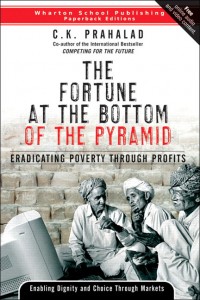
BoP-200x300A few years ago I read C.K. Prahalad’s The Fortune at the Bottom of the Pyramid: Eradicating Poverty Through Profits, a stunning book about how development can take place and successful economies can emerge even in the poorest of places. Prahalad presents case after case of how companies conducted research and supported innovations at a cost point that helped foster products that could serve some of the desperately poor populations in the world.

The other day my friend John McArthur twittered about this company – which has invented a Permethrin laced mosquito bed net guaranteed to last at least five years (testing shows it often lasts 7). Better yet, it is significantly stronger than polyester nets being both tear-proof, wash-proof and never requiring treatment.

This alone would be a great news story. But it is the economy behind the net that is equally exciting. The manufacturing of the Olyset Net is creating jobs in Africa:

Production in Africa began in 2003 when Sumitomo Chemical provided a royalty-free technology license to A to Z Textile Mills in Arusha, Tanzania. Tanzanian production was further expanded in 2008 when Sumitomo Chemical celebrated the official opening of a 50:50 joint venture factory, expanding our partnership with A to Z in East Africa. From 2009, global production capacity will exceed 40 million nets per annum, with around 50% manufactured in Africa. Furthermore, Sumitomo Chemical has recently committed to expanding production into Nigeria, the African country with the greatest malaria burden. Once production is established in Nigeria, global capacity will be 60 million Olyset nets.

Olyset-netThe news section of the website has still more good news. A Sumitomo Chemical Partnership with an Ethiopian Business will create 300 jobs in Kombolcha, Ethiopia. Is this development? Or is it Foreign Direct Investment creating jobs, feeding the African economy and helping solving one of the greatest scourges on the continent.

If you find this compelling, take a look at John’s newest Huffington Post piece where he outlines the new research and study Masters program he and Millennium Promise are helping create around the world.

A Neo-Progressive Manifesto

This piece builds on my thoughts regarding Umair Haque’s Generation M Manifesto.

Dear conservatives on the Left and Right – and those beholden to them.

We would like to break up with you.

Every day, we see a widening gap in how you and we understand the world — and what we want from it. It’s been a long time coming but we have irreconcilable differences.

You wanted big, fat, universal and eternal institutions. We want renewable, transparent, responsive, and people-oriented organizations.

You turned politics into a divisive word. We want open, engaged and deep democracy — everywhere.

You wanted financial fundamentalism – be it unrestricted, unregulated capitalism or protected and subsidized industrialism. We believe in a post-industrial economy: a shift from the hierarchical to decentralized with the use of markets as a progressive policy tool.

You wanted big growth, measured only by GDP. We want smart growth and real value, built by people with character, dignity and courage.

You wanted organizations hidden behind veils of secrecy. We want open institutions, fit for survival, designed to grow and share wealth, that seek to create markets, not own them.

You believed in top-down and trickle-down. We believe in emergent and bottom-up.

You prized biggie size life: McMansions, gas guzzlers, and McFood. We want a sustainable, humanized life.

You let citizens devolve into consumers and users. We want citizens to be hackers, creators and… citizens.

You’ve claimed the choice is between a winner take all society or a no winner society. We want an eco-system that rewards talent, ideas, productivity and collaboration – we want a meritocracy.

You wanted a culture that is controlled by the past. We want a free culture that builds on the past.

You’ve wanted to protect monopolies or protect jobs. We want an economy that allows for creative destruction.

You wanted exurbs, sprawl, and gated anti-communities. We want a society built around sustainable communities.

You wanted more money, credit and leverage — to consume ravenously. We want to be great at doing stuff that matters.

There’s a tectonic shift rocking the social, political, and economic landscape. We are pro-ams, we are creatives, we are hackers, we are neo-progressives and we are legion.

Who are neo-progressives? We are engaged. We start non-governmental organizations, work internationally, create social enterprises, volunteer in our communities, start socially conscious businesses and advocate outside of organized politics. We are a growing number of people who act differently – doing meaningful stuff that matters the most.

Neo-progressives are those of us who have not found a natural home on the left or the right of traditional politics and are increasingly returning to the core values of historical progressivism, using evidence-based public policy to help ensure the equality of opportunity in a market-based economy.

Everywhere we look, we see an explosion of neo-progressive businesses, NGOs, open-source communities, local initiatives, and government. Who are the neo-progressive role models? Obama, kind of. Larry and Sergey. The Threadless, Etsy, and Flickr peeps. Ev, Biz, and the Twitter crew who made Tehran 2.0 possible. Calvin Helin, Wendy Kopp and Teach for America, Tzeporah Berman and the ForestEthics crew as well as Mitchell Baker and the Mozilla community. The folks at Kiva, Talking Points Memo, and FindtheFarmer. Anita Roddick, Margot Fraser, Muhammad Yunus, Hernando de Soto Polar and Jeff Sachs are like the grandparents of neo-progressivism. There are tons where these innovators came from.

The creative destruction neo-progressives want isn’t just awesome — it’s vitally necessary. And if you think it all sound idealistic, think again.

We face global warming, a financial meltdown, a de-industrializing economy, increasing inequality (both nationally and internationally) and the possibility of catastrophic terrorism.

But the real crisis is the same one that confronted us in the late 18th century and in the mid 20th century and it isn’t going away, changing, or “morphing.” It’s the same old crisis — and it’s growing.

You’ve failed to recognize it for what it really is. It is in our institutions: the rules by which our economy is organized.

But increasingly they’re your institutions, not ours. You made inherited them but you failed to renew them and now they’re broken. Here’s what we mean:

“… For example, the auto industry has cut back production so far that inventories have begun to shrink — even in the face of historically weak demand for motor vehicles. As the economy stabilizes, just slowing the pace of this inventory shrinkage will boost gross domestic product, or GDP, which is the nation’s total output of goods and services.”

Clearing the backlog of SUVs built on 30-year-old technology is going to pump up GDP? So what? There couldn’t be a clearer example of why GDP is a totally flawed concept, an obsolete institution. We don’t need more land yachts clogging our roads: we need a 21st Century auto industry.

We were (kind of) kidding about seceding before. Here’s what it looks like to us: every era has a challenge, and this is ours: to renew what’s been given us and create what wasn’t — to ensure we foster a sustainable shared prosperity.

Anyone — young or old — can answer it. Neo-progressivism is about ensuring governing and economic institutions once again reflect progressive values. It is more about what you do and who you are than where you fit on a broken political spectrum. So the question is this: do you still belong to the 20th century – or the 21st?

The Generation M Manifesto (Re-mixed v.1)

I’ve always been a big Umair fan and think you should to. He writes about everything Taylor and I were getting at in our piece about The Death of Progressive Politics and the need for a neo-progressive movement.

On Wednesday Umair Haque published The Generation M Manifesto on his blog. In the very best spirit of Generation M he asked others to edit and re-mix the manifesto. I’ve added a few lines (all my edits are in red), removed the reference to “I” (underlying thinking: this is a manifesto for a group), removed the “I thinks” (this is no time to hedge ourselves)

I want to think about this more but here’s my first crack.

Addendum: I’ve actually done a lot more thinking on the Manifesto and re-mixed it more significantly here.

—-
Dear Old People Who Run the World,

My generation would like to break up with you.

Everyday, I we see a widening gap in how you and we understand the world — and what we want from it. It’s been a long time coming but I think we have irreconcilable differences.

You wanted big, fat, lazy “business.” We want small, responsive, micro-scale commerce.

You turned politics into a dirty word. We want authentic, deep democracy — everywhere.

You wanted financial fundamentalism. We want an economics that makes sense for people — not just banks.

You wanted shareholder value — built by tough-guy CEOs. We want real value, built by people with character, dignity, and courage.

You wanted organizations hidden behind a veils of secrecy. We want open institutions, fit for survival, designed to grow and share wealth, that seek to create markets, not own them.

You wanted an invisible hand — it became a digital the sleight of hand. Today’s markets are those where the majority of trades are done literally robotically. We want a visible transparent handshake: to trust and to be trusted.

You wanted growth — faster. We want to slow down — so we can become better.

You didn’t care which communities were capsized, or which lives were sunk. We want a rising tide that lifts all boats.

You wanted to biggie size life: McMansions, Hummers, and McFood. We want to humanize life.

You let citizens be devolve into consumers and users. We want citizens to be hackers, creators and… citizens.

You wanted a culture that is controlled by the past. We want a free culture that builds on the past.

You wanted exurbs, sprawl, and gated anti-communities. We want a society built on authentic around sustainable communities.

You wanted more money, credit and leverage — to consume ravenously. We want to be great at doing stuff that matters.

You sacrificed the meaningful for the material: you sold out the very things that made us great for trivial gewgaws, trinkets, and gadgets. We’re not for sale: we’re learning to once again do what is meaningful.

There’s a tectonic shift rocking the social, political, and economic landscape. The last two points above are what express it most concisely. I hate labels, but I’m going to employ a flawed, imperfect one: Generation “M.” We are pro-ams, we are creatives, we are neo-progressives, we are hackers, we are Generation “M” and we are legion.

What do the “M”s in Generation M stand for? The first is for a movement. It’s a little bit about age — but mostly about a growing number of people who are acting very differently. They are doing meaningful stuff that matters the most. Those are the second, third, and fourth “M”s.

Gen M is about passion, responsibility, authenticity, and challenging yesterday’s way of everything. Everywhere I look, I see an explosion of Gen M businesses, NGOs, open-source communities, local initiatives, government. Who’s Gen M? Obama, kind of. Larry and Sergey. The Threadless, Etsy, and Flickr guys. Ev, Biz and the Twitter crew. Tehran 2.0. The folks at Kiva, Talking Points Memo, and FindtheFarmer. Shigeru Miyamoto, Steve Jobs, Muhammad Yunus, and Jeff Sachs are like the grandpas of Gen M. There are tons where these innovators came from.

Gen M isn’t just kind of awesome — it’s vitally necessary. If you think the “M”s sound idealistic, think again.

The great crisis isn’t going away, changing, or “morphing.” It’s the same old crisis — and it’s growing.

You’ve failed to recognize it for what it really is. It is, as I’ve repeatedly pointed out, in our institutions: the rules by which our economy is organized.

But increasingly they’re your institutions, not ours. You made inherited them but you failed to renew them and now they’re broken. Here’s what I we mean:

“… For example, the auto industry has cut back production so far that inventories have begun to shrink — even in the face of historically weak demand for motor vehicles. As the economy stabilizes, just slowing the pace of this inventory shrinkage will boost gross domestic product, or GDP, which is the nation’s total output of goods and services.”

Clearing the backlog of SUVs built on 30-year-old technology is going to pump up GDP? So what? There couldn’t be a clearer example of why GDP is a totally flawed concept, an obsolete institution. We don’t need more land yachts clogging our roads: we need a 21st Century auto industry.

I was We were (kind of) kidding about seceding before. Here’s what it looks like to me us: every generation has a challenge, and this, I think, is ours: to foot the bill for yesterday’s profligacy — and to create, instead, an authentically, sustainable shared prosperity.

Anyone — young or old — can answer it. Generation M is more about what you do and who you are than when you were born. So the question is this: do you still belong to the 20th century – or the 21st?

Love,

Umair and the Edge Economy Community

Chicago's green roofs and our failed stimulus

I was completely floored (and excited) to read this article about how the Sears Tower in Chicago (recently renamed the Willis Tower) is to undergo a $350M green retrofit that will give it a green roof and it’s own wind turbines. This will reduce the energy consumed by the tower by 80% and its water consumption will drop by 24 million gallons.

As this blog notes:

the U.S Department of State estimates that buildings account for an estimated 36 percent of overall energy use, 65 percent of electricity consumption, 30 percent of all greenhouse gas emissions and 12 percent of water use in America. Green improvements to Sears Tower are aimed at reducing electricity use by 80% in just four years, equating to 68 million kilowatt hours or 150,000 barrels of oil per year. The architects firm responsible for the retro-design, Adrian Smith + Gordon Gill Architecture, has also designed a 50 storey highly sustainable tower to accompany Sears Tower on its south side which will draw power from the improved efficiency measures and work as a net-zero energy development.

So this renovation – which is to start immediately (note the shovel readiness of it) this project will:

  • create a more efficient and thus profitable building (benefiting Chicago businesses and the tax base)
  • reduce US consumption of oil by 150,000 barrels a year (reducing cash outflows and helping America’s balance of trade)
  • will immediately create 3600 jobs yo complete the work (in the construction industry, which has been hard hit by the financial crises)
  • help train and provide practical experience to, construction workers, contractors, design firms & others in creating green buildings (position them for the next economy)

This is a stimulus plan that works. Recently I argued we need a stimulus plan that is low of carbs and fat on data… this is just another example of the types of shovel ready projects that leave a legacy. Canada’s plan to date? Pave some roads and build some bridges all so that we can burn more gas moving cars around.

The Rat Pack of Public Service Sector Renewal

As many of you know I spend a lot of time thinking about public service sector renewal – that’s a wonkish term for renewing the public service. I do it because I think the public service is one of the most important institutions in the country since it affects everything we do, pretty much every day.

Over the past few years I’ve met more and more people who are equally passionate about this issue. Some I’ve met in person, others I’ve just chatted with by email. But, over the last 4 years I’ve watched a small group of bloggers – a rat pack of public service sector renewal – emerge. We’re scattered across the country and have come to from different angles but we all care about how our government is, how it should be, and how we can get to from the first place to the latter.

This is no easy task. I’m outside of government so it’s easier for me to speak truth to power. That’s why I’m so impressed with the other rat packers, in pursuit of making government better some have put their jobs on the line from time to time. I’d encourage you to go check our their blogs and give them a read.

The CPSR rat pack:

Me: as my readers know, my own thinking on public service sector renewal tends to focus on public policy development, and how it is going to be impacted by demographic change, technology, social media, networks and emergent systems.

Nick Charney’s blog CPSRenewal is one of the best blogs on public service sector renewal out there. Nick often does a weekly roundup of CPSR articles and blog posts, interviews with public servants and generally shares his thoughts.

Etienne Laliberte is one of the bravest public servants I know. A couple of years ago he wrote “An Inconvenient Renewal” in which shared his thoughts on renewal. Most important, his is probably the only document I’ve seen that treats renewal as a management problem, not a policy problem (something I’ve discussed in the past and intend to talk about again shortly). You can catch him at his blog as well.

A couple of other people I think of as being part of the Rat Pack include Peter Cowan – an OpenEverything alumnus – whose part of a team doing very interesting work with social media tools at Natural Resources Canada.

Thomas Kearney, who doesn’t blog, but is amazing nonetheless, has been a big part of the work behind GCPEDIA.

There’s Laura Wesley’s who’s got a great blog over at Results for Canadians: Measuring Success in Government. Nice to have someone concerned with how we measure success!

And finally there is the outspoken Douglas Bastien at Government of Canada 2.0, ready to tell it as it is and take no prisoners.

I know there are more people than just those I’ve mentioned, but these are the group I know and who’ve always been kind about letting an semi-outsider like me in. If you care about Canadian public service sector renewal (twitter hashtag #cpsr) then I hop you’ll add their RSS feeds to your reader.

Feeding the next economy – Give us a stimulus that stimulates, not placates

Last December – as the debates over the stimulus packages were just beginning, I wrote a piece on why the wrong stimulus today could fail us tomorrow. Well, today has become tomorrow, and we are failing.

A stimulus package should be an investment. It should create new industries and markets, it should find help create efficiencies and improve productivity, in short, in should help the economy grow in a sustainable manner. In the last depression the government accomplished this by funding infrastructure necessary for the 20th century economy, things like roads and highways for cars and transportation, power stations and grids for cities and industry, university buildings for education. Today, we already have much of that infrastructure and – while some of it needs to be renewed – we need to be focusing on what infrastructure is needed for the next economy – the digital economy – that will carry us out of this recession.

So what powers the digital economy? It isn’t coal, steel or cars and power (although these things are necessary), it’s data and connectivity.

Data is the plankton of the new economy. It seems plentiful, tiny and insignificant. But a whole ecosystem of companies, large and small are emerging to feed off of it and support our next economy. People often fail to recognize that the largest company already created by the new economy – Google – is a data company.  Google is effective, rich and powerful not because it sells ads… but because it generates petaflops of data everyday from billions of search queries. This allows it to know more about our society, and sometimes us individually – the merchandise we like, the services we want, the spam we’ll receive, even if the likelihood we’ll get sick in 4 months – than we know about yourself. Give people access to data and they will use it to become more efficient (freeing up more money to reinvest) and to create new services and opportunities (creating new jobs and profits).

Look no further than the City of Washington DC. It created a publicly available database of city collected and created data and asked local individuals and companies to use it. The result? A $50,000 dollar investment in changing processes and offering prize money has so far yielded $2.3M in value. That’s a 46 times return on investment in one year.

Now imagine that at a national level. Imagine Statistics Canada making all its data available freely (since taxpayers have already paid for its creation). As I outlined in a talk to StatsCan last year, not only would this make them a more important ministry, it could foster billions in savings, investments and new jobs all for a tiny sum. Let’s pick a truly excessive number, say $100M (.2% of the stimulus package) and imagine that’s this would be the cost for Statistics Canada to free all its data and provide in formats usable for webpages, cellphones and applications. Even if such a stimulus were only 20% as effective as Washington’s open data project it would still yield $460M in one year of new (not saved) jobs, and improved economic efficiencies and competitiveness. Over a decade, billions in new wealth would be created.

Compare this to our current course of action. To date much of our stimulus has been spent propping up (not creating) industries that are in death spirals such as logging, newspapers, and the auto-sector. The money spent isn’t about creating new or better jobs, it is simply being spent to keep jobs. Indeed, Andrew Coyne calculates that each auto-job saved cost us just under 2 million dollars. It will take years, if not decades, for such an investment to pay off, if it ever does. Worse still, the Canadian economy will be no more efficient or profitable as a result. While we are at it we might as well be giving Canadians money to buy land-line telephones to stimulate the telecommunications sector.

Oh, and it case you are wondering, the Americans already give out much of their government data for free and they are starting to give away more and more. This is a competitive race we are already losing, and only falling further and further behind.

Canada needs a better stimulus, one that is low on carbon and fat on data. Sadly, I fear our current government lacks the vision and creativity to give us what we need to prepare for the 21st century. So far we are off to an ominous start.

Is it time to get rid of the Foreign Service designation?

dfait_logoA Foreign Service officer (FS) is an employees of the Government of Canada who pass the foreign service exam and are hired by the Department of Foreign Affairs and International Trade (DFAIT)and the Canadian International Development Agency (CIDA).

This is important because becoming an FS is no easy task. Every year hundreds of Canadians write the test and few are selected for interviews. Fewer still are hired into the department. This barrier to entry has created a sense of class around the FS designation. To be an FS meant you were the best, the brightest, the most able of public servants – not only a distinct class, but a class above.

But what if this is no longer true? Moreover, what if being a class apart is what’s killing the Foreign Service?

It is worth remembering the environment out of which the FS designation emerged (and for which it is designed for). When Canada’s nascent foreign service began to take shape in the 30’s the diplomatic world looked very different. It was dominated by Europeans and largely populated by quasi royalty – former aristocrats – who had all gone to the right schools, spoke the right languages and knew all the right protocols. Foreign policy was an elite policy area – not just because it was so important – but also because it was dominated by elites (in the class sense of the word). While the role of aristocrats in foreign policy has faded long ago, the legacy of their culture lingered. As a result, the Foreign Service had to ensure that the right people became foreign service officers, no ordinary country bumpkin would do, to have influence in the diplomatic world standards had to be kept.

The FS designation also emerged out of an early and mid 20th century era when public servants did not change ministries. In Ottawa you were a Finance Man, or a Treasury Board Man, or a Natural Resources Man (and yes, for much of that period you were probably a man) and it was uncommon to move from one department to another. In this world, a strong Foreign Service culture made sense since many of the other ministries had a strong sense of culture as well.

But today the world, Canadians and Ottawa, are different. Every ministry engages in foreign policy – be it healthcare issues, the environment, energy, transport, you name it. There is hardly an issue in Canada that does not have an important international dimension. Moreover, public servants now frequently move from ministry to ministry. Indeed, a successful career in the public service requires that you move around. A broad set of experience is deemed to be essential. Finally, the typical public servant has changed dramatically. Today, Canadians are much more internationalized. Many of us are born abroad, still more of us have family abroad, and with (relatively) cheap air travel many Canadians travel abroad. This is a far cry from even 30 years ago. But not only do Canadians travel more, they are better educated. There may have been a time when the average foreign service officer was significantly better educated than the average public servant – but this is simply no longer the case. Many public servants now have Master’s degrees. Indeed, for a while, you couldn’t get hired without one.

This is the world of the public service in the 21st century, and it presents three challenges for the foreign service.

The first, it has become less and less clear what makes a Foreign Service officer unique. An increasing number of public servants outside of DFAIT and CIDA are successfully engaging in international work: negotiating treaties, attending international conferences, and working directly with other governments. If this work can be done by non-FSs the question arises… what is the value add of the Foreign Service Officer? What unique skills and knowledge do they bring? Whenever I’m in Ottawa I hear colleagues, friends, and even strangers ask this question. This is not to say Foreign Service officers are not incredibly talented- but it is asking what, as a class or group, do they offer?

This first problem is compounded by a second that few within DFAIT and CIDA wish to talk about: elitism. FSs have always thought of themselves as not only different but also (if they are honest with themselves) better than other public servants. There was likely a time when this was true. FSs were better educated and more traveled than their peers. Today however, it is no longer the case. Many public servants are relatively well traveled and well educated. The gap simply no longer exists. The result is that, around Ottawa, FSs are perceived as elitist snobs, a perception that is crippling the department. Not only does the rest of Ottawa now question the department’s value add they also, quite understandably, despise being looked down upon. Everyday a thousand small decisions are made to seek ways to work around – rather than with – DFAIT and those decisions are adding up. Nobody wants to play with the foreign service.

Finally, FS designation itself is a direct problem because it us both keeping Ottawa out DFAIT down. Today, public servants move around Ottawa getting experience in different departments – this is how the game is now played. And yet DFAIT and CIDA sit outside the game – FSs don’t want to work in another department and they often resent non-FSs who come and work in theirs. Consequently, few good ideas developed outside the ministry find there way in. Moreover, because FSs have isolated themselves they have neither the network of interdepartmental colleagues nor the experience and knowledge of how Ottawa works that their public service colleagues possess. They are getting outplayed. Still more problematic, the answers to the highly subjective Situational Judgment component of the Foreign Service Test are determined by senior Foreign Service officers. This means that those who succeed in being hired as FSs are those who are most likely to think like the outgoing generation. This creates a conservative trend within the department that reinforces old ideas and the class like elitism.

If DFAIT wants a leading role in the development of government policy it has a number of obstacles it needs to overcome. The most challenging however is reforming the system that shapes the thinking and culture of its employees. One place to start may be acknowledging that the FS designation – while an enormous source of pride – is also a source of significant problems. Opening up the FS designation to other public servants (treating it more like that the ES designation) could be one approach. Alternatively, focusing the FS designation on crisis management in the field and making it a class for people who are going to work in embassies in hostile territory or politically compromising situations may make more sense. These are just suggestions – what is most important is that the yawning culture gap between DFAIT and the rest of Ottawa must be closed – because increasingly the rest of Ottawa is discovering it can live without DFAIT, but DFAIT cannot live without the rest of Ottawa.

North America and the Auto Sector: The Upside of Down

Anyone else notice how circumscribed the debate over the auto sector has been? Some news outlets have occasionally asked “is the bail out fair?” but the discussion has remained fairly limited. Specifically, pieces on the auto-sector bailouts tends to be restricted to the negative consequences in relation to the costs in jobs: the moral hazard the bailout creates, the (unfair) treatment the bailout affords autoworkers, the concerns over the enormous burden the bailouts imposes on taxpayers, the impact on affected communities. Even within this narrow discourse,few commentators have even been outspoken. Maclean’s has probably been the most interesting. It bluntly outlined the gong show the industry has become  with this set of amazing statistics and its columnist Andrew Coyne published has posted piece after piece where he rightly points out the opportunity cost of bailing out the auto industry.

However, none of the commentary on the North American auto-sector’s dramatic decline has touched on how this change will impact the continent’s political and policy landscape. It interesting because, while it isn’t polite to talk about it, the fact is, there are upsides to the decline of the North American auto sector.

Start wit the fact that we will now only have one or two (smaller) American auto companies and their relative importance to the US economy will be dramatically diminished. It is hard to imagine that the political muscle of this sector will not equally diminish. This is no small matter. Huge swaths of American (and thus, in part, Canadian) public policy is explicitly and/or implicitly focused on ensuring that people either need cars, or that cars are never a burden. (Remember, these are companies that, with political and government acquiescence, bought up public transport companies across the US just so they could tear up the tracks their trams ran on to push people into cars or, if they had to, the buses the car companies built.)

So everything from highways, to urban planning, to emission controls, to business hours… almost everything in our society, is shaped by the fact that cars and the auto-sector were a large and integral part of the North American economy and its social fabric.

And so all these decision, all these debates about how North Americans should structure their society, they are all going to open up again as American auto companies cease to exist or decline in importance. The US congress is much more likely to impose tougher emission restrictions if those restrictions most likely impact foreign companies. If more roads don’t create more American jobs and profits then public transport – not the auto-sector – becomes slightly more appealing to subside.

It is true that Americans (and Canadians) love their cars. But this love didn’t come out of nowhere, it was nursed by decades of social policy and economic planning. Now the incentives that created and sustained that process are potentially irrevocably weakened. The consequences are terrible for those who work in the sector, but they may end up being liberating and renewing for society at large. For cities, citizens and communities the implicit legal, political and policy barriers that have prevented alternatives are already beginning to decay.

At that’s a big upside.

Open data in local education: broader lessons for government, citizens and NGOs

Last months I remember reading a couple of news stories about a provincial government ministry in Canada that was forced to become less transparent.

Forced?

Yes, this was not a voluntary move. A specific group of people pressured the government, wanting it to remove data it had made public as well as make it harder for the public to repurpose and make use of the data. So what happened? And what lessons should governments, NGOs and citizens take away from this incident?

The story revolves around the Ontario Ministry of Education which earlier this year created a website that mashed up performance data (e.g. literacy and math scores) with demographic information (e.g. percentage of pupils from low-income households and percentage of gifted students). The real problem – according to a group representing teachers, parents and stakeholders – occurred when the Ministry enabled a feature that allowed the website’s users to compare up schools to one another.

The group, called People for Education, protested that the government was encouraging a “shopping-mentality” in the public school system.

Of course, many parents already shop for schools. I remember, as a kid, hearing about how houses on one side a street, but within the catchment area of my high school, were more expensive than houses on the other side of the same street, but within the catchment area of another school. Presently however, this type of shopping is reserved for the wealthy and connected (e.g. the privileged). Preventing people from comparing schools online won’t eliminate or even discourage this activity, it will simply preference those who are able to do it, further reinforcing inequity.

The real problem however, is that the skills and analysis involved in school shopping are the same as those required in accessing and being engaged in, the performance of one’s local school. Parents, and taxpayers in general, have a right to know their childrens school’s performance – especially in comparison to similar schools. If parents don’t have information to analyze and compare, how can they know what systemic issues they should ask their childrens teachers about? More importantly, how can they know what issues to press their local school board about?

Ironically, People for Education states on its “About Us” page that it works towards a vision of a strong public education system by a) doing research; b) providing clear, accessible information to the public and c) engaging people to become actively involved in education issues in their own community.

And yet, asking the government to remove the comparison feature runs counter to all three of its activities. Limiting how the Ministry’s data can be used (and as we’ll see later, suggesting that this data shouldn’t be shared):

  • prevents parents, and other analysts such as professors or politicians, from doing their own research
  • runs counter to the goal of providing clear and accessible information to the public. Indeed, it makes information harder to access.
  • makes it harder for parents to know how they should get involved and what issues they should champion to improve their local school

What is interesting about this story is that it reveals the core values and underlying motivation of different actors. In this case People for Education – which I believe to be a well intentioned a positive contributor to the issue of education – is nonetheless revealed to have a conservative side to it.

It fears a world where citizens and parents are equipped with information and knowledge about schools. On the one hand it may fear the types of behaviours this could foster (such as school shopping). However, it may also fear a weakening of its monopoly as “expert” and advocate on educational issues. If parents can look at the data directly, and form their own analysis and conclusions, they may find that they don’t agree with People for Education. Open data would allow those it represents to self-organize, challenging the hierarchy and authority of the organization.

For whatever reason, we see an NGO bending over backwards to advocate for an outcome that runs directly counter to the very vision and activities it was founded to serve. More ironically, this result in some paradoxical messaging as an organization that champions Ontario’s school system essentially arguing that it doesn’t trust the products of that system – the citizens of Ontario – to use the information and tools provided by the Ministry that was responsible for their education. It is an unsustainable position – particularly for a group that was originally founded as a bottom up, grass-roots organization.

So what lessons are there here?

For government:

A key mistake made by the Ontario Ministry of Education is that it didn’t open up the data enough. While the website allowed users to look at school performance data they could only do this on the Ministry’s website using the Ministry’s tools and interface. Had the data been available as an API or in downloadable format someone else could have taken the data and created the system for comparing schools. People for Education were mostly upset that the Ministry’s website encouraged a “shopping-mentality.” Had the Ministry simply shared the data then People for Education could build their own interface using criteria and tools they though relevant. The Fraser Institute or a multitude of other organizations could build their own as well, and people could have used the tools and websites they found most useful and relevant. Let People for Education go head to head with the Fraser Institute and whoever else. This is not a battle the government need fight.

Lesson: Always provide the data – a goal that is hard to argue against – but sometimes, leave it to others to conduct the analysis. A marketplace of ideas will emerge, and citizens can choose what works best for them.

For NGOs in general

First, understand what open data means for your cause. One of the news articles had this highly disturbing quote from the Executive Director of People for Education:

Among her complaints about the type of information available, Ms. Kidder took issue with the ministry’s contention the Web site merely consolidated information already available to the public. “You can’t walk into your child’s school and say ‘What’s the average income of parents at this school?’ ” she said. “It’s not true at all [that this is public information].”

This is a shocking statement. In actuality, all the data assembled by the Ministry is publically available. It was just that, until now, it had remained scattered and isolated. Just because it was hard to find (and thus reserved for an elite few) or located on the school property (and thus easy for parents to locate) does not mean it didn’t exist or wasn’t public.

Lesson: Transparency is the new objectivity. People increasingly don’t trust anyone – governments, the media, or even NGOs. They want to see the analysis themselves, not take your word for it. Be prepared for this world.

Second, be careful about taking positions that will deny your supporters – and those you represent – tools with which to educate themselves. Organizations that are perceived as trying to constrain the flow of information so as to retain influence and control risk imploding. I won’t repeat this lesson in detail but Clay Shirky’s case study about the Vatican, written up in Here Comes Everybody, is a powerful example.

For educators in particular

In the past, educators have been deeply concerned with ranking systems. This is understandable. Ranking systems are often a blunt tool. Comparing apples to oranges can be foolish – but then, sometimes it is helpful. The question is to know when it is helpful and ensure it is used accordingly.

The fact is, ranking is an outcome of data. The two simply cannot be separated. The moment there is data, there is ranking. A ranking by school size, number of teachers, or amount of gym equipment is not different than a ranking of class sizes, literacy rates, disciplinary trends, or graduation rates. What matters is not the rank, but the conclusions, meaning and significance we apply to these rankings. Here, the role for groups like People for Education could be profound.

This is because we can’t be in favour of transparency and accessible information on the one hand and against ranking on the other. The two come hand in hand. What we can be opposed to are poor ranking systems.

Every profession gets assessed, and teaching should be no different. The challenge is that there is much more to teaching than what gets reflected in the data collected. This means that groups like People for Education shouldn’t be against transparency and open data – they should be trying to complexify and nuance the discussion. Once the data is publicly available anyone can create a ranking system of their own choosing – but this gives us an opportunity to have a public discussion about it. One way to do this is to create one’s own tools for measuring schools. You don’t like the Ministry of Education’s system? Create your own. Use it to talk to parents about the right questions to ask and to promote the qualitative ways to evaluate their childrens’ schools performance. It’s an open world. But that doesn’t mean it needs to be feared – it is rife with opportunity.
PublicVoice Interview on "Open," Government and Citizen Engagement

A couple of weeks ago I was interviewed by Maclean’s columnist Scott Feschuk for PublicVoice.tv on what the rise of “open” systems and the continuing evolution of information technology will mean for the future of both government and citizen engagement.

Cleverly, they’ve kept these videos nice and short – it’s all designed to be short and punchy. There will be five 1-3 minute videos in a all and so far the first two have been posted. You can see them here and here.

Sadly, the lighting isn’t all that flattering… consider yourself warned.