Category Archives: public service sector renewal

Today: "right to know" panel for parliamentarians

Today from 10am-12am EST I’ll be a panelist for Conference for Parliamentarians: Transparency in the Digital Era a panel convened by the Office of the Information Commissioner as part of Right to Know Week. Apparently the Canadian School of Public Service will provide access to this conference as part of its Armchair Discussions (www.righttoknow.ca).

More on the panel:

This conference aims to engage Parliamentarians in a debate and reflection on the new paradigm that the digital world has introduced for the right to know. Greater transparency in the digital era requires more than sound information management and the use of state-of-the-art information technology. It calls for a fundamental change of attitudes from disclosing information on a need-to-know basis to managing information with the presumption of disclosure as the default mode. How can public institutions trigger and accelerate this change of attitudes for the benefit of Canadians?

For those who are interested you can see my slides (sans audio, I’m afraid) below.

Mapping Government 2.0 against the Hype Curve

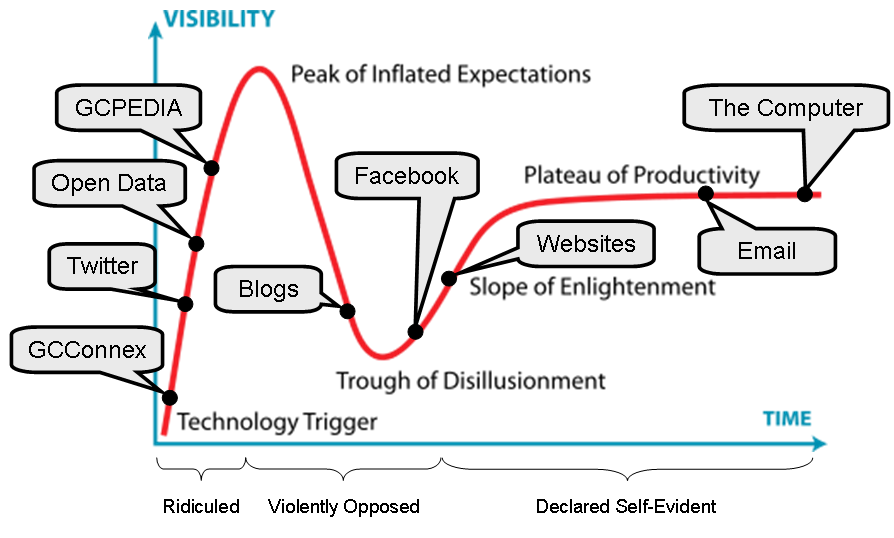
Last week Andrea DiMaio wrote an interesting post on how Government 2.0 may be approaching the peak of the hype cycle. I’d never seen the hype cycle before and it looked fun, so I thought it might be interesting to try to map where I believe some current Canadian government 2.0 projects, a few older technologies, and a few web 2.0 technologies in general, are against this chart from a government perspective.

My suspicion is that we haven’t even begun to dip into the Trough of Disillusionment with most true Web 2.0 government projects (GCPEDIA & GCConnex). However, I think governments have overcome their paranoia about facebook, but are still very wary… that said I’ve noticed some government ministries have started to use facebook as a communication tool with the public. Blogs however (which are perfectly okay for public servants to create internally) are still viewed with suspicion – internally they are almost never used. But then, heck, given the cluttered nature of most government website (and the fact that finding info is hard), I think it is clear that we are still working our way up the “Slope of Enlightenment” on this web 1.0 technology.

Gov 20 hype curve 3

Those who’ve seen me speak know I much I love Arthur Schopenhauer‘s three stages of truth:

“All truth passes through three stages. First, it is ridiculed. Second, it is violently opposed. Third, it is accepted as being self-evident.”

So I’ve also included how I think the three stages map against this chart too.

So in sum… in  my view there is good news for Government 2.0 projects – visibility is still increasing. Unfortunately there is also some bad news: prepare for increased violent opposition…

Misunderstanding and understanding the Open Data Hype

On Wednesday Gartner’s Andrea Dimaio wrote an interesting blog post entitled Open Data and Application Contests: Government 2.0 at the Peak of Inflated Expectations which Peter Smith nicely linked to the Gartner’s Hype Cycle graph from Wikipedia. I want to break his post down into three components. Two – the bad and the good, I’m going to talk about today – the third, which I’ll tackle on Monday involves some mapping and fun.

The Bad

As someone whose been thinking about and working on Open Data and Gov 2.0 for several years now three things struck me as problematic about Andrea’s post. Firstly, he misunderstands the point of open data. While many people – self-included- talk about how it can empower citizens, citizens will not be its primary beneficiary. The biggest user of open data portals is going to be government employees. Indeed, Tim Wilson reminded me the other day of our conversation with Jason Birch, the thought leader who made much of Nanaimo’s geo-data public, where he talked about how he wasn’t actually tasked with sharing data publicly – he was tasked with making the data available to other Nanaimo city employees. Sharing it with citizens was a (relatively) cost free addition. These projects aren’t about serving some techo-literati, it is about getting a city to first and foremost talk to itself – having it talk to its citizens is an important (and democracy expanding) benefit.

Second, was this unfortunate anecdote:

Yesterday I was discussing with a British client over lunch and he told me how the publication of data may lead to requests for more data (through the Freedom of Information Act), in a never-ending cycle of information gathering which is likely to cost a lot to both government and taxpayers. Another client observed (as I said in a previous post) that there is no way people will be able to tell to what extent a mash up on an application actually uses official, trusted government data.

Could government become swamped with data requests? Who knows, but in theory… it shouldn’t. Making data available should reduce the amount of time public servants spend responding to requests by diverting requests to open data portals. But let’s say Andrea’s concerns are valid and that, as a result of open data, citizens become more actively concerned and interested in how government works and thus Freedom of Information Act requests increase. The horror… citizens are interested in government! Citizens want to know how decisions are made! Remind me again… why is this a problem?

The real problem here isn’t access to data, it’s that the Freedom of Information Act process is itself broken. If open data creates a further demand for more transparent government and pushes us to foster better mechanisms for sharing government information, this is a good consequence. As for concerns that people might misrepresent public data, well a) people can already do this and we haven’t had a rash of bad applications, but even if they tried… people will stop using their service pretty quick.

Finally, another nice thing about public data is that it tends to get very clean, very quickly. My concern isn’t that government data will be misrepresented… I’m concerned that government data is already wrong and isn’t being verified. Knowing that someone might actually look at a data set is one of the most powerful incentives for organization to improve its collection. (Something Clay Shirky noted in a talk he made the other day at a Bioinformatics conference I’m at).

(There is of course, one group who may not see these a good consequences as it will change how they work: British public servant like Andrea’s client’s who raised the objections… but then they pay Gartner’s bills, not you.)

The Good

The end of Andrea Dimiao’s piece is where we find common ground. I agree that the Apps for Democracy competitions run the risk of limiting the definition of “the public” to citizen coders.  We want broader participation – particularly once more complex data sets like budgets, procurement and crime data are released – from academics, citizens groups and NGOs. Here in Vancouver we’ve talked about focusing any Apps competition on the themes of homelessness, housing and the environment, since these have been the dominant concerns of citizens in recent years.

More importantly, I agree (and love) Dimiao’s concept of employee-centric government. Indeed, my chapter for Tim O’Reilly’s upcoming book on Open Government makes a parallel argument, that namely we should stop trying to teach an analogue government to talk to a digital public and instead focus on making government digital (ie. getting it “open,” networked and using web 2.0 internally) first.

And perhaps most importantly, I agree that government 2.0 risks being over-hyped. I still believe in the potential, but know that getting there is going to be a painful process (mind the gap!). Government 2.0 advocates should expect lots of resistance and adoption problems ahead – but then change is painful.

Articles I'm Digesting 10/09/2009

Here’s a few articles I’ve been reading that I’ve found particularly compelling.

Big Food vs. Big Insurance

by Michael Pollan  (via David B.)

This great piece talks about the secondary impact of health care reform – namely that if US Health Insurance companies have to insure every American they will suddenly care a great deal more about what Americans eat, as this is a major driver of healthcare costs. Money quote (the one David B sent me that got me reading):

“But these rules may well be about to change — and, when it comes to reforming the American diet and food system, that step alone could be a game changer. Even under the weaker versions of health care reform now on offer, health insurers would be required to take everyone at the same rates, provide a standard level of coverage and keep people on their rolls regardless of their health. Terms like “pre-existing conditions” and “underwriting” would vanish from the health insurance rulebook — and, when they do, the relationship between the health insurance industry and the food industry will undergo a sea change… Suddenly, every can of soda or Happy Meal or chicken nugget on a school lunch menu will look like a threat to future profits.”

Here’s a great example of a leverage point, Pollan shows how healthcare reform will shift policy alliances, power and money in Washington and could allow for a long awaited (and needed) reform of food policy. It’s a fascinating analysis and it shows how strategically the Obama administration is thinking. They know that if they can win this battle – even with an imperfect bill – they will be gaining powerful allies for the next few battles. Brilliant.

Twitter: “pointless babble” or peripheral awareness + social grooming?

by Danah Boyd

A few weeks ago the Globe continued its war on social media by publishing this piece about how 40.55% of tweets are babble. It’s the kind of analysis that is so poorly constructed one doesn’t even know where to start in rebutting it. I’d been thinking for a while to write some coherent rebuttal, but fortunately Danah Boyd has already written it.

Open Government Data Principles

This is one of the best and simplest distillations of guiding principles around how governments should treat data that I have seen to date. Simple, concise, short yet comprehensive, these principles should hang on the CIO’s office wall in every government department or ministry around the world. As per their request I’m trying to think of ways to improve it, if I come upon any, I’ll blog about it.

Brand new old idea: The GoC Public Servant as Knowledge Worker

By Douglas Bastien

I remember when I had a contract with the Privy Council Office looking at young people in the Public Service and how they might network together, I took out a book that talked about managing knowledge workers in government and thinking how curious it was that few people in government saw themselves as Knowledge Workers. And yet, how government sees and manages its employees doesn’t always align with how knowledge workers would expect to be managed.

Doublas Bastien piece is bang on in its description of the problem. It is also a deeply depressing read. Depressing because one is forced to confront that so many of the challenges the knowledge economy, technology and social change would pose to government were identified a decades ago. Our government can predict and HR challenges, but when it comes to managing one… that’s a different story. But we shouldn’t be surprised, we don’t promote managers in government,  we promote policy wonks, and so we don’t manage the problems, we issue policies to deal with it. Definitely read Douglas’ piece, and if you like it, consider going back into my archives and reading one of the post on Public Service Sector Renewal I’m most proud of.

Many eyes make all bugs shallow – especially when the eyes get smarter

[Please bear with me for the next 24 hours – I’m moving to a new hosting company, and there may be some glitches here and there to work out. Thanks.]

My friend Diederik has been writing a number of cool posts over at his blog Network-labs.org. For example he has an awesome jetpack plugin that predicts the likelihood a bug will get fixed and a plugin that allows users to rate how badly a bug is being flamed (to spot counterproductive behaviours).

But he recently published a very cool post that uses data from Mozilla bug submissions over the past decade to demonstrate that bug submitters become more proficient over time. However, there are outliers who are a “drag” on the system. More importantly, I believe his data can be interpreted in another way. That, with some minor investment (particularly some simpler vetting screens prior to reaching bugzilla) bug submitters could learn faster.

For example, a landing screen that asks you if you’ve ever submitted a bug before might take newbies to a different page where the bugzilla process is explained in greater detail, the fact that this is not a support site is outlined, and some models of good “submissions” are shared (along with some words of encouragement). By segmenting newbies we might ease the work burden on those who have to vet the bugs.

I think this also has implications for cities and 311 systems (systems that essentially allow citizens to report problems – or bugs – with city infrastructure or services). There will inevitably be people who become heavy users of 311 – the goal is not to get frustrated with them, but to move them up a learning curve of submitting helpful and useful information as quickly as possible. Ignoring them will not work. Strategies for engagement, including understanding what is motivating them and why they continue to use the system in an ineffective way, could help save the city resources and help foster a larger army of citizens who use their spare social capital to make the city a better and more resilient space.

Creating the Open Data Bargain in Cities

Embedded below is the talk I’ve given to both community hackers (at Open Web Vancouver) as well as City of Vancouver Staff regarding the opportunities and challenges around open data and the open motion. (Here’s an update on where Vancouver is at courtesy of some amazing work by city staff).

For those willing to brave through the presentation (or simply fast forward to the end) one piece I felt is most important is the talk’s last section which outlines what I term “The Bargain” in a reference to the informal contract Clay Shirky says exists between every Web 2.0 site and their users.

The bargain comes last, because it matters only if there is a promise (open and shared data) and a set of tools (applications languages) that are already working together. The bargain is also the most complex aspect of a functioning group, in part because it is the least explicit aspect and in part because it is the one the users have the biggest hand in creating, which means it can’t be completely determined in advance… A bargain helps clarify what you can expect of others and what they can expect of you.

Clay Shirky in Here Comes Everybody (my italics, page 270)

I believe that in an open city, a similar bargain exists between a government and its citizens. To make open data a success and to engage the community a city must listen, engage, ask for help, and of course, fulfil its promise to open data as quickly as possible. But this bargain runs both ways. The city must to its part, but so, on the flip side, must the local tech community. They must participate, be patient (cities move slower than tech companies), offer help and, most importantly, make the data come alive for each other, policy makers and citizens through applications and shared analysis.

Articles I'm digesting 24/7/2009

Been a while since I’ve done one of these and I’ve got a lot of great pieces I’ve been reading. So let’s get to it.

Designs on Policy by Allison Arieff (via David B.) and TED Talk: Are we in Control of our own Decisions? by Dan Ariely

I keep hearing about the interaction between policy and design (most flatteringly an architecture professor said I had a designer’s mind” the other day) and so over the past few years I try (with some success) to read as much as I can about design. David B sent me the Arieff piece which, of course, weds my passion for public policy with design. One thing I like is the way the piece doesn’t try to boil the ocean – it doesn’t claim (like in other places) that good design will solve every problem – just that it will help mitigate against it. Most intriguing for me is this line:

“It feels weird to have to defend design’s importance, yet also completely necessary. The United Kingdom has had a policy in place since 1949; Japan since 1956. In countries like Finland, Sweden, South Korea and the Netherlands, design is a no-brainer, reflected by the impeccable elegance, usability and readability of everything in those countries from currency to airport signage.”

A design policy? How civilized. That’s something I could get behind – especially after listening to Dan Ariely’s TED talk which is downright frightening at moments given how susceptible our decisions are (and most disconcerting the decisions of our doctors, dates and who knows whose) to the layout/perception of the choice.

Lost in the Cloud by John Zittrain

A few months ago I was in Ottawa and – surprisingly and unplanned – ended up at a pub with Richard Stallman. I asked him what he thought of Cloud Computing (a term he believes is too vague to be helpful) but was nonetheless viscerally opposed to it. Many of the reasons he cites are covered by Zittrain in this thoughtful piece. The fact is, Cloud Computing (or whatever term you may wish to use) is very convenient and it carries with it huge privacy, security and access challenges. This is potentially the next big challenge for those of us who support and Open Internet – the possibility of the internet being segmented into a series of walled gardens controlled by those who run the cloud servers is real and must be thought through. If you care about public policy and/or are a geek, read this.

Is it Time to Get Rid of the Foreign Service Designation?

Am I reading my own articles? No. I am, however, absorbed by the fascinating and constructive conversation taking place – mostly involving public servants – in the comments section underneath. Here are just some snippets:

  • “For 8 years I worked at DFAIT, observing and participating in the culture within the walls of a building named after a diplomat that Wikipedia states “is generally considered among the most influential Canadians of the 20th century.” Sadly, the elitism (whether earned or not) is only the cause of a bigger problem; lack of desire to collaborate, and almost no desire to change in an era where the only constant is change.”
  • “…as I left the issue of the FS classification was quietly but passionately part of the watercooler discussion. From my perspective, in spite of a nasty AG report on the dismal state of affairs of HR at DFAIT, the department has more pressing problems, such as credibility with central agencies, a coherent sense of mission and talent attraction and retention.”
  • “I am also a bit puzzled by people who saw your piece as an attack on DFAIT – you’re advocating for human resource reform to improve the department, after all. I’m still not sure why you think DFAIT is required though, or why Canadian foreign policy suffers when departments forumulate it without involving DFAIT.”
  • “It’s good to see that even Craig Weichel, President of PAFSO, is open to your suggestion that it might be good to have more foreign service officers circulate through other government departments…”

Putting the Cart Before the Horse by Peter Cowan

A great blog post about the lessons from implementing social media in a government agency. Peter Cowan – an Open Everything alum – is part of the team at Natural Resources Canada team that has been doing amazing work (NRCan is one of the most forward looking ministries in the world in this regard). Peter’s piece focuses on misunderstanding the “business case” for social media and how it often trips up large government bureaucracies. This abbreviated but extended quote on why traditional IT business cases don’t work or aren’t necessary is filled with great thoughts and comments:

“They (Social Media tools) are simple and viral and they cost very little to implement so the traditional requirements for upfront business needs definition to control risk and guide investment are not as important. In fact it would take more time to write a proposal and business case than to just put something out there and see what happens.

More importantly though social media are fundamentally new technologies and the best way to understand their business value is to get them into the hands of the users and have them tell you. To a large degree this is what has happened with the NRCan Wiki. Most of the innovative uses of the wiki came from the employees experimenting. They have not come from a clearly articulated business needs analysis or business case done in advance.

In fact, determining business needs in advance of having a tool in hand may actually lead to status quo approaches and tools. There is the famous Henry Ford… quote goes something like “if I had asked people what they wanted in a car they would have said faster horses”. We social media folks usually deploy this quote to highlight the weakness of focusing too much on responding to people’s perceptions of their existing business needs as a determinant of technology solution since people invariably define their needs in terms of improving the way they are already doing things, not how things could be done in a fundamentally new way.

Genius.

Google’s Microsoft Moment by Anil Dash

A fantastic piece about how Google’s self-perception is causing it to make strategically unsound choices at the same time as its public perception may be radically shifting (from cute fuzzy Gizmo in to mean nasty Stripe). A thoughtful critique and a great read on how the growth and maturation of a company’s culture needs to match its economic growth. I’ve added Anil Dash to by must read blogs – he’s got lots of great content.

Open Cities – the Counter Reaction

The Washington Monthly has an interesting piece about how some bureaucracies are having a reactionary (but albeit unsurprising) reaction to open data initiatives. The article focuses on how the data used by one application, Stumble Safely “helps you find the best bars and a safe path to stumble home on” by mashing together DC Crime Data, DC Road Polygons, DC Liquor Licenses, DC Water, DC Parks, and DC Metro Stations.

However, arming citizens with precise knowledge doesn’t appear to make one group of people happy: The Washington, D.C. police department. As the article notes:

But a funny thing has happened since Eric Gundersen launched his application: Stumble Safely has become less useful, rather than more so. When you click on the gray and red crime-indicating dots that have appeared on the map in the past few months, you don’t get much information about what exactly happened—all you get is a terse, one-word description of the category of the incident (”assault,” or “theft”) and a time, with no details of whether it was a shootout or just a couple of kids punching each other in an alley.

This isn’t Gundersen’s fault—it’s the cops’. Because while Kundra and the open-data community were fans of opening up the city’s books, it turned out that the Metropolitan Police Department was not. Earlier this year, as apps like Stumble Safely grew in number and quality, the police stopped releasing the detailed incident reports—investigating officers’ write-ups of what happened—into the city’s data feed. The official reason for the change is concern over victims’ and suspects’ privacy. But considering that before the clampdown the reports were already being released with names and addresses redacted, it’s hard to believe that’s the real one. More likely, the idea of information traveling more or less unedited from cops’ keyboards to citizens’ computer screens made the brass skittish, and the department reacted the way bureaucracies usually do: it made public information harder to get. The imperatives of Government 2.0 were thwarted by the instincts of Government 1.0.

This is just one in a long list of ways that old-style government (1.0) is reacting against technology. The end result sadly however is that the action taken by the police doesn’t reduce crime, it just reduces the public’s confidence in the police force. This is just a small example of the next big debate that will take place at all levels of government: Will your government try to control information and services or will it develop trust by being both accountable and open to others building on its work? You can’t have it both ways and I suspect citizens – particularly creatives – are going to strongly prefer the latter.

This is a crosspost from my Open Cities Blog at CreativeClass.com

The Rise of the Open City: the current state of affairs

I’ve been following with great interest the number of cities partaking in open data initiatives. With the online announcement yesterday of a motion going before Calgary’s City Council, things are again on the move. So what is the count at now? This little table tries to capture who’s done what so far. If I’m missing something please do let me know – I will try to update this from time to time.

City

Date of initial activity

Action

Note

Website

Washington, DC October 12th, 2008 Created a data portal on city website and launched apps for democracy Action was taken by the CIO, no city motion passed. Currently launching a second apps for democracy contest. http://data.octo.dc.gov/
Vancouver, BC May 21st, 2009 Vancouver City Council Passes the Open Motion Open Data website is in the works, release date unknown. N/A
San Francisco, CA June 16th, 2009 City of SF posts a craigslist request looking for developers to help create a data.gov like site for the city No motion passed, there is an OpenSF blog where current activities and ideas are shared. N/A
Nanaimo, BC June 22nd, 2009 City launches an open data website No motion passed http://www.nanaimo.ca/datafeeds/
New York City, NY June 25th, 2009 A bill is being circulated by Council Member Gale Brewer Has announced a “Big Apps” competition for apps that use 80 soon to be released city data sets. N/A
Calgary, AB July 27th, 2009 City of Calgary tables an Open Motion to be debated N/A N/A
Toronto, ON 2010 Announces (April 7th, 2009) intention of creating open data website Mayor David Miller announces Toronto will create an open data website by fall of 2009 at Mesh 09 conference N/A
Ottawa, ON I’ve heard there is movement in Ottawa, have not found any information

Is it time to get rid of the Foreign Service designation?

dfait_logoA Foreign Service officer (FS) is an employees of the Government of Canada who pass the foreign service exam and are hired by the Department of Foreign Affairs and International Trade (DFAIT)and the Canadian International Development Agency (CIDA).

This is important because becoming an FS is no easy task. Every year hundreds of Canadians write the test and few are selected for interviews. Fewer still are hired into the department. This barrier to entry has created a sense of class around the FS designation. To be an FS meant you were the best, the brightest, the most able of public servants – not only a distinct class, but a class above.

But what if this is no longer true? Moreover, what if being a class apart is what’s killing the Foreign Service?

It is worth remembering the environment out of which the FS designation emerged (and for which it is designed for). When Canada’s nascent foreign service began to take shape in the 30’s the diplomatic world looked very different. It was dominated by Europeans and largely populated by quasi royalty – former aristocrats – who had all gone to the right schools, spoke the right languages and knew all the right protocols. Foreign policy was an elite policy area – not just because it was so important – but also because it was dominated by elites (in the class sense of the word). While the role of aristocrats in foreign policy has faded long ago, the legacy of their culture lingered. As a result, the Foreign Service had to ensure that the right people became foreign service officers, no ordinary country bumpkin would do, to have influence in the diplomatic world standards had to be kept.

The FS designation also emerged out of an early and mid 20th century era when public servants did not change ministries. In Ottawa you were a Finance Man, or a Treasury Board Man, or a Natural Resources Man (and yes, for much of that period you were probably a man) and it was uncommon to move from one department to another. In this world, a strong Foreign Service culture made sense since many of the other ministries had a strong sense of culture as well.

But today the world, Canadians and Ottawa, are different. Every ministry engages in foreign policy – be it healthcare issues, the environment, energy, transport, you name it. There is hardly an issue in Canada that does not have an important international dimension. Moreover, public servants now frequently move from ministry to ministry. Indeed, a successful career in the public service requires that you move around. A broad set of experience is deemed to be essential. Finally, the typical public servant has changed dramatically. Today, Canadians are much more internationalized. Many of us are born abroad, still more of us have family abroad, and with (relatively) cheap air travel many Canadians travel abroad. This is a far cry from even 30 years ago. But not only do Canadians travel more, they are better educated. There may have been a time when the average foreign service officer was significantly better educated than the average public servant – but this is simply no longer the case. Many public servants now have Master’s degrees. Indeed, for a while, you couldn’t get hired without one.

This is the world of the public service in the 21st century, and it presents three challenges for the foreign service.

The first, it has become less and less clear what makes a Foreign Service officer unique. An increasing number of public servants outside of DFAIT and CIDA are successfully engaging in international work: negotiating treaties, attending international conferences, and working directly with other governments. If this work can be done by non-FSs the question arises… what is the value add of the Foreign Service Officer? What unique skills and knowledge do they bring? Whenever I’m in Ottawa I hear colleagues, friends, and even strangers ask this question. This is not to say Foreign Service officers are not incredibly talented- but it is asking what, as a class or group, do they offer?

This first problem is compounded by a second that few within DFAIT and CIDA wish to talk about: elitism. FSs have always thought of themselves as not only different but also (if they are honest with themselves) better than other public servants. There was likely a time when this was true. FSs were better educated and more traveled than their peers. Today however, it is no longer the case. Many public servants are relatively well traveled and well educated. The gap simply no longer exists. The result is that, around Ottawa, FSs are perceived as elitist snobs, a perception that is crippling the department. Not only does the rest of Ottawa now question the department’s value add they also, quite understandably, despise being looked down upon. Everyday a thousand small decisions are made to seek ways to work around – rather than with – DFAIT and those decisions are adding up. Nobody wants to play with the foreign service.

Finally, FS designation itself is a direct problem because it us both keeping Ottawa out DFAIT down. Today, public servants move around Ottawa getting experience in different departments – this is how the game is now played. And yet DFAIT and CIDA sit outside the game – FSs don’t want to work in another department and they often resent non-FSs who come and work in theirs. Consequently, few good ideas developed outside the ministry find there way in. Moreover, because FSs have isolated themselves they have neither the network of interdepartmental colleagues nor the experience and knowledge of how Ottawa works that their public service colleagues possess. They are getting outplayed. Still more problematic, the answers to the highly subjective Situational Judgment component of the Foreign Service Test are determined by senior Foreign Service officers. This means that those who succeed in being hired as FSs are those who are most likely to think like the outgoing generation. This creates a conservative trend within the department that reinforces old ideas and the class like elitism.

If DFAIT wants a leading role in the development of government policy it has a number of obstacles it needs to overcome. The most challenging however is reforming the system that shapes the thinking and culture of its employees. One place to start may be acknowledging that the FS designation – while an enormous source of pride – is also a source of significant problems. Opening up the FS designation to other public servants (treating it more like that the ES designation) could be one approach. Alternatively, focusing the FS designation on crisis management in the field and making it a class for people who are going to work in embassies in hostile territory or politically compromising situations may make more sense. These are just suggestions – what is most important is that the yawning culture gap between DFAIT and the rest of Ottawa must be closed – because increasingly the rest of Ottawa is discovering it can live without DFAIT, but DFAIT cannot live without the rest of Ottawa.