Category Archives: random

Interview on Open Source, Open Gov & Open Data withe CSEDEV

The other week – in the midst of boarding a plane(!) – I did an interview with the CSEDEV on some thoughts around open data, open government and open source.

The kind people at CSEDEV have written up the interview in a kind of paraphrased way and published it as three short blog posts here, part 2 here and part 3 here.

Part of what makes this interesting to me is how a broader set of people are becoming interested in open government. Take CSEDEV for example. Here is an Ottawa based software firm focused on enterprise solutions. It’s part of an increasing number of software companies and IT consulting firms are taking note of the open government and open data meme. Indeed, another concrete example of this is Lagan, a large supplier of 311 systems, announced the other week that they would support the open311 standard. This dramatically alters the benefits of a 311 system and the capacity for it to serve as a platform and innovation driver for a city.

But, even more exciting, the meme is starting to spread beyond IT and software. I was recently asked to write an article on what open data and open government means for business more generally, here in BC. (Will link to it, when published)

These moments represent an important shift in the open data and open government debate. With vendors and consultants taking notice governments can more easily push for, and expect, off the shelf solutions that support open government initiatives. Not only could this reduce cost to government and improve access for public servants and citizens, it could also be a huge boost for open standards which prove to be transformative to the management of information in the public sector.

Exciting times. Watch the open government space – now that it’s linked to IT, it’s beginning to gain speed.

The week in review (or… why I blog and a thank you)

Here’s a few snippets of comments, emails and other communications I’ve had this week in response to specific posts or just the blog in general. Each one touches on why I love blogging and my readers and why this blog has come to mean so much to me.

Venting, and finding out your not alone…

So, yesterday I got a little bit into a hate-on for Statistics Canada’s website. It wasn’t the first time and pretty much every time I do it I find another soul out there whose had their soul crushed by the website as well. Take this comment from last week:

Re: Stats Canada’s website being unusable. I completely frickin agree. God. Has anyone in government actually tried to use that website? An econ professor gave our class an assigment last year that involved looking stuff up on Statscan. Half of our class failed the assignment because they gave up and the other half had the wrong data, but got the marks anyways for trying. I think he actually took that assigment off of the grading at the end. It’s a bloody gong show…

Sometimes it makes me feel more human knowing that others are out there struggling with the same thing. StatsCan does great work… I just wish they made it accessible.

…and then having some kind souls find some solutions for you.

But as nice as knowing you’re not alone… even better is how often the internet connects you to others who just happen to have that esoteric piece of knowledge that saves the day.

I agree, Stats Can is one of the worst government websites out there (specifically those stupid CANSIM tables), one that, as a policy analyst with XXXXXXXX Canada, i frequently have to use to get data. I had the data for XXXXXXX and it wasn’t hard to get it for the country.

This kind soul led me straight to a completely different page on statscan that happened to have the data I was looking for. (for those interested, it was here).

And they weren’t the only one. Another reader posted a link to the data over twitter…

Thank god there is an army good natured amateur and professional experts experienced in navigating the byzantine structure of the statscan website!

So… thank you! I’m going to try to grind out an updated pan-North American version of the Fatness Index this weekend.

Impacting Policy

But this week also had that other rewarding ingredient I love to get: hearing about a post helped, incrementally, foster better public policy. This came in via email from a public servant about yesterday’s blog post:

Your blog today provided a good example in a meeting with government colleagues about the benefits of opening data. It illustrates the implications of not releasing data to the public (e.g. stifling innovation)… It resonated well with them.

This is a huge part of why I blog. Part of it is to explore ideas, part of it is to introduce ideas and thoughts, but a big piece of it is to enable public servants and do just this, helps small internal government meeting (on subjects like open data) go a little more smoothly.

So to everyone out there, be it policy wonks, students, public servants, politicians or ordinary, engaged citizens. Thank you. It was a good week. We wrote some good posts, some good comments, had an original story on the stupidity of the census, and maintained sanity in the face of the StatsCan website. Thank you everyone for making it so fun. Hope you all have a great weekend. – Dave

Fatness Index 2 years on: the good, the bad, the ugly

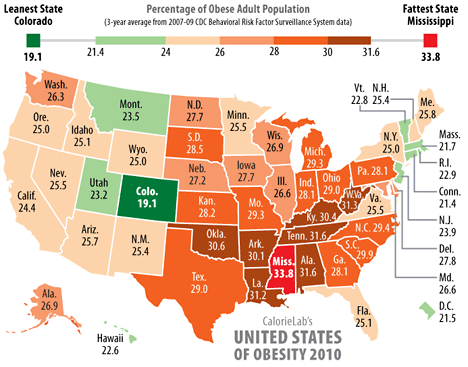
Two years ago I saw that Richard Florida and Andrew Sullivan had re-posted a map created by calorielab that color-coded US states by weight.

As I found it interesting I created a North America wide map the included Canadian data (knowing that it probably would be a perfect apple to apple comparisons). The map and subsequent blog post turned into one of my best viewed pages with well over 20,000 pageviews.

The very cool people over at Calorie Labs informed me that they have released an updated version of the American map (posted below, you can see the original at their site here). Not too much has changed, but after looking at the map I’ve a few comments.

Calorie lab’s release of an updated version of the map has triggered a few thoughts and some lessons that I think should matter to policy makers, health-care professionals and citizens in general. Here they are:

The Good

The amazing people at Calorie Lab. When I created the map 2 years ago I didn’t even check to see if their work was copyrighted. Although the data was public domain, I copied Calorielab’s colour palette as I was trying to create a “mash-up” of their work with Canadian data. I wanted the maps to look similar. My map was a derivative work.

Did the people at Calorielab freak out? No. Quite the opposite. They reached out, said thank you and asked if I needed help.

It seems this year they’ve gotten even cooler. I don’t remember if the original map’s license but with the publishing of their 2010 update they wrote:

CalorieLab’s United States of Obesity 2010 map is licensed for use by anyone in any media and can be downloaded in various formats (small GIF, large GIF, SVG, EPS).

There’s a line directed specifically at people like me. It says, please, use this map! Not only is the license open but they’ve provided it in lots of formats (Which is great cause two years I had to recreate the thing from scratch and it took hours).

So naturally you are wondering, where is David’s 2010 mashup-Northern American Fatness Index.

The Bad

The bad is that trying to find the Canadian data is a pain. A couple of times a year I get a cool idea for a visual or graph that Statistics Canada data might help me create. In minutes I’m on their webpage and, within 5 minutes, I’m walking away from my computer fearing I might throw it out the window.

StatCans website may be the worst, most inaccessible government website in the western world. Whatever data you are looking for always seems to be at least one more click away.

It spent an hour trying to find data that StatsCan allegedly wants me to find. (This in an era of google where I generally find data people don’t want me to find, in minutes). Ultimately, I think I found the relevant data on overwieight/obesity figures by province (but who knows! Should I be choosing peer group A, or B, or C, D, E, F, G? None of which have labels explaining what they mean!).

The Ugly

Sadly, it gets worse. Even if you a) locate the data on Statscan’s website and b) it is free, it will probably still be inaccessible.  The only way the data can be viewed is with a Beyond 20/20 Professional Browser. You need to learn a new software package, one 99.9% of Canadians have never heard of, and that only works on a PC (I’m on a mac). The data I want is pretty simple, a CSV file, or even an Excel spreadsheet would be sufficient, something the average Canadian could access. But I guess it is not to be.

So I give up.

You win StatsCan. There are 10s of thousands of Canadians like me who would love to do interesting things with the data our tax dollars paid to collect, but even when your data is free and “open,” it isn’t. You’ve enjoyed tremendous support in the last month from those Canadians who understand why you are important (including me) but many Canadians have had to go up a steeper learning curve around why they should care. I might suggest they’d have gotten up that curve faster if they too could have used your data.

Myself, healthcare professionals, students and countless others could paint innumerable stories explaining Canadians and Canada to one another – helping us grasp our history, our social and health challenges, as well simply who we are. But we can’t.

In the end I’m still one of your biggest supporters, but frankly even I feel alienated.

Note: If someone wants to help me get this data, I’ll take a cut at recreating the map again, otherwise, as I said before. I give up.

How Science Is Rediscovering "Open" And What It Means For Government

Pretty much everybody in government should read this fantastic New York Times article Sharing of Data Leads to Progress on Alzheimer’s. On one hand the article is a window into what has gone wrong with science – about how all to frequently a process that used to be competitive but open, and problem focused has become a competitive but closed and intellectual property driven (one need only look at scientific journals to see how slow and challenging the process has become).

But strip away the talk about the challenges and opportunities for science. At its core, this is an article is about something more basic and universal. This is an article about open data.

Viewed through this lens it is a powerful case study for all of us. It is a story of how one scientific community’s (re)discovery of open principles can yield powerful lessons and analogies for the private sector and, more importantly the public sector.

Consider first, the similarities in problems. From the article:

Dr. Potter had recently left the National Institutes of Health and he had been thinking about how to speed the glacial progress of Alzheimer’s drug research.

“We wanted to get out of what I called 19th-century drug development — give a drug and hope it does something,” Dr. Potter recalled in an interview on Thursday. “What was needed was to find some way of seeing what was happening in the brain as Alzheimer’s progressed and asking if experimental drugs could alter that progression.”

Our government’s are struggling too. They are caught with a 20th-century organizational, decision-making and accountability structures. More to the point, they move at a glacial speed. On the one hand we should be worried about a government that moves too quickly, but a government that is too slow to be responsive to crises or to address structural problems is one that will lose the confidence of the public. Moreover, like in healthcare, many of the simpler problems have been addressed. citizens are looking for solutions to more complex problems. As with the scientists and Alzheimer’s we may need new models to speed the process up for understanding and testing solutions for these issues.

To overcome this 19th century approach – and achieve the success they currently enjoy – the scientists decided to do some radical.

The key to the Alzheimer’s project was an agreement as ambitious as its goal: not just to raise money, not just to do research on a vast scale, but also to share all the data, making every single finding public immediately, available to anyone with a computer anywhere in the world.

No one would own the data. No one could submit patent applications, though private companies would ultimately profit from any drugs or imaging tests developed as a result of the effort.

Consider this. Here a group of private sector companies recognize the intellectual property slows down innovation. The solution – dilute the intellectual property, focus on sharing data and knowledge, and understand that those who contribute most will be best positioned to capitalize on the gains at the end.

Sadly this is the same problem faced within governments. Sometimes it has to do with actual intellectual property (something I’ve recently argued our governments should abandon). However, the real challenge isn’t about about formal rules, it is more subtle. In complex siloed organizations where knowledge is power the incentives to maximize influence are to not share knowledge and data. Better to use the information you have strategically, in a limited fashion, to maximize influence. The result, data is kept as a scarce, but strategic asset. This is a theme I tackled both in my chapter in Open Government and in blog posts like this one.

In short, the real challenge is structural and cultural. Scientists had previously existed in a system where reputation (and career advancement) was built by hoarding data and publishing papers. While the individual incentives were okay, collectively this behavior was a disaster. The problem was not getting solved.

Today, it would appear that publishing is still important, but there are reputational effects from being the person or group to share data. Open data is itself a currency. This is hardly surprising. If you are sharing data it means you are doing lots of work, which means you are likely knowledgeable. As a result, those with a great deal of experience are respected but there remains the opportunity for those with radical ideas and new perspectives to test hypothesis and gain credibility by using the open data.

Unsurprisingly, this shift wasn’t easy:

At first, the collaboration struck many scientists as worrisome — they would be giving up ownership of data, and anyone could use it, publish papers, maybe even misinterpret it and publish information that was wrong.

Wow, does that sound familiar. This is invariably the first question government officials ask when you begin talking about open data. The answer, both in the scientific community and for government, is that you either believe in the peer-review process and public debate, or you don’t. Yes, people might misrepresent the data, or publish something that is wrong, but the bigger and more vibrant the community, the more likely people will find and point out the errors quickly. This is what innovation looks like… people try out ideas, sometimes they are right, sometimes they are wrong. But the more data you make available to people the more ideas can be tested and so the faster the cycle of innovation can proceed.

Whether it is behind the firewall or open to the public, open data is the core to accelerating the spread of ideas and the speed of innovation. These scientists are rediscovering that fact as our some governments. We’ve much to learn and do, but the case is becoming stronger and stronger that this is the right thing to do.

Good Statistical Data: We fund it in Africa, but not in Canada

It turns out that the Canadian government is a supporter of collecting good statistical data – especially data that can be used to alleviate poverty and address disease. There’s only one catch. It can’t help Canadians.

As the fall out from the canceling of the mandatory long form census continues to grow – today the head of Alberta Health Services spoke out, saying the the census decision will hamper the province’s ability to deliver health care efficiently – we  now learn that the very arguments the government dismisses here in Canada, it supports on the international stage.

As it happens, the Canadian International Development Agency contributes to the Trust Fund for Statistical Capacity Building (TFSCB) an international fund designed to support the Marrakech Action Plan for Statistics. And what, you should legitimately ask, is the Marrakech plan? It is a general agreement by international actors to support building developing countries statistical capacity. It has, specifically, as a primary objective, the goal of developing countries capacity to perform censuses. More interestingly, it has a secondary goal, to: “Set up an international Household Survey Network.” the very same part of the census the government just gutted here in Canada.

Both the Trust Fund and the Marrakech Action plan websites explain this in detail. But so to does the CIDA website, where the government acknowledges that this work is essential as:

“The projects supported aim to improve in the collection, processing, analysis, storage, dissemination, and use of quality statistics to support poverty reduction and economic and social development. Developing countries can submit funding proposals to the Trust Fund. The proposals are ideally based on a national strategy for the development of statistics. By implementing such a strategy, countries can improve their statistical capacities to measure development progress and results, notably with regard to the Millennium Development Goals, and to better plan and utilize scarce resources.”

In short, our government accepts that the Household Survey is essential to helping marginalized people. It recognizes that such a survey will help other governments tackle poverty, health care and other social development issues. Indeed, it believes it so strongly, we will spend millions of dollars a year funding the development of statistical capacity abroad to ensure that other governments don’t do what we just did to the long form census.

I’m grateful that our government believes that good statistics and the types of questions found on the long form are essential to developing good policy – I’m just sad they don’t believe it to be true for Canada citizens.

Canada's emerging opendata mashups (plus some ideas)

Over at IT World Canada, Jennifer Kavur has put together a list of 25 sites and apps for Open Government. What’s fantastic about this list is it demonstrates to government officials and politicians that there is a desire, here in Canada, to take government data and do interesting things with it.

Whether driven by developers like Michael Mulley or Morgan Peers who just want to improve democracy and have fun, or whether it is by those like Jeff Aramini who want to start a business and make money, the appetite to do something is real, and it is growing. Indeed, the number of apps and sites is far greater than 25 including simple mashups like CSEDEV’s environment Canada pollution data display or the 17 apps recently created as part of the Apps For Climate Action competition.

What is all the more remarkable is that this growth is happening even as there is little government data available. Yes, a number of cities have made data available, but provincially and especially federally there is almost no concerted effort to make data easy to use. Indeed, many of the sites cited by Kavur have to “scrape” the data of government websites, a laborious process that can easily break if the government website changes structure. It begs the question, what would happen if the data were accessible?

As an aside, two data sets I’m surprised no one has done much with are both located on the Toronto website: Road Restriction data and DineSafe data. Given how poor the city’s beta road restriction website is and the generally high interest in traffic news, I’d have thought that one of the local papers or media companies would have paid someone to develop an iPhone app or a widget for their website using this data. It is one thing commuters and consumers want to know more about.

As for DineSafe, I’m also surprised that no one in Toronto has approached the eatsure developers and asked them if they can port the site to Toronto. I’m still more surprised that a local restaurant review website has developed a widget that shows you to the DineSafe rating of a restaurant on its review page. Or that an company like urbanspoon or yelp hasn’t hired an iPhone app developer to integrate this data into their app…

Good times for Open Data in Canada. But if the feds and provinces were on board it could be much, much better…

The Government admits the voluntary Long Form is bunk

Yesterday, in response to a legal challenge from the Federation of Francophone and Acadian Communities of Canada Minister Clement announced the government would shift questions regarding the French language from the voluntary long form to the mandatory short form of the census.

Specifically these questions would move:

1) Can this person speak English or French well enough to conduct a conversation?

2a) What language does this person speak most often at home?

2b) Does this person speak any other languages on a regular basis at home?

This was done allegedly after receiving “new” advice from the new Statscan head which advised that having these questions in the voluntary form would not satisfy the government’s obligations under the Official Languages Act.

Of course, my friend points out that by moving these question the government is admitting that data collected by the voluntary form is essentially useless. It certainly isn’t good enough for the government otherwise… why not leave it on the voluntary form? In short, the minister just admitted that the long form, for which we are going to spend over $130M dollars to collect data, is for intent and purposes, useless.

This of course runs counter to the claims the Minister has been making all along that the data would still be sound.

It also begs the question of what other obligations the government has that might not be met. Legislation around disabled Canadians comes to mind, as of course do immigrants and first nations, all groups that we will know significantly less about. Once again, good public policy is based on having sound data. It would be nice if the government at least acknowledged this.

Update: Turns out the National Statistical Council (who normally advises StatsCan on these issues but which has been cut out of the loop on the issue of the long form) has come to the same conclusion.

2nd Update: In the ongoing – we are an international laughing stock – part of the census story, Nature, one of the two most preeminent science and research peer review journals in the world has published a scathing editorial piece about the Long Form Census decision. This is equivalent to the international research community pointing at Canada and asking “why do you want to go back to the dark ages?” It’s a question that – as a passionate believer in effective public policy – I’ve been asking myself as well.

Which App for Climate Action do you like most?

Yesterday, at 5pm PST the Apps for Climate Action team at the Province of British Columbia released the list of 17 applications created using data from the Apps for Climate Action data catalog.

At the moment anyone can register and vote for the application that they think is the best. I’d encourage people to click over to the website and take a look.

The Apps for Climate Action is a demonstration of what can happen when we begin to make government held data freely available to the public: people can bring to life, even make fun, engaging and useful, what are often boring stats and numbers to bridge what Hans Rosling calls the last 6 inches (the distance from your eyes to your brain, a reference to the failure in design where we make data we can see, but not that captures our imagination).

In a month where our federal government cited imaginary data to justify policies on crime and has eliminated the gathering a huge swaths of effective data necessary for the efficient governing of our cities and rural communities as well as ensuring critical services will no longer reach innumerable Canadians, it is nice to see a province trying to do the opposite: not only understand that effective data is the cornerstone to good policy but to enable everyday, ordinary Canadians to leverage it so as to make smarter decisions, influence policy debates and empower themselves. It’s what a modern democracy, economy and civil society should look like.

The Apps for Climate action team and the government deserve a ton of praise fro striking out and trying something new and different. I hope they get worthwhile acknowledgement.

I for one am looking forward to the tough job of serving as a judge in the competition.

How not to fix a mistake: How Clement's just dug a deeper hole

Faced with a lawsuit from a Francophone group opposed to the changes to the long form of the census the government has decided to shift questions on francophone skill from the now voluntary long form to the mandatory short form of the census.

The government hopes that this will placate angry francophone voters. The reality is that it will probably make many Canadians more upset.

Now the public gets to see that:

a) It is completely obvious that the Government did not think this policy through – so much so that it must now make changes on the fly

b) That the only way to be heard by this government is to take legal action

c) That the government is willingly ignoring the innumerably other stakeholders like the federal ministries, the provinces, cities, plus 300+ NGOs, business groups, religious organizations, etc… that are negatively impacted by this decision

d) That their goal is to destroy the census and that the actions today were about accelerating that process, not consulting or listening to Canadians

Of course, the repercussions continue to pile in. Even some hard core conservative commentators think that Minister Clement has embarrassed himself and seriously damaged his career, and polls continue to show the Conservatives have slumped significantly. The most damning piece in those polls however is hidden in the find print, not only have the conservatives slid double digits, but they are not the second choice for most Canadians, so even if people do change their minds, decisions like this make it harder to imagine they’ll go conservative.

More evidence that StatsCan disagreed with Clement (aka Helping @kady out)

Over at the CBC the ever resourceful Kady O’Malley has posted documents from Statistics Canada surrounding the decision to make the long form of the census voluntary.

She’s starting to notice some interesting bits, here’s two I saw that she might want to add to the list.

First, there are two lines written by public servants that seems to run counter to Minister Clement’s defense of eliminating the long form last week

There is this statement referring to both the short and long form of the census:

Census information is used in planning schools, community health services, housing needs, daycare and emergency services and other important services for our communities.

Worse still, this next one refers explicitly to the long form (renamed the National Household Survey or NHS in this memo):

The NHS questionnaire will cover topics such as language, immigration, Aboriginal peoples, mobility, ethnicity, education, labour, income and housing.

The information in the NHS will provide data to support government programs directed at target populations. Information from the NHS will also support provincial/territorial and local government planning and program delivery.

So here is an official government memo that appears to run counter to Minister Clement’s argument last week that the only special interests were benefiting (and were thus opposed) to changes in the census. As we see here (and as I argued last week) the biggest users of this data are government who use it to ensure that programs (say for the elderly) are targeted effectively and so tax dollars used efficiently.

More importantly, the document seems to recognize that the provinces/territories and municipalities are huge stakeholders in this process – wouldn’t that suggest they should have been consulted before hand?

Indeed, Kady points this out in her piece by highlighting a comment that vainly tries to raise the flag that “stakeholders” (read other ministries, the provinces/territories, municipal governments, the bank of Canada, the list could go on for about 300+ organizations) should be consulted.

The other interesting piece from the documents that I noted was this hilarious comment (comment number 7) of which I’ve taken a screen shot.

I love the comment! “If this that important why not mandatory?

Ah the lonely voice of reason, hidden in a comment bubble of a MS Word document.

Huge credit to Kady O’Malley for doing the hard work of getting these documents and for being a grade journalist and posting them online. If you do link to this post, please also link to hers (again found here).