Category Archives: vancouver

I live on a green roof – and so should everyone

There has been an exploding interest in green roofs of late. During the recent Vision Vancouver fundraiser I was introduced to Erika Richmond who designed and built my friend Toby B.’s greenroof in the downtown east side. Walking away from the conversation I suddenly realized I may actually live on a green roof.

The building I live in has 4 floors of commercial real estate and a rooftop townhouse development built around a 20,000 sq ft garden and sidewalks. The “sidewalks” have ceders and trees planted along them, the main garden is a grass field and with over 14 decently sized wood garden plots.

Is it technically a green roof? I don’t know. But it does create a beautiful and relatively peaceful living space 25 meters above street in an increasingly busy part of town.

(I realize the photos do not look particularly green but you we are in the midst of what passes for winter here in Vancouver. I’ll try posting some new ones come spring/summer.)

But it turns out the beauty is the least important part of green roofs. For a policy geek like me there is a fascinating and increasing amount of research into the benefits of green roofs – some of the most interesting of which has been commissioned by the City of Toronto and available in a report it published in late 2005.

Savings to the city of Toronto, based the assumption that 100% of available green roof areas over 350 sq m. were retrofitted and that 75% of the roof area was made green, were:

Those are some large numbers.

What an enormous opportunity green roofs would have been for the federal budget. Buildings account for a significant amount of GHG emissions and the financial savings generated by such a plan are obviously enormous. Better still the greening of the aforementioned roofs would not require the equivalent planning of say building a highway, bridge or building and so could be undertaken relatively quickly. In short, they are shovel ready. Equally important, green roofs are probably more labour intensive (as opposed to capital intensive) than many of types of infrastructure projects. This means green roof projects might be better positioned to generate jobs and help lower our rising unemployment numbers. Massive year on year savings? Significant employment? Instant initial savings? An increase in property values? Sounds like a stimulus package winner to me.

Sadly, the trend appears to be catching on more in the United States than in Canada. A cursory exploration of the web reveals that New York City recently passed a city by-law that rewards building-owners who cover 50 percent of available rooftop space with a green roof with “a one-year property tax credit of up to $100,000. The credit would be equal to $4.50 per square-foot of roof area that is planted with vegetation, or approximately 25 percent of the typical costs associated with the materials, labor, installation and design of the green roof.” Philadelphia also has a tax credit (although it appears to be little used). Chicago however is an emerging capital of green roofs with over 200!

It is unclear whether Vancouver or Toronto have such a tax credit (it didn’t appear so, but please let me know if I’m wrong). That said, a growing number of Toronto public buildings now have green roofs and Vancouver will soon be host to Canada’s largest green roof. It’s a start, but given the size of the opportunity, we could be doing so much more.
From here to open – How the City of Toronto began Opening up

Toronto the open

For myself, the biggest buzz at ChangeCamp Toronto was that the city showed up with lots of IT staff (much of it quite senior) who were trying to better understand how they could enable others to use their data and help citizens identify and solve problems. In fact the City of Toronto ran what I believe will be seen later as the most enduring sessions in which they asked what data should they start making available immediately (as APIs).

For those not in the know, think of an API as a plug that rather than delivering electricity instead delivers access to a database.

The exciting outcome is that web designers, coders and companies can then use this data to better deliver services, coordinate activities in neighborhoods, make government more transparent, or analyze problems. For example, imagine if all the information regarding restaurants health violations were not hidden deep within a government website (in a PDF format that is not easily searchable by google) but were available on every restaurant review website? Or if road closures were available in a data stream so a google maps application could show which road were closed on any given day – and email you if they were in your neighborhood.

This is the future that cities like Toronto are moving towards. But why Toronto? How did it arrive at this place? How is it that the City of Toronto sent staff to ChangeCamp Toronto?

The emergence of open in Toronto

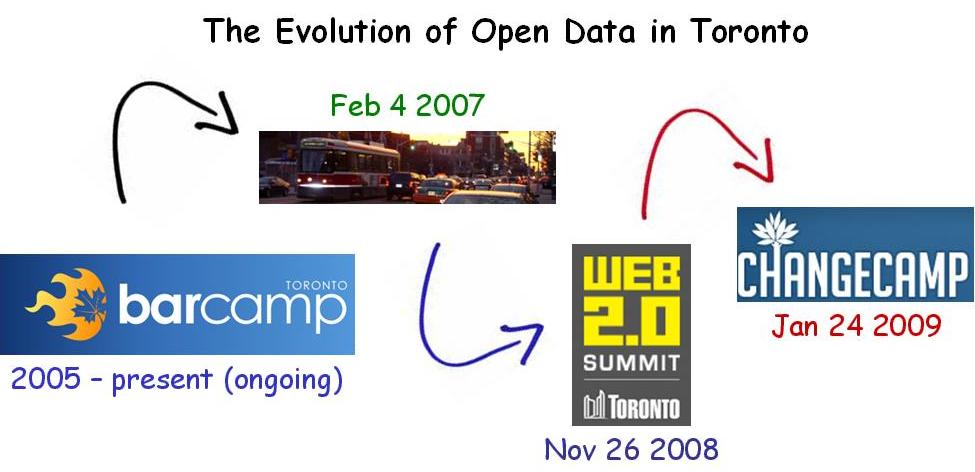
I’ve tried to map this evolution. I may have missed steps and encourage people to email me or post comments if I have.

evolution of open data TO

The first step was taken when people like David Crow created a forum – Barcamp – around which some of Toronto’s vibrant tech and social tech community began to organize itself. This not only brought the community together but it also enabled unconferences to gain traction as a fun and effective approach to addressing an issue.

Then, in late 2006 the Toronto Transit Commission (TTC) issued an Request For Proposals (RFP) for a redesign of its website. Many in the tech community – who had no interest in doing the redesign – were horrified at the RFP. It was obvious that given the specifications the new website would not achieve its potential. A community self-organized around redesigning the RFP. Others took note and, because they cared about the TTC, wanted to also talk about simple non-website changes the TTC could make to improve services. TransitCamp was this born and – with enormous trepidation, some TTC officials showed up (all of whom should be loudly applauded). The result? The tech and social tech community in Toronto was engaged in civic matters and their activities were beginning to make it onto the city government’s radar.

Other Camps carried on through 2007 and 2008 (think OpenCities), building momentum in the city. Then, in November of 2008 – a breakthrough. The City of Toronto hosted an internal Web 2.0 conference and invited Mark Surman – executive director of the Mozilla Foundation and long time participant in the Toronto social tech space – to deliver the keynote entitled “A City that Thinks like the Web“. After the talk, the Mayor of Toronto stood up and said:

” … I’ve been emailing people about your challenges. Open data for Google Transit is coming by next June, and I don’t see what we shouldn’t open source the software Toronto creates.” He also said “I promise the City will listen” if Torontonians set up a site like FixMyStreet.com

You can hear the Mayor Miller’s full response here:

In short, the Mayor promised to begin talking about opening up (and open sourcing) the city. Freeing up Ryan Merkley and the City of Toronto IT team to attend ChangeCamp

Lessons for ChangeCamp Vancouver

It remains unclear to me whether ChangeCamp is the right venue for tackling this opportunity in Vancouver.

We in Vancouver are not as far along the arc as Toronto is. We do, however, have some advantages. The map is more obvious to us and some of us have good relationships with key staff in the city. However, this process takes time. To replicate the success in Toronto, governments here on the west coast need not only be at ChangeCamp, they need to be running sessions and deeply engaged. For this to occur cultures need to be shifted, new ideas need to percolate within government institutions and agencies and relationships need to be built. All this will take time.

The creative age, the budget and the future of class conflict

Yesterday the Martin Prosperity Institute released its report Ontario in the Creative Age. I’ve been reading through it with great, great interest. The influence of Rise of the Creative Class and Who’s Your City is obvious (and expected) and the report is an important and fantastic read. Regardless of whether or not you live in the GTA/Ontario, I highly recommend it. Indeed, I would love to see the Province of British Columbia and the Metro Vancouver commission a similar report. I can imagine the methodology is now in place to do one relatively quickly, and it is urgently needed on the west coast. (Can anyone point to an economic development plan for the Greater Vancouver Area? For the City of Vancouver?)

The report also plays on a theme that has interested me for a while now. The nature of class conflict in networked and creative economy. The report tackles the issue more directly than anything else I’ve seen by Florida to date. This line from the report is illustrative:

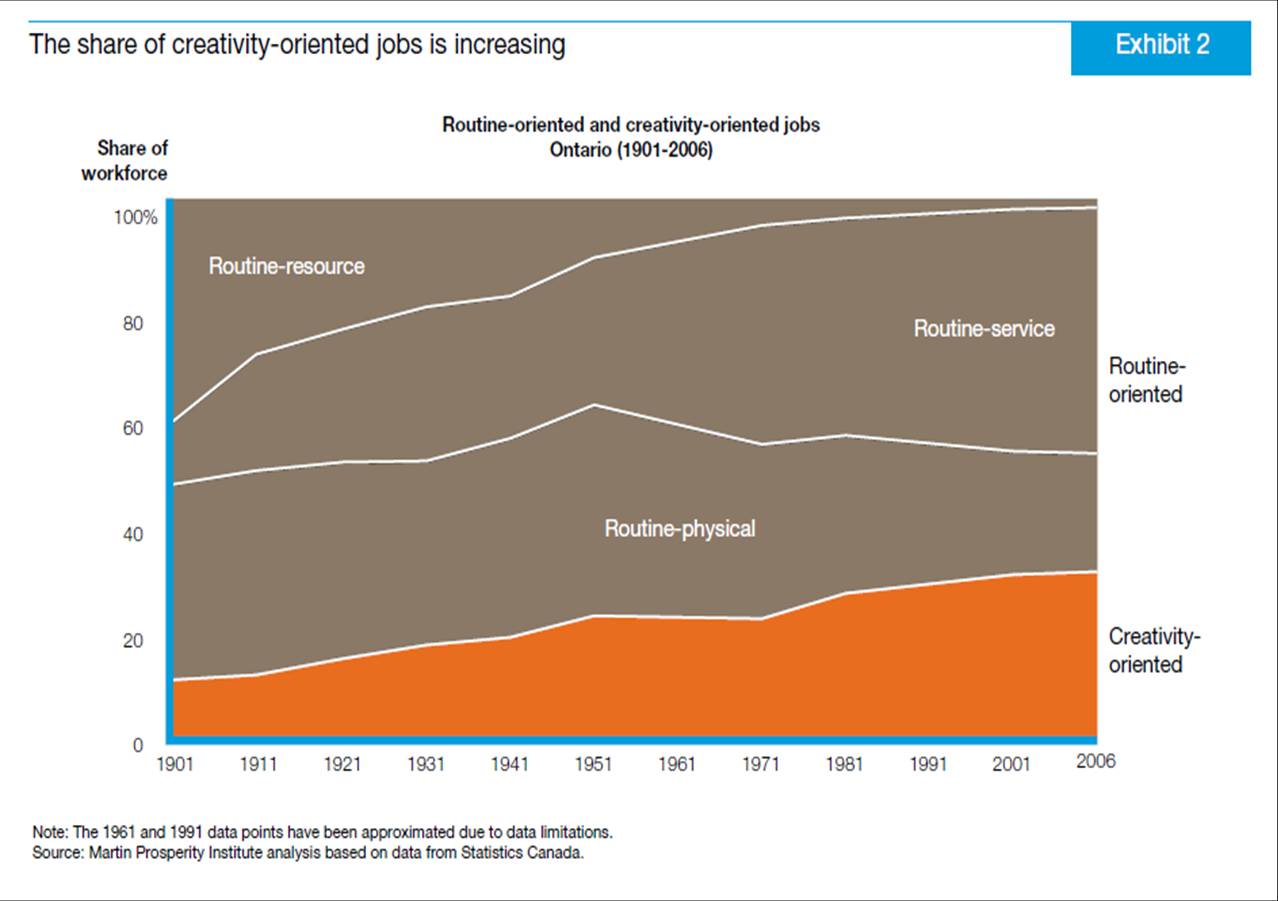
The rise of creativity is a double-edged sword. It creates tremendous wealth creation opportunities for some. Yet it can leave many behind – particularly those in jobs built on routine, and those who do not have the opportunity to gain the skills to participate advantageously in the economic transformation we are going through.

Still more interesting are the trends:
class conflict

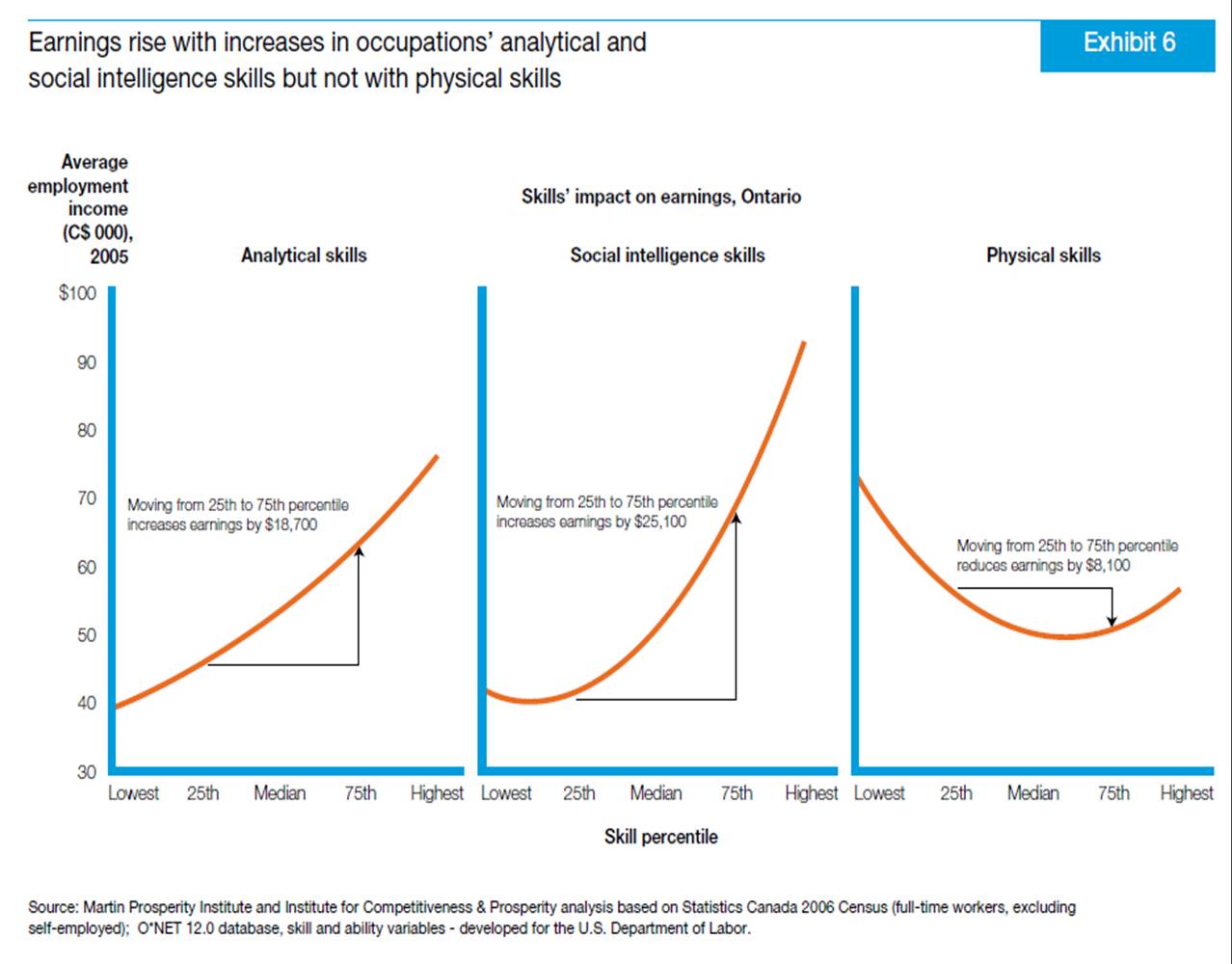
Combine this chart with there second chart that shows how wages grow depending on skill sets (no prizes for figuring out the Routine-physical-oriented jobs correlate with Physical Skills and that Social intelligence skills correlate with Creativity-Oriented jobs).

class wages

It is easy to see that the possibility of tension between routine-oriented and creativity-oriented workers could grow, especially as wage differences continue to increase.

Perhaps the most depressing conclusion to draw from this report is that the stimulus package will do little to address this inequity. A lot items that get funding in such packages (for example, some shovel ready projects) not only generate only temporary growth, but many of the jobs they foster are both becoming fewer – so we are encouraging job growth in shrinking job markets – and have a declining return on investment – so we are encouraging the development of skill-sets in workers that will not increase wages. Consequently, the very actions that traditionally might have helped stave of wage inequality (and in turn class conflict) may actually me exasperating the future likelihood of such inequality.

It’s hard to sell funding for R&D and research as these are often seen as “elite” activities, but interestingly they may offer us the greatest hope in reducing future tension and inequality. Sadly, research, science and education received little attention in the budget.

Must see show this Sunday in Vancouver

It’s Friday and time to prepare for the weekend. In that spirit the perfect opportunity has arisen to both notify Vancouverites of a great cultural opportunity and give a shout out to my friend Misha Glouberman who is bringing his famous Trampoline Hall event to Vancouver! What is Trampoline Hall you ask? Look no further then the links above, the text below or the event’s facebook page:

Trampoline Hall is a barroom lecture series usually based in Toronto, but sometimes in other places. On Feb 1, it will be in Vancouver for the first time, as part of the Push Festival.

Trampoline Hall is this: Three people talk, on subjects outside their professional field of expertise. The lectures are sometimes ridiculous, sometimes moving, and always wildly unpredictable. Each talk is followed by a Q&A with the audience which is usually also a lot of fun.

Trampoline Hall was invented by the writer Sheila Heti, and is hosted by Misha Glouberman. In Toronto, it is something of an institution, playing every month for the past seven years or so. It’s also played to great crowds in around a dozen US cities, including Atlanta, Boston, New York, Louisville, Chicago, and San Francisco. Feb 1 will be Trampoline Hall’s first time in Vancouver.

All lecturers for the Vancouver show selected are selected by Veda Hille. Here is the lineup she has chosen:

1) Andrew Feldmar will talk about Cooking from Memory.
2) Kevin Chong will discuss Fraternal Polyandry
3) Faith Moosang will assert “There are Clues Everywhere!!” in a talk about Nancy Drew.

~~~~

“”Unruly… Caustically Funny” – Durham Independent

“They’ve been doing this for several years up in Toronto… now New Yorkers are in its thrall. Clearly, we love it.” – The Village Voice

“Cloud-splitting Genius” – Lola Magazine

“Eccentricity and do-it-yourself inventiveness” – The New Yorker

I’m hoping my plane lands in time so that I can make it!

Vision Fundraiser February 4th

There is a nice gala Vision Vancouver fundraiser coming up on February 4th for those who are interested. Here’s an opportunity to mix it up with the new Mayor and Vision Council members.

As the advertisement states:

Enjoy an evening of specialty tapas highlighting the multitude of Vancouver’s diverse neighborhoods, while mingling with Vancouver’s elected officials, business leaders, union brothers and sisters, social and environmental change agents, and others who are working to make a difference in their communities.

Tickets are $150.00 each with sponsorship opportunities available – for more information call Vision’s Fundraiser Kristi Rivait at 604-568-6913 or email her at kristi@votevision.ca

on snow

From an im message I sent this morning:  my views on snow. I think it encapsulates Vancouverites position on the issue:

Snow should be like grandchildren. Fun, playful and always a car ride away.

I supposed given my age, I should say snow should be like nieces and nephews…

You can ignore eaves.ca today. It is going to be nothing my mindless fun. Not that it matters much, the hit counter is way down, which is as it should be on Christmas Eve.

Sean Yo just sent me a link of Merb and ruby merging. Hoping to blog about it shortly.

Quote of the day

“I think nobody really loves America more than black Americans, because black Americans loved America even when America didn’t love us back”

– Jamal Simmons

I was fortunate enough to see Jamal Simmons give the keynote at yesterday’s Canadian-American Business Council luncheon and this line really just floored me. In fact, I think I and a few others in the room almost got emotional when he said it. It’s difficult to imagine the pain induced by that kind of rejection from a community you care so much about.

Twittering the Vancouver Election

For those living in Vancouver, or interested in Vancouver politics, the CBC will be hosting a debate tomorrow between Vision Vancouver Mayoralty candidate Gregor Robertson and his NPA counterpart.

For those listening in on or attending the debate, the CBC is interested in hearing your immediate thoughts and feedback via twitter – simply tag your tweet: #cbcmayorsdebate and the CBC may pick it up. Thoughtful comments about Gregor, concerns about the city, or respectfully expressed concerns about NPA spin are particularly appreciated.

For those interested in the debate it is taking place tomorrow, Wednesday, November 12, from 7:30 – 9:00 p.m. at the SFU’s Segal Graduate School of Business, 500 Granville St.. It will also be broadcast live on CBC Radio One (690AM) in Vancouver and streamed live over “the interweb” at cbc.ca/bc.

If you are a vision supporter – we are in crunch time. Please do vote!  Also consider donating some money or volunteering for our e-day get out the vote initiative and, to have fun, get yourself on “the map!”

dinner with winners

Friends in Vancouver – if you have any interest in attending the Vision Vancouver Fall Fundraiser please don’t be shy in dropping me a line.

I’m pretty excited about Vision’s new slate – which you can read about here – and our prospects in the upcoming election. These are exciting times for Vancouver – I get the sense that people want to see the city grow and mature in a way they haven’t before. That is certainly one of the reasons I moved back here and got involved in Vision.

If you want to start to see what it’s all about, come on out for the dinner…

Understanding Toronto’s Buzz

For a while now I’ve noticed that something exciting is going on in Toronto. There is an energy to the place that is new and different. Social innovators abound, interesting conferences and speeches seem to occur daily, and big ideas are taking shape. Others are noticing it to (via Richard Florida).

csi_logoI know that the story of this transformation is complex, but from someone whose both been a participant and observer of the transition I feel one piece of the puzzle is perhaps easily explained. More interestingly it isn’t making a lot of peoples lists, but the Centre for Social Innovation (CSI) strikes me as a central piece of Toronto’s emergence as a place with buzz.

This idea has been solidified by my reading of Steven Johnson’s Emergence (a fantastic book BTW, but then everything he writes is excellent).

Indeed, Johnson’s opening parable about the story of slime mold provides a perfect metaphor for what has happened:

“Slime mold spends much of its life as thousands of distinct single-celled units, each moving separately from the its other comrades. Under the right conditions, those myriad cells will coalesce again into a single, larger organism…”

emergence

As Stevens explains, for a long time it was not understood what caused the slime mold to shift from single-celled into a larger organism. For a long time it was presumed that certain “leader” or “pacemaker” cells caused other cells to react. Finally, two scientists, Keller and Segel asked “What if the community of slime mold cells were organizing themselves? What if there were no pacemakers?… If the slime cells pumped out enough cyclic AMP (a signaling chemical), clusters of cells would start to form. Cells would begin following trails created by other cells, creating a positive feedback loop that encouraged more cells to join the cluster.” Critically, no single overarching cell was telling everyone else what to do. Instead each cell was evaluating the nutrients available in its immediate environment and adjusting its AMP output accordingly. The result is a bottoms-up system.

Now, while some may relish in referring to Torontonians as slime mold, they should instead wish for a similar fate. I think Toronto has experienced a phase transition like that of slime mold. Like the individual cells of slime mold, a critical mass of social innovators are finally connecting. And rather than secrete a chemical, they are sharing ideas, challenges, and opportunities. These conversations have created a positive feedback loop, attracting still more social innovators, along with philanthropists, venture capitalists and consultants, helping further foster the community that has started to thrive in Toronto. A decentralized, emergent community of social innovation is growing.

CSI has played a critical role in all this by serving as a critical aggregator, by simply providing a place and some basic support, it fostered an environment in which emergent behaviour became possible. Before SCI social innovators probably abounded across Toronto, but were isolated and alone. Today they are busy created webs of complex communities and sub-communities. Toronto has had this aggregation in the finance indsutry for some time, but for social innovators and other creative class entrepreneurs, this community of support is new. As one observer who worked on Canada25 noted to me, even 5 years ago the peer support and interest was not even a fraction of what it is today.

There are lessons here. For Toronto, but also for other cities across Canada. Obviously other factors matter. This isn’t an attempt to be completely reductionist. Toronto’s decent subway system, which allows people (cell!) to easily come together from across a large geography, makes it easier to achieve critical mass. This means similar success in cities like Calgary may be more challenging. For my home town of Vancouver, the jury is still out – transit is getting better, but what about critical mass?. But I continue to have high hopes. Perhaps the Tides Renewal Centre will come to serve a similar function as SCI in Toronto.

Regardless of where you live, Canadians everywhere should take notice. There is a buzz in Toronto, the question is, can we bottle the lightening and reproduce it elsewhere? I’d love to hear of similar projects if anyone knows of any.