Open Data and New Public Management

This morning I got an email thread pointing to an article by Justin Longo on #Opendata: Digital-Era Governance Thoroughbred or New Public Management Trojan Horse? I’m still digesting it all but wanted to share some initial thoughts.

The article begins with discussion about the benefits of open data but its real goal is to argue how open data is a pawn in a game to revive the New Public Management Reform Agenda:

My hypothesis, based on a small but growing number of examples highlighting political support for open data, is that some advocates—particularly politicians, but not exclusively—are motivated by beliefs (both explicit and unconscious) forged in the New Public Management (NPM) reform agenda.

From this perspective, support for more open data aims at building coalitions of citizen consumers who are encouraged to use open data to expose public service decisions, highlight perceived performance issues, increase competition within the public sector, and strengthen the hand of the citizen as customer.

What I found disappointing is the article’s one dimensional approach to the problem: open data may support a theory/approach to public management disliked by the author, consequently (inferring from the article’s title and tone) it must be bad. This is akin to saying any technology that could be used to advance an approach I don’t support, must be opposed.

In addition, I’d say that the idea of exposing public service decisions, highlighting perceived performance issues, increasing competition within the public sector, and strengthening the hand of the citizen as customer are goals I don’t necessarily oppose, certainly not categorically. Moreover, I would hope such goals are not exclusively the domain of NPM. Do we want a society where government’s performance issues are not highlighted? Or where public service decisions are kept secret?

These are not binary choices. You can support the outcomes highlighted above and simultaneously believe in other approaches to public sector management and/or be agnostic about the size of government. Could open data be used to advance NPM? Possibly (although I’m doubtful). But it definitely can also be used to accomplish a lot of other good and potentially advance other approaches as well. Let’s not conflate a small subset of ways open data can be used or a small subset of its supporters with the entire project and then to lump them all into a single school of thought around public service management.

Moreover, I’ve always argued that the biggest users and benefactors of open data would be government – and in particular the public service. While open data could be used to build “coalitions of citizen consumers who are encouraged to use open data to expose public service decisions” it will also be used by public servants to better understand citizens needs, be more responsive and allocate resources more effectively. Moreover, those “citizen consumers” will probably be effective in helping them achieve this task. The alternative is to have better shared data internally (which will eventually happen), an outcome that might allow the government to achieve these efficiencies but will also radically increase the asymmetry in the relationship between the government and its citizens and worse, between the elites that do have privileged access to this data, and the citizenry (See Taggart below).

So ignoring tangible benefits because of a potential fear feels very problematic. It all takes me back to Kevin Kelly and What Technology Wants… this is an attempt to prevent an incredibly powerful technology because of a threat it poses to how the public sector works. Of course, it presumes that a) you can prevent the technology and b) that not acting will allow the status quo or some other preferred approach to prevail. Again, there are outcomes much, much worse the NPM that are possible (again, I don’t believe that open data leads directly to NPM) and I would argue, indeed likely, given evolving public expectations, demographics, and fiscal constraints.

In this regard, the article sets of up a false choice. Open data is going to reshape all theories of public management. To claim it supports or biases in favour of one outcome is, I think beyond premature. But more importantly, it is to miss the trees for the forest and the much bigger fish we need to fry. The always thoughtful Chris Taggart summed much of this up beautifully in an email thread:

I think the title — making it out to be a choice between a thoroughbred or Trojan Horse — says it all. It’s a false dichotomy, as neither of those are what the open data advocates are suggesting it is, nor do most of us believe that open data is solution to all our problems (far from it — see some of my presentations[1]).

It also seems to offer a choice between New Public Management (which I think Emer Coleman does a fairly good job of illuminating in her paper[2]) and the brave new world of Digital Era Governance, which is also to misunderstand the changes being brought about in society, with or without open government data.
The point is not that open data is the answer to our problem but society’s chance to stay in the game (and even then, the odds are arguably against it). We already have ever increasing numbers of huge closed databases, many made up of largely government data, available to small number of people and companies.
This leads to an asymmetry of power and friction that completely undermines democracy; open data is not a sufficiency to counteract that, but I think it is a requirement.

It’s possible I’ve misunderstood Longo’s article and he is just across the straights at the University of Victoria, so hopefully we can grab a beer and talk it through. But my sense is this article is much more about a political battle between New Public Management and Digital Era Governance in which open data is being used as a pawn. As an advocate, I’m not wholly comfortable with that, as I think it risks misrepresenting it.
DataBC Hackathon this Saturday – inviting the public.

This Saturday, August 27, 2011 the Province of British Columbia is partnering with the Mozilla Foundation and OpenDataBC to host a open data hackathon.

The hackathon will be taking place at Mozilla Labs Vancouver. Their address is:
163 West Hastings Street, suite-200
Vancouver, BC V6B 1H5
(in the very beautiful Flack Building)

So three things:

First, as many of you are probably aware the province recently launched a data portal and so there is a lot of new data to play with. In addition the City of Vancouver continues to update its open data portal, so there is new data there as well. Will be interesting to see what people want to work on.

Second, please do not fret if you are not a developer. As we pointed out last year in the lead up to the open data day international hackathon, there are lots of ways non-developers can contribute – the easiest being… having ideas! So please come on by. I’m definitely going to be there (and I’m no coder) and look forward to seeing familiar and new faces.

Finally, and more to the point, if you are a company, non-profit, or citizen who is has a mashup, analysis, research paper, product, app or pretty much anything else you’d like to create but need data from the province, definitely swing by. I’m sure the staff on hand will be very keen to hear about what you want to do and see if they can make the data available in the near future.

The organizers are hoping that people will RVSP through their contact form (use the ‘other’ subject line) but if you decide last minute to come join, don’t be shy.

Hope to see you there!


Design Matters: Looking at a Re-themed Bugzilla

I’ll be honest. There was a time when I thought design didn’t matter. To my credit, it was a long time ago… but I used to think, if the tool was good enough, the design won’t matter, people will use it cause it is helpful. (This may or may not have influenced some fashion choices earlier in life as well – I’d like to think things have improved – but not everyone may agree it has improved sufficiently).

Being useful may be sufficient (although take a look at the government website at the bottom of this post – it’s a very useful website). But it’s no excuse for not making things easier to use. Especially when you are running an open source community and want to encourage participation and ease people up the learning curve faster.

Hence why I enjoyed recently discovering ActiveState’s implementation of Bugzilla (re-themed by Tara Gibbs). Bugzilla is the software many open source projects use to identify, track and resolve bugs.

Here we have two identical pieces of software (so the “usefulness” is the same) but what makes ActiveState’s version of Bugzilla so nice are a few simple things they’ve done to make it more user friendly (doubly pleased to see them implement some ideas I’d blogged earlier as well – great minds think alike!).

So let’s start with the Mozilla instance of Bugzilla – as this was the one I was used to.

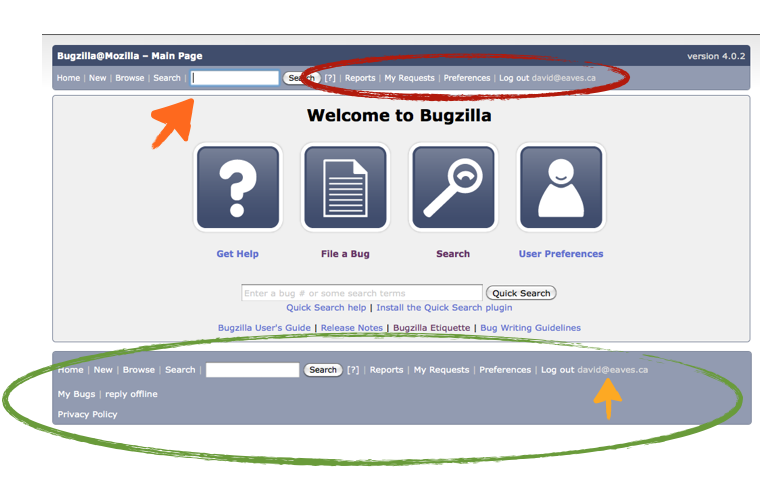
I’ve circled a couple of the key features to zero in on. Let me go through them as I want you to be thinking about them when you look at the ActiveState version:

  • Red circle: Notice that this has a lot of key items in it, but it is lost next to the “search” button, which pulls your attention away
  • Dark orange arrow: the search button! most often you won’t find a search box located here in an application.
  • Green circle: Tons of useful stuff down here, but arranged in one long horizontal list, that makes it hard to find what you’re look for (and another search box!)
  • Light orange arrow: another log out option… didn’t I see that somewhere else as well?

I want to be clear, the Bugzilla team at Mozilla is awesome. Recently hired they are trying to do a ton of stuff and this is not where I’d expect them to start (and they’ve been super responsive to everything I’ve blogged about so I’m a huge fan), I want to flag this because everyone, from software engineers to government officials need to recognize that we rely on good design to make our lives easier, to help with decision fatigue and streamline our work, every day.

Now check out the ActiveState version of the exact same software, but re-designed.

So, my cartoonish circles and arrows are mucking up the design and ascetics of both theses sites, so please forgive that. (I suggest opening them in adjacent tabs – Mozilla here, ActiveState here – so you can see them uninterrupted).

So, a few things:

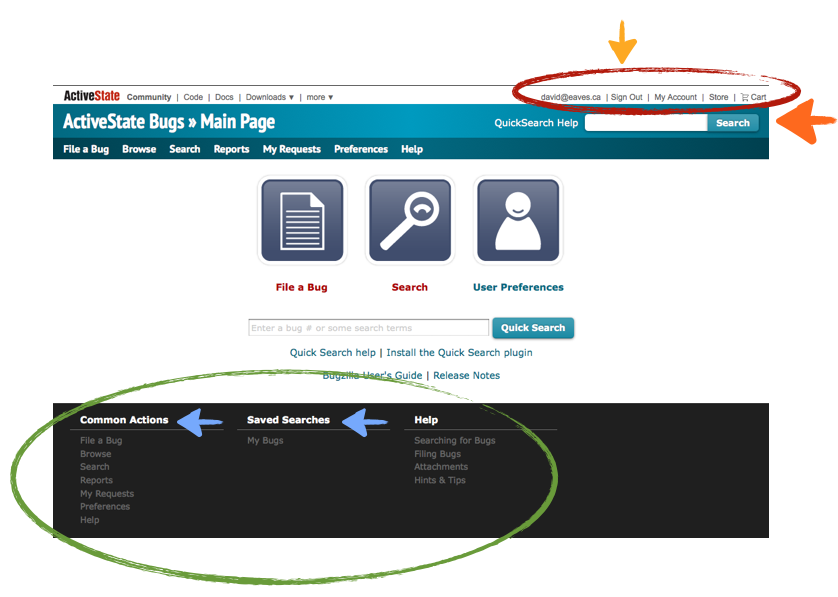
  • Red circle: Now everything to do with the administration of your account is in the top, top right hand corner. This is where Google, Facebook and most websites put this info now, that’s why you’re expecting to find it there!
  • Dark orange arrow: now the search button is in the top right hand corner. Pretty much the same location it appears in Firefox (and safari, IE, chrome, OS X, etc…) and so where users have come to expect it.
  • Green circle: This part really is genius. Did you know there were saved searches in the above version? There are, but the feature didn’t stand out. This theme sorts the users options and displays them vertically within a menu: much, much easier to digest quickly.
  • Light orange arrow: Features appear only once! For example, the sign out and search feature do not appear at the top and bottom. This helps reduce clutter and allows the user to find things more quickly

My point is that a few minor changes can dramatically improve the usability of a website or tool. Is Mozilla’s bugzilla radically worse than ActiveState’s? No, but I definitely prefer ActiveState’s design. Moreover, when you are relying on volunteer contributors and attracting new contributors is something that matters to you, this is an important gateway and so you want it to be as seamless as possible.

What’s interesting is that often it is in the non-profit and government sector that design gets neglected because it is deemed a luxury, or the “substantive” people don’t think design matters and so ignore it.

The results can be disastrous.

I mean, especially if you are in government, then you’ve really got to be advocating for better design. Consider the website below. Remember, this may be the most important citizen facing website in the Canadian government – the one stop shop to find every service you need. It is better than most government website, and yet, you’ve got a site that is still maddeningly difficult to navigate. Where am I supposed to look??? Eyes… being… pulled… in… so… many… directions…

Personally, I think you could solve 80% of the problem with this page just by getting rid of the left hand column and put a search button in the top right hand corner. But I’m supremely confident that would violate some arcane website design rule the government has and so will remain a post for another day…

Edmonton Heads for the Cloud

I’m confident that somewhere in Canada, some resource strapped innovative small town has abandoned desktop software and uses a cloud based service but so far no city of any real size has even publicly said they were considering the possibility.

That is, until today.

Looks like Edmonton’s IT group – which is not just one of the most forward looking in the country continues to make the rubber hit the road – is moving its email and office suite to the cloud. (I’ve posted the entire doc below since it isn’t easy to link to)

They aren’t the first city in the world to do this: Washington D.C., Orlando and Los Angeles have all moved to Google apps (in each case displacing Microsoft Office) but they are the first in Canada – a country not known for its risk taking IT departments.

I can imagine that a lot government IT people will be watching closely. And that’s too bad. There is far too much watching in Canada when there could be a lot of innovating and saving. While some will site LA’s bumpy transition, Orlando’s and DC’s were relatively smooth and are still cities that are far larger than most of their Canadian counterparts. LA is more akin to transitioning a province (or Toronto). Nobody else get’s that pass.

Two things:

1) I’ve highlighted what I think is some of the interesting points in the document being presented to council.

2) A lot of IT staff in other cities will claim that it is “too early” to know if this is going to work.

People. Wake up. It is really hard to imagine you won’t be moving to the cloud at some point in the VERY near future. I frankly don’t care which cloud solution you choose (Google vs. Microsoft) that choice is less important than actually making the move. Is Edmonton taking some risks? Yes. But it is also going to be the first city to learn the lessons, change its job descriptions, work flows, processes and the zillion other things that will come out of this. This means they’ll have a cost and productivity advantage over other cities as they play catch up. And I suspect, that there will never be a catch up, as Edmonton will already be doing the next obvious thing.

If your a IT person in a city, the question is no longer, do you lead or follow. It is merely, how far behind are you going to be comfortable being?

6. 13

Workspace Edmonton

Sole Source Agreement

Recommendation:

That, subject to the necessary funding being made available, Administration enter into a sole source agreement, in an amount not exceeding $5 million, and a period not exceeding five years, with Google Inc., for the provision of computing productivity tools, and that the contract be in form and content acceptable to the City Manager.

Report Summary

The IT Branch undertook a technical assessment of seven options for the delivery of desktop productivity tools. Software as a Service (‘cloud computing’) was identified as the preferred direction as it allows the corporation to work from anytime, place or device. Google Mail and Google Apps were determined to provide the best solution. The change will ensure ongoing sustainability of the services, provides opportunities for service and productivity gains, and align IT services with key principles in The Way We Green, The Way We Live and The Way We Move.

Report

The City Administration Bylaw 12005 requires approval from Executive Committee for Single Source Contracts (contracts to be awarded without tendering) in excess of $500,000, and those contracts that may exceed ten years in duration.

The Workspace Edmonton Program consists of two initiatives, which will allow the delivery of information technology software and services to employees, contractors and third party partners anytime and place, and on any device. In order to accomplish this the administration is proposing moving away from a model where software is installed on every computer to a solution where the software is housed on the internet (‘cloud computing’).

Administration is recommending the implementation of Google Apps Premier Edition as the primary computing productivity tool, with targeted use of Microsoft Office and SharePoint. The recommended direction will allow the City to move to Google Mail as the corporate messaging tool and Google Apps as the primary office productivity tools. It will also allow the corporation access to other applications offered by Google Inc. and partners to Google Inc. Microsoft Office and SharePoint will remain as the secondary office productivity tools for business areas that require these applications for specific business needs. Use of the Microsoft tools will require completion of the appropriate use case and approval by the Chief Information Officer.

Administration is requesting approval to proceed to negotiation of a contract with Google Inc. The sole source agreement is required at this time to allow the program to be developed in 2011. This is foundational work that will allow the program to proceed to implementation in 2012. The contract is also required in order to complete the Privacy Impact Assessment and develop implementation plans.

Benefits

Workspace Edmonton creates the opportunity for the City of Edmonton to significantly change the way we work. Administration will have increased options for delivering services to citizens, including enhanced mobile field services and new opportunities for community consultation and collaboration. The consumer version of Google is free to private citizens and not-for-profit groups and would allow additional options for collaboration with organizations such as community leagues with no net cost to the corporation or organization.

The move to G-Mail will allow the corporation to extend email access to all city employees, improving access to information and communications. It will also allow for implementation of a number of services without additional licensing costs, including:

  • audio and video chat
  • group sites to allow improved collaboration with external
    partners and community groups
  • internal Youtube for training and information sharing
  • increased collaboration through document sharing and simultaneous authoring capabilities

The program presents the opportunity for the City to better address the expectations of the next generation of workers by providing options to bring your device and to work with software many already use. Both Edmonton Public Schools and the University of Alberta have implemented Google Apps.

In addition, the implementation of Google Apps will include an e-records
solution for documents stored in Google Apps. This will be implemented in partnership with the Office of the City Clerk. The benefit of this being alignment with legislated and corporate requirements for records retention, retrieval, and disposal.

Moving to the Software as a Service Model (‘cloud computing’) through the internet will avoid additional hardware and support costs associated with increased service demands due to growth. This solution provides a more sustainable business model, reducing demands on resources for regular product upgrades and services support. Finally, the relocation of software and data to multiple secure data centres facilitates continuation of services during emergencies such as natural disasters and pandemics. City employees will be able to access email and documents through the internet from any office or home computer.

Solution Assessments

The IT Branch undertook a technical assessment of seven office productivity software and service delivery options. A financial assessment of the top three options was subsequently completed and the recommended direction to move to Google Inc. as the service provider was based on these assessments. Following this, the IT Branch undertook a security assessment to ensure the option chosen met security requirements and industry standards. A Privacy Impact Assessment has been initiated and will be completed upon negotiation of an agreement. Precedent in Alberta has been set with both the Edmonton Public School Board and the University of Alberta entering into agreements with Google Inc.

Strategic Direction

The Workspace Edmonton Program supports Council’s strategic direction for innovation and a well managed city, as well as key principles in The Way We Green, The Way We Move, and the Way We Live.

Budget/Financial Implications

Google Messaging and Apps will replace the existing Microsoft Exchange and majority of Office licenses. The funding currently in place for Microsoft license maintenance will be sufficient to fund the annual Google services.

2011 funding for the implementation of overall Workspace Edmonton Program is within the current IT budgets and will be the source of funding. Funding for 2012 will be included in the 2012 budget request.    A business case for this initiative was completed and is available for review.

The Workspace Edmonton model aligns with and complements the corporate initiative of Transforming Edmonton. The administration will look for opportunities to integrate the programs and utilize a portion of the funding for Transforming Edmonton to fund Workspace Edmonton change and transition requirements.

Risks

If the recommendation is not supported, Workspace Edmonton will stop and the corporation will be required to either go to Request For Proposal or remain on the existing platform. Remaining on the existing platform will require additional funding in future years to support continued maintenance costs and future growth. (Extending email only to city staff who do not currently have email accounts would cost the corporation approximately $900,000 per year with the existing solution.) Delaying the implementation to 2012 would result in delays to return on investment and achievement of the benefits.

Justification of Recommendation
Technical, financial and security assessments have been completed. The recommended solution meets business requirements, provides opportunities to increase and improve service delivery and is projected to garner a return on investment within 18 to 24 months of implementation. Approval of this recommendation will allow Administration to proceed to negotiation of a contract.

Others Reviewing this Report
• L. Rosen, Chief Financial Officer and Treasurer

WRITTEN BY – D. Kronewitt-Martin | August 24, 2011 – Corporate Services 2011COT006

Okay, last in a summer series: the Fish Taco from Tacofino, delicious

okay, look at this photo. Tell me that does not look good:

tacofino

On the left is the classic fish taco from Tacofino, on the right, their halibut special. Both are as good to eat as they look in this photo. Both are pretty minimalist, with the traditional fish taco serving up some lightly fried white fish, some light coleslaw style greens, tomato and a delicious mayo based sauce.  The halibut taco doing a more of a light coleslaw greens with the blackberrys and a lighter sauce. All goodness.  Not pictured, but also good are the freshies you can order with them. These are frozen drinks/natural slushie, they do a lemon ginger that is quite good, as well as a lime version. Compliments the food real well.

I wish the tacofino link I was sending you too had more than the funky but minimalist webpage they’ve got going on (maybe a menu or something) but you are just going to have to trust me that despite the weak web presence, the food is very much worth checking out.

In Tofino, you find these bad boys made in the beaches shopping complex in their pimped out Tacofino Van…

tacofino-truck

…which comes pretty close to the type of vehicle you want a taco like that to come out of. The good news is that you no longer have to go to the edges of the earth (literally, Tofino is at the very edge of north america) to get this tasty treat. Although I’m getting conflicting reports on their location, they are definitely on the street of Vancouver s well. I’m hearing English Bay (Denman and Davie) in downtown Vancouver, although the good peeps over at Foodology.ca are saying Howe and Robson (although now I understand that this location is serving a Vietnamese-inspired menu).

I’m hoping to do a recon mission into English Bay at some point in the near future. Test out the wares and see if they are as good as the original (above pictured) location.

Anyways, this is default lunch material when I’m chilling (or engaged in a work vacation) in Tofino, my four square presence is significant.

Just wanted to share some of the lighter facts of the Dave Eaves life as we seem to finally have hit summer in the news cycle and life’s got me busy with so many great projects – can’t wait to share more on them later.

Oyster Burger. Enough said.

It would have been easy to blog about the Conservative British Government’s appalling choice to muse openly about shutting down social media sites or deny access to certain users in response to the riots… but enough people have commented on how colossally dumb this is (not to mention hypocritical given that only last year Britain lectured China about freedom of speech) that I think we are okay.

Instead, I’m more focused on sharing the joys of oyster burgers. Indeed, devouring one of these is just one of the many, many great reasons for coming to Tofino.

Oyster-Burger

This bad boy was purchased from Big Daddy’s Fish Fry in Tofino – you can see two deep fried oysters in a bun with some mayonaise type sauce, and other toppings. While this a pretty fine burger, I confess that I find the oyster burger from the Wildside Grill just outside of town (who also have spot prawns as a special) to be superior, rather than separately fried oysters they mash them together into a single patty and it is just delicious…

Oh, and for the many people who’ve nooooo idea where Tofino is: some maps!

I’ve pretty casually looked to find oyster burgers in Vancouver and elsewhere and haven’t run into any success. Given how delicious these things are… it makes me wonder, why can’t I find them elsewhere?

Hoping to maybe have some photos of fish tacos from Tacofino later today – although these can now, thankfully, be bought in Vancouver as well since they have street vending license for the English Bay area. Good stuff!

Ah, summer.

The

Why Social Media behind the Government Firewall Matters

This comment, posted four months ago to my blog by Jesse G. in response to this post on GCPEDIA, remains one of the favorite comments posted to my blog ever. This is a public servant who understands the future and is trying to live it. I’ve literally had this comment sitting in my inbox because this whole time because I didn’t want to forget about it.

For those opposing to the use of wiki’s social media behind the government firewall this is a must read (of course I’d say it is a must read for those in favour as well). It’s just a small example of how tiny transactions costs are killing government, and how social media can flatten them.

I wish more elements of the Canadian government got it, but despite the success of GCPEDIA and its endorsement by the Clerk there are still a ton of forces pitted against it, from the procurement officers in Public Works who’d rather pay for a bulky expensive alternative that no one will use to middle managers who forbid their staff from using it out of some misdirected fear.

Is GCPEDIA the solution to everything? No. But it is a cheap solution to a lot of problems, indeed I’ll bet its solved more problems per dollar than any other IT solution put forward by the government.

So for the (efficient) future, read on:

Here’s a really untimely comment – GCPEDIA now has over 22,000 registered users and around 11,000 pages of content. Something like 6.5 million pageviews and around .5 million edits. It has ~2,000 visitors a week and around 15,000 pageviews a week. On average, people are using the wiki for around 5.5 minutes per visit. I’m an admin for GCPEDIA and it’s sister tools – GCCONNEX (a professional networking platform built using elgg) and GCForums (a forum build using YAF). Collectively the tools are known as GC2.0.

Anyways, I’m only piping up because I love GCPEDIA so much. For me and for thousand of public servants, it is something we use every day and I cannot emphasize strongly enough how friggin’ awesome it is to have so much knowledge in one place. It’s a great platform for connecting people and knowledge. And it’s changing the way the public service works.

A couple of examples are probably in order. I know one group of around 40 public servants from 20 departments who are collaborating on GCPEDIA to develop a new set of standards for IT. Every step of the project has taken place on GCPEDIA (though I don’t want to imply that the wiki is everything – face-to-face can’t be replaced by wiki), from the initial project planning, through producing deliverables. I’ve watched their pages transform since the day they were first created and I attest that they are really doing some innovative work on the wiki to support their project.

Another example, which is really a thought experiment: Imagine you’re a coop student hired on a 4 month term. Your director has been hearing some buzz about this new thing called Twitter and wants an official account right away. She asks you to find out what other official Twitter accounts are being used across all the other departments and agencies. So you get on the internet, try to track down the contact details for the comms shops of all those departments and agencies, and send an email to ask what accounts they have. Anyone who knows government can imagine that a best case turnaround time for that kind of answer will take at least 24 hours, but probably more like a few days. So you keep making calls and maybe if everything goes perfectly you get 8 responses a day (good luck!). There are a couple hundred departments and agencies so you’re looking at about 100 business days to get a full inventory. But by the time you’ve finished, your research is out of date and no longer valid and your 4 month coop term is over. Now a first year coop student makes about $14.50/hour (sweet gig if you can get it students!), so over a 4 month term that’s about $10,000. Now repeat this process for every single department and agency that wants a twitter account and you can see it’s a staggering cost. Let’s be conservative and say only 25 departments care enough about twitter to do this sort of exercise – you’re talking about $275,000 of research. Realistically, there are many more departments that want to get on the twitter bandwagon, but the point still holds.

Anyways, did you know that on GCPEDIA there is a crowd-sourced page with hundreds of contributors that lists all of the official GC twitter accounts? One source is kept up to date through contributions of users that literally take a few seconds to make. The savings are enormous – and this is just one page.

Because I know GCPEDIA’s content so well, I can point anyone to almost any piece of information they want to know – or, because GCPEDIA is also a social platform, if I can’t find the info you’re looking for, I can at least find the person who is the expert. I am not an auditor, but I can tell you exactly where to go for the audit policies and frameworks, resources and tools, experts and communities of practice, and pictures of a bunch of internal auditors clowning around during National Public Service Week. There is tremendous value in this – my service as an information “wayfinder” has won me a few fans.

Final point before I stop – a couple of weeks ago, I was doing a presentation to a manager’s leadership network about unconferences. I made three pages – one on the topic of unconferences, one on the facilitation method for building the unconference agenda, and one that is a practical 12-step guide for anyone who wants to plan and organize their own (this last was a group effort with my co-organizers of Collaborative Culture Camp). Instead of preparing a powerpoint and handouts I brought the page up on the projector. I encouraged everyone to check the pages out and to contribute their thoughts and ideas about how they could apply them to their own work. I asked them to improve the pages if they could. But the real value is that instead of me showing up, doing my bit, and then vanishing into the ether I left a valuable information resource behind that other GCPEDIA users will find, use, and improve (maybe because they are searching for unconferences, or maybe it’s just serendipity). Either way, when public servants begin to change how they think of their role in government – not just as employees of x department, but as an integral person in the greater-whole; not in terms of “information is power”, but rather the power of sharing information; not as cogs in the machine, but as responsible change agents working to bring collaborative culture to government – there is a huge benefit for Canadian citizens, whether the wiki is behind a firewall or not.

p.s. To Stephane’s point about approval processes – I confront resistance frequently when I am presenting about GCPEDIA, but there is always someone who “gets” it. Some departments are indeed trying to prevent employees from posting to GCPEDIA – but it isn’t widespread. Even the most security-conscious departments are using the wiki. And Wayne Wouters, the Clerk of the Privy Council has been explicit in his support of the wiki, going so far as to say that no one requires manager’s approval to use the wiki. I hope that if anyone has a boss that says, “You can’t use GCPEDIA” that that employee plops down the latest PS Renewal Action Plan on his desk and says, “You’ve got a lot to learn”.

Shared IT Services across the Canadian Government – three opportunities

Earlier this week the Canadian Federal Government announced it will be creating Shared Services Canada which will absorb the resources and functions associated with the delivery of email, data centres and network services from 44 departments.

These types of shared services projects are always fraught with danger. While they sometimes are successful, they are often disasters. Highly disruptive with little to show for results (and eventually get unwound). However, I suspect there is a significant amount of savings that can be made and I remain optimistic. With luck the analogy here is the work outgoing US CIO Vivek Kundra accomplished as he has sought to close down and consolidate 800 data centres across the US which is yielding some serious savings.

So here’s what I’m hoping Shared Services Canada will mean:

1) A bigger opportunity for Open Source

What I’m still more hopeful about – although not overly optimistic – is the role that open source solutions could play in the solutions Shared Services Canada will implement. Over on the Drupal site, one contributor claims government officials have been told to hold off buying web content management systems as the government prepares to buy a single solution for across all departments.

If the government is serious about lowering its costs it absolutely must rethink its procurement models so that open source solutions can at least be made a viable option. If not this whole exercise will mean the government may save money, but it will be the we move from 5 expensive solutions to one expensive solution variety.

On the upside some of that work has clearly taken place. Already there are several federal government websites running on Drupal such as this Ministry of Public Works website, the NRCAN and DND intranet. Moreover, there are real efforts in the open source community to accommodate government. In the United States OpenPublic has fostered a version of Drupal designed for government’s needs.

Open source solutions have the added bonus of allowing you the option of using more local talent, which, if stimulus is part of the goal, would be wise. Also, any open source solutions fostered by the federal government could be picked up by the provinces, creating further savings to tax payers. As a bonus, you can also fire incompetent implementors, something that needs to happen a little more often in government IT.

2) More accountability

Ministers Ambrose and Clement are laser focused on finding savings – pretty much every ministry needs to find 5 or 10% savings across the board. I also know both speak passionately about managing tax payers dollars: “Canadians work hard for their money and expect our Government to manage taxpayers dollars responsibly, Shared Services Canada will have a mandate to streamline IT, save money, and end waste and duplication.”

Great. I agree. So one of Shared Service Canada’s first act should be to follow in the footsteps of another Vivek Kundra initiative and recreate his incredibly successful IT Dashboard. Indeed it was by using the dashboard Vivek was able to “cut the time in half to deliver meaningful [IT system] functionality and critical services, and reduced total budgeted [Federal government IT] costs by over $3 billion.” Now that some serious savings. It’s a great example of how transparency can drive effective organizational change.

And here’s the kicker. The White House open sourced the IT Dashboard (the code can be downloaded here). So while it will require some work adapting it, the software is there and a lot of the heavy work has been done. Again, if we are serious about this, the path forward is straightforward.

3) More open data

Speaking of transparency… one place shared services could really come in handy is creating some data warehouses for hosting critical government data sets (ideally in the cloud). I suspect there are a number of important datasets that are used by public servants across ministries, and so getting them on a robust platform that is accessible would make a lot of sense. This of course, would also be an ideal opportunity to engage in a massive open data project. It might be easier to create policy for making the data managed by Shared Service Canada “open.” Indeed, this blog post covers some of the reasons why now is the time to think about that issue.

So congratulations on the big move everyone and I hope these suggestions are helpful. Certainly we’ll be watching with interest – we can’t have a 21st century government unless we have 21st century infrastructure, and you’re now the group responsible for it.

Open Source Data Journalism – Happening now at Buzz Data

(there is a section on this topic focused on governments below)

A hint of how social data could change journalism

Anyone who’s heard me speak in the last 6 months knows I’m excited about BuzzData. This week, while still in limited access beta, the site is showing hints its potential – and it still has only a few hundred users.

First, what is BuzzData? It’s a website that allows data to be easily uploaded and shared among any number of users. (For hackers – it’s essentially github for data, but more social). It makes it easy for people to copy data sets, tinker with them, share the results back with the original master, mash them up with other data sets, all while engaging with those who care about that data set.

So, what happened? Why is any of this interesting? And what does it have to do with journalism?

Exactly a month ago Svetlana Kovalyova of Reuters had her article – Food prices to remain high, UN warns – re-published in the Globe and Mail.  The piece essentially outlined that food commodities were getting cheaper because of local conditions in a number of regions.

Someone at the Globe and Mail decided to go a step further and upload the data – the annual food price indices from 1990-present – onto the BuzzData site, presumably so they could play around with it. This is nothing complicated, it’s a pretty basic chart. Nonetheless a dozen or so users started “following” the dataset and about 11 days ago, one of them, David Joerg, asked:

The article focused on short-term price movements, but what really blew me away is: 1) how the price of all these agricultural commodities has doubled since 2003 and 2) how sugar has more than TRIPLED since 2003. I have to ask, can anyone explain WHY these prices have gone up so much faster than other prices? Is it all about the price of oil?

He then did a simple visualization of the data.

FoodPrices

In response someone from the Globe and Mail entitled Mason answered:

Hi David… did you create your viz based on the data I posted? I can’t answer your question but clearly your visualization brought it to the forefront. Thanks!

But of course, in a process that mirrors what often happens in the open source community, another “follower” of the data shows up and refines the work of the original commentator. In this case, an Alexander Smith notes:

I added some oil price data to this visualization. As you can see the lines for everything except sugar seem to move more or less with the oil. It would be interesting to do a little regression on this and see how close the actual correlation is.

The first thing to note is that Smith has added data, “mashing in” Oil Price per barrel. So now the data set has been made richer. In addition his graph quite nice as it makes the correlation more visible than the graph by Joerg which only referenced the Oil Price Index. It also becomes apparent, looking at this chart, how much of an outlier sugar really is.

oilandfood

Perhaps some regression is required, but Smith’s graph is pretty compelling. What’s more interesting is not once is the price of oil mentioned in the article as a driver of food commodity prices. So maybe it’s not relevant. But maybe it deserves more investigation – and a significantly better piece, one that would provide better information to the public – could be written in the future. In either case, this discussion, conducted by non-experts simply looking at the data, helped surface some interesting leads.

And therein lies the power of social data.

With even only a handful of users a deeper, better analysis of the story has taken place. Why? Because people are able to access the data and look at it directly. If you’re a follower of Julian Assange of wikileaks, you might call this scientific journalism, maybe it is, maybe it isn’t, but it certainly is a much more transparent way for doing analysis and a potential audience builder – imagine if 100s or 1000s of readers were engaged in the data underlying a story. What would that do to the story? What would that do to journalism? With BuzzData it also becomes less difficult to imagine a data journalists who spends a significant amount of their time in BuzzData working with a community of engaged pro-ams trying to find hidden meaning in data they amass.

Obviously, this back and forth isn’t game changing. No smoking gun has been found. But I think it hints at a larger potential, one that it would be very interesting to see unlocked.

More than Journalism – I’m looking at you government

Of course, it isn’t just media companies that should be paying attention. For years I argued that governments – and especially politicians – interested in open data have an unhealthy appetite for applications. They like the idea of sexy apps on smart phones enabling citizens to do cool things. To be clear, I think apps are cool too. I hope in cities and jurisdictions with open data we see more of them.

But open data isn’t just about apps. It’s about the analysis.

Imagine a city’s budget up on Buzzdata. Imagine, the flow rates of the water or sewage system. Or the inventory of trees. Think of how a community of interested and engaged “followers” could supplement that data, analyze it, visualize it. Maybe they would be able to explain it to others better, to find savings or potential problems, develop new forms of risk assessment.

It would certainly make for an interesting discussion. If 100 or even just 5 new analyses were to emerge, maybe none of them would be helpful, or would provide any insights. But I have my doubts. I suspect it would enrich the public debate.

It could be that the analysis would become as sexy as the apps. And that’s an outcome that would warm this policy wonk’s soul.