Open Government – New Book from O'Reilly Media

I’m very excited to share I have a chapter in the new O’Reilly Media book Open Government (US Link & CDN Link). I’ve just been told that the book has just come back from the printers and can now be ordered.

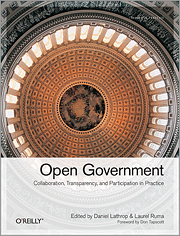
Also exciting is that a sample of the book (pictured left) that includes the first 8 chapters can be downloaded as a PDF for free.

The book includes several people and authors I’m excited to be in the company of, including: Tim O’Reilly, Carl Malamud, Ellen Miller, Micah Sifry, Archon Fung and David Weil. My chapter – number 12 – is titled “After the Collapse,” a reference to the Coasean collapse Shirky talks about in Here Comes Everybody. It explores what is beginning to happen (and what is to come) to government and civil services when transaction and coordination costs for doing work dramatically lower. I’ve packed a lot into it, so it is pretty rich with my thinking, and I’m pleased with the result.

If you care about the future of government as well as the radical and amazing possibilities being opened up by new technologies, processes and thinking, then I hope you’ll pick up a copy. I’m not getting paid for it; instead, a majority of the royalties go to the non-profit Global Integrity.

Also, the O’Reilly people are trying to work out a discount for government employees. We all would like the ideas and thinking in this book to go wide and far and around the globe.

Finally, I’d like to give a big thank you to the editors Laurel Ruma and Daniel Lathrop, along with Sarah Schacht of Knowledge as Power, who made it possible for me to contribute.

Today in the Globe: Facebook's Political Reach

I have the following piece published in the Globe and Mail today. It isn’t going to further endear me to Michael Valpy (who is already not impressed with me)… but felt another perspective on the issue was needed. He, like many traditional columnists, is not a fan of social – or digital – media. Indeed, he has argued it is destroying our country’s social cohesion and democracy. Those familiar with me know I feel differently . By allowing us to self-organize, connect to one another and to our politicians, social media is enabling a different and very powerful type kind of social cohesion and democratic expression.

I respect Valpy a lot and hope we get a chance to sit down and talk social media at some point. Given our collective interest in journalism and statements like this, it feels like it would be fruitful for both of us. Hopefully it will happen.

Facebook’s Political Reach

Yesterday, Michael Valpy posted an interesting piece about a Nanos poll showing Canadians – including younger Canadians – question how much influence political Facebook groups should have on any government.

The problem with the piece lies in the headline: “Facebook forums shouldn’t sway government, young Canadians say.” It suggests that online activism – or social media in general – isn’t credible with the public. This, however, isn’t what the poll showed. Indeed, the poll says little about the credibility of Facebook, particularly compared to other forms of political activity. It does, however, say a lot about social media’s dramatic growth in influence over the past five years.

Critically, the poll didn’t compare forms of political activity. If one had done a similar poll asking whether Canadians believe a demonstration should sway the government, or if direct action – such as when Greenpeace hung a banner from Parliament – should alter government policy, would the numbers have been dramatically different? I suspect not. Governments have electoral mandates – something Canadians broadly agree with. Most political activity, both on and offline, is designed to shape public opinion and ultimately, people’s decisions at the ballot box. That is a threat influences government.

Consequently, it may not be the medium that matters as much as the number of people involved. Do people believe the government should pay attention to a 1,000 person rally? Likely not. Should they pay attention to a 10,000 person Facebook group? Likely not as well. But at a certain point, with large enough numbers, almost any medium matters. Would people think that the government should reconsider a policy in the face of 10-million-person petition? Or a five-million-person Facebook group? Possibly. What about a 500,000-person march? Even this might prompt respondents to reconsider their response.

Ultimately, the Globe article jumps to a negative interpretation of Facebook too quickly. This is understandable in that traditional news organizations are still coming to grips with social – and digital – media. But by allowing us to self-organize, connect to one another and to our politicians, social media is enabling a different and very powerful type kind of social cohesion and democratic expression.

More interesting is how split Canadians appear to be over political groups using Facebook “to share ideas, information and to help mobilize their activities” (30 per cent have a positive view, 30 per cent have a negative view and an enormous 40 per cent are undecided). Here is a technology few Canadians knew existed five years ago, and it is already viewed favourably by a third of Canadians as a way to engage with political groups. As people become more familiar with these online activities I suspect comfort levels will rise, since many people often don’t initially understand or like new technologies. This survey shows us online political organizing is moving into the mainstream – perhaps even more mainstream than a protest or a petition.

So should Facebook influence the government? The prorogation debate shows it already can. But do people believe Facebook should be less influential than other (more traditional) forms of political activity? In this, the survey reveals very little. Indeed as Nik Nanos, the pollster who conducted the survey, adds at the end of the piece (and in contrast to the title): “we still haven’t come to grips with what [Facebook groups] really mean.”

Conservative Senator Talks Harm Reduction

First, for those who have not seen it Maxine Davis, Executive Director of the Dr. Peter Foundation has an important op-ed in the Vancouver Sun titled Attention Ottawa: Insite is a health care service.

More intriguing Safe Games 2010 and the Keeping the Door Open Society (which, for full disclosure, I sit on the board of) are hosting a panel discussion on harm reduction. One of the speakers will be Senator Pierre Claude Nolin, who sits as a Conservative and has been deeply supportive of harm reduction strategies generally and the four pillars strategy specifically here in Vancouver.

For those in Vancouver who are interested in the event – details below. Hope to see you there.

Keeping the Door Society and SafeGames 2010

invite you to attend

Global Insite – A panel discussion and public dialogue on Vancouver’s

innovative response to the international question of What to do About Drugs?

WHEN:

Friday 19th February 2010

7.00 pm – 9.00 pm; doors open 6.30 pm

WHERE:

Japanese Language Hall

487 Alexander Street @ Jackson Street / Vancouver

SPEAKERS

  • DR. ETHAN A. NADELMANN Executive Director, Drug Policy Alliance; New York
  • SENATOR PIERRE CLAUDE NOLIN, Senate of Canada; Ottawa
  • LIZ EVANS Executive Director, Portland Hotel Society; Vancouver
  • DONALD MACPHERSON Co-founder, Canadian Drug Policy Consortium; Vancouver
  • SHARON MESSAGE Past President, Vancouver Area Network of Drug Users; Vancouver
  • TARA LYONS Executive Director, Canadian Students for Sensible Drug Policy; Canada
  • GILLIAN MAXWELL (mc) Project Director, Keeping the Door Open Society, Vancouver

Please join us to hear a panel of experts discuss the Canadian Government’s recent announcement that it will continue its efforts to close down Insite – North America’s only legal supervised injection site.  We invite you to participate in the dialogue that will follow.

How Vancouver's Open Data Community Helped Open Up the French CBC

For those uninterested in the story below and who just want the iCal feed of cultural events in Vancouver, click here.

Also, I had a piece on the Globe site yesterday, was in the air all day, but was told it hit #1 most viewed, which, if true, is nice. You can read it here.

A couple of weeks ago – at a party – I met someone working at the CBC who talked about how they were organizing a calendar of all the cultural events at the Olympics. Turns out the French CBC is placing a strong emphasis on the Cultural Olympiad that is taking place concurrently to the Olympics and they were gathering all the events they could find into a spread sheet.

I commented that CBC views and listeners – French and English – would probably find such a calendar useful and that it would quite interesting if the CBC shared it as an iCal feed so that anyone could download it into their computer’s calendar.

He agreed, but was unsure how to create such a feed. Admittedly, neither was I – but I did know some people who might…

So at Vancouver’s last Open Data Hackathon – kindly hosted by the City Archives and organized by Luke C – I asked around to see if anyone might be interested in converting the spreadsheet into an ical feed. Up stepped Jason M. who did a little trouble shooting, figured out how the spreadsheet needed to be reformatted and then figured out how to convert it.

So now, if you want, you can download a fairly comprehensive list of the cultural events taking place during the Olympics straight into the calendar on your iPhone, computer, google calendar, etc…

It’s got more events than a lot of the other calendars and includes concerts being played at Maison du Quebec, Saskachewan, Alberta, Ontario and Atlantic Canada House.

This is a bit of a shift for the CBC, the kind of shift that I think we need to be supportive of… a little more open, a little more sharing and a lot more useful. Most importantly it is a great example of how the idea of open data spreads – by being useful.

Some More Core-Periphary Maps

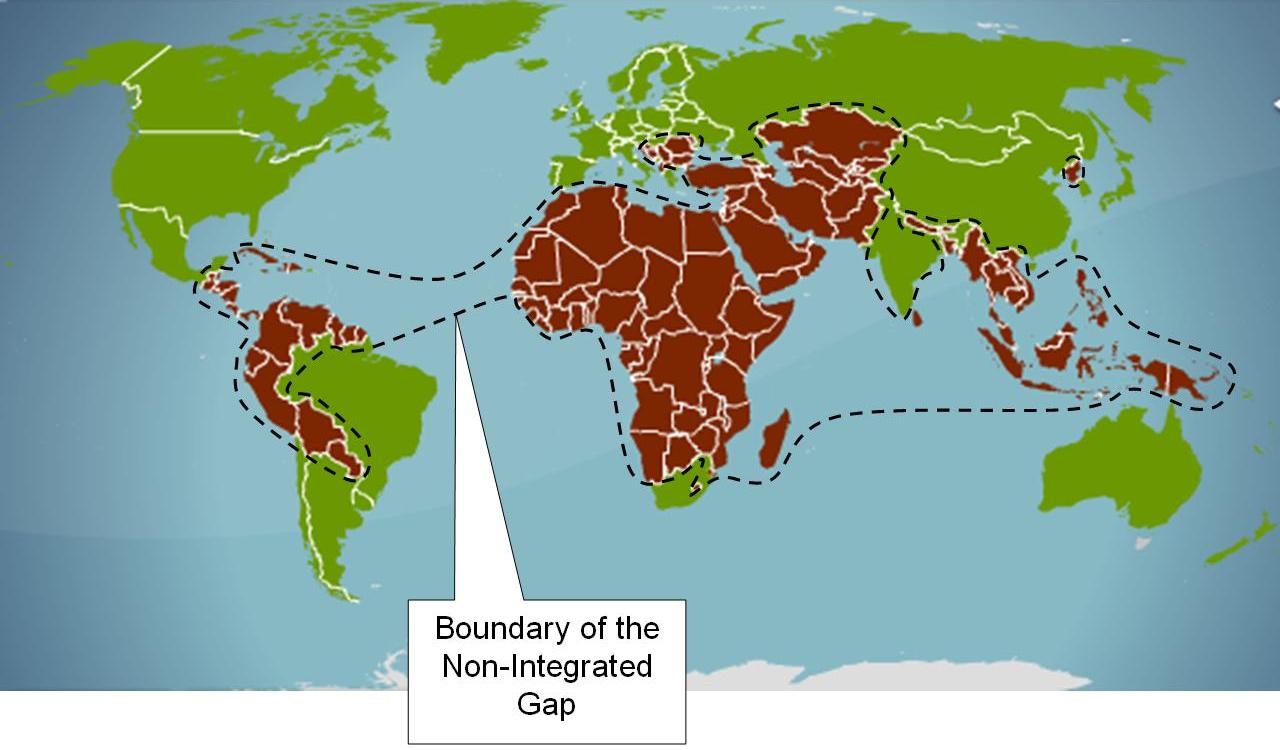
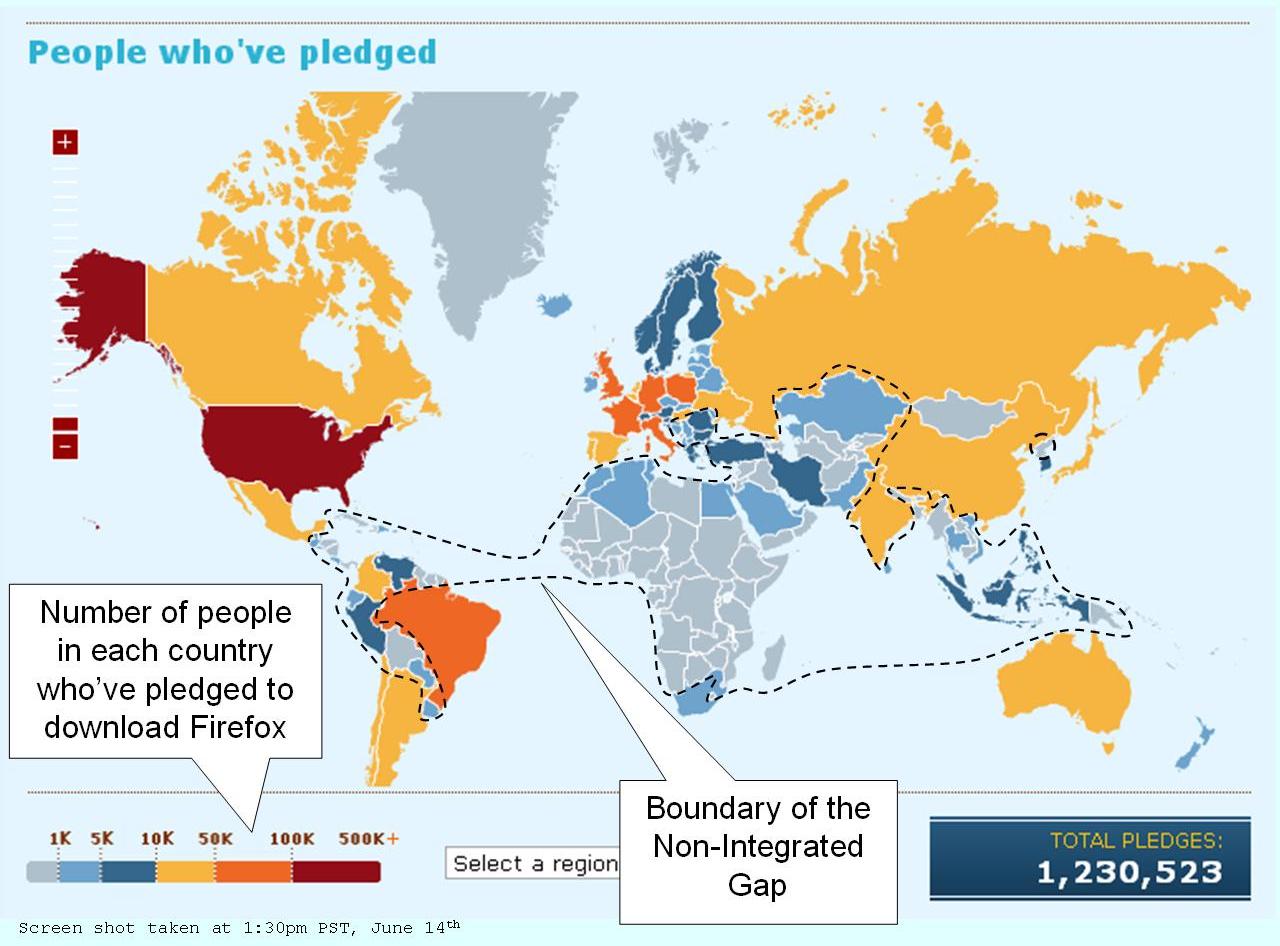
Those who’ve been reading my blog for a long time may remember one of my more popular posts comparing the Firefox 3 Pledge Map (locations of downloads of Firefox 3 back in June 2008) versus Thomas Barnett’s Map (published in The Pentagon’s New Map – his blog here).

PNM%20remixed%202

firefox PNM mash up 2

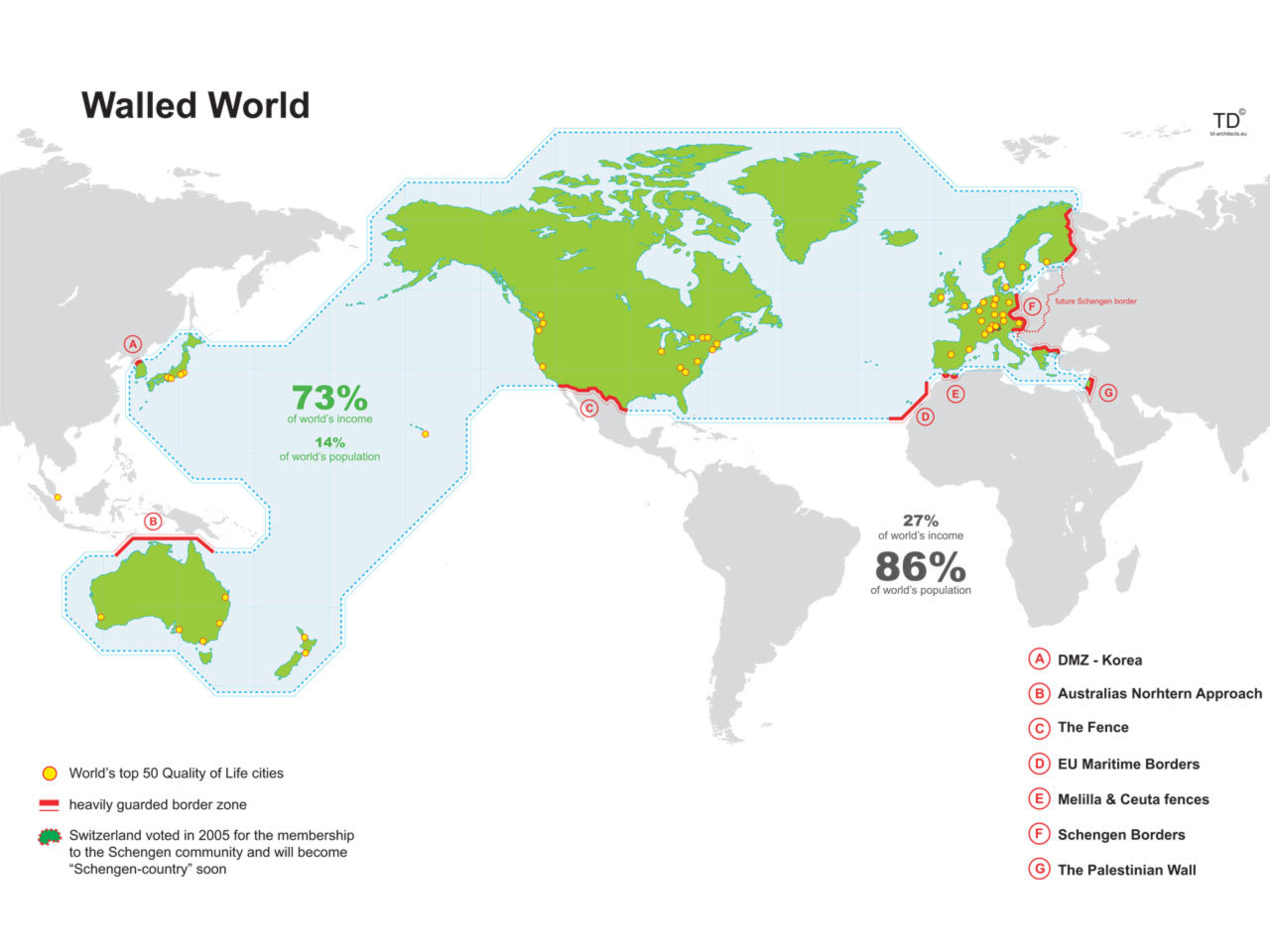
A little while back a friend shared with me a new map, called The Walled World, that she’d found over at The Raw Feed (a great site, BTW) which offers a similar perspective… but with clearly delineated walls that show who is being kept out of which parts of the world.

the-walled-world-large

All three maps continue reasonate with me. The first offers us a stategic overlay. Which countries are powers/maintainers of the international system – which places are seeking to radical alter it, or cannot seem to become part of the core.

The second shows the virtual implications of that gap. Here, the gap between core and periphery is made starkly clear in technology use.

The final shows the physical manifestation of the gap. A stark reminder of the fences we build and the enormous sums of money and energy poured into keeping certain people out.

As a final note, I do think the third map is slightly misleading. As disturbing as it is, it is actually far, far too flattering to many traditional western powers as it continues to place them at the “centre.” In a world where the United States appears to be in decline this type of map makes China, Brazil, India and Russia (and even South Africa) look like non entities. Nothing could be further from the truth.

Canadian Foreign Policy: The War on Independent Thought

Two stories this week highlight Canada’s rapidly decaying capacity to think, engage and act on foreign policy issues. The first was the Globe’s story Canadian Aid Groups Told to Keep Quiet on Policy Issues, the second is Paul Well’s detailed and devastating account of the implosion of Rights and Democracy, an NGO run by the Federal Government which has seen its entire staff revolt in the face of the political efforts by government to reset its policies.

Both stories hint at a common pattern – that through bullying, funding decisions, appointments and any other means at its disposal – the conservative government is seeking to ensure that any voice in Canada that engages international issues aligns itself with the government’s opinion. In short, this Conservative government is seeking to recentralize Canadian foreign policy. It is an effort that cannot succeed, but in which the attempt will devastate Canada’s influence in the world and negatively impact our capacity to act on the global stage.

Why is this?

Because in the 21st century a country’s foreign policy capacity – especially a small country like Canada – does not spring solely from the size of one’s military and the influence of one’s diplomats. Rather, influence springs from the capacity to tackle and address – increasingly complex – problems. Military might and diplomats can be deeply important but they are increasingly a smaller piece of the puzzle. The real question is, how does a state marshal all the resources and talents at its disposal and focus them on a problem.

In the 19th century the answer was easier. Military might and diplomats were the only tools and so control over these tools – the capacity of a single person (the PM) or group (cabinet) to focus the energy of the state on a problem – was the essence of international influence. But today this is no longer the case. Many of the critical relationships, expertise for addressing problems, volunteering capacity and even funding, lie beyond the control of the state. More importantly, public opinion has become an essential part of any effort. In this world, where the state is only one of many actors, and is one that is frequently looked upon with skepticism, how does one marshal this network or foreign policy ecosystem and attempt to focus it on a problem?

This is the great challenge facing government’s everywhere (especially those of smaller countries where resources outside of government are essential).

The conservative response – outlined above by the Globe and Paul Wells – describes an effort to assert control over these non-state actors and opinion shapers. To bully them into line and force them to not only cooperate with but mimic the government’s priorities.

This strategy will not work.

Over the short term the talent in Canada’s foreign policy network will simply balk. The best will leave for other countries which will seek to engage them on policy, not declare war on independent thought. Today we risk the great “hallowing out” of our foreign policy capacity (and thus international influence) not because the quality of our diplomats or military will decline, but because the quality of our NGO sector will decline.

Moreover, this sector’s international influence depends on independence. Other states and public opinion more generally will not respect Canadian organizations that are seen as merely puppets of the Canadian government. Indeed, expect these types of organizations to see their influence wain to a point where they become insignificant on the international stage. In short, there will be fewer Canadian voices and they will all carry less weight.

Finally however, the ecosystem will adjust. Already many Canadian organizations that work and engage in international issues find it cumbersome to work with Government. People I speak with often eschew CIDA grants since the reporting mechanisms they come with are often more expensive to implement than the value of the grant. Now that Government money is linked with political interference and meddling, an increasing number of organizations will avoid engaging the Canadian government altogether. The result? A NGO sector that is actively hostile – or at best indifferent – to the government and a diminished capacity to coordinate action, research and policy across the Canadian foreign policy ecosystem.  In short, the Canadian government will have no more control over internationally focused resources, but it will have shrunk the country’s collective influence.

In a networked world you can’t control the network, you can only seek to influence it. This government’s actions are a case study in how to lose credibility and sacrifice capacity. If, however, they don’t want a Canada that engages in the world, perhaps, in their mind, it is all worth it.
Carbon Chaos – Celebrating the Launch of an iPhone App

At the beginning of September Gerri Sinclair and I began scheming around me working with a group of her students at the Centre for Digital Media on a project. My initial idea didn’t pan out (more on that in another post) but the students pitched a new idea, one the maintained the original idea of a game that would be fun and that would carry an environmental message.

The result?

Carbon Chaos – an iPhone game designed and built to be fun while educating those who download it about the various advantages and activities of Translink – the transit authority here in the Greater Vancouver area.

And so, with a ton of pride in the students who worked really long hours to create this in a few short weeks here is some beautiful art work they created…

And here is what the game looks like in action…

In short order I hope to share what I learned from the experience and from the students who worked on this (lots of interesting lessons). Needless to say the students deserve infinite praise and I’m eternally grateful to have had the chance to work with them. Amazing, every last one of them. Big thank you’s should also go to their faculty adviser Patrick Pennfather. And finally I know everyone is grateful to TransLink, who sponsored this application and gave it a home. A forward looking organization TransLink, one thinking hard about how technology can transform it – first they opened up their google transit API to the public, then they launched a partnership with Four Square (making each station and a bus a location where you can check in) and of course, they were willing to engage some students on a game they built.

Never, in all my dreams growing up and playing games did I believe that I might one day be a video game producer. Fun, fun, fun. If you have an iPhone, hope you get a chance to download it and see what some emerging developers were able to code up.

Withholding FOI requests: In the Private Sector, that's fraud

It was with enormous interest I read on the Globe’s website about a conservative Ministerial Aide “unrealeasing” a document requested by The Canadian Press through an Access to Information request (The Access to Information Act ensures that citizens can request information about the government’s activities).

A federal cabinet minister’s aide killed the release of a sensitive report requested under freedom-of-information in a case eerily similar to a notorious incident in the sponsorship scandal.

What I find fascinating is the neither the minister (now at Natural Resources Canada) or the aide have been asked to resign.

Let’s be abundantly clear, if this were the private sector and a CEO was caught deliberately withholding material information from a shareholder… that would constitute either fraud and/or a violation of whichever provincial securities laws he/she was bound by. Moreover, such a crime that could carry with it a prison sentence.

And yet here, in the most cavalier manner, one of the most basic trusts that ensure accountability in our system is violated with almost no repercussions.

The story does have its dark humour (and a embarrassingly feeble attempt at an excuse):

Mr. Paradis’s current communications director said Mr. Togneri’s intervention was to suggest the Access to Information section offer fewer pages to the requester without charge rather than the entire 137 pages for a fee of $27.40, which had already been paid.

“He went through and thought that a huge section of a very big report wasn’t relevant and that you should be given the option of paying to get it or get the (smaller) chapter” without charge, Margaux Stastny said in an interview. “No one can overrule Access officers.”

The options were never provided to the requester, however. Instead, the department simply sent the censored report and refunded the fee.

Yes, I too am always comforted to know that my government is thinking of me and trying to save me a few pennies by ensuring I don’t see information they know I need not waste my time on.

I, of course, have another solution for how the photo copying money could be saved. What about emailing a digital copy of the report? Of course Access to Information requests (called ATIP or FOI for those in the US) are always handed out in paper, just to ensure you can’t do anything too useful with them… oh and to help ensure that they are late in delivering them.

So while, in this case, the Minister’s staff has committed an enormous gaffe – one that should have (and yet probably won’t) political implications, it is also a window into a broader problem:

FOI = broken.

I belong to a generation that gets information in .3ms (length of a google search) if you take 80 days to get my request to me (and edit it/censor it), you are a bug I will route around. This isn’t just the end of accountability in government, this is the end of the relevancy of government.

Upcoming talks…

A ton of speaking engagements have hit me in the last little bit. Here’s the most up to date list. I think they’ll be some more in the mix soon, but thought I’d throw these out there.

Panelist, Opening up Government Data (Title to be confirmed), Lac Carling 2010, Niagara on the Lake, June 16th, 2010.

Keynote, The Future of Open Government, MISA Annual Conference 2010, Niagara Falls, June 15th, 2010.

Panelist with Michael Geist, Challenges of Open Government in Canada, GOL Communications Victoria, May 28th, 2010.

Speaker, Open Data, Baseball and Government, Gov2.0 Expo Washington, DC, May 26th, 2010.

Panelist with Michael Geist, Challenges of Open Government in Canada, GOL Communications Ottawa, March 25th, 2010.

Panelists, What Guys are Doing to Get Women into Tech, SXSW, Austin TX, March 13, 2010.

Panelists, Social Business Design, Connect IT Conference, Ryerson Business Faculty, March 11th, 2010.

Speaker, Open Government in Canada, O’Reilly’s Gov 2.0 International Online Conference, March 11th, 2010. (details to follow)

Panelist, Panel on Open Government, Centre for Law, Technology, and Society, University of Ottawa, March 5th, 2010 (details to come).

Speaker, Collaboration and Open in Science, Regenstrief Institute, Indiana University, Indianapolis, Feb 17th, 2010.

Surreal Moments in Journalism – Gotcha trumps substance

A few weeks ago I think a journalism class at Ryerson had a term paper due about why main stream media has such a hard time engaging with social media. I say this since I think at least three different students from the University interview me on the subject. At the beginning of each interview they each told me that their piece might get published in the Ryerson Review of Journalism.

I really enjoyed my conversation with each of them – it is always great to have people ask you smart questions as it challenges you to think and rethink these issues. What I did find bizarre however was what happened next.

The other day a fact checker call me from Ryerson’s school of journalism.

She was nice and friendly and wanted to confirm that I had said certain things. Her questions were fairly vague and I was getting frustrated since I prefer not to be vague (When I’m getting quoted) and so was trying to tell her what I thought my precise language would have been (hey it’d been two or three 45 minute conversations several weeks early…). Finally, I just asked: “Can you just tell what the quote is?”

To which she responded: “No.”

I’m sure journalism students everywhere are about to jump on me… but I’ll confess I was a little surprised and, frankly, disappointed.

This isn’t some political scandal where if I contradict myself there is possibly evidence of some larger cover up. I’d been interviewed as a “subject matter expert” (we can debate the dubiousness of that title – I’m definitely open to challenge on that…) and so one would think that the goal would be to get a quote from me that explained, in the most lucid and helpful manner, the essence of my perspective or the issue I was raising. Substance and clarity would, I thought, have been the goal.

Apparently not.

Who knows what the quote is… (I think it relates to the fact that I believe many Canadian newspaper columnists actually hold their audience in contempt – they don’t actually want to engage with them – something I think is their Achilles heels and that distinguishes a new generation of columnists who are growing up blogging) but the process suggests me that what is really interesting to the review is being able to run with a quote I may or may not have said, because someone decided its juicy. Okay. But understand that this isn’t about getting closer to some understanding of the subject matter anymore, this is about getting a juicy quote.

So, I’ll confess this is all my fault. Lesson learned. I’ll be sure to explicitly stay off the record with journalism students from Ryerson call and will carefully construct any statement I fear might be on the record. Maybe the quotes great! But maybe not. I guess we’ll find out soon…