ChangeCamp: Pulling people and creativity out of the public policy long tail

ChangeCamp is a free participatory web-enabled face-to-face event that brings together citizens, technologists, designers, academics, policy wonks, political players, change-makers and government employees to answer one question: How do we re-imagine government and governance in the age of participation?

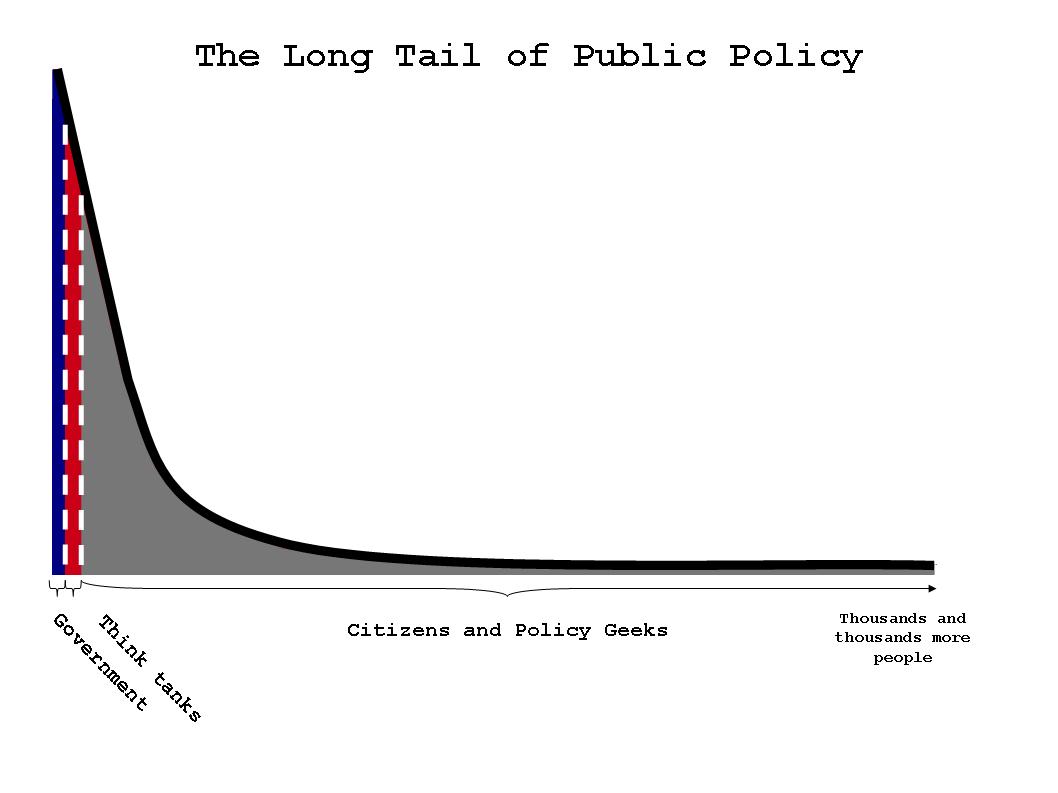
What is ChangeCamp? It is the application of “the long tail” to public policy.

It is a long held and false assumption that ordinary citizens don’t care about public policy. The statement isn’t, in of itself, false. Many, many, many people truly don’t care that much. They want to live their lives focusing on other things – pursuing other hobbies or interests – but there are many of us who do care. Public policy geeks, fans, followers, advocates, etc… we are everywhere, we’ve just been hidden in a long tail that saw the market place and capacity for developing and delivering public policy restricted to a few large institutions. The single most important lesson I learnt from my time with Canada25 is that it doesn’t have to be that way.

Did Canada25 get a new generation of Canadians, aged 20-35 engaged in public policy? I don’t know.

What I do know is, that at the very minimum, we harnessed and enormous, dispersed desire of many Canadians to participate in, and help shape, the public policy debates affecting the country. Most importantly, we did this by doing three things:

  1. we aggregated together the people who cared about public policy, we gave them peers, friends and a sense of community.
  2. we provided a vehicle through which to channel their energy
  3. by combining 1 and 2, and by using simple technology and a low cost approach – we dramatically lowered the barriers (and csots) to entry for credible participating in these national debates

Today, the technology to enable and aggregate people their ideas, to connect them with peers and to create community, is still more powerful. Our capacity to challenge, push, help, cooperate, leverage and compete with the large institutional public policy actors has never been greater. This, for me, is the goal of ChangeCamp. What concrete tools can we build, what information can we demand be opened up, what new relationships can we build to re-imagine how we – the citizens who care – participate in the creation of public policy and the effective delivery of public services. Not to compete or replace the traditional institutional actors, but to ensure more and better ideas are heard and increasingly effective and efficient services are created.

Long tail of public policy

Individually, none of us may have the collective power of a government ministry or even the resources of most think tanks. But collectively, linked together by technology and powered by our energy and spare capital, the long tail of policy geeks and ordinary citizens is bigger, nimbler, more creative and faster than anything else. Do I know that the long tail of policy can be set free? No. But ChangeCamp seems like a fun place to start experimenting, brainstorming and sharing ways we can make this country better.

Vision Fundraiser February 4th

There is a nice gala Vision Vancouver fundraiser coming up on February 4th for those who are interested. Here’s an opportunity to mix it up with the new Mayor and Vision Council members.

As the advertisement states:

Enjoy an evening of specialty tapas highlighting the multitude of Vancouver’s diverse neighborhoods, while mingling with Vancouver’s elected officials, business leaders, union brothers and sisters, social and environmental change agents, and others who are working to make a difference in their communities.

Tickets are $150.00 each with sponsorship opportunities available – for more information call Vision’s Fundraiser Kristi Rivait at 604-568-6913 or email her at kristi@votevision.ca

Why Smart Power matters

America cannot solve the most pressing problems on our own, and the world cannot solve them without America. The best way to advance America’s interest in reducing global threats and seizing global opportunities is to design and implement global solutions. This isn’t a philosophical point. This is our reality.

The president-elect and I believe that foreign policy must be based on a marriage of principles and pragmatism, not rigid ideology. On facts and evidence, not emotion or prejudice. Our security, our vitality, and our ability to lead in today’s world oblige us to recognize the overwhelming fact of our interdependence.

I believe that American leadership has been wanting, but is still wanted. We must use what has been called “smart power,” the full range of tools at our disposal — diplomatic, economic, military, political, legal, and cultural — picking the right tool, or combination of tools, for each situation. With smart power, diplomacy will be the vanguard of foreign policy. This is not a radical idea. The ancient Roman poet Terence, who was born a slave and rose to become one of the great voices of his time, declared that “in every endeavor, the seemly course for wise men is to try persuasion first.” The same truth binds wise women as well.

– Hillary Clinton, January 13th, 2009

During her confirmation hearing before the Senate Foreign Relations Committee Hillary Clinton used the term “Smart Power” no less than 12 times. It is a clever term, one that seeks to navigate between the Hard Power of military might and economic coercion, with the Soft Power of ideology, culture and agenda setting. Does the term signal something new in US foreign policy? Depends on your time frame. Without a doubt it marks the end of the George W. Bush foreign policy era. Clearly the blustery swagger of a shoot first, ask question later has ended. This is a United States that will be more cautious and more engaging. But rather than the start of something new, Smart Power likely signals a return to the Bill Clinton and Bush Sr. era of foreign policy. Indeed, as important as the term Smart Power was, the focus should lie not on the term, but on the revealing paragraph leading up to it:

“The president-elect and I believe that foreign policy must be based on a marriage of principles and pragmatism, not rigid ideology. On facts and evidence, not emotion or prejudice. Our security, our vitality, and our ability to lead in today’s world oblige us to recognize the overwhelming fact of our interdependence.”

Here the guiding principles behind the shift to Smart Power are revealed. Two strike me as paramount. The first reaffirms what I think will be the buzz word of the Obama administration: pragmatism. Despite his soaring speeches and inspiring words Obama is first and foremost interested in achieving the possible – stretch goals are fine – but ideological dreams are not for him. Second, in this speech, the United States’ next Secretary of State signalled to the world that it once again recognizes it cannot go it alone. The acknowledgement of interdependence is the antithesis of “you are with us or against us.” It is an recognition that allies – real allies, not the minnow states bullied into participation – are required to sustain and enhance the stability and prosperity of the international system. Bush Sr. understood this when creating his coalition for the first Gulf War, Clinton sought, insofar as possible, to build similar agreement when advancing his international agenda.

These have two dramatic impacts for Canada – and other countries. The first is that we should expect the Americans will ask us what we think – our advice or thoughts may not change their opinions, but we will likely be asked and when that happens, we’d better have something smart and meaningful to contribute. Second, the opportunity of being consulted comes with it the responsibility to contribute and support, even when the decision or strategy isn’t one that we completely agree with. When you’ve been part of the discussion you can walk away when the rubber hits the road. Third, those who have a well thought out plan for solving a problem will win out over those who have grievances to share. Demonstrate to this administration that you can solve a problem through realizable actions and I suspect they will listen and support you.

For Canadians nowhere is this change in attitude possible more important than on the management of the Canadian Border. I would have a new briefing plan of how we believe the border should be managed ready and waiting for when Clinton or Obama’s first arrives in Ottawa. If the Obama administration acts as it talks, I suspect it will reward and seek out, not those who do as it says, but those who solve the problems they care about. This is a welcome return to the diplomacy of the 1990’s which was also cautious and smart. It was also a good period for Canadian-American relations.

Canadians have spent years hoping the Americans will change. Now that they have, are we ready?

How not to do generational analysis

I read – and laughed – at Maclean’s latest in a series of Gen Y bashing pieces. This time it was Lianne George, with the bat, in the employment office, in her piece “Dude Where’s My Job?”

The piece said a lot more about Lianne George than it did about Gen Yers (or the Net Gen or, if you prefer, anyone under 30) tinged, as it was, with the bitter happiness of someone celebrating another’s (perceived) comeuppance. If only the analysis had been as edgy, or as fun, the piece’s tone.

The saddest element of the article was its reduction of Gen Yers to a coddled, materialistic and self-aggrandizing cohort who are finally about to taste a dose of reality. This despite the fact that – according to George – 44% of Yers still live at home (many, would likely prefer to live independently) and have large student debts (an average of $5,631 per year in according to her). Hardly the stats of an entitled generation.

She laughs that:  “This is a generation, after all, in which seven out of 10 rank themselves “above average” in academic ability.” The intent is to show Gen Yers are delusional self-aggrandizers. However, Gen Yers ARE above average in academic ability when compared to the population as a whole. The number of people attending university and college has been steadily (and aggressively) increasing. Even compared to 18 years ago, a growing % of the labour force has post-secondary education. This is to say nothing of the huge increase in the number of graduate students. For many Gen Yers maybe one parent, and almost none of their grandparents went to college or university. As such Gen Yers are more academically inclined compared to the labour force. Does this give them confidence? Maybe. But I wouldn’t confuse it with a belief they are inherently smarter or better than everyone else.

It is also problematic to talk about generations. I could easily sit here and psychoanalyze how Lianne George is almost certainly a Gen Xer who graduated at a time when there were no jobs and had to claw herself into a career she enjoyed. As such her article is just an expression of the frustration she (and by extension of course, all Gen Xers) feel towards Gen Y who (after making millions in silicon valley) they hope are finally getting their due and will have to behave more like her generation:  forced by a declining economy to abandon their dreams and hopes and become the prototypical slackers of Reality Bites, mocking life as they resign themselves to dead end job after dead end job. What a wonderful thing to wish on a generation.

The problem is – I don’t think most Gen Xers think that way. Moreover, this type of generational thinking blinds us to bigger and more important problems. Gen Xers were never all slackers and Gen Y is not a single cohort. I forsee something much more problematic and unstable emerging than a bunch of Gen Yers feeling let down by the universe. Recently I read that there has been no decline in the number of job recruiters at UBC this year. I fear that we are seeing the wedging of our economy – a separation between an growing wealthy and opportunity rich creative class, a struggling white collar class and a destitute blue collar class. While already true, I fear the main determinant of who’s asking “Dude, where’s my job” won’t be age, but class. Worse, those who end up asking the question risk becoming part of a structural unemployment problem: insufficiently skilled to enter the workforce, and lacking the capital to change their circumstances. This is the analysis we need from Maclean’s, not cheap snipping at a whole generation.

But then, maybe the cheap shots sell more magazines.

7 things about me. Soon to be 7 things about you.

Both Beltzner and Surman have tagged me with the 7 things meme and, to quote Beltzner:

“by The Laws of The Internet, I must participate in the latest meme to sweep Planet Mozilla. “

The Rules for This Particular Meme

  • Link to your original tagger(s) and list these rules in your post. (see above)
  • Share seven facts about yourself in the post. (see below)
  • Tag seven people at the end of your post by leaving their names and the links to their blogs. (see below)
  • Let them know they’ve been tagged.

My Seven:

1. I once spent the night in Rome sleeping outdoors at the Circus Maximus.


2. I have never broken a bone…


3. …or thrown a punch (although not necessarily related there is, I believe, some correlation).


4. I’ve only drunk 3 cups of coffee in my entire life (and yes, I grew up in Vancouver…).

5. I live atop of a supermarket and Home Depot (which sounds scary but is actually quite convenient).


6. A long, long, long time ago, I sung on a childrens record.

7. And once, while walking at at 5400M (17,500 ft), I was passed by a guy smoking a cigarette… (not a proud moment, but in my defense he was a local)

Seven people who are now “it”

  1. Taylor Owen, whose blog has still less levity than mine
  2. Mark Kuznicki, who loves all things webby
  3. Stephen Johnson, who is wicked smart and is on a book tour so may find this fun for his audiences…
  4. Michael Anton Dila, who has so much free time :)
  5. Alexandra Samuel or Rob Cottingham, I’m sure one will read this, the other will blog it.
  6. Sameer Vasta, for being an all round cool guy.
  7. Marc Laporte, because TikiWiki should feel the love too.

My work here is done.

Old modes of production die with the depression…

A few weeks ago I blogged about how I thought land line phones and cable TV would be among the first items to go as people cut budgets. In contrast Cell phones and internet would be among the last (can you imagine trying to find a job without an internet connection?)

Well I forgot to mention that newspapers would be the other obvious target… why spend to get a newspaper when you can get the content online for less or for free?

So I was probably rash in saying that traditional telephone companies (are there any left?) and cable companies would be among the first to feel the pinch. It is going to be newspaper companies. The end is going to come fast and furious. It won’t be pretty.

For my American friends there is already talk about how much trouble the New York Times is in. Indeed, as one industry observer points out, the NYT may not survive past MAY – although by drawing down on its credit and selling assets (like the Boston Red Sox’s) it can survive until 2010.

Here in Canada the situation is bleaker. CanWest, which owns the National Post as well as newspapers in most of the country’s major markets (such as the Vancouver Sun, here in my home town), has reported Q1 losses and its stock continues to free fall. Having lost 92% of its value in the last year it may no longer be able to meet its debt servicing requirements. It turns out that buying more newspapers is not the solution for newspaper companies. A bigger broken business model doesn’t, at some point, transform into a working business model.

The old modes of production are in trouble. Today it’s print, but TV/video better not assume the same pressures won’t be confronting them in the near future.

Microsoft: A case study in mismanaging a business ecosystem

mslogoA lot of fuss has been made about Microsoft’s inability to compete in the online space and the web specifically.  Indeed, it is widely acknowledged that Microsoft was slow to understand the web’s implications and adjust its product lines accordingly. How did the largest, most successful software company in the world fail to predict or even, once the future became clear, effectively adapt to the rise of the internet? More importantly, why hasn’t it been able to acquire its way out of trouble?

Numerous articles have been written on this, many focusing on Microsoft’s strategy and the fact that it likely faced a disruptive innovation problem. I’d like to supplement that analysis by focusing on the predatorial way Microsoft managed and engaged its business ecosystem in the 1990s. I’ve not seen this analysis before so I thought I would throw it out there.

The 1990’s were a good time for Microsoft. It experienced tremendous growth and its operating system was by far the dominant choice in the market place. It had tremendous leverage over everyone in its business ecosystem, including its competitors, customers and complementors. While this was seen as a source of strength (and profit) it also laid the foundation for many of its problems. The story of Microsoft’s competitors in its traditional marketplace – especially those that have adopted an open source space model such as Linux, Mozilla and Apache – is well documented and forms the core of the traditional disruptive innovation thesis. But I think Microsoft’s inability to counter these threats, as well as its inability to compete in new spaces – such as against Yahoo! or Google – isn’t just a result of the fact that it crushed its traditional competitors but also due to the mismanagement of its relationship with its complementors and partners. More importantly, the disruptive innovation thesis fails, on its own, to explain why Microsoft hasn’t been able to acquire itself out of its problems.

I’ve been told that one of Microsoft’s great strengths is that it has fantastic tools for developers (I’m not a coder so I can’t comment myself). However, in the 1990s and early 2000s, Microsoft lacked a sophisticated or long-term strategy for engaging the software products and companies those developers created. Given that Microsoft was sitting atop the  computer software ecosystem the company had one goal – staying there. This lead it to view anyone as a potential competitor – or if not a competitor than at least someone eating into profits that it could otherwise capture. Rather than balancing the growth of the value network with trying to capture its fair share, Microsoft prioritized the latter over the former. Consequently, many companies that produced products within the Microsoft ecosystem – particularly for Windows – were often not seen as complementors, but as rivals. Microsoft was aggressive in dealing with them – it was gracious in that it would usually offer to buy them out – on its terms – but always looming in the background was the threat that if you didn’t sell to them they would copy what you did. Consequently, many little companies that designed applications that enhanced Windows were forced to sell – or were put out of business after Microsoft copied their products and integrated them into the operating system.

A business ecosystem is like a natural one. It doesn’t matter how nutrient rich the environment (like say, one with excellent development tools) if emerging lifeforms are consistently snuffed out, pretty soon they will elect to grow and evolve elsewhere – even in places where the nutrients are weaker. This is precisely what I suspect started to happen. Likely, fewer and fewer developers wanted to approach the Microsoft ecosystem with a 10-foot pole because they would either be bought out on unfavorable terms or at an early stage (before they were too valuable) or worse, Mircosoft would simply crush them by using its enormous resources to replicate them and eat into their business.

The repercussion of this is that Microsoft saw fewer and fewer new and innovative products being created for its platforms. Programmers and developers shifted to other platforms, or created whole new platforms where they would be free to grow ideas. This, I believe, prevented Microsoft from understanding how the web would change its business. Not only did its current profits create a disincentive to altering its business strategy but it snuffed out one of the few groups of people that could warn it, educate it and challenge it, about the impending changes – its complementors and partners. Equally important is that it diminished the pool of potential acquisition targets whose culture, technology and processes might have helped Microsoft adapt. There were simply not that many mid-sized mammals in the ecosystem: Microsoft had prevented them from evolving.

Today – based on conversations I’ve had with some people in Microsoft – I get the sense that they are trying to become a better partner (or at at least, they may be aware of the problem). Perhaps Microsoft will succeed in becoming a better partner. It won’t however, be easy. Changes to how one treats complementors and partners often require rethinking the very culture of an organization. This is never an easy or quick process. In addition, it takes time to rebuild trust and attract new blood into the ecosystem… and any misstep will count dearly against you.

There are also almost certainly some interesting lessons in this for other dominant players – such as Google. Will Google behave differently? I don’t know. In many regards Microsoft behaviour was rational. It was seeking to preserve its position and maximize its share of the pie. This was made all the tougher because its market was evolving and the future was unclear. No one knew which pieces of the value network would be critical (and therefor most profitable)  and so Microsoft was simply trying to stake out as many of them as possible. It is easy to imagine Google behaving in a similar manner. But I suspect that if it does, it may also find it hard to escape Microsoft’s fate.

Big thank you to David H. for pointing out some typos and errors.
The murky future of BC-STV

I confess to reading, with great disappointment, Gordon Gibson’s comments about the upcoming referendum on STV:

“I have watched and taken part in our politics for more than 50 years,” former Liberal leader Gordon Gibson said.

“I have never seen such an opportunity,” he added.

I have. It was about 4 years ago. Something, Gibson briefly began to acknowledge before drifting back into platitudes:

“the last chance in the lifetimes of anyone in this room … a once-in-a-lifetime opportunity that we must not miss.”

Actually, this would be a twice in a lifetime opportunity, which is the problem.

Unlike in America, where ballot propositions are immediately binding, in Canada referendum’s have no legal relevance. That said, they remain an important source of legitimacy. Which is why the upcoming referendum on BC-STV is troubling. How legitimate is a referendum whose question was asked – and answered – a mere 4 years ago? Why is this referendum more valid than the last one? Why not – for example – take an average of the two?

Collectively, Canadians have endured this dilemma for decades. I remember being at a formal dinner, sitting beside a friendly Quebec sovereigntist who joked about how he would play squash with his good friend who happened to be a federalist politician. Sadly, he said, he lost every time. However, he quipped, he liked to remind his friend that he only had to win once…

Issues like the sovereignty of a province, or the structure of our electoral systems are not squash games, they are core questions about our identity and how we govern ourselves. Any proposal to alter or change them must be made through a process that bestows as much legitimacy as possible unto the new system. Pursuing a process in which you give yourself multiple kicks at the can, and deem valid the one time you reach the threshold does not accomplish this.

At least in Quebec the referendum question was separated by 15 years. This period of time meant it was possible to argue that there had been a generational change (true), that conditions had changed (also true), and that a similar, but new question could be asked once again (again, true).

The same cannot be said for BC-STV. It has only been four years, little has changed in terms of context and the exact same question will be asked.

While it supporters will claim that BC-STV is a better system (a topic for another post) derived from a legitimate process (something I believe to be contestable), the simple fact is voters rejected it a mere 4 years ago.

And herein lies the problem for BC-STV. It’s not clear there can be a positive result for its supporters. If they lose, they will be unhappy. However, if they win, what does it mean? Will the result carry sufficient credibility and legitimacy? What if it barely passes? Say 60.1%? My sense is that, barring an overwhelming or near unanimous vote – say 80% the result will be, at the very minimum, tainted. An ominous beginning for a process which all citizens should feel was enacted in a fair and legitmate manner.

eaves.ca… the 5th most popular political blog in Canada?

According to a list compiled by A Dime a Dozen I’ve been ranked as one of Canada’s top political blogs. Last month I think I was something like 17th, but this month I’ve rocketed to 5th place.

The accuracy of any blog list can be contested (and with so many political bloggers not making the cut, this one certain is being contested). So readers should make up their own mind on whether a list is good, helpful or important. That said, it is in nice to make anyone’s list, be it one built around strict criteria, or just a list of someone’s favourite blogs.

As an aside, I am surprised to find my blog ahead of Warren Kinsella and Michael Geist and pleased to see it ahead of Ezra Levant and The Western Standard and SteynOnline (whose critique of the American legal system after Conrad Black’s guilty conviction still stands as one of the worst pieces of blog commentary ever written by a professional). To see them ranking lower than my site says more about their limited appeal than it does about my readership levels.

Of course, not everyone is happy with the list and so other, alternative lists have been proposed – and I appear on some (13th), but not on another.

In the end though, it is great that others enjoy stopping by to visit and linking to me from time to time. I owe readers a big thank you. Two years in I’m still trying to stay true to some sage advice from a good friend who told me to write for myself – as though no one is going to read what I post. In part that was because in the blogosphere there is a good chance few will read what you write, but it is wiser still because blogging should be about letting your audience find you, not about finding an audience (I could get larger audiences by writing outrageous things – that temptation is often there for bloggers). So in that spirit I continue to try to be guided by my tag line: this place is my gym, somewhere to exercise my writing muscle and my mind. If it spurs others to exercise their brain muscles – or even their own writing muscles – all the better!