Tag Archives: cool links

Articles I'm digesting at the moment

While I keep track of the books I’m reading to the right I don’t often get to talk about the articles I’m reading and loving. Here are a few I’ve stumbled over in the past week that I’m still digesting.

1) Via Mike T, Obama and the dawn of the Fourth Republic by Michael Lind on the cycles of American progress and why the next 36 years are going to be very exciting.

During the first 36-year period of a republic, ambitious nation-builders in the tradition of Alexander Hamilton strengthen the powers of the federal government and promote economic modernization. During the second 36-year phase of a republic, there is a Jeffersonian backlash, in favor of small government, small business and an older way of life. During the backlash era, Jeffersonians manage to modify, but never undo, the structure created by the Hamiltonians in the previous era.

2) Via Alo, Why Canada has to wait for it’s Obama Moment, by Jeff Roberts. A piece few Canadians would be willing to write about why the politics of Aboriginals and the rest of Canada remain separated.

In the case of black Americans, their ascension to the political mainstream came in part from leaving behind talk of rights and identity and embracing a postracial style of politics. Barack Obama’s rise has followed his willingness to move away from the swamp of identity politics.

It’s a thesis that parallels that of Calvin Helin’s in Dances with Dependency that I thoroughly enjoyed. Moreover, Roberts is only half right. There is an emerging generation of (particularly urban) First Nations who are going to transform the politics of both the First Nations community and Canada.

3) Via Jeff A, Printing The NYT Costs Twice As Much As Sending Every Subscriber A Free Kindle by Nicholas Carlson . Shocked? You should be. As the author concludes:

Are we trying to say the the New York Times should force all its print subscribers onto the Kindle or else? No. That would kill ad revenues and also, not everyone loves the Kindle.

What we’re trying to say is that as a technology for delivering the news, newsprint isn’t just expensive and inefficient; it’s laughably so.

Besides, think of the forests that would be saved.

4) Via Amy L, The $300 Million Dollar Button, by Jared Spool. As Amy said to me, “you’re a believer in small changes” which I am. Very often I find people jump for the big lever to create big change which often creates numerous unanticipated (and almost always unwanted) changes. I’m much more interested in finding the small lever that creates big change. This piece is about precisely one of those moments in the design of a webpage.

It’s hard to imagine a form that could be simpler: two fields, two buttons, and one link. Yet, it turns out this form was preventing customers from purchasing products from a major e-commerce site, to the tune of $300,000,000 a year. What was even worse: the designers of the site had no clue there was even a problem.
Must see show this Sunday in Vancouver

It’s Friday and time to prepare for the weekend. In that spirit the perfect opportunity has arisen to both notify Vancouverites of a great cultural opportunity and give a shout out to my friend Misha Glouberman who is bringing his famous Trampoline Hall event to Vancouver! What is Trampoline Hall you ask? Look no further then the links above, the text below or the event’s facebook page:

Trampoline Hall is a barroom lecture series usually based in Toronto, but sometimes in other places. On Feb 1, it will be in Vancouver for the first time, as part of the Push Festival.

Trampoline Hall is this: Three people talk, on subjects outside their professional field of expertise. The lectures are sometimes ridiculous, sometimes moving, and always wildly unpredictable. Each talk is followed by a Q&A with the audience which is usually also a lot of fun.

Trampoline Hall was invented by the writer Sheila Heti, and is hosted by Misha Glouberman. In Toronto, it is something of an institution, playing every month for the past seven years or so. It’s also played to great crowds in around a dozen US cities, including Atlanta, Boston, New York, Louisville, Chicago, and San Francisco. Feb 1 will be Trampoline Hall’s first time in Vancouver.

All lecturers for the Vancouver show selected are selected by Veda Hille. Here is the lineup she has chosen:

1) Andrew Feldmar will talk about Cooking from Memory.
2) Kevin Chong will discuss Fraternal Polyandry
3) Faith Moosang will assert “There are Clues Everywhere!!” in a talk about Nancy Drew.

~~~~

“”Unruly… Caustically Funny” – Durham Independent

“They’ve been doing this for several years up in Toronto… now New Yorkers are in its thrall. Clearly, we love it.” – The Village Voice

“Cloud-splitting Genius” – Lola Magazine

“Eccentricity and do-it-yourself inventiveness” – The New Yorker

I’m hoping my plane lands in time so that I can make it!

ChangeCamp: Pulling people and creativity out of the public policy long tail

ChangeCamp is a free participatory web-enabled face-to-face event that brings together citizens, technologists, designers, academics, policy wonks, political players, change-makers and government employees to answer one question: How do we re-imagine government and governance in the age of participation?

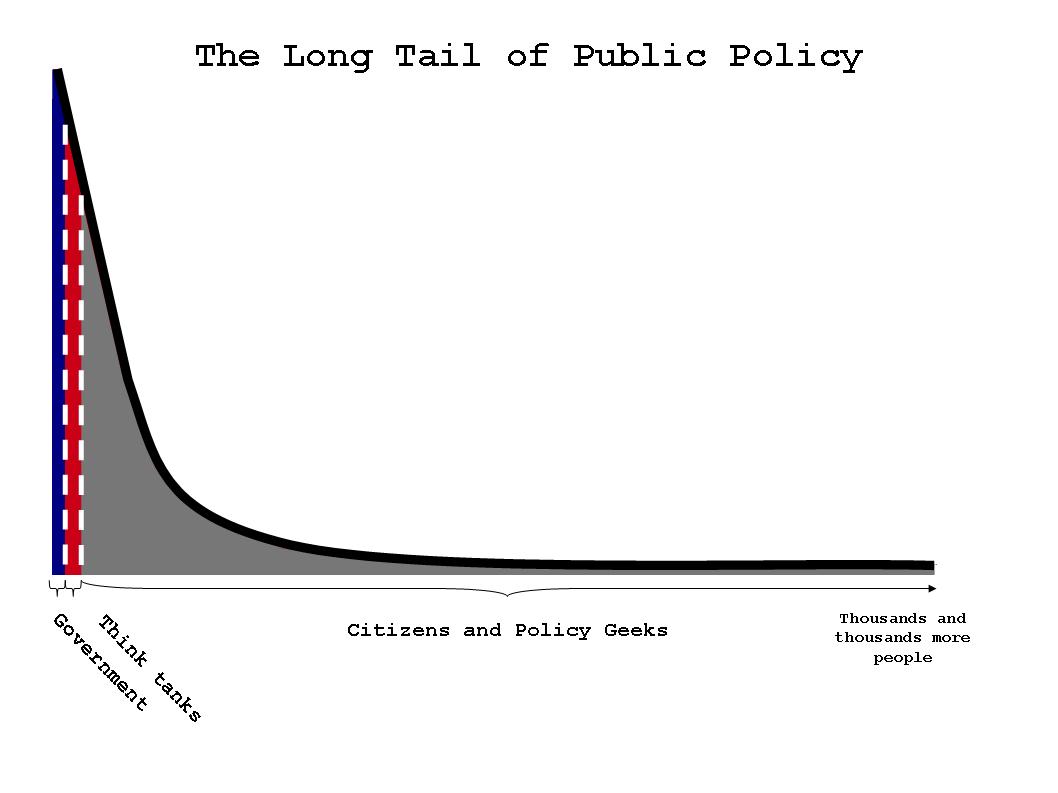
What is ChangeCamp? It is the application of “the long tail” to public policy.

It is a long held and false assumption that ordinary citizens don’t care about public policy. The statement isn’t, in of itself, false. Many, many, many people truly don’t care that much. They want to live their lives focusing on other things – pursuing other hobbies or interests – but there are many of us who do care. Public policy geeks, fans, followers, advocates, etc… we are everywhere, we’ve just been hidden in a long tail that saw the market place and capacity for developing and delivering public policy restricted to a few large institutions. The single most important lesson I learnt from my time with Canada25 is that it doesn’t have to be that way.

Did Canada25 get a new generation of Canadians, aged 20-35 engaged in public policy? I don’t know.

What I do know is, that at the very minimum, we harnessed and enormous, dispersed desire of many Canadians to participate in, and help shape, the public policy debates affecting the country. Most importantly, we did this by doing three things:

  1. we aggregated together the people who cared about public policy, we gave them peers, friends and a sense of community.
  2. we provided a vehicle through which to channel their energy
  3. by combining 1 and 2, and by using simple technology and a low cost approach – we dramatically lowered the barriers (and csots) to entry for credible participating in these national debates

Today, the technology to enable and aggregate people their ideas, to connect them with peers and to create community, is still more powerful. Our capacity to challenge, push, help, cooperate, leverage and compete with the large institutional public policy actors has never been greater. This, for me, is the goal of ChangeCamp. What concrete tools can we build, what information can we demand be opened up, what new relationships can we build to re-imagine how we – the citizens who care – participate in the creation of public policy and the effective delivery of public services. Not to compete or replace the traditional institutional actors, but to ensure more and better ideas are heard and increasingly effective and efficient services are created.

Long tail of public policy

Individually, none of us may have the collective power of a government ministry or even the resources of most think tanks. But collectively, linked together by technology and powered by our energy and spare capital, the long tail of policy geeks and ordinary citizens is bigger, nimbler, more creative and faster than anything else. Do I know that the long tail of policy can be set free? No. But ChangeCamp seems like a fun place to start experimenting, brainstorming and sharing ways we can make this country better.

Become a 2009 Sauve Scholar

For those who are interested, applications for Sauve Scholarships have been open for a few weeks now. The deadline is December 31st.

For those not in the know, the Sauve Program, now in its 6th year:

…exists for young leaders under the age of 30 from across the globe who want to change the world. The Scholars are chosen above all on the basis of criteria laid out by the Right Honourable Jeanne Sauvé:

  • Initiative
  • Motivation
  • Vision
  • Imagination
  • Demonstrated communication skills
  • Awareness of international and domestic issues
  • A strong desire to effect change

Each year, up to 14 remarkable young leaders are invited to come to Montreal for the academic calendar year. They live together in a beautifully restored mansion, enjoy unlimited access to McGill University’s academic programs and other resources – including lectures, conferences and events suited to the advancement of their individual professional and intellectual goals – while benefiting from the communal life and multi-faceted exchanges with their fellow Scholars.

The Sauvé experience, a period of personal and professional growth, is founded on:

  • Intense exchange of ideas and experience, supported by communal life
  • Extensive intellectual freedom, allowing each participant to develop according to his or her needs and aspirations
  • Focus on action accompanied by a clear commitment to the community —including the host community
  • Commitment to dialogue among cultures, which allows participants to understand and assimilate viewpoints built within multiple frames of reference

You can learn more about the program here and check out past scholars here.

Noam Chomsky name drops Taylor Owen

Check out this video of Noam Chomsky dropping my man Taylor Owen‘s name over and over again in regards to the excellent article he and Ben Kiernan wrote in The Walrus about the scope and impact of the bombing of cambodia.

Definitely check out the article if you haven’t already – it outlines a compelling case for why bombing campaigns are so problematic against insurgencies. It is a thread that Taylor and I picked up on in this op-ed in Embassy magazine last May.

name dropping begins around minute 46 – you can skip straight to it

ABC Meme for FireFox 3.x users

The Meme

Show your the top Awesomebar results for each letter of the alphabet.

Instructions

  • Without opening any other tabs, pop open your Error Console (in the Tools menu) and enter the following into the “Code:” field:C=Components;d=C.classes['@mozilla.org/browser/nav-history-service;1'].getService(C.interfaces.nsPIPlacesDatabase).DBConnection;for(o=[],c=97;c<123;c++){h=String.fromCharCode(c);q=d.createStatement('SELECT title t, url u FROM moz_inputhistory JOIN moz_places ON id=place_id WHERE input LIKE ''+h+'%' ORDER BY use_count DESC LIMIT 1');if(q.step())o.push(['',h,': ',q.row.t,''].join(''))}open('data:text/html,'+o.join('n'))
  • Click “Evaluate”. A new tab will open showing your results
  • Copy the code from that new tab and paste it into a new blog entry

History

Benjamin started it
Mardak helped with the code snippet
I saw it on Beltzner’s blog

My Results

a: Air Canada
b: Bloomberg.com: Energy Prices
c: CNN Politics: News, Opinions and Analysis from CNN.com
d: Dopplr
e: eaves.ca
f: Feedburner:: Feed Stats Dashboard
g: Globe and Mail: Canada’s National Newspaper
h: eaves.ca > Edit Comments (password required)
i: CIBC Investor’s Edge
j: Plotting of Canadian Federal Government Offices
k: Gregor Robertson: Beware of the Kingsway NDP Mafia – Straight.com
l: Literary Review of Canada: Progressivism’s End
m: Google Maps
n: New York Times
o: Ottawa Citizen
p: Personalized Start Page
q: David Eaves | FSOSS 08
r: TheStar.com | Opinion | How about real Liberal renewal?
s: StatCounter Free invisible Web Tracker
t: Technorati: Home
u: United Airlines
v: Vote Vision | Leadership • Action • Vision
w: WordPress Plugins
x: Amazon.ca: Divided We Stand
y: Youtube – Rachael Blake – Video 9 (Lost Experience)
z: Polymorph

Think Tank Watch

Did a brown bag lunch today at the Department of Foreign Affairs on network centric policy making. All kicked off by last week’s blog post on foreign policy as a disruptive innovation problem and the new world order. Great to reconnect with the department, make some new friends and meet up with some old ones.

Lots of interesting discussion which helped push some of my thinking and that I will try to blog on soon.

In the meantime, Daryl C. introduced me to Think Tank watch. A weekly service provided by the dept and its embassies. Think Tank Watch is a survey of what Think Tanks in the US, the UK and Canada are producing along with links to the articles and content. What would be great is if they also had the content on a website with an RSS feed.

To sign up for Think Tank Watch US just send email to this address asking to be on the list.

For Think Tank Watch UK send it here and for Think Tank watch Canada click here.

Another cool fact about Foreign Affairs? Free wifi in the lobby. It is, admittedly, a small thing. But it is an example of the fact that someone, somewhere in the department, understands the importance of connectivity.

It’s a positive sign and an concept that some other departments have yet to grasp.

eaves.ca friends across the media spectrum

A number of friends are publishing pieces, appearing on TV and are being interviewed. Here’s a shout out:

First up, Matteo Legrenzi fellow Antonian and now assistant professor at the Graduate School of Public and International Affairs of the University of Ottawa. Matteo wrote this piece in the Edmonton Journal in which he tries to bring some realism to Canada’s role in the middle east.

You can also catch Matteo on the little screen here where he shares his insights on the impact of oil prices on middle east politics and the canadian economy.

Second up, Erin Baines has teamed up with Stephanie Nolen of the Globe and Mail to write “The Making of a Monster” about the history of Dominic Ongwen – a member of the Lord Resistance Army who has been indicted for seven counts of crimes against humanity by the International Criminal Court. The dilemma is that Ongewn was himself abducted and made a child soldier. So to what degree is Ongewn a product of terrible circumstances beyond his control, and what should that mean for his prosecution?

Finally, in a change of pace, Kate Dugas shares the now legendary story of her divorce on page 116 of the November issue of Flare magazine. Legendary people. Legendary. (I’d link to it… but apparently Flare doesn’t believe in online content – I suggest trying your local dentist office in 2 months).

WordClouding Harper, Dion and neo-progressivism

Just got back from the Banff Forum this weekend where I had a great time making new friends, meeting up with old friends and – with Taylor – doing a panel where we discussed our Canadian Literary Review (LRC)article on how the Left is killing progressive politics. The audience gave us lots of positive feedback and, more importantly, new insights which is always both encouraging and helpful.

On the same day I discovered – thanks to the National Post (hey, it was delivered free to my hotel room) – a great site called wordle.net which creates word clouds out of any text or web page you submit it. Very cool stuff. The National Post ran each of the party’s policy platforms through wordle which I thought was creative for a newspaper (hard to imagine the Globe doing something like that). Sadly, I wish I could link to the images, but they don’t seem to available online.

Turns out the Star (using Tagcrowd) has also been creating clouds out of the speeches Dion and Harper gave one day apart at the Empire and Canadian Clubs in Toronto. Notice how the words Stephan and Dion don’t appear in Harper’s cloud whereas Stephen and Harper are among the most used words by Dion? Interesting. Also of note? Dion seems to think “jobs” will resonate, whereas Harper seems to believe “taxes” will.

Anyway, to come back to the LRC piece, I was so inspired by these tags I decided I’d create one for the LRC piece. Tada:

Created using Wordle.net

The Crash: The beginning of the end…

The response to the post on complexity theory and the financial crises has been very positive. Been recieving lots of positive feedback, thank you to any who have written or commented.

Several people, including Steven Johnson, the author of Emergence, posted a link to this great piece “The Economy Does not Compute” that I encourage everyone to read.

Dave D. emailed me with this fascinating story from the New York Times that arguably pinpoints the moment the incentives in the market were shifted that started us down the road to the present crises. Entitled Fannie Mae Eases Credit To Aid Mortgage Lending the piece is dated September 30th, 1999. This excerpt below really summarizes the underlying logic and benefits for initiating the change as well as predicts the ultimate catastrophe that it would unleash (remember, written in 1999):

”Fannie Mae has expanded home ownership for millions of families in the 1990’s by reducing down payment requirements,” said Franklin D. Raines, Fannie Mae’s chairman and chief executive officer. ”Yet there remain too many borrowers whose credit is just a notch below what our underwriting has required who have been relegated to paying significantly higher mortgage rates in the so-called subprime market.”

Demographic information on these borrowers is sketchy. But at least one study indicates that 18 percent of the loans in the subprime market went to black borrowers, compared to 5 per cent of loans in the conventional loan market.

In moving, even tentatively, into this new area of lending, Fannie Mae is taking on significantly more risk, which may not pose any difficulties during flush economic times. But the government-subsidized corporation may run into trouble in an economic downturn, prompting a government rescue similar to that of the savings and loan industry in the 1980’s.

”From the perspective of many people, including me, this is another thrift industry growing up around us,” said Peter Wallison a resident fellow at the American Enterprise Institute. ”If they fail, the government will have to step up and bail them out the way it stepped up and bailed out the thrift industry.”

The article shows us the challenges around blaming any one individual – except possibly Blll Clinton – as once the incentives for embracing a higher risk group were altered it vastly increased the chance that more and more people would cater to them and expose themselves to that risk.

The other fascinating thing about this piece is how the web is now getting to be old enough that it is becoming a fantastic tool for historians. Think of how much richer our history is going to be when critical documents like this one are both more accessible and easier to locate.