Tag Archives: mozilla

Neo-Progressivism watch: online collectivism as the 3rd way that works

Just finished reading Kevin Kelly’s piece The New Socialism: Global Collectivist Society Is Coming Online in Wired Magazine. It talks about the same themes Taylor and I were trying to surface Progressivism’s End and I suspect we agree with Kelly’s in many regards.

Taylor and I talked about how the left (now old left) killed progressive politics and how progressive politics is re-emerging in new forms (I had wanted to use Mozilla as a mini-case, but came to it too late). Kelly’s piece deals less with the past and focuses exclusively on the nascent politics that is emerging in the online space:

We’re not talking about your grandfather’s socialism. In fact, there is a long list of past movements this new socialism is not. It is not class warfare. It is not anti-American; indeed, digital socialism may be the newest American innovation. While old-school socialism was an arm of the state, digital socialism is socialism without the state. This new brand of socialism currently operates in the realm of culture and economics, rather than government—for now.

When masses of people who own the means of production work toward a common goal and share their products in common, when they contribute labor without wages and enjoy the fruits free of charge, it’s not unreasonable to call that socialism.

Maybe. I think the socialism label takes the argument a bit far. Kelly’s piece portrays open source and collective online projects as disconnected from capitalism. Certainly in the case of open-source, this is a strained argument. While motivations vary, many people who fund and contribute to Firefox do so because having an open browser allows the web – and all the commerce conducted on it – to be open and competitive. Same with Linux, between 75%-90% of contributors are paid by their employers to contribute. As Amanda McPherson, director of marketing at the Linux Foundation notes: “They’re not the guys in the basements, the hobbyists.” Consequently, many open-source projects are about preserving an open platform so that value can shift to another part of the system. It is about allowing for better, more efficient and more open markets – not about ending them.

Still more difficult to believe is Kelly’s assertion that “The more we benefit from such collaboration, the more open we become to socialist institutions in government.” If there is one political philosophy that is emerging among the online coders and hackers it isn’t socialism – it is libertarianism. I see no evidence that socialism is making a comeback – this is where Kelly’s use of the term hurts him the most. If we are seeing anything it is the re-emergence of the values of progressive politics: a desire for meritocracy, openness, transparency, efficiency and equality of opportunity. The means of achieving this is shifting, but not back towards socialism of any form.

One area I strongly agree with Kelly is that neo-progressivism (or as he prefers, the new socialism) is strongly pragmatic:

On the face of it, one might expect a lot of political posturing from folks who are constructing an alternative to capitalism and corporatism. But the coders, hackers, and programmers who design sharing tools don’t think of themselves as revolutionaries. No new political party is being organized in conference rooms—at least, not in the US. (In Sweden, the Pirate Party formed on a platform of file-sharing. It won a paltry 0.63 percent of votes in the 2006 national election.)

Indeed, the leaders of the new socialism are extremely pragmatic. A survey of 2,784 open source developers explored their motivations. The most common was “to learn and develop new skills.” That’s practical. One academic put it this way (paraphrasing): The major reason for working on free stuff is to improve my own damn software. Basically, overt politics is not practical enough.

As we wrote in an early draft of Progressivism’s End:

Having lost, or never gained, hope in either partisan politics or the political institutions that underlie the modern state, much of this generation has tuned out.  Driven by outcomes, neo-progressive’s are tired of the malaise of New Deal institutions. Believing, but with a healthy dose of skepticism, in both the regulatory capacity of the state and the effectiveness of the market economy, they are put off by the absolutism of both the right and left.  And, valuing pragmatism over ideology, they are embarrassed by partisan bickering.

The simple fact is that in a world that moves quickly, it is easier than ever to quickly ascertain what works and what does not. This gives pragamatists a real advantage over theoretically driven ideologues who have a model of the world they want reality to conform to. Kelly may be right that, at some point, this neo-progressive (or new-socialist) movement will get political. But I suspect that will only be the case if a) their modes of production are threatened (hence the copyright was). I suspect they will simple (continue) ignore the political whenever possible – why get them involved if you can achieve results without them?

Cool Job in Open Source, Science and Engagement

My friend Rikia S. sent me the link to this cool job posting on the TED website.

Based on astronomer Jill Tarter’s TED Prize wish — to search for signs of intelligent life on other planets – the SETI Institute is hiring a project manager with the experience, qualifications and energy to run the TED Prize wish project for at least two years.

For those interested in Open Source Software, who love science and astronomy and who can engage a large community of citizen-scientists who are contributing to SETI’s efforts, this is a dream job.

The full job description and contact info is on their website:

This is a unique opportunity to work in both open-source software and social media, on a project whose ramifications are literally beyond global.

We are seeking someone with deep experience in managing open-source software projects and the communities that power them to drive a bold and agenda-setting initiative. The initiative will involve managing a traditional open-source software project, as well as a complex public-facing system that will enlist the general/nontechnical public’s assistance in conducting our search. To succeed, a candidate above all needs a history of success in managing major open-source projects. While it’s not essential that this person be a coding engineer, it is essential that s/he be comfortable enough with C++ code to have technically meaningful interactions with committers and the broader open-source community. It’s also essential that s/he be a strong evangelist — able to speak inspiringly in public, and to energize, recruit and maintain engagement with key influencers in the open source coding world.

The other part of the job will be governing a project that will in many ways resemble Galaxy Zoo (an intriguing “citizen scientist” system). This will involve managing a respected Web development company as it creates the site, and thereafter overseeing/”gardening” a large community of nontechnical contributors. We expect this community to be self-policing and self-monitoring, like Wikipedia’s editorial community. But it will need leadership and a baseline architecture, and our hire will be responsible for delivering this.

This is a unique opportunity to work in both open-source software and social media, on a project whose ramifications are literally beyond global.

This will be a full-time role at the SETI Institute for two years, funded by the money TED has allocated toward granting Jill’s wish. However, because this is a TED Prize wish, one in which many people and individuals are giving a lot to make happen, we do hope to find someone who will do this at a reduced rate. We have a large brainstorm taking place on June 1 and would love to have the right person chosen and at the table for that meeting.

Please send a resume and cover letter to tedprize1@ted.com if you are interested in the position.

And please forward this opportunity on to anyone you believe possess the right skills!

Open Cities: Popularity lessons for municipal politicians

Last Thursday I posted the Vancouver City motion that is being introduced today.

Prior to the posting the motion several of my friends wondered if the subject of open data, open cities and open source were niche issues, ones that wouldn’t attract the attention or care of the media, not to mention citizens. I’m not sure that this is, as of yet, a mainstream issue, but there is clear, vocal, engaged and growing constituency – that is surprisingly broad – supporting it.

For politicians (who are often looking for media attention), open-advocates (who are looking for ways to get politicians attention) and others (who usually care about and want access to, some of the data the city collects) there are real wins to be had by putting forward a motion such as this.

To begin with, let’s look at the media and broader attention this motion has garnered to date:

First, a search of twitter for the terms Vancouver and Open shows hundreds upon hundreds of tweet from around the world celebrating the proposal. Over the weekends, I tried to track down the various tweets relating to the motion and they number at least 500, and possibly even exceed 1000. What is most interesting is that some tweets included people saying – “that they wished they lived in Vancouver.”

As an aside, have no doubt, City Hall sees this initiative in part as an effort to attract and retain talent. Paul Graham, who created a multimillion dollar software company and is now a venture capitalist summed it up best “Great [programmers] also generally insist on using open source software. Not just because it’s better, but because it gives them more control… This is part of what makes them good: when something’s broken, they need to fix it. You want them to feel this way about the software they’re writing for you.” Vancouver is not broken – but it could always be improved, and  twitter confirms a suspicion I have: that programmers and creative workers in all industries are attracted to places that are open because it allows them to participate in improving where they live. Having a city that is attractive to great software programmers is a strategic imperative for Vancouver. Where there are great software programmers there will be big software companies and start ups.

Blogs, of course, have also started to get active. As sampling includes locals in the tech sector, such as David Asher of Mozilla, Duane Nickull of Adobe, as well as others interested in geographic data. Academics/public thinkers also took note on their blogs.

Then, the online tech magazines began to write about it too. ReadWriteWeb wrote this piece, ZDnet had this piece and my original blog post went to orange on Slashdot (a popular tech news aggregator).

Of course, traditional media was in the mix too. The Straight’s tech blog was onto the story very early with this piece, a national newspaper, the Globe and Mail, had this piece by Frances Bula (which has an unfortunate sensationalist title which has nothing to do with the content) and finally, today, the Vancouver Sun published this piece.

Still more interesting will be to see the number of supportive letters/emails and the diversity of their sources. I’ve already heard supportive letters coming from local technology companies, large international tech companies, local gardening groups and a real estate consulting firm. Each of these diverse actors sees ways to use city data to help lower the costs of their business, conduct better analysis or facilitate their charitable work.

In short, issues surrounding the open city – open data, open source software and open standards – are less and less restricted to the domain of a few technology enthusiasts. There is a growing and increasingly vocal constituency in support.

Update May 20th, 2009 more media links:

The Libertarian Western Standard wrote this positive piece (apparently this is the Vancouver City only good initiative).

I did a CBC radio interview on the afternoon of May 19th during the show On the Coast with Stephen Quinn. The CBC also published this piece on its news site.

Vancouver enters the age of the open city

A few hours ago, Vancouver’s city government posted the agenda to a council meeting next week in which this motion will be read:

MOTION ON NOTICE

Open Data, Open Standards and Open Source
MOVER: Councillor Andrea Reimer
SECONDER: Councillor

WHEREAS the City of Vancouver is committed to bringing the community into City Hall by engaging citizens, and soliciting their ideas, input and creative energy;

WHEREAS municipalities across Canada have an opportunity to dramatically lower their costs by collectively sharing and supporting software they use and create;

WHEREAS the total value of public data is maximized when provided for free or where necessary only a minimal cost of distribution;

WHEREAS when data is shared freely, citizens are enabled to use and re-purpose it to help create a more economically vibrant and environmentally sustainable city;

WHEREAS Vancouver needs to look for opportunities for creating economic activity and partnership with the creative tech sector;

WHEREAS the adoption of open standards improves transparency, access to city information by citizens and businesses and improved coordination and efficiencies across municipal boundaries and with federal and provincial partners;

WHEREAS the Integrated Cadastral Information Society (ICIS) is a not-for-profit society created as a partnership between local government, provincial government and major utility companies in British Columbia to share and integrate spatial data to which 94% of BC local governments are members but Vancouver is not;

WHEREAS digital innovation can enhance citizen communications, support the brand of the city as creative and innovative, improve service delivery, support citizens to self-organize and solve their own problems, and create a stronger sense of civic engagement, community, and pride;

WHEREAS the City of Vancouver has incredible resources of data and information, and has recently been awarded the Best City Archive of the World.

THEREFORE BE IT RESOLVED THAT the City of Vancouver endorses the principles of:

  • Open and Accessible Data – the City of Vancouver will freely share with citizens, businesses and other jurisdictions the greatest amount of data possible while respecting privacy and security concerns;
  • Open Standards – the City of Vancouver will move as quickly as possible to adopt prevailing open standards for data, documents, maps, and other formats of media;
  • Open Source Software – the City of Vancouver, when replacing existing software or considering new applications, will place open source software on an equal footing with commercial systems during procurement cycles; and

BE IT FURTHER RESOLVED THAT in pursuit of open data the City of Vancouver will:

  • Identify immediate opportunities to distribute more of its data;
  • Index, publish and syndicate its data to the internet using prevailing open standards, interfaces and formats;
  • Develop appropriate agreements to share its data with the Integrated Cadastral Information Society (ICIS) and encourage the ICIS to in turn share its data with the public at large
  • Develop a plan to digitize and freely distribute suitable archival data to the public;
  • Ensure that data supplied to the City by third parties (developers, contractors, consultants) are unlicensed, in a prevailing open standard format, and not copyrighted except if otherwise prevented by legal considerations;
  • License any software applications developed by the City of Vancouver such that they may be used by other municipalities, businesses, and the public without restriction.

BE IT FINALLY RESOLVED THAT the City Manager be tasked with developing an action plan for implementation of the above.

A number of us having been working hard getting this motion into place. While several cities, like Portland, Washington DC, and Toronto, have pursued some of the ideas outlined in this motion, none have codified or been as comprehensive and explicit in their intention.

I certainly see this motion as the cornerstone to transforming Vancouver into a open city, or as my friend Surman puts it, a city that thinks like the web.

At a high level, the goal behind this motion is to enable citizens to create, grow and control the virtual manifestation of their city so that they can in turn better influence the real physical city.

In practice, I believe this motion will foster several outcomes, including:

1. New services and applications: That as data is opened up, shared and has  APIs published for it, our citizen coders will create web based applications that will make their lives – and the lives of other citizens – easier, more efficient, and more pleasant.

2. Tapping into the long tail of public policy analysis: As more and more Vancouverites look over the city’s data, maps and other pieces of information citizens will notice inefficiencies, problems and other issues that could save money, improve services and generally make for a stronger better city.

3. Create new businesses and attract talent: As the city shares more data and uses more open source software new businesses that create services out of this data and that support this software will spring up. More generally, I think this motion, over time could attract talent to Vancouver. Paul Graham once said that great programmers want great tools and interesting challenges. We are giving them both. The challenge of improving the community in which they live and the tools and data to help make it better.

For those interested in appearing before City Council to support this motion, details can be found here. The council meeting is this Tuesday, May 19th at 2pm, PST. You can also watch the proceedings live.

For those interested in writing a letter in support of the motion, send your letter here.

Reforming Government on the Globe & Mail's Wiki

A few months ago John Ibbitson – the Globe and Mail columnist who used to cover Ottawa and now covers Washington, DC – asked me if I’d help edit the 3rd chapter of his new book, Open & Shut.

The chapter, entitled Yes, Mr. President; No, Prime Minister asks why is it that after 8 years of President Bush, President Obama is able to quickly change the direction of government whereas in Canada, newly elected parties often struggle to implement their agenda.

Last week the book was released. As part of the launch process the Globe and Mail created a wiki dedicated to the book’s themes where readers can critic or expand on its ideas and analysis. More interestingly, as readers post to the wiki John will respond to their  ideas, critics and thoughts on a blog hosted by the Globe.

To kick off the wiki on Open Government, John asked me if I would write a short essay answering the following the question:

Federal politicians, and federal public servants, seem increasingly remote and disconnected from the lives of Canadians. Open and Shut maintains that this is because the public service remains closed to outsiders, and because Ottawa has ceded so much power to the provinces. Do we want our federal government to matter more in our lives, and if so, what should we do to give it meaning?

You can see my response, and what I hope will eventually become a growing number of comments on the future of the public service, here.

As an aside, two other sections have been created. One is on Open Politics, which is teed up by John Duffy (political strategist). The other is on Canada/US integration, which is kicked off by Scotty Greenwood (executive Director of the Canadian-American Business Council).

What the post-bureaucratic era will mean for the public service

In a number of blog posts and, in greater detail, in a number of lectures and speeches I’ve been outlining how the social and organizational impact of  information technologies (like wikis and blogs) will uproot and transform the public service. Specifically, in the coming era of self-organizing, the public service will have to find new ways to balance accountability and control with decentralization, accelerated information flows and emergent problem-solving.

There is, obviously, a ton to dive into here, which is what I’ve been having fun doing in my lectures and seminars. The other week while doing a presentation in Ottawa to a group of Health Canada employees, one of the participants asked me what the implications of self-organizing systems and social media would be for the core values of the public service (the Canadian Federal Public Service is the case study here, but this discussion likely applies to most government bureaucracies). More importantly, he wanted to know if they would have to be amended or changed. I’m not certain they do, but that doesn’t mean they won’t need to be reviewed…

For example, zero in on one of the Public Service’s core values in particular:

Professional Values: Serving with competence, excellence, efficiency, objectivity and impartiality.

  • Public servants must work within the laws of Canada and maintain the tradition of the political neutrality of the Public Service.
  • Public servants shall endeavour to ensure the proper, effective and efficient use of public money.
  • In the Public Service, how ends are achieved should be as important as the achievements themselves.
  • Public servants should constantly renew their commitment to serve Canadians by continually improving the quality of service, by adapting to changing needs through innovation, and by improving the efficiency and effectiveness of government programs and services offered in both official languages.
  • Public servants should also strive to ensure that the value of transparency in government is upheld while respecting their duties of confidentiality under the law.

None of these values are wrong. What will be challenging is how emerging technologies will shift expectations among citizens around how these values should being interpreted and what that means for how government operates.

In his 2008 Bertha Bassam Lecture at the University of Toronto, David Weinberger points out that for the last several centuries we have associated credibility (read: professionalism) with objectivity and impartiality (note values listed above). However, the rise of the internet is beginning to erode the link that once bound credibility to objectivity and impartiality:

“Wikipedia is far more credible because it shows us how the sausage is made makes Wikipedia far more credible. Yet this is exactly the stuff that the Britannica won’t show us because they think it would make them look amateurish and take away from their credibility. But in fact transparency – which is what this is – is the new objectivity. We are not going to trust objectivity, we are not going to trust objectivity unless we can see the discussion that lead to it.”

Replace Britannica in this sentence with “the public service” or “government” and you see the problem. The values of the public service presume that objectivity and impartiality will lead to credibility.  Increasingly, however, this is no longer the case. We want the right to see how the sausage is made. More importantly, as an increasing number of organizations like Mozilla, Wikipedia and DirectLauncher make it clear that such transparency is both technically and practically feasible – even when managing highly complex and sensitive tasks – our expectations around what we expect of government is starting to shift. Who do you trust more? Wikipedia or the Government of Canada’s website? Who let’s you see the discussion? This answer to this question is getting less and less clear.

Indeed it is this increasing number of transparent organizations that throw the last bullet in the section on professional values into sharp relief:

Public servants should also strive to ensure that the value of transparency in government is upheld while respecting their duties of confidentiality under the law.

Even if the public’s expectations of what should be legal confidential does not shift, radical change will still be necessary. Already you see people beginning to demand better access to all sorts of government data sets (think the Sunlight Foundation). And we haven’t even mentioned the whole process of Freedom of Information Requests (FOI). Here is a system that is clearly overwhelmed. But think more carefully about the whole process of FOI. The fact that information is by default secret (or functionally secret since it is inaccessible to the public) and that it must be requested is itself a powerful indication of just how fundamentally opaque government is. In a world where information generation is growing exponentially, will the government really be able to manage and access all of it, and determine what is confidential and what isn’t? This seems like a system destined for real challenges. All of this to say that even if the last line of the value statement above does not change one iota, what it means – and citizens expectations around its implementations – is going to change radically.

This transition – the movement from a public service that is opaque by 21st century standards to one that is transparent is going to be gut-wrenching, challenging and painful, not because it isn’t technically possible, but because it is going to require reversing 200 years of culture, values and modes of operation that are embedded within the public service and deeply embedded within the political class. This isn’t to say that the transition will erode the power or influence of these groups, it won’t. But it will be different, and that in of itself is often scary enough to create resistance and a painful transition.

In conclusion, I suspect that the few of the values will, or need, to change – indeed most are necessary and good. However, while the values themselves won’t change, continuing to adhere to them will require dramatic changes to how the public service operates.

Bureaucracies and New Media: How the Airforce deals with blogs

A friend forwarded me this interesting diagram that is allegedly used by the United States Air Force public affairs agency to assess how and if to respond to external blogs and comments that appear upon them.

Airforce Blog Reaction

It’s a fascinating document on many levels – mostly I find it interesting to watch how a command and control driven bureaucracy deals with a networked type environment like the blogosphere.

In the good old days you could funnel all your communications through the public affairs department – mostly because there were so few channels to manage – TV, radio and print media – and really not that many relevant actors in each one. The challenge with new media is that there are both so many new channels emerging (YouTube, twitter, blogs, etc…) that public affairs departments can’t keep up. More importantly, they can’t react in a timely fashion because they often don’t have the relevant knowledge or expertise.

Increasingly, everyone in your organization is going to have to be a public affairs person. Close off your organizations from the world, and you risk becoming irrelevant. Perhaps not a huge problem for the Air Force, but a giant problem for other government ministries (not to mention companies, or the news media – notice how journalists rarely ever respond to comments on their articles…?).

This effort by a bureaucracy to develop a methodology for responding to this new and diverse media environment is an interesting starting point. The effort to separate out legitimate complaints from trolls is probably wise – especially given the sensitive nature of many discussions the Air Force could get drawn into. Of course, it also insulates them from people who are voicing legitimate concerns but will simply be labeled as “a troll.”

Ultimately however, no amount of methodology is going to save an organization from its own people if the underlying values of the organization are problematic. Does your organization encourage people to treat one another with respect, does it empower its employees, does it value and even encourage the raising of differing perspectives, is it at all introspective? Social media is going to expose organizations underlying values to the public, the good, the bad and the ugly. In many instances the picture will not be pretty. Indeed, social media is exposing all of us – as individuals – and revealing just exactly how tolerant and engaging we each are individually. With TV a good methodology could cover that up – with social media, it is less clear that it can. This is one reason why I believe the soft skills are mediation, negotiation and conflict management are so important, and why I feel so lucky to be in that field. Its relevance and important is only just ascending.

Methodologies like that shown above represent interesting first starts. I encourage governments to take a look at it because it is at least saying: pay attention to this stuff, it matters! But figuring out how to engage with the world, and with people, is going to take more than just a decision tree. We are all about to see one another for what we really are – a little introspection, and value check, might be in order…

Blogging: Dealing with difficult comments

Embedded below is an abridged version (10 minutes!) of my 2009 Northern Voice presentation on managing and engaging the community the develops around one’s blog. Specifically, one goals of this presentation was to pull in some of the thinking from the negotiation and conflict management space and see how it might apply to dealing with people who comment on your blog. Hopefully, people will find it interesting.

Finally, a key lesson that came to me while developing the presentation is that most blogs, social media projects, and online projects in general, really need a social contract – or as Skirky describes it, a bargain – that the organizer and the community agree to. Often such contracts (or bargains) are strongly implied, but I believe it is occasionally helpful to make them explicit – particularly on blogs or projects that deal with contentious (politics) or complicated (many open source projects) issues.

At 8:43 in the presentation I talk about what I believe is the implicit bargain on my site. I think about codifying it, especially as a I get more and more commentors. That said, the community that has developed around this blog – mostly of people I’ve never met –  is fantastic, so there hasn’t been an overwhelming need.

Finally thank you to Bruce Sharpe for posting a video of the presentation.

So, I hope this brief presentation is helpful to some of you.

(Notice how many people are coughing! You can tell it was winter time!)

Wedding Open Source to Government Service Delivery

One of the challenges I’m most interested in is how we can wed “open” systems to government hierarchies. In a lecture series I’ve developed for Health Canada I’ve developed a way of explaining how we do this already with our 911 service.

To begin, I like using 911 as an example because people are familiar and comfortable with it. More importantly, virtually everyone agrees that it is not only an essential piece of modern government service but also among the most effective.

What is interesting is that 911, unlike many government programs, relies on constant citizen input.  It is a system that has been architected to be participatory. Indeed it only works because it is participatory – without citizen input the system falls apart. Specifically, it aggregates, very effectively, the long-tail 0f knowledge within a community to deliver, with pin point accuracy, an essential service to the location it is needed at a time it is needed.

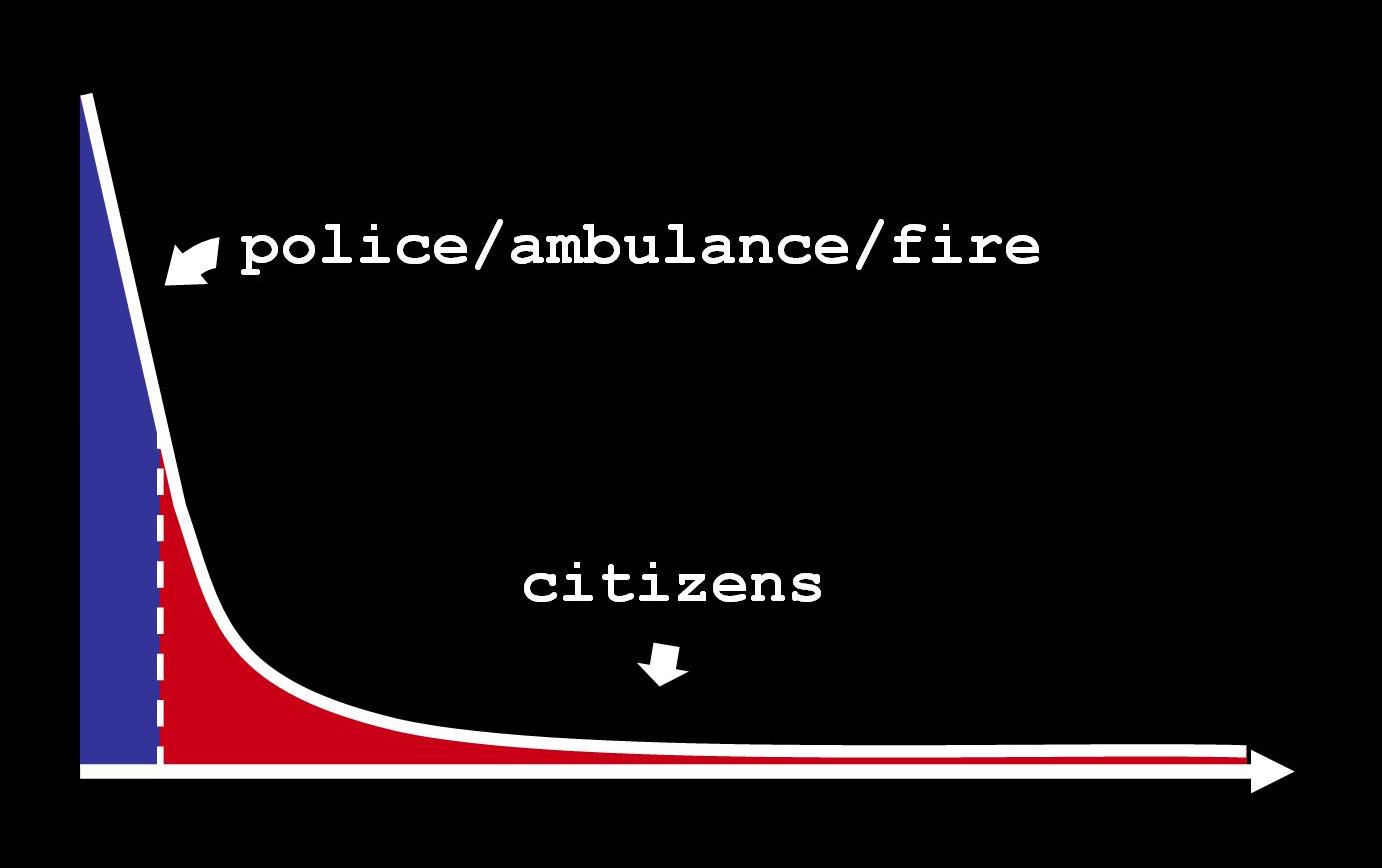
I’ve visualized in this slide below (explanation below the fold)

long tail public policy

Imagine the white curve represents all of the police, fire and ambulance interventions in a city. Many of the most critical interventions are ones the police force and ambulance service determine themselves (shaded blue). For example, the police are involved in an investigation that results in a big arrest, or the ambulance parks outside an Eagles reunion concert knowing that some of the boomers in attendance will be “over-served” and will suffer a heart attack.

However, while investigations and predictable events may account for some police/fire/ambulatory actions (and possibly those that receive the most press attention) the vast majority of arrests, fire fights and medical interventions result from plain old 911 calls made by ordinary citizens (shaded red). True, many of these are false alarms, or are resolved with minimal effort (a fire extinguisher deals with the problem, or minor amount of drugs are confiscated but no arrests made). But the sheer quantity of these calls means that while the average quality may be low, they still account for the bulk of successful (however defined) interventions. Viewed in this light 911 is a knowledge aggregator, collecting knowledge from citizens to determine where police cars, fire trucks and ambulances need to go.

Thus to find a system that leverages citizens knowledge and is architected for participation we don’t need to invent something new – there are existing systems, like 911, that we can learn from.

With this in mind, two important lessons about 911 leap out at me:

1) It is a self-interested system: While many 911 callers are concerned citizens calling about someone else I suspect the majority of calls – and the most accurate calls – are initiated by those directly or immediately impacted by a situation. People who have been robbed, are suffering from a heart attack, or who have a fire in their kitchen are highly incented to call 911. Consequently, the system leverages our self interest, although it also allows for good Samaritans to contribute as well.

2) It is narrowly focused in its construct: 911 doesn’t ask callers or permit callers to talk about the nature of justice, the history of fire, or the research evidence supporting a given medical condition. It seeks a very narrow set of data points: the nature of the problem and its location. This is helpful to both emergency response officials and citizens. It limits the quantity of data for the former and helps minimize the demands on the latter.

These, I believe, are the secret ingredients to citizen engagement of the future. A passive type of engagement that seeks specific, painless information/preferences/knoweldge from citizens to augment or redistribute services more effectively.

It isn’t sexy, but it works. Indeed we have 20 years of evidence showing us how well it works with regards to one of our most important services.

The internet is messy, fun and imperfect, just like us

Last October 23rd David Weinberger gave the 2008 Bertha Bassam Lecture at the University of Toronto. I happened to be in Toronto but only found out about the lecture on the 24th. Fortunately Taylor pointed out that the lecture is online.

I’ve never met David Weinberger (his blog is here) but I hope to one day. I maintain his book – Small Pieces Loosely Joined – remains one of, if not the best book written about the internet and society. Everything is Miscellaneous is a fantastic read as well.

The Bertha Bassam lecture is classic Weinberger: smart, accessible, argumentative and fun. But what I love most about Weinberger is how he constantly reminds us that the internet is us…  and that, as a result, it is profoundly human: messy, fun, argumentative, and above all imperfect. Indeed, the point is so beautifully made in this lecture I felt a little emotional listening to it.

Contrast that to the experience of listening to someone like Andrew Keen, a Weinberger critic who this lecture again throws into stark relief. After reflecting on Weinberger, Keen dislikes the internet and web 2.0 mostly because I think he dislikes people. It may sound harsh but if you ever hear him speak – or even read his writing – it is smart, argumentative and interesting, but it oozes with an anger and condescension that is definitely contemptuous and sometimes even borders on hatred. If the debate is reduced to whether or not we should, however imperfectly, try to connect to and learn from one another or whether we should just hold others in contempt, I think Weinberger is going to win every time. At least, I know where I stand.

Indeed, this blog is a triumph of Weinberger’s internet humanism. It is a small effort to write, to share, and to celebrate the complexity and opportunity of the world with those I know and those I don’t, but who share a similar sense of possibility. Will millions read this blog. No. But I enjoy the connections, old and new, I make with the much more modest number of people who do.

I hope you’ll watch this lecture or, if you haven’t the time, download the audio to your ipod and listen to it during your commute home. (lacking the slides won’t have a big impact)