Tag Archives: public policy

Getting Political Parties to think about Open Government/Data

Next week the Liberals will be hosting a “Thinkers Conference” in Montreal. In preparation for the event the party has been hosting articles outlining ideas for Canada’s 150th anniversary. Because of my work around open government and open data they asked if I would pen a piece on the subject for them.

I agreed.

The odds of getting open data increase dramatically if politicians get behind the initiative (it certainly helped a great deal here in Vancouver with both the Mayor and Councilor Reimer being vocal advocates). So, since they asked, I wrote.

You can read the piece here (et, en francais, ici). More importantly, if you have a moment, please consider leaving a comment under the piece. Political parties react to what voters and citizens say matters – so having a number of people react to the piece would send a message that citizens want better, more open government, as well as a strategy for building a 21st century economy.

Also, my piece from yesterday ended up in the Globe in case you missed it.

YouTube Interviews: Strengths and Weaknesses

I’m pretty much expecting to wake up today and read a number of stories about how the YouTube interview of the Prime Minister didn’t work, about how we should leave interviews to journalists, and that all this internet, audience driven stuff is a big waste of time.

I’m not sure I agree.

Was the interview good? It wasn’t amazing. But was it terrible? Definitely not. And not nearly as bad as some interviews with the Prime Minister that I’ve seen… So what worked and what didn’t work and what lessons can we draw from all this whether you live in Canada, the United States or wherever else in the world. What makes for a good crowdsourced interview?

Weaknesses:

Be careful of refocusing questions: Many of the Prime Minister’s responses were great. However, during some of the questions the Prime Minister reverted to some very well trodden talking points – or didn’t even answer the specific question asked. For example the question on mandatory minimum sentences he spoke of the Canadians say they want, not what, as the question stipulated, the research shows and the question of Marijuana become about drugs writ large – not about cannabis specifically. This is, of course, standard practice among politicians when answering reporters questions. The challenge is, that if these types of forums become popular and are watched by a number of people, it is unclear how favourable people will view a politician who avoids – however delicately or lightly – a question posed by a citizen. Maybe this medium changes nothing – but I again agree with Ivor Tossell and many others have to say:

Succeeding with social media comes down to being honest, having a frank, unfiltered voice and letting personality go along with policy.

Re-directing questions does not qualify. The public recognizes that journalists are not politicians friends and so give politicians more license when dealing with them – not so when dealing with a smart clear question from a fellow citizen.

Follow Up Questions: This of course raises the formats main weakness. There are no follow up questions allowed. So when someone evades or redirects a question there is no way to hold them to account. This doesn’t mean accountability and credibility disappear. Again, as I noted on Monday, its simply shifts onto the shoulders of the interviewee. You must now genuinely engage the question as the question asker intended. If not, I suspect you come out looking worse.

Pick your interviewer carefully. Here in Canada, Google elected to use their CFO Patrick Pichette (and ex-expatriate Canadian). I’ve only met him once at a small lunch in Montreal but I have a lot of time for him. He immediately struck meas insightful, quick and deeply intelligent. I’m also not sure he was the right choice for interviewer. Throughout the interview he is heard making sounds of agreement with the Prime Minister (such as saying “that’s terrific” after an answer) as though affirming the answer. This felt outside his role and prevented the questions from being as pointed as I believe the authors wished they would have been. All in all, the feel was less of an interview than of a friendly conversation.

Strengths:

Ask the most voted questions: Sadly, the couldn’t find a way to see the questions or how many votes they had received (#fail on google’s part there – accountability denied), but I did recognize many of the questions asked and am doubly impressed that a question on marijuana. In short, if you make a contract with the audience – eg you are going to ask the questions with the most votes… you’d better do it. I also thought many of the questions asked were quite good. Focus on the budget, Afghanistan, Foreign Aid (two foreign policy questions! two more than the last election debate in this country!), pensions, the carbon emissions policy… a good mix. Wish I knew if they were actually the questions with the most votes though…

Broadly people ask good question/but could do with some advice: Many of the questions were reasonable tough and well put. Some were a little long, and others had too many caveats that allow the interviewee to latch on to and avoid the main thrust of the inquiry. Might be good to model a good question to viewers in terms of focus and length as well as provide some written advice. I actually enjoyed seeing people ask questions and think the process could be stronger still.

Video Questions are better than read questions: Lesson for the audience. Submit your question via video. Better still, if you live in a bilingual country, try to subtitle it (Wouldn’t that be a cool thing to be able to do). The video questions really allowed the medium to show itself off, far more interesting to see a young women asking a question from her kitchen than to have an interview read it…

(Advice) Share each answer as a small video: If you really want citizens talking about issues, Google should share the entire interview, but also each individual question and answer. That way there can be questions specific comments on the YouTube site, people can blog about a specific question that concerned them and show only that question in the post, or people can simply zero in on the issue they care about most. The whole point of the internet is that information can be moved around easily – so if you are doing an interview… make it easy for your audience to share the part they cared about by making it digestable.

Be Real: The Prime Minister shone best when he was at his most conversational and relaxed. Indeed, this in part came through during the Marijuana question – his response was emotionally fantastic, he seemed genuinely concerned and possibly even off his speaking points a bit (or maybe just smooth enough to fool me, but I suspect not). Even though I found he answer infuriating – he seemed to completely forget all the lessons of prohibition (and, in effect, label every beer brewer in the country a scumbag) – he was at least human. And that’s when social media works best, when we get to see people being human. Otherwise, you just look wooden and, frankly, uninteresting.

Interview on the State of Open Gov and Gov 2.0 on O'Reilly Radar

At the moment I’m at the mid-point of an epic 8 city, two and a half week tour de force (Vancouver-Chicago-Ottawa-Edmonton-Toronto-New York City-Toronto-Austin-Indianapolis-Vancouver) with talks happening at most stops (I’ve three today).

As some of you already know, one of today’s talk is part of the online Gov 2.0 International Conference being hosted by O’Reilly Media. Last count I heard was that over 600 people had registered, so hopefully there will be a good turn out over the intertubes. It is free to attend so click on the link about to check it out.

As part of the lead up to the event I did the following interview on O’Reilly Radar, talking about where Canada is in terms of Open Government and Gov 2.0 as well as touching on some of the themes raised in my chapter “After the Collapse” that O’Reilly published in their recently released book: Open Government: Collaboration, Transparency, and Participation in Practice. Interviews like this are fun as they push my thinking – I hope you find it interesting.

On a related but separate note – C-FAX radio personality Murray Langdon interviewed me about my Globe and Mail GCPEDIA article. If you are in Victoria this morning you should be able to catch it.

Open Gov West – Seattle March 26 & 27

For westcoasters interested in and thinking about open government and open data there will be a conference in the pacific northwest bringing together key actors in the area.

Called OpenGovWest will be taking place on March 26th and 27th. A number of interesting people will be in speaking and in attendance include Andrew Hoppin (New York State Senate’s CIO), Sabra Schneider (Webmaster, King County), Bill Schrier(CIO of Seattle) and David Hume, Executive Director, (Citizen Engagement).

There is also, at the moment, an early bird registration that last until March 10th with the discount code of 7gh9.

The conference will be taking place at Seattle City Hall (and will be the first time City Hall chambers will be used to host a conference – it is a beautiful room, which is a bonus…

Some other info for open data and open gov geeks like me…

  • You can follow the conference on Twitter @opengovwest
  • The conference hashtag is #ogw
  • Sponsors who are interested can find out more about sponsoring here.
  • Again, you can register here.

It is great to see a conference of this nature coming to the west coast. Big kudos to Sarah Schacht, the Director of Knowledge As Power, who has made this conference happen.

Gov 2.0 International: Global Innovation Meeting Local Challenges

Next week I’ll be speaking at Gov 2.0 International, an online conference being hosted by O’Reilly Media.

The conference will be running from noon-2:15 EST with an agenda I’ve copy and pasted from their website (might as well admit it!). The conference is free (hard to beat) but you’ll still need to register, which you can do here.

Agenda

Joel Whitaker

Beyond Borders: Improving Global Diplomacy and Citizen Empowerment with Gov 2.0 Speaker: Joel Whitaker, U.S. Institute of Peace

Joel Whitaker is Senior Advisor to the new Center of Innovation for Science, Technology and Peacebuilding at the US Institute of Peace in Washington, DC. Current projects include peace-gaming and simulations, climate change and conflict, mapping the Middle East blogosphere, science diplomacy in Iraq and Afghanistan, online media in Iraq, and mobile communication tools for conflict-zone NGOs.

David Eaves

Open Government in Canada Speaker: David Eaves, Centre for the Study of Democracy

In this overview of the state of open government in Canada, David will outline where there have been successes and where there have been challenges. He’ll explain why this is the case and what it could mean for other jurisdictions.

Yaron Gamburg

Israel Gov 2.0: from Awareness to Implementation Speaker: Yaron Gamburg, Israel Ministry of Foreign Affairs

Gov 2.0 in Israel is still in its initial stage. There are many initiatives in different agencies, primarily in the central government. However, these initiatives are bottom-up developments, and we need strong sponsors at the senior level of the government to make a significant change.

Dominic Campbell

U.K. Innovations in Gov 2.0 Speaker: Dominic Campbell, FutureGov

This talk will look at Britain’s contribution to the Gov20 agenda, where it started from, who led it and why it took the election of Barack Obama 3000 miles away to spur the government into action.

Program subject to refinement. All talks are 30 minutes, with a 15 minute break at US-PST: 10:00am (US-EST: 1:00pm).

The entire conference will be recorded and made available to attendees free of charge afterwards.

The PM’s Advisory Committee on the Public Service: The Good, The Bad, The Hopeful

On February 25th Paul Tellier and David Emerson – two men whose understanding of Ottawa I have a tremendous amount of respect for – released The Fourth Report of the Prime Minister’s Advisory Committee on the Public Service. It is a document that is worth diving into as these reports will likely serve as reference points for (re)thinking on renewing government for the foreseeable future.

The Bad:

On the rough side, I have a single high-level comment: These reports are likely to be as close as we are going to get in Canada to Australia’s Government 2.0 Taskforce (on which I served as part of the international reference group) or Britain’s Cabinet Office Power of Information Taskforce Report (which would have been tremendous to have been involved in).

To be clear, this is not the fault of the committee. Its terms of reference appear to be much broader. This has to predictable consequences. First, relatively little time is dedicated to the general reorganizing of society being prompted by the now 40 year old internet revolution is only carving out a small role. The committee is thus not able to dive into any detail on how the changing role of information in society, on open data, on the power of self-organization, or the rising power and influence of social media could and should re-shape the public service.

Second, much more time is dedicated to thinking about problems around HR and pay. These are important issues. However, since the vision of the public service remains broadly unchanged, my sense is the reforms, while sometimes large, are ultimately tweaks designed to ensure the continuation of the current model – not prompting a rethink (or the laying of groundwork) for a 21st century public service which will ultimately have to look different to stay relevant.

The best example of the implications of this limited scope can be found under the section “Staying Relevant and Connected.” Here the report has two recommendations, including:

The Public Service must take full advantage of collaborative technologies to facilitate interaction with citizens, partners and stakeholders.

The Public Service should adopt a structured approach to tapping into broad-based external expertise. This includes collaboration and exchanges with universities, social policy organizations, think tanks, other levels of government and jurisdictions, private sector organizations and citizens.

These are good! They are also pretty vague and tame. This isn’t so much renewal as it is a baseline for a functioning 20th century public service. More importantly, given some of the other pieces in the report these appear to be recommendations about how the government can engage in pretty traditional manners (exchanges). Moreover, they are externally focused. The main problem with the public service is that its members aren’t even allowed to use collaborative technologies to interact among themselves so how can they possible be ask to collaborate externally? As I say in my OCAD lecture and my chapter in Open Government: Collaboration, Transparency, and Participation in Practice – a digital citizenry isn’t interested in talking to an analogue government. The change required is first and foremost internal. But advocating for such a change is a major effort – one that will require significant culture and process change – which I haven’t found so far in the report and which is probably beyond its scope.

The Good:

That said, when the report does talk about technology and/or collaboration – it broadly says the right things. For example, in the section Creating A Modern, Enabled Workplace the report says:

creating a workplace that will attract, retain and empower public servants to innovate, collaborate and be responsive to the public. Among other things, this must include the adoption of collaborative technologies that are increasingly widespread in other sectors.

And, perhaps more importantly, under the section Strengthening Policy Capacity: A Relevant and Connected Public Service the report states:

A public service operating in isolation runs the risk of becoming irrelevant. We believe that the quality of policy thinking must be enhanced by additional perspectives from citizens, stakeholders and experts from other jurisdictions and other sectors (e.g. business, academia, non-governmental organizations). We believe sound government policy should be shaped by a full range of perspectives, and policy makers must consistently reach beyond the National Capital Region for input and advice.

Furthermore, the Public Service now has an opportunity to engage Canadians, especially younger ones, through the use of Web 2.0 collaborative technologies such as wikis, blogs and social networking. These offer an excellent way for the Public Service to reach out and connect.

Again, great stuff. Although, my concerns from above should also be reiterated. A networked public service is one that will need new norms as it will function very differently. The task force has little to say about this (again because of their expansive purview and not through their own fault). But this issue must be addressed in full. I frequently argue that one reason public servants are so stressed is that they live double lives. They already live in a networked workplace and play by network rules in order to get their job done, however, they are perpetually told they live in a hierarchy and have to pretend they abide by that more traditional rule set. Double lives are always stressful…

The Hope:

As the committee moves forward it says it will:

…consider and advise on new business models for the Public Service with a view to creating an innovative and productive workforce that continues to deliver increasing value for money by taking advantage of new tools and technology;

I hope that open data, open systems and some of the ideas around a network government I’ve been advocating and talking about along with numerous others, get in front of the committee – these all represent building blocks for a significantly more flexible, innovative and product public service.

Canada’s Three Tiered Healthcare System

Thanks to Premier Danny Williams’ comments, we are in another short bout of collective denial and misunderstanding of Canada’s healthcare system and the public perception thereof.

1. Denial.

For those not in the know, Premier Williams recently jaunted down to Miami for heart surgery. In his interview with NTV reporter Fred Hutton, he stated, “This is my heart. It’s my health and it’s my choice.” True. It is a choice. If you can afford it.

It’s also a wonderful reflection of the fact that despite all the mythology awe, in Canada, actually have a three-tiered healthcare system. Williams enjoys the benefit of tier three – travel to the US. It’s a choice that many, many wealthy Canadians make. Indeed, it’s a choice other wealthy politicians have made, including former Quebec premier Robert Bourassa and former MP Belinda Stronach. I’m willing to bet that the Mayo Clinic has made a lot of money off wealthy Canadians.

Of course, this effect is largely ignored since most Canadians can’t afford to go to the US. So we pretend it doesn’t happen. Indeed, the 1998 Katz paper, a frequently cited paper that claims Canadians don’t travel to the US for healthcare, strikes me as deeply misleading. As the study states:

An important limitation of this study is that only public out-of-country expenditures are included in the analysis; private sources of funding, including “travel” health insurance plans and out-of-pocket payments, are omitted.

This of course doesn’t prevent them from drawing some very strong conclusions, namely that Canadians don’t go to the US for healthcare. In some ways they are right, average Canadians don’t, but what did you expect if the  study only looks at people who used Ontario public insurance – in short, those who couldn’t afford to travel to the US and pay privately…

Then of course, there is the more familiar second tier. This is private healthcare available here in Canada. Don’t be fooled, there is plenty of private healthcare in Canada. Indeed, at least 30% of healthcare spending in Canada is from private funds. This includes simple things like your glasses and dental costs, as well as the more complex, such as clinics that conduct surgery in Quebec (which the Feds don’t dare close) to those in British Columbia (which most people pretend don’t exist). These service upper middle class Canadians and, ironically, provincial Workers Compensation Boards which are not bound by the Canada Health Act and so can pay to have their patients serviced by private clinics in Canada. Irony!

Finally, there is familiar tier one — the public system that most of us avail ourselves of. (Which still has a huge private component – all those doctor offices are private businesses…) The system generally works, but often has too few doctors (try finding a GP – 4.5 Million of us haven’t!), long wait lines in Emergency Rooms (often hours long) and waiting lists for some procedures (don’t break your hip).

This is the reality of healthcare in Canada. Yes, we have universal healthcare. But it is within a three-tiered system and the wealthy – like Danny Williams – opted out a long, long time ago.

2. (Mis)perceptions of Canadian (Mis)perceptions

Of course, many Canadians know that the wealthy go elsewhere. They even know that their healthcare system is either groaning or breaking (try being on a waiting list) or financially unsustainable (try living in a province where healthcare eats up 45% of the budget and rising). Moreover, they know more money isn’t going to magically solve it (or at least not the amount of money we can afford). Did anyone really believe that $41 billion over 10 years would “save healthcare for a generation?”

(As an aside, I suspect this is why Canadians reject the Liberals’ National Daycare Program – many people agree daycare is good and important but they remain suspicious of a system that is likely to become as top-down, hard to contain and even more difficult to reform/evolve as Healthcare. In short, they don’t wanted it modeled after I system they already think is borked.)

But the story isn’t that Canadians want either the status quo or the American option. Although Canadians recognize our system has huge challenges, most of us agree the American system is far, far worse, particularly for the vast majority of us who can’t afford to fly down there to begin with. Far better to stick with the devil we know, than the bogey man to the south. The fact is… better the system you know and hate, then the one you don’t know and hate even more.

Ultimately, both the Canadian and the American models are likely done. Neither country can afford to manage double digit (or even high single digit) increases in healthcare costs. Somewhere, something has to give. But we’ll have to experience a lot more pain (and denial about how great our system is) before we get there. What I suspect is true is that the wealthy and privileged stopped caring a long time ago. They aren’t invested in the system because – residing in the third tier – they are outside of it.

Open Government – New Book from O'Reilly Media

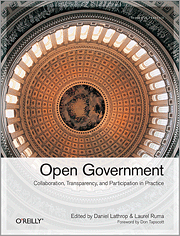
I’m very excited to share I have a chapter in the new O’Reilly Media book Open Government (US Link & CDN Link). I’ve just been told that the book has just come back from the printers and can now be ordered.

Also exciting is that a sample of the book (pictured left) that includes the first 8 chapters can be downloaded as a PDF for free.

The book includes several people and authors I’m excited to be in the company of, including: Tim O’Reilly, Carl Malamud, Ellen Miller, Micah Sifry, Archon Fung and David Weil. My chapter – number 12 – is titled “After the Collapse,” a reference to the Coasean collapse Shirky talks about in Here Comes Everybody. It explores what is beginning to happen (and what is to come) to government and civil services when transaction and coordination costs for doing work dramatically lower. I’ve packed a lot into it, so it is pretty rich with my thinking, and I’m pleased with the result.

If you care about the future of government as well as the radical and amazing possibilities being opened up by new technologies, processes and thinking, then I hope you’ll pick up a copy. I’m not getting paid for it; instead, a majority of the royalties go to the non-profit Global Integrity.

Also, the O’Reilly people are trying to work out a discount for government employees. We all would like the ideas and thinking in this book to go wide and far and around the globe.

Finally, I’d like to give a big thank you to the editors Laurel Ruma and Daniel Lathrop, along with Sarah Schacht of Knowledge as Power, who made it possible for me to contribute.

Conservative Senator Talks Harm Reduction

First, for those who have not seen it Maxine Davis, Executive Director of the Dr. Peter Foundation has an important op-ed in the Vancouver Sun titled Attention Ottawa: Insite is a health care service.

More intriguing Safe Games 2010 and the Keeping the Door Open Society (which, for full disclosure, I sit on the board of) are hosting a panel discussion on harm reduction. One of the speakers will be Senator Pierre Claude Nolin, who sits as a Conservative and has been deeply supportive of harm reduction strategies generally and the four pillars strategy specifically here in Vancouver.

For those in Vancouver who are interested in the event – details below. Hope to see you there.

Keeping the Door Society and SafeGames 2010

invite you to attend

Global Insite – A panel discussion and public dialogue on Vancouver’s

innovative response to the international question of What to do About Drugs?

WHEN:

Friday 19th February 2010

7.00 pm – 9.00 pm; doors open 6.30 pm

WHERE:

Japanese Language Hall

487 Alexander Street @ Jackson Street / Vancouver

SPEAKERS

  • DR. ETHAN A. NADELMANN Executive Director, Drug Policy Alliance; New York
  • SENATOR PIERRE CLAUDE NOLIN, Senate of Canada; Ottawa
  • LIZ EVANS Executive Director, Portland Hotel Society; Vancouver
  • DONALD MACPHERSON Co-founder, Canadian Drug Policy Consortium; Vancouver
  • SHARON MESSAGE Past President, Vancouver Area Network of Drug Users; Vancouver
  • TARA LYONS Executive Director, Canadian Students for Sensible Drug Policy; Canada
  • GILLIAN MAXWELL (mc) Project Director, Keeping the Door Open Society, Vancouver

Please join us to hear a panel of experts discuss the Canadian Government’s recent announcement that it will continue its efforts to close down Insite – North America’s only legal supervised injection site.  We invite you to participate in the dialogue that will follow.

Canadian Foreign Policy: The War on Independent Thought

Two stories this week highlight Canada’s rapidly decaying capacity to think, engage and act on foreign policy issues. The first was the Globe’s story Canadian Aid Groups Told to Keep Quiet on Policy Issues, the second is Paul Well’s detailed and devastating account of the implosion of Rights and Democracy, an NGO run by the Federal Government which has seen its entire staff revolt in the face of the political efforts by government to reset its policies.

Both stories hint at a common pattern – that through bullying, funding decisions, appointments and any other means at its disposal – the conservative government is seeking to ensure that any voice in Canada that engages international issues aligns itself with the government’s opinion. In short, this Conservative government is seeking to recentralize Canadian foreign policy. It is an effort that cannot succeed, but in which the attempt will devastate Canada’s influence in the world and negatively impact our capacity to act on the global stage.

Why is this?

Because in the 21st century a country’s foreign policy capacity – especially a small country like Canada – does not spring solely from the size of one’s military and the influence of one’s diplomats. Rather, influence springs from the capacity to tackle and address – increasingly complex – problems. Military might and diplomats can be deeply important but they are increasingly a smaller piece of the puzzle. The real question is, how does a state marshal all the resources and talents at its disposal and focus them on a problem.

In the 19th century the answer was easier. Military might and diplomats were the only tools and so control over these tools – the capacity of a single person (the PM) or group (cabinet) to focus the energy of the state on a problem – was the essence of international influence. But today this is no longer the case. Many of the critical relationships, expertise for addressing problems, volunteering capacity and even funding, lie beyond the control of the state. More importantly, public opinion has become an essential part of any effort. In this world, where the state is only one of many actors, and is one that is frequently looked upon with skepticism, how does one marshal this network or foreign policy ecosystem and attempt to focus it on a problem?

This is the great challenge facing government’s everywhere (especially those of smaller countries where resources outside of government are essential).

The conservative response – outlined above by the Globe and Paul Wells – describes an effort to assert control over these non-state actors and opinion shapers. To bully them into line and force them to not only cooperate with but mimic the government’s priorities.

This strategy will not work.

Over the short term the talent in Canada’s foreign policy network will simply balk. The best will leave for other countries which will seek to engage them on policy, not declare war on independent thought. Today we risk the great “hallowing out” of our foreign policy capacity (and thus international influence) not because the quality of our diplomats or military will decline, but because the quality of our NGO sector will decline.

Moreover, this sector’s international influence depends on independence. Other states and public opinion more generally will not respect Canadian organizations that are seen as merely puppets of the Canadian government. Indeed, expect these types of organizations to see their influence wain to a point where they become insignificant on the international stage. In short, there will be fewer Canadian voices and they will all carry less weight.

Finally however, the ecosystem will adjust. Already many Canadian organizations that work and engage in international issues find it cumbersome to work with Government. People I speak with often eschew CIDA grants since the reporting mechanisms they come with are often more expensive to implement than the value of the grant. Now that Government money is linked with political interference and meddling, an increasing number of organizations will avoid engaging the Canadian government altogether. The result? A NGO sector that is actively hostile – or at best indifferent – to the government and a diminished capacity to coordinate action, research and policy across the Canadian foreign policy ecosystem.  In short, the Canadian government will have no more control over internationally focused resources, but it will have shrunk the country’s collective influence.

In a networked world you can’t control the network, you can only seek to influence it. This government’s actions are a case study in how to lose credibility and sacrifice capacity. If, however, they don’t want a Canada that engages in the world, perhaps, in their mind, it is all worth it.