Tag Archives: technology

My new mac – some thoughts for other PC users

As some of you know, I recently shifted from a PC to a Mac. It’s a big transition for me… I’ve used a PC all my life, so it is easy to say that I’m having a little (but not a ton) of culture shock.

I’ll be honest about the single best selling feature of the mac: Spotlight.

I do very few things on my computer. Mostly I write, I surf, and I email. A LOT of email. So first and foremost, having a computer where I can find my emails and documents easily is critical. When you’ve got over 70,000 emails you want to be able to search, well, neither Microsoft Outlook, any Windows desktop search engine I’ve ever seen, or even Google desktop (which essentially requires you to load a browser each time) is going to cut it.

I NEED to be able to find stuff quickly. Google has bred me with an expectation of instant results (not a slow churning solution). Maybe Windows 7 will get there, but I’ve given up waiting. My 5 year old thinkpad wasn’t going to last long enough for me to see.

Am I happy? Absolutely. One thing our Apple friends do well is design. I love the keyboard, the screen and pretty much everything physical about the machine. Moreover, the convergence of Mac & Windows software has made the transition relatively easy – I’d be frightened to think of how much time on my computer I spend on the browser, but it is a lot… so moving from Firefox to Firefox is pretty sweet.

That said, the transition hasn’t been perfect. There are several features on the Mac that have been frustrating, and even disappointing. For those thinking of making the leap I thought I let you know the rough parts; it shouldn’t dissuade you, just set some expectations that not everything in Macworld is peaches and cream. Of course, if some veteran users have solutions to these issues, I’ll be eternally grateful.

So here’s my list of 4 things I’d change on the Mac – some of these are so petty I’m almost embarrassed…

1. No “send to” email client option. One thing Windows has that I’ve not found on the Mac is the “Send To” folder. Drop any application in the Send To folder and when you right-click on a document you have the option of opening the document with that application. What I loved was being was being able to right-click on a document, send it to my email client and bingo! A new email was created with the document attached. Very productive and easy. Alas, no such luck in the Mac.

2. No “open container” option in spotlight. Yes, I love Spotlight AND… when the drop down menu is showing me a list of found items, why can’t I right-click on it and open the containing folder? Sometimes, I don’t know what document I’m looking for, but I do know it is co-located with a document I do know the title of… Just saying.

3. In Mail, you can’t drag an email to iCal to create an event. Best feature Outlook (and I presume Entourage) has that Mail and iCal don’t is the ability to turn an email into an event. I know that Mail has the funky – click on the date and it will create an event – but it rarely brings in the relevant information. In Outlook I simply dragged an email to the calendar and presto! I had an event in which the email contents were in the notes. That way I could easily copy all the relevant details and, had a ton of context I could quickly reference within my calendar.

4. Okay, so this one seems REALLY petty… but it strikes at something deeper, something important for PC users to know. I’m feeling a little annoyed that, in Mail, when I delete an email in my inbox the cursor always moves to the newer email regardless how the mail is sorted. In Outlook it always moved “down” (Which I had arranged to mean that it went to an older email). Small, I know, but it is driving me crazy when I’m dealing with my email. Of course, this is all part of what I understand to be a larger philosophical problem with Macs (and why I’ve never been an owner before) which is that the company is centered on the idea that it knows how you should use your computer better than you do… so customizing is limited. This is the biggest culture shift for PC users. Owning a Mac is like being in a gated community… its pretty and manicured, but you have to adhere to the community bylaws, or else…! Yes the Windows world has got serious medical issues (viruses), a generic corporate feel (Windows Themes) and a approach to planning that seems modeled after Houston (I say this with some affection) but you also had a lot more freedom to create trouble or solve things your way. At the moment, I’m welcoming my new overlord because it’s like my computer has been taken over by the Swiss! It’s efficient, but if I try to complain… well you get the point.

Pretty much everything else that I’m wrestling with. The way Alt-Tab works on the Mac or the fact that I can’t open press “command+F” to open the “File” menu are things that I know, in time, I’ll adjust to.

19th Century Net Neutrality (and what it means for the 21st Century)

So what do bits of data and coal locomotive have in common?

It turns out a lot.

In researching an article for a book I’ve discovered an interesting parallel between the two in regard to the issue of Net Neutrality. What is Net Neutrality? It is the idea that when you use the Internet, you do so free of restrictions. That any information you download gets treated the same as any other piece of information. This means that your Internet service provider (say Rogers, Shaw or Bell) can’t choose to provide you with certain content faster than other content (or worse, simply block you from accessing certain content altogether).

Normally the issue of Net Neutrality gets cast in precisely those terms – do bits of data flowing through fibre optic and copper cables get treated the same, regardless of whose computer they are coming from and whose computer they are going to. We often like to think these types of challenges are new, and unique, but one thing I love about being a student of history, is that there are almost always interesting earlier examples to any problem.

Take the late 19th and early 20th century. Although the term would have been foreign to them, Net Neutrality was a raging issue, but not in regard to the telegraph cables of the day.  No, it was an issue in regards to railway networks.

In 1903 the United States Congress passed the Elkins Act. The Act forbade railway companies from offering, and railway customers from demanding, preferential rates for certain types of goods. Any “good” that moved over the (railway) network had to be priced and treated the same as any other “good.” In short, the (railway) network had to be neutral and price similar goods equally. What is interesting is that many railway companies welcomed the act because some trusts (corporations) paid the standard rail rate but would then demand that the railroad company give them rebates.

What’s interesting to me is that

a) Net Neutrality was a problem back in the late 19th and early 20th century; and

b) Government regulation was seen as an effective solution to ensuring a transparent and fair market place on these networks

The question we have to ask ourselves is, do we want to ensure that the 21st century (fibre optic) networks will foster economic growth, create jobs and improve productivity in much the same way the 19th and 20th century (railway) networks did for that era? If the answer is yes, we’d be wise to look back and see how those networks were managed effectively and poorly.  The Elkins Act is an interesting starting point, as it represented progressives efforts to ensure transparency and equality of opportunity in the marketplace so that it could function as an effective platform for commerce.

Open Data – USA vs. Canada

open-data-300x224When it comes to Open Data in Canada and the United States, things appear to be similar. Both countries have several municipalities with Open Data portals: Washington, D.C., San Francisco, and now New York City in the US, Vancouver and Nanaimo in Canada with Toronto, Edmonton, Calgary and Ottawa thinking about or initiating plans.

But the similarities end there. In particular there is a real, yawning gap at the federal level. America has data.gov but here in Canada there is no movement on the Open Data front. There are some open data sets, but nothing comprehensive, and nothing that follows is dedicated to following the three laws of open data. No data.gc.ca in the works. Not even a discussion. Why is that?

As esoteric as it may sound, I believe the root of the issues lies in the country’s differing political philosophies. Let me explain.

It is important to remember that the United States was founded on the notion of popular sovereignty. As such its sovereignty lies with the people, or as Wikipedia nicely puts it:

The American Revolution marked a departure in the concept of popular sovereignty as it had been discussed and employed in the European historical context. With their Revolution, Americans substituted the sovereignty in the person of the English king, George III, with a collective sovereign—composed of the people. Henceforth, American revolutionaries by and large agreed and were committed to the principle that governments were legitimate only if they rested on popular sovereignty – that is, the sovereignty of the people. (italics are mine)

Thus data created by the US government is, quite literally, the people’s data. Yes, nothing legally prevents the US government from charging for information and data but the country’s organizing philosophy empowers citizens to stand up and say – this is our data, we’d like it please. In the United States the burden is on the government to explain why it is withholding that which the people own (a tradition that admittedly is hardly perfect as anyone alive from the years 2000-2008 will attest to).  But don’t underestimate the power of this norm. Its manifestations are everywhere, such as in the legal requirement that any document created by the United States government be published in the public domain (e.g. it cannot have any copyright restrictions placed on it) or in America’s vastly superior Freedom of Information laws.

This is very different notion of sovereignty than exists in Canada. This country never deviated from the European context described above. Sovereignty in Canada does not lie with the people, indeed, it resides in King George the III’s descendant, the present day Queen of England. The government’s data isn’t your, mine, or “our” data. It’s hers. Which means it is at her discretion, or more specifically, the discretion of her government servants, to decide when and if it should be shared. This is the (radically different) context under which our government (both the political and public service), and its expectations around disclosure, have evolved. As an example, note that government documents in Canada are not public domain, they are published under a Crown Copyright that, while less restrictive than copyright, nonetheless constrains reuse (no satire allowed!) and is a constant reminder of the fact that Canadian citizens don’t own what their tax dollars create. The Queen does.

The second reason why open data has a harder time taking root in Canada is because of the structure of our government. In America, new projects are easier to kick start because the executive welds greater control over the public service. The Open Data initiative that started in Washington, D.C. spread quickly to the White House because its champion and mastermind, the District’s of Columbia’s CTO Vivek Kundra, was appointed Federal CIO by President Obama. Yes, Open Data tapped into an instinctual reflex to disclose that (I believe) is stronger down south than here, but it was executed because America’s executive branch is able to appoint officials much deeper into government (for those who care, in Canada Deputy Ministers are often appointed, but in the United States appointments go much deeper, down into the Assistant Deputy and even into the Director General level). Both systems have merits, and this is not a critic of Canada’s approach, simply an observation. However, it does mean that a new priority, like open data, can be acted upon quickly and decisively in the US. (For more on these difference I recommend reading John Ibbitson’s book Open & Shut).

These difference have several powerful implications for open data in Canada.

As a first principle, if Canadians care about open data we will need to begin fostering norms in our government, among ourselves, and in our politicians, that support the idea that what our government creates (especially in terms of research and data) is ours and that we should not only have unfettered access to it, but the right to analyze and repurpose it. The point here isn’t just that this is a right, but that open data enhances democracy, increases participation and civic engagement and strengthens our economy. Enhancing this norm is a significant national challenge, one that will take years to succeed. But instilling it into the culture of our public service, our civic discourse and our political process is essential. In the end, we have to ask ourselves – in a way our American counterparts aren’t likely to (but need to) – do we want an open country?

This means that secondly, Canadians are going to have to engage in a level of education of – particularly senior – public servants on open data that is much broader and more comprehensive than our American counterparts had to. In the US, an executive fiat and appointment has so far smoothed the implementation of open data solutions. That will likely not work here. We have many, many, many allies in the public service who believe in open data (and who understand it is integral to public service sector renewal). The key is to spread that knowledge and support upwards, to educate senior decision-makers, especially those at the DG, ADM and DM level to whom both the technology and concept is essentially foreign. It is critical that these decision-makers become comfortable with and understand the benefits of open data quickly. If not we are unlikely to keep pace with (or even follow) our American counterparts, something, I believe is essential for our government and economy.

Second, Canadians are going to have to mobilize to push for open data as a political issue. Even if senior public servants get comfortable with the idea, it is unlikely there will be action unless politicians understand that Canadians want both greater transparency and the opportunity to build new services and applications on government data.

(I’d also argue that another reason why Open Data has taken root in the US more quickly than here is the nature of its economy. As a country that thrives on services and high tech, open data is the basic ingredient that helps drive growth and innovation. Consequently, there is increasing corporate support for open data. Canada, in contrast, with its emphasis on natural resources, does not have a corporate culture that recognizes these benefits as readily.)

Today: "right to know" panel for parliamentarians

Today from 10am-12am EST I’ll be a panelist for Conference for Parliamentarians: Transparency in the Digital Era a panel convened by the Office of the Information Commissioner as part of Right to Know Week. Apparently the Canadian School of Public Service will provide access to this conference as part of its Armchair Discussions (www.righttoknow.ca).

More on the panel:

This conference aims to engage Parliamentarians in a debate and reflection on the new paradigm that the digital world has introduced for the right to know. Greater transparency in the digital era requires more than sound information management and the use of state-of-the-art information technology. It calls for a fundamental change of attitudes from disclosing information on a need-to-know basis to managing information with the presumption of disclosure as the default mode. How can public institutions trigger and accelerate this change of attitudes for the benefit of Canadians?

For those who are interested you can see my slides (sans audio, I’m afraid) below.

Mapping Government 2.0 against the Hype Curve

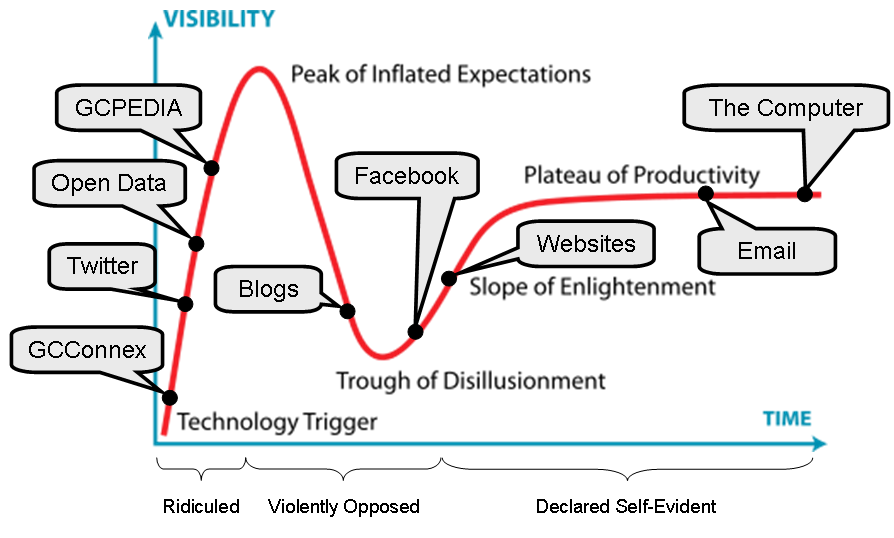
Last week Andrea DiMaio wrote an interesting post on how Government 2.0 may be approaching the peak of the hype cycle. I’d never seen the hype cycle before and it looked fun, so I thought it might be interesting to try to map where I believe some current Canadian government 2.0 projects, a few older technologies, and a few web 2.0 technologies in general, are against this chart from a government perspective.

My suspicion is that we haven’t even begun to dip into the Trough of Disillusionment with most true Web 2.0 government projects (GCPEDIA & GCConnex). However, I think governments have overcome their paranoia about facebook, but are still very wary… that said I’ve noticed some government ministries have started to use facebook as a communication tool with the public. Blogs however (which are perfectly okay for public servants to create internally) are still viewed with suspicion – internally they are almost never used. But then, heck, given the cluttered nature of most government website (and the fact that finding info is hard), I think it is clear that we are still working our way up the “Slope of Enlightenment” on this web 1.0 technology.

Gov 20 hype curve 3

Those who’ve seen me speak know I much I love Arthur Schopenhauer‘s three stages of truth:

“All truth passes through three stages. First, it is ridiculed. Second, it is violently opposed. Third, it is accepted as being self-evident.”

So I’ve also included how I think the three stages map against this chart too.

So in sum… in  my view there is good news for Government 2.0 projects – visibility is still increasing. Unfortunately there is also some bad news: prepare for increased violent opposition…

Misunderstanding and understanding the Open Data Hype

On Wednesday Gartner’s Andrea Dimaio wrote an interesting blog post entitled Open Data and Application Contests: Government 2.0 at the Peak of Inflated Expectations which Peter Smith nicely linked to the Gartner’s Hype Cycle graph from Wikipedia. I want to break his post down into three components. Two – the bad and the good, I’m going to talk about today – the third, which I’ll tackle on Monday involves some mapping and fun.

The Bad

As someone whose been thinking about and working on Open Data and Gov 2.0 for several years now three things struck me as problematic about Andrea’s post. Firstly, he misunderstands the point of open data. While many people – self-included- talk about how it can empower citizens, citizens will not be its primary beneficiary. The biggest user of open data portals is going to be government employees. Indeed, Tim Wilson reminded me the other day of our conversation with Jason Birch, the thought leader who made much of Nanaimo’s geo-data public, where he talked about how he wasn’t actually tasked with sharing data publicly – he was tasked with making the data available to other Nanaimo city employees. Sharing it with citizens was a (relatively) cost free addition. These projects aren’t about serving some techo-literati, it is about getting a city to first and foremost talk to itself – having it talk to its citizens is an important (and democracy expanding) benefit.

Second, was this unfortunate anecdote:

Yesterday I was discussing with a British client over lunch and he told me how the publication of data may lead to requests for more data (through the Freedom of Information Act), in a never-ending cycle of information gathering which is likely to cost a lot to both government and taxpayers. Another client observed (as I said in a previous post) that there is no way people will be able to tell to what extent a mash up on an application actually uses official, trusted government data.

Could government become swamped with data requests? Who knows, but in theory… it shouldn’t. Making data available should reduce the amount of time public servants spend responding to requests by diverting requests to open data portals. But let’s say Andrea’s concerns are valid and that, as a result of open data, citizens become more actively concerned and interested in how government works and thus Freedom of Information Act requests increase. The horror… citizens are interested in government! Citizens want to know how decisions are made! Remind me again… why is this a problem?

The real problem here isn’t access to data, it’s that the Freedom of Information Act process is itself broken. If open data creates a further demand for more transparent government and pushes us to foster better mechanisms for sharing government information, this is a good consequence. As for concerns that people might misrepresent public data, well a) people can already do this and we haven’t had a rash of bad applications, but even if they tried… people will stop using their service pretty quick.

Finally, another nice thing about public data is that it tends to get very clean, very quickly. My concern isn’t that government data will be misrepresented… I’m concerned that government data is already wrong and isn’t being verified. Knowing that someone might actually look at a data set is one of the most powerful incentives for organization to improve its collection. (Something Clay Shirky noted in a talk he made the other day at a Bioinformatics conference I’m at).

(There is of course, one group who may not see these a good consequences as it will change how they work: British public servant like Andrea’s client’s who raised the objections… but then they pay Gartner’s bills, not you.)

The Good

The end of Andrea Dimiao’s piece is where we find common ground. I agree that the Apps for Democracy competitions run the risk of limiting the definition of “the public” to citizen coders.  We want broader participation – particularly once more complex data sets like budgets, procurement and crime data are released – from academics, citizens groups and NGOs. Here in Vancouver we’ve talked about focusing any Apps competition on the themes of homelessness, housing and the environment, since these have been the dominant concerns of citizens in recent years.

More importantly, I agree (and love) Dimiao’s concept of employee-centric government. Indeed, my chapter for Tim O’Reilly’s upcoming book on Open Government makes a parallel argument, that namely we should stop trying to teach an analogue government to talk to a digital public and instead focus on making government digital (ie. getting it “open,” networked and using web 2.0 internally) first.

And perhaps most importantly, I agree that government 2.0 risks being over-hyped. I still believe in the potential, but know that getting there is going to be a painful process (mind the gap!). Government 2.0 advocates should expect lots of resistance and adoption problems ahead – but then change is painful.

How bloggers can keep the internet healthy

I’m continuously trying to brainstorming ways that Mozilla can find the next million mozillians and figure out activities they can do. I think I’ve stumbled on to a new one but would need some help to make it happen.

As some of you may know, as part of Mozilla Service Week Mozillians around the world donated their time and helped perform numerous Internet Health Checks. The goal here is to help people migrate off of Internet Explorer 6 (which is vulnerable to attacks and therefor makes the web less safe).

In my case, I’d already helped move pretty much anyone I know who uses IE 6 to something newer and better. What I need is a way to help prod people I don’t know.

What I thought might be interesting is if someone could build a blogger & wordpress plugin. This plug would ascertain what browser a visitor to your blog is using and… if they are using IE6… then the blog widget would let the reader know that the author of the blog strongly encourages them to upgrade to IE8, Firefox, Safari or really anything newer and safer. With this (hopefully relatively simple plug-in) Mozilla can engage the blogging community, enable people to help advocate for a safer internet and, most importantly, encourage still more IE6 users to move to something newer and safer.

Yes, it isn’t the be all and end all, but its another small idea that allows another group of people to contribute is an easy, but tangible and important way. That said, if this widget can’t be created, or if there is something easier/better that can be done, please, send me an email or comment below!

More ways to make open data sexy: 5 Municipal Apps I'd love to see (what are yours?)

One of the big goals of the open data project is to get many citizens interested in different ways the data can be used. Many citizens lack the skills to code up an application and creating a website is intimidating, but they may have ideas that could improve the city or be useful to many citizens.

In the hopes of spurring more interest in the open data and getting those not tradition involved, well… involved, I’ve created an “Ideas for the Taking” page on the Vancouver Open Data wiki. I’ve seeded the page with some of the ideas I promised I would share at the Open Data Hackathon last week . Some use open data, others don’t. Mostly however, I hop they spurn others to think of what is possible and what interests them. (PS. If you are a reader and the wiki is too confusing, just email me your idea and I’ll add it to the wiki with (or without, if you prefer) you’re name attached.

So here are some ideas I’ve brainstormed:

1. Stolen Bike Tracker

Vancouver’s cycling community is huge, sadly however, the city is plagued by a serious problem: stolen bicycles. There is no solution to this problem but I think a well crafted app could help minimize the nuisance. I can imagine an app or website in which you take a photo of your bike and upload it along with some identifying information(like the serial number) to a website. The picture stays hidden, however, if your bike gets tragically stolen you load up the apps and press the “my bike was stolen button.” This marks the physical place where your bike was stolen and activates your bike photo and marks it as stolen. Now cyclists, bike shop owners and the police can check bikes to see if they are stolen before buying them (or return them to their owner if they are recovered). In addition, a street map of bike theft would also be created. This could be particularly relevant since I suspect a great deal of bike theft is not reported. Finally, for those worried about privacy, I could imagine the app using a Craigslist style contact system that would preserve the anonymity of the original owner.

2. A Downtown East Side Landlord wiki

There are a few data sets that might allow for someone to create a geo-wiki of the DTES. I think it would be interesting to have a wiki that – on a building by building level – outlined who owned which residential buildings, what they charged in rent, a list of the room amenities and comments about the property’s management. It might also be interesting to enable photos to be posted so people can show the living conditions. Such a wiki might give the public (and prospective renters) a window into the deplorable conditions and poor practices of the worst offenders. It might also help City Staff deploy resources for investigating code violations and other questionable practices.

3. Everyblock+

Obviously, I think an Everyblock app for Vancouver would be great. The one new layer I’d love to see added to it is a charity button. With this button you would see what charities are operating on the block/area you are standing on. This is harder to imagine realizing, but cooler still would be a button that would allow you to then donate to that charity.

4. Burrard Bridge Trial Website

While not located on the Open Data Portal, the city has been releasing weekly data sets on vehicle, pedestrian and cycle trip across the Burrard Bridge Trial on the Burrard Trial blog. The data is not particularly well organized (you’d have to scrape it and its only granular to the 24hr time block – so no hour by hour data sets) but it is a start. I’d be fascinating to have a site that does a deeper analysis of the data and maybe shows it in a more interesting format. Maybe a discussion on carbon emissions reduced… still more interesting would be an analysis of bicycle accidents at present versus before the trial (data that is, sadly, not obviously available).

5. City Services vs. Land Value Mashup

It would be interesting to see what impact city services have on land values. I’m not sure if land value data is available (anyone know?) but mashing it up against the location of parks, community centres, schools, firehalls, and other city amenities would be interesting. While potentially interesting to prospective home owners (maybe a real estate agency should develop – or pay to develop – this app) I think it might also be of interest to the electorate and politicians.

One last one: A Library-Amazon Greasemonkey script

A Library-Amazon Greasemonkey search script allows a user to see if a book being displayed on an Amazon.ca website is available in the Vancouver Public Library. This has two benefits. First, it is WAY easier to find books on the Amazon site then the library site, so you can leverage Amazon’s search engine to find books (or book recommendations) at the VPL. Second, it’s a great way to keep the book budget in check!

The Vancouver Public Library has said that it will share access to its database that would allow such an app to work. I believe I have the email address for the relevant person somewhere on my computer who can make this happen. (I can get the contact info for the right person if someone nudges me.) Better still the necessary Greasemonkey script is already available (scripts exist for Palo  Alto, Seattle and Ottawa), it would be great if someone tweaked the script so it worked with the VPL.

Of course, I’m hoping that others are already hatching plans about how they’d like to use the city’s data to create something they feel passionate about. And remember, if there is an app you’d like to create but the data set isn’t available – take the Open Data survey to let your voice be heard! If any of these ideas interest you, go for it. If I can help in any way, let me know, I’m keen to contribute.

Garbage Collection now IS sexy: Introducing VanTrash

garbage-can_rgbA few months ago some of you will remember I blogged about How Open Data even makes Garbage collection sexier, easier and cheaper. I suggested that, with open data, coders could digitize the city’s garbage collection schedule and city maps and enable citizens to download it into their calendar or even set up a recurring email reminder.

The post went fairly viral being picked up places like here and here. As a result, two weeks later Luke Closs and Kevin Jones, two Vancouver based coders with a strong sense of fun and civic duty emailed me and said they’d actually scrapped the data and had created an alpha version of the site. I offered my (meagre) skills to help move the application forward and we began working on it.

Today, I’m pleased to say that VanTrash has been launched. If you live in Vancouver (or don’t) please do take a look at the website.

Our goal with VanTrash is twofold. First: we want a great service that leverages public data to helpmake our fellow citizens’ lives a little better or easier. Second: we’d like to sign up 3000 or more users.

Since there are about 260,000 households in Vancouver (although many have private contracted garbage pick up) 3000 users would represent between 1-2% of all households for whom the city collects their garbage. There are not that many services that citizens opt in for that get this market penetration – especially services created for virtually nothing. The more users we get, the stronger the message we send to government’s everywhere that government is a platform and that we need to let citizens built on top of it. More importantly, we demonstrate that great, and useful, things can be done for cheap, a lesson citizens and governments need to constantly relearn.

So if you live in Vancouver, and you think there service would be helpful to you (or perhaps to a forgetful or absent minded friend, family member or neighbour) please sign up or spread the word.

The Day my Universe Changed

burke-universeLast night I re-watched the first episode of James Burke’s 1985 history/science series, The Day the Universe Changed. If you’ve never had a had a chance to watch it, find it in your local library or watch it on Youtube (thank you Gary C for the link) you won’t regret it.

James Burke is a personal hero of mine. I fell in love with his work in Grade 9 when I stumbled across his shows on The Learning Channel. I even emailed with him in my second year of undergrad in the hopes of securing a summer job (I wasn’t successful).

There are so many things I learnt from Burke that have stayed with me over the past 2 decades but three things really stuck out as I re-watched the first episode.

First, I’ve always admired his ability to take incredibly complex ideas and make them not only easy to understand, but fun and engaging. Part of it is his passion: Here is a man with a sharp mind, a glint in his eye, and a heart in love with his chosen subject. But watching the episode, it is obvious that the script is meticulously planned. So as Burke hops around the world, every word, every scene, every prop, helps advance the idea and narrative he is conveying. Had TED talks been available over the internet in 1985, I think James Burke would have been the master TED talk presenter (and more of a household name today). I spend a good part of my life trying to convey ideas, and it’s fun to go back and see a master at work.

Second, James Burke is the first person who made me consciously comfortable with complexity. I always loved history (I ultimately majored in it) but until I met Burke history was always conveyed in a nice neat linear fashion. Burke tore that notion up. He weaves together complicated tapestries (which in the medium of television is no small feat) of not just science, history and social change, but also of luck, chance and misfortune to help paint a picture of how we ended up being both who we are, and where we are. Reflecting on my most recent talk on the future of government and on a recent blog post, I’ve frequently talked about how:

The biggest problem in predicting the future isn’t envisaging what technologies will emerge – it is forecasting how individuals and communities will respond to these technologies. In other words I often find people treat technology as a variable, but social values as a constant.

Watching Burke yesterday, I realized that 20 years ago he shared this idea with me first. If I’m comfortable with the complexity of this type of thinking today, it’s because he’s given me two decades to first get comfortable, and then mature intellectually, with it.

So if you are interested, go find a copy of The Day the Universe Changed. It is a wonderful defense of curiosity and asking questions, no matter what powers or issues that puts you at odds with. It’s that curiosity that Burke made me aware of in myself, and that today fuels and motivates me.

Thank you James.