Tag Archives: technology

Communities within Slideshare

So my presentation on Community Management as a Core Competency of Open Source recently passed the 7000 views mark. I admit that I find it somewhat incredible that one can create a lecture that gets viewed this many times. But still more interesting is seeing how the content and community around Slidecast has evolved.

Presently my presentation is the 74th most viewed slidecast on Slideshare – it just got run over by “What Teachers Make” which blew by it on its way up the charts (and rightly so, it really is quite good even if it doesn’t have sound). I am also pleased to note thought that my bit recently passed “Paris Hilton Photo Collector” and is moving in on the Beautiful Women of Japan and 50 Funny Cats.

I’ve been visiting slideshare a fair bit since I first posted to it 8 months ago. What has been interesting is that as it has gets more popular it seems that both the slidecasts get better (for example “What Teachers Make”), and that the more interesting slidecasts are polling better (note “What Teachers Make” meteoric rise). Indeed my own presenetation’s relative rise against cats and sexy women is further example of this trend. A year ago it seemed at least a fifth involved scantily clad women – but the days of those slideshows doing well appears to be in relative decline (they are still there, don’t get me wrong). It just appears that once  you are this deep in the long tail, lots of other content is more interesting to people.

All this is to say that yet again Andrew Keen should be roundly ignored, but then the very fact you are here probably means you were already ignoring him…

Someday I hope to give a speech this good

Just listened again (for possibly the 3rd or 4th time) to Clay Shirky’s speech on software, community and how we can do big things with love.

Confused?

Listen to the talk.

It’s short, there are lots of references to software programs that you probably won’t know – and don’t need to know. Underlying this is one of the greatest explanations why much of what we thought was solid is dying and what we believe is ephemeral is thriving.

It does mean that the ability to aggregate non-financial motivations, to get people together outside of managerial culture and for reasons other than the profit motive has received a huge comparative advantage. It also means that many of the future commercial opportunities are going be inextricably intertwined with that type of work and those types of groups.

For those who like blogs – RSS Bandit

For PC owners who like reading blogs I’d like to point you to RSS Bandit. It’s a program I started using a couple of months ago to track and read my favourite blogs.

Obviously those of you with Macs have other software you can use, but as a PC user I’ve found RSS Bandit has been great. One of its best features is that it downloads blog posts to your computer so that you can read them offline. As many of you know I travel a fair bit and I now often get caught up on a number of my blogs while flying. Very handy. Obviously just having all your blogs in one place is itself pretty handy – better still, keeping track of the posts you’ve read and those you haven’t is also helpful.

Oh, and as a bonus, it is both free and open source.

Of course, if any of my intrepid readers have found other blogging software they like please let me know, or better yet, post a comment.

The challenge of mozilla’s magnetism

Mozilla is unique. The project gets more media, more publicity and more buzz than virtually any other open source project. It is, in much of the public’s mind, the poster child for open source and the open internet. More critically, this isn’t some interesting observation, why this is the case, and what it means, is profound implications for the success of Mozilla, the open web and the future of the internet.

I would argue that Mozilla’s uniqueness is not a result of being the most successful open source project. (I’m sure there is much heated debate over which is the most successful, largest, most complex, most important, etc… open source community/project). The fact is, it’s irrelevant.

moz-head-bigMozilla matters because Firefox is a consumer product. And not just any consumer product, it is THE consumer product that allows people to interact with the world wide web, the most consumer oriented part of the internet. Thus, while Apache, Linux, Sendmail and the million of other open source projects matter (a great deal!) the simple fact is, Mozilla is the brand that represents both the potential of open source and the importance of an open internet. This matters because it means a) Firefox and Mozilla are the catalysts in creating social awareness among millions of consumers about the importance of the open internet and b) as a result, Mozilla will likely be the first port of call of these newly awakened activists who wish to find ways to contribute.

This, of course, is both a blessing and a curse.

One the one hand it often seems that everyone, and I mean EVERYONE, has an opinion about Mozilla (and boy am I guilty of this). I’m not inside Mozilla but I can imagine the constant barrage of “helpful” ideas or suggestions or worse, outright complaints or threats, must feel exhausting. The banging on the gates never ends and engaging in it could distract the community from its important work.

On the other hand… how great that an increasing number of people have this energy and passion for Mozilla and, by extension, the open internet. Many of those banging at the gate – and a good many more who are simply too intimidated or too unsure to even do that – are primed and ready to be among the next million mozillians. The banging (or loitering) is a symptom of a desire to contribute – indeed it may be the only outlet they know of or have.

The real question is – how do we engage these people?

Should Mozilla do more to shape and lead the social movement around the open web? As David Ascher also notes, the opportunity of broadening Mozilla’s tent by absorbing these newly minted activists into streams of activities and helping channel their energy and enthusiasm is an exciting prospect. But I’m not sure the answer is a definite yes. As Mitchell Baker – in part – points out, the risk of diluting Mozilla’s mission or its culture is a serious one.

However, the social movement around the open web is going to keep attracting supporters. Again, because Mozilla is one of the leading catalyst in creating this social awareness these supporters are going to show up at it’s doorstep first. Regardless of the choice (absorb or not absorb) to successfully support the movement I’d argue that at the very minimum Mozilla needs a plan to a) greet these newcomers and make them feel welcome; and b) some capacity to point them in the direction of a variety of institutions, organizations, projects and activities, where they can channel their energy. The more people the movement can engage – or to reframe – the more communities of action with can create within our broader community of interest, the more likely we will be successful in acheiving an open internet.

Oh, to live in a country with an open government

So the British Government doesn’t just release masses of data so the people can mash it up – they are now offering a prize to the best mash-up. Sadly, our (Canadian) government couldn’t be more secretive with it’s data.

Government EntropySure there are some low hanging fruit that I (with the help of my trusted colleague Jeremy V) was able to get and use to create this mash up of the location of government offices. Sadly, their ain’t much (that is publicly available!) to mash it up against…

Ah, the things the public would do with the data it is supposed to own and have access to, if only its government would let it…

Sometimes it’s hard not to feel like we’re uninspired, secretative and falling further, and further, behind.

Open Edits to the Mozilla Manifesto & Hello Planet Mozilla

Quite excited that I’ve been added to the ranks of Planet Mozilla – a great resource for those who want to be kept up to date on the going ons of the Mozilla project. Thank you Robert…

Since I’ve already been writing about Open Source and Mozilla there are a few posts that Mozilla Planet readers might find interesting. I thought I’d link to a few of them to give people a sense of my background and because some of them might be of interest.

First and most important is a redrafting of the Mozilla Manifesto – I’d be interested in people’s thoughts and feedback. This edit was unsolicited, I know Zak has been working on the manifesto and I thought there might be an appetite for a larger conversation.

Some others posts of interest include:

Okay, so that is quite enough… I’m looking forward to posting more.

Hackers are Social Activists mashup – Eric Raymond vs. Bill Moyes

Bullhorn5If the Open Web is a social movement then are Hackers Social Activists?

From the reaction of a number of people to that post the answer at first seems unclear. Some of those who responded shared their discomfort with the idea of being labeled a social activist. Notions of people chaining themselves to something, yelling into loudspeakers or even adopting the approach of archetype hacker activist Richard Stallman’s makes many open source supporters uneasy.

I agree – but being an activist doesn’t necessarily mean these things.

I’ve been struggling to explain why when, while re-reading the Cathedral and the Bazaar essay “Revenge of the Hackers” I was stuck by how Raymond’s description of the rise of Open Source parallels the stages of activism outlined in the “Movement Action Plan” – a strategic model for social movements developed by Bill Moyer, a US social change activist (basic outline at bottom of this post).

The parallels are not perfect, nor are they absolutely linear (but then Moyer concedes that they never are). Moreover, the language used by Bill Moyer would probably make any coder (or even non-coders like me) feel out of place or downright uncomfortable (does anyone in an open-source community talk powerholders?).  But mapping Eric Raymond against Bill Moyes is instructive. It highlights quite effectively that hackers are a movement, they are social activists (even when thy don’t consider themselves to be), and that when mobilized they can achieve big hairy audacious goals more effectively than many other groups.

I share this not because I want hackers to change who they are or what they do, but, like Eric Raymond, to help them gain a better awareness of who they are and what they are doing (accomplishing!). There are others who want to join this movement – and so understanding that there is a movement, and your role and place in it, is the first step in figuring out how to help others join in. If we want to invite, enable and foster the next million mozillians, we need to at least understand our place within the ecosystem of the open web social movement.

Title and Quotes from the 8 stage Movement Action Plan (see below) by Bill Moyers

Quotes from Eric S. Raymond’s “Revenge of the Hackers”

Stage 1: Business as UsualIn this first stage there are many conditions that grossly violate widely held, cherished human values such as freedom, democracy, security, and justice, and the best interests of society as a whole.

The opposition feels hopeless because it seems that the situation will continue indefinitely, and they feel powerless to change it.

vs.

Stage 1: A hackers life was not an easy one…I had been in the hacker culture, living through its various phases, for twenty years. Twenty years of repeatedly watching brilliant ideas, promising starts, and superior technologies crushed by slick marketing. Twenty years of watching hackers dream and sweat and build, too often only to watch the likes of the bad old IBM or the bad new Microsoft walk away with the real-world prizes. Twenty years of living in a ghetto — a fairly comfortable ghetto full of interesting friends, but still one walled in by a vast and intangible barrier of mainstream prejudice inscribed “ONLY FLAKES LIVE HERE”.
Stage 2: Normal Channels FailProve that the official doctrine and policies of powerholders and institutions violate society’s values and the public trust.

Positive results are not expected now

Except for the rare media coverage of opponents’ activities, the problem is still neither in the public spotlight nor on society’s agenda of contested issues.

vs.

Stage 2: Market fails to sustain open standardsNetscape had been targeted for destruction. Microsoft rightly feared that the open Web standards embodied by Netscape’s browser might lead to an erosion of its lucrative PC desktop monopoly. The weight of Microsoft’s billions, and shady tactics that would later trigger an antitrust lawsuit, were deployed to crush Netscape.For Netscape, the issue was less browser-related income (never more than a small fraction of their revenues) than maintaining a safe space for their much more valuable server business. If Internet Explorer achieved market dominance, Microsoft would be able to bend the Web’s protocols away from open standards and into proprietary channels that only Microsoft’s servers would be able to service.
Stage 3: Conditions RipenThe “take-off” of a new social movement requires preconditions that build up over many years. These conditions include broad historic developments, a growing discontented population of victims and allies, and a budding autonomous grassroots opposition, all of which encourage discontent with the present conditions, raise expectations that they can change, and provide the means to do it.The growing numbers of discontented local people across the country quietly start new autonomous local groups, which as a whole form a “new wave” of grassroots opposition, which is independent from the established Professional Opposition Organizations.

vs.

Stage 3: Condition Ripen
On new Groups and approaches:My first encounter with Linux came in late 1993. I had already been involved in the hacker culture for fifteen years and I thought I understood the hacker culture — and its limitations — pretty well.Encountering Linux came as a shock. I still carried in my head the unexamined assumption that hacker amateurs, gifted though they might be, could not possibly muster the resources or skill necessary to produce a usable multitasking operating system. The HURD developers, after all, had been evidently failing at this for a decade.

But where they had failed, Linus Torvalds and his community had succeeded. And they did not merely fulfill the minimum requirements of stability and functioning Unix interfaces. No. They blew right past that criterion with exuberance and flair, providing hundreds of megabytes of programs, documents, and other resources. Full suites of Internet tools, desktop-publishing software, graphics support, editors, games…you name it. The hacker tradition I had been observing for two decades seemed suddenly alive in a vibrant new way.

On a sense of awareness and identity:

…Around me was a community which had evolved the most effective software-development method ever and didn’t know it!. That is, an effective practice had evolved as a set of customs, transmitted by imitation and example, without the theory or language to explain why the practice worked.

Lacking that theory and that language hampered us in two ways. First: we couldn’t think systematically about how to improve our own methods. Second: we couldn’t explain or sell the method to anyone else… The Cathedral and the Bazaar was less a revelation of novelty than an opportunity to celebrate the new language and the consciousness that went with it. That standing ovations were not so much for my work as for the hacker culture itself — and rightly so.

Stage 4: Take Off!New social movements surprise and shock everyone when they burst into the public spotlight on the evening TV news and in newspaper headlines. Overnight, a previously unrecognized social problem becomes a social issue that everyone is talking about. It starts with a highly publicized, shocking incident, a “trigger event”…

vs.

Stage 4: Take Off!On netscape going Open-Source:

On January 22nd 1998 Netscape announced it would release the sources of the Netscape client line to the Internet… This was the event that commentators in the computer trade press would later call “the shot heard ’round the world’… For the first time in the history of the hacker culture, a Fortune 500 and darling of Wall Street had bet its future on the belief that our way was right.

Stage 5: Activist FailureThe general populace experiences dissonance, not knowing who or what to believe. While many agree with the movement’s challenges, they also fear siding with dissidents and losing the security of the powerholders and status quo. The alternatives are unclear to them. The general citizenry is about evenly divided, 50 percent to 50 percent, between the powerholders and the movement. Movement violence, rebelliousness, and seeming anti-Americanism turn people off and tend to frighten them into supporting the powerholders’ policies, police actions, and status quo.

Powerholders continue a hardline strategy, including escalating their policies to prove that they are in charge and that both the movement and public have no effect.

The overall goal is to help activists become empowered and move on to Stage Six by becoming strategists by using a framework such as MAP, forming political and personal support groups

vs.

Stage 5: Crossing the ChasmOn developing a grand strategy:

At the Mozilla launch I met with several key people in the Silicon Valley and national Linux community. While helping Netscape was clearly a short-term priority, everybody I spoke with already understood the need for a longer-term strategy.

On abandoning failed activist approaches:

It seemed clear that the term `free software’ had done our movement tremendous damage over the years. Part of this stemmed from the fact that the word `free’ has two different meanings in the English language, one suggesting a price of zero and one related to the idea of liberty. Richard Stallman, whose Free Software Foundation (FSF) has long championed the term, says “Think free speech, not free beer” but the ambiguity of the term nevertheless created serious problems — especially since most “free software” is also distributed free of charge.

Most of the damage, though, came from something worse — the strong association of the term `free software’ with hostility to intellectual property rights, communism, and other ideas hardly likely to endear it to an MIS manager.

Under the pressure of the Netscape release the FSF’s actual position didn’t matter. What mattered was that its evangelism (associating `free software’ with these negative stereotypes in the minds of the trade press and the corporate world) had backfired.

Stage 6: Win Majority of Public The majority stage is a long process of eroding the social, political, and economic supports that enable the powerholders to continue their policies. It is a slow process of social transformation that create a new social and political consensus, reversing those of normal times.

The movement’s chief goal, therefore, is to nurture, support, and empower grassroots activists and groups. Finally, activists also need to have a grand strategy for waging Stage Six majority movements to win positive social changes against the strong opposition of the powerholders.

vs.

Stage 6: Win Majority of Decision MakersThe following six months were a study in increasingly surreal contrasts. On the one hand, I was giving talks on open source to Fortune 100 corporate strategists and technology investors; for the first time in my life, I got to fly first class and saw the inside of a stretch limousine. On the other hand, I was doing guerrilla street theater with grass-roots hackers — as in the riotously funny Windows Refund Day demonstration of March 15 1999, when a band of Bay-area Linux users actually marched on the Microsoft offices in the glare of full media coverage, demanding refunds under the terms of the Microsoft End-User License for the unused Windows software that had been bundled with their machines.
Stage 7: SuccessStage Seven begins when the long process of building opposition reaches a new plateau in which the new social consensus turns the tide of power against the powerholders and begins an endgame process leading to the movement’s success. The Stage Seven process can take three forms: dramatic showdown, quiet showdown, or attrition.

vs.

Stage 7: Marketplace Supports Open Standards
In the early part of 1999 big independent software vendors began porting their business applications to Linux, following the lead set earlier by the major database vendors. In late July, the biggest of them all, Computer Associates, announced that it would be supporting Linux. And preliminary results from an August 1999 survey of 2000 IT managers revealed that 49% consider Linux an “important or essential” element of their enterprise computing strategies. Another survey by IDC described what it called “an amazing level of growth’’ since 1998, when the market research couldn’t find statistically significant use of Linux; 13% of the respondents now employ it in business operations.1999 also saw a wave of wildly successful Linux IPOs by Red Hat Linux, VA Linux Systems, and other Linux companies.
Stage 8: Moving On Stage 8: Moving On

On a separate note, I think it is fascinating the overlap between Bill Moyes Movement Action Plan – which is about activism – and Moore’s “Crossing the Chasm” – which is about technology in the market place. The two things are describing the same event (the adoption of something new) in different spaces (community/society vs. marketplace) and each highlights a point on the exact same place of an S-curve where the threat failure is greatest: the Chasm for Moore, and Activisim Failure for Moyers. Happily, I think Open-Source has crossed the threshold, but other significant challenges, challenges both Moore and Moyer have insights into, await.

Bill Moyes Movement Action Plan:

Movement Action Plan

The Firefox download map: Remixed

So with the help of my very cool friend Jeremy V. we’ve remixed the Firefox download map.

The official download map shows us the absolute number of downloads per country. From a marketing perspective this was a great idea. However, since writing the post in which I mashed up the Pentagon’s New Map with the Firefox pledge map I’ve been wondering if their is a correlation between the number of pledges/downloads of Firefox and how “connected” a country is.  To find out, we’ve recreated the Mozilla download map but changed the variables. Using population census and internet user stats from Wikipedia.

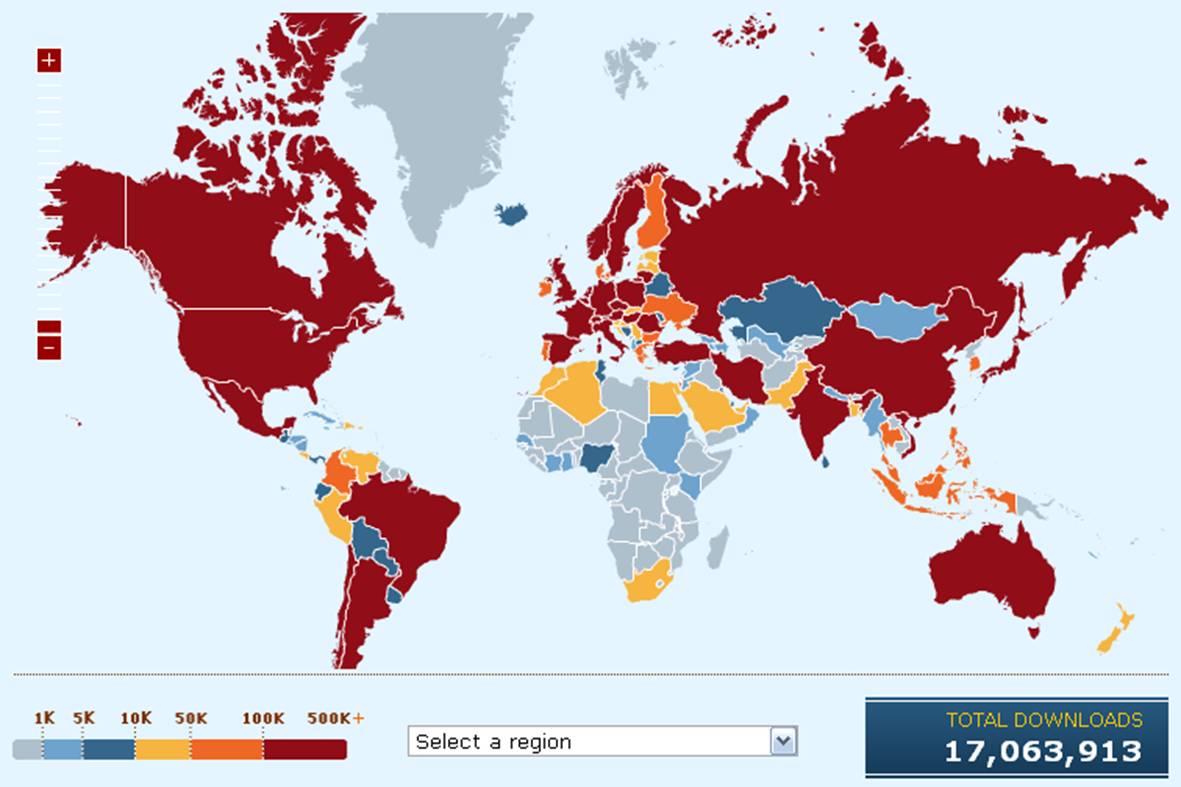
Current Firefox Download Map
Firefox download map

Remix 1: % of population that downloaded firefox

You need to upgrade your Flash Player

//

Remix 2: % of internet users that downloaded firefox

You need to upgrade your Flash Player

//

Lots to dive into here. Most notable is how India and China’s strong showing in the initial download map is obviously nothing more than a function of their sheer size. In the later two maps they do not fare as well. The fact that other browsers dominate the marketplace in these countries may also play a role. This is certainly the case in China (though I’m less certain about India). Either way though Firefox’s presence in China and India is a lot weaker than the download map suggests. What, if anything, can be done about this is worth debating.

The biggest surprise has to be Iran. It would appear that Iran is anything but the insular isolated country the western media likes to portray it as. Indeed, outside of the western world Iran has one of the highest download rates per capita. This would suggest Iran is quite well connected (and, I suspect, deeply mistrustful of MicroSoft). This should pose a challenge to Barnett’s thesis, in which connectedness should make a country safer to the international system. John Harris who wrote an excellent critique of Barnett’s thesis, would argue that Iran isn’t perceived as a threat because it is disconnected (it clearly is connected). Instead, what makes it a threat is that a ruling elite strives (however unsuccessfully) to keep it as disconnected from the rest of the world as possible. This creates tensions and challenges that exasperate the complex challenge that is Iran.

One of the most interesting impacts of open source software is that it may help countries – especially those transitioning into modern economies – increase their connectiveness. These maps seem to confirm this hypothesis. A scan of the % of the population that downloaded Firefox shows a robust number of people in emerging economies – especially in Latin America, Eastern Europe and to a lesser degree, South East Asia. Indeed, the government’s of many Central and Eastern Europe countries have mandated that their public services use open source solutions where ever possible. With many countries in the region counting download rates at over 2% of the population(!!!!) Eastern and Central Europe really is emerging as a dominant market place for Open Source solutions.

Ultimately, what is notable is that Core countries do by and large well, Gap countries do poorly and countries that sit around much of the perimeter of Barnett’s line separating the “gap from “the core” score in between. For example, the deep pits of disconnectedness are focused around the Stans and Africa, broken up only by Iran and Israel. Consequently, in my opinion the the Firefox download map gives us data that validate Barnett’s thesis. The bigger question is what can open source generally, and Firefox specifically, do to help change the map?

Two notes:
1. Since being slashdotted I’ve received many comments and emails both encouraging and critical. Please keep sending them and adding to the analysis here. Many heads are better than one and so please do contribute
2. I apologize that data for some countries (like Iceland) is not available on this map. Recreating the map wasn’t easy, and it was all in our (and really Jeremy’s) spare time so we did the best we could.

Firefox pledge map – pledges as a % of population

(sorry this post was initially messy – when you get off a transatlantic red-eye and have fifteen minutes to copy and paste in your post, things are bound to get ugly. It should be all cleaned up now)

Mozilla kindly sent me a preliminary data set of download pledges. This data is about 2 days old but should still be more or less instructive. I hope to get more up to date data soon and will update accordingly.

According to the raw data the 20 countries where the most people – as a % of the population – pledged to download Firefox. Population figures are based on those available on Wikipedia.

Country % of the pop that pledged to download
Anguilla 5.78
Falkland Islands 2.00
Montserrat 0.66
Andorra 0.60
Faeroe Islands 0.40
Iceland 0.35
Liechtenstein 0.27
Slovenia 0.26
Greenland 0.25
Estonia 0.25
Poland 0.23
Palau 0.20
Aruba 0.19
Netherlands 0.17
Maldives 0.17
Malta 0.17
Antigua And Barbuda 0.16
Latvia 0.15
Turks And Caicos Islands 0.15
Lithuania 0.15

On the one hand it is no surprise that many of these – about half – are small island countries with populations under 100,000 people. Moreover, 14 have populations under 500,000. Consequently, for many of these countries even a small number of absolute pledges translates into a high total percentage of the population. But I also think this says something about the economics of open source and the internet. It enables small isolated and sometimes neglected parts of the world economy to get effective, top of the line software for free, software that in turn enables them to participate in the global economy.

But things get more interesting if we strip out the countries with populations under 500,000. This picture eliminates the small countries (which are, in some ways, outliers) and allows us to focus on the rest of the world (167 countries made this list). Here are the results for the top and bottom 20 countries.

Top 20 (with population greater than 500,000
Country Core or Gap % of the pop that pledged to download
Slovenia Gap 0.263
Estonia Core 0.248
Poland Core 0.235
Netherlands Core 0.170
Latvia Core 0.154
Lithuania Core 0.146
Finland Core 0.144
Norway Core 0.143
Belgium Core 0.139
Portugal Core 0.131
Albania Gap 0.130
Denmark Core 0.126
Singapore Gap 0.125
Croatia Gap 0.124
Hungary Core 0.123
Canada Core 0.110
Chile Core 0.107
New Zealand Core 0.109
France Core 0.106
Australia Core 0.105
Bottom 20 (with population greater than 500,000
Country Core or Gap % of the pop that pledged to download
Ghana Gap 0.001
Burundi Gap 0.001
Kenya Gap 0.0006
Chad Gap 0.0006
Uganda Gap 0.0005
Burkina Faso Gap 0.0005
Mali Gap 0.0005
Rwanda Gap 0.0005
Cameroon Gap 0.0005
Guinea Gap 0.0004
Mozambique Gap 0.0004
Bangladesh Gap 0.0004
Malawi Gap 0.0004
Niger Gap 0.0004
Myanmar Gap 0.0003
Sudan Gap 0.0003
Nigeria Gap 0.0002
Tanzania Gap 0.0002
Dem. Republic Of The Congo Gap 0.0002
Ethiopia Gap 0.0001

I admit that when I wrote the post on Monday about the correlation between the pentagon’s new map and the firefox pledge download map I thought that once the per capita data was analyzed it would sharply change the outcome. The reality is, it doesn’t. Core countries are far and away dominant on the list. In the bottom half of the list (84 of the 167 countries with populations over 500,000) only 4 countries are in the core: India, China, Mongolia and South Africa. (of course as a % of Function Core, or even the worlds’ population, this is a lot of people!).

Eastern Europe is clearly an emerging open source powerhouse. Of the top 20 countries as a percentage pf population who pledged the top 3 are Eastern Europe and a total of 8 make the list. Only 4 of the countries are “non-integrated gap” countries all of which are transitioning (or arguably have transitioned, into “New Core” countries. Indeed, there is an argument that open source software allows new core countries to integrate into the core more rapidly by not only making some of the key tools that facilitate this transition more readily and cheaply, available but also by enabling the population to participate in their development thus building world class skills without the requisite FDI or multinational corporate investment.

The more grim news is at the bottom of the list. Perhaps unsurprisingly, but still another sad reminder, virtually every country on the bottom 20 is African (Bangladesh and Myanmar are the exceptions). In short, the countries most in need of this software, software that is freely available, still are least likely to have the capacity and infrastructure to download it.

Other notable placements were Venezuela (62) and Iran (77), much lower down the list than I initially suspected they would be.

Also interesting, and perhaps a possible challenge for Barnett (and the world) is that the 3 Core countries with fewest number of pledges were (in order from fewest to most) China (123), India (116) and South Africa (89)

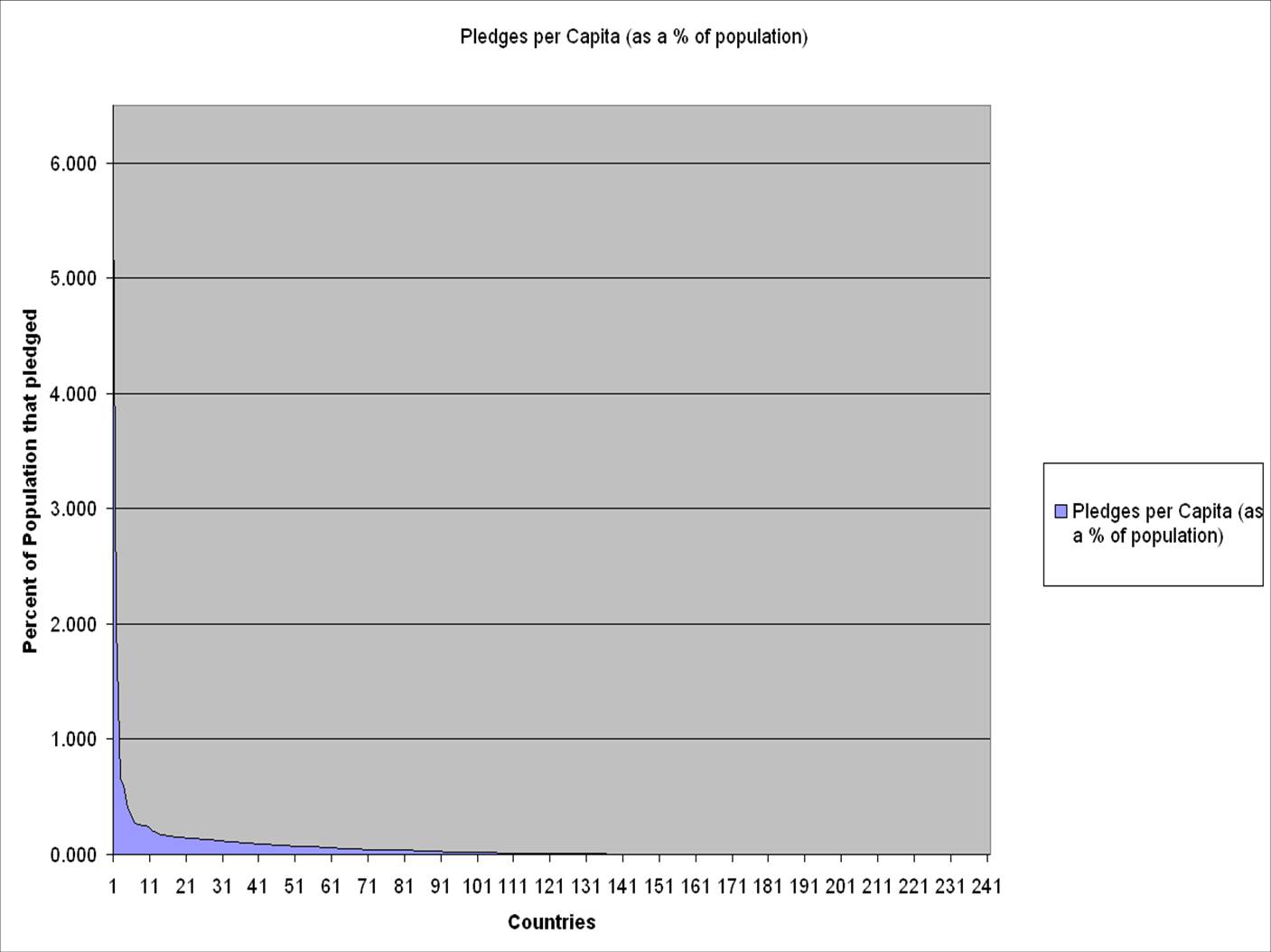
Also, just in case you were wondering, I believe the distribution of the countries rank by percentage of population makes a power law graph :)
Powerlaw pledge graph


Shocker.

Firefox 3 pledge map vs. the Pentagon’s new map

What are the geopolitics of open source? To find out I thought it would be interested to see how Thomas Barnett’s map meshed with the Spread Mozilla Firefox 3 download pledge map.

Some brief background for those not familiar with “The Pentagon’s New Map.” It is a map that sits at the heart of a book of the same title written a few years ago by Barnett. It is a compelling take on what America’s grand strategy should be for the 21st century and how it is, and more importantly isn’t, ready to execute on it. Better yet, it is engaging, thought provoking, interesting, and written so anyone can read and understand it.

The core of the book’s thesis (remixed from Wikipedia and very high level) is as follows:

  1. International systems of rules reduce the likelihood of violent conflict (e.g., the WTO Dispute Settlement Understanding)
  2. The world is divided between the Functioning Core and the Non-Integrated Gap.
    Function Core = economic interdependence, incented to abide by rules
    Non-Integrated Gap = unstable leadership and absence of international trade, weaker incentives
  3. Integration of the Gap into the global economy provides opportunities for individuals to improve their lives, presenting a desirable alternative to violence and terrorism
  4. US grand strategy for the 21st century… help countries migrate from the Non-Integrated Gap into the Functioning Core

According to Barnett’s thesis, countries in the Non-integrated Gap, because they are less connected, should probably have fewer computer users, fewer people downloading software and fewer people participating in Open-Source projects. Mashing up his map with the Firefox pledge map might give us some a clue to how well open-source conforms to his thesis.

(Note, I’ve remixed Barnett’s map to make it is easier to read on a computer with the Function Core countries in green and the Non-Integrated Gap countries in red . You can find the original map here.

PNM remixed

Below is the spread Firefox pledge map, which tracks how many people around the world have pledged to download Firefox on its release day (June 17th). I’ve overlaid the Non-Integrated Gap/Function Core border over it.

firefox PNM mash up

Some comments/thoughts:

  • Interesting correlation between low pledge totals and Non-Integrated Gap countries
  • All but two Non-Integrated Gap countries (Colombia & Turkey) have 10,000 download pledges or fewer. (I also think it is interesting that Barnett doesn’t include Turkey in the Functioning Core…)
  • Most countries within the Functioning Core have 10,000 pledges or greater (South Africa, Nordic Countries and the Baltic States are notable exceptions)
  • Non-Integrated Gap countries with the most pledges are Iran, Turkey, Venezuela, Peru, and Indonesia – interesting list. Seems to suggest that many of the countries the US tries to isolate are actually the most connected.
  • According to my Mozilla friends Poland (yes, Poland) was the first to hit the 100K pledge mark. Many new Core countries are adopting Open Source en mass to avoid paying for expensive Microsoft software. Open source may be offering them a cheap way to increase connectivity and integrate with the core faster, and on their terms. Fantastic outcome.
  • This map DOES NOT account for population variation – would be fascinating to see a map based on per capita pledges (I’ve contacted my friends at Mozilla and they’ve passed the raw data along to me so I will follow up with that analysis ASAP)
  • I will try to update the map with the final data on download day (June 17th) when all the pledges have been tallied
  • Note: Firefox pledge map copied on June 15th, 2008, 8:30 pm PST

Lots more thoughts and analysis to be done on this. I hope to blog more on this shortly. If Barnett responds in any way I promise to update – would love to hear his thoughts/reflections on this.

(One final aside, if you get the chance to see Barnett present, do so. He’s up there with Lessig in his delivery. I remember seeing him at a conference. He went long by 10 minutes. The US ambassador to Canada was in the next room waiting to give the next presentation but if any of the organizers had tried to intervene and hurry Barnett up, they would have been lynched. FYI, You can see his TED talk here.)