Tag Archives: vancouver

Understanding Toronto’s Buzz

For a while now I’ve noticed that something exciting is going on in Toronto. There is an energy to the place that is new and different. Social innovators abound, interesting conferences and speeches seem to occur daily, and big ideas are taking shape. Others are noticing it to (via Richard Florida).
csi_logoI know that the story of this transformation is complex, but from someone whose both been a participant and observer of the transition I feel one piece of the puzzle is perhaps easily explained. More interestingly it isn’t making a lot of peoples lists, but the Centre for Social Innovation (CSI) strikes me as a central piece of Toronto’s emergence as a place with buzz.

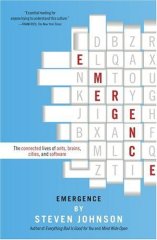
This idea has been solidified by my reading of Steven Johnson’s Emergence (a fantastic book BTW, but then everything he writes is excellent).

Indeed, Johnson’s opening parable about the story of slime mold provides a perfect metaphor for what has happened:

“Slime mold spends much of its life as thousands of distinct single-celled units, each moving separately from the its other comrades. Under the right conditions, those myriad cells will coalesce again into a single, larger organism…”
emergence

As Stevens explains, for a long time it was not understood what caused the slime mold to shift from single-celled into a larger organism. For a long time it was presumed that certain “leader” or “pacemaker” cells caused other cells to react. Finally, two scientists, Keller and Segel asked “What if the community of slime mold cells were organizing themselves? What if there were no pacemakers?… If the slime cells pumped out enough cyclic AMP (a signaling chemical), clusters of cells would start to form. Cells would begin following trails created by other cells, creating a positive feedback loop that encouraged more cells to join the cluster.” Critically, no single overarching cell was telling everyone else what to do. Instead each cell was evaluating the nutrients available in its immediate environment and adjusting its AMP output accordingly. The result is a bottoms-up system.

Now, while some may relish in referring to Torontonians as slime mold, they should instead wish for a similar fate. I think Toronto has experienced a phase transition like that of slime mold. Like the individual cells of slime mold, a critical mass of social innovators are finally connecting. And rather than secrete a chemical, they are sharing ideas, challenges, and opportunities. These conversations have created a positive feedback loop, attracting still more social innovators, along with philanthropists, venture capitalists and consultants, helping further foster the community that has started to thrive in Toronto. A decentralized, emergent community of social innovation is growing.

CSI has played a critical role in all this by serving as a critical aggregator, by simply providing a place and some basic support, it fostered an environment in which emergent behaviour became possible. Before SCI social innovators probably abounded across Toronto, but were isolated and alone. Today they are busy created webs of complex communities and sub-communities. Toronto has had this aggregation in the finance indsutry for some time, but for social innovators and other creative class entrepreneurs, this community of support is new. As one observer who worked on Canada25 noted to me, even 5 years ago the peer support and interest was not even a fraction of what it is today.

There are lessons here. For Toronto, but also for other cities across Canada. Obviously other factors matter. This isn’t an attempt to be completely reductionist. Toronto’s decent subway system, which allows people (cell!) to easily come together from across a large geography, makes it easier to achieve critical mass. This means similar success in cities like Calgary may be more challenging. For my home town of Vancouver, the jury is still out – transit is getting better, but what about critical mass?. But I continue to have high hopes. Perhaps the Tides Renewal Centre will come to serve a similar function as SCI in Toronto.

Regardless of where you live, Canadians everywhere should take notice. There is a buzz in Toronto, the question is, can we bottle the lightening and reproduce it elsewhere? I’d love to hear of similar projects if anyone knows of any.

Vision School Board Candidates Debate

Just a little update – I’ll be hosting Vision Vancouver’s school board debates tomorrow. If you are interested in getting to know the school board candidates come on down and join us. For Vision members not in the know, Vision will be having its nomination vote on the September 20th at Sir Charles Tupper Secondary.

The debate will take place 7pm tomorrow (Tuesday) at The Vancouver Community College, Downtown Campus (250 West Pender), Room # 112 – Theater.

I’ll be hosting the event and panelists Anne Guthrie Warman, Parker Learey, and Patrick Clark will be asking the candidates questions.

Vancouver and Wal-Mart – a missed opportunity

Vancouver is getting a Wal-Mart in a few months. But it isn’t the store we deserve. We could have done better, much better.

Back in 2005/06 Wal-Mart applied to construct a store in Vancouver (along South West Marine drive for those who know the city). The City of Vancouver put all sorts of hurdles in Wal-Mart’s way. In particular it told Wal-Mart that its proposed store was not sufficiently environmentally sensitive and laid out guidelines stricter than any other proposed store would have to adhere to (such as the Canadian Tire being proposed next door).

It didnt have to be this way

It didn't have to be this way

We can debate whether it is fair to force Wal-Mart to live up to a unique set of guidelines. But what is unconscionable is what the city did next. Wal-Mart hired Peter Busby, a local architect who is a world leader on sustainable development, who designed a store that consumed 1/3 the energy of a normal store with windmills generating power and underground wells heating and cooling the building. What did City Council do with the proposal? It said no. It rejected Wal-Mart’s application even though it proposed to build one of the world’s most environmentally sensitive store’s and despite the fact that city planners and staffers recommended endorsing the plan.

Fast forward to today.

Wal-Mart recently bought property on the east side of the city (at 3585 Grandview Highway) that is an old vacated Cosco and is now renovating the site. I’ve heard of no plans for a super energy efficient building, nor for an electricity generating windmill or rainwater catchment system. It’ll just be a normal, run of the mill, Wal-Mart.

What an opportunity lost for Vancouver, and for Wal-Mart.

West vs. East

So I’m in Toronto for 24 hours of meetings. I love Toronto, lots of excitement and energy in this town which is why I love coming here so much (trust me when I say I’m putting my Vancouverite cred at risk for saying this publicly).

That said, I landed and it was raining. Odd, I’m always getting mocked out east for having weather like this at home…

So, with a bit of a wry smile, I’ll admit I did get just the tiniest bit of enjoyment reading this piece.

Especially when, out in Vancouver, we are enjoying weather like this.

Come out west, we’ve got a hot patio with some cool beers waiting for you.

Wente’s disgraceful piece on Insite and harm reduction

Last Saturday Margaret Wente wrote this disgraceful piece on harm reduction in Vancouver.

In short, what is written is a compilation of anecdotal statements that ignore the actual research and science that has measured Insite’s positive impact. A quote from a sergeant who may or may not have an axe to grind is apparently worth more than the numerous peer reviewed articles in publications like the New England Journal of Medicine or The Lancet. This is of course Wente’s MO – she doesn’t need science or research, like Colbert her gut is her guide – something we learned long ago from her coverage of global warming.

This sadly, is not the worst of it. Wente goes on to misrepresent both the goals of Insite and the position of its advocates.

insiteNo one – least of all Insite’s advocates – believes Insite is the entirety of the solution. The goal is, and always has been to have a complete response (hence the four pillars). Insite seeks to reduce harm but it can’t ‘solve’ the drug problem alone, no one claimed it would and judging it by such a bar is misleading.

Is rehabilitation and treatment essential? Absolutely – something Insite supporters also believe. This is why OnSite (a temporary treatment facility pointedly not included in Wente’s article) was placed atop Insite so that users would have somewhere to stay while a permanent facility was found for them. Insite was never designed to replace treatment, but to reduce harm for those who refused or could not get it as well as provide a vehicle to help users seek help and get on treatment.

There are plenty of commentators I disagree with but enjoy reading because they challenge my assumptions and provoke interesting or thoughtful insights. Sadly, most of the time I read Wente I’m reminded why she’s not one of them.

Two additional points. The first is how the injection site has become an East vs. West phenomenon. Here in Vancouver the debate is over. Insite has public support, on the street, in the newspapers and in the halls of power. Even the comments in the Globe reflect a bias in favour from those commenting from Vancouver especially but BC in general.

Second, I initially wrote this in the comment section on the globe website (where one is exposed to some truly horrifying thinking) and thought nothing more of it until Andrew F. emailed me a supportive note. And I thought comments on newspaper articles were simply a cathartic exercise!

Urban Public Transit Done Right

Metronauts, eat your hearts out. :)

Was back in Vancouver yesterday. It was a glorious day – the kind that you write in your blog about. Anyway, rode the bus downtown for several meetings and noticed this sign:

text a bus sched

In short, you can now text “33333” + the identifying number found on every bus stop in Vancouver and… the arrival times of the next 6 scheduled buses will be texted to you.

Now this schedule is probably static and does not adjust for the fact that specific buses may be running late, caught in traffic, blown a tire, etc… But it is a start.

Anything that gives transit users more information is a good thing, especially if that means it will raise their expectations around the timeliness and predictability of service (as I suspect this will). A traffic that is more demanding of its public transport is more invested in its public transport.

I can already see the logical next step… Imagine a transit user sends a text to find out when the next bus will arrive. When that bus (and possibly the subsequent bus) fails to show up he/she starts looking for a complaints or information line to call. Their expectation is going to be that the person on the other end of the line can answer the question: “Where is my bus.” The obvious conclusion to this scenario – take the GPS emitters that are on every bus and open up their API’s so that we can all see where they are. It is going to rock transit users’ worlds when they can open up google maps on their phones and search “Vancouver, Transit, 22” and see the current location of all the 22 buses.

Translink you’ve opened a pandora’s box of expectations for this user. It is a good first step.

[BTW: Transit geeks in Vancouver should already be reading this blog, which, of course, was on the case long before me. Long live the long tail of blogs.]

Tory logic: Injection sites in Quebec = good, in BC = bad

So Yaffe’s Wednesday column (which I talked about yesterday) about how Insite would not be challenged by the conservative government if it were in Quebec has turned out to be sadly prescient.

Today, the Globe is reporting that Federal Conservative Health Minister Tony Clement is willing to consider Quebec’s request for an injeciton site even as he works to shut down the site in Vancouver. For a party that was supposed to let the west in, this is a complete outrage.

Health Minister Tony Clement says his government will not necessarily oppose safe-injection sites for illegal drugs in Quebec even though it will appeal a court decision allowing a similar facility in British Columbia…

…”I am obligated to consider each situation as a unique situation. That’s my obligation as the Minister of Health.”

Appalling. Apparently the local consensus reached in Vancouver about this approach means nothing to this government. Nor apparently, do the votes in Vancouverites. With this move it is hard to imagine the Conservatives winning any seats in Vancouver.

Yaffe: the best post on the politics of Insite

I highly recommend reading Barbara Yaffe stellar piece on the Insite injeciton site in yesterday’s Vancouver sun. In short, she points out that if Insite were in Montreal, the Conservatives would let it slide out of fear of upsetting the nationalists and treading on provincial powers. BC however, appears to be fair game.

So much for principles.

Vision Vancouver – Canada's largest municipal party

I just got news that Vision Vancouver as grown to become (what we believe to be) the largest political party in Canada. This is meteoric growth and confirms my hope that Vancouverites are increasingly looking for a progressive, centrist party to guide the city in the 21st century. I’m pretty excited to be part of this.

Press release:

Thousands of new members join Vision
Race for Vision mayoralty nomination drawing record numbers
May 19, 2008

Vision Vancouver announced today that they have had over 11,000 new members join in the past two months, driven by the excitement of Vision’s mayoralty nomination race. Raymond Louie, Al De Genova, and Gregor Robertson are competing for the Vision nomination.

“Congratulations are in order to Raymond, Al, and Gregor, who have inspired thousands of people to join Vision,” said Vision co-chair Mike Magee. “With over 11,000 people joining in recent weeks, it shows how fed up people are with Sam Sullivan and the NPA, and that they like the alternative they see in Vision Vancouver.”

“People need a government that will work for solutions to end homelessness, make housing affordable for future generations, and protect our environment. These results show that people are hungry for change in this city.”

“It’s amazing that in such a short time, Vision Vancouver could quite possibly now be the largest civic political party in Canada,” Magee added.

Thursday, May 15th was the last possible day to become a Vision member and be eligible to vote at the nomination meeting in June. Preliminary results show that well over 11,000 new members have signed up in the past two months, with a final total to be determined within the next two weeks. The mayoralty nomination meeting takes place on Sunday, June 15th at the Croatian Cultural Centre.

“Our three Mayoral candidates have worked tirelessly to engage people all over Vancouver, and as a result we’re building a winning coalition across the city,” said Magee.

“The sheer size of the Vision membership proves that the people of Vancouver want progressive leadership back in City Hall.

Vancouver to Cape Town: Cities coming in from the Cold

So posting may be a little scarce over the next 30 hours. I’m currently in the Joburg airport in the midst of my 35 hour, four flight trip home. (boo…)

However, I’m excited to be heading home and the Cape Town to Vancouver trip is an interesting one to be on since it is evoking some interesting comparisons between two cities that are, in some respects, very similar.

Indeed, yesterday, over lunch (at this wonderful place called Mariana’s) with Mark S. and his Cape Town friends we started comparing the two cities. The Cape Towners talked about how there was so much going on in South Africa, about how the country was changing and evolving, but that Cape Town seemed to be unimpacteed and possibly even opting out of this change.

I asked if Cape Town suffered from a dynamic that, I believe, has afflicted Vancouver for quite some time but that it might be on the verge of overcoming. The dynamic? Conservatism.

I’ve often called Vancouver the most conservative city in Canada. I don’t mean politically, but socially. Vancouver is so beautiful and so nice that a significant portion of the population don’t want anything to change. Change, any change, threatens to alter something about the city that people like – and so things evolve slowly in the city. (This is why the election of Larry Campbell was such a watershed moment. It is also why I’m engaged in Vision Vancouver – it’s rise could hold the promise of a more dynamic future). Fortunately (although many Vancouverites would say unfortunately) Vancouver’s growth path means that change can no longer be forestalled. The city is going to change, the question is simple do we choose to guide it and help foster a dynamic, interesting and sustainable place? Indeed, already this increased economic and social diversity and the growth that comes with it is beginning to break the old Vancouver families grip on the city’s destiny. It is also breeding a greater appetite for new approaches and strategies. the Insite Needle injection site is only the most powerful manifestation of this.

Cape Town has – according to me new friends – had a similar trajectory. It is so beautiful that no one wants anything to change. Consequently you can have a city that (like Vancouver) is quite liberal and bohemian (it is apparently Africa’s gay capital) but that is at the same time, quite conservative – in that very little changes. It has allegedly taken a back seat to the changes sweeping South Africa. The question is, will similar pressures force Cape Town to act? This I don’t know.

So, for me, flying from Cape Town back to Vancouver reminds me of why I’ve moved home. To be closer to family, but also to be part of what I beleive to be an exciting moment in Vancouver’s history – a moment when the city may shed its more convservative impulses and act on the progressive ideals that I believe underlie its culture. It’s an exciting time and I hope Cape Town captures this spirit as well.