Yearly Archives: 2010

Open Gov West – Seattle March 26 & 27

For westcoasters interested in and thinking about open government and open data there will be a conference in the pacific northwest bringing together key actors in the area.

Called OpenGovWest will be taking place on March 26th and 27th. A number of interesting people will be in speaking and in attendance include Andrew Hoppin (New York State Senate’s CIO), Sabra Schneider (Webmaster, King County), Bill Schrier(CIO of Seattle) and David Hume, Executive Director, (Citizen Engagement).

There is also, at the moment, an early bird registration that last until March 10th with the discount code of 7gh9.

The conference will be taking place at Seattle City Hall (and will be the first time City Hall chambers will be used to host a conference – it is a beautiful room, which is a bonus…

Some other info for open data and open gov geeks like me…

  • You can follow the conference on Twitter @opengovwest
  • The conference hashtag is #ogw
  • Sponsors who are interested can find out more about sponsoring here.
  • Again, you can register here.

It is great to see a conference of this nature coming to the west coast. Big kudos to Sarah Schacht, the Director of Knowledge As Power, who has made this conference happen.

Gov 2.0 International: Global Innovation Meeting Local Challenges

Next week I’ll be speaking at Gov 2.0 International, an online conference being hosted by O’Reilly Media.

The conference will be running from noon-2:15 EST with an agenda I’ve copy and pasted from their website (might as well admit it!). The conference is free (hard to beat) but you’ll still need to register, which you can do here.

Agenda

Joel Whitaker

Beyond Borders: Improving Global Diplomacy and Citizen Empowerment with Gov 2.0 Speaker: Joel Whitaker, U.S. Institute of Peace

Joel Whitaker is Senior Advisor to the new Center of Innovation for Science, Technology and Peacebuilding at the US Institute of Peace in Washington, DC. Current projects include peace-gaming and simulations, climate change and conflict, mapping the Middle East blogosphere, science diplomacy in Iraq and Afghanistan, online media in Iraq, and mobile communication tools for conflict-zone NGOs.

David Eaves

Open Government in Canada Speaker: David Eaves, Centre for the Study of Democracy

In this overview of the state of open government in Canada, David will outline where there have been successes and where there have been challenges. He’ll explain why this is the case and what it could mean for other jurisdictions.

Yaron Gamburg

Israel Gov 2.0: from Awareness to Implementation Speaker: Yaron Gamburg, Israel Ministry of Foreign Affairs

Gov 2.0 in Israel is still in its initial stage. There are many initiatives in different agencies, primarily in the central government. However, these initiatives are bottom-up developments, and we need strong sponsors at the senior level of the government to make a significant change.

Dominic Campbell

U.K. Innovations in Gov 2.0 Speaker: Dominic Campbell, FutureGov

This talk will look at Britain’s contribution to the Gov20 agenda, where it started from, who led it and why it took the election of Barack Obama 3000 miles away to spur the government into action.

Program subject to refinement. All talks are 30 minutes, with a 15 minute break at US-PST: 10:00am (US-EST: 1:00pm).

The entire conference will be recorded and made available to attendees free of charge afterwards.

The PM’s Advisory Committee on the Public Service: The Good, The Bad, The Hopeful

On February 25th Paul Tellier and David Emerson – two men whose understanding of Ottawa I have a tremendous amount of respect for – released The Fourth Report of the Prime Minister’s Advisory Committee on the Public Service. It is a document that is worth diving into as these reports will likely serve as reference points for (re)thinking on renewing government for the foreseeable future.

The Bad:

On the rough side, I have a single high-level comment: These reports are likely to be as close as we are going to get in Canada to Australia’s Government 2.0 Taskforce (on which I served as part of the international reference group) or Britain’s Cabinet Office Power of Information Taskforce Report (which would have been tremendous to have been involved in).

To be clear, this is not the fault of the committee. Its terms of reference appear to be much broader. This has to predictable consequences. First, relatively little time is dedicated to the general reorganizing of society being prompted by the now 40 year old internet revolution is only carving out a small role. The committee is thus not able to dive into any detail on how the changing role of information in society, on open data, on the power of self-organization, or the rising power and influence of social media could and should re-shape the public service.

Second, much more time is dedicated to thinking about problems around HR and pay. These are important issues. However, since the vision of the public service remains broadly unchanged, my sense is the reforms, while sometimes large, are ultimately tweaks designed to ensure the continuation of the current model – not prompting a rethink (or the laying of groundwork) for a 21st century public service which will ultimately have to look different to stay relevant.

The best example of the implications of this limited scope can be found under the section “Staying Relevant and Connected.” Here the report has two recommendations, including:

The Public Service must take full advantage of collaborative technologies to facilitate interaction with citizens, partners and stakeholders.

The Public Service should adopt a structured approach to tapping into broad-based external expertise. This includes collaboration and exchanges with universities, social policy organizations, think tanks, other levels of government and jurisdictions, private sector organizations and citizens.

These are good! They are also pretty vague and tame. This isn’t so much renewal as it is a baseline for a functioning 20th century public service. More importantly, given some of the other pieces in the report these appear to be recommendations about how the government can engage in pretty traditional manners (exchanges). Moreover, they are externally focused. The main problem with the public service is that its members aren’t even allowed to use collaborative technologies to interact among themselves so how can they possible be ask to collaborate externally? As I say in my OCAD lecture and my chapter in Open Government: Collaboration, Transparency, and Participation in Practice – a digital citizenry isn’t interested in talking to an analogue government. The change required is first and foremost internal. But advocating for such a change is a major effort – one that will require significant culture and process change – which I haven’t found so far in the report and which is probably beyond its scope.

The Good:

That said, when the report does talk about technology and/or collaboration – it broadly says the right things. For example, in the section Creating A Modern, Enabled Workplace the report says:

creating a workplace that will attract, retain and empower public servants to innovate, collaborate and be responsive to the public. Among other things, this must include the adoption of collaborative technologies that are increasingly widespread in other sectors.

And, perhaps more importantly, under the section Strengthening Policy Capacity: A Relevant and Connected Public Service the report states:

A public service operating in isolation runs the risk of becoming irrelevant. We believe that the quality of policy thinking must be enhanced by additional perspectives from citizens, stakeholders and experts from other jurisdictions and other sectors (e.g. business, academia, non-governmental organizations). We believe sound government policy should be shaped by a full range of perspectives, and policy makers must consistently reach beyond the National Capital Region for input and advice.

Furthermore, the Public Service now has an opportunity to engage Canadians, especially younger ones, through the use of Web 2.0 collaborative technologies such as wikis, blogs and social networking. These offer an excellent way for the Public Service to reach out and connect.

Again, great stuff. Although, my concerns from above should also be reiterated. A networked public service is one that will need new norms as it will function very differently. The task force has little to say about this (again because of their expansive purview and not through their own fault). But this issue must be addressed in full. I frequently argue that one reason public servants are so stressed is that they live double lives. They already live in a networked workplace and play by network rules in order to get their job done, however, they are perpetually told they live in a hierarchy and have to pretend they abide by that more traditional rule set. Double lives are always stressful…

The Hope:

As the committee moves forward it says it will:

…consider and advise on new business models for the Public Service with a view to creating an innovative and productive workforce that continues to deliver increasing value for money by taking advantage of new tools and technology;

I hope that open data, open systems and some of the ideas around a network government I’ve been advocating and talking about along with numerous others, get in front of the committee – these all represent building blocks for a significantly more flexible, innovative and product public service.

21st Century Olympics

Just resting now after a few wild days closing off out the Olympics.

My sense is that, despite the grumblings of the UK press (which has some pretty good reasons to set the bar low), these Olympics will get good marks. Athletes got to venues on time, the infrastructure was able to handle the crowds and people had fun. For Canadians there were the added benefits of owning the podium working and, of course, a gold medal in hockey. Things did go wrong, but they were in largely beyond the control of the organizers (it would be great if we could make it snow or stop an El Nino but happily, we can’t) or – in the case of the Olympic Cauldron – they were dealt with.

I had a number of wonderful experiences. I was able to be at the Canada-Russia game. I met a few athletes, even saw a few medalists – and was (very generously) given 5th row tickets to the men’s hockey bronze medal games by Bryce Davidson. I held an Olympics torch, saw the Stanley Cup and got to see the fireworks display at LiveCity in Yaletown. Moreover, I get to ride the Canada Line – the subway to Richmond and the Airport that was built for the Olympics – almost everyday.

All this to say – I had a great time.

But having witnessed two weeks of Olympics I can help but feel there is an underlying challenge for the Olympics – one that emerges from the security concerns of a post-September 11th world and the Olympic Committees obsession with ensuring that only its sponsors are able to advertise, broadcast or even talk about the Olympics.

As technology improves the capacity of the Olympics to prevent people from broadcasting live from the Olympics is going to become increasingly challenging. The Olympics is maybe one of the best examples of an entire jurisdiction being controled so that – to paraphrase Lawrence Lessig – a legal structure, as opposed to technology, becomes the limit free speech and expression. Increasingly, truly free societies may begin to balk at the restrictions the IOC wishes to place not just on corporations but on citizens who are hosting the games. This is also true of the security required to host theses events. The Winter Olympics are relatively small and – security he was very present but not overwhelming. But only by post-September 11th standards. The fact is that, unlike in Calgary, today the venues are fenced off and secured – leaving the Olympics at times feeling a little more like a G20 event than a celebration. Or perhaps, to be more fair, there are really two Olympics – that going on behind the fence, and the rest taking place in the city.

In short, I begin to wonder how many communities – especially those within liberal democracies where individual rights are well established – are going to want to bid on the Olympics. Perhaps the biggest risk is that the IOC, in a bid to sustain its business model, will find itself increasingly having to partner with cities in countries with perhaps not the strongest human rights or democratic standards precisely because it is only those places that can enforce the rules (both in terms of safety and licensing) that that IOC will demand.

I think Vancouver avoided the security excesses people feared about but it isn’t hard to see – looking at Vancouver – the dangerous direction the Olympics could be headed in. And that would be tragedy. Whatever people may say, the Olympics remain a powerful symbol for peace and global brotherhood. Moreover, if done right they can leave host cities with important legacy infrastructure projects (again – the Canada Line stands out). But if the business model of the Olympics mean that it must lock down the cities that host it the costs may simply become too high for most communities.

My sense is that a re-imagining of the Olympics business model is probably in order – one that will allow it to respond to the realities of a networked 21st century world and that re-balance safety concerns with the need to create an environment that is fun and open. Moreover, such a re-imagining would be a fantastic project – something that might revitalize the Olympics in other powerful ways – making it more open, accessible and inspiring, in short, an Olympics that is relevant and ready for the 21st century.

Open Source Strategy: OpenMRS case study

Last week I had the pleasure of being invited to Indianapolis to give a talk at the Regenstrief Institute – an informatics and healthcare research organization – which also happens to host the founders of OpenMRS.

For those not familiar with OpenMRS (which I assume to be most of you) it is open-source, enterprise electronic medical record system platform specifically designed to respond to those actively building and managing health systems in the developing world. It’s a project I’m endlessly excited about not only because of its potential to improve healthcare in developing and emerging markets, but also because of its longer-term potential to serve as a disruptive innovator in developed markets.

Having spent a few days at Regenstrief hanging out with the OpenMRS team, here are some take aways I have regarding where they are, and where – in my mind – they should consider heading and what are some of the key places they could focus on to get there.

Current State: Exiting Stealth Mode

Paul Biondich and Andrew Arenson point me to this article about Community Source vs. Open Source which has an interesting piece on open source projects that operate in “Stealth Mode”

It is possible to find models similar to community source within the open source environment. For example, some projects opt to launch in a so called ‘stealth mode’, that is, they operate as a truly open source development from inception, but restrict marketing information about the project during the early stages. This has the effect of permitting access to anyone who cares enough to discover the project, whilst at the same time allowing the initiating members to maintain a focus on early strategic objectives, rather than community development.

OpenMRS has grown in leaps and bounds and – I would argue – has managed to stay in stealth mode (even with the help of their friends at Google summer of code). But for OpenMRS to succeed it must exit stealth mode (a transition that has already been steadily gathering steam). By being more public it can attract more resources, access a broader development community and role out more implementations for patients around the world. But to succeed I suspect that a few things need to be in place.

Core Opportunities/Challenges:

1. Develop OpenMRS as a platform to push people towards cooperating (as opposed requiring collaboration) whenever possible.

One of the smartest things Firefox did was create add-ons. The innovation of add-ons accomplished two benefits. First, it allowed those working on the trunk of the Firefox code to continue to do their work without being distracted by as many feature requests from developers who had an idea they wanted to try out. Second, it increased the number of people who could take interest in Firefox, since now you could code up your own add-on cooperatively but independently, of the rest of the project.

With OpenMRS my sense is that then entire UI is a platform that others should be able to develop or build add-on’s for. Indeed, the longer term business model that makes significant sense to me is to treat OpenMRS like WordPress or Drupal. The underlying code is managed by a core open source community but installation, customization, skinning, widgets, etc… is done by a mix of actors from amateurs, to independent hackers and freelancers to larger design/dev organizations. The local business opportunities to support OpenMRS and, in short, create an IT industry in the developing world, are enormous.

2. Structural Change(s)

One consequence of treating OpenMRS as a platform is that the project needs to be very clear about what is “core” versus what is platform. My sense is that members of the Mozilla team does not spend a lot of time hacking on add-ons (unless they have proven so instrumental they are brought into the trunk). Looking at WordPress the standard install theme is about as basic as one could expect. It would seem no one at WordPress is wasting cycles developing nice themes to roll out with the software. There is a separate (thriving) community that can do that.

As a result, my sense is that OpenMRS should ensure that its front-end developers slowly begin to operate as a separate entity. One reason for this is that if they are too close to the trunk developers they may inadvertently prevent prevent the emergence of a community that would specialize in the installing and customizing of OpenMRS. More importantly, those working on the platform and those working on the trunk may have different interests, and so allowing that tension to emerge and learning how to manage it in the open will be healthy for the long term viability of the project as more and more people do front end work and share their concerns with trunk developers.

3. Stay Flexible by Engaging in Community Management/Engagement

One of the challenges that quickly emerges when one turns a software product into an innovation platform is that the interests of those working on the product and those developing on the platform can quickly divide. One often here’s rumblings from the Drupal community about how drupal core developers often appear more interested in writing interesting/beautiful code than in making Drupal easier to use for businesses (core vs. platform!). Likewise, Firefox and Thunderbird also hear similar rumblings from add-on developers who worry about how new platforms (jetpack) might make old platforms (add-ons) obsolete. In a sense, people who build on platforms are inherently conservative. Change, even (or sometimes especially!) change that lowers barriers to entry means more work for them. They have to ensure that whatever they’ve built on top of the platform doesn’t break when the platform changes. Conversely trunk developers can become enamored with change for change’s sake – including features that offer marginal benefits but that disrupt huge ecosystems.

In my mind, managing these types of tension is essential for an open source project – particularly one involving medical records. Trunk developers will need to have A-level facilitation and engagement skills, capable of listening to platform developers and others, not be reactive or defensive, understand interests and work hard to mediate disputes – even disputes they are involved in. These inter-personal skills will be the grease that ensure the OpenMRS machine can keep innovating while understanding and serving the developer community that is building on top of it. The OpenMRS leadership will also have to take a strong lead in this area – setting expectations around how, and how quickly OpenMRS will evolve so that the developer ecosystem can plan accordingly. Clear expectations will do wonders for reducing tensions between disparate stakeholders.

4) Set the Culture in Place now

Given that OpenMRS is still emerging from Stealth mode, now is the time to imprint the culture with the DNA it will need to survive the coming growth. A clear social contract for participation, a code of community conduct and clearer mission statement that can be referenced during decisions will all be essential. I’m of course also interested in the tools we can role out that will help manage the community. Porting over to Trac the next generation of Diederik’s bug-fix predicter, along with his flame monitor, are ways to give community the influence to have a check on poor behaviour and nudge people towards making better choices in resolving disputes.

5) Create and Share Data to Foster Markets

Finally, I think there is enormous opportunity for a IT industry – primarily located in the developing world – to emerge and support OpenMRS. My sense is that OpenMRS should do everything it can to encourage and foster such an industry.

Some ideas for doing this have been inspired by my work around open data. I think it is critical that OpenMRS start asking implementations to ping them once complete – and again whenever an upgrade is complete. This type of market data – anatomized – could help the demonstrate demand for services that already exists, as well as its rate of growth. Developers in underserved counties might realize there are market niches to be filled. In addition, I suspect that all of the OpenMRS implementations that have been completed that we don’t know about represent a huge wealth of information. These are people who managed to install OpenMRS with no support and possibly – on the cheap. Understanding how they did and who was involved could yield important best practices as well as introduce us to prospective community members with a “can do” spirit and serious skills. I won’t dive into too much detail here, but needless to say, I think anonymized but aggregated data provided for free by OpenMRS could spur further innovation and market growth.

Postscript

I’m sure there is lots to debate in the above text – I may have made some faulty assumptions along the way – so this should not be read as final or authoritative, mostly a contribution to what is an ongoing discussion at OpenMRS. Mostly I’m excited about where things are and where they are going, and the tremendous potential of OpenMRS.

The Big Apps come to Vancouver

Disappointed I hadn’t found this out sooner… Turns out the winners of New York’s Big Apps competition have created a Vancouver version of the winning application.

Steven Lao and Victor Sima, creators of the Android phone application Wayfinder, won “Best Overall Application” and prize money of US$5000. The Wayfinder application is an augmented reality application that enables you to use your Android phone’s camera to locate the nearest bus stop, subway station or seabus station.

So what does “augmented reality” mean? Take a look at the image below (this is the Wayfinder application in action).

This is image is what you would see looking at your phone’s screen. The screen is showing whatever building or road (or anything) that the phone’s camera is point at, but then is superimposing a “bubble” that hovers over the nearest actual subway or bus station (In this case it is 0.4 miles as the crow flies, through the building you’r looking at). This means you can simple use your phone to scan around an locate the nearest bus stop with out having to figure out where you are on a map.

Since Vancouver is hosting the Winter Olympics and because Translink made the deft move of sharing its transit data the Wayfinder programmers decided to create a Vancouver version – something they were able to do even though they never visited Vancouver.

You can learn more about Wayfinder in a recent audio interview with Directions Magazine available as a podcast. (H/T to Jonathan M. at the City of Vancouver who pointed this out to me!)

Canada’s Three Tiered Healthcare System

Thanks to Premier Danny Williams’ comments, we are in another short bout of collective denial and misunderstanding of Canada’s healthcare system and the public perception thereof.

1. Denial.

For those not in the know, Premier Williams recently jaunted down to Miami for heart surgery. In his interview with NTV reporter Fred Hutton, he stated, “This is my heart. It’s my health and it’s my choice.” True. It is a choice. If you can afford it.

It’s also a wonderful reflection of the fact that despite all the mythology awe, in Canada, actually have a three-tiered healthcare system. Williams enjoys the benefit of tier three – travel to the US. It’s a choice that many, many wealthy Canadians make. Indeed, it’s a choice other wealthy politicians have made, including former Quebec premier Robert Bourassa and former MP Belinda Stronach. I’m willing to bet that the Mayo Clinic has made a lot of money off wealthy Canadians.

Of course, this effect is largely ignored since most Canadians can’t afford to go to the US. So we pretend it doesn’t happen. Indeed, the 1998 Katz paper, a frequently cited paper that claims Canadians don’t travel to the US for healthcare, strikes me as deeply misleading. As the study states:

An important limitation of this study is that only public out-of-country expenditures are included in the analysis; private sources of funding, including “travel” health insurance plans and out-of-pocket payments, are omitted.

This of course doesn’t prevent them from drawing some very strong conclusions, namely that Canadians don’t go to the US for healthcare. In some ways they are right, average Canadians don’t, but what did you expect if the  study only looks at people who used Ontario public insurance – in short, those who couldn’t afford to travel to the US and pay privately…

Then of course, there is the more familiar second tier. This is private healthcare available here in Canada. Don’t be fooled, there is plenty of private healthcare in Canada. Indeed, at least 30% of healthcare spending in Canada is from private funds. This includes simple things like your glasses and dental costs, as well as the more complex, such as clinics that conduct surgery in Quebec (which the Feds don’t dare close) to those in British Columbia (which most people pretend don’t exist). These service upper middle class Canadians and, ironically, provincial Workers Compensation Boards which are not bound by the Canada Health Act and so can pay to have their patients serviced by private clinics in Canada. Irony!

Finally, there is familiar tier one — the public system that most of us avail ourselves of. (Which still has a huge private component – all those doctor offices are private businesses…) The system generally works, but often has too few doctors (try finding a GP – 4.5 Million of us haven’t!), long wait lines in Emergency Rooms (often hours long) and waiting lists for some procedures (don’t break your hip).

This is the reality of healthcare in Canada. Yes, we have universal healthcare. But it is within a three-tiered system and the wealthy – like Danny Williams – opted out a long, long time ago.

2. (Mis)perceptions of Canadian (Mis)perceptions

Of course, many Canadians know that the wealthy go elsewhere. They even know that their healthcare system is either groaning or breaking (try being on a waiting list) or financially unsustainable (try living in a province where healthcare eats up 45% of the budget and rising). Moreover, they know more money isn’t going to magically solve it (or at least not the amount of money we can afford). Did anyone really believe that $41 billion over 10 years would “save healthcare for a generation?”

(As an aside, I suspect this is why Canadians reject the Liberals’ National Daycare Program – many people agree daycare is good and important but they remain suspicious of a system that is likely to become as top-down, hard to contain and even more difficult to reform/evolve as Healthcare. In short, they don’t wanted it modeled after I system they already think is borked.)

But the story isn’t that Canadians want either the status quo or the American option. Although Canadians recognize our system has huge challenges, most of us agree the American system is far, far worse, particularly for the vast majority of us who can’t afford to fly down there to begin with. Far better to stick with the devil we know, than the bogey man to the south. The fact is… better the system you know and hate, then the one you don’t know and hate even more.

Ultimately, both the Canadian and the American models are likely done. Neither country can afford to manage double digit (or even high single digit) increases in healthcare costs. Somewhere, something has to give. But we’ll have to experience a lot more pain (and denial about how great our system is) before we get there. What I suspect is true is that the wealthy and privileged stopped caring a long time ago. They aren’t invested in the system because – residing in the third tier – they are outside of it.

Open Government – New Book from O'Reilly Media

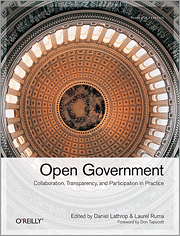
I’m very excited to share I have a chapter in the new O’Reilly Media book Open Government (US Link & CDN Link). I’ve just been told that the book has just come back from the printers and can now be ordered.

Also exciting is that a sample of the book (pictured left) that includes the first 8 chapters can be downloaded as a PDF for free.

The book includes several people and authors I’m excited to be in the company of, including: Tim O’Reilly, Carl Malamud, Ellen Miller, Micah Sifry, Archon Fung and David Weil. My chapter – number 12 – is titled “After the Collapse,” a reference to the Coasean collapse Shirky talks about in Here Comes Everybody. It explores what is beginning to happen (and what is to come) to government and civil services when transaction and coordination costs for doing work dramatically lower. I’ve packed a lot into it, so it is pretty rich with my thinking, and I’m pleased with the result.

If you care about the future of government as well as the radical and amazing possibilities being opened up by new technologies, processes and thinking, then I hope you’ll pick up a copy. I’m not getting paid for it; instead, a majority of the royalties go to the non-profit Global Integrity.

Also, the O’Reilly people are trying to work out a discount for government employees. We all would like the ideas and thinking in this book to go wide and far and around the globe.

Finally, I’d like to give a big thank you to the editors Laurel Ruma and Daniel Lathrop, along with Sarah Schacht of Knowledge as Power, who made it possible for me to contribute.

Today in the Globe: Facebook's Political Reach

I have the following piece published in the Globe and Mail today. It isn’t going to further endear me to Michael Valpy (who is already not impressed with me)… but felt another perspective on the issue was needed. He, like many traditional columnists, is not a fan of social – or digital – media. Indeed, he has argued it is destroying our country’s social cohesion and democracy. Those familiar with me know I feel differently . By allowing us to self-organize, connect to one another and to our politicians, social media is enabling a different and very powerful type kind of social cohesion and democratic expression.

I respect Valpy a lot and hope we get a chance to sit down and talk social media at some point. Given our collective interest in journalism and statements like this, it feels like it would be fruitful for both of us. Hopefully it will happen.

Facebook’s Political Reach

Yesterday, Michael Valpy posted an interesting piece about a Nanos poll showing Canadians – including younger Canadians – question how much influence political Facebook groups should have on any government.

The problem with the piece lies in the headline: “Facebook forums shouldn’t sway government, young Canadians say.” It suggests that online activism – or social media in general – isn’t credible with the public. This, however, isn’t what the poll showed. Indeed, the poll says little about the credibility of Facebook, particularly compared to other forms of political activity. It does, however, say a lot about social media’s dramatic growth in influence over the past five years.

Critically, the poll didn’t compare forms of political activity. If one had done a similar poll asking whether Canadians believe a demonstration should sway the government, or if direct action – such as when Greenpeace hung a banner from Parliament – should alter government policy, would the numbers have been dramatically different? I suspect not. Governments have electoral mandates – something Canadians broadly agree with. Most political activity, both on and offline, is designed to shape public opinion and ultimately, people’s decisions at the ballot box. That is a threat influences government.

Consequently, it may not be the medium that matters as much as the number of people involved. Do people believe the government should pay attention to a 1,000 person rally? Likely not. Should they pay attention to a 10,000 person Facebook group? Likely not as well. But at a certain point, with large enough numbers, almost any medium matters. Would people think that the government should reconsider a policy in the face of 10-million-person petition? Or a five-million-person Facebook group? Possibly. What about a 500,000-person march? Even this might prompt respondents to reconsider their response.

Ultimately, the Globe article jumps to a negative interpretation of Facebook too quickly. This is understandable in that traditional news organizations are still coming to grips with social – and digital – media. But by allowing us to self-organize, connect to one another and to our politicians, social media is enabling a different and very powerful type kind of social cohesion and democratic expression.

More interesting is how split Canadians appear to be over political groups using Facebook “to share ideas, information and to help mobilize their activities” (30 per cent have a positive view, 30 per cent have a negative view and an enormous 40 per cent are undecided). Here is a technology few Canadians knew existed five years ago, and it is already viewed favourably by a third of Canadians as a way to engage with political groups. As people become more familiar with these online activities I suspect comfort levels will rise, since many people often don’t initially understand or like new technologies. This survey shows us online political organizing is moving into the mainstream – perhaps even more mainstream than a protest or a petition.

So should Facebook influence the government? The prorogation debate shows it already can. But do people believe Facebook should be less influential than other (more traditional) forms of political activity? In this, the survey reveals very little. Indeed as Nik Nanos, the pollster who conducted the survey, adds at the end of the piece (and in contrast to the title): “we still haven’t come to grips with what [Facebook groups] really mean.”