Category Archives: cool links

New York release road map to becoming a digital city

Yesterday, New York City released its “Road Map for the Digital City: Achieving New York City’s Digital Future.” For those who missed the announcement, especially those concerned about the digital economy, the future of government and citizen services, the document is definitely worth downloading and scanning.

At the heart of the document sits a road map which I’ve ripped from the executive summary and pasted below.What makes me particularly interested in it is how the Open Government section is not uniquely driven by the desire for transparency but with the goal of spurring innovation and increasing access to services. Of course, the devil is in the details but I’m increasingly convinced that open initiatives will be more successful when the government of the day has some specific policy objectives (beyond just transparency) it wishes to drive home, with open data as part of the mix (more on this in a post coming soon).

As such, “government as platform” works best when the government also builds atop the platform. It itself must be a consumer and stakeholder. This is why section 3 is so important and interesting. Essentially section 2 and 3 have parts that are strikingly similar, its just that section 2 outlines the platform and lays out that the government hopes others will build on top of it whereas parts of section 3 outline what the government intends to build atop of it. Of course section 3 goes further and talks as well about gathering information and data from the public which is the big thing in the Gov 2.0 space that many governments have not gotten around to doing effectively – so this will be worth watching more closely. All of this is great news and exactly what governments should be thinking about.

It is great when a big city comes out with a document like this because while New York is not the first to be thinking these ideas, but its profile means that others will start devoting resources to pursue these ideas more aggressively.

Exciting times.

1. Access

The City of New York ensures that all New Yorkers can access the Internet and take advan- tage of public training sessions to use it effectively. It will support more vendor choices to New Yorkers, and introduce Wi-Fi in more public areas.

  1. Connect high needs individuals through federally funded nyc Connected initiatives
  2. Launch outreach and education efforts to increase broadband Internet adoption
  3. Support more broadband choices citywide
  4. Introduce Wi-Fi in more public spaces, including parks

2. Open Government

By unlocking important public information and supporting policies of Open Government, New York City will further expand access to services, enable innovation that improves the lives of New Yorkers, and increase transparency and efficiency.

  1. Develop nyc Platform, an Open Government framework featuring APIs for City data
  2. Launch a central hub for engaging and cultivating feedback from the developer community
  3. Introduce visualization tools that make data more accessible to the public
  4. Launch App Wishlists to support a needs-based ecosystem of innovation
  5. Launch an official New York City Apps hub

3. Engagement

The City will improve digital tools including nyc.gov and 311 online to streamline service and enable citizen-centric, collaborative government. It will expand social media engagement, implement new internal coordination measures, and continue to solicit community input in the following ways:

  1. Relaunch nyc.gov to make the City’s website more usable, accessible, and intuitive
  2. Expand 311 Online through smartphone apps, Twitter and live chat
  3. Implement a custom bit.ly url redirection service on nyc.gov to encourage sharing and transparency
  4. Launch official Facebook presence to engage New Yorkers and customize experience
  5. Launch @nycgov, a central Twitter account and one-stop shop of crucial news and services
  6. Launch a New York City Tumblr vertical, featuring content and commentary on City stories
  7. Launch a Foursquare badge that encourages use of New York City’s free public places
  8. Integrate crowdsourcing tools for emergency situations
  9. Introduce digital Citizen Toolkits for engaging with New York City government online
  10. Introduce smart, a team of the City’s social media leaders
  11. Host New York City’s first hackathon: Reinventing nyc.gov
  12. Launch an ongoing listening sessions across the five boroughs to encourage input

4. Industry

New York City government, led by the New York City Economic Development Corporation, will continue to support a vibrant digital media sector through a wide array of programs, including workforce development, the establishment of a new engineering institution, and a more stream- lined path to do business.

  1. Expand workforce development programs to support growth and diversity in the digital sector
  2. Support technology startup infrastructure needs
  3. Continue to recruit more engineering talent and teams to New York City
  4. Promote and celebrate nyc’s digital sector through events and awards
  5. Pursue a new .nyc top-level domain, led by DOITT


Become an IDEO.org Resident

This looks quite interesting.

IDEO, an organization known for bringing spurring innovation, creative thinking and user-friendly design, is looking to focus on the social sector. As part of this effort they are going to be hiring a number of residents to use IDEO’s approach and methodology to focus on pressing social problems around the world. IDEO’s an organization I’ve a lot of time and respect for, certainly somewhere I think it would have been amazing to spend a summer in college or a few years afterwards.

Here’s two snippets from their website:

We’re launching IDEO.org to spread human-centered design through the social sector and improve the lives of people in low-income communities across the globe. IDEO.org is starting this September and looking for its first class of residents to be part of the team. Build empathy, generate ideas, prototype concepts, deliver solutions. Join us!

and

Through the course of 11 months, residents will work on poverty related challenges covering an array of topics – such as, agriculture, gender equity, financial services, health, and water and sanitation. Example projects include working with a microfinance institution in Kenya to create new ways for low-income customers to save, supporting a small Indian start-up to design a low-cost electricity system, or partnering with a domestic healthcare non-profit to bring birth control options to low-income women in the U.S.

Residents will be based in San Francisco, but will spend significant time traveling and in the field. Candidates should have an openness to other cultures and lifestyles and will be expected to be self-reliant and thrive in a start-up environment.

You can read more here. Definitely an opportunity worth checking out.

Articles I'm Digesting: Feb 28th, 2011

Been a while since I’ve done one of these. A surprising amount of reading getting done in my life despite a hectic schedule. In addition to the articles below, I recently finished Shirky’s Cognitive Surplus (solid read) and am almost done Kevin Kelly’s What Technology Wants, which, is blowing my mind. More on both soon, I hope.


Why Blogs (Still) Aren’t Dead…No Matter What You’ve Heard by Kimberly Turner

I got to this via Mathew Ingram of GigaOM. A few months ago there was some talk about the decline of blogs. You could almost hear the newspaper people rubbing their hands with glee. Turns out it was all bogus. This article outlines some great stats on the issue and lays out where things are at, and why the rumor got started. The sooner than everyone, from the newspaper writer, to the professional blogger, to the amateur blogger to the everyday twitterer accepts/realizes they are on the same continuum and actually support one another, the happier I suspect we’re all going to be.

The Inside Story of How Facebook Responded to Tunisian Hacks by Alexis Madrigal

Totally fascinating and fairly self-explanatory:

By January 5, it was clear that an entire country’s worth of passwords were in the process of being stolen right in the midst of the greatest political upheaval in two decades. Sullivan and his team decided they needed a country-level solution — and fast…

…At Facebook, Sullivan’s team decided to take an apolitical approach to the problem. This was simply a hack that required a technical response. “At its core, from our standpoint, it’s a security issue around passwords and making sure that we protect the integrity of passwords and accounts,” he said. “It was very much a black and white security issue and less of a political issue.”

That’s pretty much the stand I’d like a software service to take.

Work on Stuff that Matters: First Principles by Tim O’Reilly

Basically, some good touch stones for work, and life, from someone I’ve got a ton of respect for.

Love and Hate on Twitter by Jeff Clark

Awesome visualizations of the use of the words love and hate on twitter. It is amazing that Justin Bieber always turns up high. More interesting are how brands and politicians get ranked.

The Neoformix blog is just fantastic. For hockey fans, be sure to check out this post.

Lazy Journalist Revealer. This. Is. Awesome.

Everybody keeps thinking that transparency and improved access to content is something that is only going to affect government, or, maybe some corporations.

I’ve tried to argue differently in places like this blog post and in Taylor and I’s chapter in The New Journalist.

Here’s a wonderful example of how new tools could start to lay more bare the poor performance of many newspapers in actually reporting news and not simple regurgiatating press releases.

Check out the site – called Churnalism.com – that allows you to compare any UK news story against a database of UK press releases. Brilliant!

Wish we had one of these here in North America.

Found this via the Future Journalism Project, which also links to a story on the Guardian website.

What I’m doing at Code for America

For the last two weeks – and for much of January – I’m in San Francisco helping out with Code for America. What’s Code for America? Think Teach for America, but rather than deploying people into classrooms to help provide positive experiences for students and teachers while attempting to shift the culture of school districts, Code for America has fellows work with cities to help develop reusable code to save cities money, make local government as accessible as your favorite website, and help shift the government’s culture around technology.

code-for-america1-150x112The whole affair is powered by a group of 20 amazing fellows and an equally awesome staff that has been working for months to make it all come together. My role – in comparison – is relatively minor, I head up the Code for America Institute – a month long educational program the fellows go through when they first arrive.  I wanted to write about what I’ve been trying to do both because of the openness ideals of Code for America and to share any lessons for others who might attempt a similar effort.

First, to understand what I’m doing, you have to understand the goal. On the surface, to an outsider, the Code for America change process might look something like this:

  1. Get together some crazy talented computer programers (hackers, if you want to make the government folks nervous)
  2. Unleash them on a partner city with a specific need
  3. Take resulting output and share across cities

Which of course, would mistakenly frame the problem as technical. However, Code for America is not about technology. It’s about culture change. The goal is about rethinking and reimagining  government as better, faster, cheaper and adaptive. It’s about helping think of the ways its culture can embrace government as a platform, as open and as highly responsive.

I’m helping (I think) because I’ve enjoyed some success in getting government’s to think differently. I’m not a computer developer and at their core, these successes were never technology problems. The challenge is understanding how the system works, identify the leverage points for making change, develop partners and collaborate to engage those leverage points, and do whatever it takes to ensure it all comes together.

So this is the message and the concept the speakers are trying to impart on the fellows. Or, in other words, my job is to help unleash the already vibrant change agents within the 20 awesome fellows and make them effective in the government context.

So what have we done so far?

We’ve focused on three areas:

1) Understand Government: Some of the fellows are new to government, so we’ve had presentations from local government experts like Jay Nath, Ed Reiskin and Peter Koht as well as the Mayor of Tuscon’s chief of staff (to give a political perspective). And of course, Tim O’Reilly has spoken about how he thinks government must evolve in the 21st century. The goal: understand the system as well as, understand and respect the actors within that system.

2) Initiate & Influence: Whether it is launching you own business (Eric Ries on startups), starting a project (Luke Closs on Vantrash) or understanding what happens when two cultures come together (Caterina Fake on Yahoo buying Flickr) or myself on negotiating, influence and collaboration, our main challenges will not be technical, they will be systems based and social. If we are to build projects and systems that are successful and sustainable we need to ask the right questions and engage with these systems respectfully as we try to shift them.

3) Plan & Focus: Finally, we’ve had experts in planning and organizing. People like Allen Gunn (Gunner) and the folks from Cooper Design, who’ve helped the fellows think about what they want, where they are going, and what they want to achieve. Know thyself, be prepared, have a plan.

The last two weeks will continue to pick up these themes but also give the fellows more time to (a) prepare for the work they will be doing with their partner cities; and (b) give them more opportunities to learn from one another. We’re half way through the institute at this point and I’m hoping the experience has been a rich – if sometimes overwhelming – one. Hopefully I’ll have an update again at the end of the month.

Most Popular Eaves.ca Posts of 2010

Some people have asked me, what were the 10 most viewed posts from last year? Well here as posts that were written last year in order of popularity (excluding static pages and the homepage):

  1. Case Study: How Open data saved Canada $3.2 Billion
  2. Learning from Libraries: The Literacy Challenge of Open Data
  3. Why Old Media and Social Media Don’t Get Along
  4. Let’s do an International Open Data Hackathon
  5. When Police Lie
  6. UK Adopts Open Government License for everything: Why it’s good and what it means
  7. Visualizing Firefox Plugins Memory Consumption
  8. Wikileaks and the coming conflict between closed and open
  9. What Munir’s Resignation means to Public Servants
  10. Minister Moore and the Myth of Market Forces

Here are the 20 viewed posts in 2010 including posts written in previous years (and including static pages)

  1. My Homepage
  2. Fatness Index – Canada vs. United States
  3. About David
  4. Case Study: How Open data saved Canada $3.2 Billion
  5. Learning from Libraries: The Literacy Challenge of Open Data
  6. Why Old Media and Social Media Don’t Get Along
  7. The other reason young people don’t vote – or why I didn’t vote yesterday
  8. WestJet vs. Air Canada
  9. R2D2 – in the right place at the right time for a reason.
  10. Concerns from Beyond the West: The dangers one-member, one-vote
  11. Banned Blogs
  12. Let’s do an International Open Data Hackathon
  13. When Police Lie
  14. Save the Census Coalition
  15. UK Adopts Open Government License for everything: Why it’s good and what it means
  16. How GCPEDIA will save the public service
  17. Firefox 3 pledge map vs. the Pentagon’s new map
  18. Speeches
  19. The Supreme Court of Canada: There are no journalists, only citizens
  20. The Three Laws of Open Government Data

At some point I’ll write a piece about my favourite posts from 2010…

What I love about the latter list is how many old posts are in there. Some just keep logging hits year after year. The Fatness Index has links all over the internet to it so there is never a day where it doesn’t get at least a few hits. Also think it is hilarious that the R2D2 post is always so strong since it really just links to a great post on another blog – Google just really likes putting it up high on those searches.

What I really like though is the mix: there are pieces on GCPEDIA, open data, the media, Firefox and open source, and politics. A great mix.

What Governments can Learn about Citizen Engagement from Air Canada

Yes. You read that title right.

I’m aware that airlines are not known for their customer responsiveness. Ask anyone whose been trapped on a plane on the tarmac for 14 hours. You know you’ve really dropped the ball when Congress (which agrees on almost nothing) passes a customer bill of rights explicitly for your industry.

Air Canada, however, increasingly seems to be the exception to this rule. Their recent response to online customer feedback is instructive of why this is the case. For governments interested in engaging citizens online and improving services, Air Canada is an interesting case study.

The Background

Earlier this year, with great fanfare, Air Canada announced it was changing how it managed its frequent flyer reward system. Traditional, it had given out upgrade certificates which allowed customers who’d flown a certain number of flights the air-canada-logoability to upgrade themselves into business class for free. Obviously the people who use these certificates are some of Air Canada’s more loyal customers (to get certificates you have to be flying a fair amount). The big change was that rather than simple giving customers certificates after flying a certain number of miles, customers would earn “points” which they could allocate towards flights.

This was supposed to be a good news story because a) it meant that users had greater flexibility around how they upgraded themselves and b) the whole system was digitized so that travelers wouldn’t have to carry certificates around with them (this was the most demanded feature by users).

The Challenge

In addition to the regular emails and website announcement an Air Canada representative also posted details about the new changes on a popular air traveler forum called Flyertalk.com. (Note: Here is the first great lesson – don’t expect customers or citizens to come to you… go to where they hang out, especially your most hard core stakeholders).

flyertalk_logoVery quickly these important stakeholders (customers) began running the numbers and started discovering various flaws and problems. Some noticed that the top tier customers were getting a lesser deal than ordinary customers. Others began to sniff out how the new program essentially meant their benefits were being cut. In short, the very incentives the rewards program was supposed to create were being undermined. Indeed the conversation thread extended to over 113 pages. With roughly 15 comments per page, that meant around 1500 comments about the service.

This, of course, is what happens with customers, stakeholder and citizens in a digital world. They can get together. They can analyze your service. And they will notice any flaws or changes that do not seem above board or are worse than what previously existed.

So here, on Flyertalk, Air Canada has some of its most sophisticated and important customers – the people that will talk to everyone about Air travel rewards programs, starting to revolt against its new service which was supposed to be a big improvement. This was (more than) a little bit of a crisis.

The Best Practice

First, Air Canada was smart because it didn’t argue with anyone. It didn’t have communication people trying to explain to people how they were wrong.

Instead it was patient. It appeared silent. But in reality it was doing something more important, it was listening.

Remember many of these users know the benefits program better than most Air Canada employees. And it has real impact on their decisions, so they are going to analyze it up and down.

Second, When it finally did respond, Air Canada did several things right.

It responded in Flyertalk.com – again going to where the conversation was. (It subsequently sent around an email to all its members).

It noted that it had been listening and learning from its customers.

More than just listen, Air Canada had taken its customers feedback and used it to revise its air travel rewards program.

And, most importantly, the tone it took was serious, but engaging. Look at the first few sentences:

Thanks to everyone for the comments that have been posted here the last few days, and especially those who took the time to post some very valuable, constructive feedback. While it’s not our intent to address every issue raised on this forum on the changes to the 2011 Top Tier program, some very valid points were raised which we agree should be addressed to the best of our ability. These modifications are our attempt to do just that.

Governments, this is a textbook case on how to listen to citizens. They use your services. They know how they work. The single biggest take away here is, when they complain and construct logical arguments about why a service doesn’t make sense use that feedback to revise the service and make it better. People don’t want to hear why you can’t make it better – they want you to make it better. More importantly, these types of users are the ones who know your service the best and who talk to everyone about it. They are your alpha users – leverage them!

Again, to recap. What I saw Air Canada do that was positive was:

  • Engage their stakeholders where their stakeholders hang out (e.g. not on the Air Canada website)
  • Listen to what their stakeholders had to say
  • Use that feedback to improve the service
  • Communicate with customers in a direct and frank manner

Air Canada is doing more than just getting this type of engagement right. Their twitter account posts actual useful information, not just marketing glop and spin. I’m not sure who is doing social media for them, but definitely worth watching.

There’s a lot here for organizations to learn from. Moreover, for a company that used to be a crown corp I think that should mean there is hope for your government too – even if they presently ban access to facebook, twitter or say, my blog.

Big thank you to Mike B. for pointing out this cool case study to me.

Launching Emitter.ca: Open Data, Pollution and Your Community

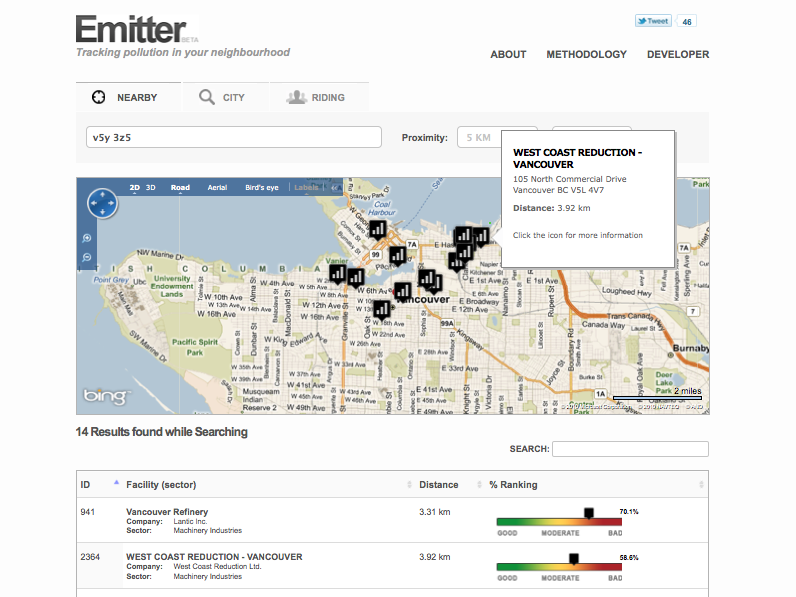
This week, I’m pleased to announce the beta launch of Emitter.ca – a website for locating, exploring and assessing pollution in your community.

Why Emitter?

A few weeks ago, Nik Garkusha, Microsoft’s Open Source Strategy Lead and an open data advocate asked me: “are there any cool apps you could imagine developing using Canadian federal government open data?”

Having looked over the slim pickings of open federal data sets – most of which I saw while linking to them datadotgc.ca – I remembered one: Environment Canada’s National Pollutant Release Inventory (NPRI) that had real potential.

Emitter-screen-shot

With NPRI I felt we could build an application that allowed people and communities to more clearly see who is polluting, and how much, in their communities could be quite powerful. A 220 chemicals that NPRI tracks isn’t, on its own, a helpful or useful to most Canadians.

We agreed to do something and set for ourselves three goals:

  1. Create a powerful demonstration of how Canadian Federal open data can be used
  2. Develop an application that makes data accessible and engaging to everyday Canadians and provides communities with a tool to better  understand their immediate region or city
  3. Be open

With the help of a crew of volunteers with knew and who joined us along the way – Matthew Dance (Edmonton), Aaron McGowan (London, ON), Barranger Ridler (Toronto) and Mark Arteaga (Oakville) – Emitter began to come together.

Why a Beta?

For a few reasons.

  1. There are still bugs, we’d love to hear about them. Let us know.
  2. We’d like to refine our methodology. It would be great to have a methodology that was more sensitive to chemical types, combinations and other factors… Indeed, I know Matt would love to work with ENGOs or academics who might be able to help provide us with better score cards that can helps Canadians understand what the pollution near them means.
  3. More features – I’d love to be able to include more datasets… like data on where tumours or asthama rates or even employment rates.
  4. I’d LOVE to do mobile, to be able to show pollution data on a mobile app and even in using augmented reality.
  5. Trends… once we get 2009 and/or earlier data we could begin to show trends in pollution rates by facility
  6. plus much, much more…

Build on our work

Finally, we have made everything we’ve done open, our methodology is transparent, and anyone can access the data we used through an API that we share. Also, you can learn more about Emitter and how it came to be reading blog posts by the various developers involved.

Thank yous

Obviously the amazing group of people who made Emitter possible deserve an enormous thank you. I’d also like to thank the Open Lab at Microsoft Canada for contributing the resources that made this possible. We should also thank those who allowed us to build on their work, including Cory Horner’s Howdtheyvote.ca API for Electoral District boundaries we were able to use (why Elections Canada doesn’t offer this is beyond me and, frankly, is an embarrassment). Finally, it is important to acknowledge and thank the good people at Environment Canada who not only collected this data, but have the foresight and wisdom to share make it open. I hope we’ll see more of this.

In Sum

Will Emitter change the world? It’s hard to imagine. But hopefully it is a powerful example of what can happen when governments make their data open. That people will take that data and make it accessible in new and engaging ways.

I hope you’ll give it a spin and I look forward to sharing new features as they come out.

Update!

Since Yesterday Emitter.ca has picked up some media. Here are some of the links so far…

Hanneke Brooymans of the Edmonton Journal wrote this piece which was in turn picked up by the Ottawa Citizen, Calgary Herald, Canada.com, Leader Post, The Province, Times Columnist and Windsor Star.

Nestor Arellano of ITBusiness.ca wrote this piece

Burke Campbell, a freelance writer, wrote this piece on his site.

Kate Dubinski of the London Free Press writes a piece titled It’s Easy to Dig up Dirt Online about emitter.ca

Launching datadotgc.ca 2.0 – bigger, better and in the clouds

Back in April of this year we launched datadotgc.ca – an unofficial open data portal for federal government data.

At a time when only a handful of cities had open data portals and the words “open data” were not being even talked about in Ottawa, we saw the site as a way to change the conversation and demonstrate the opportunity in front of us. Our goal was to:

  • Be an innovative platform that demonstrates how government should share data.
  • Create an incentive for government to share more data by showing ministers, public servants and the public which ministries are sharing data, and which are not.
  • Provide a useful service to citizens interested in open data by bringing it all the government data together into one place to both make it easier to find.

In every way we have achieved this goal. Today the conversation about open data in Ottawa is very different. I’ve demoed datadotgc.ca to the CIO’s of the federal government’s ministries and numerous other stakeholders and an increasing number of people understand that, in many important ways, the policy infrastructure for doing open data already exists since datadotgc.ca show the government is already doing open data. More importantly, a growing number of people recognize it is the right thing to do.

Today, I’m pleased to share that thanks to our friends at Microsoft & Raised Eyebrow Web Studio and some key volunteers, we are taking our project to the next level and launching Datadotgc.ca 2.0.

So what is new?

In short, rather than just pointing to the 300 or so data sets that exist on federal government websites members may now upload datasets to datadotg.ca where we can both host them and offer custom APIs. This is made possible since we have integrated Microsoft’s Azure cloud-based Open Government Data Initiative into the website.

So what does this mean? It means people can add government data sets, or even mash up government data sets with their own data to create interest visualization, apps or websites. Already some of our core users have started to experiment with this feature. London Ontario’s transit data can be found on Datadotgc.ca making it easier to build mobile apps, and a group of us have taken Environment Canada’s facility pollution data, uploaded it and are using the API to create an interesting app we’ll be launching shortly.

So we are excited. We still have work to do around documentation and tracking some more federal data sets we know are out there but, we’ve gone live since nothing helps us develop like having users and people telling us what is, and isn’t working.

But more importantly, we want to go live to show Canadians and our governments, what is possible. Again, our goal remains the same – to push the government’s thinking about what is possible around open data by modeling what should be done. I believe we’ve already shifted the conversation – with luck, datadotgc.ca v2 will help shift it further and faster.

Finally, I can never thank our partners and volunteers enough for helping make this happen.