Category Archives: public policy

From here to open – How the City of Toronto began Opening up

Toronto the open

For myself, the biggest buzz at ChangeCamp Toronto was that the city showed up with lots of IT staff (much of it quite senior) who were trying to better understand how they could enable others to use their data and help citizens identify and solve problems. In fact the City of Toronto ran what I believe will be seen later as the most enduring sessions in which they asked what data should they start making available immediately (as APIs).

For those not in the know, think of an API as a plug that rather than delivering electricity instead delivers access to a database.

The exciting outcome is that web designers, coders and companies can then use this data to better deliver services, coordinate activities in neighborhoods, make government more transparent, or analyze problems. For example, imagine if all the information regarding restaurants health violations were not hidden deep within a government website (in a PDF format that is not easily searchable by google) but were available on every restaurant review website? Or if road closures were available in a data stream so a google maps application could show which road were closed on any given day – and email you if they were in your neighborhood.

This is the future that cities like Toronto are moving towards. But why Toronto? How did it arrive at this place? How is it that the City of Toronto sent staff to ChangeCamp Toronto?

The emergence of open in Toronto

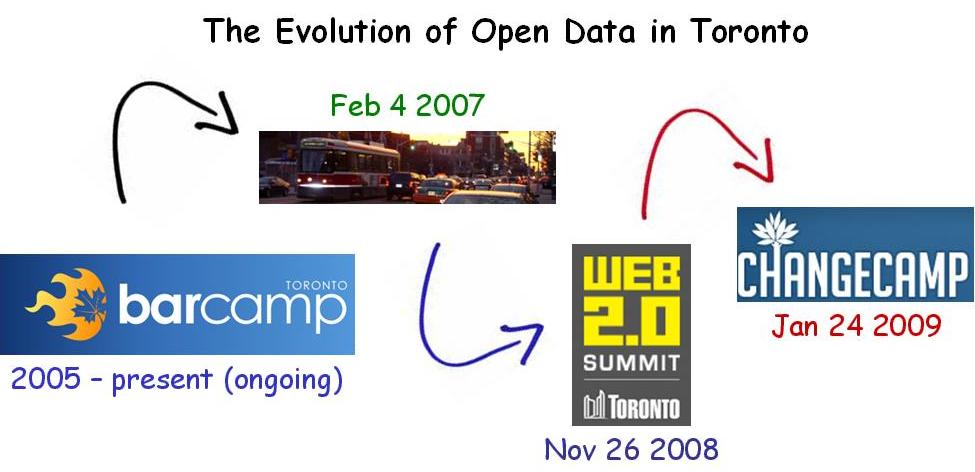
I’ve tried to map this evolution. I may have missed steps and encourage people to email me or post comments if I have.
evolution of open data TO

The first step was taken when people like David Crow created a forum – Barcamp – around which some of Toronto’s vibrant tech and social tech community began to organize itself. This not only brought the community together but it also enabled unconferences to gain traction as a fun and effective approach to addressing an issue.

Then, in late 2006 the Toronto Transit Commission (TTC) issued an Request For Proposals (RFP) for a redesign of its website. Many in the tech community – who had no interest in doing the redesign – were horrified at the RFP. It was obvious that given the specifications the new website would not achieve its potential. A community self-organized around redesigning the RFP. Others took note and, because they cared about the TTC, wanted to also talk about simple non-website changes the TTC could make to improve services. TransitCamp was this born and – with enormous trepidation, some TTC officials showed up (all of whom should be loudly applauded). The result? The tech and social tech community in Toronto was engaged in civic matters and their activities were beginning to make it onto the city government’s radar.

Other Camps carried on through 2007 and 2008 (think OpenCities), building momentum in the city. Then, in November of 2008 – a breakthrough. The City of Toronto hosted an internal Web 2.0 conference and invited Mark Surman – executive director of the Mozilla Foundation and long time participant in the Toronto social tech space – to deliver the keynote entitled “A City that Thinks like the Web“. After the talk, the Mayor of Toronto stood up and said:

” … I’ve been emailing people about your challenges. Open data for Google Transit is coming by next June, and I don’t see what we shouldn’t open source the software Toronto creates.” He also said “I promise the City will listen” if Torontonians set up a site like FixMyStreet.com

You can hear the Mayor Miller’s full response here:

In short, the Mayor promised to begin talking about opening up (and open sourcing) the city. Freeing up Ryan Merkley and the City of Toronto IT team to attend ChangeCamp

Lessons for ChangeCamp Vancouver

It remains unclear to me whether ChangeCamp is the right venue for tackling this opportunity in Vancouver.

We in Vancouver are not as far along the arc as Toronto is. We do, however, have some advantages. The map is more obvious to us and some of us have good relationships with key staff in the city. However, this process takes time. To replicate the success in Toronto, governments here on the west coast need not only be at ChangeCamp, they need to be running sessions and deeply engaged. For this to occur cultures need to be shifted, new ideas need to percolate within government institutions and agencies and relationships need to be built. All this will take time.
The creative age, the budget and the future of class conflict

Yesterday the Martin Prosperity Institute released its report Ontario in the Creative Age. I’ve been reading through it with great, great interest. The influence of Rise of the Creative Class and Who’s Your City is obvious (and expected) and the report is an important and fantastic read. Regardless of whether or not you live in the GTA/Ontario, I highly recommend it. Indeed, I would love to see the Province of British Columbia and the Metro Vancouver commission a similar report. I can imagine the methodology is now in place to do one relatively quickly, and it is urgently needed on the west coast. (Can anyone point to an economic development plan for the Greater Vancouver Area? For the City of Vancouver?)

The report also plays on a theme that has interested me for a while now. The nature of class conflict in networked and creative economy. The report tackles the issue more directly than anything else I’ve seen by Florida to date. This line from the report is illustrative:

The rise of creativity is a double-edged sword. It creates tremendous wealth creation opportunities for some. Yet it can leave many behind – particularly those in jobs built on routine, and those who do not have the opportunity to gain the skills to participate advantageously in the economic transformation we are going through.

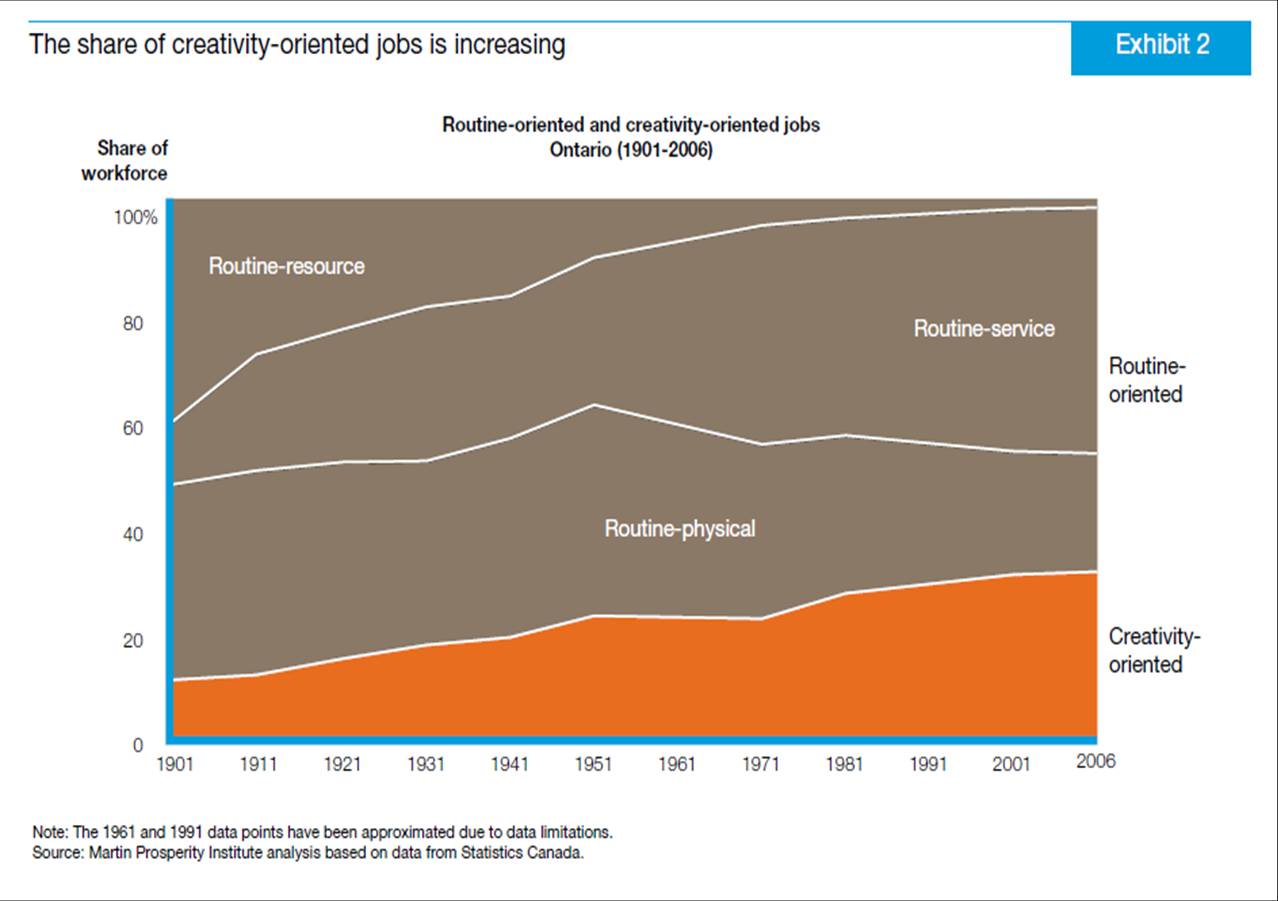
Still more interesting are the trends:
class conflict

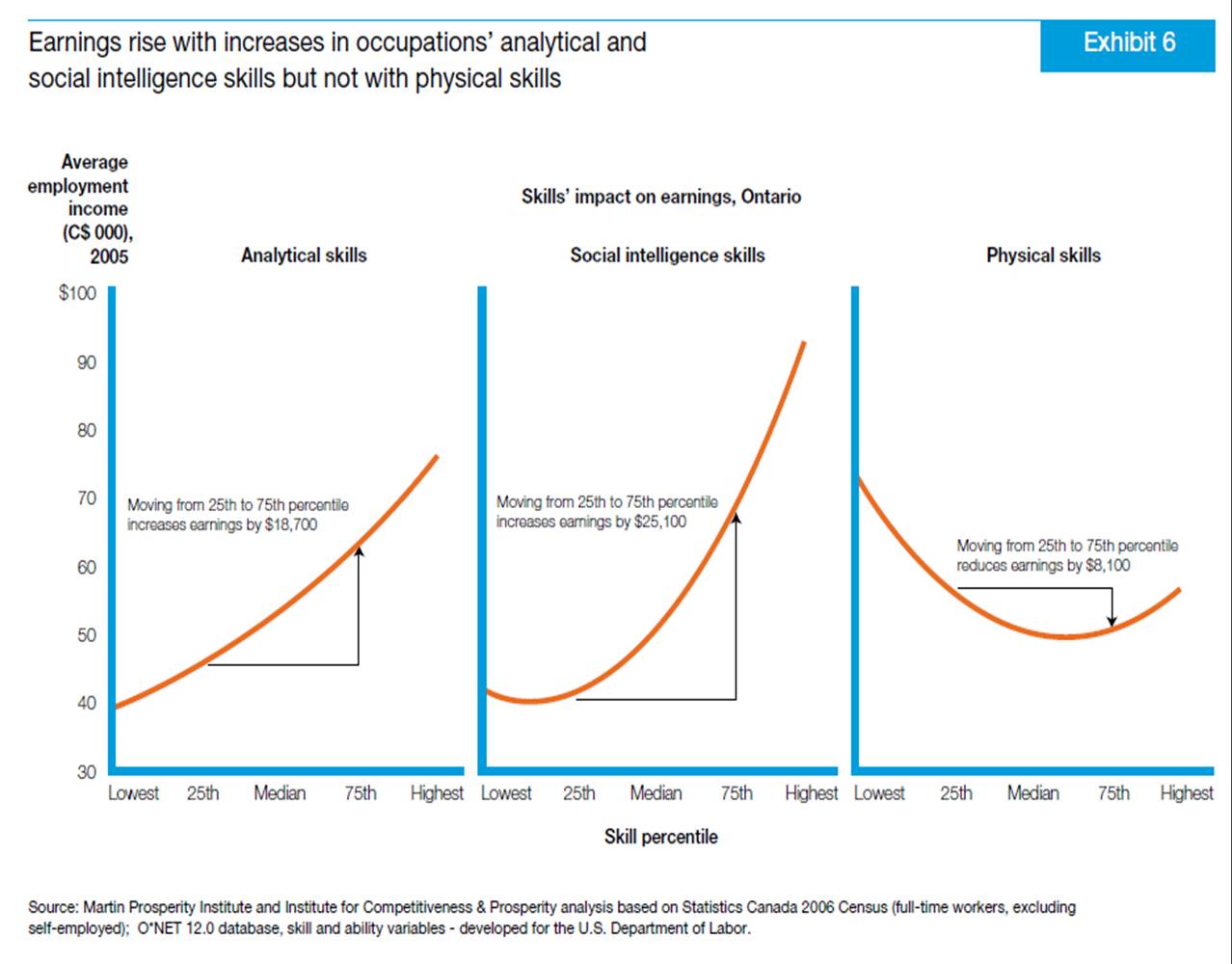
Combine this chart with there second chart that shows how wages grow depending on skill sets (no prizes for figuring out the Routine-physical-oriented jobs correlate with Physical Skills and that Social intelligence skills correlate with Creativity-Oriented jobs).

class wages

It is easy to see that the possibility of tension between routine-oriented and creativity-oriented workers could grow, especially as wage differences continue to increase.

Perhaps the most depressing conclusion to draw from this report is that the stimulus package will do little to address this inequity. A lot items that get funding in such packages (for example, some shovel ready projects) not only generate only temporary growth, but many of the jobs they foster are both becoming fewer – so we are encouraging job growth in shrinking job markets – and have a declining return on investment – so we are encouraging the development of skill-sets in workers that will not increase wages. Consequently, the very actions that traditionally might have helped stave of wage inequality (and in turn class conflict) may actually me exasperating the future likelihood of such inequality.

It’s hard to sell funding for R&D and research as these are often seen as “elite” activities, but interestingly they may offer us the greatest hope in reducing future tension and inequality. Sadly, research, science and education received little attention in the budget.

Creating a City of Vancouver that thinks like the web

Last November my friend Mark Surman – Executive Director of the Mozilla Foundation – gave this wonderful speech entitled “A City that Thinks Like the Web” as a lunchtime keynote for 300 councillors, tech staff and agency heads at the City of Toronto’s internal Web 2.0 Summit.

During the talk the Mayor of Toronto took notes and blackberried his staff to find out what had been done and what was still possible and committed the City of Toronto to follow Mark’s call to:

  1. Open our data. transit. library catalogs. community centre schedules. maps. 311. expose it all so the people of Toronto can use it to make a better city. do it now.
  2. Crowdsource info gathering that helps the city.  somebody would have FixMyStreet.to up and running in a week if the Mayor promised to listen. encourage it.
  3. Ask for help creating a city that thinks like the web. copy Washington, DC’s contest strategy. launch it at BarCamp.

The fact is every major city can and should think like the web. The first step is to get local governments to share (our) data. We, collectively as a community, own this data and could do amazing things with it, if we were allowed. Think of how Google Maps is now able to use Translink data to show us where bus stops are, what buses stop there and when the next two are coming!

Google Map Transit YVR

Imagine if anyone could create such a map, mashing up a myriad of data from local governments, provincial ministries, StatsCan? Imagine the services that could be created, the efficiencies gained, the research that would be possible. The long tail of public policy analysis could flourish with citizen coders, bloggers, non-profits and companies creating ideas, services, and solutions the government has neither the means nor the time to address.

If the data is the basic food source of such an online ecosystem then having it categorized, structured and known is essential. The second step is making it available as APIs. Interestingly the City of Vancouver appears to have taken that first step. VanMaps is a fascinating project undertaken by the City of Vancouver and I encourage people to check it out. It is VERY exciting that the city has done this work and more importantly, made it visible to the public. This is forward thinking stuff. The upside is that, in order to create VanMaps all the data has been organized. The downside is that – as far as I can tell – the public is restricted to looking at, but not accessing, the data. That means integrating these data sets with Google maps, or mashing it up with other data sets is not possible (please correct me if I’ve got it wrong).

Indeed, in VanMaps Terms of Use suggests that even if the data were accessible, you aren’t allowed to use it.

VanMaps EULA

Item 4 is worth noting. VanMap may only be used for internal business or personal purposes. My interpretation of this is that any Mashups using VanMap data is verboten.

But let’s not focus on that for the moment. The key point is that creating a Vancouver that thinks like the web is possible. Above all, it increasingly looks like the IT infrastructure to make it happen may already be in place.

Which University will be smart enough to make Masoda Younasy an offer?

Yesterday, Michael Adams pointed me to this great story in the Globe and Mail about the Masoda Younasy – the granddaughter of Afghanistan’s former king, Mohammad Zahir Shah – who, because she created and ran her own construction business, advocated for reform and mused about entering politics has had death threats hurled against her.

In an extraordinary move, Canada has offered her a permit to live here while her life is at risk. A fantastic start.

So what does she want to do? According to the article:

…her aim is to attend a Canadian university and obtain a political-science degree she might some day put to use in her home country.

What an amazing opportunity. Not only for Ms. Younasy, but for Canadians and, more specifically, the university smart enough and agile enough to offer her a speedy enrollment. My own preference is that Queen’s, which is home to the Centre for the Study of Democracy, might make her an offer. Here is a women keen on bringing democracy and opportunity to a country that has seen little of either – her goals couldn’t be more aligned with those of the institution and her perspective and experience would greatly enrich the discussions in all her classes.

These are the types of opportunities that are easily missed, often because the long term opportunities and benefits – to the student, the university and the country – get trumped by bureaucracy and lack of vision. Well, for those who wonder if it is worthwhile, take note that unwittingly done something similar before and everyone was better off because of it.

ChangeCamp: Pulling people and creativity out of the public policy long tail

ChangeCamp is a free participatory web-enabled face-to-face event that brings together citizens, technologists, designers, academics, policy wonks, political players, change-makers and government employees to answer one question: How do we re-imagine government and governance in the age of participation?

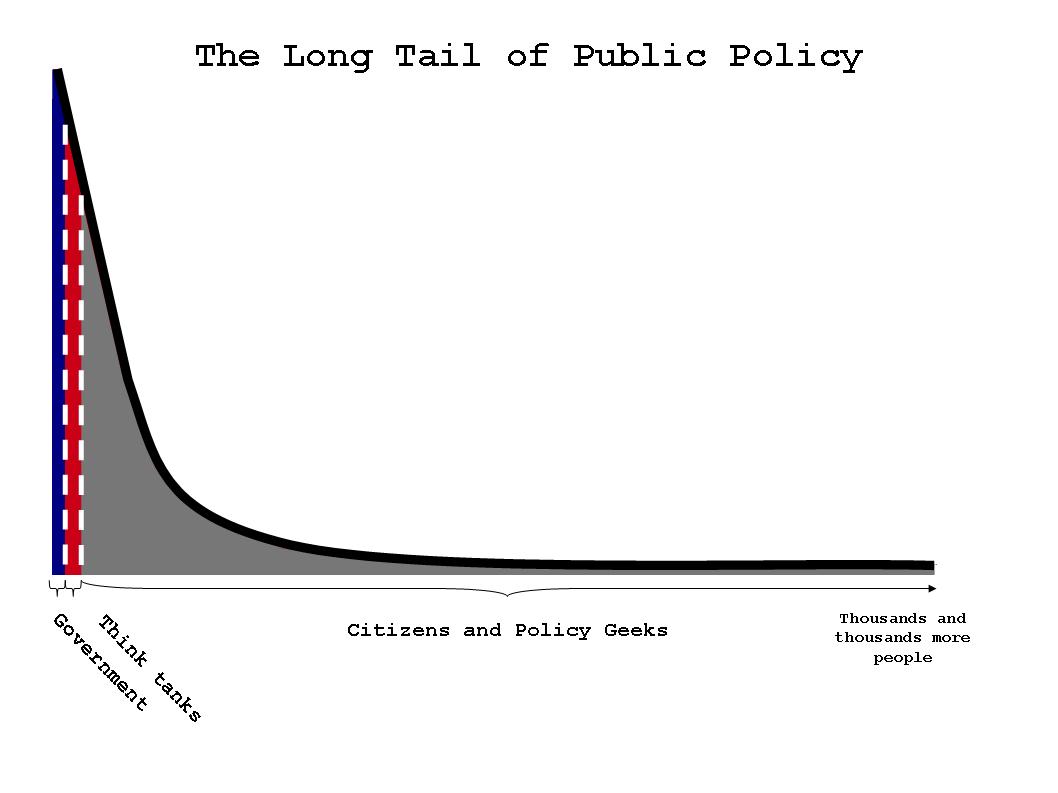
What is ChangeCamp? It is the application of “the long tail” to public policy.

It is a long held and false assumption that ordinary citizens don’t care about public policy. The statement isn’t, in of itself, false. Many, many, many people truly don’t care that much. They want to live their lives focusing on other things – pursuing other hobbies or interests – but there are many of us who do care. Public policy geeks, fans, followers, advocates, etc… we are everywhere, we’ve just been hidden in a long tail that saw the market place and capacity for developing and delivering public policy restricted to a few large institutions. The single most important lesson I learnt from my time with Canada25 is that it doesn’t have to be that way.

Did Canada25 get a new generation of Canadians, aged 20-35 engaged in public policy? I don’t know.

What I do know is, that at the very minimum, we harnessed and enormous, dispersed desire of many Canadians to participate in, and help shape, the public policy debates affecting the country. Most importantly, we did this by doing three things:

  1. we aggregated together the people who cared about public policy, we gave them peers, friends and a sense of community.
  2. we provided a vehicle through which to channel their energy
  3. by combining 1 and 2, and by using simple technology and a low cost approach – we dramatically lowered the barriers (and csots) to entry for credible participating in these national debates

Today, the technology to enable and aggregate people their ideas, to connect them with peers and to create community, is still more powerful. Our capacity to challenge, push, help, cooperate, leverage and compete with the large institutional public policy actors has never been greater. This, for me, is the goal of ChangeCamp. What concrete tools can we build, what information can we demand be opened up, what new relationships can we build to re-imagine how we – the citizens who care – participate in the creation of public policy and the effective delivery of public services. Not to compete or replace the traditional institutional actors, but to ensure more and better ideas are heard and increasingly effective and efficient services are created.

Long tail of public policy

Individually, none of us may have the collective power of a government ministry or even the resources of most think tanks. But collectively, linked together by technology and powered by our energy and spare capital, the long tail of policy geeks and ordinary citizens is bigger, nimbler, more creative and faster than anything else. Do I know that the long tail of policy can be set free? No. But ChangeCamp seems like a fun place to start experimenting, brainstorming and sharing ways we can make this country better.

Why Smart Power matters

America cannot solve the most pressing problems on our own, and the world cannot solve them without America. The best way to advance America’s interest in reducing global threats and seizing global opportunities is to design and implement global solutions. This isn’t a philosophical point. This is our reality.

The president-elect and I believe that foreign policy must be based on a marriage of principles and pragmatism, not rigid ideology. On facts and evidence, not emotion or prejudice. Our security, our vitality, and our ability to lead in today’s world oblige us to recognize the overwhelming fact of our interdependence.

I believe that American leadership has been wanting, but is still wanted. We must use what has been called “smart power,” the full range of tools at our disposal — diplomatic, economic, military, political, legal, and cultural — picking the right tool, or combination of tools, for each situation. With smart power, diplomacy will be the vanguard of foreign policy. This is not a radical idea. The ancient Roman poet Terence, who was born a slave and rose to become one of the great voices of his time, declared that “in every endeavor, the seemly course for wise men is to try persuasion first.” The same truth binds wise women as well.

– Hillary Clinton, January 13th, 2009

During her confirmation hearing before the Senate Foreign Relations Committee Hillary Clinton used the term “Smart Power” no less than 12 times. It is a clever term, one that seeks to navigate between the Hard Power of military might and economic coercion, with the Soft Power of ideology, culture and agenda setting. Does the term signal something new in US foreign policy? Depends on your time frame. Without a doubt it marks the end of the George W. Bush foreign policy era. Clearly the blustery swagger of a shoot first, ask question later has ended. This is a United States that will be more cautious and more engaging. But rather than the start of something new, Smart Power likely signals a return to the Bill Clinton and Bush Sr. era of foreign policy. Indeed, as important as the term Smart Power was, the focus should lie not on the term, but on the revealing paragraph leading up to it:

“The president-elect and I believe that foreign policy must be based on a marriage of principles and pragmatism, not rigid ideology. On facts and evidence, not emotion or prejudice. Our security, our vitality, and our ability to lead in today’s world oblige us to recognize the overwhelming fact of our interdependence.”

Here the guiding principles behind the shift to Smart Power are revealed. Two strike me as paramount. The first reaffirms what I think will be the buzz word of the Obama administration: pragmatism. Despite his soaring speeches and inspiring words Obama is first and foremost interested in achieving the possible – stretch goals are fine – but ideological dreams are not for him. Second, in this speech, the United States’ next Secretary of State signalled to the world that it once again recognizes it cannot go it alone. The acknowledgement of interdependence is the antithesis of “you are with us or against us.” It is an recognition that allies – real allies, not the minnow states bullied into participation – are required to sustain and enhance the stability and prosperity of the international system. Bush Sr. understood this when creating his coalition for the first Gulf War, Clinton sought, insofar as possible, to build similar agreement when advancing his international agenda.

These have two dramatic impacts for Canada – and other countries. The first is that we should expect the Americans will ask us what we think – our advice or thoughts may not change their opinions, but we will likely be asked and when that happens, we’d better have something smart and meaningful to contribute. Second, the opportunity of being consulted comes with it the responsibility to contribute and support, even when the decision or strategy isn’t one that we completely agree with. When you’ve been part of the discussion you can walk away when the rubber hits the road. Third, those who have a well thought out plan for solving a problem will win out over those who have grievances to share. Demonstrate to this administration that you can solve a problem through realizable actions and I suspect they will listen and support you.

For Canadians nowhere is this change in attitude possible more important than on the management of the Canadian Border. I would have a new briefing plan of how we believe the border should be managed ready and waiting for when Clinton or Obama’s first arrives in Ottawa. If the Obama administration acts as it talks, I suspect it will reward and seek out, not those who do as it says, but those who solve the problems they care about. This is a welcome return to the diplomacy of the 1990’s which was also cautious and smart. It was also a good period for Canadian-American relations.

Canadians have spent years hoping the Americans will change. Now that they have, are we ready?

Why Policy Matters in Politics

There are a shocking number of people involved in the political process who firmly believe that policy doesn’t matter. That, at best, it distracts from, and at worst it impedes, successful political campaigns. Obviously, readers of my blog (not to mention those who know me) know that I am a big believer in the power and importance of public policy specifically and ideas in general. So I’ve been feeling nicely bombarded with confirming evidence that substantive policy – as opposed to simply style or spin – really is at the heart of political success.

The first is short and simply: Frank Rich’s excellent, and brutally entitled, column “A President Forgotten but Not Gone” in the Saturday New Times, where he uses Bush as example of the limits both of propaganda, and of power without purpose.

The second is much more in depth. It comes from reading of Tom Kent’s “A Public Purpose.” In it, while talking about the remaking of the Liberal Party after the defeat of the St. Laurent Government in 1957, he notes:

The main lines of policy of the rebuilt Liberal party – conspicuously, the emphasis on employment, medicare, a national pension plan, but many others too – were adopted at the party convention of January 1958, and by as democratic a procedure within the convention as the processes of political parties ever produce…

The policies did not, in other words, originate from the remaking of the party. In essence, they were already written when the organizational rebuilding took place. To a large extent, indeed, the new people who did the organizing came forward because they were coming to a body of ideas, for the better government of Canada, that they felt to be at once progressive and practical.

This is the central fact about the remaking of the Liberal party from 1957-1963. The process was not to regroup, reorganize, and, some time later, determine policies. The main lines of policy came first. They were the presence behind all the detailed work of opposing, reorganizing, finding candidates, building support. all that came second, not first. (Emphasis mine)

Kent’s comments reaffirmed for me three reasons why policy matters in politics:

a) First, while we can debate the degree to which the public reacts to a policy platform, a sound policy platform is an important step to gaining the public confidence. Thus, I can agree with Kinsella that governments are generally turfed out, not elected, while maintaining that an electorates willingness to turn to an alternative is dramatically improved if said alternative has a coherent set of (well thought out) policies.

b) Second, a sound policy platform is necessary to making a party electable because it has always been ideas, not the remote promise of power, that has attracted the new blood and energy to the party. As Kent points out, in 1957 the new policy platform of the Liberal party preceded its reorganizations and rejuvenation because new innovative and progressive policies attracted a new generation of leaders, activists and organizers into the party. Without this new energy a party will wither and die, no matter how inept or incompetent is competitors.

c) Finally, and possibly most importantly, policy is critical to governing successfully. Kissinger, for all his faults, articulated this challenge succinctly:

High office teaches decision making, not substance. It consumes intellectual capital; it does not create it. Most high officials leave office with the perceptions and insights with which they entered; they learn how to make decisions but not what decisions to make.

In short, once elected you are too busy to build your intellectual capital and to formulate a plan. You must have a vision and platform in place beforehand, otherwise you’ll end up looking like Diefenbaker or Martin, operating without an obvious direction or purpose. Policy matters because without it, time in government will be unproductive, painful and short.

The Next Economy – Why the wrong Stimulus today could fail us tomorrow

After reading The Great Crash it is hard to not feel that we are the cusp of another economic depression – the parallels between today and 1929 or almost eeire. Much like the last crash, a whole slew of business models, technologies and ways of thinking are simply going to become obsolete (or at least, not-profitable).

For example, I was talking to an American friend whose partner had been laid off by a bank and they were talking about what expenses they were going to try to eliminate. High on the list? Their land line and cable television. Low on the list? Cell phones and their high speed internet. This may finally be the beginning of the end for the old copper wire – this will accelerate a trend begun about a decade ago in which households have no fixed phone line. Indeed, Reuters is reporting that:

In the first half of 2008, 17.5 percent of households were wireless only, up from 13.6 percent a full year earlier…

…Service providers such as Verizon Communications, AT&T Inc, Qwest Communications International and others have seen a steep increase in customers cutting the cord on their home phones.

Qwest said recently that the trend was exacerbated by the weak economy as some customers were disconnecting home phones to save money.

It makes sense. Why keep a land line when you can just use your cell, or even Skype for free when you are at home?

What this means is that connectivity has never been more important to people – not just for social, but also for professional reasons. Can anyone imagine a professional, creative classer or service sector employee, under the age of 35 looking, for a job without an internet connection? Impossible. The simple fact is that a robust telecommunications network – specifically, access to the internet – is today what an electrical, phone or road network was in the 1930’s. That means, if you want to help invest for the economy of tomorrow, help bring the costs of accessing the internet today – and make sure everyone can get access.

At the moment, one reason why costs are high is because providers have agreed to build their networks out, even to “unprofitable” parts of the country. If the government provided – or helped to provide – such access internet access could be rendered cheaper and service could be improved.

My biggest fear is that here in Canada and the in United States the call for a “new” New Deal with result in a stimulus package that looks a lot like the new deal of the 1930’s – with big infrastructure projects receiving the bulk of the money. The fact is, unlike in the 1930’s new roads aren’t going to generate the same returns over the next 50 years like they did back then – there will be marginal returns at best and negative returns at worst. What we need to identify the infrastructure that is going to guide the next economy, not the last one.

And be afraid, because one thing is almost certain, the next economy almost certainly doesn’t include an auto sector of even remotely the same size or structure. (Think how much ZIP car reduces the need for cars.)

Noam Chomsky name drops Taylor Owen

Check out this video of Noam Chomsky dropping my man Taylor Owen‘s name over and over again in regards to the excellent article he and Ben Kiernan wrote in The Walrus about the scope and impact of the bombing of cambodia.

Definitely check out the article if you haven’t already – it outlines a compelling case for why bombing campaigns are so problematic against insurgencies. It is a thread that Taylor and I picked up on in this op-ed in Embassy magazine last May.

name dropping begins around minute 46 – you can skip straight to it

Why StatCan is (or could be) like Google

Statscan Google logoThe other week I gave a talk on Gen Y, Gen X, Technology and the Future of the Public Service at StatCan’s managers’ meeting. The speaker before me apparently told the gathering that they “should be more like Google” if they want to recruit young talent. During his Q&A one of the managers asked how a government agency could be like Google (a legitimate question, I thought) and the speaker didn’t have much to say. Frustrating, no?

Definitely.

But I think there is a good case. While the idea of StatCan emulating one of the best performing, young, hottest companies in Silicon Valley may sound far-fetched, it needn’t. StatCan can be like Google. In fact, it already is.

Look, for a second, a Google’s strategy. Google’s mission is encapsulated in its SEC filing statement:

“to organize the world’s information …. and make it universally accessible and useful”. Google explains that it believes that the most effective, and ultimately the most profitable, way to accomplish our mission is to put the needs of our users first. Offering a high-quality user experience has led to strong word-of-mouth promotion and strong traffic growth. Putting users first is reflected in three key commitments illustrated in the Google SEC filing: “1. We will do our best to provide the most relevant and useful search results possible, independent of financial incentives. Our search results will be objective and we will not accept payment for inclusion or ranking in them.

  1. We will do our best to provide the most relevant and useful advertising. Advertisements should not be an annoying interruption. If any element on a search result page is influenced by payment to us, we will make it clear to our users.
  2. We will never stop working to improve our user experience, our search technology and other important areas of information organization”.

To organize the world’s information… and make it universally accessible. This a huge part of StatCan’s mission. To organize Canada’s information… (now if only we made it universally accessible).

I think Google’s mission is similar to StatCan’s. Indeed the main difference is that StatCan not only organizes Canada’s information; it also creates that data. However, this is a space that Google has moved aggressively into — why do you think it has created platforms like Google Earth? To facilitate the creation of data so that it has more to organize and offer its users. Indeed, what is interesting about Google is that it knows the more information and data that is out there – for free – the more useful and important it becomes. It means more people doing searches, which means more advertising revenue.

So what does this mean for StatCan?:

First, distinguish and separate what you do: “Creating and organizing information about Canada” from what makes you valuable: making this information universally available to citizens.

Second, make yourself the centre of a data gathering, sharing and analyzing eco-system: There are thousands, if not hundreds of thousands of people out there who could do amazing things with StatCan’s data. The problem is, it isn’t easy to find, often you have to pay for it, and it is usually only available in HTML charts that aren’t easily accessed, and certainly not dynamically available. If StatCan data was available as API’s and Excel spreadsheets, then a whole ecosystem of multimillion dollar businesses, bloggers and other pro-ams would emerge around it as supporters, collaborators and complementors.

Finally, hire young people to make it happen because if you are open, they will come: Does StatCan want young people to come work for them? Then stop behaving like a 20th-century consulting firm whose job is to hoard data and conduct analyses for clients. (Don’t worry you can still do this). Instead, act like the 21st-century Google-like platform that you are. Your job should be to make your data as searchable, taggable, as pluggable, in short, as usable, as possible. This, in addition to collection, should be the top priority. If StatCan’s data were easily available (say as an API) people would start using it in all sorts of creative ways – this, and this alone will drive innovation, excitement, energy and buzz about Statcan into the workplace. In short, it will make Statcan relevant. StatCan should be a place where young Canadians want to work so they can learn how to handle and disseminate HUGE quantities of data to everyone from the smallest bloggers to the largest companies. That skill set is going to be critical in the 21st century and so such a mission will attract talent top talent, if StatCan gives them the freedom to play and build it.

StatCan is like Google — if it chooses to be. It can’t offer the stock options, but it can offer a cool opportunity to help build the country’s most critical data ecosystem for a 21st century economy. That’s a job lots of geeks would be interested in.