Category Archives: public service sector renewal

PublicVoice Interview on "Open," Government and Citizen Engagement

A couple of weeks ago I was interviewed by Maclean’s columnist Scott Feschuk for PublicVoice.tv on what the rise of “open” systems and the continuing evolution of information technology will mean for the future of both government and citizen engagement.

Cleverly, they’ve kept these videos nice and short – it’s all designed to be short and punchy. There will be five 1-3 minute videos in a all and so far the first two have been posted. You can see them here and here.

Sadly, the lighting isn’t all that flattering… consider yourself warned.

Why Canada’s public services need faith

As I mentioned the otherday, I recently finished Thomas S. Kuhn’s classic 1962 book “The Structure of Scientific Revolutions.” For those unfamiliar with the text, it is the book that gave us the important and oft over-used term, “paradigm shift.”

Here, in this book about how progress is made in the sciences I was completely floored by this paragraph in penultimate chapter: The Resolution of Revolutions.

…the issue is which paradigm should in the future guide research on problems many of which neither competitor can yet claim to resolve completely. A decision between alternate ways of practicing science is called for, and in the circumstances that decision must be based less on past achievement than on future promise. The man who embraces a new paradigm at an early stage must often do so in defiance of the evidence provided by problem-solving. He must, that is, have faith that the new paradigm will succeed with the many large problems that confront it, knowing only that the old paradigm has failed with a few. A decision of that kind can only be made on faith. (pages 157-158/3rd edition)

This describes precisely how I feel about Public Service Sector Renewal (reforming the public service). When I talk and write about an open and networked government I understand it raises questions around accountability, ministerial responsibility and human resource management. I’m aware that these are “large problems” for which our present structure has some – albeit highly imperfect and I’d argue, quickly eroding – answers.

Moreover it is true, that if we decided on how and if to reform government based solely on the performance of past models then we would always choose the status quo. The corporate hierarchy has served us well. Any new model will appear, relatively speaking, untested. But a growing number of us know that the status quo is unsustainable.

I know that any new system, however slight the change, will bring with it new challenges and questions, but the paralyzing and untenable problems with the current system will ultimately outweigh these unknowns – even in an organization as conservative as the public service. Ultimately, I am saying that a new system can succeed with many large problems confronting it even as the old system has failed only with a few.

So, as odd as it is to admit, I am, in part, acting on faith. Not only that, I believe the public service is going to learn to have faith as well. Why? Because in the end we won’t have a choice – the old problems this system cannot solve will demand it. We will have to change, and that will mean, someone, somewhere in the public service have put their foot forward into the unknown.

Indeed, many already have.

Reforming Government on the Globe & Mail's Wiki

A few months ago John Ibbitson – the Globe and Mail columnist who used to cover Ottawa and now covers Washington, DC – asked me if I’d help edit the 3rd chapter of his new book, Open & Shut.

The chapter, entitled Yes, Mr. President; No, Prime Minister asks why is it that after 8 years of President Bush, President Obama is able to quickly change the direction of government whereas in Canada, newly elected parties often struggle to implement their agenda.

Last week the book was released. As part of the launch process the Globe and Mail created a wiki dedicated to the book’s themes where readers can critic or expand on its ideas and analysis. More interestingly, as readers post to the wiki John will respond to their  ideas, critics and thoughts on a blog hosted by the Globe.

To kick off the wiki on Open Government, John asked me if I would write a short essay answering the following the question:

Federal politicians, and federal public servants, seem increasingly remote and disconnected from the lives of Canadians. Open and Shut maintains that this is because the public service remains closed to outsiders, and because Ottawa has ceded so much power to the provinces. Do we want our federal government to matter more in our lives, and if so, what should we do to give it meaning?

You can see my response, and what I hope will eventually become a growing number of comments on the future of the public service, here.

As an aside, two other sections have been created. One is on Open Politics, which is teed up by John Duffy (political strategist). The other is on Canada/US integration, which is kicked off by Scotty Greenwood (executive Director of the Canadian-American Business Council).

What the post-bureaucratic era will mean for the public service

In a number of blog posts and, in greater detail, in a number of lectures and speeches I’ve been outlining how the social and organizational impact of  information technologies (like wikis and blogs) will uproot and transform the public service. Specifically, in the coming era of self-organizing, the public service will have to find new ways to balance accountability and control with decentralization, accelerated information flows and emergent problem-solving.

There is, obviously, a ton to dive into here, which is what I’ve been having fun doing in my lectures and seminars. The other week while doing a presentation in Ottawa to a group of Health Canada employees, one of the participants asked me what the implications of self-organizing systems and social media would be for the core values of the public service (the Canadian Federal Public Service is the case study here, but this discussion likely applies to most government bureaucracies). More importantly, he wanted to know if they would have to be amended or changed. I’m not certain they do, but that doesn’t mean they won’t need to be reviewed…

For example, zero in on one of the Public Service’s core values in particular:

Professional Values: Serving with competence, excellence, efficiency, objectivity and impartiality.

  • Public servants must work within the laws of Canada and maintain the tradition of the political neutrality of the Public Service.
  • Public servants shall endeavour to ensure the proper, effective and efficient use of public money.
  • In the Public Service, how ends are achieved should be as important as the achievements themselves.
  • Public servants should constantly renew their commitment to serve Canadians by continually improving the quality of service, by adapting to changing needs through innovation, and by improving the efficiency and effectiveness of government programs and services offered in both official languages.
  • Public servants should also strive to ensure that the value of transparency in government is upheld while respecting their duties of confidentiality under the law.

None of these values are wrong. What will be challenging is how emerging technologies will shift expectations among citizens around how these values should being interpreted and what that means for how government operates.

In his 2008 Bertha Bassam Lecture at the University of Toronto, David Weinberger points out that for the last several centuries we have associated credibility (read: professionalism) with objectivity and impartiality (note values listed above). However, the rise of the internet is beginning to erode the link that once bound credibility to objectivity and impartiality:

“Wikipedia is far more credible because it shows us how the sausage is made makes Wikipedia far more credible. Yet this is exactly the stuff that the Britannica won’t show us because they think it would make them look amateurish and take away from their credibility. But in fact transparency – which is what this is – is the new objectivity. We are not going to trust objectivity, we are not going to trust objectivity unless we can see the discussion that lead to it.”

Replace Britannica in this sentence with “the public service” or “government” and you see the problem. The values of the public service presume that objectivity and impartiality will lead to credibility.  Increasingly, however, this is no longer the case. We want the right to see how the sausage is made. More importantly, as an increasing number of organizations like Mozilla, Wikipedia and DirectLauncher make it clear that such transparency is both technically and practically feasible – even when managing highly complex and sensitive tasks – our expectations around what we expect of government is starting to shift. Who do you trust more? Wikipedia or the Government of Canada’s website? Who let’s you see the discussion? This answer to this question is getting less and less clear.

Indeed it is this increasing number of transparent organizations that throw the last bullet in the section on professional values into sharp relief:

Public servants should also strive to ensure that the value of transparency in government is upheld while respecting their duties of confidentiality under the law.

Even if the public’s expectations of what should be legal confidential does not shift, radical change will still be necessary. Already you see people beginning to demand better access to all sorts of government data sets (think the Sunlight Foundation). And we haven’t even mentioned the whole process of Freedom of Information Requests (FOI). Here is a system that is clearly overwhelmed. But think more carefully about the whole process of FOI. The fact that information is by default secret (or functionally secret since it is inaccessible to the public) and that it must be requested is itself a powerful indication of just how fundamentally opaque government is. In a world where information generation is growing exponentially, will the government really be able to manage and access all of it, and determine what is confidential and what isn’t? This seems like a system destined for real challenges. All of this to say that even if the last line of the value statement above does not change one iota, what it means – and citizens expectations around its implementations – is going to change radically.

This transition – the movement from a public service that is opaque by 21st century standards to one that is transparent is going to be gut-wrenching, challenging and painful, not because it isn’t technically possible, but because it is going to require reversing 200 years of culture, values and modes of operation that are embedded within the public service and deeply embedded within the political class. This isn’t to say that the transition will erode the power or influence of these groups, it won’t. But it will be different, and that in of itself is often scary enough to create resistance and a painful transition.

In conclusion, I suspect that the few of the values will, or need, to change – indeed most are necessary and good. However, while the values themselves won’t change, continuing to adhere to them will require dramatic changes to how the public service operates.

Public Service Renewal Event in Ottawa: Etienne LaLiberte

For public servants who read my blog I wanted to let you know that Etienne Laliberte, who I’ve got a lot of time for on the Public Service Renewal front, is coming to Ottawa to do an armchair discussion this Tuesday. I consider Etienne a must talk to person around this stuff so if you find the ideas on this blog interesting, definitely go check him out.

Armchair Discussion – National Capital Region

Tuesday, March 17, 2009, 8:30 a.m. to 11:00 a.m. (ET)

Living Renewal: How to Turn an Organization Around in 1,000 Days

Speaker: Etienne Laliberté
Senior Advisor, Change Management and Organization Development,
Conservation and Protection – Fisheries and Oceans Canada

English Presentation

Challenge the myths around change management and demonstrate how simple – and yet difficult! – turning an organization around can be!

To say the organization was in a poor state would be an understatement – it was a mess! Much of the pride and commitment of the employees had been eroded, if not lost altogether. Relations between management and staff were strained and the organization was preceded throughout by its “bad reputation”.

Fast-forward 3 years later: trust has been rebuilt, employees are as dedicated as they ever were, and people are now saying: “If this organization was able to realized great change, anyone can!” How did this organization renew itself? What were the steps that lead to organizational healing? What were the big lessons learned? What can you do to make renewal a reality in your organization?

In this presentation, Etienne Laliberté, will tell the story of the renewal lived in his organization over the years, and even share the secrets of how they systematically do staffing in three weeks (yes, that is correct: only three weeks!!!). Please join us!

You are invited to attend this Armchair Discussion on-site at 65 Guigues Street (Ottawa) or participate online via live Webcast (video and audio feed offered online).

Speaker: Etienne Laliberté is Senior Advisor, Change Management and Organization Development, for Conservation and Protection at Fisheries and Oceans Canada in Vancouver (Etienne.Laliberte@dfo-mpo.gc.ca). He is best known for his provocative paper “An Inconvenient Renewal“. He is also the author of the blog “Contrarian Thinking“. A federal Public Servant since 2003, Etienne holds a Masters in Project Management (M.SC.) and has ten years of experience in the subject areas of consulting and management. He has received recognition for his work including the 2005 Management Trainee Association (MTA) Merit Award; the 2008 Fisheries and Oceans Canada Pacific Region Distinction Award, and; the 2008 National Managers’ Community Leadership Award for the Pacific Region. For more: http://www.gcpedia.gc.ca/index.php/User:EtienneLaliberte

To register, please visit the School’s Web site:

http://www.csps-efpc.gc.ca/eve/air/index-eng.asp

Discussion informelle – Région de la Capitale Nationale

Mardi 17 mars 2009, 8 h 30 à 11 h (HE)

Vivre le renouvellement: comment transformer une organisation en 1000 jours

Conférencier: Etienne Laliberté
Conseiller principal, Gestion du changement et développement organisationnel
Conservation et protection – Pêches et Océans Canada

Présentation en anglais

Détruisez les mythes entourant la gestion du changement et voyez à quel point il est simple – et pourtant si difficile – de transformer une organisation !

Ce serait un euphémisme que d’affirmer que l’organisation était en mauvais état – c’était un beau gâchis! La fierté et l’engagement des employés avaient été gravement ébranlés, voire complètement anéantis. Les relations entre la direction et le personnel étaient tendues et partout, la mauvaise réputation de l’organisation la précédait.

Projetons-nous dans l’avenir, soit trois ans plus tard : la confiance est restaurée, les employés sont plus dévoués et les gens disent maintenant : « Si cette organisation a réussi tout cela, tout le monde peut y arriver! ». Comment cette organisation est-elle parvenue à se renouveler? Quelles étapes ont mené à cette guérison organisationnelle? Quelles sont les grandes leçons apprises? Que pouvez-vous faire pour faire du renouvellement une réalité dans votre organisation?

Au cours de cette présentation, Étienne Laliberté relatera le déroulement du renouvellement vécu dans son organisation au cours des dernières années, et partagera même comment on y fait de la dotation en trois semaines (oui, vous avez bien lu: seulement trois semaines!!!). Soyez des nôtres!

Vous êtes invités à assister à cette Discussion informelle en personne au 65, rue Guigues (Ottawa) ou participer au moyen de la webdiffusion en direct (couverture vidéo et audio offerte en ligne).

Conférencier : Etienne Laliberté est Conseiller principal, Gestion du changement et développement organisationnel, Conservation et protection, Pêches et Océans Canada à Vancouver. Il est l’auteur de « Un renouvellement qui dérange : les gestionnaires de la FP sont-ils disposés à modifier leur mode de gestion ». Il est également l’auteur du blogue « Contrarian Thinking » (site anglais). Fonctionnaire au gouvernement fédéral depuis 2003, M. Laliberté est titulaire d’une maîtrise en gestion de projet (M. Sc.) et compte dix années d’expérience dans les domaines de la consultation et de la gestion. M. Laliberté a été reconnu pour son travail. En effet, il a été récipiendaire du Prix d’excellence de l’Association des stagiaires en gestion en 2005, du Prix de distinction de Pêches et Océans Canada pour la région du Pacifique en 2008, et du Prix du leadership de la communauté nationale des gestionnaires pour la région du Pacifique également en 2008. Pour en savoir plus: http://www.gcpedia.gc.ca/index.php/User:EtienneLaliberte

Pour vous inscrire, veuillez consulter le site Web de l’École:

http://www.csps-efpc.gc.ca/eve/air/index-fra.asp

How GCPEDIA will save the public service

GCPediaGCPEDIA (also check out this link) is one of the most exciting projects going on in the public service. If you don’t know what GCPEDIA is – check out the links. It is a massive wiki where public servants can share knowledge, publish their current work, or collaborate on projects. I think it is one of two revolutionary changes going on that will transform how the public service works (more on this another time).

I know some supporters out there fear that GCPEDIA – if it becomes too successful – will be shut down by senior executives. These supporters fear the idea of public servants sharing information with one another will simply prove to be too threatening to some entrenched interests. I recognize the concern, but I think it is ultimately flawed for two reasons.

The less important reason is that it appears a growing number of senior public servants “get it.” They understand that this technology – and more importantly the social changes in how people work and organize themselves that come along with them – are here to stay. Moreover, killing this type of project would simply send the worst possible message about public service sector renewal – it would be an admission that any real efforts at modernizing the public service are nothing more than window dressing. Good news for GCPEDIA supporters – but also not really the key determinant.

The second, and pivotal reason, is that GCPEDIA is going to save the public service.

I’m not joking.

Experts and observers of the Public Service has been talking for the last decade about the demographic tsunami that is going to hit the public service. The tsunami has to do with age. In short, a lot of people are going to retire. In 2006 52% of public servants are 44-65. in 1981 it was 38%, in 1991 it was 32%. Among executives the average ages are higher still. EX-1’s (the most junior executive level) has an average age of 50, Ex 2’s are at 51.9, Ex 3’s at 52.7 and Ex 4’s at 54.1. (numbers from David Zussman – link is a powerpoint deck)

Remember these are average ages.

In short, there are a lot of people who, at some point in the next 10 years, are going to leave the public service. Indeed, in the nightmare scenario, they all leave within a short period of time – say 1-2 years, and suddenly an enormous amount of knowledge and institutional memory walks out the door with them. Such a loss would have staggering implications. Some will be good – new ways of thinking may become easier. But most will be negative, the amount of work and knowledge that will have to be redone to regain the lost institutional memory and knowledge cannot be underestimated.

GCPEDIA is the public service’s best, and perhaps only, effective way to capture the social capital of an entire generation in an indexed and searchable database that future generations can leverage and add to. 10’s of millions of man-hours, and possible far more, are at stake.

This is why GCPEDIA will survive. We can’t afford for it not to.

As an aside, this has one dramatic implication. People are already leaving so we need to populate GCPEDIA faster. Indeed, if I were a Deputy Minister I would immediately create a 5 person communications team whose sole purpose was two fold. First to spread the word about the existence of GCPEDIA as well as help and encourage people to contribute to it. Second, this team would actually interview key boomers who may not be comfortable with the technology and transcribe their work for them onto the wiki. Every department has a legend who is an ES-6 and who will retire an ES-6 but everybody knows that they know everything about everything that ever happened, why it happened and why it matters. It’s that person everybody wants to consult with in the cafeteria. Get that person, and find a way to get their knowledge into the wiki, before their pension vests.

Wedding Open Source to Government Service Delivery

One of the challenges I’m most interested in is how we can wed “open” systems to government hierarchies. In a lecture series I’ve developed for Health Canada I’ve developed a way of explaining how we do this already with our 911 service.

To begin, I like using 911 as an example because people are familiar and comfortable with it. More importantly, virtually everyone agrees that it is not only an essential piece of modern government service but also among the most effective.

What is interesting is that 911, unlike many government programs, relies on constant citizen input.  It is a system that has been architected to be participatory. Indeed it only works because it is participatory – without citizen input the system falls apart. Specifically, it aggregates, very effectively, the long-tail 0f knowledge within a community to deliver, with pin point accuracy, an essential service to the location it is needed at a time it is needed.

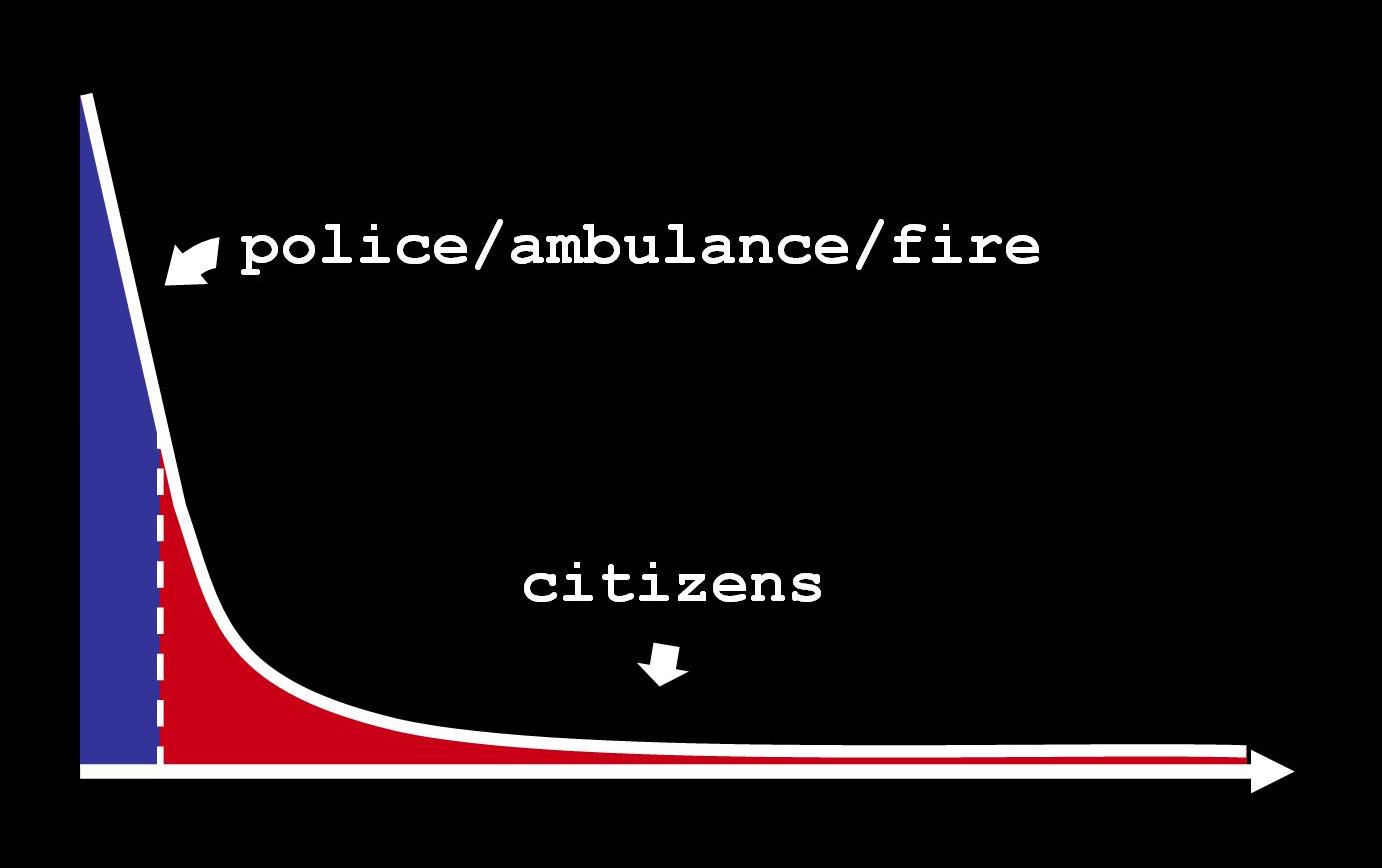
I’ve visualized in this slide below (explanation below the fold)

long tail public policy

Imagine the white curve represents all of the police, fire and ambulance interventions in a city. Many of the most critical interventions are ones the police force and ambulance service determine themselves (shaded blue). For example, the police are involved in an investigation that results in a big arrest, or the ambulance parks outside an Eagles reunion concert knowing that some of the boomers in attendance will be “over-served” and will suffer a heart attack.

However, while investigations and predictable events may account for some police/fire/ambulatory actions (and possibly those that receive the most press attention) the vast majority of arrests, fire fights and medical interventions result from plain old 911 calls made by ordinary citizens (shaded red). True, many of these are false alarms, or are resolved with minimal effort (a fire extinguisher deals with the problem, or minor amount of drugs are confiscated but no arrests made). But the sheer quantity of these calls means that while the average quality may be low, they still account for the bulk of successful (however defined) interventions. Viewed in this light 911 is a knowledge aggregator, collecting knowledge from citizens to determine where police cars, fire trucks and ambulances need to go.

Thus to find a system that leverages citizens knowledge and is architected for participation we don’t need to invent something new – there are existing systems, like 911, that we can learn from.

With this in mind, two important lessons about 911 leap out at me:

1) It is a self-interested system: While many 911 callers are concerned citizens calling about someone else I suspect the majority of calls – and the most accurate calls – are initiated by those directly or immediately impacted by a situation. People who have been robbed, are suffering from a heart attack, or who have a fire in their kitchen are highly incented to call 911. Consequently, the system leverages our self interest, although it also allows for good Samaritans to contribute as well.

2) It is narrowly focused in its construct: 911 doesn’t ask callers or permit callers to talk about the nature of justice, the history of fire, or the research evidence supporting a given medical condition. It seeks a very narrow set of data points: the nature of the problem and its location. This is helpful to both emergency response officials and citizens. It limits the quantity of data for the former and helps minimize the demands on the latter.

These, I believe, are the secret ingredients to citizen engagement of the future. A passive type of engagement that seeks specific, painless information/preferences/knoweldge from citizens to augment or redistribute services more effectively.

It isn’t sexy, but it works. Indeed we have 20 years of evidence showing us how well it works with regards to one of our most important services.

From here to open – How the City of Toronto began Opening up

Toronto the open

For myself, the biggest buzz at ChangeCamp Toronto was that the city showed up with lots of IT staff (much of it quite senior) who were trying to better understand how they could enable others to use their data and help citizens identify and solve problems. In fact the City of Toronto ran what I believe will be seen later as the most enduring sessions in which they asked what data should they start making available immediately (as APIs).

For those not in the know, think of an API as a plug that rather than delivering electricity instead delivers access to a database.

The exciting outcome is that web designers, coders and companies can then use this data to better deliver services, coordinate activities in neighborhoods, make government more transparent, or analyze problems. For example, imagine if all the information regarding restaurants health violations were not hidden deep within a government website (in a PDF format that is not easily searchable by google) but were available on every restaurant review website? Or if road closures were available in a data stream so a google maps application could show which road were closed on any given day – and email you if they were in your neighborhood.

This is the future that cities like Toronto are moving towards. But why Toronto? How did it arrive at this place? How is it that the City of Toronto sent staff to ChangeCamp Toronto?

The emergence of open in Toronto

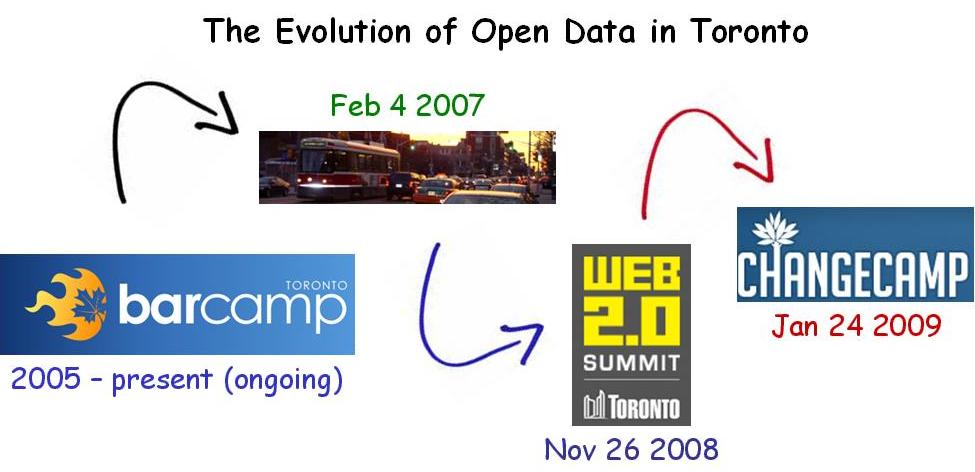
I’ve tried to map this evolution. I may have missed steps and encourage people to email me or post comments if I have.

evolution of open data TO

The first step was taken when people like David Crow created a forum – Barcamp – around which some of Toronto’s vibrant tech and social tech community began to organize itself. This not only brought the community together but it also enabled unconferences to gain traction as a fun and effective approach to addressing an issue.

Then, in late 2006 the Toronto Transit Commission (TTC) issued an Request For Proposals (RFP) for a redesign of its website. Many in the tech community – who had no interest in doing the redesign – were horrified at the RFP. It was obvious that given the specifications the new website would not achieve its potential. A community self-organized around redesigning the RFP. Others took note and, because they cared about the TTC, wanted to also talk about simple non-website changes the TTC could make to improve services. TransitCamp was this born and – with enormous trepidation, some TTC officials showed up (all of whom should be loudly applauded). The result? The tech and social tech community in Toronto was engaged in civic matters and their activities were beginning to make it onto the city government’s radar.

Other Camps carried on through 2007 and 2008 (think OpenCities), building momentum in the city. Then, in November of 2008 – a breakthrough. The City of Toronto hosted an internal Web 2.0 conference and invited Mark Surman – executive director of the Mozilla Foundation and long time participant in the Toronto social tech space – to deliver the keynote entitled “A City that Thinks like the Web“. After the talk, the Mayor of Toronto stood up and said:

” … I’ve been emailing people about your challenges. Open data for Google Transit is coming by next June, and I don’t see what we shouldn’t open source the software Toronto creates.” He also said “I promise the City will listen” if Torontonians set up a site like FixMyStreet.com

You can hear the Mayor Miller’s full response here:

In short, the Mayor promised to begin talking about opening up (and open sourcing) the city. Freeing up Ryan Merkley and the City of Toronto IT team to attend ChangeCamp

Lessons for ChangeCamp Vancouver

It remains unclear to me whether ChangeCamp is the right venue for tackling this opportunity in Vancouver.

We in Vancouver are not as far along the arc as Toronto is. We do, however, have some advantages. The map is more obvious to us and some of us have good relationships with key staff in the city. However, this process takes time. To replicate the success in Toronto, governments here on the west coast need not only be at ChangeCamp, they need to be running sessions and deeply engaged. For this to occur cultures need to be shifted, new ideas need to percolate within government institutions and agencies and relationships need to be built. All this will take time.

Lessons from the Globe and Mail's Policy Wiki

I’ve been observing the Globe Policy Wiki with enormous interest. I’m broadly supportive of all of Mathew Ingram’s experiments and efforts to modernize the Globe. That said, my sense is that this project project faces a number of significant challenges. Some from the technology, others around how it is managed. Understanding and cataloging the ups and downs of such this effort is essential. At some point (I suspect in the not too distant future) wikis will make their way into the government’s policy development process – the more we understand the conditions under which they flourish, the more likely such experiments will be undertaken successfully.

Here are some lessons I’ve taken away:

1. The problem of purpose: accuracy vs. effectiveness

Wiki’s are clearly effective at spreading concrete, specific knowledge. Software manuals, best practice lists and Wikipedia works because – more often than not – they seek to share a concrete, objective truth. Indeed “the goal” of Wikipedia is to strive for verifiable accuracy. Consequently, a Wikipedia article on Mohandas Karamchand Gandhi can identify that he was born on October 2nd, 1869. We can argue whether or not this is true, but he was born on a specific day, and people will eventually align around the most accurate answer. Same with a software wiki – a software bug is caused by a specific, verifiable, set of circumstances.  Indeed, because the article is an assemblage of facts its contributors have an easier time pruning or adding to the article.

Indeed, it is where there is debate and subjective interpretation that things become more complicated in Wikipedia. Did George Bush authorize torture? I’ll bet Wikipedia has hosted a heady debate on the subject that, as yet, remains unresolved.

A policy wiki however, lives in this complicated space. This is because the goal of a policy wiki is not accuracy. Policies are are not an assemblage of facts whose accuracy can be debated. A policy is a proposal – an argument – informed by a combination of assumptions, evidence and values. How does one edit an argument? If we share different values, what do I edit? If I have contradictory evidence, what do I change? Can or should one edit a proposal they simply don’t agree with? In Wikipedia or in online software manual the response would be: “Does it make the piece more accurate?” If the answer is yes, the you should.

But with is the parallel guiding criteria for a policy wiki? “Does it make the policy more effective?” Such a question is significantly more open to interpretation. Who defines effective?

It may be that for a policy wiki will only work within communities that share a common goal, or that at least have a common metric for assessing effectiveness. More likely, Wikis in areas such as public policy may require an owner who ultimately acts as an arbiter deciding which edits stand and which edits will get deleted.

2. Combining voting with editing is problematic.

The goal of having people edit and improve a policy proposal runs counter to those of having them vote on a proposal. A wiki is, by definition, dynamic. Voting – or any preference system – implies that what is being voted on is static and unchanging; a final product that different people can assess.  How can a user vote in favour of something if, the next day, if it can be changed into something I may disagree with it? By allowing simultaneously for voting and editing I suspect the wiki discourages both. Voters are unsure if what they are voting for will stay the same, editors were likely wary of changing anything too radically because the voting option suggests proposals shouldn’t change too much – undermining the benefits of the wiki platform.

3. While problematic for editing, the Policy Wiki could be a great way to catalog briefs

One thing that is interesting about the wiki is that anyone can post their ideas. If the primary purpose were to create a catalogue of ideas the policy wiki could be a great success. Indeed, given that people are discouraged from radically altering policy notes this is effectively what the Policy Wiki is (is it still a wiki?). Presently the main obstacle to this success is the layout. The policy briefs currently appear in a linear order based on when they were submitted. This means a reader must scroll through them one by one. There is no categorization or filtering mechanism to help readers find policies they specifically care about. A search feature would enable readers to find briefs with key words. Also, enabling users to “tag” briefs would allow readers to filter the briefs in more useful ways. One could, for example, ask to see briefs tagged “environment,” or “defense” taking you to the content you want to see faster.

Such filtering approaches might distribute readers more accurately based on their interests. In a recent blog post Ingram notes that the Flat Tax briefing note received the most page views. But this should hardly come as a surprise (and probably should not be interpreted as latent interest in a flat tax). The flat tax brief was the first brief on the list. Consequently, casual observers showing up on the site to see what it was all about were probably just clicking on the first brief to get a taste.