Category Archives: technology

YouTube Interviews: Strengths and Weaknesses

I’m pretty much expecting to wake up today and read a number of stories about how the YouTube interview of the Prime Minister didn’t work, about how we should leave interviews to journalists, and that all this internet, audience driven stuff is a big waste of time.

I’m not sure I agree.

Was the interview good? It wasn’t amazing. But was it terrible? Definitely not. And not nearly as bad as some interviews with the Prime Minister that I’ve seen… So what worked and what didn’t work and what lessons can we draw from all this whether you live in Canada, the United States or wherever else in the world. What makes for a good crowdsourced interview?

Weaknesses:

Be careful of refocusing questions: Many of the Prime Minister’s responses were great. However, during some of the questions the Prime Minister reverted to some very well trodden talking points – or didn’t even answer the specific question asked. For example the question on mandatory minimum sentences he spoke of the Canadians say they want, not what, as the question stipulated, the research shows and the question of Marijuana become about drugs writ large – not about cannabis specifically. This is, of course, standard practice among politicians when answering reporters questions. The challenge is, that if these types of forums become popular and are watched by a number of people, it is unclear how favourable people will view a politician who avoids – however delicately or lightly – a question posed by a citizen. Maybe this medium changes nothing – but I again agree with Ivor Tossell and many others have to say:

Succeeding with social media comes down to being honest, having a frank, unfiltered voice and letting personality go along with policy.

Re-directing questions does not qualify. The public recognizes that journalists are not politicians friends and so give politicians more license when dealing with them – not so when dealing with a smart clear question from a fellow citizen.

Follow Up Questions: This of course raises the formats main weakness. There are no follow up questions allowed. So when someone evades or redirects a question there is no way to hold them to account. This doesn’t mean accountability and credibility disappear. Again, as I noted on Monday, its simply shifts onto the shoulders of the interviewee. You must now genuinely engage the question as the question asker intended. If not, I suspect you come out looking worse.

Pick your interviewer carefully. Here in Canada, Google elected to use their CFO Patrick Pichette (and ex-expatriate Canadian). I’ve only met him once at a small lunch in Montreal but I have a lot of time for him. He immediately struck meas insightful, quick and deeply intelligent. I’m also not sure he was the right choice for interviewer. Throughout the interview he is heard making sounds of agreement with the Prime Minister (such as saying “that’s terrific” after an answer) as though affirming the answer. This felt outside his role and prevented the questions from being as pointed as I believe the authors wished they would have been. All in all, the feel was less of an interview than of a friendly conversation.

Strengths:

Ask the most voted questions: Sadly, the couldn’t find a way to see the questions or how many votes they had received (#fail on google’s part there – accountability denied), but I did recognize many of the questions asked and am doubly impressed that a question on marijuana. In short, if you make a contract with the audience – eg you are going to ask the questions with the most votes… you’d better do it. I also thought many of the questions asked were quite good. Focus on the budget, Afghanistan, Foreign Aid (two foreign policy questions! two more than the last election debate in this country!), pensions, the carbon emissions policy… a good mix. Wish I knew if they were actually the questions with the most votes though…

Broadly people ask good question/but could do with some advice: Many of the questions were reasonable tough and well put. Some were a little long, and others had too many caveats that allow the interviewee to latch on to and avoid the main thrust of the inquiry. Might be good to model a good question to viewers in terms of focus and length as well as provide some written advice. I actually enjoyed seeing people ask questions and think the process could be stronger still.

Video Questions are better than read questions: Lesson for the audience. Submit your question via video. Better still, if you live in a bilingual country, try to subtitle it (Wouldn’t that be a cool thing to be able to do). The video questions really allowed the medium to show itself off, far more interesting to see a young women asking a question from her kitchen than to have an interview read it…

(Advice) Share each answer as a small video: If you really want citizens talking about issues, Google should share the entire interview, but also each individual question and answer. That way there can be questions specific comments on the YouTube site, people can blog about a specific question that concerned them and show only that question in the post, or people can simply zero in on the issue they care about most. The whole point of the internet is that information can be moved around easily – so if you are doing an interview… make it easy for your audience to share the part they cared about by making it digestable.

Be Real: The Prime Minister shone best when he was at his most conversational and relaxed. Indeed, this in part came through during the Marijuana question – his response was emotionally fantastic, he seemed genuinely concerned and possibly even off his speaking points a bit (or maybe just smooth enough to fool me, but I suspect not). Even though I found he answer infuriating – he seemed to completely forget all the lessons of prohibition (and, in effect, label every beer brewer in the country a scumbag) – he was at least human. And that’s when social media works best, when we get to see people being human. Otherwise, you just look wooden and, frankly, uninteresting.
The Prime Minister, The Press and The Fear Disintermediation

Last week the Prime Minister announced that he would use YouTube to answer citizen submitted questions. Over the past seven days thousands of Canadians have submitted and voted on questions that they would like to Prime Minister to answer.

Is this novel or new? Not really – on a smaller scale politicians have been doing Town Hall meetings for decades and, in the US, President Obama has answered questions posed over YouTube and indeed, some YouTube questions were even inserted into the Presidential debates in the 2008 presidential election.

Is it, however, good? Absolutely. Giving Canadians the opportunity to submit questions to the Prime Minister – and to vote on questions that they think are important – is a fantastic way to let the government (and media) know about the priorities and concerns of citizens. Some will laugh at the fact that the top questions revolve around the decriminalization of cannabis. But then, there is a significant and vocal minority who both feel strongly about this subject and unrepresented by the political parties and the media. I think it is fantastic that they get to ask the Prime Minister their question.

Then there are those who wonder if this YouTube press conference is another death knell for traditional media. Some journalists have scoffed at the idea of citizens asking questions. Citizens don’t know the issues well enough or aren’t articulate enough to ask questions. Maybe, but journalists should remember that they are talking about their audience. Can one really write for an audience you hold in contempt? Maybe it would be worth listening to them… Underling it all is a concern that the press will be cut out of the picture. If the Prime Minister can connect directly with citizens… what role is left for the press? The fact is there will always be a role of intelligent, informed people to comment on what is going on in Ottawa. Indeed, smart traditional media outlets should welcome this developing. By drawing people into the political process YouTube is growing the audience of people who care about politics and who will want to read about it.

But will the Q&A help the Prime Minister attract voters and even engage citizens? That is a completely different question. Where the journalists have a point is that they – sometimes deservedly, sometimes not – have brought credibility to the process of holding the Prime Minister and government to account. Their job (performed with a mixed degree of success) is to ask hard questions. They bring credibility to the process. What I’m not sure the PMO (or politicians generally) realize is that removing journalists doesn’t make the process easier – it makes it harder. Now the credibility of the process lies completely in their hands. If the Prime Minister does not address questions that received a lot of votes – the whole experiment will be labeled a communications gimmick and could end up costing him. Moreover, if he only answers softball questions or doesn’t actually engage the tough components of some of the questions posed, he will lose credibility. No longer can the PMO blame the media for spinning him badly, Canadians will now see if, left completely to his own devices, will the Prime Minister actually talk about issues or just issue talking points, reach out to Canadians or firm up his base.

And actually engaging votes will require a big shift for the PMO (or most politicians). As most online experts will tell you, and as Ivor Tossell aptly discussed yesterday, online interactions work best when you actually interact with the audience. Issuing press releases and spouting sound bites over a blog, or a YouTube video, won’t cause the online world to take interest, in fact, it will positively turn them against you. But then, maybe this is a constituency most politicians simply don’t care about and so simply being online will be sufficient, as it gives the Prime Minister and other politicians the appearance of being online to the offline world…

Some questions I hope the PM answers:

“A majority of Canadians when polled say they believe marijuana should be legal for adults and taxes like alcohol. Why don’t you end the war on drugs and focus on violent criminals.” (Cause it is the most voted for)

“Sir, the US Government much larger yet they disclose much more information about contracts, grants and lobbyists. When will the Government of Canada disclosure more information to the taxpayers of Canada” (cause I care about open government)

Since research has shown that mandatory minimum sentencing does not deter future crime, what makes you believe this is still an effective way of prosecuting criminals? (cause evidence based public policy matters)

Why is the government not more open about the Afghan detainee issue? Every time a legitimate question is asked, the response is that we should “support our troops” and look the other way (because every Canadian wants this questions answered)

Mid-last year, the CBC stated that the GST cuts introduced by your government have hiked the deficit by as much as $10 BILLION. Since most everyday purchases only end up saving Canadians pennies, why not raise the GST back to previous levels? (a great accountability question)

“Canadians seemed happy about your decision to match donations to Haiti after the devastating Earthquake; however, it has recently been discovered that the money has not gone out. Why was there a delay and when can we expect to see the money spent?” (great accountability question)

“As a gay Canadian, why should I support your government?” (was told about this question but couldn’t find it – google, filter failure! – I think this is precisely the type of question the media will never ask…)

Q&A from O'Reilly Media: Gov 2.0 International Online Conference

I know during my session I wasn’t able to answer everyone’s questions. However, I was able to find a few other questions in the chat and twitter stream. I’m a big believer that everyone should have a chance to ask a question so – with apologies that I couldn’t do them live – here are some responses!

@Subbob: How possible is to have real meaty policy discussion within a gvmt internal wiki, given the possibility of leaks, which may lead to a scandal?

Short answer: Absolutely.
Longer answer: I actually think there are two different points you are raising – (a) can you have a substantive discussion in a wiki and (b) can you do (a) under the threat of a leak.
I think (a) on its own, is definitely doable. Indeed, it may be the best place to have a substantive discussion. It allows a diversity of actors (with the civil service – and possibly some invited from the outside?) to participate. The key is creating a culture where people explain the underlying logic of their arguments and avoid positional statements. Lots of stuff I can port in from the negotiation and collaboration theory space here. Take a look at my presentation “Community Management as the Core Competency of Open Source.”

The threat of a leak increases the range of choices by which one leaks a document, but not the risk (in my opinion) stays the same. Did the installations of telephones in government employees offices increased the risk of leaks? I’d say it just lowered the transaction cost. But should we tear out the phones from government employees offices? Absolutely not. They need them to work. More importantly, as I shared on the conversation – I’m really disturbed by the unintended consequences of these decision to disallow tools cause of the risks of leaks: what does it say about the trust government has in its employees – and its ability to attract or retain top talent. (I talk about this point in more detail here, little bit about it again here.

Much like 3rd world leapfrogged 1st world in mobile, do you see the same thing happening with Gov2?

Super interesting question.

Short answer: Yes

Long answer… it is more complicated.

First, we are definitely straying on the edges of where I’m knowledgeable enough to talk about this, so take everything I say with grains of salt (of course you should approach everything I say, or anyone for that matter, with a healthy amount of skepticism). I think there is an opportunity to governments in developing countries to leap straight to Gov2. Indeed, some of the opportunities around fighting corruption (not have human tellers for many services, who sometimes demand to be bribed before helping) is driving this in places like India. Moreover, I think the cellphone network in Africa may drive some governments to build themselves around such networks, which could cause them to create themselves in networked as opposed to hierarchical manners.

I see two major obstacles. One structural, one cultural.

The structural challenge is the nature of how democratic systems do (and should work). The accountability model found in democracy often means that strong hierarchical lines of control extend out of the executive. This is even more the case in authoritarian regimes. My suspicion is that even though sometimes weak, emerging democracies or emerging markets have as much “unlearning” to do as we do in rethinking these models. Given they may be smaller this might be easier, but…

Never underestimate the culture challenges. For better or worse the Western World has held up its democracies and government institutions as “the model” against which others should measure themselves (and, we should collectively note, in many cases have tied our development funding to promoting that model). This means that rather than inventing something new, replicating what exists in the west has become the gold standard for democracy and governance. I suspect that in many cases replicating these models is actually the goal of many public services in emerging markets or developing democracies – so the barrier is that those on the ground and a goal that will likely steer them away from gov2.0.

Really tricky question that one… Would love to see what examples of gov2.0 exist on the ground in some emerging markets. What a wonderful opportunity.

What is state of knowledge capture in Canada crown agencies? Earliest SoMe projects in US included use of forums as pseudo-wikis for internal knowledge capture.

Great question and I confess I do not know (for those unfamiliar with the term a Crown Corporation is a company owned by the government but run independently – so, for example, Canada Post, would be a Crown Corp). If anyone knows of some projects in this space please comment or send me an email.

Interview on the State of Open Gov and Gov 2.0 on O'Reilly Radar

At the moment I’m at the mid-point of an epic 8 city, two and a half week tour de force (Vancouver-Chicago-Ottawa-Edmonton-Toronto-New York City-Toronto-Austin-Indianapolis-Vancouver) with talks happening at most stops (I’ve three today).

As some of you already know, one of today’s talk is part of the online Gov 2.0 International Conference being hosted by O’Reilly Media. Last count I heard was that over 600 people had registered, so hopefully there will be a good turn out over the intertubes. It is free to attend so click on the link about to check it out.

As part of the lead up to the event I did the following interview on O’Reilly Radar, talking about where Canada is in terms of Open Government and Gov 2.0 as well as touching on some of the themes raised in my chapter “After the Collapse” that O’Reilly published in their recently released book: Open Government: Collaboration, Transparency, and Participation in Practice. Interviews like this are fun as they push my thinking – I hope you find it interesting.

On a related but separate note – C-FAX radio personality Murray Langdon interviewed me about my Globe and Mail GCPEDIA article. If you are in Victoria this morning you should be able to catch it.

Today in the Globe: A Click Heard Across the Public Service

I had the following piece published in the Globe and Mail today. It’s actually better if you read it there since I could easily include the hyperlinks when blogging from my phone.

The piece can be found here:
http://www.theglobeandmail.com/news/politics/a-click-heard-across-the-public-service/article1493566/

A Click Heard Across the Public Service

Quietly, without fanfare, a small but powerful seismic shift took place in the public service last week. Against the roar of the budget, the rumblings around pension reform and the release of the Fourth Report of the Prime Minister’s Advisory Committee on the Public Service it went virtually unnoticed. But the long-term ramifications of this event could be more significant than the others.

So what happened?

The Clerk of the Privy Council Office – the most senior public servant in Canada – logged on to GCPEDIA, created a page and asked public servants to talk to him directly about renewing the bureaucracy. Although a simple act, it has deep significance. In an organization that has struggled with renewing itself for the 21st century, GCPEDIA represents this single most ambitious experiment for rethinking how the public service conducts its business. Like the now famous Wikipedia, GCPEDIA is a wiki: a collection of pages that any public servant can create or edit. But rather than serve as an encyclopedia, it serves as a creative space, a place where public servants can collaborate, share their work openly with others across government and gather a diversity of perspectives on the challenges and programs they work on.

In short, GCPEDIA and other similar platforms offer one of the government’s best opportunities to breakdown silos both within and across ministries.

And this is why it is so distrusted in some quarters. These technologies – increasingly commonplace in the private and non-profit sector for their capacity to improve efficiency and distribute information – challenge cultural norms and processes in hierarchical institutions. More subversive still, at least in a culture that sometimes identifies power with budget or headcount, GCPEDIA costs less than $1.5-million in staff time. It is hard to imagine a tool, service or technology made available to every public servant in Canada in the last decade that’s as affordable.

The arrival of these new social media tools is disruptive. Some public servants are keen users, others are confused and uncertain while still others – particularly managers – see the technology as a threat to their control over information. Consequently, while many – including many young public servants or ministries like Natural Resources – have embraced wikis and Wikipedia, others have directly forbidden their employees to share information or work on the platform.

The Clerk’s decision to use GCPEDIA is thus an important statement – one he intended to be heard across the public service. He is signaling to others, especially those in senior positions, to look closely at GCPEDIA and other new tools and encouraging them to experiment with how it might transform their work.

Like many public servants, the Clerk knows the status quo cannot continue. As William Eggers points out in his interview with Kathryn May, Canadians are increasingly disillusioned by the gap between what government promises and what it delivers. When asked to name major successful government projects over 90 per cent of public servants surveyed provided examples a decade old or more. Moreover, in a world where more and more activity takes place online an increasingly digital citizenry and workforce is not interested in engaging with, or being served by, an analogue government. If the public service is going to succeed in addressing large problems, or even just small ones that cross ministries, it needs to find new ways of working and collaborating internally. Indeed, it is hard to imagine that it will be able to retain good employees unless it gives them modern tools – tools they use for free at home – to do their job.

Battles over pensions, talk about the budget or reports about changing the public service will dominate the headlines, but a more profound debate is quietly taking place – one that will have far reaching consequences to both the future of our government and the country. The Clerk’s mouse click does not end the debate, but it does signal that the leadership is increasingly interested in developing a 21st-century public service and one that is willing to engage in real experiments to achieve it.

Open Source Strategy: OpenMRS case study

Last week I had the pleasure of being invited to Indianapolis to give a talk at the Regenstrief Institute – an informatics and healthcare research organization – which also happens to host the founders of OpenMRS.

For those not familiar with OpenMRS (which I assume to be most of you) it is open-source, enterprise electronic medical record system platform specifically designed to respond to those actively building and managing health systems in the developing world. It’s a project I’m endlessly excited about not only because of its potential to improve healthcare in developing and emerging markets, but also because of its longer-term potential to serve as a disruptive innovator in developed markets.

Having spent a few days at Regenstrief hanging out with the OpenMRS team, here are some take aways I have regarding where they are, and where – in my mind – they should consider heading and what are some of the key places they could focus on to get there.

Current State: Exiting Stealth Mode

Paul Biondich and Andrew Arenson point me to this article about Community Source vs. Open Source which has an interesting piece on open source projects that operate in “Stealth Mode”

It is possible to find models similar to community source within the open source environment. For example, some projects opt to launch in a so called ‘stealth mode’, that is, they operate as a truly open source development from inception, but restrict marketing information about the project during the early stages. This has the effect of permitting access to anyone who cares enough to discover the project, whilst at the same time allowing the initiating members to maintain a focus on early strategic objectives, rather than community development.

OpenMRS has grown in leaps and bounds and – I would argue – has managed to stay in stealth mode (even with the help of their friends at Google summer of code). But for OpenMRS to succeed it must exit stealth mode (a transition that has already been steadily gathering steam). By being more public it can attract more resources, access a broader development community and role out more implementations for patients around the world. But to succeed I suspect that a few things need to be in place.

Core Opportunities/Challenges:

1. Develop OpenMRS as a platform to push people towards cooperating (as opposed requiring collaboration) whenever possible.

One of the smartest things Firefox did was create add-ons. The innovation of add-ons accomplished two benefits. First, it allowed those working on the trunk of the Firefox code to continue to do their work without being distracted by as many feature requests from developers who had an idea they wanted to try out. Second, it increased the number of people who could take interest in Firefox, since now you could code up your own add-on cooperatively but independently, of the rest of the project.

With OpenMRS my sense is that then entire UI is a platform that others should be able to develop or build add-on’s for. Indeed, the longer term business model that makes significant sense to me is to treat OpenMRS like WordPress or Drupal. The underlying code is managed by a core open source community but installation, customization, skinning, widgets, etc… is done by a mix of actors from amateurs, to independent hackers and freelancers to larger design/dev organizations. The local business opportunities to support OpenMRS and, in short, create an IT industry in the developing world, are enormous.

2. Structural Change(s)

One consequence of treating OpenMRS as a platform is that the project needs to be very clear about what is “core” versus what is platform. My sense is that members of the Mozilla team does not spend a lot of time hacking on add-ons (unless they have proven so instrumental they are brought into the trunk). Looking at WordPress the standard install theme is about as basic as one could expect. It would seem no one at WordPress is wasting cycles developing nice themes to roll out with the software. There is a separate (thriving) community that can do that.

As a result, my sense is that OpenMRS should ensure that its front-end developers slowly begin to operate as a separate entity. One reason for this is that if they are too close to the trunk developers they may inadvertently prevent prevent the emergence of a community that would specialize in the installing and customizing of OpenMRS. More importantly, those working on the platform and those working on the trunk may have different interests, and so allowing that tension to emerge and learning how to manage it in the open will be healthy for the long term viability of the project as more and more people do front end work and share their concerns with trunk developers.

3. Stay Flexible by Engaging in Community Management/Engagement

One of the challenges that quickly emerges when one turns a software product into an innovation platform is that the interests of those working on the product and those developing on the platform can quickly divide. One often here’s rumblings from the Drupal community about how drupal core developers often appear more interested in writing interesting/beautiful code than in making Drupal easier to use for businesses (core vs. platform!). Likewise, Firefox and Thunderbird also hear similar rumblings from add-on developers who worry about how new platforms (jetpack) might make old platforms (add-ons) obsolete. In a sense, people who build on platforms are inherently conservative. Change, even (or sometimes especially!) change that lowers barriers to entry means more work for them. They have to ensure that whatever they’ve built on top of the platform doesn’t break when the platform changes. Conversely trunk developers can become enamored with change for change’s sake – including features that offer marginal benefits but that disrupt huge ecosystems.

In my mind, managing these types of tension is essential for an open source project – particularly one involving medical records. Trunk developers will need to have A-level facilitation and engagement skills, capable of listening to platform developers and others, not be reactive or defensive, understand interests and work hard to mediate disputes – even disputes they are involved in. These inter-personal skills will be the grease that ensure the OpenMRS machine can keep innovating while understanding and serving the developer community that is building on top of it. The OpenMRS leadership will also have to take a strong lead in this area – setting expectations around how, and how quickly OpenMRS will evolve so that the developer ecosystem can plan accordingly. Clear expectations will do wonders for reducing tensions between disparate stakeholders.

4) Set the Culture in Place now

Given that OpenMRS is still emerging from Stealth mode, now is the time to imprint the culture with the DNA it will need to survive the coming growth. A clear social contract for participation, a code of community conduct and clearer mission statement that can be referenced during decisions will all be essential. I’m of course also interested in the tools we can role out that will help manage the community. Porting over to Trac the next generation of Diederik’s bug-fix predicter, along with his flame monitor, are ways to give community the influence to have a check on poor behaviour and nudge people towards making better choices in resolving disputes.

5) Create and Share Data to Foster Markets

Finally, I think there is enormous opportunity for a IT industry – primarily located in the developing world – to emerge and support OpenMRS. My sense is that OpenMRS should do everything it can to encourage and foster such an industry.

Some ideas for doing this have been inspired by my work around open data. I think it is critical that OpenMRS start asking implementations to ping them once complete – and again whenever an upgrade is complete. This type of market data – anatomized – could help the demonstrate demand for services that already exists, as well as its rate of growth. Developers in underserved counties might realize there are market niches to be filled. In addition, I suspect that all of the OpenMRS implementations that have been completed that we don’t know about represent a huge wealth of information. These are people who managed to install OpenMRS with no support and possibly – on the cheap. Understanding how they did and who was involved could yield important best practices as well as introduce us to prospective community members with a “can do” spirit and serious skills. I won’t dive into too much detail here, but needless to say, I think anonymized but aggregated data provided for free by OpenMRS could spur further innovation and market growth.

Postscript

I’m sure there is lots to debate in the above text – I may have made some faulty assumptions along the way – so this should not be read as final or authoritative, mostly a contribution to what is an ongoing discussion at OpenMRS. Mostly I’m excited about where things are and where they are going, and the tremendous potential of OpenMRS.

Open Government – New Book from O'Reilly Media

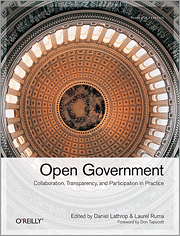
I’m very excited to share I have a chapter in the new O’Reilly Media book Open Government (US Link & CDN Link). I’ve just been told that the book has just come back from the printers and can now be ordered.

Also exciting is that a sample of the book (pictured left) that includes the first 8 chapters can be downloaded as a PDF for free.

The book includes several people and authors I’m excited to be in the company of, including: Tim O’Reilly, Carl Malamud, Ellen Miller, Micah Sifry, Archon Fung and David Weil. My chapter – number 12 – is titled “After the Collapse,” a reference to the Coasean collapse Shirky talks about in Here Comes Everybody. It explores what is beginning to happen (and what is to come) to government and civil services when transaction and coordination costs for doing work dramatically lower. I’ve packed a lot into it, so it is pretty rich with my thinking, and I’m pleased with the result.

If you care about the future of government as well as the radical and amazing possibilities being opened up by new technologies, processes and thinking, then I hope you’ll pick up a copy. I’m not getting paid for it; instead, a majority of the royalties go to the non-profit Global Integrity.

Also, the O’Reilly people are trying to work out a discount for government employees. We all would like the ideas and thinking in this book to go wide and far and around the globe.

Finally, I’d like to give a big thank you to the editors Laurel Ruma and Daniel Lathrop, along with Sarah Schacht of Knowledge as Power, who made it possible for me to contribute.

Today in the Globe: Facebook's Political Reach

I have the following piece published in the Globe and Mail today. It isn’t going to further endear me to Michael Valpy (who is already not impressed with me)… but felt another perspective on the issue was needed. He, like many traditional columnists, is not a fan of social – or digital – media. Indeed, he has argued it is destroying our country’s social cohesion and democracy. Those familiar with me know I feel differently . By allowing us to self-organize, connect to one another and to our politicians, social media is enabling a different and very powerful type kind of social cohesion and democratic expression.

I respect Valpy a lot and hope we get a chance to sit down and talk social media at some point. Given our collective interest in journalism and statements like this, it feels like it would be fruitful for both of us. Hopefully it will happen.

Facebook’s Political Reach

Yesterday, Michael Valpy posted an interesting piece about a Nanos poll showing Canadians – including younger Canadians – question how much influence political Facebook groups should have on any government.

The problem with the piece lies in the headline: “Facebook forums shouldn’t sway government, young Canadians say.” It suggests that online activism – or social media in general – isn’t credible with the public. This, however, isn’t what the poll showed. Indeed, the poll says little about the credibility of Facebook, particularly compared to other forms of political activity. It does, however, say a lot about social media’s dramatic growth in influence over the past five years.

Critically, the poll didn’t compare forms of political activity. If one had done a similar poll asking whether Canadians believe a demonstration should sway the government, or if direct action – such as when Greenpeace hung a banner from Parliament – should alter government policy, would the numbers have been dramatically different? I suspect not. Governments have electoral mandates – something Canadians broadly agree with. Most political activity, both on and offline, is designed to shape public opinion and ultimately, people’s decisions at the ballot box. That is a threat influences government.

Consequently, it may not be the medium that matters as much as the number of people involved. Do people believe the government should pay attention to a 1,000 person rally? Likely not. Should they pay attention to a 10,000 person Facebook group? Likely not as well. But at a certain point, with large enough numbers, almost any medium matters. Would people think that the government should reconsider a policy in the face of 10-million-person petition? Or a five-million-person Facebook group? Possibly. What about a 500,000-person march? Even this might prompt respondents to reconsider their response.

Ultimately, the Globe article jumps to a negative interpretation of Facebook too quickly. This is understandable in that traditional news organizations are still coming to grips with social – and digital – media. But by allowing us to self-organize, connect to one another and to our politicians, social media is enabling a different and very powerful type kind of social cohesion and democratic expression.

More interesting is how split Canadians appear to be over political groups using Facebook “to share ideas, information and to help mobilize their activities” (30 per cent have a positive view, 30 per cent have a negative view and an enormous 40 per cent are undecided). Here is a technology few Canadians knew existed five years ago, and it is already viewed favourably by a third of Canadians as a way to engage with political groups. As people become more familiar with these online activities I suspect comfort levels will rise, since many people often don’t initially understand or like new technologies. This survey shows us online political organizing is moving into the mainstream – perhaps even more mainstream than a protest or a petition.

So should Facebook influence the government? The prorogation debate shows it already can. But do people believe Facebook should be less influential than other (more traditional) forms of political activity? In this, the survey reveals very little. Indeed as Nik Nanos, the pollster who conducted the survey, adds at the end of the piece (and in contrast to the title): “we still haven’t come to grips with what [Facebook groups] really mean.”

Carbon Chaos – Celebrating the Launch of an iPhone App

At the beginning of September Gerri Sinclair and I began scheming around me working with a group of her students at the Centre for Digital Media on a project. My initial idea didn’t pan out (more on that in another post) but the students pitched a new idea, one the maintained the original idea of a game that would be fun and that would carry an environmental message.

The result?

Carbon Chaos – an iPhone game designed and built to be fun while educating those who download it about the various advantages and activities of Translink – the transit authority here in the Greater Vancouver area.

And so, with a ton of pride in the students who worked really long hours to create this in a few short weeks here is some beautiful art work they created…

And here is what the game looks like in action…

In short order I hope to share what I learned from the experience and from the students who worked on this (lots of interesting lessons). Needless to say the students deserve infinite praise and I’m eternally grateful to have had the chance to work with them. Amazing, every last one of them. Big thank you’s should also go to their faculty adviser Patrick Pennfather. And finally I know everyone is grateful to TransLink, who sponsored this application and gave it a home. A forward looking organization TransLink, one thinking hard about how technology can transform it – first they opened up their google transit API to the public, then they launched a partnership with Four Square (making each station and a bus a location where you can check in) and of course, they were willing to engage some students on a game they built.

Never, in all my dreams growing up and playing games did I believe that I might one day be a video game producer. Fun, fun, fun. If you have an iPhone, hope you get a chance to download it and see what some emerging developers were able to code up.

Withholding FOI requests: In the Private Sector, that's fraud

It was with enormous interest I read on the Globe’s website about a conservative Ministerial Aide “unrealeasing” a document requested by The Canadian Press through an Access to Information request (The Access to Information Act ensures that citizens can request information about the government’s activities).

A federal cabinet minister’s aide killed the release of a sensitive report requested under freedom-of-information in a case eerily similar to a notorious incident in the sponsorship scandal.

What I find fascinating is the neither the minister (now at Natural Resources Canada) or the aide have been asked to resign.

Let’s be abundantly clear, if this were the private sector and a CEO was caught deliberately withholding material information from a shareholder… that would constitute either fraud and/or a violation of whichever provincial securities laws he/she was bound by. Moreover, such a crime that could carry with it a prison sentence.

And yet here, in the most cavalier manner, one of the most basic trusts that ensure accountability in our system is violated with almost no repercussions.

The story does have its dark humour (and a embarrassingly feeble attempt at an excuse):

Mr. Paradis’s current communications director said Mr. Togneri’s intervention was to suggest the Access to Information section offer fewer pages to the requester without charge rather than the entire 137 pages for a fee of $27.40, which had already been paid.

“He went through and thought that a huge section of a very big report wasn’t relevant and that you should be given the option of paying to get it or get the (smaller) chapter” without charge, Margaux Stastny said in an interview. “No one can overrule Access officers.”

The options were never provided to the requester, however. Instead, the department simply sent the censored report and refunded the fee.

Yes, I too am always comforted to know that my government is thinking of me and trying to save me a few pennies by ensuring I don’t see information they know I need not waste my time on.

I, of course, have another solution for how the photo copying money could be saved. What about emailing a digital copy of the report? Of course Access to Information requests (called ATIP or FOI for those in the US) are always handed out in paper, just to ensure you can’t do anything too useful with them… oh and to help ensure that they are late in delivering them.

So while, in this case, the Minister’s staff has committed an enormous gaffe – one that should have (and yet probably won’t) political implications, it is also a window into a broader problem:

FOI = broken.

I belong to a generation that gets information in .3ms (length of a google search) if you take 80 days to get my request to me (and edit it/censor it), you are a bug I will route around. This isn’t just the end of accountability in government, this is the end of the relevancy of government.