Tag Archives: free culture

Some of my favourite Vancouverites on Net Neutrality

A couple of Vancouverites can be seen below talking about the danger currently facing the future of the internet here in Canada as our government allows the telco’s to determine who will be the winners and losers of the digital age.

If you haven’t already I’d strongly encourage you to head over to the “SaveourNet.ca” facebook group and become a member.

broadcast artists in a communication world

Just a brief follow up on yesterday’s piece. One reader yesterday pointed out that the CRTC did “get the internet” and that it was the interveners – The Alliance of Canadian Cinema, Television and Radio Artists (ACTRA) that “didn’t get it.” I think there is lots to dive into about the CRTC but part of his point is well taken. Check out this problematic quote from ACTRA:

“The Internet is just another media-distribution platform like any other that we’ve had,” said Stephen Waddell, executive director of the Alliance of Canadian Cinema, Television and Radio Artists. “And in our view, if the CRTC doesn’t give some opportunity to Canadian content to have a place on that platform, we’re going to be immersed in non-Canadian content.”

The number of problems with this statement are almost overwhelming. Building on some of the reasons I discussed yesterday the internet is not like any other distribution platform. Rather than analyze it line by line, I thought I would hand things over to Clay Shirky, who in Here Comes Everybody explains how our  friends at ACTRA are caught in the same dilemma as scribes at the end of the 15th century:

Consider the position of a scribe in the early 1400s. The ability to write, one of the crowning achievements of human inventiveness, was difficult to attain and, as a result, rare. Only a tiny fraction of the populace could actually write… In this environment a small band of scribes performed the essential service of refreshing cultural memory. By hand-copying new editions of existing manuscripts, they performed a task that could be preformed no other way. The scribe was the bulwark against great intellectual loss…

…Now consider the position of the scribe at the end of the 1400s. Johannes Guttenburg’s invention of movable type in the middle of the century created a sudden and massive reduction in the difficulty of reproducing a written work… a scribe, someone who has given his life over to literacy as a cardinal virtue, would be conflicted about the meaning of movable type. After all, if books are good, then surely more books are better. But at the same time the very scarcity of literacy was what gave scribal efforts its primacy, and the scribal way of life was based on this scarcity…

…The spread of literacy after the invention of movable type ensured not the success of the scribal profession but its end. Instead of mass professionalization, the spread of literacy was a process of mass amateurization. The term “scribe” didn’t get extended to everyone who could read and write. Instead it simply disappeared, as it no longer denoted a professional class.

This is what the internet has done to radio, television and cinema professionals. It has radically lowered the barriers for the creation of Canadian content.

So do we lament the loss of scribes? Not at all – we are liberated because today we can all write. Has the acerage quality declined? Possibly, we aren’t all writing Dante’s Inferno. But the best writing is way, way better (and better paying as well).

Will we lament the loss of television, cinema and radio (I doubt they will disappear completely) no. Something new and more interesting will arise to replace it. With the end of scribes we didn’t writers, instead we gained something far more valuable, the growth of contemporary authors! (who in 1350 could have imagined a world of authors, book stores, top 10 best seller lists?)

Now, imagine if there had been a tax on every printing press to pay for scribes to continue copying books… that would have just made books more expensive and less accessible.

We must acknowledge ACTRA fear of the new world. However self-serving, it is rational and genuine. Everything is going to be unpredictable for a while. But the future also the opportunity for something new an amazing – unimaginable ways for new types artists and mediums to describe the human condition and touch our souls. Just because it won’t be the way it has been done – through the broadcast mediums of radio, television, and cinema – doesn’t mean that it won’t be good. Indeed, I predict, that once the dust has settled, there will be more artists, producers, actors, and creatives in general, many of who will continue to get paid well. It’s just that the line between amateur and professional will be more blurred. There may even be a role for a professional association – although I imagine it will look, much, much different. Scary, yes. But also unavoidable.

The CRTC’s broadcast nationalism won’t matter in a networked world

nocrtcWoke up today was confronted by yet another headline demonstrating why the Canadian Radio-television and Telecommunications Commission (CRTC) must go.

For those who’ve never heard of the CRTC, it is the government agency that regulates Canadian broadcasting and telecommunications activities, the best-known of which is probably the Canadian content rules.

At the core of the proposal is a fundamental misunderstanding of the internet. The CRTC wishes to treat it like a broadcast medium – one where there are distinct roles of creators and consumers. Happily for us, this is not what the internet is. Instead it is what Clay Shirky describes as a communications medium – one where we are all talking to one another and where the distinction between creator and consumer has broken down.

So with that lens in mind, I encourage you to read the article. Below is my analysis:

Amid fears that Canada’s culture is being drowned in a sea of online video from around the world, federal regulators are looking at setting up a $100-million fund to support homegrown programming on the Internet… under a scenario proposed yesterday, Internet service providers could be asked to surrender 3 per cent of their subscriber revenue – roughly $100-million – to a fund that would help produce Canadian programs for the Web.

Is Canadian content being drowned out in a sea of online videos? I suppose. But so is everybody’s. It is the nature of the medium. What % of content on the internet is American, Indian, Chinese? Does it matter? Not really. Because people don’t surf the internet like they surf the radio or television – most often the seek out content. But the CRTC is used to a certain % of content being Canadian on the radio and television because it controlled how much content ended up on those mediums. This is their frame and why they can’t understand the internet.

Ironically, even though we don’t know what % of online content is Canadian what the CRTC cannot grasp is that since the advent of the internet ordinary Canadian both produced more content and – I’ll wager – consumed more Canadian content than ever before. Think of all the blogs, videos, podcasts made by ordinary Canadians that are sharing Canadian stories over the web. Think of this blog. Ensuring Canadian stories get shared is core to the CRTC’s mandate. And yet, for all their discussion about Canadian content the CRTC does not include content created by all those Canadians who’ve previously could never tell their stories.

Why? Because none of us have title of “producer” or “writer” or “actor” in the CRTC’s eyes. We (Canadians) don’t count as culture.

More ironically, the one thing you often can’t find online (and/or has been slow to get online) is the very media the CRTC does count as culture and that it seeks to protect – the Canadian TV and radio shows broadcast on CTV, CBC and Global. These artifacts of the broadcast era have fought or denied the existence if the internet, who have been the slowest to make their content available to us, now want us to foot the bill for creating their content.

What I can be certain of is that the $100 million raised by the CRTC will not go towards Canadians telling their story on the web. My blog, your blog, your podcast, or your video of the play you wrote, none of these will never see the CRTC’s money. Instead a public servant somewhere in Ottawa will determine what is “Canadian” not so we can promote Canadians stories, but so that we can prop the old and dying business model of broadcast media – the expensive production facilities, the hierarchies of managers and staffers that are necessary to produce older media like television.

Nor is this is not about protecting artists – writers, actors, singers – they all thrived before the advent of television, and they will thrive after its demise in ways we cannot imagine. Again, this is not about them. It is about an industry trying to prop up a dying broadcast medium and a government agency trying to assert control over what can be defined as Canadian.

Both are problematic and have no place in a networked world. As a closing counter factual, imagine a tax on your phone designed to raised funds to ensure a certain % of all phone calls in the world were being conducted by Canadians. A fund designed to pay people to make “Canadian” phone calls. That is what this is. At the very time when we need the internet to be free and as cheap as possible so those with the fewest resources can make use of it to tell their stories, organize protests, create a new business or just find a job, we are going to try to make it more expensive.

In short. Are Canadians lost in a sea of content? Yes. And they are thriving in it. More Canadian stories are being told than ever before. Moreover, I never watched Canadian content on television, but today I read numerous Canadian blogs, and listen to the occasional podcast. I never consumed so much Canadian media in my life.  Moreover, never has Canadian content been so widely viewed. Readers of even this small blog come from around the world.

What we don’t need is a tax that makes it more expensive for ordinary Canadians to tell their stories. We don’t need a levy that props up a dying business model. We don’t need a government agency that defines what is “Canadian culture.” Arguing against this proposal is not the most important battle of our time, but it is worth fighting against. Today Canadian culture is a free culture, increasingly defined and created by Canadians. That’s the promise of the internet, why would we fight that?

The internet is messy, fun and imperfect, just like us

Last October 23rd David Weinberger gave the 2008 Bertha Bassam Lecture at the University of Toronto. I happened to be in Toronto but only found out about the lecture on the 24th. Fortunately Taylor pointed out that the lecture is online.

I’ve never met David Weinberger (his blog is here) but I hope to one day. I maintain his book – Small Pieces Loosely Joined – remains one of, if not the best book written about the internet and society. Everything is Miscellaneous is a fantastic read as well.

The Bertha Bassam lecture is classic Weinberger: smart, accessible, argumentative and fun. But what I love most about Weinberger is how he constantly reminds us that the internet is us…  and that, as a result, it is profoundly human: messy, fun, argumentative, and above all imperfect. Indeed, the point is so beautifully made in this lecture I felt a little emotional listening to it.

Contrast that to the experience of listening to someone like Andrew Keen, a Weinberger critic who this lecture again throws into stark relief. After reflecting on Weinberger, Keen dislikes the internet and web 2.0 mostly because I think he dislikes people. It may sound harsh but if you ever hear him speak – or even read his writing – it is smart, argumentative and interesting, but it oozes with an anger and condescension that is definitely contemptuous and sometimes even borders on hatred. If the debate is reduced to whether or not we should, however imperfectly, try to connect to and learn from one another or whether we should just hold others in contempt, I think Weinberger is going to win every time. At least, I know where I stand.

Indeed, this blog is a triumph of Weinberger’s internet humanism. It is a small effort to write, to share, and to celebrate the complexity and opportunity of the world with those I know and those I don’t, but who share a similar sense of possibility. Will millions read this blog. No. But I enjoy the connections, old and new, I make with the much more modest number of people who do.

I hope you’ll watch this lecture or, if you haven’t the time, download the audio to your ipod and listen to it during your commute home. (lacking the slides won’t have a big impact)

Creating a City of Vancouver that thinks like the web

Last November my friend Mark Surman – Executive Director of the Mozilla Foundation – gave this wonderful speech entitled “A City that Thinks Like the Web” as a lunchtime keynote for 300 councillors, tech staff and agency heads at the City of Toronto’s internal Web 2.0 Summit.

During the talk the Mayor of Toronto took notes and blackberried his staff to find out what had been done and what was still possible and committed the City of Toronto to follow Mark’s call to:

  1. Open our data. transit. library catalogs. community centre schedules. maps. 311. expose it all so the people of Toronto can use it to make a better city. do it now.
  2. Crowdsource info gathering that helps the city.  somebody would have FixMyStreet.to up and running in a week if the Mayor promised to listen. encourage it.
  3. Ask for help creating a city that thinks like the web. copy Washington, DC’s contest strategy. launch it at BarCamp.

The fact is every major city can and should think like the web. The first step is to get local governments to share (our) data. We, collectively as a community, own this data and could do amazing things with it, if we were allowed. Think of how Google Maps is now able to use Translink data to show us where bus stops are, what buses stop there and when the next two are coming!

Google Map Transit YVR

Imagine if anyone could create such a map, mashing up a myriad of data from local governments, provincial ministries, StatsCan? Imagine the services that could be created, the efficiencies gained, the research that would be possible. The long tail of public policy analysis could flourish with citizen coders, bloggers, non-profits and companies creating ideas, services, and solutions the government has neither the means nor the time to address.

If the data is the basic food source of such an online ecosystem then having it categorized, structured and known is essential. The second step is making it available as APIs. Interestingly the City of Vancouver appears to have taken that first step. VanMaps is a fascinating project undertaken by the City of Vancouver and I encourage people to check it out. It is VERY exciting that the city has done this work and more importantly, made it visible to the public. This is forward thinking stuff. The upside is that, in order to create VanMaps all the data has been organized. The downside is that – as far as I can tell – the public is restricted to looking at, but not accessing, the data. That means integrating these data sets with Google maps, or mashing it up with other data sets is not possible (please correct me if I’ve got it wrong).

Indeed, in VanMaps Terms of Use suggests that even if the data were accessible, you aren’t allowed to use it.

VanMaps EULA

Item 4 is worth noting. VanMap may only be used for internal business or personal purposes. My interpretation of this is that any Mashups using VanMap data is verboten.

But let’s not focus on that for the moment. The key point is that creating a Vancouver that thinks like the web is possible. Above all, it increasingly looks like the IT infrastructure to make it happen may already be in place.

Old modes of production die with the depression…

A few weeks ago I blogged about how I thought land line phones and cable TV would be among the first items to go as people cut budgets. In contrast Cell phones and internet would be among the last (can you imagine trying to find a job without an internet connection?)

Well I forgot to mention that newspapers would be the other obvious target… why spend to get a newspaper when you can get the content online for less or for free?

So I was probably rash in saying that traditional telephone companies (are there any left?) and cable companies would be among the first to feel the pinch. It is going to be newspaper companies. The end is going to come fast and furious. It won’t be pretty.

For my American friends there is already talk about how much trouble the New York Times is in. Indeed, as one industry observer points out, the NYT may not survive past MAY – although by drawing down on its credit and selling assets (like the Boston Red Sox’s) it can survive until 2010.

Here in Canada the situation is bleaker. CanWest, which owns the National Post as well as newspapers in most of the country’s major markets (such as the Vancouver Sun, here in my home town), has reported Q1 losses and its stock continues to free fall. Having lost 92% of its value in the last year it may no longer be able to meet its debt servicing requirements. It turns out that buying more newspapers is not the solution for newspaper companies. A bigger broken business model doesn’t, at some point, transform into a working business model.

The old modes of production are in trouble. Today it’s print, but TV/video better not assume the same pressures won’t be confronting them in the near future.

Twittering to help the homeless – and why it is bad!

Here is a great story out of Vancouver of a group of strangers using twitter to come together and help the homeless.

Another example of how social media can build new friends and community and help make the world a better place – sadly we all know it won’t have any impact of the powerful narrative of youth as uncaring, self-centred narcsistic and apathetic.

And then there are those who think these tools are really just the hands of the devil. I didn’t know anyone still read Andrew Keen but the other day a reader pointed to his (1000th) column on how the internet will end society as we know it. Check out this excerpt:

The 1930s fascists were expert at using all the most technologically sophisticated communications technologies—the cinema, radio, newspapers, advertising—to spew their destructive, hate-filled message. What they excelled at was removing the the traditional middlemen like religion, media, and politics, and using these modern technologies of mass communications to speak with reassuring familiarity to the disorientated masses.

Imagine if today’s radically unregulated Internet, with its absence of fact checkers and editorial gatekeepers, had existed back then. Imagine that universal broadband had been available to enable the unemployed to read the latest conspiracy theories about the Great Crash on the blogosphere. Imagine the FDR-baiting, Hitler-loving Father Charles Coughlin, equipped with his “personalized” YouTube channel, able, at a click of a button, to distribute his racist message to the suffering masses. Or imagine a marketing genius like the Nazi chief propagandist Josef Goebbels managing a viral social network of anti-Semites which could coordinate local meet-ups to assault Jews and Communists.

You can almost feel the anger and rage ooze off the screen – try reading the whole thing. I can see why Keen is scared – he probably has visions of people like him running around the internet. That said, he’s ultimately right on one level, anyone can use these tools. But the solution is what? To ban them all? Regulate them into ineffectiveness? Ultimately you can’t have the opportunity of self-organizing enlightenment without the possibility of self-organizing hatred. But maybe then, we don’t want kids wandering making friends and helping homeless people. Yes, now that I reflect on it, being a passive hollywood and park avenue fed consumer was always so much better for society, democracy and freedom. Thank you for saving me from myself Andrew Keen!

Cultural theories of risk and the rise of emergence systems

My (very cool) friend Alex T. recently introduced me to the grid/group typology. As explained in wikipedia:

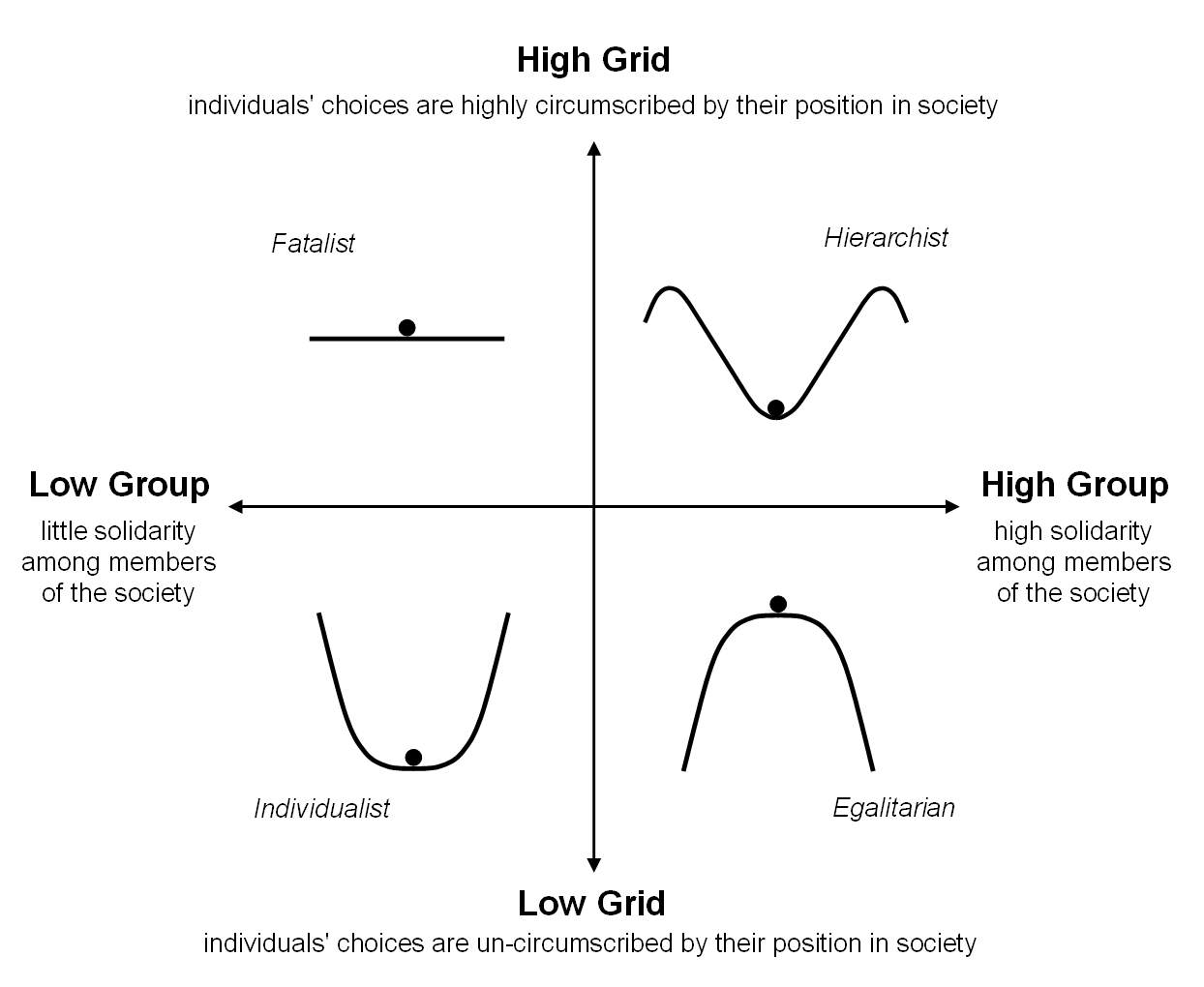
Mary Douglas, an anthropologist studying traditional African religion observed that different societies feared different sorts of threats, and that these differences correlated with differences in their social structure. Later, Douglas argued that social structures differ along two principal axes: “grid” and “group (see graph).”

The important things is – if your society organized itself along one of these structures – it is challenging, if not impossible to see a solution outside of that structure. What I think is exciting is that the egalitarian mode of thinking – thanks to the internet and social software – may be ascendant, explaining some of the reason market based systems (individualists) and bureaucracy based systems (hierarchist) feel threatened.

Grid vs Group

From Christopher Hood: The Art of The State (again via wikipedia):

Fatalists feel isolated in a world that imposes arbitrary constraints on them. They view nature as a ball on a flat surface, rolling randomly in any direction. There is little they can do to control their situation, and resign themselves to riding out whatever fate throws at them.

Hierarchist see a society with a well-defined role for each member. Thus , they believe in the need for a well-defined system of rules, and fear social deviance (such as crime) that disrupts those rules. Hierarchists see nature as “perverse/tolerant”: it can be exploited within certain limits, but if those limits are exceeded the system will collapse. They thus rely heavily on experts, who can identify those limits and establish rules to keep society within proper bounds.

Individualist see their choices as unconstrained by society and they lack close ties to other people. They value individual initiative in the marketplace, and fear threats like war that would hamper free exchange. The individualist view of nature as resilient. Like a ball resting at the bottom of a cup, nature will return to its original stable position after any disturbance. Thus, individualists embrace trial-and-error, as they have confidence that the system will fix itself in the end.

Arguably, much of the left-right axis of our politics is a battle between Individualists on the right (let the market rule!) and Hierarchists on the left (government oversight!) with fatalists abstaining (what’s the point?).

Hood’s description of Egalitarians is intriguing mostly because I think it is quite narrow and, if slightly tweaked, could help describe the rise of an important new block of voters (part of the neo-progressive movement Taylor and I write about).

Hood description (again, via wikipedia)

Egalitarians experience low grid and high group. They live in voluntary associations where everyone is equal and the good of the group comes before the good of any individual. In order to maintain their solidarity, egalitarians are sensitive to low probability-high consequence risks (such as nuclear power), and use them to paint a picture of impending apocalypse. Risk and Culture was, in part, a polemic against the environmental movement, which Douglas and Wildavsky saw as sharing the worldview and social organization of religious cults. Egalitarians see nature as fragile, like a ball balanced precariously on an overturned cup. Any small disturbance will send it crashing down. Thus egalitarians advocate the precautionary principle and cling to traditional ways of life that have proven to be sustainable, rather than risking disaster by trying new technologies.

Hood describes the Egalitarian way as one with high levels of cooperation within a group that is socially distinct from the outside world and which relies on dynamic rules set through constant debate and case-specific solutions to every issue as it arises.

Hood’s contempt is well placed. Many tightly held communities facing what they believe to be massive threats can indeed take on cult-like characteristics. But that is not their only possibility. Indeed, societies that organize along these lines have new powerful tools – namely the internet – to use to organize themselves. More importantly, these communities can coordinate themselves and achieve powerful outcomes even with weak bonds. Many of the “egalitarians” I see today are those creating projects that seek to engage citizens and pool individual resources to address collective problems. Indeed, many open-source projects fit this mold very well.

More importantly, most of these projects are not cult-like, but are self-organizing and emergent. They see that a situation (like the environment or the open web) is vulnerable and they don’t believe a) it is self-correcting (like individualists) b) it can be perfectly moderated or controlled by top down systems (like hierarchists); or c) that collective or individual action is futile (like fatalists).

There are few examples of egalitarians (or emergents) that spring to mind as successful – certainly the organizational and political discourse has been dominated by hierarchists and individualists. Maybe this explains why people have such a hard time defining new forms of organisation – like open-source projects. They are trying to peg their participants as either right-wing market loving individualists or left-wing regulation loving hierarchists. The fact is they are neither. While hardly uniform, my experience is that they are often libertarians (low-grid) who believe in free-association, collaboration and emergent systems (high-group).

The increased manifestation of this new structure in society could diversify how we perceive and try to solve problems. But in the short term observers (like pundits on CNN) will continue to try to put force this peg of a new circular group into an old square hole.


From Consumers to Creators of their Historical Narrative

At a meeting I attended on Monday I was introduced to Robert Thompson, Secretary and Treasurer of a cool outfit called Operation Dialogue. Operation Dialogue seeks to “inspire and capture a lively and passionate dialogue among Canadians about what it is to be “Canadian.”

Their most interesting project? An online quiz on Canadian history. Anyone in high school who answers all 50 questions correctly is entered into a draw for numerous college scholarships (paid directly to the university). The best part? The site actively encourages “cheating” insofar as students are prompted – through hyperlinks – to research the correct answers. Indeed this is the whole point, to get kids to read about, look into and learn about the different aspects of Canadian history.

As a student of history, I’m a fan.

My humble suggestion, which Robert took to heart, was to hold a secondary contest with a small scholarship, that would reward the student who designed the coolest question – including links to resources and historical references – for the following year’s quiz. I mean, if you want kids to be turned on by history, why not have them help write it? Who is better positioned to know the history their peers will be most into? It felt like an easy way to make the quiz both more attractive and so help better satsify the organization’s mission.

I say make’em active historians, rather than just passive consumers. That’s what the net should be about.