Tag Archives: technology

The CRTC’s broadcast nationalism won’t matter in a networked world

nocrtcWoke up today was confronted by yet another headline demonstrating why the Canadian Radio-television and Telecommunications Commission (CRTC) must go.

For those who’ve never heard of the CRTC, it is the government agency that regulates Canadian broadcasting and telecommunications activities, the best-known of which is probably the Canadian content rules.

At the core of the proposal is a fundamental misunderstanding of the internet. The CRTC wishes to treat it like a broadcast medium – one where there are distinct roles of creators and consumers. Happily for us, this is not what the internet is. Instead it is what Clay Shirky describes as a communications medium – one where we are all talking to one another and where the distinction between creator and consumer has broken down.

So with that lens in mind, I encourage you to read the article. Below is my analysis:

Amid fears that Canada’s culture is being drowned in a sea of online video from around the world, federal regulators are looking at setting up a $100-million fund to support homegrown programming on the Internet… under a scenario proposed yesterday, Internet service providers could be asked to surrender 3 per cent of their subscriber revenue – roughly $100-million – to a fund that would help produce Canadian programs for the Web.

Is Canadian content being drowned out in a sea of online videos? I suppose. But so is everybody’s. It is the nature of the medium. What % of content on the internet is American, Indian, Chinese? Does it matter? Not really. Because people don’t surf the internet like they surf the radio or television – most often the seek out content. But the CRTC is used to a certain % of content being Canadian on the radio and television because it controlled how much content ended up on those mediums. This is their frame and why they can’t understand the internet.

Ironically, even though we don’t know what % of online content is Canadian what the CRTC cannot grasp is that since the advent of the internet ordinary Canadian both produced more content and – I’ll wager – consumed more Canadian content than ever before. Think of all the blogs, videos, podcasts made by ordinary Canadians that are sharing Canadian stories over the web. Think of this blog. Ensuring Canadian stories get shared is core to the CRTC’s mandate. And yet, for all their discussion about Canadian content the CRTC does not include content created by all those Canadians who’ve previously could never tell their stories.

Why? Because none of us have title of “producer” or “writer” or “actor” in the CRTC’s eyes. We (Canadians) don’t count as culture.

More ironically, the one thing you often can’t find online (and/or has been slow to get online) is the very media the CRTC does count as culture and that it seeks to protect – the Canadian TV and radio shows broadcast on CTV, CBC and Global. These artifacts of the broadcast era have fought or denied the existence if the internet, who have been the slowest to make their content available to us, now want us to foot the bill for creating their content.

What I can be certain of is that the $100 million raised by the CRTC will not go towards Canadians telling their story on the web. My blog, your blog, your podcast, or your video of the play you wrote, none of these will never see the CRTC’s money. Instead a public servant somewhere in Ottawa will determine what is “Canadian” not so we can promote Canadians stories, but so that we can prop the old and dying business model of broadcast media – the expensive production facilities, the hierarchies of managers and staffers that are necessary to produce older media like television.

Nor is this is not about protecting artists – writers, actors, singers – they all thrived before the advent of television, and they will thrive after its demise in ways we cannot imagine. Again, this is not about them. It is about an industry trying to prop up a dying broadcast medium and a government agency trying to assert control over what can be defined as Canadian.

Both are problematic and have no place in a networked world. As a closing counter factual, imagine a tax on your phone designed to raised funds to ensure a certain % of all phone calls in the world were being conducted by Canadians. A fund designed to pay people to make “Canadian” phone calls. That is what this is. At the very time when we need the internet to be free and as cheap as possible so those with the fewest resources can make use of it to tell their stories, organize protests, create a new business or just find a job, we are going to try to make it more expensive.

In short. Are Canadians lost in a sea of content? Yes. And they are thriving in it. More Canadian stories are being told than ever before. Moreover, I never watched Canadian content on television, but today I read numerous Canadian blogs, and listen to the occasional podcast. I never consumed so much Canadian media in my life.  Moreover, never has Canadian content been so widely viewed. Readers of even this small blog come from around the world.

What we don’t need is a tax that makes it more expensive for ordinary Canadians to tell their stories. We don’t need a levy that props up a dying business model. We don’t need a government agency that defines what is “Canadian culture.” Arguing against this proposal is not the most important battle of our time, but it is worth fighting against. Today Canadian culture is a free culture, increasingly defined and created by Canadians. That’s the promise of the internet, why would we fight that?
Articles I'm digesting – Feb 13 2009

New Planets & an Unknown Object Discovered Beyond the Solar System

Future telescopes such as NASA’s Kepler, set for launch in 2009, would be able to discover dozens or hundreds of Earth-like worlds. The Space Interferometry Mission (SIM), to be launched early in the next decade, consists of multiple telescopes placed along a 30 foot structure. With an unprecedented resolution approaching the physical limits of optics, the SIM is so sensitive that it almost defies belief: orbiting the earth, it can detect the motion of a lantern being waved by an astronaut on Mars.

The last sentence says it all. My mind = blown.

Fareed Zakaria – Worthwhile Canadian Initiative (via Sameer Vasta)

Canada has done more than survive this financial crisis. The country is positively thriving in it. Canadian banks are well capitalized and poised to take advantage of opportunities that American and European banks cannot seize. The Toronto Dominion Bank, for example, was the 15th-largest bank in North America one year ago. Now it is the fifth-largest. It hasn’t grown in size; the others have all shrunk.

So what accounts for the genius of the Canadians? Common sense. Over the past 15 years, as the United States and Europe loosened regulations on their financial industries, the Canadians refused to follow suit, seeing the old rules as useful shock absorbers. Canadian banks are typically leveraged at 18 to 1—compared with U.S. banks at 26 to 1 and European banks at a frightening 61 to 1. Partly this reflects Canada’s more risk-averse business culture, but it is also a product of old-fashioned rules on banking.

I’ve always thought Zakaria was one of the smartest commentators in the US. I’ve unbelievably excited he has his own show on CNN. Finally a show where real ideas are discussed not by pundits but by actual wonks. His show single-handedly elevates the entire CNN brand. Now he’s saying nice things about us. Hopefully we won’t let it go to our heads.

How the Crash Will Reshape America: The Last Crisis of the Factory Towns by Richard Florida.

When work disappears, city populations don’t always decline as fast as you might expect. Detroit, astonishingly, is still the 11th-largest city in the U.S. “If you no longer can sell your property, how can you move elsewhere?” said Robin Boyle, an urban-planning professor at Wayne State University, in a December Associated Press article. But then he answered his own question: “Some people just switch out the lights and leave—property values have gone so low, walking away is no longer such a difficult option.”

Perhaps Detroit has reached a tipping point, and will become a ghost town. I’d certainly expect it to shrink faster in the next few years than it has in the past few. But more than likely, many people will stay—those with no means and few obvious prospects elsewhere, those with close family ties nearby, some number of young professionals and creative types looking to take advantage of the city’s low housing prices. Still, as its population density dips further, the city’s struggle to provide services and prevent blight across an ever-emptier landscape will only intensify.

Many of the old industrial clusters are dying and we’ll have to manage this decline while helping figure out what the next wave will look like. This is part of the reason why think the federal government’s failure to invest in green technology/innovation will stand as one of the biggest lost opportunities of the century. At the peak of a financial crises and at the moment when our cities – particularly our mid-sized cities – need to think about what their economies will look like for the next 100 years (think renewable energy, green roofs/architecture, mobile computing, next-generation social services) we’ve plowed $30B into 20th century buildings and roads. Hopefully the good news of Zakaria will outweigh the bad news from Florida. I hope so, since it appears this crisis won’t be sufficiently significant to spur us to rethink our future.

Upcoming talks

Starting next week things are going to get busy for a few days. I’ve a number of upcoming talks and would be interested in feedback, stories, ideas for any and/or all of them.

Future of the Public Service: I will be doing a series of lectures/seminars on the future of the public service for Health Canada in Vancouver, Ottawa, Edmonton and possibly Montreal or Toronto in mid-march. I’ve got a number of ideas and themes I intend to talk on – technology, generational change, and open source – but am of course always looking for others.

If you have a story or an article suggestion please do pass them along. Personal stories of frustration and angst, or conversely success and empowerment, in the public service are always deeply appreciated.

US NOW panel:  I’ll be part of a panel discussion at a screening of Us Now, a documentary that tells the stories of online networks that are challenging the existing notion of hierarchy.

When: FEB 20th 2009 — 7pm
Where: SFU Harbour Centre — Room 1900
You can register (for free!) here.

Northern Voice: Finally, I’ll be doing a presentation with Rebecca Bollwitt on Dealing with angry comments, Trolls, Spammers, and Sock Puppets at this year’s Northern Voice.

Northern Voice is a two-day, non-profit personal blogging and social media conference held annually in Vancouver.

When: February 20th and 21st
Where: Forestry Sciences Centre, 2424 Main Mall, UBC main campus
You can register for Northern Voice here.

Thoughts, ideas, articles and other inspirations on any or all of these are always welcome!

From here to open – How the City of Toronto began Opening up

Toronto the open

For myself, the biggest buzz at ChangeCamp Toronto was that the city showed up with lots of IT staff (much of it quite senior) who were trying to better understand how they could enable others to use their data and help citizens identify and solve problems. In fact the City of Toronto ran what I believe will be seen later as the most enduring sessions in which they asked what data should they start making available immediately (as APIs).

For those not in the know, think of an API as a plug that rather than delivering electricity instead delivers access to a database.

The exciting outcome is that web designers, coders and companies can then use this data to better deliver services, coordinate activities in neighborhoods, make government more transparent, or analyze problems. For example, imagine if all the information regarding restaurants health violations were not hidden deep within a government website (in a PDF format that is not easily searchable by google) but were available on every restaurant review website? Or if road closures were available in a data stream so a google maps application could show which road were closed on any given day – and email you if they were in your neighborhood.

This is the future that cities like Toronto are moving towards. But why Toronto? How did it arrive at this place? How is it that the City of Toronto sent staff to ChangeCamp Toronto?

The emergence of open in Toronto

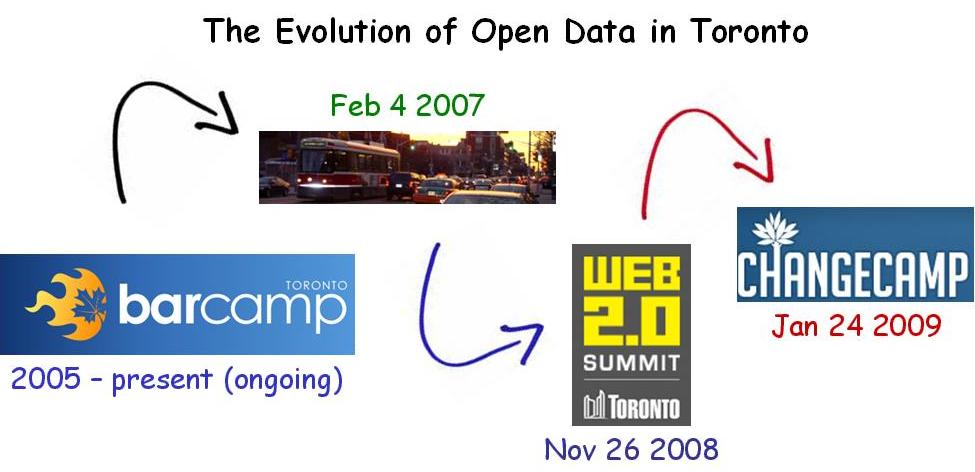
I’ve tried to map this evolution. I may have missed steps and encourage people to email me or post comments if I have.

evolution of open data TO

The first step was taken when people like David Crow created a forum – Barcamp – around which some of Toronto’s vibrant tech and social tech community began to organize itself. This not only brought the community together but it also enabled unconferences to gain traction as a fun and effective approach to addressing an issue.

Then, in late 2006 the Toronto Transit Commission (TTC) issued an Request For Proposals (RFP) for a redesign of its website. Many in the tech community – who had no interest in doing the redesign – were horrified at the RFP. It was obvious that given the specifications the new website would not achieve its potential. A community self-organized around redesigning the RFP. Others took note and, because they cared about the TTC, wanted to also talk about simple non-website changes the TTC could make to improve services. TransitCamp was this born and – with enormous trepidation, some TTC officials showed up (all of whom should be loudly applauded). The result? The tech and social tech community in Toronto was engaged in civic matters and their activities were beginning to make it onto the city government’s radar.

Other Camps carried on through 2007 and 2008 (think OpenCities), building momentum in the city. Then, in November of 2008 – a breakthrough. The City of Toronto hosted an internal Web 2.0 conference and invited Mark Surman – executive director of the Mozilla Foundation and long time participant in the Toronto social tech space – to deliver the keynote entitled “A City that Thinks like the Web“. After the talk, the Mayor of Toronto stood up and said:

” … I’ve been emailing people about your challenges. Open data for Google Transit is coming by next June, and I don’t see what we shouldn’t open source the software Toronto creates.” He also said “I promise the City will listen” if Torontonians set up a site like FixMyStreet.com

You can hear the Mayor Miller’s full response here:

In short, the Mayor promised to begin talking about opening up (and open sourcing) the city. Freeing up Ryan Merkley and the City of Toronto IT team to attend ChangeCamp

Lessons for ChangeCamp Vancouver

It remains unclear to me whether ChangeCamp is the right venue for tackling this opportunity in Vancouver.

We in Vancouver are not as far along the arc as Toronto is. We do, however, have some advantages. The map is more obvious to us and some of us have good relationships with key staff in the city. However, this process takes time. To replicate the success in Toronto, governments here on the west coast need not only be at ChangeCamp, they need to be running sessions and deeply engaged. For this to occur cultures need to be shifted, new ideas need to percolate within government institutions and agencies and relationships need to be built. All this will take time.

Articles I'm digesting at the moment

While I keep track of the books I’m reading to the right I don’t often get to talk about the articles I’m reading and loving. Here are a few I’ve stumbled over in the past week that I’m still digesting.

1) Via Mike T, Obama and the dawn of the Fourth Republic by Michael Lind on the cycles of American progress and why the next 36 years are going to be very exciting.

During the first 36-year period of a republic, ambitious nation-builders in the tradition of Alexander Hamilton strengthen the powers of the federal government and promote economic modernization. During the second 36-year phase of a republic, there is a Jeffersonian backlash, in favor of small government, small business and an older way of life. During the backlash era, Jeffersonians manage to modify, but never undo, the structure created by the Hamiltonians in the previous era.

2) Via Alo, Why Canada has to wait for it’s Obama Moment, by Jeff Roberts. A piece few Canadians would be willing to write about why the politics of Aboriginals and the rest of Canada remain separated.

In the case of black Americans, their ascension to the political mainstream came in part from leaving behind talk of rights and identity and embracing a postracial style of politics. Barack Obama’s rise has followed his willingness to move away from the swamp of identity politics.

It’s a thesis that parallels that of Calvin Helin’s in Dances with Dependency that I thoroughly enjoyed. Moreover, Roberts is only half right. There is an emerging generation of (particularly urban) First Nations who are going to transform the politics of both the First Nations community and Canada.

3) Via Jeff A, Printing The NYT Costs Twice As Much As Sending Every Subscriber A Free Kindle by Nicholas Carlson . Shocked? You should be. As the author concludes:

Are we trying to say the the New York Times should force all its print subscribers onto the Kindle or else? No. That would kill ad revenues and also, not everyone loves the Kindle.

What we’re trying to say is that as a technology for delivering the news, newsprint isn’t just expensive and inefficient; it’s laughably so.

Besides, think of the forests that would be saved.

4) Via Amy L, The $300 Million Dollar Button, by Jared Spool. As Amy said to me, “you’re a believer in small changes” which I am. Very often I find people jump for the big lever to create big change which often creates numerous unanticipated (and almost always unwanted) changes. I’m much more interested in finding the small lever that creates big change. This piece is about precisely one of those moments in the design of a webpage.

It’s hard to imagine a form that could be simpler: two fields, two buttons, and one link. Yet, it turns out this form was preventing customers from purchasing products from a major e-commerce site, to the tune of $300,000,000 a year. What was even worse: the designers of the site had no clue there was even a problem.

ChangeCamp: Pulling people and creativity out of the public policy long tail

ChangeCamp is a free participatory web-enabled face-to-face event that brings together citizens, technologists, designers, academics, policy wonks, political players, change-makers and government employees to answer one question: How do we re-imagine government and governance in the age of participation?

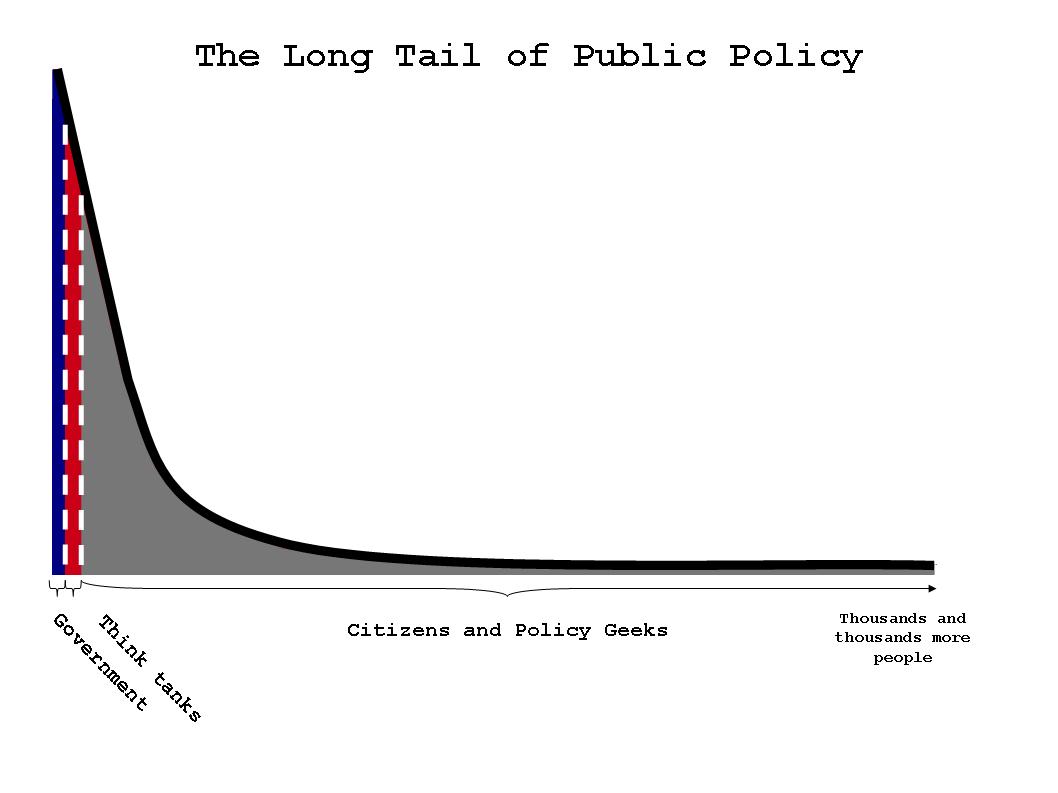
What is ChangeCamp? It is the application of “the long tail” to public policy.

It is a long held and false assumption that ordinary citizens don’t care about public policy. The statement isn’t, in of itself, false. Many, many, many people truly don’t care that much. They want to live their lives focusing on other things – pursuing other hobbies or interests – but there are many of us who do care. Public policy geeks, fans, followers, advocates, etc… we are everywhere, we’ve just been hidden in a long tail that saw the market place and capacity for developing and delivering public policy restricted to a few large institutions. The single most important lesson I learnt from my time with Canada25 is that it doesn’t have to be that way.

Did Canada25 get a new generation of Canadians, aged 20-35 engaged in public policy? I don’t know.

What I do know is, that at the very minimum, we harnessed and enormous, dispersed desire of many Canadians to participate in, and help shape, the public policy debates affecting the country. Most importantly, we did this by doing three things:

  1. we aggregated together the people who cared about public policy, we gave them peers, friends and a sense of community.
  2. we provided a vehicle through which to channel their energy
  3. by combining 1 and 2, and by using simple technology and a low cost approach – we dramatically lowered the barriers (and csots) to entry for credible participating in these national debates

Today, the technology to enable and aggregate people their ideas, to connect them with peers and to create community, is still more powerful. Our capacity to challenge, push, help, cooperate, leverage and compete with the large institutional public policy actors has never been greater. This, for me, is the goal of ChangeCamp. What concrete tools can we build, what information can we demand be opened up, what new relationships can we build to re-imagine how we – the citizens who care – participate in the creation of public policy and the effective delivery of public services. Not to compete or replace the traditional institutional actors, but to ensure more and better ideas are heard and increasingly effective and efficient services are created.

Long tail of public policy

Individually, none of us may have the collective power of a government ministry or even the resources of most think tanks. But collectively, linked together by technology and powered by our energy and spare capital, the long tail of policy geeks and ordinary citizens is bigger, nimbler, more creative and faster than anything else. Do I know that the long tail of policy can be set free? No. But ChangeCamp seems like a fun place to start experimenting, brainstorming and sharing ways we can make this country better.

Old modes of production die with the depression…

A few weeks ago I blogged about how I thought land line phones and cable TV would be among the first items to go as people cut budgets. In contrast Cell phones and internet would be among the last (can you imagine trying to find a job without an internet connection?)

Well I forgot to mention that newspapers would be the other obvious target… why spend to get a newspaper when you can get the content online for less or for free?

So I was probably rash in saying that traditional telephone companies (are there any left?) and cable companies would be among the first to feel the pinch. It is going to be newspaper companies. The end is going to come fast and furious. It won’t be pretty.

For my American friends there is already talk about how much trouble the New York Times is in. Indeed, as one industry observer points out, the NYT may not survive past MAY – although by drawing down on its credit and selling assets (like the Boston Red Sox’s) it can survive until 2010.

Here in Canada the situation is bleaker. CanWest, which owns the National Post as well as newspapers in most of the country’s major markets (such as the Vancouver Sun, here in my home town), has reported Q1 losses and its stock continues to free fall. Having lost 92% of its value in the last year it may no longer be able to meet its debt servicing requirements. It turns out that buying more newspapers is not the solution for newspaper companies. A bigger broken business model doesn’t, at some point, transform into a working business model.

The old modes of production are in trouble. Today it’s print, but TV/video better not assume the same pressures won’t be confronting them in the near future.

Microsoft: A case study in mismanaging a business ecosystem

mslogoA lot of fuss has been made about Microsoft’s inability to compete in the online space and the web specifically.  Indeed, it is widely acknowledged that Microsoft was slow to understand the web’s implications and adjust its product lines accordingly. How did the largest, most successful software company in the world fail to predict or even, once the future became clear, effectively adapt to the rise of the internet? More importantly, why hasn’t it been able to acquire its way out of trouble?

Numerous articles have been written on this, many focusing on Microsoft’s strategy and the fact that it likely faced a disruptive innovation problem. I’d like to supplement that analysis by focusing on the predatorial way Microsoft managed and engaged its business ecosystem in the 1990s. I’ve not seen this analysis before so I thought I would throw it out there.

The 1990’s were a good time for Microsoft. It experienced tremendous growth and its operating system was by far the dominant choice in the market place. It had tremendous leverage over everyone in its business ecosystem, including its competitors, customers and complementors. While this was seen as a source of strength (and profit) it also laid the foundation for many of its problems. The story of Microsoft’s competitors in its traditional marketplace – especially those that have adopted an open source space model such as Linux, Mozilla and Apache – is well documented and forms the core of the traditional disruptive innovation thesis. But I think Microsoft’s inability to counter these threats, as well as its inability to compete in new spaces – such as against Yahoo! or Google – isn’t just a result of the fact that it crushed its traditional competitors but also due to the mismanagement of its relationship with its complementors and partners. More importantly, the disruptive innovation thesis fails, on its own, to explain why Microsoft hasn’t been able to acquire itself out of its problems.

I’ve been told that one of Microsoft’s great strengths is that it has fantastic tools for developers (I’m not a coder so I can’t comment myself). However, in the 1990s and early 2000s, Microsoft lacked a sophisticated or long-term strategy for engaging the software products and companies those developers created. Given that Microsoft was sitting atop the  computer software ecosystem the company had one goal – staying there. This lead it to view anyone as a potential competitor – or if not a competitor than at least someone eating into profits that it could otherwise capture. Rather than balancing the growth of the value network with trying to capture its fair share, Microsoft prioritized the latter over the former. Consequently, many companies that produced products within the Microsoft ecosystem – particularly for Windows – were often not seen as complementors, but as rivals. Microsoft was aggressive in dealing with them – it was gracious in that it would usually offer to buy them out – on its terms – but always looming in the background was the threat that if you didn’t sell to them they would copy what you did. Consequently, many little companies that designed applications that enhanced Windows were forced to sell – or were put out of business after Microsoft copied their products and integrated them into the operating system.

A business ecosystem is like a natural one. It doesn’t matter how nutrient rich the environment (like say, one with excellent development tools) if emerging lifeforms are consistently snuffed out, pretty soon they will elect to grow and evolve elsewhere – even in places where the nutrients are weaker. This is precisely what I suspect started to happen. Likely, fewer and fewer developers wanted to approach the Microsoft ecosystem with a 10-foot pole because they would either be bought out on unfavorable terms or at an early stage (before they were too valuable) or worse, Mircosoft would simply crush them by using its enormous resources to replicate them and eat into their business.

The repercussion of this is that Microsoft saw fewer and fewer new and innovative products being created for its platforms. Programmers and developers shifted to other platforms, or created whole new platforms where they would be free to grow ideas. This, I believe, prevented Microsoft from understanding how the web would change its business. Not only did its current profits create a disincentive to altering its business strategy but it snuffed out one of the few groups of people that could warn it, educate it and challenge it, about the impending changes – its complementors and partners. Equally important is that it diminished the pool of potential acquisition targets whose culture, technology and processes might have helped Microsoft adapt. There were simply not that many mid-sized mammals in the ecosystem: Microsoft had prevented them from evolving.

Today – based on conversations I’ve had with some people in Microsoft – I get the sense that they are trying to become a better partner (or at at least, they may be aware of the problem). Perhaps Microsoft will succeed in becoming a better partner. It won’t however, be easy. Changes to how one treats complementors and partners often require rethinking the very culture of an organization. This is never an easy or quick process. In addition, it takes time to rebuild trust and attract new blood into the ecosystem… and any misstep will count dearly against you.

There are also almost certainly some interesting lessons in this for other dominant players – such as Google. Will Google behave differently? I don’t know. In many regards Microsoft behaviour was rational. It was seeking to preserve its position and maximize its share of the pie. This was made all the tougher because its market was evolving and the future was unclear. No one knew which pieces of the value network would be critical (and therefor most profitable)  and so Microsoft was simply trying to stake out as many of them as possible. It is easy to imagine Google behaving in a similar manner. But I suspect that if it does, it may also find it hard to escape Microsoft’s fate.

Big thank you to David H. for pointing out some typos and errors.

eaves.ca… the 5th most popular political blog in Canada?

According to a list compiled by A Dime a Dozen I’ve been ranked as one of Canada’s top political blogs. Last month I think I was something like 17th, but this month I’ve rocketed to 5th place.

The accuracy of any blog list can be contested (and with so many political bloggers not making the cut, this one certain is being contested). So readers should make up their own mind on whether a list is good, helpful or important. That said, it is in nice to make anyone’s list, be it one built around strict criteria, or just a list of someone’s favourite blogs.

As an aside, I am surprised to find my blog ahead of Warren Kinsella and Michael Geist and pleased to see it ahead of Ezra Levant and The Western Standard and SteynOnline (whose critique of the American legal system after Conrad Black’s guilty conviction still stands as one of the worst pieces of blog commentary ever written by a professional). To see them ranking lower than my site says more about their limited appeal than it does about my readership levels.

Of course, not everyone is happy with the list and so other, alternative lists have been proposed – and I appear on some (13th), but not on another.

In the end though, it is great that others enjoy stopping by to visit and linking to me from time to time. I owe readers a big thank you. Two years in I’m still trying to stay true to some sage advice from a good friend who told me to write for myself – as though no one is going to read what I post. In part that was because in the blogosphere there is a good chance few will read what you write, but it is wiser still because blogging should be about letting your audience find you, not about finding an audience (I could get larger audiences by writing outrageous things – that temptation is often there for bloggers). So in that spirit I continue to try to be guided by my tag line: this place is my gym, somewhere to exercise my writing muscle and my mind. If it spurs others to exercise their brain muscles – or even their own writing muscles – all the better!

Twittering to help the homeless – and why it is bad!

Here is a great story out of Vancouver of a group of strangers using twitter to come together and help the homeless.

Another example of how social media can build new friends and community and help make the world a better place – sadly we all know it won’t have any impact of the powerful narrative of youth as uncaring, self-centred narcsistic and apathetic.

And then there are those who think these tools are really just the hands of the devil. I didn’t know anyone still read Andrew Keen but the other day a reader pointed to his (1000th) column on how the internet will end society as we know it. Check out this excerpt:

The 1930s fascists were expert at using all the most technologically sophisticated communications technologies—the cinema, radio, newspapers, advertising—to spew their destructive, hate-filled message. What they excelled at was removing the the traditional middlemen like religion, media, and politics, and using these modern technologies of mass communications to speak with reassuring familiarity to the disorientated masses.

Imagine if today’s radically unregulated Internet, with its absence of fact checkers and editorial gatekeepers, had existed back then. Imagine that universal broadband had been available to enable the unemployed to read the latest conspiracy theories about the Great Crash on the blogosphere. Imagine the FDR-baiting, Hitler-loving Father Charles Coughlin, equipped with his “personalized” YouTube channel, able, at a click of a button, to distribute his racist message to the suffering masses. Or imagine a marketing genius like the Nazi chief propagandist Josef Goebbels managing a viral social network of anti-Semites which could coordinate local meet-ups to assault Jews and Communists.

You can almost feel the anger and rage ooze off the screen – try reading the whole thing. I can see why Keen is scared – he probably has visions of people like him running around the internet. That said, he’s ultimately right on one level, anyone can use these tools. But the solution is what? To ban them all? Regulate them into ineffectiveness? Ultimately you can’t have the opportunity of self-organizing enlightenment without the possibility of self-organizing hatred. But maybe then, we don’t want kids wandering making friends and helping homeless people. Yes, now that I reflect on it, being a passive hollywood and park avenue fed consumer was always so much better for society, democracy and freedom. Thank you for saving me from myself Andrew Keen!