Monthly Archives: November 2010

Opening up parliament and getting government IT right

Last week I received two invitations to present.

The first was an invitation to present to the Parliamentary Standing Committee on Access to Information, Privacy and Ethics. They are preparing a report on Open Government and would like me to make a short presentation and then answer questions for a couple of hours. This is a ways out but obviously I’m treating it with a significant amount of seriousness – so if you have thoughts or comments on things you think I should share, please feel free to ping me or comment below.

(Speaking of parliament… as an aside, I want again to let developers there know that through some engagement I’ve been having with the parliamentary IT staff they’ve informed me they will be releasing a number of data sets in January including the Hansard.)

Second is, next week, I’ll be at the United Nations as part of the Expert Group Meeting on the 2012 e-Government Survey: Towards a More Citizen-Centric Approach. My main goal here is to stop getting governments to compare themselves to one another on how “successful” they are in delivering services and information online. With a few notable exceptions, most government websites are at best functional at worst, unnavigable.  Consequently, comparing themselves to one another allows them to feel like all is okay, when really they are collectively trapped in a world of design mediocrity.

Yes, they aren’t pretty words, but someone has to say them.

So any thoughts on this subject are welcome as well.

More soon on the hackathon and the census.

International Open Data Hackathon – 63 cities, 25 countries, 5 continents

and counting. Never could any of us have imagined that there would be so many stepping forward to organize an event in their cities.

The clear implication is that Open Data matters. To a lot of people.

To a lot of us.

If you are in the media, a politician or the civil service: pay attention. There are a growing number of people – not just computer programmers and hackers, but ordinary citizens – who’ve come to love and want to help build sites and applications like fixmystreet, wheredoesmymoneygo, emitter.ca or datamasher.

If you are planning to participate in a hackathon – I hope you’ll read the next part (and help continue grow the wiki).

I think, for the day – December 4th – we all really have three shared goals.

1. Have fun

2. Help foster local supportive and diverse communities of people who advocate for open data

3. Help raise awareness of open data, why it matters, by building sites and applications

I’m confident that the first two will happen, but as I said in an earlier post… it is important that we have artifacts at the end of the day to share with the world.

In pursuit of that goal, I continue to believe that one of the easiest things we can do is localize cool projects that have happened in other jursidictions. For example, a team in Bangalore, India as well as a team in Vancouver & Victoria, Canada are contemplating porting openparliament.ca to their respective jurisdictions. It’s a great way to get a huge win and a new, useful, site up and running in a (relatively) short period of time.

I write this because I’m thinking there must be tons of interesting and engaging open data applications out there. If you run such an application… (I’m especially looking at you Sunlight Foundation, Open Knowledge Foundation, MySociety & others…) and you think people in other jurisdictions might want to localize them for their country, state or city… then I’d like you to consider doing the following:

Post to the Apps page of the wiki:

  • the project name,
  • link to the source code repository,
  • any documentation,
  • the various tasks you think will be involved in localizing it
  • things that non-coders can do to advance the project (like research, documentation, graphics, copy text for websites, etc…)
  • and some (very) rough senses of scope and timelines

(Note, I’m hoping to throw a template up shortly, but sadly, right now, I’m hoping on a red-eye flight so can’t do it… with luck tomorrow sometime I’ll delete this text and have added an example like openparliament.ca. For now Victoria and Vancouver have the beginnings of what I’m thinking of on their wiki pages)

Nothing would be cooler than having open data apps ported around world, helping spread citizen engagement, democratic accountability and fun with them.

I know there are some emails flying around about connecting cities for demos as suggested on the opendata hackathon website. Hope to have more on that soon as well.

Also, if you do think that media or local officials will attend and you’d like to brief them on opendata, I have some people at the world bank who’ve been helping launch and expand their open data portal who might be willing to help engage and explain why it is important to such people. Could be nice to have the additional help. Up to you. But feel free to let me know if there is interest.

Finally, if you are running a hackathon, please reach out and say hi. I’d love to hear from you.

Excited.

Very, very excited.

Open Data: If British Conservatives get it right, the French…

This is a pretty stunning press release from Access Info Europe concerning the French government’s response to the open data movement. Statist government’s were always going to struggle with the internet and open data… but this shows just how bad things can get.

Press Release

For immediate publication

France proposes police controls on who uses public information

Madrid/Paris, 23 November 2010 – A law to be discussed in the French parliament before the end of 2010 will result in the police carrying out “behaviour” checks on members of the public and organisations wanting to reuse information obtained from public bodies. The likely effect is to severely limit access to information and freedom of expression.

The draft law currently before the French National Assembly amends the 1995 Police Security Act and will extend the scope of police “behaviour” checks from legitimate purposes such as checking on those to have access to dangerous substances and high security zones to those who want to reuse information obtained from public bodies. The criteria for the background checks are not specified in the law.

The information affected could include, for example, databases on public spending, copies of laws, or electoral results. Much data held by local authorities which is of great interest to the public such as schedules and real-time locations of trains and buses, information about recycling schemes, and construction works permits would also fall under these new controls.

The associations Access Info Europe and Regards Citoyens today expressed concerns that the law, if adopted, will significantly complicate and slow access to information in France.

“This is an extremely dangerous law which would seriously limit freedom of expression in France,” said Helen Darbishire, Executive Director of Access Info Europe.

“Subjecting those who wish to access and reuse public datasets to vaguely-defined morality controls runs counter to the basic principles of the freedom of expression and information enshrined in the French Constitution, and is a violation of European Court of Human Rights jurisprudence and EU law,” added Darbishire.

Access Info Europe notes that in 2010 many leading democracies such as the US and the UK, Norway and Spain, Australia and New Zealand, are posting on line large volumes of public data making them free for anyone in the world to use. They do this out of recognition of the societal and economic benefits that flow from the reuse of public sector information.

“If this provision were to be adopted, France would be closing down public access to information rather than opening it up,” concluded Benjamin Ooghe-Tabanou, co-founder of Regards Citoyens.

Notes for Editors:

1. Access Info Europe is a human rights organisation head-quartered in Madrid which promote the right of access to information and open government data in Europe. Access Info Europe believes that more public information means better participation in and greater accountability of public bodies.

2. Regards Citoyens is a civic association which promotes the opening of public data to secure greater transparency of democratic institutions in France.

3. The proposed reform is to 1995 Security Law (Loi n°95-73 du 21 janvier 1995 d’orientation et de programmation relative à la sécurité).

4. The amendment would impact on the right of access to public information granted under the 1978 Access to Administrative Documents Law as modified by European Union Directive 2003/98/EC of the European Parliament and of the Council of 17 November 2003 on the re-use of public sector information. The EU Directive requires that governments to create “fair, proportionate and non-discriminatory conditions for the re-use of [public sector] information.” The European Commission is currently reviewing this Directive. This case and the broader impact of this Directive on the fundamental right of access to information should be carefully reviewed by the Commission.

5. The Council of Europe Convention on Access to Official Documents from 2009, not yet signed by France, requires that all requesters be treated equally and without discrimination. It is illegitimate under this and other international standards to ask why someone wants information or what they will do with it.

6. The European Court of Human Rights has ruled that access to information held by public bodies when these are monopolies is an inherent part of the right to freedom of expression: information is needed to participate in democratic public debate. See, inter alia Társaság a Szabadságjogokért v. Hungary (App no 37374/05), ECHR, 14 April 2009.

7. Examples of online portals for accessing public data include www.data.gov, www.data.gov.uk, www.data.gov.au, www.data.gov.nz.

For more information – in English or French – please contact:

Victoria Anderica, Access Info Europe, victoria@access-info.org

Office phone: +34 91 366 5344

Mobile: +34 606 592 976

Helen Darbishire, Access Info Europe (www.access-info.org)

helen@access-info.org, mobile: +34 667 685 319

How Tories could do transparency – Globe and Mail

Today’s blog post appears in the Globe and Mail. You can read it there (please do, also give it a vote).

How Tories could do transparency

Britain’s new Conservative government did something on Friday that Canadians would fine impossible to imagine. After a brief video announcement from Prime Minister David Cameron about the importance of the event, Francis Maude, Minister of the Cabinet Office, and Tim Berners-Lee, inventor of the World Wide Web, announced that henceforth the spending data for every British ministry on anything over £25,000 (about $40,000) would be available for anyone in the world to download. The initial release of information revealed thousands and thousands of lines of data and almost £80-billion (about $129.75-billion) in spending. And starting in January, every ministry must update the data once a month.

For the British Conservative Party, this is a strategic move. Faced with a massive deficit, the government is enlisting the help of all Britons to identify any waste. More importantly, however, they see releasing data as a means by which to control government spending. Indeed, Mr. Maude argues: “When you are forced to account for the money you spend, you spend it more wisely. We believe that publishing this data will lead to better decision-making in government and will ultimately help us save money.” And they might be right. Already, organizations like Timetric, the Guardian newspaper and the Open Knowledge Foundation have visualized, organized and indexed the data so it is easier for ordinary citizens understand and explore how their government spends their money.

These external sites are often more powerful than what the government has. After observing the way these sites handle the data, the minister noted how he wished he’d had access to them while negotiating with some of the government’s largest contractors.

For Canadians, the Conservative-Liberal Democrat coalition government is but a distant example of a world that a truly transparent government could – and should – create. In contrast, Stephen Harper’s Conservatives seem stuck in a trap described by Mr. Maude in his opening sentences: “Opposition parties are always remarkably keen on greater government transparency, but this enthusiasm mysteriously tends to diminish once they actually gain power.” Canada’s Conservatives have been shy about sharing any information with anyone. Afghan detainee files aren’t shared with Parliament; stimulus package accounts were not emailed to the Parliamentary Budget Office, but uselessly handed over in 4,476 printed pages. Even the Auditor-General is denied MP expense data. All this as access-to-information wait times exceed critical levels and Canada, unlike the United States, Britain , Australia and New Zealand, languishes with no open-data policy. Only once has the government pro-actively shared real “data,” when it shared some stimulus data that could be downloaded.

The irony is not only that the Tories ran on an agenda of accountability and transparency, but that – as their British counterparts understand – actually implementing a transparency and open-data policy may be one of the best ways to stamp a conservative legacy on the government’s future. Moreover, it could be a very popular move.

During the digital economy strategy consultations, open data was the second-most popular suggestion. Interestingly, it would appear the Liberals are prepared to explore the opportunity. They are the only party with a formal policy on open data that matches the standards recently set by Britain and, increasingly, in the United States.

Open data will eventually come to Canada. When, however, is unclear. In the meantime it is our colleagues elsewhere that will reap the benefits of savings, improved analysis and better civic engagement. So until Mr. Harper’s team changes its mind, Canadians must look abroad to see what a Conservative government that actually believes in transparency could look like.

David Eaves is a public-policy entrepreneur, open government activist and negotiation expert based in Vancouver

Patch Culture, Government and why Small Government Advocates are expensive

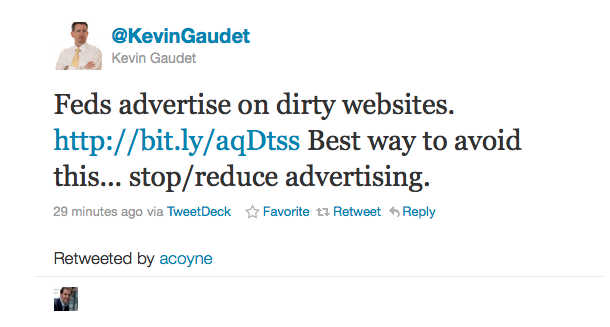
So earlier today I saw this post by Kevin Gaudet, Federal Director of the Canadian Taxpayers Federation and retweeted by Andrew Coyne (one of the country’s best commentators).

It pretty much sums up why Governments (incorrectly) fear open data and open government:

Screen-shot-2010-11-17-at-6.57.05-AM

The link is to a story on The Sun’s website: Government agencies caught advertising on sex sites!!!! (okay, the exclamation marks are mine).

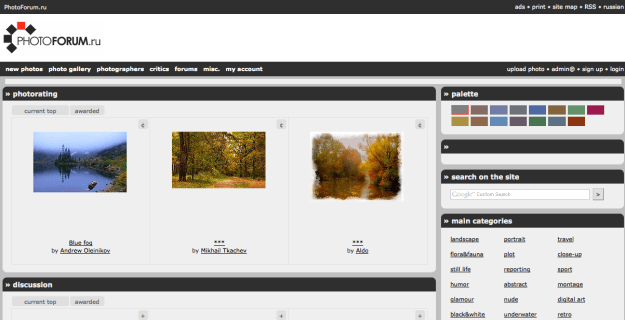
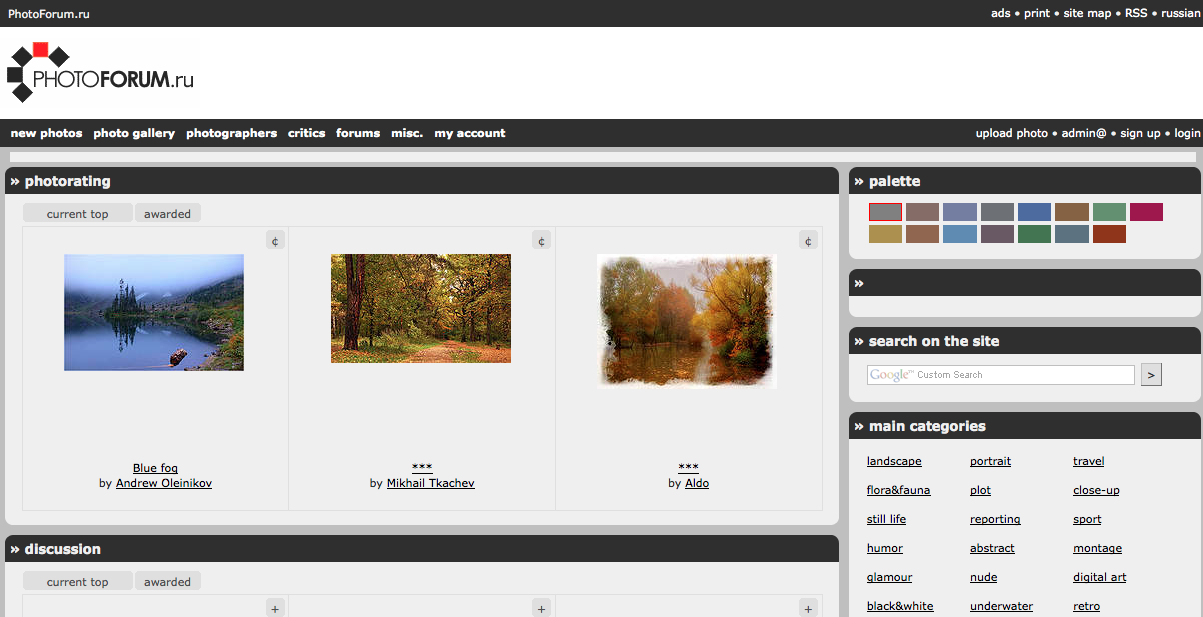
This is exactly the type of headline every public servant and politician is terrified of. The details, of course, aren’t nearly as salacious. A screenshot Photoforum.ru reveals its a stock photo website (which probably does violate all sorts of copyrights) and, I am sure, there are some photos, somewhere on the site, of nude women, much like there are on say Flickr or Facebook.
Screen-shot-2010-11-17-at-7.09.04-AM1


Three interesting things here:

1. The challenge: Non-stories suck time and energy. The government, of course, didn’t choose to advertise on Photoforum.ru. It hired an agency, Cossette, that placed the ads through Google AdSense. (this is actually the good part of the story – great to hear that the government is using Google AdSense which is a cheap and effective way to advertise). But today, I assure you that dozens of public servants, at least one member of the Heritage Minister’s political staff and a few Canada Post employees are spending the next few days running around like chickens with their heads cut off trying to find out how an ad in a $5000 contract ended up on a relatively harmless site. The total cost of all that investigative work and the reports they will generate to address this “scandal” will probably cost taxpayers $10,000s, if not $100,000s in staff time and energy. No wonder governments fear disclosure. The distraction and cost in time and energy needed to fix a non-story is enormous.

2. The diagnosis: The accountability systems trap: What’s interesting of course, is everybody is acting rationally. The Sun (while stretching the truth) is reporting on the misuse (however minor) of taxpayer dollars. Same with the Canadian Taxpayers Federation (CTF). But the solutions are terrible. The CTF demand that the government eliminate all advertising is nonsensical. We can debate whether every ad is needed, but a flat out ban is silly. There are lots of things governments need to inform citizens about. So we can talk about reducing the government’s ad budget, but this news story doesn’t advance that aim either. Indeed, the Canadian Taxpayers and the Sun have, indirectly, helped inflate the cost of government. As noted, the government, acting rationally, now has dozens of people spending their time solving a crisis around a some minor ad campaigns.

So we have a system where everyone is behaving rationally. But the outcome are terrible. This is the scandal. Indeed, if one were really concerned about the effective spending of taxpayer dollars what one would quickly realize that what’s actually broken here isn’t government advertising, it’s the process by which governments react to and address problems.

3. One Approach: Patch-Culture and Open Data. So it is understandable that government types fear disclosure as, presently, they often seeing it leading to the above situtation.

But what’s interesting is that we could handle it differently.

This same story, in the software world, would have been quite different. The Sun article would have simple been understand as someone pointing out a (minor) bug. The software developers (in the case the public servants) would have patched it (which they did, ending the ads deployment to these sites) and the whole thing would have been a non-event. But at least, for minimal cost and effort, the software (ad program) would be better making both the developers (public servants/politicians) and users (taxpayers) happy. So why is it so different with government?

Two reasons.

First. Government’s pretend that everything they do is perfect. They live with an industrial worldview where you had to get something perfect before launching it since you were going to stamp out 100,000 copies of the things and any bug would get replicated that many times. Of course, very little of government is like this, much more of it is like software where you can make fixes along the way. What makes software so great (although sometimes frustrating too) is that they acknowledge this and so patch it on the fly. Patch-culture – as my friend David Humphrey likes to call it – where people help software get better by point out flaws, and even offering solutions, is exactly what our government needs to learn.

Second. People jump to the worst conclusions because governments appear secretive. Because they don’t proactively disclose (and because Access to Information process is sooooo slow) they always look like they are hiding something. Consequently, when people find mistakes they presume people have been hiding it, trying to cover it up and/or that it was made with some malicious intent. In an open source community, when people find a bug, they often assume it was a (dumb) mistake – not a nefarious plot to do achieve some dubious ends. Open data makes a patch culture easier to create because when you share what you are doing it is hard to believe you have some evil intent. Yes, people may just assume you are dumb – but that is actually better than evil (especially for powerful institutions like government).

Open data is about changing the culture everywhere, both inside and outside government. It won’t do it over night and it won’t do it perfectly but it can help. And it’s a shift we need to make.

Conclusion

I could easily have imagined the above story playing differently in world where patch culture has taken shape within government. Someone discovers the ads on photoforum.ru, thinks it is an error (someone made a dumb choice), submits a bug to the government, the ads are removed, the bug is patched, everybody is happy and… no wasteful non-story about government spending.

Indeed, we could have instead allocated all that wasted time and energy to have the debate the CTF actually wants to have: how much of the budget should go towards advertising.

What we need to be thinking about is what is the system we are in, what are the incentives it creates for the various actors and then think of the system we’d like, and figure out how to get from here to there. I think Open Data is an important (but not exclusive) part of the puzzle for changing the relationship between the government, the press and citizens. It may even create some new problems, but I think they will be better, less costly and more interesting problems then the ones we have now, we are frankly destroying budgets and the institutions we need to serve us.
Open Data planning session at BarCamp Vancouver

With the International Open Data Hackathon a little more the 2 weeks away a lot has happened.

On the organizing wiki people in over 50 cities in 21 countries and 4 continents have offered to organize local events. Open data sets that people can use have been posted to a specially created page, a few nascent app ideas have been shared, as has advice on how to run a hackathon. (on twitter, the event hashtag is #odhd)

In Vancouver, the local BarCamp will be taking place this weekend. I’m not in town, however, Aaron Gladders, local hacker with a ton of experience working with and opening up data sets, contacted me to let me know he’d like to do a planning session for the hackathon at Barcamp. If you’re in Vancouver I hope you can attend.

Why? Because this is a great opportunity. And it has lessons for the hackathons around the world.

I love it because it means people can share ideas and projects they would like to hack on, recruit others, as well as hear feedback about challenges, obstacles, alternative approaches, and think about all of this  for two weeks before the hackathon. A planning session also has  has an even bigger benefit. It means more people are likely to arrive on the day with something specific ready to work on. I want the hackathons to be social. But they can’t be exclusively so. It is important that we actually try to create some real products that are useful to us and/or our fellow citizens.

For those elsewhere in the world who are also thinking about December 4th I hope that some of us will start reaching out to one another and thinking about how we will spend the day. A few thoughts on this:

1. Take a look at the data sets that are out there before Dec 4th. People have been putting together a pretty good list here.

2. Localization. I think some of the best wins will be around localizing successful apps from other places. For example, I’ve been encouraging the team in Bangalore to consider localizing Michael Mulley’s OpenParliament.ca application (the source code for which is here). If you have an application you think others might want to localize, add it to the application page on the wiki. If there is an app out there you’d like to localize, write its author/developer team. Ask them if they might be willing to share the code.

3. Get together with 2-3 friends and come up with a plan. What do you want to accomplish on the 4th?

4. If you are looking for a project, let people know on the wiki, leave a twitter handle or some way for people with idea to contact you before the 4th.

Okay, that’s it for now. I’m really excited about how much progress we’ve made in a few short weeks. Ideally at the end of the 4th I’d love for some cities to be able to showcase some apps to the world that they’ve created. We have an opportunity to show the media, politicians, public servants, our fellow citizens, but most importantly, each other, just want is possible with open data.


Is Government Funding the Kiss of Death?

Over the past few years/months talking to various people in the charitable and non-profit sector a recurring theme has emerged: More and more of them are either eschewing government funding or trying to find ways to do so.

Given that governments are the largest source of funding… why would they do this?

The reason is simple. The overhead of administering, overseeing and reporting back on (particularly federal and provincial) government grants or awards has become so onerous that the costs of oversight are increasingly greater than the value of the grant itself. This is particularly true of smaller grants (in the 5 digit range) but still true of even 6 figure awards. In addition to oversight, many people in the sector inform me that governments are not only looking more closely at how recipients spend the money they receive but are increasingly assertive in specifying how they should spend it.

So, in sum, it’s not hard to see why organizations want to walk away. The costs of the money is increasingly too great. On the one hand, compliance means more and more money is diverted to administration – rather than the core mission of the group – and increasing oversight means a loss of autonomy. Consequently, less money can go towards innovative, but riskier, new approaches that might yield better outcomes, or greater efficiencies.

The outcome, I fear, is a non-profit and charitable sector that starts to cleave in two.

On the one side will be non-profits (like those of some colleagues I know) that see eschewing government money as the only way to stay nimble, innovative and independent. These groups will either find progressive granting organizations, wealthy individuals or alternative ways create revenues. Freed to spend their funds as they see best, the most effective will achieve escape velocity and be able to operate for long periods of time without needing to consider government funding.

On the other side, there risks being those locked into government dependency. Unable to fund new projects and innovative approaches that might attract new external funding, they will be trapped in a government deathgrip, forced to adopt traditional approaches and take on excessive overhead, all in order to meet their funding obligations. In short, they will need to mirror the very bureaucracy that not being independent from was what was supposed to give them a competitive advantage.

On the one hand, this is the kind of situation that makes me jealous of the United States with its large pool of private foundations and granting organizations that ensure innovation thrives in the non-profit/charitable sector. But that is a structural difference smaller countries like Canada will not be able to overcome. We need our government’s to be smarter since we can’t replicate the American model.

This is made all the more difficult since those who’ve achieved escape velocity want little to do with government, while those dependent on government funding are probably the least likely (or empowered) to speak up. Sadly, no one wants to upset the government… (why bite the hand that feeds, even if the fruit is poisoned?) so we live in a world of silence on this issue.

I’ll confess, I’m somewhat stumped by the issue but I am worried about it. This country depends on non-profits more than people realize… anything that hampers their effectiveness is a collective drain on productivity, efficiency and competitiveness, to say nothing of social justice.

Launching Emitter.ca: Open Data, Pollution and Your Community

This week, I’m pleased to announce the beta launch of Emitter.ca – a website for locating, exploring and assessing pollution in your community.

Why Emitter?

A few weeks ago, Nik Garkusha, Microsoft’s Open Source Strategy Lead and an open data advocate asked me: “are there any cool apps you could imagine developing using Canadian federal government open data?”

Having looked over the slim pickings of open federal data sets – most of which I saw while linking to them datadotgc.ca – I remembered one: Environment Canada’s National Pollutant Release Inventory (NPRI) that had real potential.

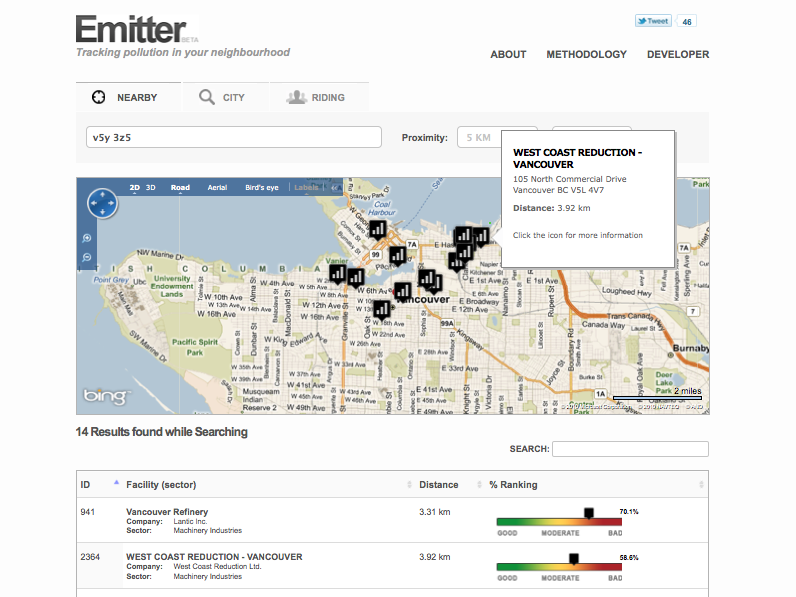
Emitter-screen-shot

With NPRI I felt we could build an application that allowed people and communities to more clearly see who is polluting, and how much, in their communities could be quite powerful. A 220 chemicals that NPRI tracks isn’t, on its own, a helpful or useful to most Canadians.

We agreed to do something and set for ourselves three goals:

  1. Create a powerful demonstration of how Canadian Federal open data can be used
  2. Develop an application that makes data accessible and engaging to everyday Canadians and provides communities with a tool to better  understand their immediate region or city
  3. Be open

With the help of a crew of volunteers with knew and who joined us along the way – Matthew Dance (Edmonton), Aaron McGowan (London, ON), Barranger Ridler (Toronto) and Mark Arteaga (Oakville) – Emitter began to come together.

Why a Beta?

For a few reasons.

  1. There are still bugs, we’d love to hear about them. Let us know.
  2. We’d like to refine our methodology. It would be great to have a methodology that was more sensitive to chemical types, combinations and other factors… Indeed, I know Matt would love to work with ENGOs or academics who might be able to help provide us with better score cards that can helps Canadians understand what the pollution near them means.
  3. More features – I’d love to be able to include more datasets… like data on where tumours or asthama rates or even employment rates.
  4. I’d LOVE to do mobile, to be able to show pollution data on a mobile app and even in using augmented reality.
  5. Trends… once we get 2009 and/or earlier data we could begin to show trends in pollution rates by facility
  6. plus much, much more…

Build on our work

Finally, we have made everything we’ve done open, our methodology is transparent, and anyone can access the data we used through an API that we share. Also, you can learn more about Emitter and how it came to be reading blog posts by the various developers involved.

Thank yous

Obviously the amazing group of people who made Emitter possible deserve an enormous thank you. I’d also like to thank the Open Lab at Microsoft Canada for contributing the resources that made this possible. We should also thank those who allowed us to build on their work, including Cory Horner’s Howdtheyvote.ca API for Electoral District boundaries we were able to use (why Elections Canada doesn’t offer this is beyond me and, frankly, is an embarrassment). Finally, it is important to acknowledge and thank the good people at Environment Canada who not only collected this data, but have the foresight and wisdom to share make it open. I hope we’ll see more of this.

In Sum

Will Emitter change the world? It’s hard to imagine. But hopefully it is a powerful example of what can happen when governments make their data open. That people will take that data and make it accessible in new and engaging ways.

I hope you’ll give it a spin and I look forward to sharing new features as they come out.

Update!

Since Yesterday Emitter.ca has picked up some media. Here are some of the links so far…

Hanneke Brooymans of the Edmonton Journal wrote this piece which was in turn picked up by the Ottawa Citizen, Calgary Herald, Canada.com, Leader Post, The Province, Times Columnist and Windsor Star.

Nestor Arellano of ITBusiness.ca wrote this piece

Burke Campbell, a freelance writer, wrote this piece on his site.

Kate Dubinski of the London Free Press writes a piece titled It’s Easy to Dig up Dirt Online about emitter.ca

Launching datadotgc.ca 2.0 – bigger, better and in the clouds

Back in April of this year we launched datadotgc.ca – an unofficial open data portal for federal government data.

At a time when only a handful of cities had open data portals and the words “open data” were not being even talked about in Ottawa, we saw the site as a way to change the conversation and demonstrate the opportunity in front of us. Our goal was to:

  • Be an innovative platform that demonstrates how government should share data.
  • Create an incentive for government to share more data by showing ministers, public servants and the public which ministries are sharing data, and which are not.
  • Provide a useful service to citizens interested in open data by bringing it all the government data together into one place to both make it easier to find.

In every way we have achieved this goal. Today the conversation about open data in Ottawa is very different. I’ve demoed datadotgc.ca to the CIO’s of the federal government’s ministries and numerous other stakeholders and an increasing number of people understand that, in many important ways, the policy infrastructure for doing open data already exists since datadotgc.ca show the government is already doing open data. More importantly, a growing number of people recognize it is the right thing to do.

Today, I’m pleased to share that thanks to our friends at Microsoft & Raised Eyebrow Web Studio and some key volunteers, we are taking our project to the next level and launching Datadotgc.ca 2.0.

So what is new?

In short, rather than just pointing to the 300 or so data sets that exist on federal government websites members may now upload datasets to datadotg.ca where we can both host them and offer custom APIs. This is made possible since we have integrated Microsoft’s Azure cloud-based Open Government Data Initiative into the website.

So what does this mean? It means people can add government data sets, or even mash up government data sets with their own data to create interest visualization, apps or websites. Already some of our core users have started to experiment with this feature. London Ontario’s transit data can be found on Datadotgc.ca making it easier to build mobile apps, and a group of us have taken Environment Canada’s facility pollution data, uploaded it and are using the API to create an interesting app we’ll be launching shortly.

So we are excited. We still have work to do around documentation and tracking some more federal data sets we know are out there but, we’ve gone live since nothing helps us develop like having users and people telling us what is, and isn’t working.

But more importantly, we want to go live to show Canadians and our governments, what is possible. Again, our goal remains the same – to push the government’s thinking about what is possible around open data by modeling what should be done. I believe we’ve already shifted the conversation – with luck, datadotgc.ca v2 will help shift it further and faster.

Finally, I can never thank our partners and volunteers enough for helping make this happen.