Category Archives: canadian politics

The Myth of the "Wasted" Vote

One of the most disturbing allegations to come out of the electoral reform debate was the notion that people who voted – but whose candidate didn’t win – had their vote “wasted.”

The biggest problem with this analysis is that it casts the meaning and purpose of voting in the narrowest light possible. Defined this way, the purpose of voting is only to elect your representative. Consequently, you either succeed or you fail. Once the vote is over, how you voted takes on no further meaning.

This, of course, is completely false.

Ultimately, governments may win a majority of seats in a legislature, but the margin of their victory does impact the manner and confidence with which they govern. Parties nervous about their future will look to see how they can steal votes from other parties by adopting (stealing) their ideas. In this regard, voting is a powerful signal voters can send, one that communicates quite powerfully to parties, letting them know what they should do if they want to increase their appeal to certain communities.

For a practical example, take a look at the Green Party in British Columbia. Does voting for the BC Green Party constitute a wasted vote? I believe not. I would argue the existence of the Green Party – and the significant vote that it garners – has forced the other parties to react to its agenda. Would we presently have a Liberal Party in BC that is implementing a carbon tax if it weren’t for the Green Party? I suspect not. The pressure this group brought to bear – by making clear that there is a voting constituency interested in Green matters – has been significant, even if it has not won any seats. I would argue that not one of those votes has been “wasted.” Each one has communicated a powerful message.

I can imagine that living in a riding where a specific party is unlikely to win can be frustrating – but calling those votes wasted reveals a misunderstanding of how the system can be influenced and unfairly devalues the voting process. I hope we get over using this language if we end up looking at electoral reform again…

Open Cities: Popularity lessons for municipal politicians

Last Thursday I posted the Vancouver City motion that is being introduced today.

Prior to the posting the motion several of my friends wondered if the subject of open data, open cities and open source were niche issues, ones that wouldn’t attract the attention or care of the media, not to mention citizens. I’m not sure that this is, as of yet, a mainstream issue, but there is clear, vocal, engaged and growing constituency – that is surprisingly broad – supporting it.

For politicians (who are often looking for media attention), open-advocates (who are looking for ways to get politicians attention) and others (who usually care about and want access to, some of the data the city collects) there are real wins to be had by putting forward a motion such as this.

To begin with, let’s look at the media and broader attention this motion has garnered to date:

First, a search of twitter for the terms Vancouver and Open shows hundreds upon hundreds of tweet from around the world celebrating the proposal. Over the weekends, I tried to track down the various tweets relating to the motion and they number at least 500, and possibly even exceed 1000. What is most interesting is that some tweets included people saying – “that they wished they lived in Vancouver.”

As an aside, have no doubt, City Hall sees this initiative in part as an effort to attract and retain talent. Paul Graham, who created a multimillion dollar software company and is now a venture capitalist summed it up best “Great [programmers] also generally insist on using open source software. Not just because it’s better, but because it gives them more control… This is part of what makes them good: when something’s broken, they need to fix it. You want them to feel this way about the software they’re writing for you.” Vancouver is not broken – but it could always be improved, and  twitter confirms a suspicion I have: that programmers and creative workers in all industries are attracted to places that are open because it allows them to participate in improving where they live. Having a city that is attractive to great software programmers is a strategic imperative for Vancouver. Where there are great software programmers there will be big software companies and start ups.

Blogs, of course, have also started to get active. As sampling includes locals in the tech sector, such as David Asher of Mozilla, Duane Nickull of Adobe, as well as others interested in geographic data. Academics/public thinkers also took note on their blogs.

Then, the online tech magazines began to write about it too. ReadWriteWeb wrote this piece, ZDnet had this piece and my original blog post went to orange on Slashdot (a popular tech news aggregator).

Of course, traditional media was in the mix too. The Straight’s tech blog was onto the story very early with this piece, a national newspaper, the Globe and Mail, had this piece by Frances Bula (which has an unfortunate sensationalist title which has nothing to do with the content) and finally, today, the Vancouver Sun published this piece.

Still more interesting will be to see the number of supportive letters/emails and the diversity of their sources. I’ve already heard supportive letters coming from local technology companies, large international tech companies, local gardening groups and a real estate consulting firm. Each of these diverse actors sees ways to use city data to help lower the costs of their business, conduct better analysis or facilitate their charitable work.

In short, issues surrounding the open city – open data, open source software and open standards – are less and less restricted to the domain of a few technology enthusiasts. There is a growing and increasingly vocal constituency in support.

Update May 20th, 2009 more media links:

The Libertarian Western Standard wrote this positive piece (apparently this is the Vancouver City only good initiative).

I did a CBC radio interview on the afternoon of May 19th during the show On the Coast with Stephen Quinn. The CBC also published this piece on its news site.

I’m voting no to BC-STV

For those outside of British Columbia we have a referendum on May 12th to determine if the province should shift from its current voting system, called First Past the Post (FPTP), to Single Transferable Vote (BC-STV).

Watching the back and forth over the referendum on BC-STV has, I sense, left most citizens of British Columbia exasperated and confused. On both sides, people pronounce that a change will either bring political nirvana to the province, or utter disaster. It’s all a little over dramatic.

The truth is, the current system is not a disaster nor is the proposed change a nirvana. Both have strengths and weaknesses – this is because fundamentally, they are seeking to accomplish different things.

At present, our system favours geographic representation. In BC we don’t have a single election, we have 85 individual elections – one in each riding. Consequently, a party that wins 34% in each individual race could win every seat. This means that ideologically – a single perspective get represented. It is rare, but it is possible.

BC-STV is an attempt to create electoral outcomes that better reflect not how individual ridings voted, but how people voted across the province. In short, it seeks to enhance ideological representation by enabling voters who are distributed across ridings to elect representatives whose ideas resonate with them.

The challenge is, one cannot have it both ways. You cannot strengthen province wide ideological representation without weakening local representation. And herein lies the central trade off between the two systems: Local accountability versus great ideological representation at the provincial level.

Both are noble objectives. They just happen to be incompatible, one comes at the expense of the other. For me, this reduces any assessment of BC-STV to this question: do the benefits of improved ideological representation outweigh the costs of reduced local accountability? I think the answer is no.

In part, this is because I happen to place a high value on local representation. Others who think geography is less important than ideology will likely disagree (these are legitimate, and likely irreconcilable perspectives).

However, I’m also concerned about BC-STV because to achieve better ideological representation, I believe it makes some significant and problematic trade-offs (listed below). That, and there are the infamous unknown unknowns involved in adopting a new system.

Incomprehensible

The biggest problem with BC-STV is that, to achieve a balance between ideological and local representation, it presents votes with a system that is almost impossible to understand. I’m a policy wonk and a political junkie, as such I’m genuinely interested in these things and like to think I know a little about them. I’ve just gone through the literature umpteenth times and while I understand how it works, it is grossly complicated. I have not ideas of what its implications will be nor am I sure that the manner and order by which votes get weighted is fair.

One thing you want from an electoral system is that it be easily understood. This is important so that people know exactly who they are voting for and what their vote means. BC-STV is so complicated that the Vote No campaign websites directs readers to the explanatory video developed by the Citizens Assembly (their opponents). Even its advocates can’t explain it simply.

Opaque

In order to create greater ideological representation BC-STV has to weaken local representation. It does this by making ridings (districts for Americans) larger. Consequently, in BC-STV we would end up with mega ridings, the largest being 372,000 sq km. But the ratio of elected officials to votes would however, remain the same meaning that each “riding” would be served by somewhere between 2 and 7 MPs. This has several problematic implications.

First, who’s accountable? When there is a problem in your riding who do you complain to? Who is your elected official? Do you complain to all seven? The one you voted for? The member who is part of the government? All of them? A 7 member riding dilutes the connection between the voter and their representatives.

Second, it can create problematic feedback loops. If voters who vote for the Green Party only ever contact the Green Party representative and Liberal Party voters only contact the Liberal Party member in their riding we run the risk of creating a selection bias driven echo chambers. Party’s actually become more ideological and partisan.

Finally, individual MPs voices are diminished. In our current system, MPs influence derives from the fact that they have a machine on the ground and that they know their riding better than anyone. Large ridings make this harder to sustain. More importantly, when there are multiple candidates from a single party in the riding, the party can choose to deploy more resources towards candidates that will not challenge the party or its leader. The outcome is that BC-STV actually weakens the independence of elected officials.

Small Parties, Big Voices

I’m not opposed to coalition governments per se but, unlike many BC-STV supporters, I do not think they are inherently good either. BC-STV supporters are correct in asserting that smaller parties will have a greater voice. What often isn’t explained is that that voice won’t be proportional to the number of seats they elect – it can end up being disproportionately influential. Imagine a small party that garnered 8% of the provincial vote holds the balance of power in the legislature. It can effectively make any demand it wants to prop up the government. As a result, a platform supported by just 8% of voters suddenly becomes dominant. I know many of my environmentalist friends are excited by the prospect of the Green Party holding that balance of power… but there is no guarantee that this would be the outcome. What if the nascent Conservative Party were to be that force? They would almost certainly force the Liberals – arguable the most progressive party on the environment and First Nations issues – to move backwards on issues like the Carbon Tax and the New Relationship.

For these and other reasons, I’m ultimately opposed to BC-STV. Is FPTP perfect? Hardly, but BC-STV is still less so.

I now there are a lot of readers out there who are supporters so feel free to vent below in the comments section. I’ll try to respond to counter arguments as best I can.

For those who want to know more and educate themselves before tomorrow’s vote, here is a link to the BC-STV site and to the No STV site.


Reforming Government on the Globe & Mail's Wiki

A few months ago John Ibbitson – the Globe and Mail columnist who used to cover Ottawa and now covers Washington, DC – asked me if I’d help edit the 3rd chapter of his new book, Open & Shut.

The chapter, entitled Yes, Mr. President; No, Prime Minister asks why is it that after 8 years of President Bush, President Obama is able to quickly change the direction of government whereas in Canada, newly elected parties often struggle to implement their agenda.

Last week the book was released. As part of the launch process the Globe and Mail created a wiki dedicated to the book’s themes where readers can critic or expand on its ideas and analysis. More interestingly, as readers post to the wiki John will respond to their  ideas, critics and thoughts on a blog hosted by the Globe.

To kick off the wiki on Open Government, John asked me if I would write a short essay answering the following the question:

Federal politicians, and federal public servants, seem increasingly remote and disconnected from the lives of Canadians. Open and Shut maintains that this is because the public service remains closed to outsiders, and because Ottawa has ceded so much power to the provinces. Do we want our federal government to matter more in our lives, and if so, what should we do to give it meaning?

You can see my response, and what I hope will eventually become a growing number of comments on the future of the public service, here.

As an aside, two other sections have been created. One is on Open Politics, which is teed up by John Duffy (political strategist). The other is on Canada/US integration, which is kicked off by Scotty Greenwood (executive Director of the Canadian-American Business Council).

RCMP and Vatican: The downfall of hierarchical and opaque organizations

I’m on the road which is basically the only time I watch TV news and was pleased that I did this evening since I caught Terry Milewski’s excellent follow up piece on the how the RCMP has dealt (or in this case, not dealt) with investigating its own officers over the death of Polish traveler Robert Dziekanski.

The thing that really struck me about Milewski’s story was how much it appeared to suggest that the RCMPs method for dealing with problematic individuals parallels that of the Vatican’s. In the 70’s, 80’s and 90’s the Vatican regularly moved priests it knew was molesting children from diocese to diocese. Priests like Father John Gagan, who molested dozens and dozens of people were never suspended or ordered to take treatment. They were simply shuffled around and the problem was covered up.

The retired RCMP officers in Milewski’s piece suggest that a similar practice occurs within the RCMP. For example, one of the officers involved in the death of Robert Dziekanski, Corporal Benjamin Robinson (who subsequently, has allegedly been involved in a drinking and driving incident which resulted in a death and in which he fled the scene) has apparently experienced a number of challenges in his previous posts. The point here is not to assess Corporal Robinson, but a system that promoted and moved him around rather than offer him needed support.

What is most scary for Canadians is that the RCMP does not appear to understand how quickly the public’s loss of faith could grow and thus manifest into a real crises of confidence in the organization. Consider the recent past of RCMP scandals:

In isolation, each scandal is not a problem. Collectively, given people’s capacity to use the internet to create coalitions and mobilize, resistance to bureaucratic, authoritarian and opaque institutions can crystallize very, very quickly.

Clay Shirky offers one of the best examples of this in his book, Here Comes Everybody where he talks about the rise of Voice of the Faithful – a catholic protest group formed in reaction to the pedophile priest scandal in 2002. Here is Shirky discussing the issue in an interview:

Because in 2002, Father John Gagan, a pedophile priest in Boston, was brought to trial and The Boston Globe covered the story. And during the course of this trial and then the subsequent outrage, this little group formed in a basement in January, called Voice of the Faithful. It was basically outraged Catholics who wanted to do something.

By that summer, they went from 30 people in a church basement to 25,000 members in 21 countries around the world. Now, groups don’t grow that fast, or they didn’t prior to the Internet.

And one of the really remarkable things that I think demonstrated how quickly the Catholic outrage solidified into this reaction – and Voice of the Faithful was instrumental in both changing Vatican policy but also getting several high-level bishops and archbishops to resign their posts because of the bad handling of the pedophile scandal.

The Catholic Church very much wanted to say, this is a one-off. This is an unusual case. But, in fact, almost exactly 10 years before, in 1992, something almost identical happened. In that case, the priest’s name was Porter. But it took place in the same diocese in Massachusetts. Bishop Law was the same person in charge. The Boston Globe was the same newspaper reporting.

But in that case, it just blew over. Part of the difference between ’92 and 2002, which is to say, between failure to reform the Church and at least partial success in reforming the Church, is that in ’92 The Boston Globe wasn’t really global. It was a local paper. There was no way for coverage in the Boston area to suddenly become of global importance.

The other part of the story is that it isn’t just about consuming media. It’s actually about doing something about it. Everybody who read about Voice of the Faithful in one of these stories could join online, they could make a donation immediately, and that changed from a big gap between thought and action in ’92 to a very small gap between thought and action in 2002.

Canadians are increasingly losing faith in the RCMP. And much like many Boston Catholics lost faith in the Vatican, they should be. It is an organization fraught with challenges, that has little, or at least very poor, civilian oversight.

The problem for the RCMP is that, increasingly, Canadians have the capacity to mobilize over this issue and the organization’s response to challenges to its authority have not been well received. Today, a rag tag and splintered group of people ranging from anti-rape activists, first nation advocates, the polish community, human and citizen right advocates and harm reduction advocates could be the proverbial 30 people in a basement Shirky talks about in his Voice of the Faithful example. When those concerned with the RCMP coalesce, it may appear to happen quickly and grow exponentially. My hope remains that the RCMP addresses its issues before this happens. My fear, is that without pressure, it won’t.

Ultimately, authoritarian and opaque institutions such as the RCMP and the Vatican will continue to have relevance in a world of networked enabled citizens, but I suspect that their freedom to operate unobserved and unquestioned will become increasingly constrained. Another painful transition is ahead, but one that is long overdue and necessary.

Why voting is like eating ice cream

In the past I’ve posted about how I believe that voting should be more convenient, and that this could help start a virtuous loop that might lead more young people to vote. Specifically, I’ve lamented that we have a voting system that concentrates voting stations in community centres, churches and schools – places that are out of the way and/or not on common commuting paths for many young people.

People can complain that young people are lazy. Maybe they are – but so what? In an era where things are available at the click of a mouse young people are accustomed to a different level of convenience. You might wish they were willing to walk through the snow for a kilometer or two to vote, but by and large they aren’t. Does this mean that I don’t think we should try to encourage people to care about voting more – absolutely not, I’m a huge fan of groups like Student Vote. But I believe that there may be some quick – more readily achieved – and cheaper wins in designing voting systems for lazy people. This would certainly be easier than trying to make people less lazy.

I’ve recently started following the blog by the authors of Nudge, since I’m a big fan of figuring out how we can passively design systems to that encourage people to adopt “good” behaviours. Recently they pointed to a food/diet blog that outlined the conclusions of the following (sadly uncited) experiment:

“One cafeteria tested (how much effort people will go to to eat ice cream) by leaving the lid of an ice cream cooler closed on some days and open on other days. The ice cream cooler was in the exact same location, and people could always see the ice cream.  All that varied was whether they had to go through the effort of opening the lid in order to get it.  Even that was too much work for many people.  If the lid was closed, only 14% of the diners decided it was worth the modest effort to open it.  If the lid was open, 30% decided it was ice cream time.”

Essentially, this tiny shift doubled the number of people who chose ice cream. Rather than designing new (complicated) ways of voting, this is where I’d like to start. What are the small things we can do around voting to make it easier, to “nudge” people to make the civically minded choice? Voting booths in more places – and nicer places, say the local coffee shop? In the mall? Or how about on the street corner? And then of course, there is the postal voting (that actually comes on time and works) and the holy grail of on-line voting (with all of its dangerous identity implications).

Either way, let’s think about how we can re-engineer voting and make it easier for those of us born in the 20th (not to mention 21st) century. We could castigate and hate ourselves for being lazy – or we can design an easier way to vote, one that will nudge us towards a behaviour people seem to think is good. I know I’d rather spend my energy on the latter.

Articles I'm digesting 6/2/2009

The Quiet Unravelling of Canadian Democracy by James Travers

This poignant piece by James Travers is long overdue. The concentration of power in the Prime Minister’s Office – which started with Trudeau and has continued with each successive Prime Minister – along with the decline of cabinet and of parliamentary committees, is corroding our governing institutions. Travers sums it all up succinctly and frighteningly.

My sense is that – while no one would articulate it this way – people may be disengaged from politics because we expect so little from our MPs, so little from the system itself. Our governing system has – I believe – been durable because it relies less on hard rules and more on conventions and norms. This has given it flexibility but also demands a certain degree of self-restraint and self-managed code of conduct among its participants.What makes the corrosion hard to point at specifically is that there is rarely a single, specific triggering event – no moment when a “rule” is broken, but rather a slow process where conventions and norms are abandoned. Take the recent Conservative Party tactic of engaging in personal attacks during member statements. No “rules” were broken, but another norm, one that tried to help elevate the level of discussion in the house, was weakened.

I’m less interested in radical changes – such as new ways to elect members – since it is unclear to me why or how these would change things (and the unanticipated consequences are more troubling still). Instead, there are small steps that could have dramatic results. Giving MPs real money for research and policy staff (like their counterparts in the US) would be one area where I think a small change could – over time – shift some (admittedly not all) power back to MPs. But in the mean time let us get better aware of the problem – so if you can, take a look at Travers piece.

Einstein, Franklin, and the Role of Creativity in Today’s World” (a lecture) by Walter Isaacson (via David B)

After listening to this beautiful lecture Saturday morning I realized that I’d read (or listened to, to be precise) Isaacson’s book Benjamin Franklin: An American Life. The lecture tries to tease out what made Einstein and Franklin great men – it wasn’t enough that they were intelligent (lots of people are intelligent) but what is it that made them creative? In short, it is to do what is important to you and to maintain the capacity to challenge – to be intolerant of assumptions, institutional inertia and lazy thinking – while remaining hyper-tolerant of others, their thinking and their perspectives.

If you don’t have the patience to listen to the whole talk (which is 44 minutes, there are 25 minutes of Q&A) then consider fast forwarding to the 37th minute of talk where he talks of both men’s final moments. The way they are at humble, aware of their sins and successes, inspiring to those around them but, most of all, consistently dedicated to the values and tasks they love, well, honestly, it left me teary. Consider Franklin’s funeral in 1790 where:

“All 35 Ministers, Preachers and Priests of Philadelphia link arms with the Rabbi of the Jews to march with him to the grave. It is that type of creativity of tolerance, of looking for new ways of doing things that they were fighting for back in Franklin’s time and I really do think that’s a struggle we are fighting for both at home and in the world today.”

The lecture reminded me of why Isaacson’s book transformed Franklin into a hero to me.

The Quiet Coup by Simon Johnson

This article has been circulating around for a couple of weeks now and it is the most damning admonition of both the financial collapse and both Bush’s and Obama’s response that I have read.

But there’s a deeper and more disturbing similarity [between the US and the financial collapses in South Korea, Malaysia, Russia and Argentina]: elite business interests—financiers, in the case of the U.S.—played a central role in creating the crisis, making ever-larger gambles, with the implicit backing of the government, until the inevitable collapse. More alarming, they are now using their influence to prevent precisely the sorts of reforms that are needed, and fast, to pull the economy out of its nosedive. The government seems helpless, or unwilling, to act against them.

It gets worse.

But these various policies—lightweight regulation, cheap money, the unwritten Chinese-American economic alliance, the promotion of homeownership—had something in common. Even though some are traditionally associated with Democrats and some with Republicans, they all benefited the financial sector. Policy changes that might have forestalled the crisis but would have limited the financial sector’s profits—such as Brooksley Born’s now-famous attempts to regulate credit-default swaps at the Commodity Futures Trading Commission, in 1998—were ignored or swept aside.

The biggest danger? The crises gets somewhat resolved… and nothing changes. This is why I’m such a big fan of Umair Haque’s blog.

Is Charest ready to pounce? by Rheal Seguin

A while back I predicted that, after the Conservatives bungled the budget and the coalition was struck that Layton, Dion and Harper would all lose their jobs before the end of 2009. I stand by the claim (and now have money riding on it with some good people out there). It would appear that the press is increasingly smelling blood in the water around Harper…

Why Insite Matters

insiteFor those who have not seen it there is a stunning piece on the 5th Estate about Insite – the Supervised Injection Site in the Downtown Eastside of Vancouver – where TV cameras are allowed inside the facility for the first time.

I wish I could embed the video in this blog post and walk you through it, but sadly the CBC doesn’t allow me to do this. To view the piece you have to go to the 5th Estate’s website.

The piece is long, so below I recommend some specifics point that touched me. You can scroll directly to them:

02:20 – A basic video walk through of Insite that explains, plainly how it works.

04:15 –  Interview with Darwin Fisher – the Insite intake manager – who shares with us the logic of Insite. In short, the facility connects some of the most marginalized citizens with society, giving us an opportunity to provide them with services, develop relationships, and keep the door open to the possibility of getting into detox programs.

09:58 – An interview with a user – David Brodrick – who talks about why he uses Insite and his desire to respect his community. Insite’s critics sometimes want us to forget these people are humans – living in our own backyard – this clip makes that impossible to do.

25:09 – A discussion about how the Federal Government is trying to shut Insite down and how four successive Vancouver Mayors – from across the political spectrum – are supportive, along with the community, local business and the BC Government (who funds it).

31:00 – It is hard not to be blunt here. But for those who don’t support Insite, are you prepared to tell this person, their friends, and their family, that you believe their addiction comes from a moral failing and that they should either go into detox right now, or die on the streets of Vancouver? Without Insite, this is essentially the choice we are putting before people like David. Insite is not the solution, but it is a step in the process that helps us address the problem.

My only critique of the piece is that it opens by stating Insite is experimental and controversial. This language that perpetuates a false story. Insite is no longer experimental. It is a piece of the healthcare system in Vancouver that is proven – in peer reviewed medical journals – to be an effective way to save lives. Moreover, it is proven, by a federal government report, to save taxpayers’ money. Finally, in Vancouver, Insite is not controversial. It enjoys overwhelming support, among business leaders, community groups, within conservative and liberal political parties and among the public at large. Insite – and harm reduction strategies – are about as controversial in the lower mainland as public transit. The debate isn’t about whether it should exist, but how we can do more of it.

If you are intersted in supporting Insite – consider visiting this website.

Federal Leaders on the run…

In early December – as a result of the mess that was the first Conservative budget and the proposed coalition – I proposed that all the federal leaders, save Duceppe, would be out of their jobs within a year. We’ve already lost Dion… that just leaves Harper and Layton. In both cases things are look like they are proceeding apace: Harpers’ office is in disarray with senior people leaving, and Layton’s numbers have tanked.

Some highlights from the pieces…

What does all this mean? Search me. But some who orbit just outside Mr. Harper’s innermost circle speculate that a Conservative party with no heir apparent could lose its leader before the next election.

Layton was seen positively by 37 per cent and negatively by 49 per cent of respondents, almost a complete reversal since the closing days of the election campaign when the NDP leader was the most favourably viewed national leader.

I suspect that Mulcair and a host of Conservatives are at least beginning to feel out the possibility of a leadership bid.

Not persudaded? I understand completely, but perhaps you could be tempted into placing a friendly wager. Just to keep things intersesting of course…

The creative age, the budget and the future of class conflict

Yesterday the Martin Prosperity Institute released its report Ontario in the Creative Age. I’ve been reading through it with great, great interest. The influence of Rise of the Creative Class and Who’s Your City is obvious (and expected) and the report is an important and fantastic read. Regardless of whether or not you live in the GTA/Ontario, I highly recommend it. Indeed, I would love to see the Province of British Columbia and the Metro Vancouver commission a similar report. I can imagine the methodology is now in place to do one relatively quickly, and it is urgently needed on the west coast. (Can anyone point to an economic development plan for the Greater Vancouver Area? For the City of Vancouver?)

The report also plays on a theme that has interested me for a while now. The nature of class conflict in networked and creative economy. The report tackles the issue more directly than anything else I’ve seen by Florida to date. This line from the report is illustrative:

The rise of creativity is a double-edged sword. It creates tremendous wealth creation opportunities for some. Yet it can leave many behind – particularly those in jobs built on routine, and those who do not have the opportunity to gain the skills to participate advantageously in the economic transformation we are going through.

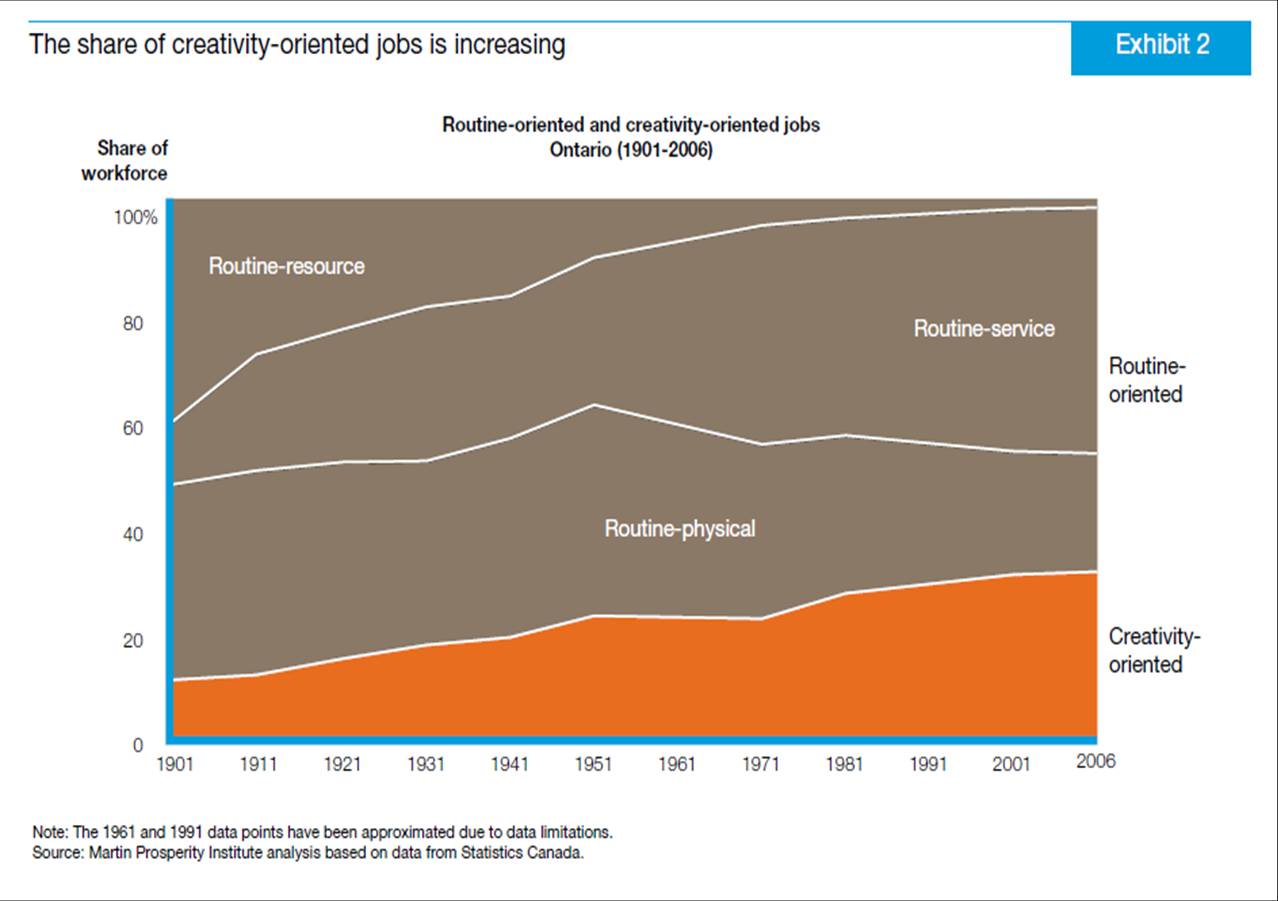
Still more interesting are the trends:
class conflict

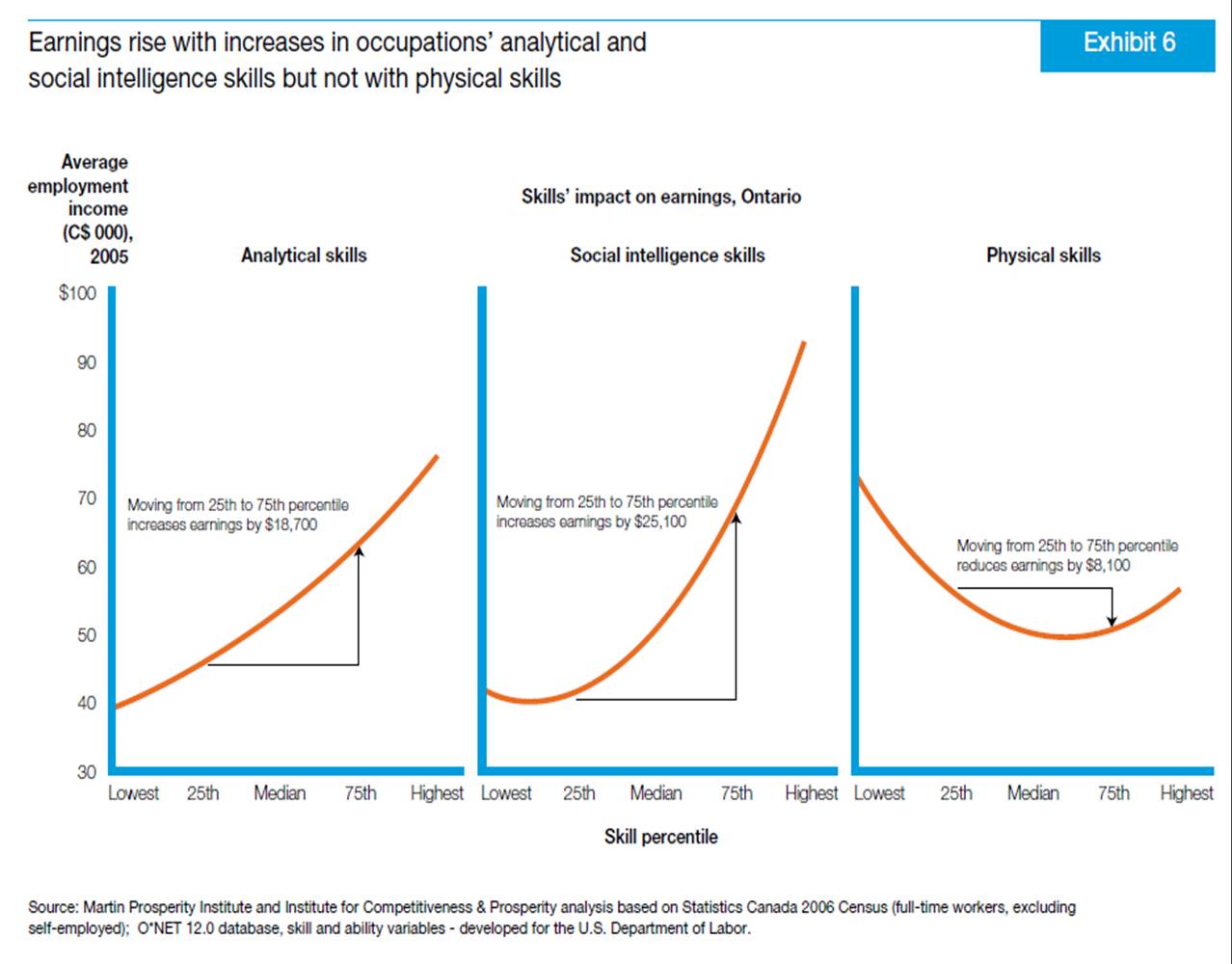
Combine this chart with there second chart that shows how wages grow depending on skill sets (no prizes for figuring out the Routine-physical-oriented jobs correlate with Physical Skills and that Social intelligence skills correlate with Creativity-Oriented jobs).

class wages

It is easy to see that the possibility of tension between routine-oriented and creativity-oriented workers could grow, especially as wage differences continue to increase.

Perhaps the most depressing conclusion to draw from this report is that the stimulus package will do little to address this inequity. A lot items that get funding in such packages (for example, some shovel ready projects) not only generate only temporary growth, but many of the jobs they foster are both becoming fewer – so we are encouraging job growth in shrinking job markets – and have a declining return on investment – so we are encouraging the development of skill-sets in workers that will not increase wages. Consequently, the very actions that traditionally might have helped stave of wage inequality (and in turn class conflict) may actually me exasperating the future likelihood of such inequality.

It’s hard to sell funding for R&D and research as these are often seen as “elite” activities, but interestingly they may offer us the greatest hope in reducing future tension and inequality. Sadly, research, science and education received little attention in the budget.