Category Archives: public policy

left wing tonic for Michael Byers

Recently I’ve been reading more and more of Policy Options. I’m not a reading every issue (although I’m not trying to) but I am enjoying much of what I do get through.

Going way back to the February issue there was an article by Robin Sears entitled “Canada in North America: From Political Sovereignty to Economic Integration.” The piece was a hard assessment about the limits of Canadian sovereignty and economic independence in light of our geographical position next to the United States. He notes that our position is one where we must work with our American cousins and try to gain as much influence as possible – a bold statement these days – but one that remains true. Perhaps no more so today. When things are at their worst (and I’ll admit, they are) that’s precisely when we need a map for a better path. As Sears points out…:

Imagine the vision, the courage and imagination that it took in the harsh winter of European famine of 1947-48 for two powerless French statesmen to sit in a Paris café and begin to plan for a united Europe! …They reflected grimly on “the success of the victorious Allied powers” in Europe.

The continent was being savaged by Soviet armies in the east and staggered under starvation in the west. The only European unity any rational person could foresee was a shared visceral hatred of Germany and everything it had stood for. The miracle that was the Marshall Plan was still in the future. Germany was a decade away from its economic leap forward. England, torn by its loss of empire, with its special relationship with the United States and its eternal ambivalence about Europe, was unreliable.

The simple fact is, we are stuck on this north american rock with the a powerful neighbor who knows little about us, and cares less and less every day. The only thing that will be worse is when they suddenly do care about us – like our border after 9/11. Sears’ is at pains to find ways to foster political structures to promote cooperation between Canada and the United States and he’s right. We need them. Those who wish to die at the altar of sovereignty, preserving it absolutely at no matter what cost, will find that they have significantly less influence, not only abroad, but at home as well. Worse, sovereignty is usually not what they care about. In perhaps the pieces most biting line, Sears points out:

“Canadian nationalists trying to ring-fence our sovereignty are engaged in an especially ironic struggle, given their citizenship in the nation that invented the modern, more supple form of sovereignty: federalism. Those who are most determined to draw deeper lines in the ongoing crusade against American encroachment on our national sovereignty are often the strongest advocates of Canada’s leadership in the development of global governance through multilateral institutions. The contradiction reveals less about their convictions about sovereignty than about their plain vanilla anti-Americanism.”

Ouch.

The piece is interesting and worth reading on its own merits. But what makes it still more compelling is its author. So who is this man? Excellent question. First, despite the article’s bent, analysis and conclusion, he’s not a Conservative. No, for the uninitiated (like me) Robin Sears was the national campaign director of the NDP during the Broadbent years and served as Bob Rae’s chief of staff when he was premier. He was also Deputy Secretary General of the Socialist International. For those on the left whose only prescription to our geographic conundrum is to seal the border and throw away the key (a proposition that would see no end of pain for the Canadian economy) it is interesting to find those, on the same side of the spectrum, who disagree. I hope we see more of them… frankly the debate needs their perspective.


so dave, what do you do? (or my life, on a powerpoint slide)

So more than once people have asked me what I do… and sadly the answer is never easy. All the titles I’ve heard feel a little overwhelming, mostly because I don’t think I’ve done enough to earn any of them: public policy entrepreneur, public thinker, writer… Indeed, I most often use negotiation consultant and public policy analyst – but these fail to capture the threads of ideas that I’m attempting to weave together.

Herein lies the main challenge. Because I have picked up a number of diverse threads, my life sometimes looks scattered. (Admittedly, occasionally it is). But I see the connections between these disparate areas and I draw strength and ideas from the connections between them. Consequently, I need to do better at explain these connections, and why the matter, to others.

In pursuit of this goal I’ve created a map of my (work) life. Outlined are the three main themes I focus on and then, to show how my activities map against them I’ve listed a) some of the issues I tackle, b) the organizations I work with, for or sit on the advisory boards of, and c) some conferences where I give talks. Some stuff may be missing (indeed, if you see something please send me an email or comment below).

Better, I hope this might inspire you to map your own life. If it does please let me know, I’d love to see it and link to it.

At the very minimum, I hope this leaves you understanding me better.
note: you can click on the image to make it bigger

Urban Public Transit Done Right

Metronauts, eat your hearts out. :)

Was back in Vancouver yesterday. It was a glorious day – the kind that you write in your blog about. Anyway, rode the bus downtown for several meetings and noticed this sign:

text a bus sched

In short, you can now text “33333” + the identifying number found on every bus stop in Vancouver and… the arrival times of the next 6 scheduled buses will be texted to you.

Now this schedule is probably static and does not adjust for the fact that specific buses may be running late, caught in traffic, blown a tire, etc… But it is a start.

Anything that gives transit users more information is a good thing, especially if that means it will raise their expectations around the timeliness and predictability of service (as I suspect this will). A traffic that is more demanding of its public transport is more invested in its public transport.

I can already see the logical next step… Imagine a transit user sends a text to find out when the next bus will arrive. When that bus (and possibly the subsequent bus) fails to show up he/she starts looking for a complaints or information line to call. Their expectation is going to be that the person on the other end of the line can answer the question: “Where is my bus.” The obvious conclusion to this scenario – take the GPS emitters that are on every bus and open up their API’s so that we can all see where they are. It is going to rock transit users’ worlds when they can open up google maps on their phones and search “Vancouver, Transit, 22” and see the current location of all the 22 buses.

Translink you’ve opened a pandora’s box of expectations for this user. It is a good first step.

[BTW: Transit geeks in Vancouver should already be reading this blog, which, of course, was on the case long before me. Long live the long tail of blogs.]

Fatness Index – Canada vs. United States

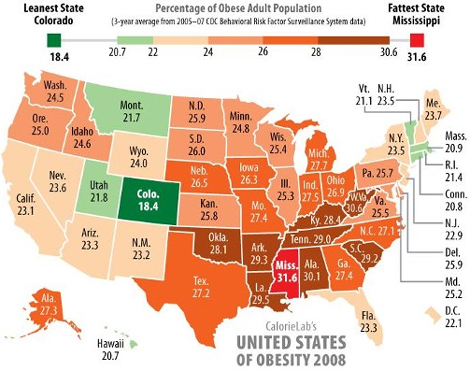
Yesterday I noticed that Richard Florida and Andrew Sullivan re-posted a map (created by calorielab) that color coded US states by the percentage of the population that was obese. I wondered if a similar map existed for Canada. Although there are several that highlight obesity – such as this one and this one – none are quite like this one. More importantly, none allowed for an easy and direct comparison between the two countries.

So I’ve taken the calorielab map, remade it, and extend it to all of North America by applying its criteria to Canadian provinces (and by using some Statistics Canada figures found here). The result is a “green armband” (of relative health) stretching across the continent.

Obese Map of NA 2

If Canadian provinces were ranked along side US States, they would rank 1st (BC), 2nd (QC), 3rd (ON), 4th (AB) and tied for 5th (MB) (YK) as the least obese provinces/states. Colorado would be the first American state placing 7th, with the provinces of NS in 8th and SK in 9th. PEI and NB would appear 15th and 16th and NFLD would appear 19th. NWT and NU would close out in 30th and 31st position. You can see the original chart at the bottom of this page.

Actually even some of the grimmer looking patches of Canada’s map have a silver lining. The Arctic Territories, specifically Nunavut (NU) and the North-West Territories (NWT), appear obese and thus unhealthy. However, Statistics Canada notes that obesity criterion for Inuit populations should be more relaxed since a high BMI does not appear to have the same health risk for Inuit as for non-Inuit. Interesting, eh?

And here is the original map I’m riffing off of…

obesitystates


Oh, to live in a country with an open government

So the British Government doesn’t just release masses of data so the people can mash it up – they are now offering a prize to the best mash-up. Sadly, our (Canadian) government couldn’t be more secretive with it’s data.

Government EntropySure there are some low hanging fruit that I (with the help of my trusted colleague Jeremy V) was able to get and use to create this mash up of the location of government offices. Sadly, their ain’t much (that is publicly available!) to mash it up against…

Ah, the things the public would do with the data it is supposed to own and have access to, if only its government would let it…

Sometimes it’s hard not to feel like we’re uninspired, secretative and falling further, and further, behind.

The Open Source Public Service

Consider these to quotes side by side:

First,

“Human beings generally take pleasure in a task when it falls in a sort of optimal-challenge zone; not so easy as to be boring, not too hard to achieve. A happy programmer is one who is neither underutilized nor weighed down with ill-formulated goals and stressful process friction. Enjoyment predicts efficiency.

Relating to your own work process with fear and loathing (even in the displacing, ironic way suggested by hanging up Dilbert cartoons) should therefore be regarded in itself as a sign that the process has failed. Joy, humor, and playfulness are indeed assets…”

– Eric Raymond, The Cathedral & The Bazaar

(BTW: Who would have thought that the entire line of Dilbert cartoons – their humorous reflections on how organizations (dis)function – could be made depressingly painful in one brief phrase.)

Second,

“Disability claims and stress leaves are soaring. For many public service managers, the work-life balance is so unhealthy that one major federal department has tried to implement a BlackBerry ban between 7 p.m. and 7 a.m., so that people can reclaim some of their personal time. Management scholars are using the public service as a laboratory to study workplace dysfunction…

…The discussion about public service renewal is ongoing, but one valuable contribution arrived this week. In a report released Wednesday, the Public Policy Forum, an Ottawa-based think tank, succinctly identifies some of the key problems facing the public service. Few of these observations are likely to surprise Ottawa insiders, but it’s useful all the same to see them legitimized by respected researchers.

 var addthis_pub = ‘canada.com’;

function textCounter(field,cntfield,maxlimit)
{
if (field.value.length > maxlimit) // if too long…trim it!
field.value = field.value.substring(0, maxlimit);
// otherwise, update ‘characters left’ counter
else
{
var divLabel = document.getElementById(“divLabel”);
divLabel.innerHTML = maxlimit – field.value.length + ” characters remaining”;

}
}

The report confirms, for example, public servants feel so tangled up in procedure and regulations they are unable to get meaningful work done… Yes, public servants need to be accountable, especially in the post-Gomery universe, but if the “web of rules” is completely extinguishing every spark of innovation and producing the most risk-averse organization in the country, then there’s a problem.”

The Ottawa Citizen Editorial Board

The narrative of the public service as a byzantine, rule bound place has become so accepted it is now unquestioned gosple. The truth is always more complicated. I know of, and occasionally hear from, people who work in places where (usually small) teams of public servants work in flat collaborative groups that are able to achieve great things. But the narrative exists for a reason – as the above Ottawa Citizen piece attests. This is why where you work in the public service (and often who you work for) is far more important than what file you work on.

So how much work in the public service falls within the optimal-challenge zone described by Raymond? More importantly, how many public servants would continue to do their job if they weren’t paid? 10%? 35%? 50%?

My suspicion is that the open source community for public policy is actually quite large. It includes those in the public service – who are tied up and tied down in their silos, but also extends much further. The problem is that it is tied down by process and an industrial model to “churning out” policy that doesn’t work well with today’s knowledge workers.

Canada25 showed that hundreds and indeed thousands of young people wanted to think about, engage in, and write about public policy in their spare time. All we did was allow them to focus on whatever they wanted and create as frictionless a process as possible. The result? Four well received policy papers in 6 years on top of numerous smaller projects, debates, discussion groups and countless other outcomes I don’t even know about.

The main point is that “open” can work in policy development. So maybe it is time to set the public service free? To allow policy analysts to self-organize and focus their attention to where they believe they can best contribute, rather than having hundreds if not thousands of them babysitting files that simple don’t move?

Why not treat policy challenges like open source software programs. Create a policyforge (modeled after sourceforge) where the policy can reside and where the module policy owner, can foster a community and accept its ideas, opinions and edits.

Will it work? I can’t guarantee it. But we’d better start experimenting because the one thing we do know. The current system is beginning to crack.

The Public Service as a Gift Economy

In his description of why Open Source works Eric Raymond notes that open source communities don’t operate as command hierarchies or even as exchange economies. Instead they often operate as gift economies:

Gift cultures are adaptations not to scarcity but to abundance. They arise in populations that do not have significant material-scarcity problems with survival goods… Abundance makes command relationships difficult to sustain and exchange relationships an almost pointless game. In gift cultures, social status is determined not by what you control but by what you give away.

What is interesting about the public service is that it, in theory, could operate like an open source gift economy. Indeed, there are no survival necessities for those who work in the public service – their salaries are generally acceptable and their jobs secure.

This isn’t to say scarcity doesn’t exist within the public service. But it is driven by two variables – neither of which is intrinsically scarce – but have been made so by the public service’s cultural history and industrial structure.

giftThe first is resources, which are siloed into various functions and cannot allocate themselves to problems without the consent of a centralized administrator.

The second is information, which for primarily historical corporate cultural reasons is rarely shared, and is hoarded in order to maintain control over resources or agendas.

Neither of this are necessary for the public service to function. Indeed, it would function a whole lot more efficiently and effectively if such a scarcity model were abandoned. This is why I’ve been such an advocate for a social networking system within the public service – it would serve as a clearing house to allow information and resources (people) to move around the system more freely and allocate itself more efficiently.

Such a clearing house would reduce the benefits of hoarding information, as it would be increasingly difficult to leverage information into control over an agenda or resource. Instead the opposite incentive system would take over. Sharing information or your labour (as a gift) within the public service would increase your usefulness to, and reputation among, others within the system. Nor would this mean political actors at the centre of this system would have to abandon agenda control – a central authority can still have enourmous influence ascribing value to what should be worked on. It would simply no longer have absolute authority over that agenda (It is worth noting that under the current model this absolute agenda power is merely theoretical anyway – public servants have an amazing ability of doing whatever the hell they want regardless who which party is setting the agenda).

Indeed, the above contrast also explains, in part, the challenge around recuiting. As gift styled economies become more prevalent, the command hierarchy model of the public service is becoming an increasingly undesirable system within which to reside.

Update: Think a gift economy built around reputation and recognition still doesnt make sense? The Ottawa Citizen’s Katheryn May recently noted that “The “churn” of the public service, characterized by the rapid and high turnover of people in jobs, has been identified as a big problem. The APEX survey showed 64 per cent of executives think of leaving their organization at least every month. More than half want to leave because of lack of recognition. (H/T to CPRenewal)”

Tory logic: Injection sites in Quebec = good, in BC = bad

So Yaffe’s Wednesday column (which I talked about yesterday) about how Insite would not be challenged by the conservative government if it were in Quebec has turned out to be sadly prescient.

Today, the Globe is reporting that Federal Conservative Health Minister Tony Clement is willing to consider Quebec’s request for an injeciton site even as he works to shut down the site in Vancouver. For a party that was supposed to let the west in, this is a complete outrage.

Health Minister Tony Clement says his government will not necessarily oppose safe-injection sites for illegal drugs in Quebec even though it will appeal a court decision allowing a similar facility in British Columbia…

…”I am obligated to consider each situation as a unique situation. That’s my obligation as the Minister of Health.”

Appalling. Apparently the local consensus reached in Vancouver about this approach means nothing to this government. Nor apparently, do the votes in Vancouverites. With this move it is hard to imagine the Conservatives winning any seats in Vancouver.

Government social networking

Again, as a follow up to my talk at DPI on web 2.0 technologies and government, Nicolas sent me a brief article on IBM’s internal experimentation with of Socian Networking.

Those at DPI will know that one of the reasons I believe social networking for government is important is that enables employees of massive organizations – both in terms of geography and number of employees – to find and engage with one another. As such it is a clearing house for ideas and people, helping them find and connect with one another. Hence this paragraph in the article obviously tickled my goat (yeah, I said tickled my goat):

…in a global company with nearly 400,000 employees, most people are too far away to plop down in a teammate’s cubicle or grab a cup of coffee. These social tools, IBM hopes, will provide a substitute for personal connections that flew away with globalization—and help to build and strengthen far-flung teams. “People are putting up pictures of their family, the same way they’d put them up in the cubicle,” says Joan DiMicco, one of the research scientists.

People may not think of the public service as globalized (or like IBM) but it does have over 325,000 employees spread out over 3 and half time zones across a 5,187 km axis east to west. That’s pretty globalized and IBM-like right there.

Make Government easier (part 1)

The other week I had the pleasure of giving a keynote at the annual DPI conference – put on by the Association of Public Service Professionals. (I’m hoping to slidecast the presentation soon – just trying to get my hands on a recording ofthe presentation).

In the audience were something like 800 IT professionals from the Public Service – a great group of people – many of whom I’m had a great time connecting over email with this past week.

direct.srv.gc.ca_direct500_images_english_titleObviously, I spent some time talking about social networking in a government context – Facebook.gc.ca as I’ve come to refer to it. As many people know (but don’t think about in these terms) the government does offer a social networking piece of software, its called the Government Electronic Directory Service or, for short, GEDS.

As I’ve mentioned before GEDS has limited functionality, it only helps you find someone whose name, phone number or title you already know. But that can still be useful and so a ton of people – both within and outside government. However, after talking to a number of people, I’ve discovered that not one person I’ve met actually knows how to get to the GEDS website. They all have to search for it in Google to find it! Talk about making one of the best IT tools within government difficult to find/use!

Why is that?

Because the GEDS URL (or web address) is the easy to remember:

http://direct.srv.gc.ca/cgi-bin/direct500/BE

Really? Why did the people who created this IT directory simply not make everyone’s life easier and make it:

http://geds.gc.ca

Now, while I think GEDS should be replaced but something more sophisticated, I nonetheless bet that its usage would be much higher – or at least, its users would be much happier – with this little address change.

It’s a simple change – but exactly the kind of thinking that applied more broadly, could make our government run just a little more smoothly.